
Lie-Nielsen Toolworks
Published Dec 8, 2023See the process of making the Lie-Nielsen No. 62 Low Angle Jack Plane: initial pattern making; pouring the castings at the foundry; machining, grinding, and finishing all the parts; final assembly, inspection, and wrapping.
April 16, 2024
April 4, 2024
Boeing and the ongoing competency crisis
Niccolo Soldo on the pitiful state of Boeing within the larger social issues of collapsing social trust and blatantly declining competence in almost everything:

“Boeing 521 427”by pmbell64 is licensed under CC BY-SA 2.0


By now, most of you have heard of the increasingly popular concept known as “the competency crisis”. For those of you who haven’t, the competency crisis argues that the USA is headed towards a crisis in which critical infrastructure and important manufacturing will suffer a catastrophic decline in competency due to the fact that the people (almost all males) who know how to build/run these things are retiring, and there is no one available to fill these roles once they’re gone. The competency crisis is one of the major points brought up by people when they point out that America is in a state of decline.
As all of you are already aware, there is also a general collapse in trust in governing institutions in the USA (and all across the West). Cynicism is the order of the day, with people naturally assuming that they are being lied to constantly by the ruling elites, whether in media, government, the corporate world, and so on. A competency crisis paired with a collapse in trust in key institutions is a vicious one-two punch for any country to absorb. Nowhere is this one-two combo more evident than in one of America’s crown jewels: Boeing.
I’m certain that all of you are familiar with the “suicide” of John Barnett that happened almost a month ago. John Barnett was a Quality Control Manager working for Boeing in the Charleston, South Carolina operation. He was a “lifer”, in that he spent his entire career at Boeing. He was also a whistleblower. His “suicide” via a gunshot wound to the right temple happened on what was scheduled to be the third and last day of his deposition in his case against his former employer.
In more innocent and less cynical times, the suggestion that he was murdered would have had currency only in conspiratorial circles, serving as fodder for programs like the Art Bell Show. But we are in a different world now, and to suggest that Barnett might have been killed for turning whistleblower earns one replies like “could be”, “I’m pretty sure that’s the case”, and the most common one of all: “I wouldn’t doubt it”. No one believes that Jeffrey Epstein killed himself. Many people believe the same about John Barnett. The collapse in trust in ruling institutions has resulted in an environment where conspiratorial thinking naturally flourishes. Maureen Tkacik reports on Boeing’s downward turn, using Barnett’s case as a centre piece:
“John is very knowledgeable almost to a fault, as it gets in the way at times when issues arise,” the boss wrote in one of his withering performance reviews, downgrading Barnett’s rating from a 40 all the way to a 15 in an assessment that cast the 26-year quality manager, who was known as “Swampy” for his easy Louisiana drawl, as an anal-retentive prick whose pedantry was antagonizing his colleagues. The truth, by contrast, was self-evident to anyone who spent five minutes in his presence: John Barnett, who raced cars in his spare time and seemed “high on life” according to one former colleague, was a “great, fun boss that loved Boeing and was willing to share his knowledge with everyone,” as one of his former quality technicians would later recall.
Please keep in mind that this report offers up only one side of the story.
A decaying institution:
But Swampy was mired in an institution that was in a perpetual state of unlearning all the lessons it had absorbed over a 90-year ascent to the pinnacle of global manufacturing. Like most neoliberal institutions, Boeing had come under the spell of a seductive new theory of “knowledge” that essentially reduced the whole concept to a combination of intellectual property, trade secrets, and data, discarding “thought” and “understanding” and “complex reasoning” possessed by a skilled and experienced workforce as essentially not worth the increased health care costs. CEO Jim McNerney, who joined Boeing in 2005, had last helmed 3M, where management as he saw it had “overvalued experience and undervalued leadership” before he purged the veterans into early retirement.
“Prince Jim” — as some long-timers used to call him — repeatedly invoked a slur for longtime engineers and skilled machinists in the obligatory vanity “leadership” book he co-wrote. Those who cared too much about the integrity of the planes and not enough about the stock price were “phenomenally talented assholes”, and he encouraged his deputies to ostracize them into leaving the company. He initially refused to let nearly any of these talented assholes work on the 787 Dreamliner, instead outsourcing the vast majority of the development and engineering design of the brand-new, revolutionary wide-body jet to suppliers, many of which lacked engineering departments. The plan would save money while busting unions, a win-win, he promised investors. Instead, McNerney’s plan burned some $50 billion in excess of its budget and went three and a half years behind schedule.
There is a new trend that blames many fumbles on DEI. Boeing is not one of those. Instead, the short-term profit maximization mindset that drives stock prices upward is the main reason for the decline in this corporate behemoth.
Comments Off on Boeing and the ongoing competency crisis
March 26, 2024
What Makes a Good Book
Lost Art Press
Published Nov 26, 2023✅ Read and subscribe to the Lost Art Press Blog: https://blog.lostartpress.com/
🏪 Visit Our Store: https://lostartpress.com
Comments Off on What Makes a Good Book
March 24, 2024
Gahendra: the Nepalese Not-A-Martini
Forgotten Weapons
Published Jul 8, 2018(This video has been updated from its original form to fix translation issues and to clarify that Nepal was not, in fact, a British colony. Originally published January 10, 2017.)
Long a mysterious unknown member of the Martini family, the Nepalese Gahendra rifles finally became available in the US and Europe after IMA purchased Nepal’s cache of historic arms. The Gahendra is a uniquely Nepalese design built to sidestep British reluctance to supply military arms to the country. Developed by a General Gahendra (who is also responsible for the Bira copy of the Gardner Gun), the rifle is not actually a Martini at all. Instead, it shares its mechanical features mostly with the earlier Peabody falling block rifles, using a hammer and flat mainspring (the Martini improvement replaces there with a striker and coil spring).
Gahendras are chambered for the standard British .577/.450 Martini cartridge, although their bore diameters vary substantially, and one should absolutely slug a specific rifle before loading ammunition for it. In fact, unless you are capable of proficiently assessing the safety of the Gahendra, it is wiser not to shoot them at all. These rifles were individually handmade well over a hundred years ago using steels of questionable metallurgy and hardening.
That said, the guns were actually much better made than most people assume, considering their non-interchangeable parts. Craftsmen built each rifle part by part, giving the factory an output of just four rifles per day. Production began in the 1880s, and according to the Nepalese government ended prior to 1899. Dates on the rifles, however, are commonly found as late as 1911. These dates are generally assumed to be inventory or refurbishment dates.
(more…)
Comments Off on Gahendra: the Nepalese Not-A-Martini
March 10, 2024
Viking longships and textiles
Virginia Postrel reposts an article she originally wrote for the New York Times in 2021, discussing the importance of textiles in history:

The Sea Stallion from Glendalough is the world’s largest reconstruction of a Viking Age longship. The original ship was built at Dublin ca. 1042. It was used as a warship in Irish waters until 1060, when it ended its days as a naval barricade to protect the harbour of Roskilde, Denmark. This image shows Sea Stallion arriving in Dublin on 14 August, 2007.
Photo by William Murphy via Wikimedia Commons.
Popular feminist retellings like the History Channel’s fictional saga Vikings emphasize the role of women as warriors and chieftains. But they barely hint at how crucial women’s work was to the ships that carried these warriors to distant shores.
One of the central characters in Vikings is an ingenious shipbuilder. But his ships apparently get their sails off the rack. The fabric is just there, like the textiles we take for granted in our 21st-century lives. The women who prepared the wool, spun it into thread, wove the fabric and sewed the sails have vanished.
In reality, from start to finish, it took longer to make a Viking sail than to build a Viking ship. So precious was a sail that one of the Icelandic sagas records how a hero wept when his was stolen. Simply spinning wool into enough thread to weave a single sail required more than a year’s work, the equivalent of about 385 eight-hour days. King Canute, who ruled a North Sea empire in the 11th century, had a fleet comprising about a million square meters of sailcloth. For the spinning alone, those sails represented the equivalent of 10,000 work years.
Ignoring textiles writes women’s work out of history. And as the British archaeologist and historian Mary Harlow has warned, it blinds scholars to some of the most important economic, political and organizational challenges facing premodern societies. Textiles are vital to both private and public life. They’re clothes and home furnishings, tents and bandages, sacks and sails. Textiles were among the earliest goods traded over long distances. The Roman Army consumed tons of cloth. To keep their soldiers clothed, Chinese emperors required textiles as taxes.
“Building a fleet required longterm planning as woven sails required large amounts of raw material and time to produce,” Dr. Harlow wrote in a 2016 article. “The raw materials needed to be bred, pastured, shorn or grown, harvested and processed before they reached the spinners. Textile production for both domestic and wider needs demanded time and planning.” Spinning and weaving the wool for a single toga, she calculates, would have taken a Roman matron 1,000 to 1,200 hours.
Picturing historical women as producers requires a change of attitude. Even today, after decades of feminist influence, we too often assume that making important things is a male domain. Women stereotypically decorate and consume. They engage with people. They don’t manufacture essential goods.
Yet from the Renaissance until the 19th century, European art represented the idea of “industry” not with smokestacks but with spinning women. Everyone understood that their never-ending labor was essential. It took at least 20 spinners to keep a single loom supplied. “The spinners never stand still for want of work; they always have it if they please; but weavers are sometimes idle for want of yarn,” the agronomist and travel writer Arthur Young, who toured northern England in 1768, wrote.
Shortly thereafter, the spinning machines of the Industrial Revolution liberated women from their spindles and distaffs, beginning the centuries-long process that raised even the world’s poorest people to living standards our ancestors could not have imagined. But that “great enrichment” had an unfortunate side effect. Textile abundance erased our memories of women’s historic contributions to one of humanity’s most important endeavors. It turned industry into entertainment. “In the West,” Dr. Harlow wrote, “the production of textiles has moved from being a fundamental, indeed essential, part of the industrial economy to a predominantly female craft activity.”
Comments Off on Viking longships and textiles
March 9, 2024
Salt – mundane, boring … and utterly essential
In the latest Age of Invention newsletter, Anton Howes looks at the importance of salt in history:
There was a product in the seventeenth century that was universally considered a necessity as important as grain and fuel. Controlling the source of this product was one of the first priorities for many a military campaign, and sometimes even a motivation for starting a war. Improvements to the preparation and uses of this product would have increased population size and would have had a general and noticeable impact on people’s living standards. And this product underwent dramatic changes in the seventeenth and eighteenth centuries, becoming an obsession for many inventors and industrialists, while seemingly not featuring in many estimates of historical economic output or growth at all.
The product is salt.
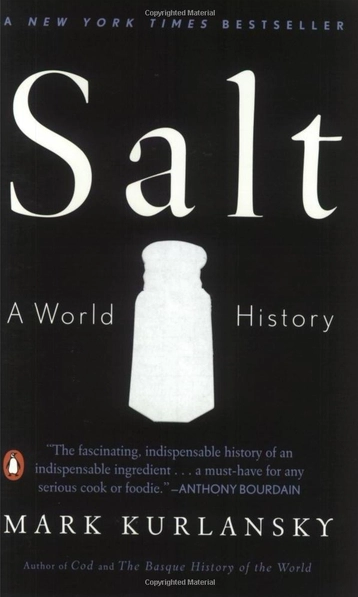
Making salt does not seem, at first glance, all that interesting as an industry. Even ninety years ago, when salt was proportionately a much larger industry in terms of employment, consumption, and economic output, the author of a book on the history salt-making noted how a friend had advised keeping the word salt out of the title, “for people won’t believe it can ever have been important”.1 The bestselling Salt: A World History by Mark Kurlansky, published over twenty years ago, actively leaned into the idea that salt was boring, becoming so popular because it created such a surprisingly compelling narrative around an article that most people consider commonplace. (Kurlansky, it turns out, is behind essentially all of those one-word titles on the seemingly prosaic: cod, milk, paper, and even oysters).
But salt used to be important in a way that’s almost impossible to fully appreciate today.
Try to consider what life was like just a few hundred years ago, when food and drink alone accounted for 75-85% of the typical household’s spending — compared to just 10-15%, in much of the developed world today, and under 50% in all but a handful of even the very poorest countries. Anything that improved food and drink, even a little bit, was thus a very big deal. This might be said for all sorts of things — sugar, spices, herbs, new cooking methods — but salt was more like a general-purpose technology: something that enhances the natural flavours of all and any foods. Using salt, and using it well, is what makes all the difference to cooking, whether that’s judging the perfect amount for pasta water, or remembering to massage it into the turkey the night before Christmas. As chef Samin Nosrat puts it, “salt has a greater impact on flavour than any other ingredient. Learn to use it well, and food will taste good”. Or to quote the anonymous 1612 author of A Theological and Philosophical Treatise of the Nature and Goodness of Salt, salt is that which “gives all things their own true taste and perfect relish”. Salt is not just salty, like sugar is sweet or lemon is sour. Salt is the universal flavour enhancer, or as our 1612 author put it, “the seasoner of all things”.
Making food taste better was thus an especially big deal for people’s living standards, but I’ve never seen any attempt to chart salt’s historical effects on them. To put it in unsentimental economic terms, better access to salt effectively increased the productivity of agriculture — adding salt improved the eventual value of farmers’ and fishers’ produce — at a time when agriculture made up the vast majority of economic activity and employment. Before 1600, agriculture alone employed about two thirds of the English workforce, not to mention the millers, butchers, bakers, brewers and assorted others who transformed seeds into sustenance. Any improvements to the treatment or processing of food and drink would have been hugely significant — something difficult to fathom when agriculture accounts for barely 1% of economic activity in most developed economies today. (Where are all the innovative bakers in our history books?! They existed, but have been largely forgotten.)
And so far we’ve only mentioned salt’s direct effects on the tongue. It also increased the efficiency of agriculture by making food last longer. Properly salted flesh and fish could last for many months, sometimes even years. Salting reduced food waste — again consider just how much bigger a deal this used to be — and extended the range at which food could be transported, providing a whole host of other advantages. Salted provisions allowed sailors to cross oceans, cities to outlast sieges, and armies to go on longer campaigns. Salt’s preservative properties bordered on the necromantic: “it delivers dead bodies from corruption, and as a second soul enters into them and preserves them … from putrefaction, as the soul did when they were alive”.2
Because of salt’s preservative properties, many believed that salt had a crucial connection with life itself. The fluids associated with life — blood, sweat and tears — are all salty. And nowhere seemed to be more teeming with life as the open ocean. At a time when many believed in the spontaneous generation of many animals from inanimate matter, like mice from wheat or maggots from meat, this seemed a more convincing point. No house was said to generate as many rats as a ship passing over the salty sea, while no ship was said to have more rats than one whose cargo was salt.3 Salt seemed to have a kind of multiplying effect on life: something that could be applied not only to seasoning and preserving food, but to growing it.
Livestock, for example, were often fed salt: in Poland, thanks to the Wieliczka salt mines, great stones of salt lay all through the streets of Krakow and the surrounding villages so that “the cattle, passing to and fro, lick of those salt-stones”.4 Cheshire in north-west England, with salt springs at Nantwich, Middlewich and Northwich, has been known for at least half a millennium for its cheese: salt was an essential dietary supplement for the milch cows, also making it (less famously) one of the major production centres for England’s butter, too. In 1790s Bengal, where the East India Company monopolised salt and thereby suppressed its supply, one of the company’s own officials commented on the major effect this had on the region’s agricultural output: “I know nothing in which the rural economy of this country appears more defective than in the care and breed of cattle destined for tillage. Were the people able to give them a proper quantity of salt, they would … probably acquire greater strength and a larger size.”5 And to anyone keeping pigeons, great lumps of baked salt were placed in dovecotes to attract them and keep them coming back, while the dung of salt-eating pigeons, chickens, and other kept birds were considered excellent fertilisers.6
1. Edward Hughes, Studies in Administration and Finance 1558 – 1825, with Special Reference to the History of Salt Taxation in England (Manchester University Press, 1934), p.2
2. Anon., Theological and philosophical treatise of the nature and goodness of salt (1612), p.12
3. Blaise de Vigenère (trans. Edward Stephens), A Discovrse of Fire and Salt, discovering many secret mysteries, as well philosophical, as theological (1649), p.161
4. “A relation, concerning the Sal-Gemme-Mines in Poland”, Philosophical Transactions of the Royal Society of London 5, 61 (July 1670), p.2001
5. Quoted in H. R. C. Wright, “Reforms in the Bengal Salt Monopoly, 1786-95”, Studies in Romanticism 1, no. 3 (1962), p.151
6. Gervase Markam, Markhams farwell to husbandry or, The inriching of all sorts of barren and sterill grounds in our kingdome (1620), p.22
Comments Off on Salt – mundane, boring … and utterly essential
February 28, 2024
V-2: Hitler’s Wunderwaffe
World War Two
Published 27 Feb 2024Hitler hopes that the V-2 rocket will turn the tide of the war. It’s cutting edge technology and impossible to intercept. Right now, the first long-range ballistic missile is raining death on London and Antwerp. But is it too little, too late? Find out the backstory to this powerful weapon.
(more…)
Comments Off on V-2: Hitler’s Wunderwaffe
February 9, 2024
You can’t pro-actively synergize action-oriented metrics in the heat of battle
No, I’m not sure if that headline makes any sense, as I was never particularly receptive to the latest buzzwords of any given management fad that went through from the 70s onwards. They all seemed to share a few characteristics along with a bespoke sheaf of buzzwords, PowerPoint slides galore, and lots of spendy courses you had to send all your employees to endure. Is there anything more dispiriting to staff morale than a VP or director who’s just returned from a week-long training seminar in an exotic location on this year’s latest “revolutionary” “transformational” management fad?
It’s bad when companies that make widgets or smartphone apps or personal hygiene products fall for these scams, but it’s terrifying to discover that your military isn’t immune … and in fact revel in it:
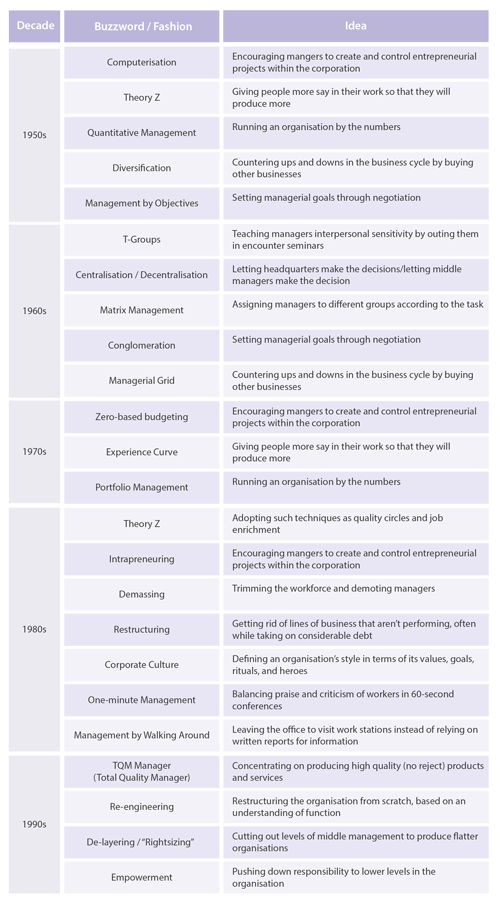
Image from “Fads and Fashions in Management”, The European Business Review, 2015-07-20.
https://www.europeanbusinessreview.com/fads-and-fashions-in-management/
We spent these last few decades since the fall of the Soviet Union weaving a comfortable web of CONOPS and implemented “efficiencies” constructed of consultant-speak, weekend-MBA jargon, and green eyeshade easy-buttons bluffed from the podium by The Smartest People in the Room™ to an audience on balance populated by people who already had the short list of jobs they wanted once they shrugged off their uniform in a PCS cycle or two.
Agree, endorse, parrot, prepare …. profit!
War is New™!, Revolutionary™!, Transformational™!. Hard power is Offset™! If we change a bunch of simple words in to multi-syllabic cute acronyms … then the future will be ours, our budgets will be manageable, and our board seats will be secured! Efficiency to eleventy!
Facing the People’s Republic of China on the other side of the International Date Line … how efficient do you feel? How effective?
Something very predictable happened in our quarter century roadtrip on the way to Tomorrowland; we realized instead we wound up on Mr. Toad’s Wild Ride instead.
I would like the record to show here in 2QFY24 that this exact problem was discussed in detail back when I was a JO in the mid-1990. This is not shocking to anyone who is wearing the uniform of a GOFO. They lived the same history I did.
We knew we were living a lie that we could sustain a big fight at sea. An entire generation of Flag Officers led this lie in the open and ordered everyone else to smile through it. Ignore your professional instincts, and trust The Smartest People in the Room™.
Once again, Megan Eckstein brings it home;
If U.S. military planners’ worst-case scenario arose in the Pacific — having to defend Taiwan from a Chinese invasion — American military forces would target Chinese amphibious ships.
Without them, according to Mark Cancian, who ran a 2022 wargame for the Center for Strategic and International Studies that examined this exact scenario, China couldn’t invade the neighboring island.
…
U.S. submarines would “rapidly fire everything they have” at the multitude of targets, Cancian said, “using up torpedoes at a much, much higher rate than the U.S. has expected to do in the past.”
Navy jets, too, would join in — but they’d run out of Long Range Anti-Ship Missiles within days, …
It’s this nightmare scenario that’s driving the Navy to increase its stockpile of key munitions: the LRASM, the MK 48 heavyweight torpedo, the Standard Missile weapons and the Maritime Strike Tomahawk, among others.
Over a decade after the Pacific Pivot, a couple of years after the US Navy became the world’s second largest navy after being the worlds largest for living memory of 99% of Americans, and two years after the Russo-Ukrainian War reminded everyone that, yeah … 3-days wars usually aren’t.
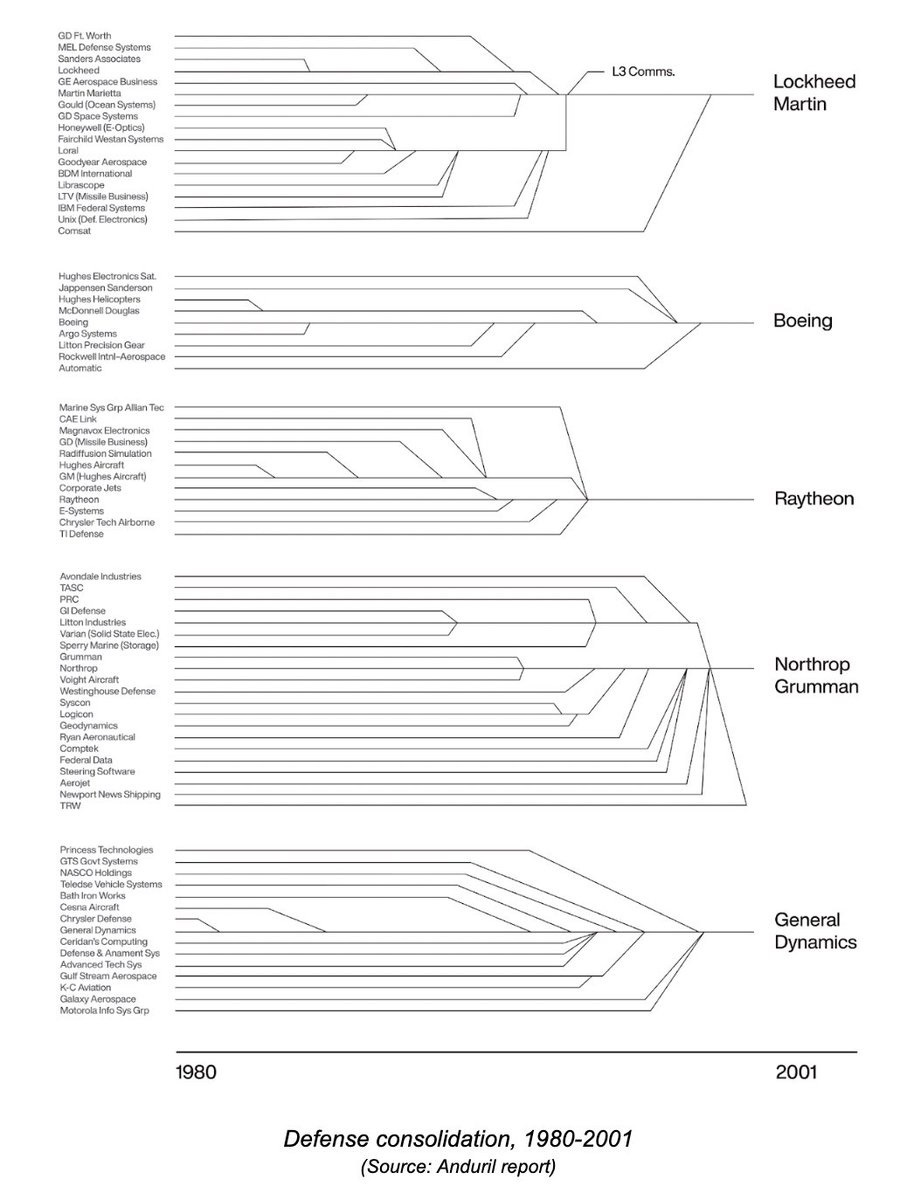
And the defence industries of the 1980s and 90s have all swallowed up smaller competitors — again following “normal” business practices of the time, seeking economies of scale and manufacturing efficiencies and closing down less-profitable assembly lines or entire lines of business.
Let’s go back to SECDEF Perry’s 1990s “Last Supper”, you know, the one that was all about the efficiencies of consolidation of the defense industry.
Three decades later, what is the solution to the strategic risk we find ourselves in due to our inability to arm ourselves?
… “the bottleneck is rocket motors” because so few companies are qualified to build them for the United States, Okano explained. To help, the Navy issued a handful of other transaction agreement contracts to small companies who will learn to build the Mk 72 booster and the Mk 104 dual-thrust rocket motor so prime contractors have more qualified vendors to work with, she added.
LOLOLOL … what “small companies?” That ecosystem is “old think”. If we need to go back to that structure, that will take decades not just to build, but decades of a viable demand signal.
Looks like we have started that as “small companies” perhaps repurpose part of their company to a military division. If we can just stop them from being gobbled up by the primes, it might be nice to return to a more robust, competitive ecosystem. Soviet-like consolidation and McNamaraesque efficiencies got us here, perhaps time to try something old as new again.
Nothing is less efficient to go to war with than a military designed for an efficient peace.
Comments Off on You can’t pro-actively synergize action-oriented metrics in the heat of battle
January 20, 2024
Why Tyrian Purple Dye Is So Expensive | So Expensive | Insider Business
Insider Business
Published 21 Jan 2023Making authentic Tyrian purple dye starts with extracting a murex snail gland. After a series of painstaking steps, Tunisian dye maker Mohamed Ghassen Nouira turns as much as 45 kilograms of snails into a single gram of pure Tyrian purple extract. When he’s done, he can sell it for $2,700. Some retailers sell a gram of the pigment for over $3,000. In comparison, 5 grams of synthetic Tyrian purple costs under $4.
So, why is real Tyrian purple so hard to make? And is that why it’s so expensive?
(more…)
Comments Off on Why Tyrian Purple Dye Is So Expensive | So Expensive | Insider Business
January 16, 2024
Why Real Dijon Mustard Is So Expensive | So Expensive Food | Business Insider
Insider Business
Published 12 Jul 2022Dijon mustard has a tangier, sharper, and spicier flavor compared to other types of mustard. It takes its name from the town of Dijon in Burgundy, France, where it originated. But despite its name, the majority of Dijon mustard that is sold all over the world doesn’t come from France. The few jars that do will cost you up to six times more than regular Dijon mustard (or double if we want to compare it to Grey Poupon). So how is real Dijon mustard different? And why is it so expensive?
Editor’s Note: In this video, the translations at 2:10 and 3:16 are incorrect. The rind of the mustard seed is wrongly referred to as “sound of mustard”. The correct translation is mustard bran. Insider regrets the error.
(more…)
Comments Off on Why Real Dijon Mustard Is So Expensive | So Expensive Food | Business Insider
December 23, 2023
DON’T GET SCREWED!!! Get the best deals on vintage handplanes
Rex Krueger
Published 22 Dec 2023When it comes to purchasing a piece of the past, a little knowledge goes a long way.
(more…)
Comments Off on DON’T GET SCREWED!!! Get the best deals on vintage handplanes
November 18, 2023
QotD: Teaching Marx’s Labour Theory of Value in university
You have to deal with Marx and Marxists in every nook and cranny of the ivory tower, of course, but when you teach anything in modern history you have to confront him head on. Since Marx was a shit-flinging nihilist pretending to be a philosopher while masquerading as an economist, economics is the easiest entry point to his thought. So I’d go at him head-on.
The Labor Theory of Value makes intuitive sense, especially to college kids, who consider themselves both idealists and socially sophisticated. So, I’d tell them, we all agree: Nike’s sneakers cost $2 to make, but sell for $200; therefore, the other $198 must be capitalist exploitation, right? In a socially-just world, sneakers would never cost more than $2, since that’s the amount of “socially useful” labor that went into making them.
To really get them thinking, at that point I’d offer to trade them my shoes, which were of course the butt-ugliest things I could find, bought special at the local Salvation Army just for that purpose. “These cost $2,” I’d tell them. “They’re my social justice shoes. Who’s willing to trade? Oh, nobody? Why ever not?” Or I’d come to class in a plain Wal-Mart t-shirt, on which I’d written “I Heart [This University]” in Magic Marker. Same deal, I’d tell them. “The stuff you guys are wearing sends the same message, but I’ve been in the bookstore, I know for a fact that the hoodie you’re wearing [pointing to the most dolled-up Basic Becky I could find] costs $75. My shirt only cost $2. We’re both telling the world that we love [this university], but yours cost a whole lot more. You, Becky, are taking like $73 out of the mouths of poor people by wearing that … right?”
Repeat as often as needed, until they get the idea that “price” isn’t the same thing as “cost”. This isn’t physics class, I’d tell them, where we can assume away important real-world stuff like friction. Out here in the real world, we have to take stuff like “overhead” and “taxes” into account, such that even if those ugly sneakers or that crappy college-logo t-shirt only “cost” $2 at the point of manufacture, getting them onto the shelves at the the store here in College Town adds a whole bunch more. And then there’s demand, which we’ve already covered. I offered to trade y’all my shoes. Hell, I offered to give away my homemade t-shirt, and nobody took me up on it. You might change your tune if you were naked – and here we will note that this was the kind of situation Karl Marx was putatively addressing – but if you have any choice at all you’ll stick with what you have, because nobody in his right mind wants to wander around campus in a homemade t-shirt …
In short, I’d tell them, price is information. Done right – in an absolutely free market, the capital-L Libertarian paradise, which is of course as bong-addled a fantasy as Marx’s – price is perfect information. Nike’s sneakers don’t sell for $200 because that’s what it cost to make them. The $200 is the aggregate of all those costs we talked about before – cost of materials, labor, transportation, taxes, and, as we’ve seen by the fact that y’all still won’t trade me shoes, the most important piece of information, demand.
Severian, “Velocity of Information (I)”, Founding Questions, 2020-12-26.
Comments Off on QotD: Teaching Marx’s Labour Theory of Value in university
November 15, 2023
“If you cannot make your own pig iron, you are just LARP’n as a real power”
CDR Salamander talks about the importance of an old industry to a modern industrial economy:

We probably need to start this out by explaining exactly what a blast furnace is and why it is important if you want to be a sovereign nation.
First of all, what it does;
The purpose of blast furnace is to chemically reduce and physically convert iron oxide into liquid iron called “hot metal” The blast furnace is a huge, steel stack lined with refractory brick where iron ore, coke and limestone are charged into the top and preheated air is blown into the bottom. The raw materials require 6 to 8 hours to descend to the bottom of the furnace where they become the final product of liquid slag and liquid iron. These liquid products are drained from the furnace at regular intervals. The hot air that was blown into the bottom of the surface ascends to the top in 6 to 8 seconds after going through numerous chemical reactions. Once the blast furnace is started it continuously runs for four to ten years with only short stops to perform planned maintenance.
Why are blast furnaces so important? Remember the middle part of Billy Joel’s “Iron, coke, chromium steel?”
“Coke” is in essence purified coal, almost pure carbon. It is about the only thing that can at scale make “new” or raw iron, aka “pig iron”. Only coke in a blast furnace can make enough heat to turn iron ore in to iron. You can’t get that heat with an electric furnace.
Pig iron is the foundation of everything that follows that makes an industrial power. If you cannot make your own pig iron, you are just LARP’n as a real power.
It takes a semester at least to understand this, but here is all you really need to know;
Primary differences
While the end product from each of these is comparable, there are clearly differences between their capabilities and process. Comparing each type of furnace, the major distinctions are:
Material source – blast furnaces can melt raw iron ore as well as recycled metal, while electric arc furnaces only melt recycled or scrap metal.
Power supply – blast furnaces primarily use coke to supply the energy needed to heat up the metal, while EAFs use electricity to accomplish this.
Environmental impact – because of the fuels used for each, EAFs can produce up to 85% less carbon dioxide than blast furnaces.
Cost – EAFs cost less than blast furnaces and take up less space in a factory.
Efficiency – EAFs also reach higher temperatures much faster and can melt and produce products more quickly, as well as having more precise control over the temperature compared to blast furnaces.
We’ll get to that environmental impact later, but the “Material source” section is your money quote.
Without a blast furnace, all you can do is recycle scrap iron.
You cannot fight wars at scale if all you have is scrap iron. You cannot be an industrial hub off of just scrap iron. If you are a nation of any size, you then become economically and security vulnerable at an existential level. I don’t care how much science fiction you get nakid and roll in; wars are won by steel, ungodly amounts of steel.
Where do you get the steel to build your warships? Your tanks? Your factories? Your buildings? Your factories?
If you can only use scrap, then you are simply a scavenger living off the hard work of previous generations. Eventually you run out. You will wind up like the cypress mills of old Florida where, once they ran out of cypress trees, they simply sold off the cypress lumber their mills were constructed of … and then went bankrupt.

Comments Off on “If you cannot make your own pig iron, you are just LARP’n as a real power”
October 30, 2023
The funny side of reviewing woodworking tools
Christopher Schwarz used to be the editor of one of the big US woodworking magazines and part of the job included being inundated with free tools from manufacturers eager to get a review in an upcoming issue of the magazine. Some — and not just the marginal producers — had the misfortune of shipping tools that failed to work properly (or at all) when tested:
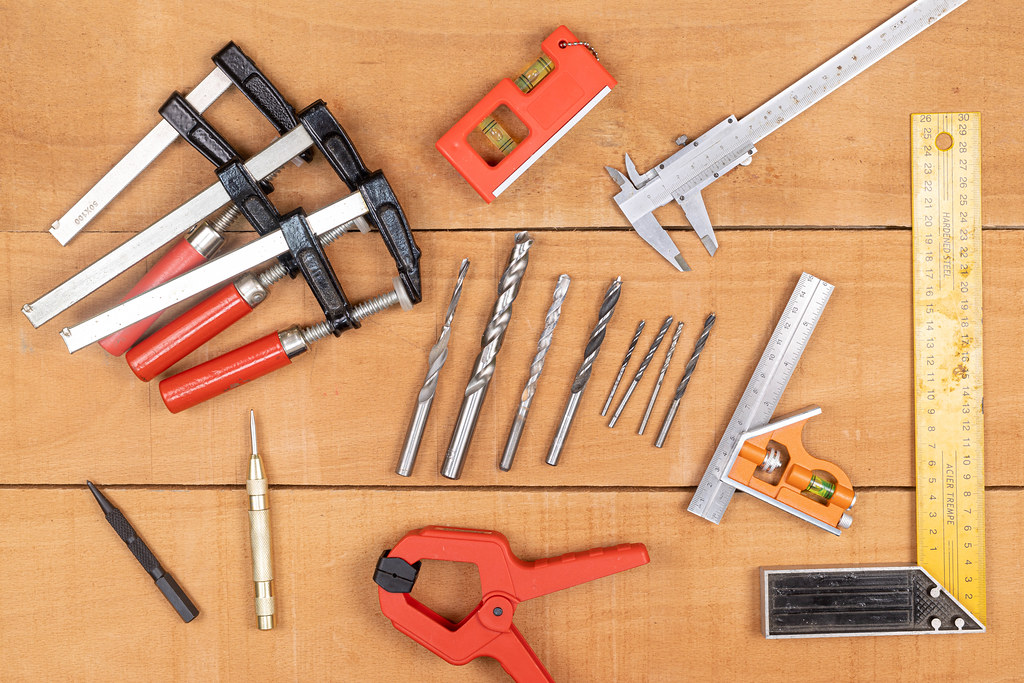
“Woodworking Tools on the wooden table” by wuestenigel is licensed under CC BY 2.0 
 .
.
… it should come as no surprise that toolmakers also make mistakes. Most readers probably think that the tools that came into our shop had been carefully tested and tuned by the manufacturers to make sure they were perfect. Based on how many goofed-up tools I saw, I doubt that’s the case.
And in fact, I took it as a mark of the toolmakers’ honesty when they sent us one right off the warehouse floor.
Here’s a small sample of some of the stuff I’ve seen:
DeWalt: The company makes good tools, but we had a jigsaw come into the shop where the blade clamping mechanism failed. It went click, click, then the blade dropped out like a rotten tooth. When DeWalt introduced its first hybrid table saw, the first rip fence we got was twisted. So was the second. The third replacement was fine.
Delta: When Delta introduced its C-arm drum sander, we were all excited in the shop. We set it up, plugged it in and cranked the puppy up. It spun up and then spun down forever. The motor burned out after three seconds.
Harbor Freight: It might sound too easy to pick on this discount seller. But they sell tools and people buy them. So here goes: When we tested the company’s plunge router, the collet failed. The bit slipped out and flew out. That was one of the days that I wished we had some Depends in the first-aid kit.
Black & Decker: Here’s every tool marketer’s worst nightmare. Black & Decker sent us its new cordless tape measure. Now let’s ignore for a moment the possibility that you do not need an electric tape measure. So Senior Editor David Thiel took it out of the box in front of the entire staff and demonstrated how it works. The tape extended about a foot and then died forever.
Metabo: Cordless drills aren’t supposed to shoot flames out the back are they?
Lobo: When we tested its edge sander the sheet metal base flexed like tin foil. You would turn the machine on, and the thing would do the twist like Chubby Checker.
Powermatic: Yes, even Powermatic. An early version of its benchtop mortiser had a flaw in the piece of metal that joined the motor to the arm mechanism. The gears on the interior stripped out. So when you pulled the arm, the motor never moved.
Tools for Working Wood: The Ray Iles mortising chisels are great, but one of my students at the Marc Adams School of Woodworking snapped the tip off one when working in poplar. I heard it from across the room. It turned out that a few of the tools had been made from A2 instead of D2. It did make for an amusing day as everyone crowded around the chisel like the victim of a car accident.
Lie-Nielsen Toolworks: I had a narrow iron shoulder plane that was an early production run. The bronze grip wouldn’t stay in place when you retracted the iron. When I turned the screw, the plane disassembled itself in my hands.
Veritas: An early version of the Veritas cabinet scraper (an adaptation of the No. 80) would clog after a few passes like Crystal Gayle’s shower’s drain. The company has since fixed that problem and the tool works great.
Stanley Tools: During a test of jack planes, we had a tool that simply would not function. It was like it was haunted. If you snugged up the frog screw to where you thought it should be, you couldn’t adjust the iron. If you loosened the frog screw so you could adjust the iron, the thing would chatter and shake like a Vega going 56 mph. We never figured that one out.
Wenzloff & Sons: While teaching a sawing class at Kelly Mehler’s School of Woodworking, one student’s carcase saw was misbehaving. It was tearing out the shoulders of his tenons something fierce. At first I thought it was user error. Turns out the saw was filed for rip when it was supposed to be crosscut.
Let me conclude by saying that mistakes slip out the door for every toolmaker (and magazine editor and book publisher). We’ve never heard of any toolmaker with zero returns. The real test of a toolmaker (and editor) is how you deal with the mistakes when they occur.
Comments Off on The funny side of reviewing woodworking tools
October 24, 2023
See Inside The M3 Grant | Tank Chats Reloaded
The Tank Museum
Published 30 Jun 2023With a crew of six and a chaotically crowded interior, the Grant was a US-produced WW II tank more used by the British and Indian Armies than anyone else. Join Chris Copson as he explores probably the best preserved example of this rare vehicle – and listen out for the cheese sandwich …
(more…)
Comments Off on See Inside The M3 Grant | Tank Chats Reloaded


