
World War Two
Published 28 Dec 2021Quantity had a quality of its own. 1942 was the year in which the dimensions of the Second World War became truly apparent. The US and its unmatched economic power began to outproduce any other warring nation, manufacturing a fleet of ships and aircraft in record time. In the east Soviet industry began recovering itself, producing tens of thousands of tanks despite tremendous losses. All the while the German logistic system got overwhelmed by the vastness of the occupied territory.
(more…)
December 29, 2021
War in Numbers 1942 – WW2 Special
Comments Off on War in Numbers 1942 – WW2 Special
December 15, 2021
Is the Wehrmacht Defeated in 1942? – WW2 Special
World War Two
Published 14 Dec 2021It’s late 1942 and the German Army is close to ruin. The Ostheer alone has suffered more than a million casualties in its fight against the Red Army. If the Wehrmacht cannot find a way to return to its former strength or reap decisive strategic benefits in the near future, it will ultimately face destruction in a war of attrition.
(more…)
Comments Off on Is the Wehrmacht Defeated in 1942? – WW2 Special
December 9, 2021
The sequel to the British disaster at the Battle of Coronel, the German disaster at the Battle of the Falkland Islands
On December 8th, the people of the Falkland Islands observe “Battle Day” to commemorate the British naval victory off the islands in 1914. This is the bookend to the Battle of Coronel the previous month (described here and here), where a Royal Navy squadron was almost annihilated by Imperial Germany’s East Asia Squadron under Vice-Admiral Graf Maximilian von Spee. At the Battle of the Falkland Islands, an equally lop-sided victory eliminated von Spee’s ships with minimal damage to Rear Admiral Sir Frederick Doveton Sturdee’s squadron. In The Critic, A.S.H. Smyth outlines the events as shown in a British film released in 1927:
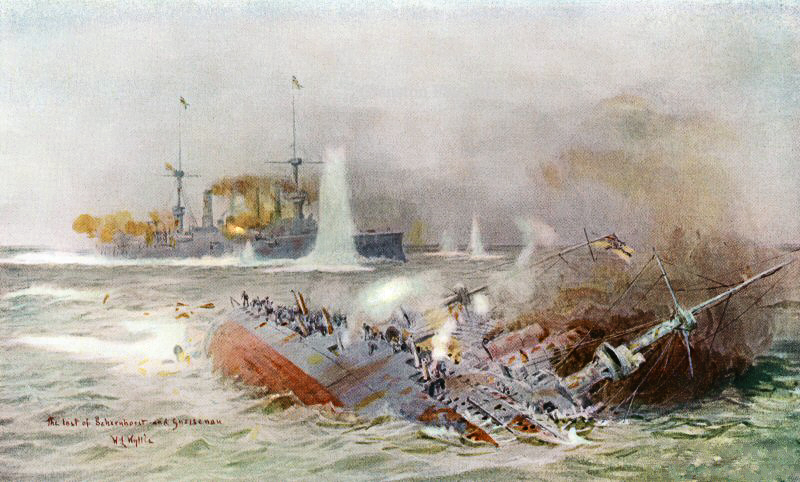
Battle of the Falkland Islands, 1914 by William Lionel Wyllie. SMS Scharnhorst rolls over and sinks while SMS Gneisenau continues to fight.
Originally published in 1918 by Cassel & Company. Retouched image via Wikimedia Commons
Rear Admiral Sir Frederick Doveton Sturdee (unimprovably British, isn’t it?), Chief of War Staff at the Admiralty, and at distinct risk of being scapegoated for the Coronel catastrophe, was summarily appointed Commander-in-Chief South Atlantic and Pacific(!) and despatched posthaste by [First Sea Lord John “Jackie”] Fisher (with whom he did not get on), on something of a do-or-die mission as the commander of new, eight-cruiser squadron.
The Admiral Superintendent of Devonport warns that Sturdee’s two battle cruisers, Invincible and Inflexible, cannot be ready before Friday the 13th November. First Lord of the Admiralty Winston Churchill balks at that ill-omened date, and orders that they sail on the 11th, ready or not. (Students of the 1982 conflict may see more than a couple of parallels here.) Cue: dockyard refitting montage.
Cut to the German colony at Valparaiso, where his countrymen fête von Spee’s glorious German victory in their first naval battle. “Damnation to the British Navy!” they want to toast. No, says, von Spee: “to a gallant enemy.” Handed a bouquet of flowers, he says he’ll keep them for his funeral “when my time comes.” For “when were the British ever content to leave an enemy to his triumph?”
Von Spee was well aware, it seems, that running the gauntlet up through the Atlantic was going to be a torrid prospect, even without a veangeful enemy on the look-out for him personally. But homeless (Tsingtau had fallen to the Japanese), in need of fuel, and down to half their ammunition, von Spee’s captains urged him now to head for Germany, and he agreed.
Von Spee’s ships were in need of dockyard maintenance and not steaming efficiently, but thanks to a captured British collier they were not in need of coal to be able to get home. Before setting off from where they’d been refuelling, Spee decided to strike another blow against the British and raid the Royal Navy’s supply base at Port Stanley in the Falkland Islands where only local militia were expected to be defending.
It was, among other things, sheer bad luck that von Spee came up to Stanley just a few hours after Sturdee had arrived with his group of cruisers — all newer, faster, and better-gunned than their fatigued German counterparts — and was busily refuelling. Likewise, that the sea was calm, there was little wind, and visibility was excellent. Too late, Gneisenau observes that there are British warships in the harbour! (The acting here is particularly terrible.)
It has been suggested that von Spee had not known that the British ships were “waiting” there (they hardly were); but it has also been alleged that he was misled by poor German intelligence, or even false British cryptography. [The Wikipedia article on the battle credits misinformation by British intelligence for leading von Spee into the trap.]
In Britain, meanwhile, the Admiralty is under the impression that Sturdee is the one who has been caught unawares in the Falkland Islands. Von Spee is a mere 12 miles away, and none of the British ships have their steam up. The FIVF [the Falklands Islands Volunteer Force] are called out, as the ships are ordered to go from zero to hero. One poor lad has to run up the Union Jack in local weather conditions (I’ve been that lad: he has my sympathies); another forgets his rifle, as emphasised by a heavily-asterisked title card.
As so often happens, Fate now played its hand, and Canopus, parked, with her fully-functioning 12-inch guns (so missed at Coronel) in Stanley Harbour, as the Islands’ main defensive battery, came into her own. As the Germans turn and run, Canopus opens fire, and soon enough the “grimly purposeful” cruiser group — “fittingly bearing names from the four corners of Britain … Kent, Cornwall, Glasgow and Carnarvon” — set off in pursuit.
The maths was simply not on the Germans’ side. Sturdee even sent his men below to eat. At midday, he called them back to Action Stations. Von Spee responded by ordering his light cruisers to scatter and make for neutral ports, while Scharnhorst and Gneisenau remained to “accept action to cover their escape”. Flashback to the presentation of those flowers.
Comments Off on The sequel to the British disaster at the Battle of Coronel, the German disaster at the Battle of the Falkland Islands
December 7, 2021
Kokoda Trail: D-by-D Recap 01
World War Two
Published 6 Dec 2021For the past months, we have continuously mentioned the fighting on the Kokoda Track, but it was often a mere footnote next to the colossal battles happening throughout the world. Today, we give you a unique recap of all that’s been going on in this remote theater of war.
(more…)
Comments Off on Kokoda Trail: D-by-D Recap 01
November 24, 2021
Tank Chats #133 | Renault UE Chenillette | The Tank Museum
The Tank Museum
Published 6 Aug 2021In this weeks Tank Chat, Curator David Willey talks about the Renault UE Chenillette. A light tracked armoured carrier produced by France between 1932 and 1940.
(more…)
Comments Off on Tank Chats #133 | Renault UE Chenillette | The Tank Museum
November 11, 2021
QotD: War and human capital
… perhaps there is a parallel between the state of human capital in the American elite [today] and the German elite during the war. The German soldiers were the best in the world, but the people further up the line were not the best tacticians. At the upper reaches, the strategists were terrible in all sorts of ways, starting with Hitler, who was laughably inept at running a war. Winning was never an option, but the Germans could have avoided total obliteration if they had better leaders.
The blame for this is always put on Hitler and that’s a good place to start, but the Germans had a brain power problem throughout the planning layer. This is obvious in how they went about making tanks. Instead of going for a tank that was cheap and easy to produce by a civilian workforce, they tried to build tanks that were complex and required specialists to produce. The effects of allied bombing raids were amplified by this strategic blunder in production planning. This is a very basic error in planning and execution.
One possible cause of this was that the middle-aged men who would have been sorting these production and design problems had died during the Great War. The German army tended to “use up” their units, rather than cycle them in and out of lines. That meant that a lot of experience with supply and logistics was lost in the trenches. The British and the Americans rotated units in and out of the lines, thus they came out of the war with a vast number of people with experience in the nuts and bolts of war fighting.
The current ruling class needs the Germans to be seen as the ultimate in super villains, but the truth is the Germans were dumb about a lot of important things. The Russians came up with sloped armor, for example, and the Germans never bothered to steal the idea, even after Kursk. The Germans got their hands on the Churchill tank, but never bothered to learn anything from it. They never learned from the Americans how to use communications to coordinate their artillery and their armor.
In many respects, the story of the tank in the war is a great proxy for the story of human capital and cultural intelligence. The Germans had the best trained military on earth, but they lacked human capital in the strategy and tactics layer. Either the culture was unable to produce it or there was simply not enough smart people to create the necessary smart fraction. That was ultimately why Germany was wiped from the map. It’s probably why no new culture has arisen from that place on the map either.
The Z Man, “Tanking It”, The Z Blog, 2019-03-01.
Comments Off on QotD: War and human capital
November 6, 2021
Is the Answer in Uranus? – The Soviet Plan to Win at Stalingrad – WW2 SPECIAL
World War Two
Published 4 Nov 2021Georgy Zhukov told Josef Stain in September that if the Red Army could just hold out until November, he could put together a counteroffensive that would defeat the enemy. Well, November is here, and that counteroffensive is ready to kick off, but how was it put together? Let’s find out.
(more…)
Comments Off on Is the Answer in Uranus? – The Soviet Plan to Win at Stalingrad – WW2 SPECIAL
November 1, 2021
Indochina and The Battle of Dien Bien Phu
The History Guy: History Deserves to Be Remembered
Published 29 Sep 2017The History Guy remembers how decolonization led to proxy war and the Battle of Dien Bien Phu in what is now known as Vietnam.
The episode discusses and presents historical photographs and film footage depicting events during a period of war, which some viewers may find disturbing. All events are described for educational purposes and are presented in historical context.
The History Guy uses images that are in the Public Domain. As photographs of actual events are often not available, I will sometimes use photographs of similar events or objects for illustration.
Patreon: https://www.patreon.com/TheHistoryGuy
The History Guy: Five Minutes of History is the place to find short snippets of forgotten history from five to fifteen minutes long. If you like history too, this is the channel for you.
Awesome The History Guy merchandise is available at:
https://teespring.com/stores/the-hist…The episode is intended for educational purposes. All events are presented in historical context.
#DienBienPhu #militaryhistory #thehistoryguy
Comments Off on Indochina and The Battle of Dien Bien Phu
September 30, 2021
Petrol shortages in the UK
I’ve seen several reports on the somewhat sudden rash of petrol (gasoline to US/Canadian readers) shortages in Britain, and most of those reports airily pin the blame for the situation on Brexit. To the media, Brexit seems to be an all-purpose explanation for anything that goes wrong (in the same way that previous administrations get the blame for current problems even many years after they left power). Sean Gabb says that despite the frequent glib blaming of Brexit, in this case it is part of the reason:
There is in the United Kingdom a shortage of lorry drivers. This means a dislocation of much economic activity. Because it cannot be delivered, there is no petrol in the filling stations. Because there are not enough drivers, and a shortage of fuel, we may soon have shortages of food in the shops. Christmas this year may not involve its usual material abundance.
These difficulties are wholly an effect of the new political economy that has emerged in England and in many other Western countries since about 1980. An army of managers, of agents, of administrators, of consultants and advisers and trainers, and of other middle class parasites has appropriated a growing share of the national income. This has happened with at least the active connivance of the rich and the powerful. Since, in the short term, the distribution of the national income is a zero-sum game, the necessary result is low and falling real wages for those who actually produce. So long as the productive classes can be kept up by immigration from countries where even lower wages are on offer, the system will remain stable. Because leaving the European Union has reduced the supply of cheap labour, the system is no longer stable in England.
There are two obvious solutions. The first is to rearrange the distribution of income, to make the productive classes more able and more willing to produce. Since this would mean reducing the numbers or incomes or both of the parasite classes, the second is the solution we mostly read about in the newspapers. This is to restore the flow of cheap foreign labour.
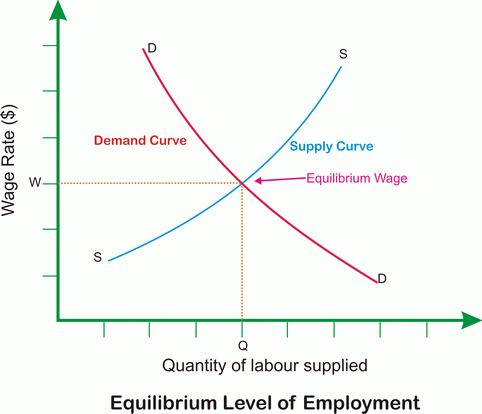
In summary, that is my explanation of what is happening. For those who are interested, I will now explain at greater length. According to the mainstream theory of wages, labour is a commodity. Though workers are human beings, the labour they supply to employers is of the same general nature as machine tools and copper wire and cash registers and whatever else is bought and sold in the markets for producer goods. A wage therefore is a price, and we can illustrate the formation of wage rates with the same supply and demand diagrams as we use for illustrating the formation of prices:
The supply curve slopes upwards because most work is a nuisance. Every hour of labour supplied is an hour that cannot be spent doing something more enjoyable. Beyond a certain level, workers can only be persuaded to supply more labour if more money is offered for each additional hour of labour. As with other producer goods, the shape of the demand curve is determined both by the price of what labour can be used to produce and by the law of diminishing returns.
[…]
Our problem in England is that large areas of economic activity have been rigged. There is an immensely large state sector, paid for by taxes on the productive. Most formally private activity is engrossed by large organisations that are able to be so large either because of limited liability laws or by regulations that only large organisations can obey. The result is that wages are often determined less by market forces than by administrative choice. In this kind of rigged market, we cannot explain the distribution of income as a matter of continual choice between marginal increments of competing inputs until the whole has been distributed. It may be better to look at a modified wages fund theory. A large organisation has a pot of money left over from the sale of whatever its product may be, minus payments to outside suppliers, and minus whatever the directors choose to classify as profit. This is then distributed according to the free choice of the directors, or how hard they can be pushed. Or we can keep the mainstream cross-diagrams, but accept that the demand curve is determined less by marginal productivity than by the overall prejudices of those in charge.
Therefore the growth of a large and unproductive middle class, and the screwing down of all other wages to pay for this. This is not inevitable in rigged markets, but is possible. It has come about since the 1980s for three reasons:
First, the otherwise unemployable products of an expanded higher education sector have used all possible means to get nice jobs for themselves and their friends;
Second, the rich and the powerful have accommodated this because higher wages and greater security for the productive might encourage them to become as assertive as they were before the 1980s;
Third, that these rich and powerful see the parasite classes as a useful transmitter of their own political and moral prejudices.
Comments Off on Petrol shortages in the UK
August 4, 2021
Oil – Hitler’s Only Chance to Win the War? – WW2 Special
World War Two
Published 3 Aug 2021Well, we all know by know that the Wehrmacht is driving into the Caucasus to try and take the Soviet oilfields, but how bad is their oil situation, actually? And how will they get it out of the ground if the Soviets sabotage the fields and wells? What exactly is the plan? Let’s find out.
(more…)
Comments Off on Oil – Hitler’s Only Chance to Win the War? – WW2 Special
July 28, 2021
How Hitler Created the World’s Worst Traffic Jam – WW2 – 152B – July 27, 1942
World War Two
Published 27 Jul 2021“I said DAMN, this traffic jam … How I hate to be late, hurts my motor to go so slow. Time I get home my supper be cold. Damn, this traffic jam.” (James Taylor, the Eastern Front, 1942)
(more…)
Comments Off on How Hitler Created the World’s Worst Traffic Jam – WW2 – 152B – July 27, 1942
July 11, 2021
Fall Blau – A Victim of Its Own Success? – 150 – WW2 – July 10, 1942
World War Two
Published 10 Jul 2021Adolf Hitler is not happy, and yet phase one of Fall Blau has accomplished all of its goals and done so ahead of the timetable. However, the Soviet Army in 1942 is not the same as that in 1941, and is not waiting around this time to be captured by the hundreds of thousands, and if things continue then the Axis might just be wasting a ton of gas to take a ton of empty space.
(more…)
Comments Off on Fall Blau – A Victim of Its Own Success? – 150 – WW2 – July 10, 1942
June 14, 2021
How To Defend A Star Fortress Forever
SandRhoman History
Published 13 Jun 2021Thanks to Audible for sponsoring this video! Start listening with a 30-day Audible trial. Choose one audiobook and two Audible Originals absolutely free: http://audible.com/sandrhoman or text sandrhoman to 500-500.
In this video we will provide you with the most necessary knowledge to defend a star fortress forever.
Patreon (thank you): https://www.patreon.com/sandrhomanhis…
Paypal (thank you: paypal.me/SandRhomanhistory
We also have Twitter: https://twitter.com/Sandrhoman#history #siege #sandrhoman
Sources:
Hoppe, S., s.v. “Festungsbau”, in: Enzyklopädie der Neuzeit.
Lynn, J. A., “States in Conflict 1661-1763”, in: Parker, G. (Ed.), The Cambridge History of Warfare, Cambridge 2005.
Lynn, J. A., “The trace itallienne and the Growth of Armies”, in: Rogers, C. J. (Ed.), The Military Revolution Debate. Readings on the Military Transformation of Early Modern Europe, Boulder / San Francisco / Oxford 1995.
Ortenburg, G., Waffe und Waffengebrauch im Zeitalter der Landsknechte (Heerwesen der Neuzeit, Abt. 1, Bd. 1) Koblenz 1984.
Parker, G., “The Limits to Revolutions in Military Affairs: Maurice of Nassau, the Battle of Nieuwpoort (1600), and the Legacy”, in The Journal of Military History, 71;2, 2007; S. 331 – 372.
Rogers, C.J. / Tallet F. (editors), European Warfare, 1350–1750, 2010.
Van Nimwegen, O., The Dutch Army and the Military Revolutions, 1588-1688.

Comments Off on How To Defend A Star Fortress Forever
April 19, 2021
QotD: Logistics and training
When we consider logistics and training we should consider then both, together, as part of Support ~ with a capital S. Support also includes keeping facilities (barracks and training areas and workshops and supply depots) up to date.
Training is not just teaching selected skills; it involves planning on how many people will be needed, each with specific skill sets, to crew ships, to serve in regiments and battalions, to fly airplanes and to repair and maintain ships and tanks and trucks and aircraft over the long haul. Training also involves ensuring that teams know how to work together … training is how we prepare for war.
The capital S Support base […] must be properly staffed, properly funded (which means funding must be stable, over the years and decades) and properly organized and managed. Supporting our troops and fleets of ships, vehicles and aircraft requires a mix of civil and military people: some in uniform, some civil servants and some on contract from the private sector. There is no perfect model … most modern, Western states, including America, Australia, Britain, Canada, Denmark and so on, use a mix of military, civil service and contractor support service. each trying to get the right mix of operational effectiveness and economy. The key, as I mentioned above, is stability. The support system need to be properly staffed and funded year in and year out, decade after decade. Those elements ~ dockyards and depots and workshops and schools and agencies comprise the firm base upon which the nation’s war-fighting (combat) powers depend.
Ted Campbell, “My Plan (3)”, Ted Campbell’s Point of View, 2018-09-15.
Comments Off on QotD: Logistics and training
April 4, 2021
German railway logistical problems after Operation Barbarossa began
I was involved in a discussion on the TimeGhost Army forum on the reasons the Wehrmacht didn’t get as much use out of the existing Soviet railway system to support their forces. I ended up writing enough that I thought it’d be worth pulling together into a blog post. The original question was why didn’t the Germans build new rail lines in Poland to the Russian gauge — which was different enough from the standard 4′ 8 1/2″ gauge used in most of the rest of Europe to help supply their armies.
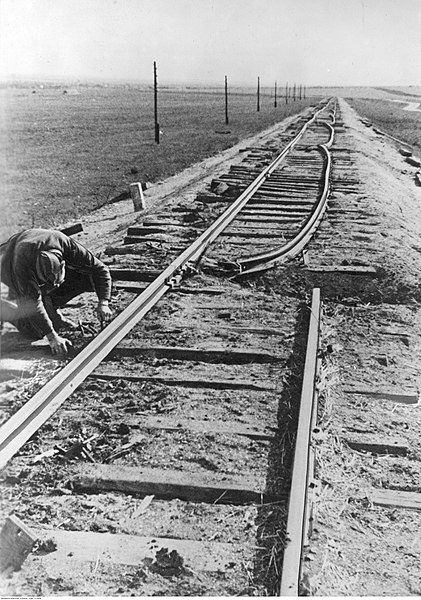
Example of the damage to Soviet railway lines conducted during the Soviet retreat in 1941.
This photo originally from Wydawnictwo Prasowe Kraków-Warszawa via Wikimedia Commons.
In Christian Wolmar’s Engines of War: How Wars Were Won and Lost on the Railways, he outlines the troubles the Germans faced after launching Operation Barbarossa with regard to logistics on the railway network. Each of the main Germany axes of advance had only one Soviet rail line to provide the bulk of the transport, but the Soviets had successfully withdrawn or destroyed the majority of the locomotives and rolling stock. German industry could have been assigned the task of producing new locomotives to fit the Russian gauge, but re-gauging the existing track was significantly faster.
This meant a significant labour requirement to unload incoming German trains at the furthest point of conversion and re-loading onto the few Russian trains that were able to be put back into service. This was a major task for the German army even before Partisan activity began in earnest. The available coal to fuel the engines in Russia was of inferior thermal quality to the coal the German locomotives were designed to use, so in addition to all the military supplies that had to be carried, the Germans also had to supplement the Russian coal with significant amounts of better coal from elsewhere in Europe.
The next problem didn’t show up until late in 1941, but it was the same problem the fighting troops had to contend with: the Russian winter. Russian railway locomotives were engineered to operate throughout the year, but German locomotives almost never faced the low temperatures that happen in Russia, so any German locomotive allowed to freeze was almost certainly lost to permanent mechanical failure (the locomotive’s entire boiler would need to be replaced, which was not a repair that could be made in the field).
Compounding the problems for the Germany railway troops was that the military planners failed to give the railway troops any priority for supplies and reinforcements, which meant that the higher priority troops (the front-line soldiers) often had to wait longer and/or receive less because the railways weren’t able to repair damaged track or rolling stock or increase the speed of re-gauging the Russian railways.
Somone agreed that these were significant problems for the Wehrmacht, but weren’t they at least somewhat taken into consideration in the planning process:
You’re quite correct that the military planners must have been aware of these issues and a rational army staff would have taken them fully into account in their war plans. It’s possible that they expected to capture a much larger proportion of the Russian locomotives and rolling stock in the initial attacks, but they should have made contingency plans that didn’t absolutely depend on all of them falling into German hands … which is what appears to have been their “plan”.
I agree that it would have been a sensible thing to take into consideration that even if everything went off perfectly – and it never does in wartime – large parts of the German military were going to be staying in Russia for a very long time. Russian winter is, thanks to the historical experiences of Charles XII and Napoleon, proverbial. Hitler’s interventions in the planning process can only account for so much of the irrational optimism: the rest is clearly staff failure at many different levels.
Historical changes of gauge in peacetime have been achieved in amazingly short periods of time … but that was with the advantage of advance planning and having vast numbers of workers available on a tight timetable to get it done. My personal sense (not derived from Christian Wolmar’s book) is that the German military as a whole put too much emphasis on the “teeth” and no where near enough on the “tail” for anything other than a “short, victorious war”.
Railways in North America had certainly tried to adopt as many mechanical aids to track maintenance as they could afford, but I’m not sure if that was equally true of European railways at that time. I recall watching a late 1940s promotional film by one of the “Big Four” British railways showing the innovative way they were now doing track work, and even with some quite modern mechanical aids, there were still dozens of workers clustered around the work (in that time period, not wearing any of what we’d now consider essential safety gear), because labour was still relatively cheap and plentiful.
[…]
There’s a hoary old saying about amateurs plan strategy, but professionals plan logistics. Despite having the benefit of basically inventing the modern military staff system, German plans in WW2 appear in hindsight to be very amateurish once you get to the strategic scale. […] Given the constraints, I think the Germans did far better than they should have done to get as close to Moscow as they did. […] Human psychology plays a large part in explaining both the Germans’ incredible over-confidence (what the Japanese termed “Victory disease”) and Stalin’s willing self-delusion that the Germans wouldn’t attack him while his forces weren’t ready.
Comments Off on German railway logistical problems after Operation Barbarossa began


