
… Spartan operational capabilities were extremely limited, even by the already low standards of its peers, meaning very large Greek poleis (like Athens or Syracuse).
Greek logistics in this period in general were very limited compared to either Macedonian or Roman logistical capabilities in subsequent centuries, or contemporary Persian logistics capabilities. Ironically, the most sustained study of classical Greek logistics concerns the campaigns of Xenophon (J.W. Lee, A Greek army on the March (2008)), meaning that it concerns not polis amateurs but an army of mercenary professionals, and yet compared to what the Macedonians would be able to do (see D.W. Engels, Alexander the Great and the Logistics of the Macedonian Army (1978)) half a century later in the same terrain, even these Greek logistics – probably the gold standard of their time – are astoundingly underdeveloped.
Put very briefly: Greek armies seem to have had relatively little carrying or logistics capacity. They did not seem to have generally moved with sufficient engineering tools or materials for effective field fortification or siege warfare. This is compounded by their inability to mill grain on the move (something Macedonian and Roman armies could do), which compounds problems of using local supply. You can eat unmilled grain (it can be roasted or boiled into porridge, but this is less than ideal. What they do tend to have is a high number of non-combat personal servants (precisely the sort of fellows good Roman or Macedonian generals drive out of the camp as soon as possible), who impose additional logistics burdens without much increasing the operational range or endurance of the army. Consequently, Greek armies struggled to stay out in the field throughout the year, whereas Roman and Macedonian armies were routinely capable of year-round campaigning.
Bret Devereaux, “Collections: This. Isn’t. Sparta. Part VII: Spartan Ends”, A Collection of Unmitigated Pedantry, 2019-09-27.
July 12, 2022
QotD: Greek city-state logistics in the time of the Peloponnesian War
June 17, 2022
Napoleon’s Retreat from Moscow – Why He Failed in Russia
Real Time History
Published 16 Jun 2022Sign up for the CuriosityStream + Nebula Bundle: https://curiositystream.com/realtimeh…
Napoleon’s retreat from Moscow and from Russia as a whole is one of the most dramatic scenes in history. Starving and freezing, the French Grande Armée is desperately trying to reach the Berezina River. The revitalized Russian Army is on their heels and almost catches their prey in the 2nd Battle of Krasny. But it wasn’t just “General Winter” that defeated Napoleon in Russia.
» SUPPORT US ON PATREON
https://patreon.com/realtimehistory» THANK YOU TO OUR CO-PRODUCERS
John Ozment, James Darcangelo, Jacob Carter Landt, Thomas Brendan, Kurt Gillies, Scott Deederly, John Belland, Adam Smith, Taylor Allen, Rustem Sharipov, Christoph Wolf, Simen Røste, Marcus Bondura, Ramon Rijkhoek, Theodore Patrick Shannon, Philip Schoffman, Avi Woolf, Emile Bouffard, William Kincade, Daniel L Garza, Stefan Weiß, Matt Barnes, Chris Daley, Marco Kuhnert, Simdoom» SOURCES
Boudon, Jacques-Olivier. Napoléon et la campagne de Russie en 1812 (2021).
Chandler, David. The Campaigns of Napoleon, Volume 1 (New York 1966).
Lieven, Dominic. Russia Against Napoleon (2010).
Mikaberidze A. The Battle of the Berezina: Napoleon’s Great Escape (Pen&Sword Military, 2010)
Rey, Marie-Pierre. L’effroyable tragédie: une nouvelle histoire de la campagne de Russie. (2012).
Zamoyski, Adam. 1812: Napoleon’s Fatal March on Moscow. (2005).
Отечественная война 1812 года. Энциклопедия (Москва: РОССПЭН, 2004)
Безотосный В. М. Россия в наполеоновских войнах 1805–1815 гг. (Москва: Политическая энциклопедия, 2014)
Троицкий Н.А. 1812. Великий год России (Москва: Омега, 2007)
(Прибавление к «Санкт-Петербургским ведомостям» №87 от 29 октября 1812 / http://www.museum.ru/museum/1812/War/…)» OUR STORE
Website: https://realtimehistory.net»CREDITS
Presented by: Jesse Alexander
Written by: Jesse Alexander
Director: Toni Steller & Florian Wittig
Director of Photography: Toni Steller
Sound: Above Zero
Editing: Toni Steller
Motion Design: Toni Steller
Mixing, Mastering & Sound Design: http://above-zero.com
Digital Maps: Canadian Research and Mapping Association (CRMA)
Research by: Jesse Alexander, Sofia Shirogorova
Fact checking: Florian WittigChannel Design: Simon Buckmaster
Contains licensed material by getty images
Maps: MapTiler/OpenStreetMap Contributors & GEOlayers3
All rights reserved – Real Time History GmbH 2022
June 5, 2022
Banzai Charges in Alaska – WW2 – 197 – June 4, 1943
World War Two
Published 4 Jun 2022The Chinese defeat the Japanese at Shipai Fortress and the Americans maul the Japanese in the Aleutians. The Japanese are also worried about the possibility of the USSR joining the war against them. Meanwhile the Allies still plan to invade Sicily, but have no idea what they’ll do after that.
(more…)
June 3, 2022
Chat Tanks #148 M548 | The Tank Museum
The Tank Museum
Published 18 Feb 2022► JOIN OUR PATREON: Our Patreons have already enjoyed Early Access and AD free viewing of our weekly YouTube video! Consider becoming a Patreon Supporter today: https://www.patreon.com/tankmuseum
► TIMESTAMP:
00:00 – INTRO
00:28 – FEATURES
(more…)
May 21, 2022
Ukraine & T-72: The death of the tank? | The Tank Museum
The Tank Museum
Published 20 May 2022Tank Museum Curator David Willey explores the current conflict in Ukraine and the performance of the T-72 tank; putting it into historical context and exploring other times during the last hundred years when the death of the tank has been predicted.
Consider becoming a Patreon Supporter today: https://www.patreon.com/tankmuseum
00:00 | Intro
00:40 | Wider context
11:01 | Tanks in History
(more…)
April 23, 2022
QotD: The “Modern System” of combat
The modern system assumes that any real opponent can develop enough firepower to both obliterate any fixed defense (like a line of trenches) or to make direct approaches futile. So armies have to focus on concealment and cover to avoid overwhelming firepower (you can’t hit what you can’t see!); since concealment only works until you do something detectable (like firing), you need to be able [to] move to new concealed positions rapidly. If you want to attack, you need to use your own firepower to fix the enemy and then maneuver against them, rather than punching straight up the middle (punching straight up the middle, I should note, as a tactic, was actually quite successful pre-1850 or so) or trying to simply annihilate the enemy with massed firepower (like the great barrages of WWI), because your enemy will also be using cover and concealment to limit the effectiveness of your firepower (on this, note Biddle, “Afghanistan and the Future of Warfare” Foreign Affairs 82.2 (2003); Biddle notes that even quantities of firepower that approach nuclear yields delivered via massive quantities of conventional explosives were insufficient to blast entrenched infantry out of position in WWI.)
That means that modern system forces are focused on cover and concealment in defense, but on mobility – often very rapid mobility – in attack. The doctrines that developed to operationalize variations on the modern system (Bewegungskrieg, Deep Battle, AirLand Battle, and so on) all relied (intentionally or not) on pushing the tempo of an attack beyond the ability of a defender to coordinate a defense, on the theory that this would produce tactical and even operational collapse. That theory, it turns out, works very well, but it comes with some costs (I should note here I am stretching the definition of Biddle’s “modern system” a bit and also glossing over a lot of detail in maneuver warfare doctrines).
The thing is, embracing the Modern System is hard. Actually pulling this off requires a relatively high degree of training. It also requires delegating a lot of authority down to lower officers and NCOs. You need both because individual small units need to keep moving and maneuvering even when they may not have time to get direct orders from above, and they need the freedom to respond to local conditions and utilize local terrain, often down to the squad or fireteam level. In turn, that means it is really hard to do if your common soldiers are undertrained, simply illiterate, or if (as in an authoritarian regime) you can’t trust your officers with any kind of independence. Modern authoritarian “coup-proofing” makes it practically impossible to actually implement the modern system effectively (which is part of why most tin-pot dictators produce such poor military performance; though note that not all authoritarian regimes need to coup-proof in this way).
It’s also expensive. Getting the mobility to pull this off on the operational level means mechanizing almost everything in your army, so that the infantry and artillery can keep up with the advance units and so that the logistics can keep up with them. Doing that requires a lot of command sophistication, but it also just requires a ton of hardware. Everything needs to be motorized, mechanized and portable, and then all of that needs to be tied into radio communications, GPS, and so on. And because you’re delegating authority down to smaller and smaller units, those units need all of that expensive communications, and so on. All of that hardware costs a fortune.
But – and this is the core of Biddle’s argument – when modern system armies encounter armies that have not implemented the modern system in conventional pitched battle, the result is generally a crushingly one-sided affair. That’s going to matter a lot for the analysis going forward: so far, it doesn’t seem possible to hold territory (meaning not fighting as guerillas, but actually engaging in positional warfare in the Maoist sense) with a non-modern system army against a modern system army. Non-modern system armies that try get pretty badly wrecked. The 1991 Iraq war is the traditional case study in just how badly wrecked: the coalition (using the modern system) took 292 KIA; 776 WIA compared to the Iraqi Army (without the modern system) suffering 25,000+ KIA and 75,000+ WIA. That stunning lopsidedness is going to matter a lot for the argument going forward.
Bret Devereaux, “Collections: Why Don’t We Use Chemical Weapons Anymore?”, A Collection of Unmitigated Pedantry, 2020-03-20.
April 22, 2022
How Russian Partisans Waged Guerilla War Against Napoleon
Real Time History
Published 21 Apr 2022Sign up at https://curiositystream.com/realtimeh… and get Nebula bundled in.
The face of war was changing in 1812. While the Russian Army retreated and left behind scorched earth, Russian partisans took up arms against Napoleon’s troops. They harassed and attacked vital supply lines and we a true menace to the Grande Armée‘s rear.
» SUPPORT US ON PATREON
https://patreon.com/realtimehistory» THANK YOU TO OUR CO-PRODUCERS
John Ozment, James Darcangelo, Jacob Carter Landt, Thomas Brendan, Kurt Gillies, Scott Deederly, John Belland, Adam Smith, Taylor Allen, Rustem Sharipov, Christoph Wolf, Simen Røste, Marcus Bondura, Ramon Rijkhoek, Theodore Patrick Shannon, Philip Schoffman, Avi Woolf,» SOURCES
Boudon, Jacques-Olivier. Napoléon et la campagne de Russie en 1812. 2021.
Chandler, David: The Campaigns of Napoleon, Volume 1, New York. 1966.
Durova, Nadezhda. Cavalry Maiden. Journals of a Female Russian Officer in the Napoleonic Wars. 1990.
Lieven, Dominic. Russia Against Napoleon. 2010.
Mikaberidze, Alexander. “The Lion of the Russian Army”: Life and Military Career of General Prince Peter Bagration 1765-1812. PhD Dissertation, 2003.
Rey, Marie-Pierre. L’effroyable tragédie: une nouvelle histoire de la campagne de Russie. 2012.
Zamoyski, Adam. 1812: Napoleon’s Fatal March on Moscow. 2005.» OUR STORE
Website: https://realtimehistory.net»CREDITS
Presented by: Jesse Alexander
Written by: Jesse Alexander
Director: Toni Steller & Florian Wittig
Director of Photography: Toni Steller
Sound: Above Zero
Editing: Toni Steller
Motion Design: Toni Steller
Mixing, Mastering & Sound Design: http://above-zero.com
Digital Maps: Canadian Research and Mapping Association (CRMA)
Research by: Jesse Alexander
Fact checking: Florian WittigChannel Design: Simon Buckmaster
Contains licensed material by getty images
Maps: MapTiler/OpenStreetMap Contributors & GEOlayers3
All rights reserved – Real Time History GmbH 2022
April 15, 2022
Russian Army Saved by French Blunder – The Battle of Lubino 1812
Real Time History
Published 14 Apr 2022Support us on Patreon: https://patreon.com/realtimehistory
French general Junot and Emperor Napoleon I had a bit of a history by the time of the 1812 campaign. Even though Junot has been in Napoleon’s service for years, he hadn’t been promoted to Marshal. At the Battle of Lubino (Battle of Valutino-Gora) Junot stands idly by as the Grande Armée is missing their best chance yet to win a decisive victory over the Russians. To the north, at Polotsk the French and Russians are also clashing.
» THANK YOU TO OUR CO-PRODUCERS
John Ozment, James Darcangelo, Jacob Carter Landt, Thomas Brendan, Kurt Gillies, Scott Deederly, John Belland, Adam Smith, Taylor Allen, Rustem Sharipov, Christoph Wolf, Simen Røste, Marcus Bondura, Ramon Rijkhoek, Theodore Patrick Shannon, Philip Schoffman, Avi Woolf,» SOURCES
Boudon, Jacques-Olivier. Napoléon et la campagne de Russie en 1812. 2021.
Lieven, Dominic. Russia Against Napoleon. 2010.
Maag, Albert. De Schicksale der Schweizerregimente in Napoleons I. Feldzug nach Russland 1812. 1900.
Rey, Marie-Pierre. L’effroyable tragédie: une nouvelle histoire de la campagne de Russie. 2012.
Zamoyski, Adam. 1812: Napoleon’s Fatal March on Moscow. 2005.» OUR STORE
Website: https://realtimehistory.net»CREDITS
Presented by: Jesse Alexander
Written by: Jesse Alexander
Director: Toni Steller & Florian Wittig
Director of Photography: Toni Steller
Sound: Above Zero
Editing: Toni Steller
Motion Design: Toni Steller
Mixing, Mastering & Sound Design: http://above-zero.com
Digital Maps: Canadian Research and Mapping Association (CRMA)
Research by: Jesse Alexander
Fact checking: Florian WittigChannel Design: Simon Buckmaster
Contains licensed material by getty images
Maps: MapTiler/OpenStreetMap Contributors & GEOlayers3
All rights reserved – Real Time History GmbH 2022
April 9, 2022
Bicycle – Can You Put a Gun on It? – WW2 Special
World War Two
Published 8 Apr 2022“Bicycling to victory! Soldiers were moved by trucks and trains to the front, transported on the backs of tanks and armoured vehicles into combat. But sometimes they also went by using the good old bicycle. Pedaling over the paved roads of Western Europe and East Asia, specialised bicycle-companies surprised through mobility and independence. Bikes were comparatively cheap to mass produce and did not need fuel nor fodder. So they proved a real alternative to those nations that had to budget their oil resources.”
(more…)
March 25, 2022
All-Out War Against Napoleon – The Grand Manifesto of Alexander I
Real Time History
Published 24 Mar 2022Get Nebula and CuriosityStream in a great bundle deal: https://curiositystream.com/realtimeh…
In the beginning of Napoleon’s invasion of Russia, the Russian Tsar Alexander I was under pressure to rally his people. A month into the campaign he declared the The Patriotic War (Отечественная война) to fight back Napoleon — who was already having serious supply issues and a deteriorating logistics network.
» SUPPORT US ON PATREON
https://patreon.com/realtimehistory» THANK YOU TO OUR CO-PRODUCERS
John Ozment, James Darcangelo, Jacob Carter Landt, Thomas Brendan, Kurt Gillies, Scott Deederly, John Belland, Adam Smith, Taylor Allen, Rustem Sharipov, Christoph Wolf, Simen Røste, Marcus Bondura, Ramon Rijkhoek, Theodore Patrick Shannon, Philip Schoffman, Avi Woolf,» SOURCES
Boudon, Jacques-Olivier. Napoléon et la campagne de Russie en 1812. 2021.
Chandler, David. The Campaigns of Napoleon, Volume 1. New York 1966.
Clausewitz, Carl von. Hinterlassene Werke des Generals Carl von Clausewitz über Krieg und Kriegsführung. Siebenter Band, Der Feldzug von 1812 in Rußland, der Feldzug von 1813 bis zum Waffenstillstand und der Feldzug von 1814 in Frankreich. Berlin 1835.
Geschichte der Kriege in Europa seit dem Jahre 1792 als Folgen der Staatsveränderung in Frankreich unter König Ludwig XVI., neunter Teil, 1. Band. Berlin 1839.
Hartwich, Julius von. 1812. Der Feldzug in Kurland. Nach den Tagebüchern und Briefen des Leutnants Julius v. Hartwich. Berlin 1910.
Holzhausen, Paul. Die Deutschen in Russland 1812. Leben und Leiden auf der Moskauer Heerfahrt. Berlin 1912.
Lieven, Dominic. Russia Against Napoleon. 2010.
Mikaberidze, Alexander. “The Lion of the Russian Army”: Life and Military Career of General Prince Peter Bagration 1765-1812. PhD Dissertation, 2003.
Rey, Marie-Pierre. L’effroyable tragédie: une nouvelle histoire de la campagne de Russie. 2012.
Robson, Martin. A History of the Royal Navy: the Napoleonic Wars. 2014.
Tagebuch des Königlich Preußischen Armeekorps unter Befehl des General-Leutnants von Yorck im Feldzug von 1812. Berlin 1823.
Zamoyski, Adam. 1812: Napoleon’s Fatal March on Moscow. 2005.
Безотосный В. М. Россия в наполеоновских войнах 1805–1815 гг. (Москва: Политическая энциклопедия, 2014)
Отечественная война 1812 года. Энциклопедия (Москва: РОССПЭН, 2004)» OUR STORE
Website: https://realtimehistory.net»CREDITS
Presented by: Jesse Alexander
Written by: Jesse Alexander
Director: Toni Steller & Florian Wittig
Director of Photography: Toni Steller
Sound: Above Zero
Editing: Toni Steller
Motion Design: Toni Steller
Mixing, Mastering & Sound Design: http://above-zero.com
Digital Maps: Canadian Research and Mapping Association (CRMA)
Research by: Sofia Shiogorova, Jesse Alexander
Fact checking: Florian WittigChannel Design: Simon Buckmaster
Contains licensed material by getty images
Maps: MapTiler/OpenStreetMap Contributors & GEOlayers3
All rights reserved – Real Time History GmbH 2022
March 12, 2022
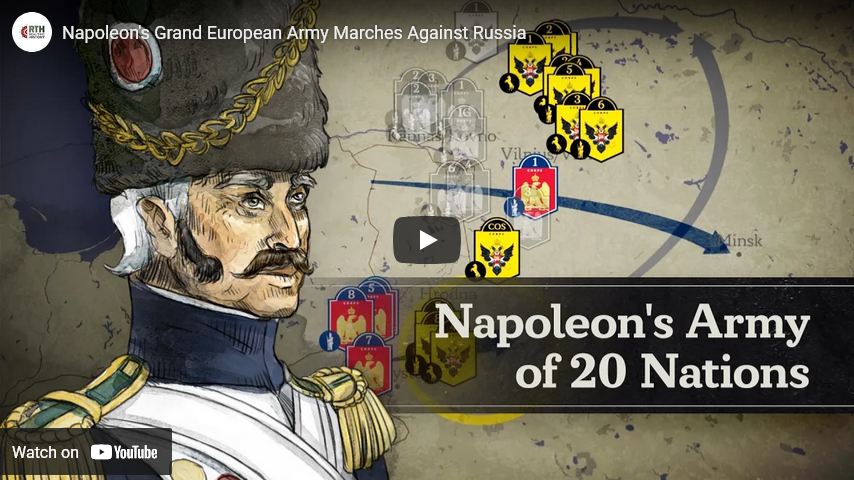
Napoleon’s Grand European Army Marches Against Russia
Real Time History
Published 11 Mar 2022Get Nebula and CuriosityStream in a great bundle deal: https://curiositystream.com/realtimeh…
When Napoleon marched his Grande Armée into Russia in 1812, he had assembled the biggest army in modern European history. Only half of his troops came from territories of the expanded French Empire. Tens of thousands of troops also came from Poland, Prussia, Austria, and the German States as well as Southern Europe.
» SUPPORT US ON PATREON
https://patreon.com/realtimehistory» THANK YOU TO OUR CO-PRODUCERS
John Ozment, James Darcangelo, Jacob Carter Landt, Thomas Brendan, Kurt Gillies, Scott Deederly, John Belland, Adam Smith, Taylor Allen, Rustem Sharipov, Christoph Wolf, Simen Røste, Marcus Bondura, Ramon Rijkhoek, Theodore Patrick Shannon, Philip Schoffman, Avi Woolf,» SOURCES
Boudon, Jacques-Olivier. Napoléon et la campagne de Russie en 1812. 2021.
Brun, Jean-François. “Le cheval dans la Grande Armée“, Revue historique des armées (249), 2007.
Del Negro, Piero. “Les Italiens dans la Grande Armée. La campagne de Russie et le patriotisme italien“, Revue historique des armées (250), 2008.
Elting, John. Swords Around a Throne: Napoleon’s Grande Armée. 1997.
Lieven, Dominic. Russia Against Napoleon. 2010.
Nieuwazny, Andrzej. “Les Polonais de la Grande Armée“, in Rey, Marie-Pierre and Thierry Lentz, eds. 1812, la campagne de Russie. 2012.
Rey, Marie-Pierre. L’effroyable tragédie: une nouvelle histoire de la campagne de Russie. 2012.
Zamoyski, Adam. 1812: Napoleon’s Fatal March on Moscow. 2005.» OUR STORE
Website: https://realtimehistory.net»CREDITS
Presented by: Jesse Alexander
Written by: Jesse Alexander
Director: Toni Steller & Florian Wittig
Director of Photography: Toni Steller
Sound: Above Zero
Editing: Toni Steller
Motion Design: Toni Steller
Mixing, Mastering & Sound Design: http://above-zero.com
Digital Maps: Canadian Research and Mapping Association (CRMA)
Research by: Jesse Alexander
Fact checking: Florian WittigChannel Design: Simon Buckmaster
Contains licensed material by getty images
Maps: MapTiler/OpenStreetMap Contributors & GEOlayers3
All rights reserved – Real Time History GmbH 2022
March 10, 2022
“Putin’s War”
In his latest post on the Russian-Ukrainian conflict, Stephen Green suggests we will end up calling it “Putin’s War”:
Putin apparently believed his top general — “who has never been a professional soldier” — that the Russian Army was up to the task of quickly defeating Ukraine.
Ukraine’s president, Volodymyr Zelenskyy, was supposed to flee or be killed/captured — not lead a heroic resistance. Ukraine’s kleptocratic government was supposed to collapse. Putin seems not to have had a Plan B, aside from the old Russian habit of firing artillery and rockets at stuff until even the rubble stops bouncing.
Putin failed to heed the lesson of Grozny: That even a besieged city, cut off from all reinforcement, can hold out for weeks. Kyiv is neither completely under siege nor cut off from reinforcement.
Putin also seems to have badly underestimated the West’s willingness to put the screws to the Russian economy, even though we’re putting the screws to ourselves, too.
If the war continues going badly for Russia, it ought to be remembered not as the Ukraine War or even the Russo-Ukraine War.
It ought to be called Putin’s War.
But at the rate Joe Biden is going, the Ukraine War might end up being known as the Putin-Biden War, and we all get to pay for it.
I posted a couple of comments on MeWe about his article:
I was commenting on another thread a bit earlier about how the fall of the Soviet Union revealed just how much of their military power was smoke and mirrors … a whole country of military Potemkin Villages. From what we can tell is happening in Ukraine, things haven’t improved much for the successor Russian military. On the other hand, thanks to progressive control of pretty much everything in the west, we’re starting to realize a lot of western military strength is a bit Potemkin-y. And the progressive warhawks now want to start WWIII? Let’s all hope they don’t get their wish!
Near the end of the column, you suggest calling it “Putin’s War”, which I think is a good idea. I’m starting to see Putin and the apparent state of the Russian military as being quite analogous to Mussolini and the Italian military. Il Duce had carefully excluded from his advisors and military leadership anyone who might tell him the truth about the state of Italy’s war-making capabilities and was clearly drinking his own ink on the propaganda side. Italy was forced into a war they were not equipped to fight because Il Duce believed the newsreel and parade-ground might he saw was real. Sound like something Putin may have done as well?

In The Critic, Peter Caddick-Adams catches us up on the war news to date:
It was during the Winter War of 1939-40, when plucky little Finland stood up to the might of Soviet Russia, that the Finns prepared a nasty surprise for their attackers. They made millions of petrol bombs and named them after the Russian Foreign Minister, Mr Molotov. Today, it is Ukraine that has borrowed the Finnish recipe book to greet a new generation of Russian invaders with petrol and fire.
How has the current war against another Russian neighbour, Ukraine, progressed? After months of tensions and intense diplomacy, including assurances to the UK’s Defence Minister by his Russian counterpart that there were “no plans to invade”, Mr Putin’s forces crossed the threshold early on 24 February. This had been preceded by long-announced military “manoeuvres” in neighbouring Belarus, which saw the assembly of over 100,000 combat-ready troops with all their vehicles and equipment. We now know this was a long-planned distraction to cover the concentration and preparation of their forces for war.
They came from 4 directions: Belarus in the north, from out of the rebel-held Donbas in the east, from Crimea in the south, and via amphibious assaults around the port of Mariupol. This tactic was designed to distract and divide the defenders and cause them to dilute their numbers. However, defying a basic military principle of war, the plan also inflicted the same disadvantage on the Russians. None of the four attacking thrusts possessed sufficient force to defeat their opponents and knife their way through to their objectives.
The first strikes in the early hours were a surprise only in their time and location, for Ukraine’s President Zelensky had long feared the worst, and other nations had quietly assessed an invasion was likely, rather than probable. Accompanied by the air raid sirens of Ukraine’s civil protection service, explosions from Russian cruise missile strikes were heard across the country. Some 600 have been fired since. Their airborne forces landed at civilian airports and military airbases. These elite paratroops were deployed to enable endless planeloads of follow-on forces to drive on the principal cities of Kyiv and Kharkiv before Ukraine woke up to what was happening.
The Russian tactical goal remains to control Ukraine by separating its pro-Western government from the population, hence the importance of the cities. President Zelensky declared martial law, ordered mobilization of all men between 18 and 60 and appealed to the wider world for help. Thousands started making Molotov cocktails, so deadly to attacking tanks more than 80 years ago. In some ways this war is anachronistic, with a Russian armoured train being filmed moving supplies forward. Expect railway sabotage with shades of Lawrence of Arabia. On 1 March, Belarus predictably entered the war on Russia’s side with such timing, that it is assumed President Lukashenko was merely following a script Vladimir Putin had written months earlier.
In The Line, Matt Gurney wonders what will happen if Russia actually loses the war:
Military historians and security experts are going to be studying the first two weeks of this invasion for years. Entire careers will be made of this, whole PhD theses written. Armies have always marched on their stomachs, but a modern army also needs massive quantities of fuel and lubricants, ammunition for hungry weapons systems, spare parts for weapons and vehicles, medical supplies and, yes, food for the troops, and also the ability to move wounded troops and prisoners backward down the supply line. This all takes an enormous amount of planning and specialized equipment and knowledge. Sustaining an army on the move means having the necessary supplies and items in abundant supply, but also having a sophisticated enough logistics system to get them to where they’re needed in a timely way. This involves everything from having good warehouse inventory control systems to the vehicles required to ferry the supplies to where they’re needed, plus a trained pool of manpower to run the whole operation. And the logistics system itself needs to be sustained — what good is a fleet of trucks to deliver supplies to the front if you can’t fuel those trucks?
We knew Russian logistics were well below Western standards. Logistics units never get the attention they deserve compared to the more exciting frontline units, and in a cash-strapped, corruption-riddled military like Russia’s, that means major problems in times of war — in an already poorly off military, the units that get even less TLC than most are going to be in rough shape indeed. Still, the Russians are underperforming what many Western analysts expected. We knew they’d be bad at this, but this is really bad.
There are reports of Russian troops running out of fuel and food, and abandoning their vehicles in place. There are other reports of long-expired Russian combat rations. In what was perhaps the nerdiest but most fascinating Twitter analysis thread of the war thus far, a retired American Department of Defence employee looked closely at photos from the battlefields in Ukraine and concluded that the tires on Russian vehicles were failing prodigiously, suggesting that the vehicles were not properly cared for when in storage. Again, given the known funding and corruption problems in the Russian military, that’s extremely plausible.
I mentioned this in an earlier Ukraine post, that the Soviet doctrine was much more oriented to the attack, and units and formations that hit heavier resistance than they could overcome were to be left behind to struggle, rather than be reinforced as most western military doctrine would prefer. Units were expected to fight until they were no longer combat-effective (or longer) and “expended” more like ammunition, in ways no western army could possibly support. As a result, Soviet and Soviet-aligned armies tended to be proportionally much more heavily armed, but very modestly supplied and logistics was very much a backwater where unpopular or inefficient officers could be sent to rot, professionally. I think most western analysts had assumed the successor Russian forces had moved away from those ideas, but the fighting to date in Ukraine seems to show that to be mistaken.
February 19, 2022
QotD: Army marching speed in the pre-industrial era
So let’s think about – in very general terms – what needs to happen and in what order for a large body of infantry to march. Everyone wakes up and starts to get moving (probably around 5am). Breakfast needs to happen, which may require making fires. Tents need to be struck and stowed along with all of the gear in the baggage train and individual soldiers need to stow their own equipment. All sorts of small tasks add up to eat away parts of the morning. Then everyone needs to get gathered and ready to march.
And now – because you are a large body of infantry, you wait. Let me explain – let’s take a nominally full strength (c. 3,000 men) American Civil War brigade, marching on a road 13ft or so wide. You can get five men (a little cramped) into a single row on that road, meaning that the infantry itself stretches 600 ranks deep. Unlike in the movies (which love ultra-compact marching formations because it looks cool) you need a few feet of separation between rows for best effect (WW2 US Army guidelines specified 2-5 yards), let’s assume each soldier occupies about 5 feet in the marching order. So the infantry is 3,000ft long (914m; nine football fields). We also need unit separation (between the regiments, it’s important to avoid “accordioning” on the march and facilitate control; WW2 army regs suggested 100 yards between companies, 50 yards between platoons, so these could be quite large), so let’s round up to 4,000 ft (1219m; 13 football fields).
But we also have tents, food supplies, spare ammunition and all sorts of other of what the Romans would have called impedimenta (sidenote: if you are thinking, “well, but a pre-gunpowder army doesn’t need this; 1) arrows take up space and 2) camp entrenching supplies – the Romans marched heavy). How many wagons, pack animals or porters you need varies – the Romans seem to have often moved with a mule for every six-to-eight men, plus the army’s siege train. A good rule-of-thumb I’ve seen for American Civil War estimates is around 20 wagons per thousand, so 60 wagons. Rule of thumb in the ACW is 80 wagons to a mile of road, so our wagon train ought to take up around another 4,000ft.
(Sidenote: you can see why logistics gets complicated fast. Even in explaining a rule of thumb, I have to resort to rules of thumb, or else we have to inventory all of the stuff an infantry brigade needs, and all of the food they need and then parcel it out by wagons (and then figure for the mule-or-horse teams for the wagons) and on and on. Fortunately for the historians, this sort of work was done by the armies at the time and written down, so we tend to use their staff-work.)
So the entire force is probably a bit more than 8,000 ft long – 1.5 miles. In practice, there’s actually a lot more space eaten up in separation (between wagons, between men) so it would be longer, but I don’t want to get lost in the details. And this is for just 3,000 infantry – we have no cavalry with their many spare horses (three per man as a typical minimum) or god forbid a siege train which might involve hundreds of wagons.
Bret Devereaux, “New Acquisitions: How Fast Do Armies Move?”, A Collection of Unmitigated Pedantry, 2019-10-06.
January 19, 2022
Triumph by Sea, Tragedy by Land – Supplying Guadalcanal – WW2 Special
World War Two
Published 18 Jan 2021Tens of thousands of Japanese soldiers were fighting over the jungles and beaches of Guadalcanal. To supply them with food, ammunition and medicine, the Japanese Navy had to resort to a series of daring supply runs — nicknamed the “Tokyo Express”. In the face of overwhelming American air superiority, the Tokyo Express had to find a tactic to overcome their enemy’s advantage, or it would doom its soldiers stranded on the island.
(more…)
January 7, 2022
Desert War – Dysentery, Disease, and Dehydration – WW2 Special
World War Two
Published 6 Jan 2022North Africa. The Axis and Allies are fighting each other but even more, they’re fighting the desert itself. The men of the desert burn during the day and freeze at night. They do most of their fighting on a litre of water and a packet of army biscuits. What is life in such a hostile environment?
(more…)


