
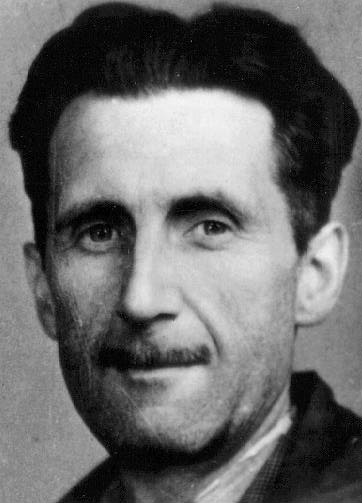
Orwell’s press card portrait, 1943
For years past I have been an industrious collector of pamphlets, and a fairly steady reader of political literature of all kinds. […] When I look through my collection of pamphlets — Conservative, Communist, Catholic, Trotskyist, Pacifist, Anarchist or what-have-you — it seems to me that almost all of them have the same mental atmosphere, though the points of emphasis vary. Nobody is searching for the truth, everybody is putting forward a “case” with complete disregard for fairness or accuracy, and the most plainly obvious facts can be ignored by those who don’t want to see them. The same propaganda tricks are to be found almost everywhere. It would take many pages of this paper merely to classify them, but here I draw attention to one very widespread controversial habit — disregard of an opponent’s motives. The key-word here is “objectively”.
We are told that it is only people’s objective actions that matter, and their subjective feelings are of no importance. Thus pacifists, by obstructing the war effort, are “objectively” aiding the Nazis; and therefore the fact that they may be personally hostile to Fascism is irrelevant. I have been guilty of saying this myself more than once. The same argument is applied to Trotskyism. Trotskyists are often credited, at any rate by Communists, with being active and conscious agents of Hitler; but when you point out the many and obvious reasons why this is unlikely to be true, the “objectively” line of talk is brought forward again. To criticize the Soviet Union helps Hitler: therefore “Trotskyism is Fascism”. And when this has been established, the accusation of conscious treachery is usually repeated.
This is not only dishonest; it also carries a severe penalty with it. If you disregard people’s motives, it becomes much harder to foresee their actions. For there are occasions when even the most misguided person can see the results of what he is doing. Here is a crude but quite possible illustration. A pacifist is working in some job which gives him access to important military information, and is approached by a German secret agent. In those circumstances his subjective feelings do make a difference. If he is subjectively pro-Nazi he will sell his country, and if he isn’t, he won’t. And situations essentially similar though less dramatic are constantly arising.
In my opinion a few pacifists are inwardly pro-Nazi, and extremist left-wing parties will inevitably contain Fascist spies. The important thing is to discover which individuals are honest and which are not, and the usual blanket accusation merely makes this more difficult. The atmosphere of hatred in which controversy is conducted blinds people to considerations of this kind. To admit that an opponent might be both honest and intelligent is felt to be intolerable. It is more immediately satisfying to shout that he is a fool or a scoundrel, or both, than to find out what he is really like. It is this habit of mind, among other things, that has made political prediction in our time so remarkably unsuccessful.
George Orwell, “As I Please”, Tribune, 1944-12-08.
June 10, 2023
QotD: The word “objectively”
June 1, 2023
QotD: “The Puritans were the SJWs of their day”
Predestination is Calvinism’s fundamental doctrine. To the Calvinist, all human effort is utterly futile, since nothing we could ever possibly do could affect our salvation, or lack thereof, which was decreed by God long before the foundations of the world were laid. How the hell you get from “all human effort is futile” to “we must totally remake society” is above my pay grade, feel free to check Walzer if you want to give it a go, but it’s obvious that the Calvinists did get there — see the English Civil Wars, which themselves were a sideshow to the whole charming episode we pros call The Period of the Wars of Religion, 1517-1648.
The Puritans, as English Calvinists were called, wrote difficult prose, but in translation it sounds shockingly modern. The Puritans were the SJWs of their day, obsessed with their own pwecious widdle selves. They didn’t get around to making up xzheyr own pronouns, but they did give themselves self-righteous new names — when Ben Johnson called his caricature Puritan Zeal-of-the-Land Busy he got big laughs, but he wasn’t really joking, they really did stuff like that. To be a Puritan requires two things: An obsessive focus on the tiniest micro-movements of your own soul …
… and an equally obsessive focus on forcing other people to disclose the tiniest micro-movements of their souls. There’s nothing anyone could ever do, so trivial that a Puritan could in good conscience overlook it. Calvin’s Geneva was the closest thing to a police state 16th century technology allowed, and when their turn came, Oliver Cromwell and the boys gave importing it to England the old college try. And, of course, Plymouth Bay Colony started as a Puritan police state …
Ideology, then, removes the distinction between public and private. You can’t simply say you’re a Puritan, you really have to BE one — constantly, perfectly, since there’s nothing that Puritanism doesn’t touch. And the only way to do that, of course, is to do everything in full public view at all times. Calvin did — as Walzer remarks, John Calvin, the man, is almost completely absent from Calvin’s writings. (Unlike Luther, whose idiosyncratic, not to say lunatic, personality comes through in practically every sentence). Calvin achieved that clear windowpane prose Orwell claimed was the mark of a great writer — nothing between audience and subject at all. Calvin would, indeed, take the remark that he’s almost a complete cipher, personally, as a very high compliment.
Severian, “Ideology II”, Rotten Chestnuts, 2020-11-09.
May 31, 2023
The War Against The Patriarchy, updated
Janice Fiamengo responds to a recent Joel Kotkin op-ed in the National Post discussing the “war of the sexes” and the long, long string of victories chalked up by the “weaker sex”:

The war between the sexes has ended, and rather than a co-operative future that could benefit all, it has turned out to be more like a lopsided win for the female side.
So begins Joel Kotkin’s National Post op/ed “Women have won the ‘war between the sexes’, but at what cost?” It is a welcome but disappointing analysis that starts with a show of defiance and ends in quiet desperation. Of course, it’s good to find anyone in a major newspaper willing to cast a less-than-adulatory eye on “The Future [that] is Female” or to write sympathetically about men, and Kotkin, a prolific author on cities and technocracy, proves his good faith on the strength of that opening statement alone. Aside from the wishful thinking of believing feminism to be winding down (was #MeToo a prelude to ceasefire?) or ever having envisioned a co-operative future (he should take a look at Kate Millett’s incendiary “Theory of Sexual Politics“), Kotkin is to be commended for daring to name as a war the decades of post-1960s activism, in which all the decisive victories have been claimed by feminists against men.
Kotkin, however, isn’t able to continue in the take-no-prisoners style he chose for his opening salvo. He is prevented, either by his own prudence, his lack of deep knowledge, or the paper’s editorial insistence, from targeting feminist ideology and policies in the rest of the article. In fact, the article doesn’t name a single piece of debilitating feminist legislation or even make one reference to the many expressions of anti-male contempt that are now deeply embedded in our public culture. The result is a curiously disembodied discussion in which serious social problems linked to male decline are pointed to without any attempt made to say exactly how they came about or how they might be reversed.
“The crux of the problem,” Kotkin tells us to start off, “lies in the fact that as women rise, men seem to be falling.” Here we see him start to draw back from the attack, as if afraid to say what he really thinks. His phrasing makes male decline sound like a natural phenomenon, an illustration of the primordial principle of Yin and Yang. Or perhaps it is simply that men, with their allegedly fragile egos and hegemonic masculinity, haven’t been able to compete against all that female ability, once dammed up by the patriarchy, now finally being let loose on the world (though always with calls for more to be done to assist women).
[…]
Kotkin refers to men “left behind” in the economy, but he keeps mum about the decades of affirmative action in higher education and hiring (detailed by Paul Nathanson and Katherine Young in Legalizing Misandry, pp. 81-124) as well as draconian sexual harassment legislation that have made work life unrewarding and often punitive for men.
He stresses the loss of sexual amity and of willingness to marry, but avoids discussing the nightmare of family law that has made marriage or even cohabitation perilous for many men.
The sins of omission do not end there. Perhaps working on the assumption — not without basis — that any discussion of social problems will need to focus on women at least as much as on men, Kotkin proceeds to backtrack on his earlier claim about women’s victory in the sex war, outlining instead a downbeat portrait of women’s troubles. Citing research by Jonathan Haidt, he tells us that adolescent girls have been severely affected by depression and self-harm, that many young women, without reliable men to support them, have had to fend for themselves in a difficult economic climate, and that single mothers, left with few options, are unable to offer stability to their children. It looks as if the decline of men mentioned early in the article has mainly hurt women and their children.
What Kotkin neglects to mention — surely deliberately — is that adolescent boys commit suicide at 4 X the rate of girls, resolving their depression decisively enough that Haidt seems not to have felt the need to account for them; that women are the ones who choose divorce in approximately 70% of cases; and that divorced fathers are too often denied a real role in their children’s lives while being burdened past endurance by exorbitant support payments. In other words, for every sad woman held up for our concern, there is a plurality of equally sad men rendered invisible in the conventional reporting. The staggering statistics on male suicide provide a stark illustration of Kotkin’s initial contention about the casualties of the sex war — yet he leaves these aside, choosing instead to voice the now-obligatory concern about the trans threat to women’s sports.
Perhaps most importantly, Kotkin suggests through his word choice that the data he cites are simply “trends”, occurrences that came about through economic and demographic factors independent of the sex war initially evoked. But they aren’t. They flow directly from a feminist vision in which the family — explicitly understood by feminist leaders to be a source of abuse and oppression — must be transformed and women liberated from reliance on the fathers of their children. Under this vision, a more just and equitable world will be ushered in by women’s superior leadership once they are freed from their unpaid labor in the home and the many sexist barriers that hold them back. That freedom must be aided, according to conventional wisdom, through abundant contraception, unfettered abortion, collectivized child care, no-fault divorce, programs and propaganda to urge men to do more housework, and non-stop encouragement to women — in movies, sit-coms, advertising, articles, and government equity programs — to give up on their men.
May 13, 2023
What was the First Modern War?
Real Time History
Published 12 May 2023The question about the first modern war has caused lively debates among historians and YouTube comment sections alike. In this video we take a look at a few candidates and some arguments why they are or aren’t modern wars.
(more…)
April 16, 2023
Do Foucault and Derrida deserve the blame for PoMo excesses?
In Spiked, Patrick West says that it’s a misunderstanding of Foucault and Derrida to blame them for the rise of wokeness:

Michel Foucault speaking at the Hospital das Clínicas of the State University of Guanabara in Brazil, 1974.
Public domain image from the Arquivo Nacional Collection via Wikimedia Commons.
It has become common to blame wokeness on its supposed philosophical parent: postmodernism. As the standard narrative goes, postmodernism is the ideology that entrenched itself in Anglophone universities in the 1980s and 1990s. It talked of relativism, of the absence of objective truth, of the spectre of a pervasive, invisible power, and it was generally anti-Western. A whole generation of professors, writers, journalists and a fair few activists have subsequently been raised on this diet of postmodern thinking. And the result is a cultural elite that is wedded to wokeness.
[…]
For these critics of woke, Foucault’s influence, in particular, is seemingly everywhere. According to [Douglas] Murray [in The War on The West], it’s through the “anti-colonial” philosophy popularised by the Foucault-inspired scholar, Edward Said, that Foucault and therefore postmodernism have filtered down into woke philosophy, which holds that Western society is uniquely racist and to blame for all of today’s ills. Equally, right-wing critics of wokeness will claim that the trans movement has sprung from the postmodern contention that sexuality and gender are entirely socially constructed and therefore plastic and malleable.
If Foucault is regarded as the father of wokeness then 19th-century philosopher Friedrich Nietzsche tends to be regarded as the grandfather. After all, Foucault was profoundly influenced by Nietzsche and even proudly declared himself to be “Nietzchean”. Nietzsche, like Foucault, also saw all human behaviour stemming from the desire for power. And he conceived of morality – good and evil, right and wrong – as the mere manifestation of the will to power. As he wrote of the “origin of knowledge”, in The Joyous Science (1883): “Gradually, the human brain became full of such judgements and convictions, and a ferment, a struggle, and lust for power developed in this tangle. Not only utility and delight but every kind of impulse took sides in this fight about ‘truths’.” One can see this Nietzschean sentiment at work in Foucault’s Discipline and Punish (1975): “Power produces knowledge … power and knowledge directly imply one another.”
So, according to this largely right-wing narrative, wokeness is the product of a 20th-century philosophical assault on truth, objectivity and the West. And it was inspired by Nietzsche and led by several “cultural Marxist” thinkers.
There are several problems with this rather neat story. The first error is to use the phrase “cultural Marxism” to talk of postmodernism or wokeness. This term doesn’t really make sense. Marx himself conceived of his work as a historical materialism. It was focussed on class and the means of production, not on culture. Yes, in the 1940s and 1950s, some Frankfurt School thinkers, who sometimes presented themselves as Marxist, did focus on culture rather than class. But as Joanna Williams writes in How Woke Won (2022), their thinking “represented less a continuation of Marxism and more a break with Marx”.
Moreover, postmodern thinkers were broadly opposed to Marxism. Many may have been signed-up Communists in their youth (the French Communist Party dominated left-wing politics at the time), but by the 1960s they had become highly critical of Marxist politics. They rejected the idea that history was progressing “dialectically” towards a communist future, or “telos”. And they were often hostile to the scientific objectivity and “Enlightenment” values so central to Marxism. Foucault wrote that history was not the story of progress; it was but a series of non-linear discontinuities and contingencies. And Jean-François Lyotard (1924-1998), in his highly-influential The Postmodern Condition (1979), announced and celebrated the end of “grand narratives”, and with it the end of the Marxist “grand narrative” of progress. Lyotard’s writings from the 1970s onwards were violently antithetical to Marxism, especially its claims to objective truth.
As for wokeness itself, it has nothing to do with Marxism. With their myopic focus on race and gender, woke activists are utterly blind to the material, class-structure of society. Today, bizarrely, it’s often conservatives who are more attuned to the plight of the working class than woke “radicals”. As Williams writes, “critics who insist that woke is simply Marxism in disguise are wide of the mark”.
March 23, 2023
Sometimes, it helps to know how the sausage is actually made
Apologies to the ghost of Otto von Bismarck for misappropriating his famous quote “Laws are like sausages. It is best not to see them being made.” In this case, it’s actually quite enlightening to see how video magic helps make the progressive media experience:

Among the worst disasters for progressivism in recent decades has been the work of Aaron Sorkin, whose impossibly articulate ratatat dialogue made it way too easy to imagine sexy technocrats saving the world. It’s great entertainment, but normalized unreasonable expectations of the flawed human beings who happen to have high IQs and impeccable credentials.
As a child of the New Left, I never missed The West Wing: it was irresistible catnip for my adolescent hopes and dreams, and so much more satisfying than whatever was on the news — except for the eloquent public intellectuals on the Bill Moyers show on PBS. Later, as an idealistic policy major at Brown, I was surprised and disappointed to find basically nobody operating on that level.
It was only when I’d lucked into joining the Moyers organization that I began to understand how such Sorkinesque eloquence was manufactured each week — not with deliberate dishonesty, but ever more misleading as years passed and the scene grew shallower.
We’d typically tape on Thursday or Friday mornings to turn around by Friday nights. Being of Bill Moyers’ approximate height, I was tasked with showing up early to fill his chair as gruff union guys set up cameras and lighting. Then, as Bill’s blogger and research assistant, I’d watch live interviews from the control room to highlight quotable moments.
Uncut conversations were eye-opening; it was astonishing how often our esteemed guests hemmed and hawed and got basic facts embarrassingly wrong. And how many came off batshit crazy: one, later an anchor on MSNBC, speculated that Captain Sully’s Miracle on the Hudson — visible from our west side offices — had been God blessing the Obamas.
Drafting the Moyers Blog and promotional listings, I’d sit in with producers and video editors to consult on coalescing broadcasts. They were like wizards, casting away awkwardness and errors to sculpt artful vignettes of the most compelling bits of conversations that often stretched well over an hour or more.
So many of the most rousing clips came from when guests were at their most factually inaccurate, and editors deftly dipped in and out to pull and seamlessly reassemble the very best parts. It was wondrous alchemy, and a privilege to work with super-talented creatives, but the reality of our academic pundits remained the same.
Viewers, or at least those motivated enough to weigh in, frequently testified that their social-democratic faith had been wavering until they’d seen whichever inspiring interview affirming what they’d always believed. I always found that frustrating, wondering if they might have reacted more thoughtfully to the real deal than the perfected package that aired.
By no means were Bill Moyers and team operating with any less than the highest of ethics or best of intentions—from their perspective, we were clarifying what our distinguished guests were truly saying. The problem was that the intellectual scene our show channeled was dwindling, but my colleagues so badly wanted things to be better that it was all too easy to paper over the accelerating collapse of discourse. I remember trying to explain to Bill what a Brooklyn hipster was, or how to click around tumblr, but he didn’t really want to know.
H/T to Jesse Walker, by way of Colby Cosh for the link.
March 14, 2023
“Strangely, my friends have a more negative view of the feminist movement than I do”
Bryan Caplan explains why he chooses to write the books he writes:

Almost by definition, writing controversial books tends to provoke negative emotional reactions. Anger above all. Anger which, in turn, inspires fear. And not without just cause; the sad story of Salman Rushdie sends shivers down the spine of almost any writer. If you write controversial books — or care about someone who does — you should be at least a little afraid of the anger your writing inspires.
[…]
In contrast, when I announced the imminent publication of Don’t Be a Feminist, the fear went through the roof. Several folks warned me of “career suicide”. Others told me that I had no idea what horrors awaited me. Friends staged mini-interventions on my behalf.
The underlying premise, naturally, was that the feminist movement is at once terribly powerful and horribly bad-tempered.
My best guess is that the warnings are overblown. Strangely, my friends have a more negative view of the feminist movement than I do. Whether my guess is right or wrong, though, all this intense, widespread fear really ought to trouble the feminist conscience.
If I said, “Hi” to one of my kids’ friends, and they responded by fleeing in terror, my reaction would be, “Did I do something to scare him?” I would ask my kids, “Why was he so afraid of me?” If such incidents started to repeat, I would be severely troubled. “I thought I came off as a friendly dad, but I guess I’m seen as an ogre.”
The same applies if I were a feminist, and I discovered that critics are literally afraid to criticize feminism. If only a few critics feared feminism, my question would be, “What did we do to scare them?” If I discovered that fear of feminism was widespread, a full soul-search would be in order. “I thought we came off as a friendly movement, but I guess we’re seen as ogres.”
And guess what? Fear of feminism plainly is widespread.
What, then, are feminists doing wrong? Above all, cultivating and expressing vastly too much anger. Sharing your angry feelings is an effective way to dominate the social world, but a terrible way to discover the truth or sincerely convince others. Maybe you don’t mean to scare others; maybe you’re just acting impulsively. Yet either way, the fear feminists inspire is all too real.
March 11, 2023
QotD: We used to call them “parlour pinks”
What’s life like in the Soviet Union? They neither know nor care, until the brute facts of life in the USSR are rubbed into their faces for so long that they have to acknowledge them. At which point they simply switch allegiances. Kolakowski’s essay doesn’t mention Paul Hollander’s Political Pilgrims, but they arrive at essentially the same conclusion — that instead of becoming disillusioned with Communism (Socialism, “social justice”) itself, the irritated butterflies of the Left grow disillusioned with a particular country or leader. The USSR has failed, yes, but — all together now! — “real Communism has never been tried”, so let’s put all our faith in Mao … and then Castro … and then Chavez, et cetera ad nauseam.
It’s all about maintaining the purity of the idea in the face of disappointing, vulgar, grubby reality. An honest-to-Marx Communist will come into plenty of contact with reality. A Leftist never will, because xzhey have convinced xzhemself that even the mugging they’re currently experiencing is a lofty and noble expression of authenticity. They’re willing to die for the Revolution, certainly — the urge for martyrdom has always been highly conspicuous on the Left. So long as they never feel that base, grubby, vulgar proletarian urge to defend themselves, they’ll be fine.
[…]
“Never cheer for your own.” When you come right down to it, that’s the Leftist motto. Leftists don’t deride “sportsball”, for instance, because they’re un-athletic little dweebs who were always picked last at recess (well, ok, not only that). It’s because cheering for a team, any team, is vulgar. It’s what grubby little proles do. (That’s another way to distinguish a Communist from a Leftist, by the way. Actual Commies love sports; look at all the resources the USSR poured into the Olympics, for instance. That’s because sports are good training for war).
Is Leftism curable? Can they be made to cheer for their own? Experience suggests that the cure will be very harsh indeed … if indeed it’s possible at all.
Severian, “Grubby Little Proles”, Rotten Chestnuts, 2020-05-31.
February 21, 2023
Smart people are at least as likely to fall for false beliefs as anyone else
Gurwinder explains why people well above average intelligence are actually more likely to adopt irrational ideas:
What causes delusion?
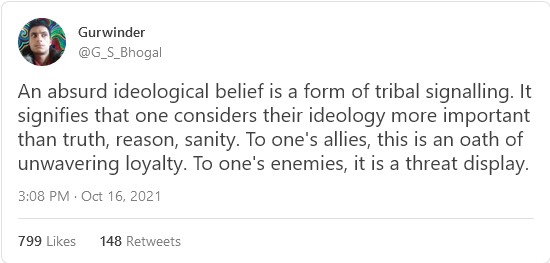
The prevailing view is that people adopt false beliefs because they’re too stupid or ignorant to grasp the truth. This may be true in some cases, but just as often the opposite is true: many delusions prey not on dim minds but on bright ones. And this has serious implications for education, society, and you personally.
In 2013 the Yale law professor Dan Kahan conducted experiments testing the effect of intelligence on ideological bias. In one study he scored people on intelligence using the “cognitive reflection test”, a task to measure a person’s reasoning ability. He found that liberals and conservatives scored roughly equally on average, but the highest scoring individuals in both groups were the most likely to display political bias when assessing the truth of various political statements.
In a further study (replicated here), Kahan and a team of researchers found that test subjects who scored highest in numeracy were better able to objectively evaluate statistical data when told it related to a skin rash treatment, but when the same data was presented as data regarding a polarizing subject — gun control — those who scored highest on numeracy actually exhibited the greatest bias.
[…]
Since we’re a social species, it is intelligent for us to convince ourselves of irrational beliefs if holding those beliefs increases our status and well-being. Dan Kahan calls this behavior “identity-protective cognition” (IPC).
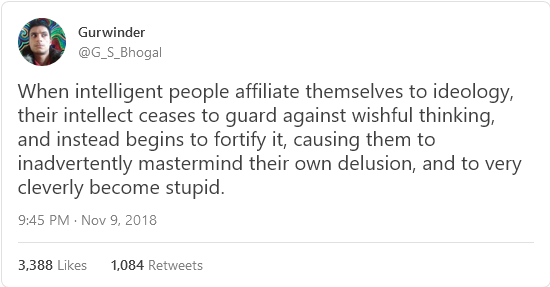
By engaging in IPC, people bind their intelligence to the service of evolutionary impulses, leveraging their logic and learning not to correct delusions but to justify them. Or as the novelist Saul Bellow put it, “a great deal of intelligence can be invested in ignorance when the need for illusion is deep”.
What this means is that, while unintelligent people are more easily misled by other people, intelligent people are more easily misled by themselves. They’re better at convincing themselves of things they want to believe rather than things that are actually true. This is why intelligent people tend to have stronger ideological biases; being better at reasoning makes them better at rationalizing.
This tendency is troublesome in individuals, but in groups it can prove disastrous, affecting the very structure and trajectory of society.
For centuries, elite academic institutions like Oxford and Harvard have been training their students to win arguments but not to discern truth, and in so doing, they’ve created a class of people highly skilled at motivated reasoning. The master-debaters that emerge from these institutions go on to become tomorrow’s elites — politicians, entertainers, and intellectuals.
Master-debaters are naturally drawn to areas where arguing well is more important than being correct — law, politics, media, and academia — and in these industries of pure theory, secluded from the real world, they use their powerful rhetorical skills to convince each other of FIBs. During their master-debatery circlejerks, the most fashionable delusions gradually spread from individuals to departments to institutions to societies.
Some of these FIBs can now be found everywhere. A particularly prominent example is wokeism, a popularized academic worldview that combines elements of conspiracy theory and moral panic. Wokeism seeks to portray racism, sexism, and transphobia as endemic to Western society, and to scapegoat these forms of discrimination on white people generally and straight white men specifically, who are believed to be secretly trying to enforce such bigotries to maintain their place at the top of a social hierarchy.
January 17, 2023
How ideological programming in British schools make men like Andrew Tate inevitable
To be honest, I don’t think I’d ever heard of Andrew Tate before his legal troubles in Romania hit the headlines, and I’m not well-versed on his achievements (such as they might be). Janice Fiamengo also admits that Tate wasn’t on her radar before then, but she’s done some work to try to put him into perspective:
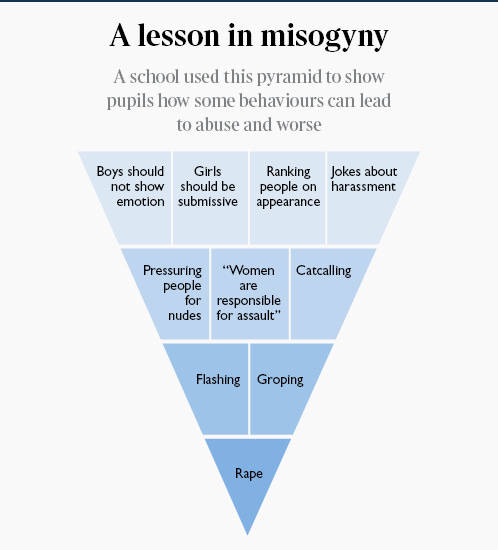
What has Tate got to do with UK education, except perhaps as a telling symbol of its unintended consequences? Why not just model and enforce ideals such as courtesy, self-restraint, and hard work, while upholding high academic standards? The article demonstrates how deeply committed schools have become to ideological programming. Some schools have drawn up “entire lessons focused on Tate” (!!!) while others deal more generally with “misogyny and gender stereotypes”. Whatever the particulars, the general message is unvarying: “We’ve all got to work collaboratively and collectively to support young men to reframe masculinity—away from this toxic ideology that’s presented by the likes of Tate.”
No one who’s been following the feminist narrative over the past decade or two will be surprised by the dogmatic reference to “toxic ideology,” now standard in any discussion of “reframing” boyhood. There is just one problem for the concerned teachers: Tate is five steps ahead of them, having already made clear to his millions of followers why injunctions about “reframing masculinity” are just code for the continual marginalization that most boys naturally want nothing to do with. The moment Tate and his allies expressed their scorn for the project, it lost its power overs the millions of boys forced to sit in feminist classrooms across the UK. Tate confirmed what boys intuitively knew: having their masculinity “reframed” will prevent them from pursuing masculine dreams, from being proud of themselves as male, admired by their male peers, and able to attract the interest of pretty girls. Teachers can keep on telling boys that peer approval through masculine moxy isn’t important, but that won’t make it true.
The point is not whether Tate’s (“I’ve got 33 cars“) program is an unalloyedly good one; the point is that it is manifestly better than the recipe for self-loathing and irrelevance being offered by the schools. The school’s program is the same that has been tried for years without any enthusiastic uptake because it offers nothing affirmatively male for young men to be and do (see especially White Ribbon UK, which has been trying for years to turn boys into handmaidens of feminism). All the normal things that centuries of boys in every major civilization on earth have cared about—competitiveness, status, toughness, mastery, knowledge, self-reliance, stoicism, high-jinks, displays of ability, and male bonding—are now frowned upon and must be replaced by feminine traits like empathy, egalitarianism, conformity, verbal display, and tone-policing. It doesn’t take a gender studies specialist to see that the life being offered these boys is one of deference, self-suppression, and self-contempt. No boy should want that.
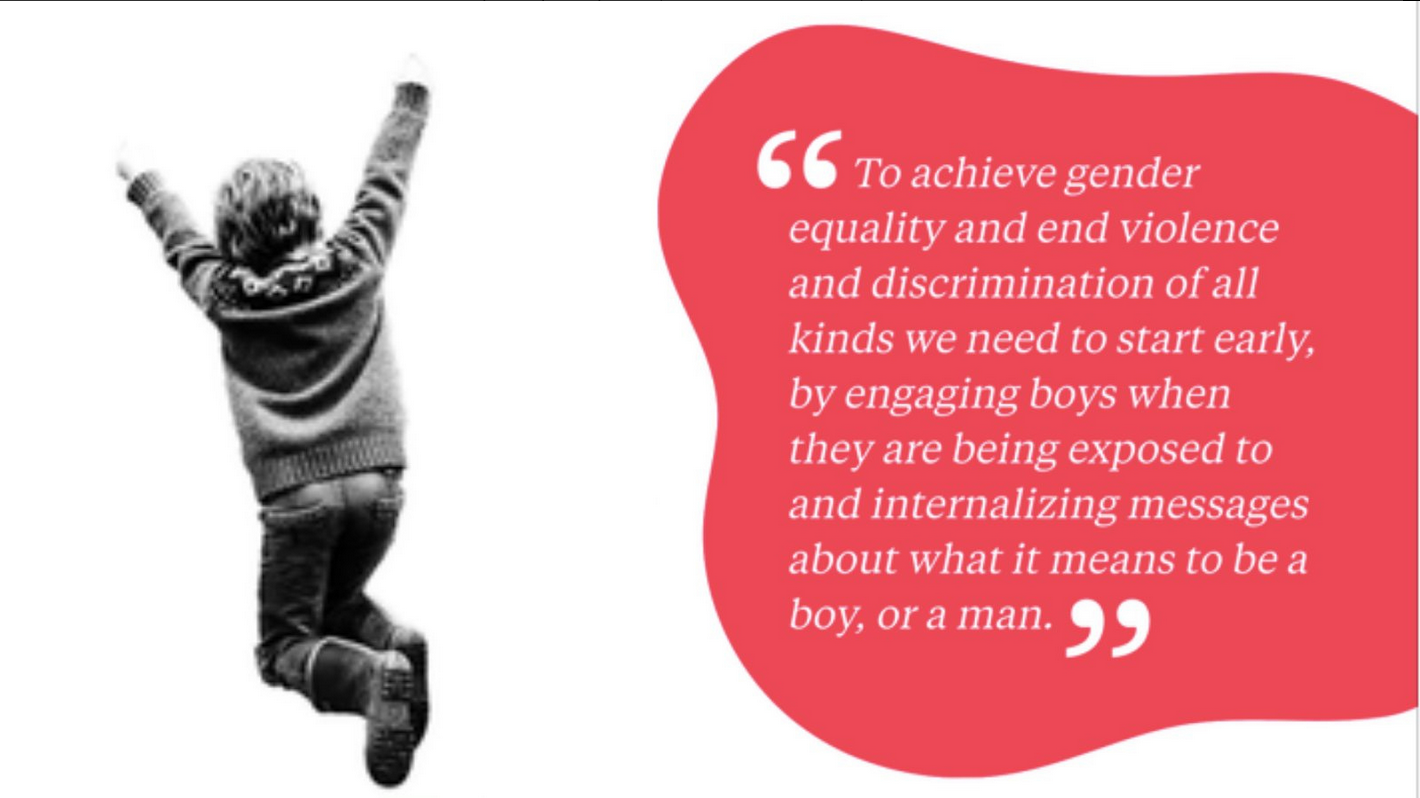
In case you doubt my characterization, take a look at the Global Boyhood Initiative’s report on The State of UK Boys: Understanding and Transforming Gender in the Lives of UK Boys, published in 2022. The report was written for “teachers, youth workers, early-years practitioners and other professionals” to achieve “gender equity and social justice”.
Incidentally, the report includes a section attacking an alleged “overemphasis” on research showing boys and men as victims of intimate partner violence by women. While the report enthusiastically promotes the end of “gender” through transgenderism and social constructivism, it emphatically does not support the end of gendered norms about which sex is violent. On this front, the report laments that “even young boys” now believe that male persons can be victimized by female persons, citing the case of Johnny Depp’s abuse by Amber Heard. Nothing could more clearly signal the report authors’ chagrined awareness of the difficulty of controlling boys’ thoughts in the internet age.
The rest of the report explores pathways to weaken masculinity. On a number of occasions, it takes aim at “simplistic notions that boys require male ‘role models'” because such notions “frame women as inadequate to parent and teach boys”. Taking for granted that “gender is not tied to sex organs, hormones, or biological traits” (one wonders, then, why trans persons elect to take hormones and to change their sex organs), the emphasis throughout the report is on “realigning” masculinity to highlight gender fluidity, transgenderism, and inclusion of girls. The document has absolutely nothing good to say about masculinity, which it describes, variously, as “a seductive form of power”, “hegemonic”, and “oppressive”. It even uses the derogatory term “boysplaining” to stigmatize boys’ alleged way of talking.
Even such seemingly benign behaviors as “laughter, banter, and entertaining one another” are said to be “laddish” and linked to the exclusion of women and homosexuals. Taking pleasure in being good at sport is also given a negative valence by being associated with bullying.
As in all such feminist propaganda, the report seeks the evacuation of all positive content from masculinity. “Realigned” boys are to anchor their sense of self mainly in not being what boys have always been. They are to shun the allegedly “hegemonic” characteristics of “physical, sexual, and mental prowess; being action-oriented; ‘knowing’; having autonomy […]; and being emotionally tough.” It is surely no coincidence that modern boys and young men have fallen well behind their female peers in educational attainment, economic status, and performance on the job market. “Prowess” is out, knowing is out, being active is out, toughness is out. No wonder so many boys feel lost, disaffected, and resentful, and no wonder some see Andrew Tate as a hero.

January 13, 2023
“Forced teaming”
In Quillette, Jonathan Kay provides us with our new term of the week:

Two people at EuroPride 2019 in Vienna holding an LGBTQ+ pride rainbow flag featuring a design by Daniel Quasar; this variation of the rainbow flag was initially promoted as “Progress” a PRIDE Flag Reboot.
Photo by Bojan Cvetanović via Wikimedia Commons.
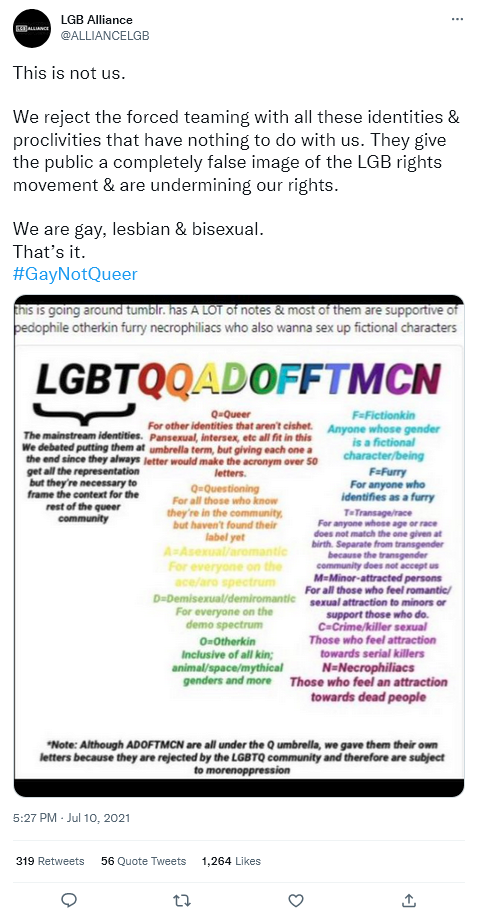
I learned a new term this week: “Forced teaming“. It describes what happens when a group of people — say, gay men and lesbian women — are forbidden from breaking ranks with some larger constituency, such as (in this case) the LGBT movement.
The example I’m discussing here is one that Quillette writers have been exploring for several years now. As author Allan Stratton noted last year, the central ideological fixation of many transgender-rights activists is the negation of biological sex as a meaningful marker of human identity. The true source of sexual attraction, they will insist, isn’t the reality of sexed male and female bodies; but rather an abstract gender spirit lodged within our souls, which somehow broadcasts itself in a way that prospective romantic partners are able to sense and interpret. As Stratton notes, this mythology isn’t just flagrantly wrong. It’s also homophobic to such extent that it denies the sexually defined nature of gay identity. Moreover, this homophobic element can’t be excised from gender ideology without fatally undercutting the (typically unspoken) mission of many biologically male trans activists, since giving up this claim “would be to admit that a lesbian isn’t going to be attracted to a male body, no matter how many times she is assured that the body in question belongs to someone who identifies as a woman.”
On Wednesday, Montreal-based Substacker Eliza Mondegreen provided an eyewitness report that helps illustrate what the “forced teaming” of ideologically non-compliant LGB men and women now looks like. The Centre for Human Rights and Legal Pluralism (CHRLP) at McGill University had planned to host a January 9th talk about the tension between sex and gender identity, to be delivered by Robert Wintemute, a professor of Human Rights Law at King’s College London. According to the event page, he was to discuss “whether or not the law should be changed to make it easier for a transgender individual to change their legal sex from their birth sex, and about exceptional situations, such as women-only spaces and sports, in which the individual’s birth sex should take priority over their gender identity, regardless of their legal sex.”
Though Wintemute seems the furthest thing from a bigot (or even a conservative), he is loathed by many trans activists due to what they see as an act of unforgivable apostasy. In 2006, Wintemute co-authored something called the “Yogyakarta Principles“, an international manifesto demanding that unfettered self-identification be recognized as the one and only means of distinguishing men from women. But he later recanted, declaring that “a key factor in my change of opinion has been listening to women”. Needless to say, many of Wintemute’s former activist friends then began treating him like Lord Voldemort. And Montreal’s Gazette newspaper, echoing such denunciations, darkly warned readers that the visiting human-rights professor had “ties to LGB Alliance, an advocacy group described by various LGBTQ2+ organizations and activists as a transphobic hate group”. (In truth, the LGB Alliance is simply a British charity that, as its name suggests, signal-boosts lesbian, gay, and bisexual individuals who believe that the interests of L, G, and B are now sometimes at cross-purposes with T.)
British feminists, who by now are well used to progressive mobs shutting down speaking events in the name of trans solidarity, may guess the rough contours of what happened next. A self-described “transfeminist sapphic activist” named Celeste Trianon compared Wintemute to a “cannibal”, and announced a protest, suggesting that followers should “bring out the pitchforks”.
December 3, 2022
QotD: Mantetsu and the Kwantung Army
Thus the South Manchuria Railway Corporation, originally contracted to develop a defunct line in a disputed territory, soon developed into a full-spectrum enterprise. Pretty much all heavy industry in the Japanese areas of Manchuria were divisions of Mantetsu. But since all the heavy industry depended on mines, and transportation, and food and housing for workers, and banks, and schools for the workers’ children, etc., pretty soon Mantetsu ran all of that, too. By the late 1920s, you could argue that Mantetsu was almost its own country.
It even had its own army, and that’s where things get really interesting.
The Kwantung Army was the security force assigned to the South Manchuria Railway Zone. The Japanese weren’t stupid; they knew the perils of independent commands far from home, and they rotated units through with some regularity. Nonetheless, the command staff remained fairly stable over the years … and so did Mantetsu’s.
The Japanese weren’t stupid, but they were people, and people being people, soon enough the lines between the Kwantung Army and Mantetsu began to blur. And since the lines between Mantetsu, the Imperial Army, and the government were already pretty blurry, pretty soon the concerns of one became the concern of all. (Nor was the Navy left out, though I’m not discussing them in order to keep it simple. They were up to their eyeballs in Mantetsu, too, because warships need lots of steel and steel comes from Manchuria).
A small but highly committed and totally ideologized faction developed inside the Kwantung Army. Several, in fact, and one of them (the Imperial Way faction) attempted an actual coup d’etat in 1936. It was put down, and the Imperial Way faction dissolved (in theory), but the problem of an intensely ideologized officer corps remained. Long story short, you had a small group of highly ideologized officers garrisoning a remote province pulling the entire Empire into big, unwinnable wars.
One could make the case that World War II in the Pacific was ultimately caused by about fifteen or twenty guys in the Kwantung Army.
That’s overly reductionist, but it highlights the huge problem with organizations slipping the leash. In theory, there was a clear chain of command, and even the head of the Kwantung Army was a down it a ways — he was subordinate to the Army Council, which was subordinate to the War Minister, who was subordinate to the Parliament, who were subordinate to the Emperor. In theory, lots of people could’ve sacked Gen. Araki, or his mini-me Ishiwara Kanji (a lieutenant colonel through most of it). Equally in theory, Mantetsu had no say in any of it — the Kwantung Army was a formation of the Imperial Japanese Army, not Mantetsu’s private security force.
But in reality, Mantetsu was so wired in to the Japanese government that in a lot of cases, it was the government. But not always, because the same could be said about the Army, and the Navy, both of which were also wired into Mantetsu up to the very top (or vice versa, your choice). And Mantetsu had their Media arm, of course, as did the Army and Navy …
What all this boiled down to, then, was a power vacuum. I know, that seems weird, but a skilled bureaucratic infighter like Ishiwara never lacked for groups to play against each other. The Army and Navy would oppose on principle any move that seemed to aggrandize the other, neither could go against Mantetsu (and neither could control it), and all had to pay at least lip service to the civilian government. Because of this, real power fell to whomever had the balls to grab it …
… which was the officer corps of the Kwantung Army. They assassinated at least two Manchurian warlords, staged a number of false flag attacks on their own positions, and generally got up to however you say “standard issue Juggalo fuckery” in Japanese, up to and including a full-scale war with China.
Severian, “Slipping the Leash”, Founding Questions, 2022-08-27.
November 21, 2022
QotD: Socialism is nihilism
That seems bizarrely wrong, considering how much effort Socialists put into saving the world. But look at it objectively, comrade (heh heh), and you’ll see that Save-the-World-ism, of whatever flavor, always boils down to Destroy-the-World-ism. Always. It doesn’t matter how the world gets “saved;” it always gets blown up in the process. You still can’t find a better primer on chiliastic psychology than Norman Cohn’s The Pursuit of the Millennium. The specifics of each loony doctrine changed, but the underlying presumption was always the same: Kill everyone, destroy everything, and then Jesus comes.
This is true even of millennialists whose doctrines don’t obviously entail killing everyone. Calvinists, for example. I spent decades trying to explain Calvinism to undergrads, and never once succeeded. The gulf between their words and their actions is too vast for the adolescent mind. There are only two logical responses to the doctrine of “double predestination”: quietism, or hedonism. They knew it, too, which is why they started burning people at the stake the minute they got any real power. Look at what they did, not what they said, and you’ll see nihilism plain as day. Calvin’s Geneva was the nearest thing to a police state that could be achieved with 16th century technology. The ideal Calvinist would say nothing, do nothing, think nothing, as he sat in the plain pews of his unadorned chapel, waiting for death and the Final Judgment. Calvinists wanted to grind the world to a halt, not blow it up, but once again the mass extinction of the human race is a feature, not a bug.
Take Jesus out of the equation, and you end up at pure shit-flinging nihilism in less than three steps. Marxism is perhaps the most exquisitely pointless doctrine ever devised. It’s more pleasant to have than to have not, I suppose, but no matter how much everyone has, we’re still just naked apes, living the brief days of our vain lives under an utterly indifferent sky. Marxists are a special kind of stupid, so they don’t realize it, but … they won. Modern Western “poor” people keel over from heart disease while fiddling with their smartphones in front of 50″ plasma tvs. While wearing $200 sneakers. We’re so far from being “alienated” from the fruits of our labor that “labor” is an all-but-meaningless concept for lots of us — and the further down the social scale you go, the more meaningless it gets. The modern ghetto dweller simply is Marx’s ideal proletarian. Does he look self-actualized to you? Ecce homeboy.
I assure you, the SJWs know this. Calvinists to the core, they know better than anyone the utter futility of all human effort. So they do what the original Calvinists did: Displace, displace, displace. Don’t take it from me, take it from a card-carrying Marxist. The end result is the same: Whether you’re a Puritan or an SJW, the only way to escape the crushing meaninglessness of your condition is to spend every moment of every day contemplating your pwecious widdle self.
Throw in the transitive property of equality, and you’ve got people like Hillary Clinton. If Socialism is Nihilism, then Nihilism is Socialism. Far from arguing against the idea … that Hillary et al are motivated solely by hatred, I’m 100% behind it. In fact, I’d argue that the Nihilism comes first — people who have convinced themselves that life is pointless always, always, embrace the biggest and most all-encompassing form of collectivism on offer. What could be crueler, than to be given all this for nothing? It’s not even a sick joke, since a joke implies a joker.
How can you not hate this world, then, and everything in it? More to the point: how can you not hate yourself, for seeing the world as it really is? Ignorance is bliss … but how can you not hate them, too, those poor deluded motherfuckers who still think stuff like God and love and family and the designated hitter might somehow mean something? Vanity, vanity, all is vanity … and if I have to face the existential horror of it all, then fuck it, so do you. “Capitalism,” the “free market,” “representative government” — call it what you will, it’s all just vanity, just another way for the sheeple to keep deluding themselves. Fuck it, and fuck them. Burn it down. Burn it allllll down.
Severian, “A Tyranny of Nihilism”, Rotten Chestnuts, 2019-10-22.
November 12, 2022
QotD: The short careers of secret police chiefs
(The Romanian Securitate had public intimidation down to an art form. They’d follow random guys around using big, obvious details, the better to prove to the proletariat that everyone was suspect. It is to them, not Mafia dons or aspiring rappers, that we owe the now-standard Eurotrash track suit look).
Secret police goons suffer from two serious structural problems, though, that not even the guys in Stove’s book [The Unsleeping Eye] really ever solved. The first is the obvious one, that guys who know where the bodies are buried are always at risk of using that knowledge. Napoleon’s guy Joseph Fourche, and FDR’s main man J. Edgar, lived out their natural lives (as did Elizabeth’s spymaster Sir Francis Walsingham), but of them, only Fourche lived in anything approaching what we would call an ideologized society, and that was small beer.
The rest of those guys died in harness, because of course they did. Adolf Hitler was an especially stupid dictator, and Heinrich Himmler an especially servile little freak, but I have no doubt that if the Reich had gone on much longer [Himmler] would’ve shanked [Hitler]. If Heydrich hadn’t gotten perforated in Prague, he no doubt would’ve gone after [Himmler] even sooner. Lenin and especially Stalin burned through secret police chiefs on the regular, because they pretty much had to.
I don’t know about the goons in the Chinese etc. secret police, but I’d be shocked to find anyone with more than a few years’ tenure, because purges are simply a way of life in totally ideologized societies. For every Khrushchev who manages to hang on – n.b. he was a Red Army commissar during the war, i.e. a not-so-secret police goon — there are fifty guys who live fast and die hard, because that’s just how totalitarians rule.
The stoyaknik, of course, is well served to consider the current scene as if he were watching the Politburo of an exceptionally deluded Commie regime, one made up almost entirely of ruthless yet clueless retards … who still believe, for the most part, in Communism.
That was always the problem for Kremlinologists in evaluating the USSR — whatever the Boss of the moment decided would, of course, immediately be retconned into the Scriptures by the Academicians, but what did the Big Guy himself think about it? That constrained his choices. Stalin and Khrushchev were true Communists, there’s no question about that, but they came up in the school of the hardest possible knocks — if they needed to do something directly contrary to Leninism in order to hang on to power, then Comrade Ilych can suck it.
For anything short of mortal, though, they’d more often than not behave as stereotypical Commies, so the first thing any Kremlinologist had to do was determine the seriousness of the situation from the Politburo’s perspective. Not an easy task, as you might imagine, and what made it worse was: as the USSR gained stability and Communism matured, the old school hardasses all died off and were replaced by True Believers. Mikhail Gorbachev, for instance, didn’t start making his mark until after Stalin’s death, and he wasn’t a real up-and-comer until after Khrushchev — that is, he started rising through the ranks only after the hard boys were gone.
Thus, while Khrushchev was a true Commie, he still had some hard reality to constrain him. Gorby didn’t. He really believed all that Marxist-Leninist horseshit about democracy and etc.; he was far more doctrinaire than the earlier generation could possibly be. Thus Kremlinologists were forever baffled when he did stupid things that made no sense from the Realpolitik perspective, but were perfectly in keeping with the Scriptures. They thought Perestroika was some big 4D chess feint, for instance, instead of just a soft boy doing something noodle-headed.
Severian, “Book Review: The Unsleeping Eye by R.J. Stove”, Founding Questions, 2022-08-09.
October 6, 2022
QotD: Life in grad school
After a few years of this, you forget what normal life is even like. You come to understand the deep and longstanding grievances the Poststructuralist Feminist Marxists have with the Marxist Feminist Poststructuralists. Oh, there’s scads of “diversity” on campus — all those recruiting brochures they mail to dumb parents in the ‘burbs aren’t lying — but there’s one thing you’ll never, ever find: The thought that maybe politics doesn’t matter all that much.
That’s the answer, right there. Academic “humanities” work is mostly bullshit because most people just don’t care about politics. To normals, if they think about “politics” at all, it’s in Schoolhouse Rock terms — some guys in Washington vote on some stuff, and that’s how a bill becomes a law. They certainly don’t mean ideology, which is pretty much the only thing academics mean. That a normal person could walk into the voting booth without really knowing if he’s going to pull the lever for Trump or Hillary fries an egghead’s circuits…
… and yet, as we all know, the majority of American voters do this, every single time. There’s something profound about normal person behavior that academics just can’t — or won’t — grasp.
Severian, “Ignoring the Human Factor”, Rotten Chestnuts, 2019-08-14.


