
Rex Krueger
3 Nov 2025yLinks from this video:
History of Raised Panels: https://www.youtube.com/watch?v=M6iIqZY4gvc
Learn About Hardwoods: https://www.youtube.com/watch?v=_NmKfzc3g-I&t=229s
Find and fix up a Rabbet Plane: https://www.youtube.com/watch?v=NcJeu0qMvwc&t=184sGet behind the scenes and FREE plans: https://www.patreon.com/rexkrueger
November 4, 2025
Making history the simple way
Comments Off on Making history the simple way
October 21, 2025
The amazing invisible detail
Rex Krueger
Published 20 Oct 2025Patrons saw this video early: / rexkrueger
Comments Off on The amazing invisible detail
October 15, 2025
Your tools belong in a chest
Rex Krueger
Published 29 May 2025Compass Rose Toolworks: https://www.compassrosetools.com/
Check out my Courses: https://rexkrueger.retrieve.com/
Patrons saw this video early: patreon.com/rexkrueger
Follow me on Instagram: @rexkrueger
Comments Off on Your tools belong in a chest
October 5, 2025
How to Make a Stool with a Woven Seat | Paul Sellers
Paul Sellers
Published 9 May 2025I designed a basic introductory-level project to steer and guide any new woodworker into making a great first-time project. I also wanted a basic introduction to weaving Danish cord (but you can use nylon or natural rope) into a seat.
The two came together in a single stool that, though simple and fun to make, will last a lifetime. There are features to working the wood that you will be unlikely to see or learn about elsewhere because I designed the project with you, the beginner or novice woodworker and seat weaver, in mind.
Trade secrets and tips of the trade throughout, you might just amaze yourself, your family, and friends with a professional-looking outcome.
Bookmarks:
Rails Layout: 02:08
Shaping the Legs: 16:48
Glue Up: 35:34
Finishing: 51:53
Seat Weaving: 54:14
(more…)
Comments Off on How to Make a Stool with a Woven Seat | Paul Sellers
September 28, 2025
The beginning woodworker … an easy mark
On his Substack, Christopher Schwarz posts a weekly “earlywood” article pulled from his extensive back-catalogue of woodworking books and magazine articles. This week, he addresses the plight of the beginner in the woodworking hobby just before the internet became ubiquitous:
When people begin woodworking, most go through a phase (I did) in which they are willing to soak up every single piece of information they can find. Many will subscribe to multiple woodworking magazines, buy astonishing numbers of woodworking books, seek out catalogs and advertisements for woodworking tools, and buy anything they can afford that looks remotely useful.
This is when people are vulnerable. They need guidance. Unfortunately, woodworking is a mostly solitary pursuit. And so we spend incredible, astonishing and shocking amounts of money on equipment, books and instruction. And most of it is of questionable worth.
Because of this phenomenon:
- The woodworking magazine business had a glut of magazines. When we ran the numbers in the 1990s, we surmised that there should be three magazines serving woodworkers. Instead, there were more: Fine Woodworking, WOOD, American Woodworker, Woodsmith, Shopnotes, Workbench, Popular Woodworking, Woodworker’s Journal, Woodshop News, Woodcraft, Weekend Woodcrafts, Woodwork and a host of specialized magazines. What propped up these magazines? Beginners. Eventually, most woodworkers winnow their subscriptions down to one or two magazines. But the spendthrift beginner made it possible for many magazines to survive.1
- The woodworking book industry produced a glut of books. In the 1990s, my mailbox was stuffed with new woodworking books every week. It wasn’t unusual to see seven or eight new woodworking titles in a month. That’s coo-coo. Why did this work? New woodworkers wanted the latest information. New books are better than old books (duh!). And so publishers churned out books that had an 18-month life cycle before disappearing forever.2
- The woodworking tool industry thrives on new SKUs. After covering woodworking tool manufacturers for nearly three decades, it’s obvious that they introduce new products every year to goose sales. That’s why you have a new crop of cordless drill/drivers every year. And it’s also why you have a rash of odd products that seem (on the surface) to be innovative – silicone glue brushes, painter’s pyramids, many router table jigs, marrying a chisel with a rasp, aluminum squares, putting a laser on everything, oddball and worthless sanders (the Black & Decker Mouse; Porter-Cable Profile Sanders), and battery-powered clamps and tape measures. The list is endless, and it’s not a modern phenomenon. When my grandfather was woodworking in the 1970s, he was charmed by a jig that let you cut dovetails with a corded drill. The only people who are dumb enough to fall for these products are beginners and woodworking journalists. Beginners don’t know better, and journalists need copy to fill the empty space between the covers.3
Some of you might be thinking I’m exaggerating my experiences. I’m not. The good news is that the Internet did a Half-Nelson on most of these stupid business practices. When people now go through their “indiscriminate sponge” phase, they do it on YouTube and soak up as much ridiculousness as they wish.
For free. Mostly.
Eventually, they will be able to ignore the tool-chugging nincompoops and focus on what’s important: Building basic skills using simple and robust tools (and maybe a few well-built machines).
Honestly, it’s a good thing to be a bit jaded about the woodworking tool and publishing industries. It makes you a better consumer and encourages us to do better. So please, for the sake of the future of the craft, don’t buy the Bench Cookies.
- Some modern context follows. Many of these magazines have disappeared or have been consolidated. But you know what? I still think we have too many woodworking magazines these days. Or not enough. I forget which is right.
- More modern context follows. Most of these publishers have gone tits up. And good riddance. We don’t need a new book every year on advanced router techniques.
- Modern context follows. Nothing has changed here.
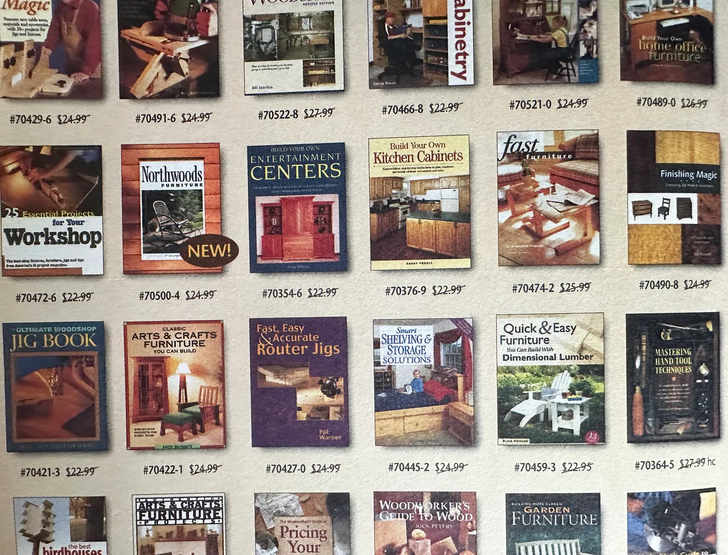
I matched this profile of the “indiscriminate sponge” beginner and I had huge numbers of woodworking books and magazines … until I finally noticed that the magazine articles in the latest issue were basically the same as the ones I’d first seen three years earlier, just with more gee-gaws and doo-dads added (microadjusters-for-everything were flavour of the month when I finally exited my sponge phase).
Comments Off on The beginning woodworker … an easy mark
September 23, 2025
Learn EVERYTHING from Home Depot wood
Rex Krueger
Published 22 Sept 2025
Comments Off on Learn EVERYTHING from Home Depot wood
September 11, 2025
Make the Joiners Mallet in an Afternoon
Rex Krueger
Published 2 May 2025
Comments Off on Make the Joiners Mallet in an Afternoon
September 5, 2025
September 2, 2025
How to Make a Poor Man’s Gauge | Paul Sellers
Paul Sellers
Published 25 Apr 2025Creating solutions does not always mean going out to buy dedicated manufactured tools but thinking about how you can become the solution.
In this short video, I show how you can set up an ingenious way to set out for hinge recessing, mortise and tenon parts, and then a beading tool in a matter of a minute or two only. It’s a trick that’s bailed me out time and time again.
It’s yours just by watching and learning!
(more…)
Comments Off on How to Make a Poor Man’s Gauge | Paul Sellers
August 22, 2025
You built a tool chest. Now, make it YOURS.
Rex Krueger
Published 21 Aug 2025
Comments Off on You built a tool chest. Now, make it YOURS.
August 1, 2025
How to make flat boards straight, smooth and square (stock preparation part 2) | Paul Sellers
Paul Sellers
Published 28 Jul 2013In this video Paul Sellers shows how to prepare a flat smooth board from rough stock. He does this with winding sticks and a no. 4 plane.
Part 1 is here: How to make square stock straight, sm…
Someone asked about the can Paul uses to lubricate the sole of the plane. You can find out how to make one here: http://paulsellers.com/2011/10/recycl…
To find out more about Paul Sellers and the projects he is involved with visit http://paulsellers.com
Comments Off on How to make flat boards straight, smooth and square (stock preparation part 2) | Paul Sellers
July 25, 2025
How to make square stock straight, smooth and square (stock preparation part 1) | Paul Sellers
Paul Sellers
Published 8 Apr 2013Paul Sellers shows how to prepare wood from its rough sawn state into useable stock. He goes into detail about how to remove twist from a square piece of wood and make it “four square”. He does all of this with hand tools. Specifically the plane, square and winding sticks. The video was first posted on https://woodworkingmasterclasses.com
To find out more about Paul Sellers and the projects he is involved with go to http://paulsellers.com
Comments Off on How to make square stock straight, smooth and square (stock preparation part 1) | Paul Sellers
July 8, 2025
Paul’s Drawer Tour | Paul Sellers
Paul Sellers
Published 21 Feb 2025What’s the question? Why did Paul put the drawer in such a dumb place, or what does Paul use the drawer in his bench apron for?
Well, this drawer is pretty much my catchall for all of the small tools and bits of equipment that would definitely go astray in quick-time if I didn’t have it.
The hundred and more pieces and fifty types cannot be housed in any kind of order without my becoming obsessive and compelled. It gives me efficiency and economic ability minute by minute, and to say it’s opened a hundred times in a given day would not be an exaggeration.
Those odd moments of inconvenience when something in my vise stops its use are so well worth it. I love this drawer exactly where it is.
(more…)
Comments Off on Paul’s Drawer Tour | Paul Sellers
May 26, 2025
Card Scraper Guide | Paul Sellers
Paul Sellers
Published 17 Jan 2025A Dual-Purpose Aid That’s More Than It Looks!
It’s not always easy to successfully establish a good cutting edge to a card scraper, and we woodworkers just love DIY over almost everything and anything else we do.
You will not regret the ten minutes it takes to make this lifetime aid that guarantees pristine cutting edges to your card scraper every single time you need it.
Any scrap of wood will do, so now you have no reason not to master sharpening card scrapers for the rest of your life.
——————–
(more…)
Comments Off on Card Scraper Guide | Paul Sellers


