Quotulatiousness

June 23, 2019

They managed to get 7% approval? That’s surprising

Filed under: Business, Law, Liberty, Politics, Technology, USA — Tags: , , , , , — Nicholas @ 05:00

Michael van der Galien reports on a recent poll of registered voters in the United States that will not be happy reading for many social media companies:

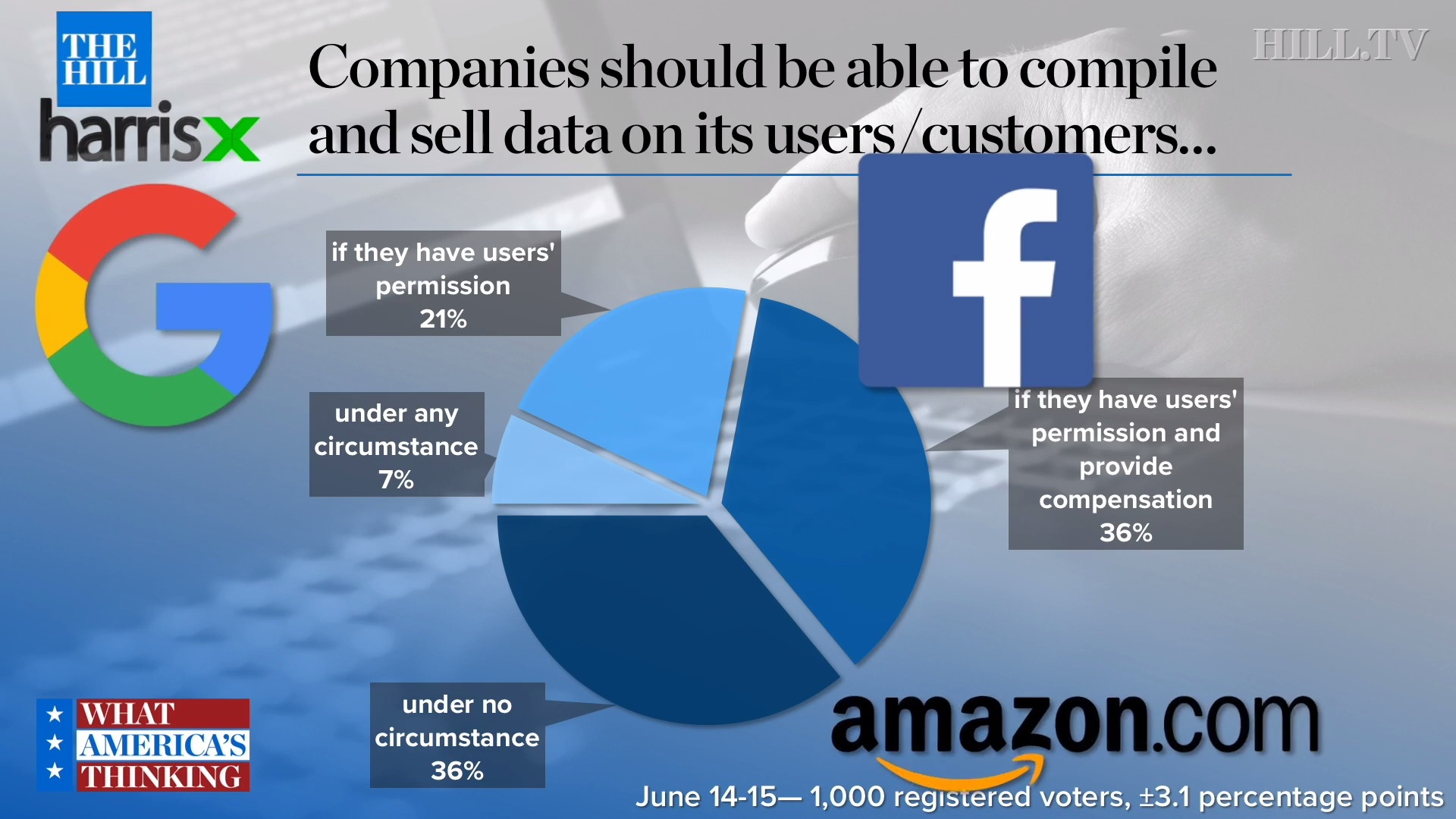
Only seven percent are happy with social media companies being able to harvest and sell data without permission or compensation.
Chart from Hill.TV – https://thehill.com/hilltv/what-americas-thinking/449576-poll-voters-overwhelmingly-want-more-regulations-on-personal

Thirty-six percent of those polled say there is no scenario imaginable to them in which it’s OK for companies to collect and sell such information. Read that again: one-third of those asked always oppose companies like Facebook, Twitter, Amazon, and Google collecting and selling such data. Another 36% said they can support the collection and selling of personal data if the individuals involved are compensated for it.

Only 21% say they believe companies should be able to collect and sell personal information of users if they’ve expressly asked for permission. As for selling and collecting it without permission:

    Eight percent of Republicans and also Democratic respondents said that firms should be allowed to sell information without permission. Seven percent of independents agreed.

In other words, this is a bipartisan issue, which makes perfect sense. After all, this issue affects all of us, whether we are conservative or liberal.

Matthew Sheffield has more for Hill.TV:

On Monday, the Washington Post reported that the Federal Trade Commission has been investigating Google’s YouTube division for tracking child users, a practice allegedly in violation of a 1998 law which forbids tracking and targeting children under 13 years of age.

The poll found broad bipartisan agreement on what companies should be allowed to do with consumer data. Eight percent of Republicans and also Democratic respondents said that firms should be allowed to sell information without permission. Seven percent of independents agreed.

About the same number of Democrats and Republicans said that companies should not be able to sell data under any circumstance. Thirty-three percent of GOP respondents took this position, as did 35 percent of Democrats. Forty percent of independents agreed.

Younger voters were more willing to allow companies to sell consumer data than older ones although it was still a minority position. Fourteen percent of respondents who were between 18 and 34 said they supported letting companies compile and sell personal data without permission while only 2 percent of those 65 and above agreed.

May 8, 2019

QotD: Those “my-kid-was-almost-sex-trafficked” hoaxes

Filed under: Law, Media, Quotations, Technology, USA — Tags: , , , , , — Nicholas @ 01:00

Perhaps you’re wondering why someone would make up such a preposterous story. I have an idea.

For the last few years, there has been a string of moms going on Facebook, breathlessly claiming that they were out at the mall (or Ikea, or Target), when suddenly they realized that they were being stalked by a kidnapper clearly planning to snatch their kids and sex-traffic them.

The evidence is usually something like, “I saw a guy staring at my baby.” Or, “I saw the couple in one aisle and then I went down a different aisle and there they were again,” or, “I looked outside and there was a van with its door open!”

Inevitably, the mom congratulates herself on having had the wherewithal to figure out what was going on just in time, and bravely thwart the heinous crime by, uh, staring the guys down. Then the mom usually says something like, “if it happened to me it could happen to you,” without reminding readers that in fact, nothing happened. No one grabbed a kid. No one was sex-trafficked. (The head of the Crimes Against Children Research Center, David Finkelhor, says he knows of zero cases of a child kidnapped from a parent in public and sex trafficked.) It’s all in the moms’ heads.

Yet they get thousands, sometimes tens of thousands, of approving shares and comments on social media.

Here’s one story. Here’s another, and another, and another. Here’s one that went mega-viral a few years back. You get the idea. It’s a panic, with a twist: adulation.

The mom ends up the hero of the non-event, basking in comments like thank you for sharing this, and so glad you are safe and, you are such a strong, conscientious mama.

If only this hoax story could go as viral as the my-kid-was-almost-sex-trafficked posts.

Lenore Skenazy, “Mom Charged With Falsely Accusing a Man of Trying to Kidnap Her 5-Year-Old at the Mall”, Reason, 2019-07-04.

May 4, 2019

Canadian privacy laws

Filed under: Cancon, Law, Liberty, Media — Tags: , , , — Nicholas @ 03:00

Michael Geist asks whether it matters that Canadian privacy laws provide more privacy protection if they can’t actually be enforced:

It has long been an article of faith among privacy watchers that Canada features better privacy protection than the United States. While the U.S. relies on binding enforcement of privacy policies alongside limited sector-specific rules for children and video rentals, Canada’s private sector privacy law (PIPEDA or the Personal Information Protection and Electronic Documents Act), which applies broadly to all commercial activities, has received the European Union’s stamp of approval, and has a privacy commissioner charged with investigating complaints.

Despite its strength on paper, my Globe and Mail op-ed notes the Canadian approach emphasizes rules over enforcement, which runs the risk of leaving the public woefully unprotected. PIPEDA establishes requirements to obtain consent for the collection, use and disclosure of personal information, but leaves the Privacy Commissioner of Canada with limited tools to actually enforce the law. In fact, the not-so-secret shortcoming of Canadian law is that the federal commissioner cannot order anyone to do much of anything. Instead, the office is limited to issuing non-binding findings and racing to the federal court if an organization refuses to comply with its recommendations.

The weakness of Canadian law became evident last week when the federal and British Columbia privacy commissioners released the results of their investigation into Facebook arising from the Cambridge Analytica scandal. The report details serious privacy violations and includes several recommendations for reform, including new measures to ensure “valid and meaningful consent”, greater transparency for users, and oversight by a third-party monitor for five years.

Facebook’s response? No thanks. The social media giant started by disputing whether the privacy commissioner even had jurisdiction over the matter. After a brief negotiation, the company simply refused to adopt the commissioners’ recommendations. As their report notes “Facebook disagreed with our findings and proposed alternative commitments, which reflected material amendments to our recommendations, in certain instances, altering the very nature of the recommendations themselves, undermining the objectives of our proposed remedies, or outright rejecting the proposed remedy.”

April 4, 2019

Of course Facebook is now in favour of government regulation … it’ll keep out their competition

The recent calls for the government to regulate social media got support from Mark Zuckerberg, which seems to have surprised some in the media. It’s not at all uncommon for established firms to not only welcome government oversight but to actively support it — because it’s a highly effective strategy to strangle smaller competitors and keep new competitors from entering the field:

On Saturday, Mark Zuckerberg appealed to the government for increased regulation of the internet including his company Facebook. According to Zuckerberg, increased government action is needed to protect society from harmful content, ensure election integrity, protect people’s privacy, and to guarantee data portability. If enacted, the government would possess a wide range of control over internet businesses. For Zuckerberg, this is for the public’s best interest.

But make no mistake about it, Zuckerberg’s cries for regulation is not an appeal to his humanitarianism. On the other hand, it solves glaring issues that Facebook has faced since the 2016 election.

[…]

With increased government oversight, Facebook’s leadership will finally be able to pass the buck to someone else. The government will provide them with a clear set of rules that they will be accountable for. Any negative press coverage that occurs outside of those guidelines, will not be attributable to their company but to the rule-making body of the government. This will allow Facebook’s leadership to regain credibility within a clearly definable framework that they are not responsible for creating.

But perhaps Zuckerberg’s appeal for regulation is even more cunning. Government regulation will undoubtedly be met with higher costs. Internet companies will have to spend more on staffing to be in compliance with the increased burdens implemented by the rule-making body. We saw this play out in the banking industry after the Great Recession. A study conducted last year found that since 2009, banks have been fined a total of $345 billion dollars in penalties and noncompliance costs. Further, another study found that in 2016 banks spent $100 billion dollars on regulatory compliance alone.

Large internet companies like Facebook and Google will easily absorb the strain of increased regulatory costs. It is the smaller businesses that will feel the financial squeeze. With increased regulatory compliance spending, smaller startups will face an even bigger hill to climb to compete with the likes of Facebook.

Another “feature” of government regulation is what is known as “regulatory capture”, as the regulating body and the regulated organizations, after an initial period of ostentatious “conflict”, settle down into a cosy symbiotic relationship … in only a few years, many of the regulatory staff will find themselves working for one of the regulated organizations, and vice-versa. The regulatory body will — like all bureaucracies — start to care more about keeping itself alive and growing than about the original reason it was set up. Small organizations will stall or go extinct, and only the existing dinosaurs will carry on, protected from competition by their regulator’s powers.

March 3, 2019

QotD: Four ways to corporate monopoly

1. Proprietary technology. This one is straightforward. If you invent the best technology, and then you patent it, nobody else can compete with you. Thiel provocatively says that your technology must be 10x better than anyone else’s to have a chance of working. If you’re only twice as good, you’re still competing. You may have a slight competitive advantage, but you’re still competing and your life will be nasty and brutish and so on just like every other company’s. Nobody has any memory of whether Lycos’ search engine was a little better than AltaVista’s or vice versa; everybody remembers that Google’s search engine was orders of magnitude above either. Lycos and AltaVista competed; Google took over the space and became a monopoly.

2. Network effects. Immortalized by Facebook. It doesn’t matter if someone invents a social network with more features than Facebook. Facebook will be better than their just by having all your friends on it. Network effects are hard because no business will have them when it first starts. Thiel answers that businesses should aim to be monopolies from the very beginning – they should start by monopolizing a tiny market, then moving up. Facebook started by monopolizing the pool of Harvard students. Then it scaled up to the pool of all college students. Now it’s scaled up to the whole world, and everyone suspects Zuckerberg has somebody working on ansible technology so he can monopolize the Virgo Supercluster. Similarly, Amazon started out as a bookstore, gained a near-monopoly on books, and used all of the money and infrastructure and distribution it won from that effort to feed its effort to monopolize everything else. Thiel describes how his own company PayPal identified eBay power sellers as its first market, became indispensible in that tiny pool, and spread from there.

3. Economies of scale. Also pretty straightforward, and especially obvious for software companies. Since the marginal cost of a unit of software is near-zero, your cost per unit is the cost of building the software divided by the number of customers. If you have twice as many customers as your nearest competitor, you can charge half as much money (or make twice as much profit), and so keep gathering more customers in a virtuous cycle.

4. Branding. Apple is famous enough that it can charge more for its phones than Amalgamated Cell Phones Inc, even for comparable products. Partly this is because non-experts don’t know how to compare cell phones, and might not trust Consumer Reports style evaluations; Apple’s reputation is an unfakeable sign that their products are pretty good. And partly it’s just people paying extra for the right to say “I have an iPhone, so I’m cooler than you”. Another company that wants Apple’s reputation would need years of successful advertising and immense good luck, so Apple’s brand separates it from the competition and from the economic state of nature.

Scott Alexander, “Book Review: Zero to One”, Slate Star Codex, 2019-01-31.

August 13, 2018

QotD: The new Wobblies

Filed under: Media, Quotations, Technology — Tags: , , — Nicholas @ 01:00

I live in two worlds. One has www in front of it. I must admit I don’t like the imaginary place that’s become the ironclad version of reality for most people. The jackanapes who rule the Friendface planet are the worst people extant, if you ask me. By the way, if you’re reading this, you asked me.

I don’t like the invertebrates who run the Intertunnel. I’ve decided they need a name. Let’s coin the term right here and now: The Wobblies. The Website Wankers of the World have united into a Voltron of suck, and they rule this alternate ecosystem that’s taken over the real world. They don’t care if anything productive happens in the brave new world they’ve created. As long as they lord over the nonproduction, of course.

Sippican, “Minor Swing by Minors”, Sippican Cottage, 2016-11-05.

August 9, 2018

“… here’s your nut graf – this is about Facebook death”

Filed under: Media, Technology — Tags: , , , — Nicholas @ 03:00

Are you on Facebook? Or perhaps it’s more proper to ask “are you still on Facebook?” J.D. Jagiello used to be:

To Whom It May Concern:

I was already tired of your rants about food, bad-hair days, roommates, feeling too many feelings, the public transit, lost IKEA tools, TV shows, wives, husbands and children and, above all, Trump (that’s like ranting about having an asshole—we all have it). I was tired of your quirky disregard of punctuation and how it’s for the olds. Guys you don’t need it to understand what I’m trying to say, so here’s your nut graf – this is about Facebook death.

I was tired of the quizzes: What Kind of Pizza Are You?

And the Inspirational Quotes. “It’s during our darkest hours we must focus on the light” (—Aristotle, supposedly). Here’s mine: “There’s no better time than now to delete.” (Position this one against a background of a man in canoe swimming away to a proxy of freedom.)

Shares about yoga, running, god? Ugh.

“Funny” kid dialogues: no. (But I’ve done it myself, yeah.)

I read your high-brow discussions about postmodernism or grammar, out of my leftover Good-For-You homework sense of obligation. I didn’t go to the right schools to be able to join in and I don’t retain information easily. I rarely felt philistine-aggressive about it; I accepted that I didn’t have the membership.

On a positive note, I always looked at your baby pictures because I like babies. I will miss the baby pictures. I won’t miss twice-a-week updates on some of those babies.

I also never got sick of memes or videos of animals, or articles about octopuses or archaeological digs or stupid but cleverly funny reviews of your mundane experiences on the bus or your convos with grandma. On a serious note: I am also passionate about health policies, and Indigenous issues in my country and have a lot of educated friends who post about it — stuff that doesn’t even make it to mainstream media — so I liked to get my information that way.

I used to post status updates on Facebook that many people found interesting or funny, and sometimes I shared opinions, and it was a good place to feel socially connected during times of isolation (a new baby, illness). But about two years ago or so, I stopped posting about anything serious, though I still asked for recommendations, innocent stuff. Occasionally—an old reflex—I would post something of more substance but then delete quickly because Facebook became the place of who knows who is watching.

I’ve tapered off my Facebook activities over the last few months. I check my feed at most once per day, and I find myself scrolling quickly past “the same old stuff”. I occasionally leave comments on some of my friends’ posts, but for the most part, I’m not getting into conversations — especially on anything faintly political — and I don’t much miss it. I stopped automatically posting links to my blog earlier this year … and only a couple of people seem to have noticed. That tracks well with my blog statistics which show very little of my traffic comes from Facebook and that number didn’t drop very far after I stopped posting links. I still use a plugin to auto-Tweet my blog posts, but outside a few Vikings fan groups, I’ve never really been interested in conversations on that platform.

Facebook’s algorithms seem to have noticed my slow disengagement, as I’m now getting reminders and notifications when friends post much more often than I remember in the past. I’m even getting the odd “Friend A responded to Friend B’s post” stuff, which is certainly a new attempt to entice me to log in again.

July 4, 2018

It’s never a good idea to expand the power of the state

Francis Porretto on the problem of giving the state yet another tool for its already overflowing toolbox:

    The party in power is smug and arrogant. The party out of power is insane.” – Megan McArdle, a.k.a. “Jane Galt”

Among the older maxims of politics is to beware handing the State a new power without first reflecting on how your opponents could use it against you. For as sure as the Sun rises in the East, your opponents will return to dominance someday, and whatever powers you awarded the State will be in their hands.

Just now, the focus is on President Trump’s choice of a replacement for retiring Supreme Court Associate Justice Anthony Kennedy. The Democrats are tearing their collective hair out over this, as now that the filibuster is a dead letter for judicial appointees, their minority status in the Senate leaves them no way to block his selection. Yet it was Senate Democrats during the Obama Administration who first attacked the filibuster – when they were in the majority and sought to confirm Obama appointees. Coulda told ‘em then, but they weren’t in a mood to listen.

Today’s critical battles are over freedom of expression and “deplatforming.”

Some folks of sound mind and generally good will are exercised about how Silicon Valley giants such as Facebook and Twitter regulate their immensely popular social-media platforms to disfavor conservatives. The complaints have been many, and a great many of them are both accurate (i.e., the things complained about really happened) and valid (i.e., only persons of conservative or libertarian bent were silenced). However, they come up against a barrier that’s proved impassable to date: the right of private property.

So a lot of those folks have embraced the notion that those platforms could be regulated by the federal government as public accommodations. That’s the conception under which the Civil Rights Acts were deemed to hold legitimate authority over restaurants, hotels, movie theaters, and other nominally private properties. If you present your facility as “open to the public,” the logic runs, then you can be forbidden to discriminate – i.e., to provide your services to some members of the “public” but not others.

(For those who remember the “nationwide Bell System,” the phrase common carrier might rise to mind. The concept is essentially the same, as was the federal government’s assertion of authority over it. However, in that particular case, the rationale was that the Bell System was a monopoly, protected by that same federal government. Telecom deregulation and the breakup of the Bell System put paid to that scheme, thank God.)

Those in the Right who favor this notion are asking for trouble. Someday the balance of power will shift leftward once again. What would the Democrats – an increasingly totalitarian bunch who’ve never seen a law, a regulation, or a tax it didn’t love – do with the precedent that an Internet platform can be regulated as a public accommodation, despite being private property?

H/T to Bill St. Clair for the link.

June 30, 2018

Enriching the public in ways that do not show up in the GDP calculations

Filed under: Business, Economics, Media, Technology — Tags: , , , , — Nicholas @ 05:00

Tim Worstall looks at the calls to regulate the big tech firms and points out that we already get a very good deal on “free stuff” that isn’t reflected in standard economic statistics:

It won’t have escaped your attention that rather large numbers of people are calling for the regulation of the tech companies. The Amazon, Google, Facebook (Apple and Microsoft often added, just because they’re large) nexus have lots of power over markets and thus therefore – well, therefore something. My own prejudice here is that certain people just cannot look at centres of power and or money without insisting that they, the complainers, should be the ones exercising that power and determining the disposition of that money. Thus much of the drive for “democratic” regulation of the economy more generally, the self proclaimed democrats being the ones who would end up with the power. The advantage of this analysis being that it does describe reality, the same people do end up making the same arguments about different companies over time. Mere prominence brings the demand for control.

The economist on this subject is Jean Tirole. His Nobel was for exploring this very subject, tech companies and the two sided market. Google, for example, sells the search engine to us and us to the advertisers. The tech here is different, obviously, but the underlying economics is the same as that of the free newspaper.

Tirole’s a new book out and there are a number of interesting points to be had from it:

    Yes, on the whole consumers tend to get a good deal, because we use wonderful services — like Google’s search engine, Gmail, YouTube, and Waze — for free. To be certain, we are not paid for the valuable data we provide to the platforms, as for example Eric Posner and Glen Weyl remind us in their recent book Radical Markets. But on the whole, our living standards have substantially improved thanks to the digital revolution.

From which we can extract a few points. We’re richer, we really are. Substantially richer and yet in a manner that normal economic statistics entirely fail to capture. As Hal Varian has pointed out, GDP doesn’t deal well with free. Near all of those benefits of the digital revolution are coming to us for free and so aren’t recorded in that GDP. So, we’re richer yet the numbers say we’re not. In that is much of the explanation of slow economic growth these days, even of slow real wage growth. We’re just not counting what is happening to our living standards.

But we can and should go further than that. If the above is true then we’re very much less unequal than we’re recording. Stuff that’s free is, obviously enough, distributed rather more evenly among the population than extant monetary incomes. You, me and Bill Gates all have access to exactly the same amount of Facebook at the same price. We’re entirely equal in that sense. Bill’s actually poorer concerning search engines, stuck for emotional reasons with Bing as he is while we get to use Google or DuckDuckGo. Our standard measures of inequality are wrong both because of the undermeasurement of new wealth and also the extremely equitable pattern of the distribution of that new wealth.

May 23, 2018

Farage and Zuckerberg

Filed under: Business, Europe, Liberty, Media, Technology — Tags: , , , , — Nicholas @ 04:00

April 19, 2018

The mis-measurement of the digital economy

Filed under: Economics, Technology — Tags: , , , , — Nicholas @ 05:00

In the Continental Telegraph, Tim Worstall explains why our current statistical model does not adequately reflect the online world’s contribution to our economy:

To give my favourite current example. WhatsApp is used by some billion people around the world for some to all of their telecoms needs. It turns up in economic statistics as a reduction in productivity.

That’s mad.

In more detail, WhatsApp is free to use and carries no advertising. That means there’s no sale associated with it. We measure consumption at market prices – a price of $0 means no consumption. Consumption is one of the three ways we measure GDP – each of the three should be the same as the other two but isn’t because lying about taxes.

The other two calculations are all incomes, or all production. Things that are sold at no price do not add to production given that we measure it at market prices.

Income, well, there’re 200 or so engineers at Facebook who work on it (I checked with Facebook itself). Say their salary is $250k a year each. Probably too low but we’ve got to use some number or other. $50 million then. That’s incomes added to GDP.

So, in our three methods of calculating GDP – they should all be the same but that doesn’t matter here – we’ve value of WhatsApp (more accurately, WhatsApp adds value of $x each year to the global economy) of $50 million. Or $0 or $0.

April 15, 2018

Facebook is stalking you, even if you don’t have an account

Filed under: Business, Media, Technology — Tags: , , , — Nicholas @ 03:00

At the Electronic Frontier Foundation, Gennie Gebhart and Jamie Williams explain why Facebook doesn’t need to listen in on your microphone to serve you with creepy ads:

In ten total hours of testimony in front of the Senate and the House this week, Mark Zuckerberg was able to produce only one seemingly straightforward, privacy-protective answer. When Sen. Gary Peters asked Zuckerberg if Facebook listens to users through their cell phone microphones in order to collect information with which to serve them ads, Zuckerberg confidently said, “No.”

What he left out, however, is that Facebook doesn’t listen to users through their phone microphones because it doesn’t have to. Facebook actually uses even more invasive, invisible surveillance and analysis methods, which give it enough information about you to produce uncanny advertisements all the same.

This was what finally got Elizabeth to close her Facebook account: very shortly after posting a status update that referenced a particular business (that’s been gone for decades), she started getting ads for modern equivalents outside her Facebook session. Clearly, her advertising profile had been updated to include her “new” interest, and the ads were now tailored to this sudden change of tastes.

But how does Facebook know to serve you an ad for a specific product right after you talk about it? What explains seeing ads for things you have never searched for or communicated about online? The list is long. Instead of listening to your conversations through your phone, Facebook:

  • tracks you through Like buttons across the web, whether or not you are logged in or even have a Facebook account.
  • maintains shadow profiles on people who don’t use Facebook.
  • logs Android users’ calls and texts.
  • absorbs unique phone identifiers through in-app advertising to associate your identity across the different devices you use.
  • tracks your location and serves ads based on where you are, where you live, and where you work.
  • tracks your in-store purchases to link the ads you see online with the purchases you make offline.
  • watches the things you start writing but don’t post to track your self-censorship.
  • linked purchases to Messenger accounts to allow sellers to send confirmation messages without affirmative user permission.
  • bought and advertised a VPN to track what users are doing on other apps and crush competition.
  • manipulated your Newsfeed to see if it can make you sad or happy.
  • files patents for emerging tracking technology, like tracking your location through the dust on your phone camera, for potential future use.

Tracking and analysis methods like these power not only those too on-the-nose ads, but also invasive “People You May Know” recommendations.

Users are onto this. If you have ever been creeped out by an ad for a product popping up right after you were talking out loud about it, your fear and even paranoia are warranted — just not for the exact reasons you might think. No matter how Facebook achieves its frighteningly accurate ads and suggestions, the end result is the same: an uncomfortable, privacy-invasive user experience.

I’m getting closer to the point of pulling the plug on my Facebook account as well … it seems like every week or so I need to go spelunking in the privacy settings to shut off yet another way they want to monetize my information or invade my privacy even more. Several of my FB friends are dabbling with MeWe.com as an alternative and they do claim not to track you or otherwise compromise your privacy.

April 10, 2018

QotD: The built-in toxicity of social media

Filed under: Media, Politics, Quotations — Tags: , , — Nicholas @ 01:00

The internet age has brought us a medium with a bias towards even more gutteral, visceral messaging. Social media encourage short, punchy messages, and by punchy, I mean people are trying to punch each other with words. The medium has a bias towards stridency and absolutism, because you really can’t include too much nuance and caveat in 140 characters.

It also has a strong bias towards anger, because, as far as short missives go, “Go fuck yourself” has the virtue of being brief, direct, and very easy to write.

Much easier to write a bunch of fuck yous to strangers than compose an article explaining your beliefs or the defects of the claims of those you disagree with.

And a lazy medium thereby encourages lazy thinking.

I kind of think anything important one has to say should be said in person. If you’re going to break up with someone, it should be in person.

If you’re going to tell someone you’ll never speak to him again because he supports a candidate you don’t like, you should probably man up to deliver that message in person, too.

If you have the guts. But that’s hard. Much easier just to rip someone in a 140 character Sick Burn.

Ace, “Divisive Political Season Causing Mass Unfriending on FaceBook”, Ace of Spades H.Q., 2016-08-15.

March 30, 2018

New Firefox extension to reduce Facebook‘s default tracking

Filed under: Technology — Tags: , , , — Nicholas @ 04:00

If you use Firefox as your primary browser, you might be interested in a new Firefox extension that limits how Facebook tracks your activity:

Mozilla Firefox has a new extension to prevent Facebook from tracking your online habits.

Capitalizing on the fears surrounding Facebook privacy, Mozilla has designed the “Facebook Container,” a Firefox add-on that blocks Facebook from tracking users when they click on ads or links that take them off the site.

Facebook currently uses a program called Pixel to collect information on how users engage with the site. When users click on links, they visit external sites but are still logged in to Facebook‘s platform. These outside sites will contain “share” or “like” buttons, and when users engage with these functions, this activity is connected to their Facebook identity. That’s how Facebook is able to fine-tune its advertisements to its users. While this is a well-known practice, many aren’t aware that their behaviors outside the core function of Facebook are tracked.

But when people using Facebook Container click a link on Facebook, it loads in a seperate blue tab that isolates users’ activities from the core site. In these blue tabs, users will not be logged into Facebook, which prevents further data collection. Users do have the option to continue to use the “share” and “like” buttons, but Mozilla notes that these activities may still be tracked. The extension doesn’t prevent data collection, but it offers users more control over their privacy.

It may only be a token toward reclaiming a tiny bit of your online privacy, but even tokens can be valuable in the aggregate.

March 29, 2018

Google, Facebook, anti-trust laws, and the Network Effect

Google and Facebook (and other, lesser, social media companies) have a lot of information on you. Lots and lots and lots of information on you. Many people are coming to the conclusion that this is bad, bad news and “something must be done”. Politicians and activists share a tendency to respond to such demands by pushing “something” they already favour as the solution to the popular demand for action. A few days ago, the “something” seemed to be some form of anti-trust action over the social media giants.

In the Continental Telegraph, Tim Worstall explains why an over-the-top anti-trust offensive is likely to leave everyone in a worse state than the status quo:

Which brings us to the tech companies of today:

Big Tech May Be Monopolistic, But It’s Good for Consumers

Quite so, thus no antitrust actions should or need be taken.

At the first level there’s the simple point that Facebook, Google a little less, Microsoft, e-Bay, they benefit from network effects. The more people who use them the more attractive they become to the next user. Meaning that size, in and of itself, creates yet more size. That’s just what we mean by network effects.

In turn that also means that the efficient size of an organisation here is that global monopoly. It isn’t true in most cases because there are diseconomies of scale as well as economies of it, but another way to describe network effects is just that we’re insisting that the -economies outweigh the dis- at scales up to and including 7 billion people.

In that first reading of antitrust that would mean they gain economic power and thus government must step in. In our second reading that’s not enough.

Firstly, the monopolists must exercise that economic power they have. Something not greatly in evidence as just having power doesn’t mean it can be exercised. For when you do try to, say, raise prices can someone come in and try to undercut you? If so you’ve got contestable economic power, or even a contestable monopoly. As an example, think the Chinese and rare earths. They were producing some 97% of the world’s supply. So, they decided to play silly buggers, exercise that power. It took a couple of years but two new mines opened, China’s share of rare earths fell and prices halved, below their original point. People contested that Chinese economic power when China tried to exercise it. China didn’t win either.

If Google tried to raise the price of adverts then business would flow away from them. If Facebook started charging for access then there wouldn’t be a Facebook. They’ve got contestable monopolies.

[…]

Sure, we should keep a wary eye open and if the consumer is being gouged then we could and should do something. But while we’ve got efficient companies, monopolies or not, benefiting consumers then the correct response is to get the hell out of the way.

Unless you’re a politician who simply wants to expand the powers politicians have over society – something which explains most politicians – but then we can tell them to go boil their heads. Only the exercise of economic power to the disbenefit of consumers justifies intervention.

« Newer PostsOlder Posts »

Powered by WordPress