
The Clintons? Hillary got rich, Bill got laid, republican virtue got screwed. Like the sickly leaders of late-Soviet politburos, both appear older and feebler than their years: once the star performer of the double-act, Bill staggers around like the Blowjob of Dorian Gray; the life has all but literally been sucked out of him. His straight-woman, once the reliably stolid, stone-faced Margaret Dumont of his cigar-waggling routine, now has to be propped up on street bollards and fed lines by her medical staff. When she shuts down and she’s out cold, who’s driving the pantsuit? Huma? Cheryl? Podesta? Bill and Hillary have been consumed by their urges. America would be electing the Walking Dead, insatiable and fatal to the touch, but utterly hollow.
Mark Steyn, “Hollow E’en”, Steyn Online, 2016-11-01.
November 19, 2017
QotD: The Clintons
November 17, 2017
Canada is back in peacekeeping … sorta
Ted Campbell is not happy with the government’s “decision” on peacekeeping:
It appears that today, Prime Minister Justin Trudeau announced just about the “best thing” for him and his Liberals in the long, long, long run up to the 2019 election campaign; but it’s pretty much the worst thing he could do for Canada and the Canadian Forces and the UN. In fact: it appears to involve a handful of “penny packet” commitments ~ a “grab bag” one journalist said, none of which will do much good ~ being too small to even been noticed amongst the 75,000+ UN soldiers in Africa ~ and none of which will contribute materially to the Trudeau Liberal’s quest for a second class, temporary, powerless seat on the worthless UN Security Council.
Let’s be very clear: Canada is not “back” ~ this is a far cry from the sort of traditional UN peacekeeping that Canada did in the 1950s, ’60s and ’70s and that Justin Trudeau and many, many Canadians imagined in 2015, and it is a far cry from what Canada could do if the government really wanted to help.
[…] I suspect that too many non-military voices in too many special interest groups argued for the “penny packet” and “let the UN help decide” approach. My suspicion is that the UN simply doesn’t know how to organize or manage a complex, logistical and/or air transport mission, and the “civil society” special interests that want Canada “back” in UN peacekeeping have no idea at all about military matters or how to get the most bang for the buck.
The good news for the Liberals is that it will the autumn of 2018, at the earliest, when “negotiations” with the UN come to some sort of conclusion and, probably, early 2019 before Canada actually sends anyone into anything like harm’s way … just in time for a campaign photo-op with the PM waving good-by to some female RCAF members in baby blue berets as they board a plane bound for somewhere. And, so long as the UN doesn’t send any home in caskets the Trudeau
governmentcampaign team will be happy. But it will give Team Trudeau another chance to smugly proclaim that “Canada’s back,” and that’s all that really matters in official Ottawa late in this decade.
October 31, 2017
We may no longer refer to a last-place candidate as having “lost their deposit”
Colby Cosh on a recent court ruling in that hotbed of radical democracy, the Alberta Queen’s Bench, declaring candidate deposits for federal elections to be unconstitutional:
Deposits are a tradition in Canadian federal elections as old as the ballot itself, dating to 1874. But Queen’s Bench Justice Avril Inglis’s ruling suggests that their days are probably numbered. They were introduced for the purpose, stated at the time and very often re-stated since, of deterring frivolous candidates for office. Before the year 2000, you needed to hand over $1,000 to run in a federal election: you got half back automatically if you complied with the Ps and Qs of election law, and the other half if you got at least 15 per cent of the vote.
This practice ran into trouble when (literal) communists litigated against it, arguing that it impeded the Charter rights of the poor and humble to participate in elections. Parliament acknowledged this by making the full $1,000 refundable, so talking heads no longer speak of “forfeiting one’s deposit” on election night. But the government continued to take the view that the “frivolous” need to be discouraged from pursuing federal candidacies. This was not really a satisfying rectification of the Charter issue, as Kieran Szuchewycz, an Edmontonian with some legal experience, seems to have noticed.
The truth is that Szuchewycz (who, for all I know, could be the guy who mops my local 7-Eleven) ran circles around the Department of Justice lawyers who turned up to oppose him. Justice Inglis has ruled that the $1,000 deposit fails almost every point of the Oakes test for laws that impinge on Charter rights. She found that “preserving the legitimacy of the electoral process” is an important objective, but the connection between having a grand lying around and being a “serious” candidate is not clear.
Szuchewycz observed that nowhere in the literature defending election deposits is “seriousness” or “frivolousness” defined. Nobody can point to an example of any harm arising from the existence of even admittedly frivolous candidates, like the long-established Rhinos.
And, well, the deposit doesn’t seem to discourage the Rhinos, does it? If you are well-heeled but “frivolous” you can afford the deposit. If you are in earnest, but broke, it’s a problem. And there are other “seriousness” tests in election law, notably the requirement for candidates to gather nominating signatures from riding residents. So what’s the thousand bucks for specifically?
Update, 8 November: Elections Canada is respecting the Alberta Queen’s Bench decision and no longer requires candidates in federal elections to submit a deposit. H/T again to Colby Cosh.
October 26, 2017
So what was the point in the Sudbury byelection trial?
I admit I didn’t follow this case in any detail, but what little I did read left me scratching my head over what the actual crime was supposed to have been. I certainly don’t have any partiality for the defendants, but there really didn’t seem to be any “there” there in any “breaking the law” way. Chris Selley (who actually did have to pay attention to the trial) seems to have felt much the same way:
Justice Howard Borenstein kicked the living daylights out of the Crown’s case in the Sudbury byelection trial on Tuesday, acquitting Liberal operatives Gerry Lougheed and Pat Sorbara of bribery without the defence calling evidence. The “directed verdict” means he didn’t think any Crown evidence would result in a conviction even if a jury believed it entirely — not a great look for the prosecution. Defence lawyers Brian Greenspan (for Sorbara) and Michael Lacy (for Lougheed) didn’t say whether their clients would pursue the Crown for costs, but they were otherwise inclined to orate. Both called it a “vindication.”
“This is as close in law as you can have to saying, ‘she’s innocent,’ ” said Greenspan.
“Nothing changed during this case. The evidence that was presented was the evidence that was available from the very beginning,” said Lacy. “And yet here we are, however many days later, with no case to answer for. (It) raises questions about why they prosecuted this matter to begin with.”
No kidding. I wouldn’t trust the lawyers the Crown came up with to wash my car, but they can’t have come cheap.
Under the circumstances, it’d be quite reasonable for them to attempt to recoup their legal costs.
So that was that. Two Liberals, three charges, three acquittals — and rightly so, says I. As I’ve said before, the Crown’s desultory shambles of a case managed to shift me from thinking Lougheed and Sorbara behaved greasily, if not illegally, to thinking they had barely done anything noteworthy. Both claimed to have no regrets on Tuesday; moments after the acquittal, the Liberals welcomed Sorbara back into the fold on Twitter. The opposition’s rote angry press releases ring rather hollow — especially in the Tories’ case, considering all the recent allegations of riding-level skullduggery.
On the bright side, we have some precedent at least. This is the first time anyone has ever been charged under the bribery provision of the Ontario Election Act, which dates from 1998. Seven other provinces have similar bribery provisions in their election acts; so far as I can tell no one has ever been charged under them either. The only mentions made of the new provision in debates at the Ontario legislature were about how everyone would surely agree it was a great idea. The next time politicians decide to tinker with the Election Act, they should get their intentions on the record. Had Borenstein sided with the Crown, he would nearly have outlawed politics altogether.
October 6, 2017
New NDP leader Jagmeet Singh even gets the thumbs up from crusty old conservative fogey
That is, Singh is seen as a much bigger threat to Justin Trudeau than to “stodgy” Andrew Scheer … which, in electoral terms, might leave the Liberals and NDP fighting it out for second place in the polls and the Conservatives up near majority territory. He’s certainly teh new hotness as far as the newspapers are concerned:
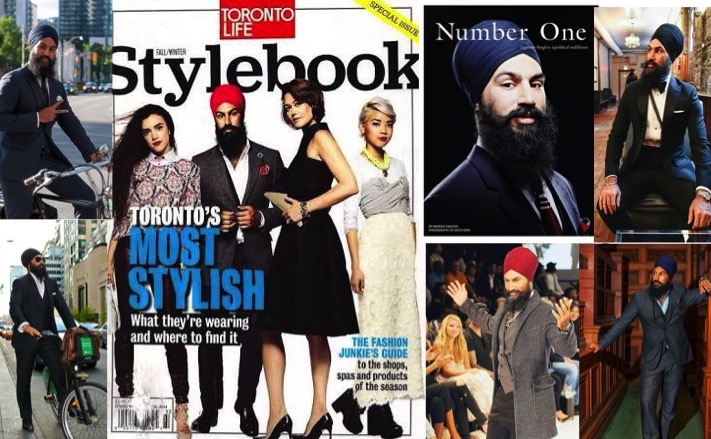
The media is buzzing about Jagmeet Singh being a game changer. Campbell Clark, writing in the Globe and Mail, says that “The NDP once picked stalwarts to fight the good fight as leader. Now, they have chosen someone who might disrupt Canadian politics. Don’t underestimate the potential for Jagmeet Singh to shake things up.” Chantal Hébert, writing in the Toronto Star, says “[Andrew] Scheer has to be hoping that Singh will give Trudeau more of a run for his money, for it usually takes a divided progressive vote for the Conservatives to win power.” And Lorne Gunter, writing in the Edmonton Sun, says that “Trudeau is a paper “progressive” – a poser – compared to Singh … [and] … unlike Thomas Mulcair, Singh’s predecessor as NDP leader, Singh won’t lose core social democrat voters by running to the right of the Liberals in the next federal election the way Mulcair did in 2015 … [thus, and] … In short, Singh is a headache the Liberals never imagined having. Compared to Trudeau, he is younger (38 rather than 45), smarter, at least as well-dressed and even more of a trendy, politically correct symbol.“
“But,” Mr Gunter says, while Jagmeet’s Singh’s selection is bad news for the Liberals, it “should be good for the Tories … [because] … It should revive vote-splitting on the left. And it should allow Tory Leader Andrew Scheer, while dull, to appear as the only clear alternative to the two Big Government leaders.”
Singh isn’t likely to draw a lot of votes from the Tories, but he’s a major threat to Trudeau in exactly those mediagenic qualities that Trudeau used to such great effect in the last federal election. Justin is in danger of being out-cooled by the new guy. A lot will depend on how long the media allows Singh’s political honeymoon to last, as they will be the primary channel for the “cool duel” to play out.
October 3, 2017
Jagmeet Singh wins the federal NDP leadership race
The NDP have finally selected a leader who may be able to recapture some of the “lightning in a bottle” phenomenon of the late Jack Layton’s time as party leader (and bring back some former NDP voters who plumped for Justin last time around). Jay Currie is enthusiastic about the new guy:
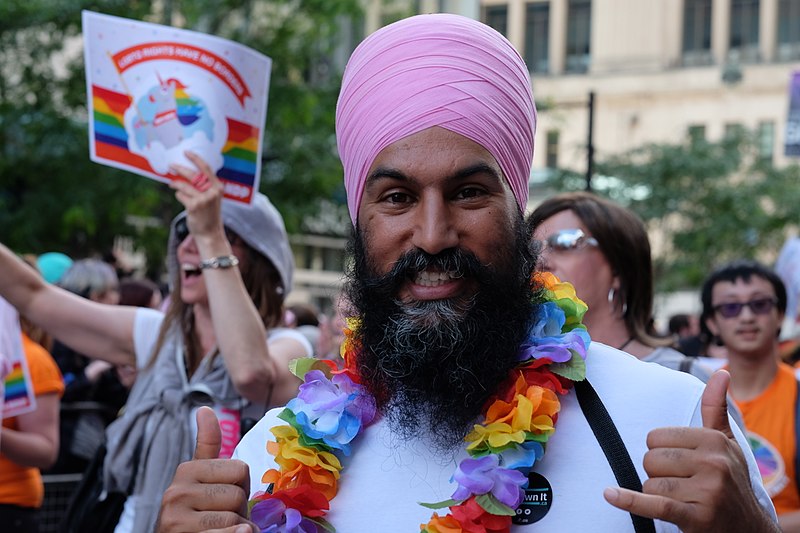
Federal NDP leader Jagmeet Singh taking part in a Pride Parade in June 2017 (during the leadership campaign).
Photo via Wikimedia.
… I was cheered to see the rollover victory of Jagmeet Singh for the NDP leadership. Singh seems to be from the pragmatic end of the NDP and will be relatively immune from identitarian and intersectional attack simply because he’s brown and wears brilliant turbans. He’s intelligent, well spoken and has a bit of charisma. And he is just going to kill Justin Trudeau in places Trudeau needs to win.
It is simplistic to say that the Sikh community in Canada will universally support one of its own, there will certainly be a temptation to defect from Trudeau to Singh. While that might have some effect in Tory ridings, it will be felt most strongly in seats which have traditionally swung from Liberal to New Democrat and back again.
I am not sure, however, that Singh’s ethnicity is his biggest threat to Trudeau. By 2019 the emptiness of much of the Liberal’s program will be apparent to all. The broken promises, the tepid policy initiatives and, above all, the fiscal incompetence on the revenue side and on expenditures will be pretty apparent. For small business owners and consumers with half a clue, the combination of the lunatic small business tax measures and the expensive, but pointless, carbon tax will pour votes into the Conservative column. But with Canada’s first past the post system, that may not be enough.
Singh’s real threat to Trudeau is in marginal seats where the Libs beat the Conservatives by a few thousand votes in the last election because a) people had had enough of Harper, b) Justin seemed bright and shiny. People who would have voted NDP in the past were so eager to get rid of Harper they voted for Trudeau. Mulclair simply lacked the appeal to keep the faithful in the pews. At a guess, the rank and file NDP voters, as well as the multi-culti virtue signallers, will be much more inclined to give Singh a go. Which means he has the capacity to bleed off Liberal voters in significant numbers.
September 24, 2017
We Read Hillary’s Book So You Don’t Have To
ReasonTV
Published on 22 Sep 2017Hillary Clinton’s new book What Happened attempts to explain Trump’s upset victory in 2016 through a series of reasons which are not Hillary Clinton.
September 12, 2017
QotD: Mandatory voting is still a stupid idea
My old boss, William F. Buckley Jr., often said liberals don’t care what you do so long as it’s compulsory (though he probably borrowed the line from his friend M. Stanton Evans).
There’s probably no better illustration of this illiberal streak in liberalism than the idea of “compulsory voting.” The argument usually goes like this: Voter turnout in America is low. Low voter turnout is bad. Therefore, we should make voting mandatory. (This argument is most popular after an election like last week’s when things don’t go so well for Democrats.)
When asked why low voter turnout is bad, one usually gets a mumbled verbal stew of Norman Rockwell–esque pieties about enhanced citizenship, reduced polarization, and, on occasion, veiled suggestions that Washington would get its policies right — or I should say left — if everyone voted.
To call most of these arguments gobbledygook is a bit unfair — to gobbledygook. First note that this logic can be applied to literally every good thing, from brushing your teeth to eating broccoli. Moreover, the notion that forcing people who don’t care about politics to vote will make them more engaged and thoughtful citizens is ludicrous. We force juvenile delinquents (now called “justice-involved youth” by the Obama administration) and other petty criminals to clean up trash in parks and alongside highways. Is there any evidence this has made them more sincere environmentalists? If we gave every student in the country straight As, that would make all the education trend lines look prettier, but it wouldn’t actually improve education.
This sort of enforced egalitarianism is reminiscent of Kurt Vonnegut’s short story “Harrison Bergeron,” set in a society where everyone must be equal. Above-average athletes are hobbled to make them conform with the unathletic. The smart are made dumb. Ballet dancers are weighed down so they can’t jump any higher than normal people. The prettier ones must wear masks.
[…]
Even the ancient left-wing assumption that if we could politically activate the downtrodden masses of the poor and the oppressed to storm the polling stations, we might topple the supposed tyranny of privilege and inequality is wrong, too. The overwhelming consensus among political scientists who’ve looked at the question is that universal turnout would not change the results of national elections. It would, however, probably have a positive effect on local elections for school boards and municipal governments, because these low-turnout elections are monopolized by entrenched bureaucrats and government unions (and that’s the way they like it, by the way).
Jonah Goldberg, “Progressives Think That Mandatory Voting Would Help Them at the Polls”, National Review, 2015-11-13.
August 4, 2017
Short memories and willing self-deception over Venezuela
In the Los Angeles Times, James Kirchick took the pundits to task for their adulation of Venezuela’s government as it plunged deliberately into a humanitarian disaster:
On Sunday, Venezuelan President Nicolas Maduro claimed victory in a referendum designed to rewrite the country’s constitution and confer on him dictatorial powers. The sham vote, boycotted by the opposition, was but the latest stage in the “Bolivarian Revolution” launched by Maduro’s predecessor, the late Hugo Chavez. First elected in 1998 on a wave of popular goodwill, Chavez’s legacy is one of utter devastation.Shaded relief map of Venezuela, 1993 (via Wikimedia)
Thanks to Chavismo’s vast social welfare schemes (initially buoyed by high oil prices), cronyism and corruption, a country that once boasted massive budget surpluses is today the world’s most indebted. Contraction in per capita GDP is so severe that “Venezuela’s economic catastrophe dwarfs any in the history of the U.S., Western Europe or the rest of Latin America” according to Ricardo Hausmann, former chief economist of the Inter-American Development Bank. Transparency International lists Venezuela as the only country in the Americas among the world’s 10 most corrupt.
Socialist economic policies — price controls, factory nationalizations, government takeovers of food distribution and the like — have real human costs. Eighty percent of Venezuelan bakeries don’t have flour. Eleven percent of children under 5 are malnourished, infant mortality has increased by 30% and maternal mortality is up 66%. The Maduro regime has met protests against its misrule with violence. More than 100 people have died in anti-government demonstrations and thousands have been arrested. Loyal police officers are rewarded with rolls of toilet paper.
The list of Western leftists who once sang the Venezuelan government’s praises is long, and Naomi Klein figures near the top.
In 2004, she signed a petition headlined, “We would vote for Hugo Chavez.” Three years later, she lauded Venezuela as a place where “citizens had renewed their faith in the power of democracy to improve their lives.” In her 2007 book, The Shock Doctrine, she portrayed capitalism as a sort of global conspiracy that instigates financial crises and exploits poor countries in the wake of natural disasters. But Klein declared that Venezuela had been rendered immune to the “shocks” administered by free market fundamentalists thanks to Chavez’s “21st Century Socialism,” which had created “a zone of relative economic calm and predictability.”
Chavez’s untimely death from cancer in 2013 saw an outpouring of grief from the global left. The caudillo “demonstrated that it is possible to resist the neo-liberal dogma that holds sway over much of humanity,” wrote British journalist Owen Jones. “I mourn a great hero to the majority of his people,” said Oliver Stone, who would go on to replace Chavez with Vladimir Putin as the object of his twisted affection.

June 6, 2017
Should the UK general election have been postponed?
Colby Cosh discusses the (relatively few) calls to postpone the British general election in the wake of the recent terror attacks on British cities:
History repeats itself, first as tragedy, then as farce: so said Marx. He was making a joke about the second Emperor Napoleon, and it is still the first thing everybody remembers about the man; it is thus one of the greatest bon mots in the history of journalism. And it is, incidentally, the only law of history devised by Marx that actually works.
We have seen it applied in England by Muslim fanatics this past fortnight. The May 22 attack on Manchester Arena by a radicalized local seems to have involved high technical sophistication, and possibly assistance from an international network of terrorism suppliers. The target was chosen so as to victimize children and to involve a celebrity. (Ariana Grande had been on nobody’s list of people likely to provide a shining global example of civil courage, but here we are!) The killer’s plan was followed through with heartbreaking competence.
Then came the Saturday night attack on London Bridge. I have to be careful in discussing it: seven people are dead and dozens more have suffered life-altering injuries or horror in the rampage. But we are also under an important obligation to keep these things in perspective. Next to the attack on Manchester the London Bridge assault—undertaken with a van, some knives, and fake (!?) suicide vests—looks like a poorly considered, even improvised, terrorist lark. You would say it sounded like something out of a satirical movie parody of Muslim terrorists if Chris Morris hadn’t already made Four Lions.
[…]
Even the “suspension” of political activity by the major parties was more hypothetical than real after the London Bridge incident, with both Prime Minister Theresa May and Opposition Leader Jeremy Corbyn using the time to needle one another in public statements. May is a former home secretary, and was thus a longtime head of a public security apparatus that seems to have been deaf to warnings about the murderers behind both terror incidents. Corbyn, meanwhile, spent decades as the sort of leftist-bookshop-haunting radical uncle who never has an unkind word for a terrorist or rogue state.
An election campaign is not a good time to stamp out talk about terrorism. And under these circumstances, the argument between the main parties could not fail to be somewhat sharp and personal. But what are the general principles for interrupting or diminishing election campaigning in the face of terror? We can imagine harder cases than this one. And the problem is not quite the same as the mere logistical issue of when an election must be delayed or prolonged because of terrorism. It is, as I say, an issue of etiquette, one that perhaps defies formula.
May 28, 2017
Maxime Bernier falls just short of victory in federal Conservative leader race
He was defeated on the thirteenth ballot by Andrew Scheer (who?)
Andrew Scheer emerged as Conservative leader after 13 ballots on Saturday evening, a surprise victory but one with which most Tories seem to be at peace.
He overtook Maxime Bernier on the final ballot, thanks to the support of social conservatives — even though he has pledged not to reopen the abortion debate — and Quebeckers upset at Bernier’s stance on supply management.
Bernier was struck by the 30 per cent curse: no Canadian leadership candidate has won after recording less than 30 per cent on the first ballot.
Scheer’s victory was a vote for moderation and continuity — a very conservative choice.
The new leader performed strongly in Quebec, even beating Bernier in his home riding of Beauce. He also won in Ontario, Atlantic Canada and his home province of Saskatchewan.
Scheer won by just 7,000 votes in the popular vote.
It’s pointed out that Bernier’s opposition to our illiberal protectionist supply management system may have been the deciding factor (it certainly cost him support in his own riding and in Quebec as a whole). It’d be almost amusing if Justin Trudeau is forced to break up the supply management system as a concession to save NAFTA…
Britain’s general election – “Except for Europe, the contest is between an authoritarian hag and a Fenian scumbag”
Sean Gabb is holding his nose and voting Tory this time around, but he’s not happy about it:
For the avoidance of doubt, I still intend to vote Conservative in this dreadful election. And, if Labour seems to be catching up in the opinion polls, so, I suspect, will enough people to give the Conservatives a decent majority. The general election is a rerun of last year’s Referendum. There is no other consideration that ought to sway anyone who is looking beyond our present circumstances. We vote Conservative. We leave the European Union. We hope and work for a realignment in British politics. Except for this, however, I would be dithering between another vote for UKIP and a spoiled ballot. Except for Europe, the contest is between an authoritarian hag and a Fenian scumbag.
Theresa May and Jeremy Corbyn have made their responses to the Manchester Bombings. According to the BBC,
Theresa May has urged world leaders to do more to combat online extremism, saying the fight against so-called Islamic State is “moving from the battlefield to the internet.”
What she has in mind is outlined in the Conservative Manifesto:
[W]e will establish a regulatory framework in law to underpin our digital charter and to ensure that digital companies, social media platforms and content providers abide by these principles. We will introduce a sanctions regime to ensure compliance, giving regulators the ability to fine or prosecute those companies that fail in their legal duties, and to order the removal of content where it clearly breaches UK law. We will also create a power in law for government to introduce an industry-wide levy from social media companies and communication service providers to support awareness and preventative activity to counter internet harms, just as is already the case with the gambling industry.
If this hardly needs translating into Plain English, I will make the effort. The Conservatives are proposing to censor the Internet. Anyone who, in this country, publishes opinions or alleged facts the authorities dislike will be prosecuted. If these are published abroad, access to the relevant websites will be blocked. Internet companies will be taxed to pay for a Ministry of Propaganda to go beyond anything now provided by the BBC.
We are supposed to think the main targets of censorship will be the radical Moslems. I have no doubt some effort will be made to shut them up. The main targets, however, will be on the nationalist right. These are the ones who will be harried and prosecuted and generally threatened into silence. The only person so far to have lost a job on account of the bombings is the LBC presenter Katie Hopkins. She made a sharp comment on air about the Moslems, and was out. Other than that, we have had a continual spray of propaganda about the Religion of Peace, and how its core texts have nothing to do with suicide bombings or mass-rape or disorder.
In Britain, in Europe, in America, there are powerful interests that are itching to censor the Internet. It is the Internet that has made us cynical. It is the Internet that is giving us the probable truth. It is because of the Internet that the authorities are being held to account. Never let a good atrocity go to waste. Get the people ready for censorship while the bodies are still being reassembled.
May 26, 2017
A Brief History of Politicians Body-Slamming Journalists
Published on 25 May 2017
In the twilight hours of a special election to replace Montana’s lone congressman, Republican hopeful Greg Gianforte reportedly “body slammed” and punched a Guardian reporter after the journalist tried to ferret out an answer about GOP health care plans. In this video Reason TV imagines a world in which other, high profile politicians give into violent impulses when confronted by the press.
Polls opened in Montana less than twenty-four hours after Gianforte’s confrontation with Guardian reporter Ben Jacobs, and his subsequent assault charge. In the event that Mr. Gianforte is elected to Congress there is a reasonable chance he will interact with more journalists in the future, and possibly even have to formulate responses to Republican legislation at some point.
Written by Andrew Heaton, Austin Bragg, and Meredith Bragg
Performed by Andrew Heaton and Austin Bragg
Produced by Meredith Bragg and Austin Bragg
May 10, 2017
BC Greens the biggest winners in provincial election
Jay Currie explains why, even though they didn’t “win” the election, the BC Green Party is the biggest winner from yesterday’s general election in the province:
There are two losers tonight: the Liberals and the NDP. And there is one winner: the Greens. They managed to split the NDP vote and likely cost the NDP a majority government.
However, where the NDP and the Liberals have no obvious room to grow their electorate, the Greens have a very good shot at expanding theirs. The fact is that the people who shop at Whole Foods, send their kids to “French Immersion” if they can’t afford private (not for racist reasons of course) and think recycling is an act of benediction are legion. They used to vote NDP, now they have an alternative.
Andrew Weaver may be a lousy climate scientist but he is not an unintelligent man. He can count (so long as it does not involve climate change time series) and there are six ridings where the Greens came second. A rational, non-coalition, support of the Liberals would let him pass legislation of greater consequence than a ban on mandatory high heels for women in serving jobs. The Liberals, who will likely be reduced to a rural rump despite having likely won the most seats, are basically being elected by BC’s version of “deplorables”. Nice people think they are a bit, well, common.
Dr. Weaver, well educated, Oak Bay resident and articulate guy that he is should be able to target those nice, white, very liberal people and peel them away from both the Liberals and the NDP. Plus, Weaver has the children who have grown up on Green ideology masquerading as education.
One winner tonight: the Greens.
May 9, 2017
The French presidency is sorted, but what about the opposition?
Megan McArdle reports on the state of the two former mainstream parties in France after both were unable to get their presidential candidate past the first round of voting:
When I arrived in France a week ago, many Americans were asking whether this election was going to be the French Brexit, and Marine Le Pen the French Trump. Given the strength of Emmanuel Macron’s lead in the polls, I thought this was the wrong question. France, in fact, already had a Brexit-sized political earthquake, when neither of the two mainstream parties of left and right made it into the second round.
The center-right Republican Party currently seems to be flailing around, trying to decide where it goes next. It is nonetheless in better shape than the left’s Socialist Party, whose devotees are currently standing around its sickbed, speaking in hushed tones. Jean-Luc Mélenchon pinched many Socialist voters, particularly lower-income and unemployed urban dwellers, with his “France Insoumise” (France unbowed) platform; Macron won over the prosperous by coming out full-bore for Europe, globalization, economic reform, and immigration. Even Le Pen got a few in the second round, mostly those who identify as “far left.” One hates to prematurely report a death, of course, but it’s certainly hard to see how the Socialists manage to recover from their humiliating single-digit performance in the first round of this election.
With both major parties in disarray, the question naturally arises: If Emmanuel Macron’s brand of ardent globalization becomes the focal ideology for one side of the political spectrum, what will constitute the natural opposition?
[…] Right now French politics doesn’t have two poles; according to political scientist Arun Kapil, it has five: the far left, the small and hardy band of loyal Socialists, En Marche!, the Republicans, and the National Front. And one possibility is that these poles winnow somewhat, but never come back to the old intra-right and intra-left alliances that stabilized French politics into something approaching a two-party system. Mélenchon is a true believer who so far seems unwilling to make strategic alliances, and the National Front is similarly uncooperative, even if other parties wanted to cooperate with them, which they don’t. If those blocs hold onto enough voters to tip an election, but never quite enough to win one, future French elections may get kind of wild.
It’s too early to tell yet which of these possible futures will hold. But we may start to get some guess in June’s legislative elections. How well En Marche! does will provide clues to just how big a shift Macron has actually achieved in French politics. How well the Republicans do will give us some sign of whether they can get their mojo back. And the performance of the far left and the far right will indicate whether France is on its way to establishing a “new normal” not that much different from the old — or striking out for uncharted territory, where there may well be some dragons lurking.


