
One of the most difficult problems for a journalist covering a presidential campaign is getting to know the candidates well enough to make confident judgments about them, because it is just about impossible for a journalist to establish a personal relationship with any candidate who has already made the big leap from “long shot” to “serious contender.” The problem becomes more and more serious as the stakes get higher, and by the time a candidate has survived enough primaries to convince himself and his staff that they will all be eating their lunches in the White House Mess for the next four years, he is long past the point of having either the time or the inclination to treat any journalist who doesn’t already know him personally as anything but just another face in the campaign “press corps.”
There are many complex theories about the progressive stages of a presidential campaign, but for the moment let’s say there are three: Stage One is the period between the decision to run for president and the morning after the New Hampshire primary when the field is still crowded, the staff organizations are still loose and relaxed, and most candidates are still hungry for all the help they can get – especially media exposure, so they can get their names in the Gallup Poll; Stage Two is the “winnowing out,” the separating of the sheep from the goats, when the two or three survivors of the early primaries begin looking like long-distance runners with a realistic shot at the party nomination; and Stage Three begins whenever the national media, the public opinion polls and Mayor Daley of Chicago decide that a candidate has picked up enough irreversible momentum to begin looking like at least a probable nominee, and a possible next president.
This three-stage breakdown is not rooted in any special wisdom or scientific analysis, but it fits both the 1972 and 1976 Democratic campaigns well enough to make the point that any journalist who doesn’t get a pretty firm personal fix on a candidate while he’s still in Stage One might just as well go with his or her instincts all the way to Election Day in November, because once a candidate gets to Stage Two his whole lifestyle changes drastically.
At that point he becomes a public figure, a serious contender, and the demands on his time and energy begin escalating to the level of madness. He wakes up every morning to face a split-second, 18-hour-a-day schedule of meetings, airports, speeches, press conferences, motorcades and handshaking. Instead of rambling, off-the-cuff talks over a drink or two with reporters from small-town newspapers, he is suddenly flying all over the country in his own chartered jet full of syndicated columnists and network TV stars……. Cameras and microphones follow him everywhere he goes, and instead of pleading long and earnestly for the support of 15 amateur political activists gathered in some English professor’s living room in Keene, New Hampshire, he is reading the same cliché-riddled speech – often three or four times in a single day – to vast auditoriums full of people who either laugh or applaud at all the wrong times and who may or may not be supporters……. And all the fat cats, labor leaders and big-time pols who couldn’t find the time to return his phone calls when he was desperately looking for help a few months ago are now ringing his phone off the hook within minutes after his arrival in whatever Boston, Miami or Milwaukee hotel his managers have booked him into that night. But they are not calling to offer their help and support, they just want to make sure he understands that they don’t plan to help or support anybody else, until they get to know him a little better.
It is a very mean game that these high-rolling, coldhearted hustlers play. The president of the United States may no longer be “the most powerful man in the world,” but he is still close enough to be sure that nobody else in the world is going to cross him by accident. And anybody who starts looking like he might get his hands on that kind of power had better get comfortable, right from the start, with the certain knowledge that he is going to have to lean on some very mean and merciless people just to get himself elected.
Hunter S. Thompson, “Fear and Loathing on the Campaign Trail ’76: Third-rate romance, low-rent rendezvous — hanging with Ted Kennedy, Jimmy Carter, and a bottle of Wild Turkey”, Rolling Stone, 1976-06-03.
May 7, 2018
QotD: Running for the presidency
May 3, 2018
I’m sure just calling him “Ontario’s Trump” will be a fantastic winning strategy in June…
Chris Selley on Ontario Progressive Conservative leader Doug Ford’s on-again, off-again plans for the Greenbelt:
Thus far, for want of many specific Progressive Conservative policy proposals, the Liberal line on Doug Ford has essentially been to brace for catastrophe: trust that no matter what he says, he will fire everyone and cut everything and destroy all that you hold dear, because he’s Doug Ford and that’s what Doug Ford does. Oh also he’s Donald Trump. The Liberals know no other way of campaigning. They were comparing Patrick Brown to Trump way back in October.
On Monday, though, Ford unveiled a specific, bold, novel and controversial policy approach on the major issue of affordable housing in the Greater Toronto Area — something wonks and pundits and opposition politicians could really sink their teeth into. Sadly it was a tremendously dumb policy: to develop “a big chunk” of the Greenbelt, while somehow tacking other compensatory bits of land onto it to ensure it didn’t shrink in overall size.
It was the worst of all things Ford: uninformed (there is no need for this); confusing (where exactly are they going to find all this replacement land?); a bit sketchy (the Liberals released a video of Ford saying the idea came from big developers); and ultimately not worth the napkin it was drawn on the back of. On Tuesday afternoon, citing public feedback, Ford abandoned the plan and promised to be the greenbelt’s fiercest protector.
“I govern through the people, not through government,” he explained in a statement. (He is running to lead Canada’s second-largest government.) Campaign spokesperson Melissa Lantsman was reduced to characterizing it as a great leadership moment.
April 17, 2018
The trap Trudeau carefully laid for himself
Andrew Coyne on the interminable “negotiations” for the Kinder Morgan pipeline:
Whatever anyone’s concerns — economic, environmental, Aboriginal or other — that is the process by which those concerns are adjudicated. And that is the process that approved the pipeline: the NEB, the cabinet and the courts, all ruling in its favour (though not every legal appeal has been exhausted: a case is still before the Federal Court of Appeal on behalf of seven First Nations arguing they were not adequately consulted).
Why, then, do so many feel entitled, not merely to disagree, or to protest, as is their democratic right, but to substitute their own authority for that prescribed by law: to defy the courts, to threaten disorder, and to deny federal jurisdiction?
Much of the blame should be attached to the current custodians of lawful authority, the governments of Canada and British Columbia. It was Justin Trudeau who, campaigning for office, gave his imprimatur to the extralegal, anti-democratic doctrine of “social licence,” telling pipeline opponents that “governments might grant permits, but only communities can grant permission.”
It was Trudeau, too, who lent support to the notion that Aboriginal communities have, not merely a constitutional right to be consulted on projects affecting lands to which they have title, as the courts have found they have, but an absolute veto. And it was Trudeau who legitimized those who, because they did not like the NEB’s decision, had dismissed it as biased or negligent, with his promise of a special panel to review the project.
Likewise it was John Horgan who, campaigning for office, famously promised to “use every tool in the toolbox” to stop the pipeline from being built. We know now that his government has known since at least the time it took office that it had no constitutional authority to do so. But if Horgan had hoped to walk back the promise, in the grand tradition of Canadian politics, after he was elected, he finds his way blocked by his partners in power, the Green Party.
So he has instead opted to stall for time, delaying permits, threatening legislation, and — someday, maybe — referring the whole business to the courts, hoping the project’s sponsor, Kinder Morgan, will give up in frustration. As, at length, it has declared it will do if Horgan’s government is not brought to heel, with spectacular effect: it has spurred the Trudeau government to state, in terms that allow no retreat, that “the pipeline will be built.”
But reasserting lawful authority, after so many years of disuse, will not be as easy as all that. It is not only the Trudeau or Horgan governments, after all, that have played this game: before Horgan, there was Christy Clark and her constitutionally odious “five conditions” for “approving” the Northern Gateway pipeline, and before Trudeau there were decades of federal governments that allowed the provinces to run the jurisdictional table against them, in the name of “co-operative federalism.”
April 12, 2018
“Bernier was accused, variously, of naivete, hypocrisy, vanity, divisiveness and sour grapes”
Andrew Coyne covers the “revelations” (that anybody who’d been paying attention already knew) about how the federal Conservative leadership race was won and lost from Maxime Bernier’s upcoming book, Doing Politics Differently: My Vision for Canada.
You would think this would be something of a scandal. The leadership race was hijacked by members of a vested interest who not only had no prior involvement with the party, but most likely wished it ill: what in civilized countries are called “entryists.” The winner of the race, the party’s current leader, sold himself and the party, not just to the highest bidder, but to a particularly venal bidder at that, with a direct financial interest in the outcome.
The result was to leave the party hitched to what is widely acknowledged as an indefensible policy, one that takes food off the table of the country’s poorest families for the benefit of a dwindling number of wealthy quota-owners. That the policy — combining internal supply quotas, sky-high external tariffs, and heavy doses of government regulation — makes a mockery of every principle for which the party allegedly stands is probably worth mentioning as well.
So naturally the response of party supporters, on being lately reminded of all this, was fury … at the guy who pointed it out.
That would be Bernier. In his forthcoming book, the plangently titled Doing Politics Differently: My Vision for Canada, a chapter of which was released this week, the former industry minister recalls how Scheer’s campaign courted the dairy industry’s “fake Conservatives,” who were “only interested in blocking my candidacy and protecting their privileges.” He notes the ballooning of party membership in Quebec just before the vote, from 6,000 to 16,000, and its collapse back to 6,000 shortly afterward.
And that’s about it. He does not attribute his defeat solely to his stand on supply management: indeed he thinks he won more votes than he lost over it. Neither does he question the legitimacy of Scheer’s victory — indeed he acknowledges that Scheer’s tactic is “fair game in a democratic system.” He merely points out that this sort of squalid trading of votes for favours is “why so many people are so cynical about politics.”
April 8, 2018
Premier Wynne’s crazy (high speed) train proposal
I usually start any criticism of new railway line proposals with a disclaimer that I’m actually very pro-railways. I do so because it’s absolutely true and it kind of hurts me to shoot down these wonderful-sounding schemes just because they make no economic sense whatsoever. Last week, Jen Gerson found herself doing exactly the same thing while discussing the Ontario Liberal proposal for a new high speed passenger line:
It would be good to preface this column with a confession. I love trains. I loved taking trains while tooling about in Europe in my ‘20s. I would happily trade additional travel time to enjoy the comforts of a train in favour of airport security and an airline seat.
[…]
Train lovers like myself often like to lament the fact that Canada is the only G7 nation without a high-speed rail line, as if that fact makes us technologically backward — as opposed to merely sparsely populated.
But as Feigenbaum points out, there are only two high-speed rail lines anywhere in the world that make any money after factoring in build and operating costs: Tokyo to Kyoto, and Paris to Lyon. “There is another line in Japan that breaks even. All of the rest of the High Speed Rail projects in the world lose money and some lose a lot of money,” Feigenbaum says.
“In the North American context, you need at least 3 million people in each of the metropolitan areas [you’re serving]. You need incredibly high population density in both of these cities. You need very good inner-city transit systems and you need generally low rates of car ownership.”
Toronto qualifies as a reasonable high speed rail hub by this definition. Windsor does not.
And she doesn’t even mention the almost-universal cost overruns on major infrastructure projects like this, nor delays in obtaining equipment (especially if the winning bidder is Bombardier).
I swear I have squandered days of my life thinking about this train to Windsor and I’ve come to the conclusion that it is an onion of stupid. Every layer you peel away reveals some new and terrible aspect that doesn’t make any sense.
Fortunately, this is almost certainly just an election promise that will never actually go further than some lovely animations and perhaps a few physical scale models for politicians’ photo ops leading up to the vote. It will then probably disappear from the picture even if the Liberals get back into office.
March 12, 2018
And the next premier of Ontario is likely to be … Doug Ford?
Saturday’s Ontario Progressive Conservative leadership contest went down to the wire … and beyond, as voting glitches pushed the announcement of a winner beyond the time the party had rented the facility in Markham, so attendees had to go elsewhere to wait for the final result. In a disturbingly similar way to the last US presidential election, Christine Elliot won the popular vote, but the result hinged on the number of constituencies won, which went to Ford. Several of my (Liberal or NDP) friends on Facebook, who’d announced they’d joined the PCs explicitly to vote against Ford, were aghast at the result.
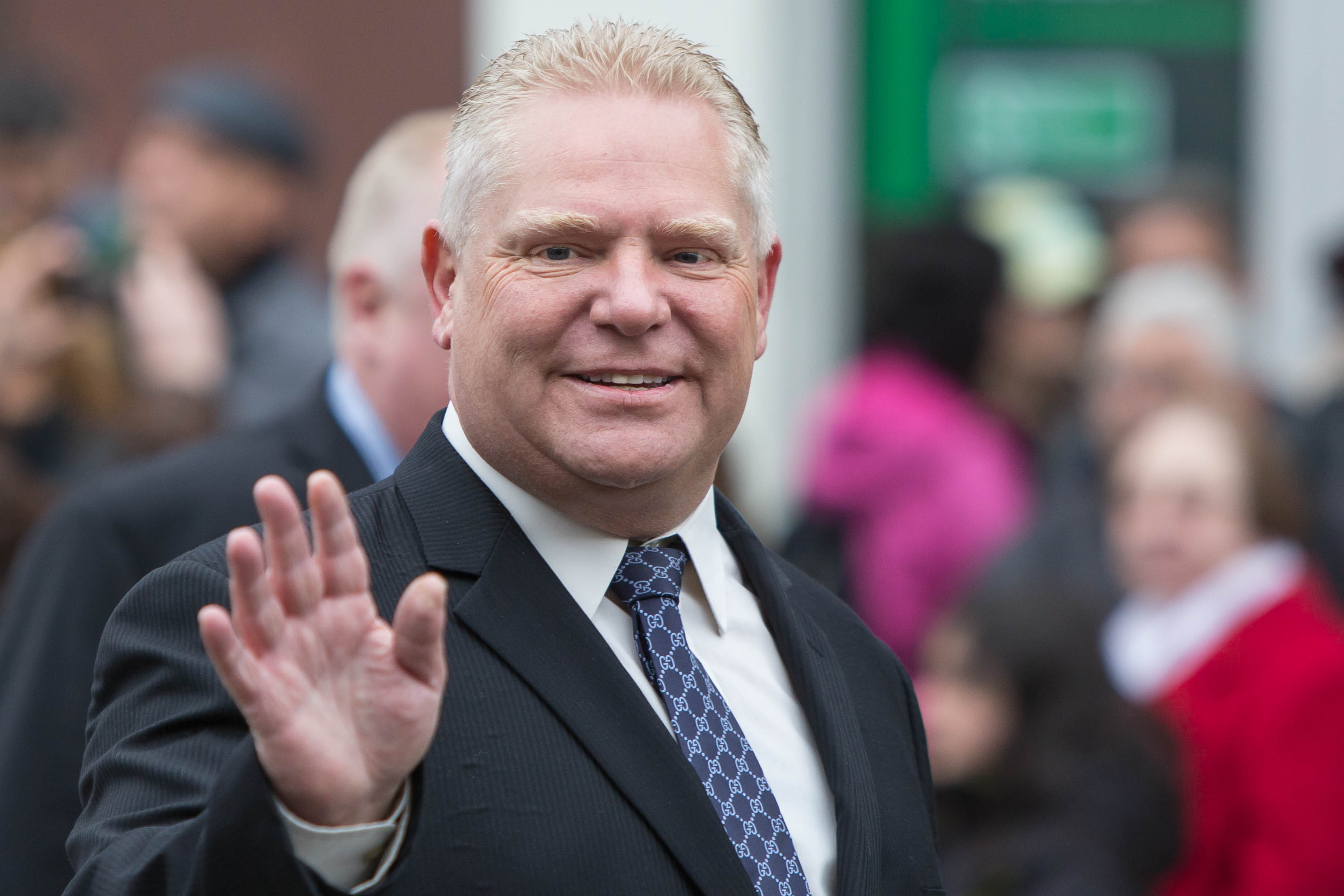
New Ontario Progressive Conservative leader Doug Ford at the 2014 Good Friday procession in East York.
Photo via Wikimedia.
In the National Post, Chris Selley reports on the three-ring circus:
In the end, maybe caucus had it right. If more than anything else Ontario’s Progressive Conservatives wanted to win on June 7 then maybe they should have stuck with interim leader Vic Fedeli. If the ultra-folksy MPP for Nipissing wasn’t the most compelling imaginable premier-in-waiting, he would certainly have cut a less divisive figure than Doug Ford, who was announced as the party’s new leader late Saturday night in a small room at a Markham conference centre.
“To the party members I say thank you. To the people of Ontario I say relief is on its way,” Ford told reporters and campaign workers. “And to Kathleen Wynne, I say your days as premier are numbered.”
That got a massive cheer, of course, but this is an outcome that many in the party consider a worst-case scenario. An Angus Reid poll released this week asked “soft” Tory voters whether each candidate would make them more or less likely to support the party: Ford’s net score (more likely minus less likely) was minus 27 per cent; Christine Elliott, who finished a very narrow second Saturday — her third failed shot at the position — was at plus 20.
Sticking with Fedeli would also have spared the party the hideous embarrassment of Saturday’s botched convention. Vote-counting dragged on for hours thanks to a chunk of ballots that had been allocated to the wrong ridings. A packed crowd of partisans was left in the dark for three hours, then told to hang tight for another 30 minutes, and then sent away into the night with no result. In lieu of a cascade of balloons, there was booing and hollering. Various Ford supporters, citing ostensibly conclusive media reports earlier in the day that Ford had won, alleged party elites were trying to steal it.
These were not the ideal circumstances in which to build unity, which was the stated purpose of the event. “You’ve been through a very tough couple of months — perhaps the toughest times in the history of the Progressive Conservative Party of Ontario,” Alberta United Conservative Party leader Jason Kenney told the crowd. “You’ve gone through weeks of anxiety and adversity. But I am certain that you will overcome this time of trial, and that this afternoon, with the election of your leader, you will emerge stronger, united and victorious in the election.”
“This afternoon,” he said. We were so young then.
CORRECTED: 2018 Ontario PC leadership electoral point flow. #onpcldr pic.twitter.com/0w89PK9Er2
— Paul Fairie (@paulisci) March 11, 2018
The flow of votes from Allen to Ford was expected, but what I didn’t expect was the proportion of Mulroney votes that flowed to Ford instead of Elliot (I’d expected roughly 100% to Elliot, but a significant number went to Ford instead).
Perhaps the most surprising thing about the leadership campaign was how well Ford managed to stick to his talking points and not be baited into the kind of media spectacle his late brother seemed to specialize in. A tougher test awaits in the June provincial election, however. The Liberals and NDP have been gifted a full warehouse of attack ads, based on the Ford brothers’ chaotic and at times incoherent term in office in Toronto, but there may be a limit to the overall usefulness of this arsenal: rather like the US media attacking Trump during the last US election, we’ve probably heard it all before.
The circus may not be over yet, however, as reports on Sunday indicated that Christine Elliot is demanding an investigation into the election.
March 10, 2018
Jacob Rees-Mogg versus the Tory establishment
In the Continental Telegraph, Hector Drummond describes the rise of Jeremy Corbyn despite the bitter resistance of the Labour party establishment and says that the mistake Labour made was allowing Corbyn on the ballot in the first place — the party rank and file were far more ideologically “left” than the MPs and party officials. “When Corbyn was elected leader, it looked like Labour had shot itself through the foot. It now looks like what actually happened was that New Labour shot itself through the heart.”
On the other side, the closest equivalent threat to the Tory party establishment appears to be Jacob Rees-Mogg:
It’s clear that the wet Tory establishment is not keen on Jacob Rees-Mogg. On the surface that appears to be because he holds robust views that are at odds with theirs: he’s an actual Conservative, and they are, of course, anything but. But I wonder if there’s a deeper fear there as well: do they worry that if Rees-Mogg becomes leader then the party will slip out of their grasp in the way that Labour was taken over by hard-left, Momentum commies?
[…]
So I suspect the Tory establishment think that at all costs Rees-Mogg must be kept off a leadership ballot, because there’s a good chance he would win: he constantly tops the polls among party members for preferred leader. You see how the thinking would go after that. He’ll appoint a dry Cabinet. The likes of Gove and Johnson would be given a freer rein. Maybe even John Redwood would come into cabinet. All the disgruntled right-wingers who’ve quit the party in recent decades would come flocking back, including all the racists. We’d have a proper Brexit. The new members would get involved in choosing more right-wing candidates in local constituencies, which the central office would now be okay with. Some centrist MPs and councillors would quit the party, and The Guardian and the BBC will big up their huffy resignation letters. Anna Soubry, having left the party, will do wall-to-wall TV interviews telling the BBC and CNN how bad the Tories are under Rees-Mogg. And so the Tories would lose voters from the middle as they come to be seen as another bunch of UKIP-style golf-club bores, and Jeremy Corbyn will win the election (which the Tory establishment will think is a horrible outcome, but not quite as horrible as Rees-Mogg winning the election).
However, such fears are a bit overblown. True, Anna Soubry probably would quit, but that’s a good thing. Disgruntled right-wingers may come back into the fold, but that’s a good thing as long for the Tories (as long as overt racists are kicked out) – the Tories need those people back voting for them, and working for them.
But I can’t see Rees-Mogg upturning the Conservative establishment. Maggie Thatcher couldn’t do it, she remained a outlier for her entire career despite being PM for years, so I doubt Rees-Mogg could either (although I hope he can). And although there’s a lot of energy on the right at the moment, there’s nothing like Momentum, with its quasi-religious fervour, and its Stalinist-style fanaticism. Plus the wider establishment, like the BBC, the civil service and the Universities are virulently anti-right, and they have a vice-like grip on power, and they’ll harry the Conservatives under Rees-Mogg. So the party would go right to some degree, but not to any great extent. And eventually the squishy MPs will kill off Rees-Mogg once he makes a mistake.
But it should be good while it lasts, as long the Establishment fails to prevent him getting onto the leadership ballot paper.
March 7, 2018
The reception Mulroney Sr. got shows how little “sizzle” the Conservatives can offer now
Chris Selley covered the recent Caroline Mulroney event featuring her father Brian:
Watching 79-year-old Brian Mulroney campaign for his daughter on Tuesday, I’d be hard-pressed to argue age matters at all.
The public-facing aspects of this leadership campaign have often been stilted, joyless and jittery, with Doug Ford carefully keeping his powder dry and Mulroney trying to build confidence without screwing up. Only Christine Elliott has often sounded passionate, confident and halfway credible all at once.
Mulroney père, on the other hand, waltzed into a packed banquet hall in Vaughan at noon on Tuesday like a conquering hero, to a standing ovation, and settled in behind the lectern like it was a favourite sweater and a mug of hot cocoa. When he was done, but for the greyer beards, the camera-wielding mob that escorted him out of the room might as well have had Justin Trudeau at its centre.
Mulroney regaled us with a smorgasbord of chucklesome anecdotes, bons mots and name-dropping. He cheerfully batted away several entreaties that he return to politics. He said he mooted the idea to Mila during Jean Chrétien’s infamous “I don’t know if I am in West, South, North or East Jerusalem” press conference in 2000.
“I think it’s a wonderful idea,” she supposedly replied, “and I know your new wife is really going to love the experience.” Much mirth!
Mulroney pooh-poohed the need for legislative experience in an aspiring premier — perhaps the biggest knock against his daughter — arguing he had none when he won the Tory leadership in 1983 and rampaged to a majority government, and suggesting he “want(s) no part of” the sort of experience that Kathleen Wynne and Co. have in spades.
“I knew Ontario when it was the driver of Confederation, the engine of Canada’s economy, a glorious leader in this country,” he prated, crediting the “strong, consistent and brilliant” leadership of Tory premiers John Robarts, Bill Davis and Mike Harris for “the large measure” of its success. “And now Ontario has been reduced to accepting equalization payments from Newfoundland and Labrador.”
[…]
Demonstrably, in Canada, you do not need a huge, room-filling personality to govern effectively. But if you haul out Brian Mulroney to campaign for you, you’re going to invite comparisons. And if you’re going to claim that the current government has literally laid waste to the province, a guy like Mulroney is liable to highlight just how modest the Conservatives’ proposals are to rebuild it all from scratch.
February 26, 2018
Taking Corbyn seriously
In The Spectator, Brendan O’Neill begins considering the threat of a Corbyn premiership:
This week, the Corbynistas bared their teeth. They gave us an insight into the mob-like authoritarianism that lurks behind the facade of their ‘kind’ politics. They insisted Jeremy Corbyn wasn’t a spy for the Stalinists while at the same time exposing their Stalinist tendencies. ‘How dare you lump us in with Stalinists?’, they cried, while in the next breath making manic-eyed videos threatening the press and forming online mobs to punish those who criticise their Dear Leader. The irony has been dark.
For the first time, I feel fearful of Corbynism. Until now, I’ve seen the Corbynistas as a somewhat tragic movement, a kind of cosplay for middle-class millennials who doll up their rather staid politics — their love of the nanny state, their fear of Brexit, their preference for identity politics over class politics — in Marxist memes and Red blather. But this week we have seen another side to them. We have seen their intolerance of rowdy political criticism, their instinct for political interference in the press. This looks increasingly like a movement of petit-bourgeois vengeance.
Exhibit A is Corbyn’s positively Trumpite threat to the press that ‘change is coming’. For all the Corbyn camp’s loathing of Trump, they share his brutish disdain for the trouble-making media. In the video, Corbyn’s contorted face takes to task right-wing newspapers that have indulged the Czech spy story over the past week, and warns that when the Corbynistas come to power there will be a shake-up of press ownership and pressure on press oligarchs to pay more taxes.
His supporters present this an anti-establishment act: a brave Labourite standing up to filthy rich newspaper men. Please. Corbyn’s threatening video was directly inspired by the press’s attacks on him over the past week. He publicly denounced the press in the manner of a tinpot tyrant for one reason only: because the press has been ridiculing his naff, Soviet-tinged shenanigans in the late 1980s. This is political interference: angry at the press attacks on him, he whipped up an online mob to agitate for more press control.
[…]
The Corbynistas’ reactionary clamour for official interference in the press was captured in an article at Novara Media, home to the weird mix of nanny statism, anti-democracy and middle-class pity for the poor that motors the millennial wing of the Corbynista movement. It congratulated Corbyn for ‘send[ing] shivers down the spine of the media establishment’, and promised that under a Labour government Leveson 2 would ‘finish the job and open up this bankrupt industry’. This promise of Leveson 2 is reason enough never to vote for Corbyn’s Labour: it would ride roughshod over the great radical history of this nation, from the Levellers to the Chartists, all of whom were repulsed by the idea of state meddling in the press.
February 8, 2018
Dilbert’s Scott Adams Explains How He Knew Trump Would ‘Win Bigly’
ReasonTV
Published on 7 Feb 2018The cartoonist-turned-political-prognisticator talks about Trump, “master persuaders,” and winning arguments in a “world where facts don’t matter.”
—————-
In 2015, Scott Adams, the cartoonist behind the massively popular comic strip Dilbert, boldly predicted that Donald Trump would win the 2016 presidential election.
“The reason I can see it coming is because I have studied this field of persuasion,” says Adams. “I saw this Trump character and he had the full tool set.” The 60-year-old Bay Area resident doesn’t agree with Trump on many political issues, but his prediction was enough for his to receive death threats from embittered Hillary Clinton supporters.
Adam’s new book, Win Bigly: Persuasion in a World Where Facts Don’t Matter, is both a detailed analysis of how Trump reframed political rhetoric during the 2016 campaign and a guide to how all of us can communicate more effectively and persuasively.
Adams sat down with Reason‘s Nick Gillespie in front of a live audience in San Francisco to talk about his book, his “extreme liberal” views, the popularity of his live broadcasts with followers via Twitter, and why Trump is a “master persuader.”
Cameras by Zach Weismueller, Paul Detrick, and Justin Monticello. Edited by Ian Keyser.
February 6, 2018
January 12, 2018
President Oprah?
I didn’t watch the TV or movie awards show that Oprah used to launch her presidential campaign test balloon, but many others did. Those who watched it generally came away very impressed, based on mentions in my various social media feeds. Those who read it later include skeptics like Colby Cosh:
The Oprah for President boomlet didn’t last long, did it? Oprah Winfrey is somebody who has been discussed occasionally as a semi-serious presidential candidate since the early 1990s. The talk-show hostess accumulated so much cultural and financial capital so quickly, once she became a national television figure, that the thought has always been universal: if she really wanted to run, it is hard to see how she could be stopped.
Indeed, if the Americans elected her, she would undoubtedly turn out to have the same sort of presidential “pre-history” that Donald Trump did. People had been making “President Trump” jokes for ages, although we never noticed quite how many of those jokes there were until they all came true and weren’t jokes anymore.
On Sunday night, Oprah give an acceptance speech for a lifetime-achievement award at the Golden Globes, and people found it so stirring that it started a mini-wave of “Oprah 2020” references and remarks on social media. What was most interesting about the speech was not its intensity or its profundity, but the fact that it was, self-evidently, designed as a political candidate’s address.
[…]
If you would like a Hollywood liberal president, or any president other than the one the United States has, criticizing Oprah goes against your immediate partisan interests. (At least it probably does. Is anyone really too sure about the character of her personal core politics?) There is no sense denying it: if she did run, she probably could win. In 2016 we all got a stark lesson in just how much televisual familiarity, a large personal fortune, and control of media attention can accomplish in a presidential election.
And, of course, she has enormous charisma. Even those of us who think her influence on American culture has been baleful must acknowledge there is something magnificent and stately about her, and that she represents the American dream about as well as any individual human could. Financially, Donald Trump can only dream of having her track record — and, probably, her fortune.
It doesn’t mean she should be president. One almost suspects that the Oprah 2020 trial balloon might have enjoyed more success if it had been launched six months ago. Amid the tearful liberal trauma that followed the defeat of Hillary Clinton, the Most Qualified Presidential Candidate Of All Time, the despairing temptation to seek a television president even more familiar than Trump was bound to be more powerful. The passage of time, combined with Ms. Clinton’s obnoxious re-litigation of a strategically dumb campaign, may have helped blue America regain its senses. This is, I think, good news. And not just for the liberals.
December 29, 2017
Autopsy of the “Remain” campaign – but the rules only apply to the little people!
It’ll be interesting to see if anything comes of this:
The Remain campaign flouted Electoral Commission rules so it could overspend by up to £7.5 million during the referendum, a Guido investigation can reveal. Over the next few days Guido will be looking at how the various Remain groups coordinated their messaging, campaign plans, data, materials and donations, causing them to overspend by more than double the legal limit. Sorry Electoral Commission HQ, you’re going to have to come back early from your Christmas holidays…
The Electoral Commission rules are clear: if one campaign “coordinates [its] activity with another campaigner”, then they are “highly likely to be working together”. This definition of “working together” is important, because the Electoral Commission also says: “the lead campaign group must count all of the spending of all the campaigners it works together with towards its own limit”. Guess what… they didn’t.
Two books provide detailed accounts of a number of Remain campaigns coordinating plans and working together in the weeks leading up to the referendum. Tim Shipman’s All Out War reveals “[Craig] Oliver led an early-morning conference call for the media teams at 6.15am. At 7.30am there was a second conference call, in which Stronger In would tell Labour In, Conservatives IN and the Liberal Democrats about their plans for the day”. This clearly counts as “coordinating” and “working together” under the Electoral Commission’s definition.
December 16, 2017
Why not try a truly independent “independent counsel”?
Jay Currie suggests someone the US government could bring in to investigate the whole “deep state” mess who would not be in any way tainted by past contacts or entanglements:
The American mess is deep and sordid and, frankly, needs to be cleaned up. But by who?
The fact is that virtually any special counsel appointed by the DOJ will be tainted one way or another. And so, apparently, will investigators drawn from the FBI. It is a mess but it also needs to be resolved.
So, a friendly suggestion from Canada.
Our deeply respected, longest serving, Chief Justice of the Supreme Court of Canada is retiring at the end of the year. Beverly McLaughlin, while I disagree with some of her opinions, is tough, fair-minded and very, very, smart. By the nature of her position, she is “read in” on intelligence and security cleared. She’ll be bombarded with job offers but, if asked nicely, might be willing to lead an investigation into the whole ball of wax which the 2016 American election created. Russians, Hilly’s server and how it was dealt with by the FBI, Lynch on the tarmac with Bill, Mueller, Comely: the whole thing.
But Bev is not enough. Sending a small detachment of the RCMP – white collar and intelligence – with her, with really serious investigative powers, would get the whole mess cleared up in six months. (The scarlet tunics would be optional but would make great tv as they raided offices and homes of the swamp creatures.) McLaughlin would not proffer charges, rather she would write a report and recommend such charges as arise.
Better still, the Chief Justice and the Horsemen would be paid for – independently – by the Canadian government with a bill to be presented to our American cousins at the end of the investigation.
Sometimes the mess is so big you need an independent professional to clean it up. This is one of those times.
December 1, 2017
“Maybe Trump’s voters aren’t angry enough yet”
One of the most disturbing phenomena of modern American political discourse is just how badly Trump’s critics are doing their jobs. It’s almost as though they’re collectively trying to get him another term in office. ESR has a bit of a rant:
I have more and more sympathy these days for the Trump voters who said, in effect, “Burn it all down.” Smash the media. Destroy Hollywood. Drain the DC swamp. We’ve all long suspected these institutions are corrupt. What better proof do we need than their systematic enabling of rape monsters?
As a tribune of the people Trump is deeply flawed. Some of his policy ideas are toxic. His personal style is tacky, ugly, and awful. But increasingly I am wondering if any of that matters. Because if he is good for nothing else, he is good for exposing the corruption, incompetence, and fecklessness of the elites – or, rather in their desperation to take him down before he breaks their rice bowls they expose themselves
Yeah. Is there anyone who thinks all these rocks would be turning over if Hillary the serial rape enabler were in the White House? Nope. With her, or any establishment Republican, it’d be cronyism all they way down, because they’d feel a need to keep the corrupt elites on side. Not Trump – his great virtue, perhaps overriding every flaw, is that he doesn’t give a fuck for elite approval.
Maybe Trump’s voters aren’t angry enough yet. It’s not just a large number of women our elites have raped and victimized, it’s our entire country. Our infrastructure is crumbling, our debt is astronomical, our universities increasingly resemble insane asylums, our largest inner cities are free-fire zones terrorized by a permanent criminal underclass. And what’s the elite response? Oh, look, a squirrel – where the squirrel of the week is carbon emissions, or transgender rights, or railing at “white privilege”, or whatever other form of virtue signaling might serve to hide the fact that, oh, look they put remote-controlled locks on their rape dungeons.
It’s long past time for a cleansing fire.


