Quotulatiousness

May 4, 2017

Marine Le Pen may win or lose on May 7th, but the voters she represents will not go away

Filed under: Europe, France, Politics — Tags: , , , , — Nicholas @ 05:00

Bill Wirtz on the long-term trends that may or may not be represented in the voting for the second round of voting in the French presidential elections:

After the first round of voting last Sunday, the French electorate decided to send independent candidate Emmanuel Macron (23.8 percent) and far-right nationalist Marine Le Pen (21.6 percent) to the next round of voting on May 7th.

Opponents of Le Pen’s radical policies are now calling for a gathering of the so-called “Front Républicain,” the Republican Front.

Inspired by the name of Le Pen’s National Front, the Republican Front gathers those who reject the rampant nationalist positions of the French far-right, which they consider contrary to the “Republican spirit.”

While not an established party in itself, the Republican Front represents a coalition of different parties in the République against a particularly unpopular candidate like Marine Le Pen. […]

For many French voters, the second round is an ideological dilemma. If for instance, the candidate they were supporting fails to progress to the next round, they may be more or less forced to throw their support behind a candidate with whom they have severe disagreements.

Now, the country’s political role models and media personalities expect the electorate to cast a “vote utile,” the “useful vote,” preventing Le Pen from coming to power. And ultimately that is exactly what will happen.

Both candidates will get involved in heated debates but in the end, the gathering of the Republic Front, with all mainstream parties rallying behind Macron in order to avoid Le Pen, will prevent the French nationalist from taking the Elysée Palace.

And yet, the consequences of this policy might be dangerously ill-advised.

Ici Londres: Do Theresa May’s opponents seriously prefer Juncker?

Filed under: Britain, Europe, Politics — Tags: , , , — Nicholas @ 04:00

Published on 3 May 2017

May 2, 2017

Britain’s “foregone conclusion” election

Filed under: Britain, Europe, Politics — Tags: , , , , , — Nicholas @ 05:00

Colby Cosh provides a thumbnail sketch of how Britain got to the point of having an election where the end result is not in great doubt, and the likely losers and big losers:

[British PM Theresa May] has now broken that promise [to serve the full term her party won in 2015], unapologetically. Any half-sane politician’s instinct would tell her that this is an incredibly dangerous thing to have done, and we all know that voters generally loathe unnecessary election activity, or that they pretend to. But the current polls suggest that the British public completely understands why she broke the promise, that they approve of her breaking it, and that they intend to reward her for it. If you follow the UK election as a Canadian, you will hear May talking about “strong and stable” government at about 200 RPM, in exactly the same way Stephen Harper used to. This is no coincidence.

The Labour Party is torn between the old-fashioned socialist militants who made Jeremy Corbyn leader and the respectable corporate types who actually run the party and serve in the House of Commons. The UK has legislation requiring fixed-term parliaments, so May needed the support of Labour in a Commons vote in order to hold an early election. A Parliament can still be dismissed early if there is a vote of no confidence in the government, or if two-thirds of MPs vote to allow it.

Which they did. Corbyn loyalists, uncertain whether their man could survive as leader until 2020, had little reason not to consent to the snap vote. Labourite Corbyn-haters, seeing a chance to dispose of their village-Marxist boss without the dangers of a party coup, went along too. They almost seem to be half-throwing the election, relieved to have some prospect of Labour returning to power before 2025.

Meanwhile, the Scottish National Party, seemingly in firm control of Scottish politics and culture, made the Quebec mistake of talking about another independence referendum too soon after losing one. It is a classic shark jump. The people of Scotland seem to have realized that within Scotland, the UK general election will be a referendum on whether they want another divisive, stressful independence struggle right away.

This is not looking like good news for the strident but useless SNP delegation to Westminster. Polls show the Conservatives running a strong second in Scotland, with a chance of taking ten or so seats away from the Nats. Four years ago, I would have fully expected to be typing “Jesus Christ just held a press conference in Clackmannanshire” before I typed the words in that last sentence.

May 1, 2017

“We can leave aside the idea of a libertarian revival. No one in or near government wants less control by the State”

Filed under: Britain, Europe, Liberty, Politics — Tags: , , , , , — Nicholas @ 04:00

Sean Gabb reflects on the coming British general election (where he’s decided to hold his nose and vote Conservative, despite his strong distaste for Theresa May’s governing style and the party itself):

… we are entering an age of rapid ideological change. Questions of whether we should have identity cards, or if the authorities should be able to censor the media, are becoming less important than the questions of who makes these decisions, and how they are made. There is not – and probably, in my lifetime, never has been – a libertarian option in British politics. The choice has always been so far which elements of a broadly leftist-authoritarian agenda should be pushed hardest. The choice now is between a Conservative Government that has no electoral interest in leftism, and limited inclination to uphold its hegemony, and various parties that will try to keep that hegemony going till it fully shrivels away. The Conservative Party is an organisation of frauds and liars. Its directors are in the pocket of any interest group with money to spend. Though split on exactly what it believes, however, Labour is a party of true believers. The Conservatives will do evil by inertia, Labour by choice. Without hope of immediate improvement, I will vote Conservative.

Give her a decent majority, and Theresa May will take us out of the European Union on acceptable terms. These terms will be available almost for the asking. The European Union is little more than the agent of twenty seven governments, all with conflicting interests. The British Government will have a fresh mandate to act on behalf of a unitary state. Mrs May is no fool, and she must understand that her hold on power and her place in the history books are both contingent on how she manages our disengagement. Her lack of principle is beside the point – or may be an advantage.

And then?

We can leave aside the idea of a libertarian revival. No one in or near government wants less control by the State. Hardly any of the electors want it. This is probably for the best. I have been an insider on the British free market movement for about forty years. Those who run it are willing to nod approvingly whenever freedom of speech is mentioned, or due process of law. The mainstream utopia, though, involves full speed ahead for the City banking casinos, and an immigration policy that will stuff the rest of us into sixty-storey tower blocks of bedsitting rooms. What we can more likely expect – and hope for – is what I will delicately call a revival of national identity. This will eventually involve some regard for historic liberties. It will also involve a degree of directed reindustrialisation, and even a pretty generous welfare system.

April 19, 2017

Voting against “Father Turk”‘s legacy

Filed under: Europe, Government, Religion — Tags: , , , — Nicholas @ 04:00

The secular Turkish Republic is fading fast, as the results of the Turkish referendum amount to a concentration of vast powers in the hands of Recep Tayyip Erdoğan. We sometimes joke that Vladimir Putin is the new Tsar, but it’s less funny to refer to Erdoğan as the new Sultan … because it’s much closer to being true:

On Jan. 20, 1921, the Turkish Grand National Assembly passed the Teşkilât-ı Esasîye Kanunu, or the Law on Fundamental Organization. It would be almost three years until Mustafa Kemal — known more commonly as Ataturk, or “Father Turk” — proclaimed the Republic of Turkey, but the legislation was a critical marker of the new order taking shape in Anatolia.

The new country called Turkey, quite unlike the Ottoman Empire, was structured along modern lines. It was to be administered by executive and legislative branches, as well as a Council of Ministers composed of elected representatives of the parliament. What had once been the authority of the sultan, who ruled alone with political and ecclesiastic legitimacy, was placed in the hands of legislators who represented the sovereignty of the people.

More than any other reform, the Law on Fundamental Organization represented a path from dynastic rule to the modern era. And it was this change that was at stake in Turkey’s referendum over the weekend. Much of the attention on Sunday’s vote was focused on the fact that it was a referendum on the power of the Turkish presidency and the polarizing politician who occupies that office, Recep Tayyip Erdogan. Yet it was actually much more.

Whether they understood it or not, when Turks voted “Yes”, they were registering their opposition to the Teşkilât-ı Esasîye Kanunu and the version of modernity that Ataturk imagined and represented. Though the opposition is still disputing the final vote tallies, the Turkish public seems to have given Erdogan and the AKP license to reorganize the Turkish state and in the process raze the values on which it was built. Even if they are demoralized in their defeat, Erdogan’s project will arouse significant resistance among the various “No” camps. The predictable result will be the continuation of the purge that has been going on since even before last July’s failed coup including more arrests and the additional delegitimization of Erdogan’s parliamentary opposition. All of this will further destabilize Turkish politics.

[…]

The AKP and supporters of the “yes” vote argue that the criticism of the constitutional amendments was unfair. They point out that the changes do not undermine a popularly elected parliament and president as well as an independent (at least formally) judiciary. This is all true, but it is also an exceedingly narrow description of the political system that Erdogan envisions. Rather, the powers that would be afforded to the executive presidency are vast, including the ability to appoint judges without input from parliament, issue decrees with the force of law, and dissolve parliament. The president would also have the sole prerogative over all senior appointments in the bureaucracy and exercise exclusive control of the armed forces. The amendments obviate the need for the post of prime minister, which would be abolished. The Grand National Assembly does retain some oversight and legislative powers, but if the president and the majority are from the same political party, the power of the presidency will be unconstrained. With massive imbalances and virtually no checks on the head of state, who will now also be the head of government, the constitutional amendments render the Law on Fundamental Organization and all subsequent efforts to emulate the organizational principles of a modern state moot. It turns out that Erdogan, who would wield power not vested in Turkish leaders since the sultans, is actually a neo-Ottoman.

Mark Steyn says “I told you so”:

As they used to say way back when in the long Ottoman twilight, the Turk is the sick man of Europe. Following this weekend’s Caliph-for-Life referendum, the Turk is sicker than ever. But he’s no longer of Europe, and instead is exiting for a destination dark and catastrophic for almost all his neighbors.

Sultan Erdoğan – who, a mere 15 years ago, was banned from holding political office – has now succeeded in dismantling almost every defining element of the Kemalist republic. What replaces it will be a crude strongman state in service of Islamic imperialism. I have read a lot of commentary this morning, starting with Douglas Murray’s “Turkish Democracy Has Just Died” and moving on to Yavuz Baydar’s “The End Of Turkey As We Know It” via Alex Alexiev’s “Who Lost Turkey?” And several readers have been kind enough to inquire where’s my own “Who Lost Turkey?” piece. Well, the truth is I published it exactly ten years ago, to the day of Erdoğan’s referendum. From the April 16th 2007 edition of National Review, “De-Boning Turkey“:

    The modern secular Muslim state – a country that gave women the vote before Britain did and was Israel’s best friend in an otherwise hostile region – certainly, that Turkey seems to be being de-boned by the hour: it now has an Islamist government whose Prime Minister has canceled trade deals with Israel, denounced the Iraqi elections, and frosted out the US Ambassador because he was Jewish; a new edition of Mein Kampf is prominently displayed at the airport bookstore. In other words, the Zionist Entity’s best pal is starting to look like just another cookie-cutter death-to-the-Great-Satan stan-of-the-month.

In fairness to the new Caliph, ever since he emerged from his semi-pro footballing career to run for Mayor of Istanbul, he’s played a more cunning game than the stan-of-the-month loons. As he said in one of his most famous soundbites, democracy is a bus you ride to the stop you want – and then you get off. And he was quite happy to take the scenic route, stop by stop by stop. In the two or three years after he came to power, I was assured that he was a “moderate Islamist” not merely by the all the foreign-policy think-tank “experts” but even by his political rivals in the previous Kemalist government. […]

Here’s a third graphic – yesterday’s referendum results. The Kurdish south-east, the old secular Rumelian west – and in between the vast green carpet of a new post-Kemalist caliphate:
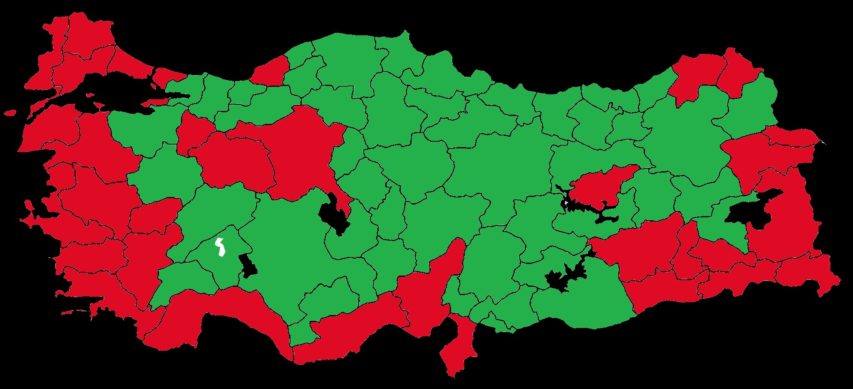
Turkish referendum results, “yes” voting areas in green, “no” in red.

Overlay the fertility rates on the electoral results: demography proved destiny. As you’ll recall, Kemal Atatürk was born Mustafa Kemal. The new moniker was a title bestowed on him by the post-Ottoman parliament. Atatürk means “Father of the Turks”. Alas, he wasn’t father of enough of them. And the men who were had other ideas about Turkey’s future. We’ve all met charming, urbane, witty, secular Turks. I worked with one recently, and enjoyed his company immensely. But on that ever expanding big green Islamic carpet from east to west there’s no place for them.

March 31, 2017

QotD: Government as Superman … reality as Kryptonite

Filed under: Bureaucracy, Government, Politics, Quotations, USA — Tags: , — Nicholas @ 01:00

… politics is all details. And each of those tiny little details has to be endlessly negotiated, because the system is set up precisely to frustrate a powerful guy with a big idea. You may recall your middle school social studies teacher talking about “checks and balances.” This is what that looks like. Kryptonite, if you will.

So there is no shortcut around the long days spent debating whether the tax credit should be 3.45 percent or 3.65 percent, and drafting pages of legislation that amend some obscure subclause of the immigration code to read “that” rather than “which,” and ending up with a middling, pork-riddled program that costs too much and doesn’t do anything close to what its visionary proponents promised.

Governing is not like building a building; it’s not like running a business. It’s like, well, trying to herd three branches of government in roughly the same direction. These branches are composed of thousands of people, each of whom has their own agenda, and represents millions more, each of whom has their own agenda, and will hound out of office anyone who strays too far from it. This is a wildly ponderous and inefficient way to do anything, which is why I am a libertarian; almost anything can be done better when you’re not trying to build it by a committee.

But in a representative democracy, this is what we have. There is no superhero strong enough to overcome the villain. There is actually not even a villain to defeat, only the unslayable amoeboid agglomeration of 300 million citizens’ worth of unenlightened self-interest. In the immortal words of P.J. O’Rourke: “Every government is a parliament of whores. The trouble is, in a democracy the whores are us.”

Megan McArdle, “Voters Want Change. Candidates Disappoint. Repeat.”, Bloomberg View, 2015-08-21.

March 24, 2017

Kathleen Wynne … the Ontario Liberal Party’s saviour?

Filed under: Cancon, Politics — Tags: , , , , — Nicholas @ 05:00

Chris Selley tries to position Ontario Premier Kathleen Wynne as being the greatest asset of the Liberal Party:

The question of Kathleen Wynne’s future as leader of the Ontario Liberal Party made its way to the public airwaves this week in the form a panel discussion on TVO’s The Agenda. Host Steve Paikin asked former Liberal MP Greg Sorbara what advice he would offer the premier, and his response caused a bit of a stir.

“It is extremely unlikely that you’ll win the next election. The facts are the facts,” he said he would tell her. “I have not seen a party in the last year of its mandate turn (poll) numbers around when they are as bad as (the Liberals’) are.” And he noted the numbers are “particularly bad” for Wynne personally.

The latest Mainstreet Research/Postmedia poll, released last week, had the Liberals at 22-per-cent support, 10 points behind the Tories. Forum Research last measured Wynne’s approval rating at 11 per cent, and her disapproval rating at 77 per cent. Just nine per cent said she would make the best premier of the three party leaders.

Okay, so where does Wynn come off as the Liberals’ best hope?

If Liberals are worried “it’s all over,” as Sorbara put it, I would submit it’s in large part because, on election day 2018, they’ll have been in power for 15 and a half not very impressive years. That’s the longest streak in Ontario in three decades. No party has managed it federally since St. Laurent took over from Mackenzie King.

Stuff builds up.

Stuff like, you know, Dalton McGuinty promising in writing not to raise taxes, then instituting a “health premium,” which he claimed wasn’t a tax, and then admitting under duress that it was a tax; like lottery retailers defrauding players to the tune of $100 million, and casinos managing to lose money; like allowing Ornge to spin out of control into corruption, mismanagement and overspending; like the electronic health records debacle; like turning a blind eye while native protesters illegally occupied Caledonia; like flushing a billion dollars or so down the john to cancel gas plants sooner than risk voters’ ire, then claiming there’s “no wrong time to make the right decision;” like various apparatchiks winding up arrested for little things like bribery and conspiring to delete government emails; like taking hundreds of thousands of dollars from companies that benefit from government largesse, shamelessly demanding cash for access to ministers, and only changing the rules when it finally became politically untenable; like a debt-to-GDP ratio that grew 40 per cent, from third-lowest among the provinces to fourth-highest; and like astronomical hydro bills born to a significant degree of bad political decisions.

All of that, and yet Wynne somehow managed to get a majority government last time around. Ontario’s masochistic voters clearly do deserve to get it, as Mencken said, “good and hard”.

February 8, 2017

QotD: Camille Paglia on who should have run for president

Filed under: Politics, Quotations, USA — Tags: , , , , — Nicholas @ 01:00

reason: So what is it about Hillary that bothers you?

Paglia: She’s a fraud!

reason: Explain how.

Paglia: She can’t have an opinion without poll-testing it. She’s a liar. This is not a strong candidate for our first woman president. To me, Dianne Feinstein should have presented herself.

reason: Ah! Are you kidding?

Paglia: No. I don’t care what her views are. What I’m saying is, for the post of president — that’s commander in chief of the military. It’s got to be a woman with a familiarity with military matters and [who] also has gravitas. And Dianne Feinstein, I first became aware of her after those murders [of San Francisco Mayor George Moscone and Supervisor Harvey Milk] that occurred in City Hall…

reason: She certainly never lets you forget that she was there.

Paglia: No. But I have never forgotten because it was one of the great moments where a woman took charge in absolute chaos after a barbarous murder. The whole government was falling apart, and she came to the media and gave the news and was steady. And I said, “That’s it. That’s the formula for the first woman president.”

So what I’m interested in is what is very important in this modern era: How do you use the media to communicate? If you’re going to be a woman president, she must communicate strength, reserve, and yet compassion. That formula — I’ve been waiting, and waiting, and waiting for it. The only person in America who’s had it as far as I’m concerned was Dianne Feinstein, and she didn’t put herself forward for whatever reason as president.

But Hillary does not have it. Hillary is a mess. And we’re going to award the presidency to a woman who’s enabled the depredations and exploitation of women by that cornpone husband of hers? The way feminists have spoken makes us blind to Hillary’s record of trashing [women]. They were going to try to destroy Monica Lewinsky. It’s a scandal! Anyone who believes in sexual harassment guidelines should have seen that the disparity of power between [Bill] Clinton and Monica Lewinsky was one of the most grotesque ever in the history of sex crime. He’s a sex criminal! We’re going to put that guy back in the White House? Hillary’s ridden on his coattails. This is not a woman who has made her own career. The woman failed the bar exam in Washington! The only reason she went to Arkansas and got a job in the Rose Law Firm was because her husband was a politician.

Camille Paglia, “Everything’s Awesome and Camille Paglia Is Unhappy!”, Reason, 2015-05-30.

February 4, 2017

Trudeau’s promise to reform the election system: “It had ‘face-melting political blowback’ written all over it”

Filed under: Cancon, Politics — Tags: , , , — Nicholas @ 02:00

My headline distorts Chris Selley‘s message a bit, but he does correctly point out that Justin Trudeau’s promise was a cynical ploy to attact NDP votes to Liberal candidates, not a genuine commitment to move away from FPTP in our federal election system:

So far as I can tell, the publicly stated evidence that senior members of the Liberal party had any interest in changing the electoral system amounted to Justin Trudeau’s single expression of interest in ranked ballots. There was no evidence at all to suggest any senior party members thought FPTP was the worst electoral system imaginable for Canada — the only interpretation of the platform promise. That being the case, the promise was far too conveniently enticing to New Democrat voters to take at face value.

As to referendums: ample Canadian precedent holds that electoral reform is contingent upon them. And a cursory glance at public opinion made plain that nothing justified breaking that precedent. An Abacus Data poll for the Broadbent Institute, published shortly after the 2015 election, asked respondents to rank their preferences among the current system, mixed-member PR (MMP), pure PR and ranked ballots. The most popular first choice by far, at 43 per cent, was the current system; it was also the second-most popular second choice. The most popular alternative, MMP, was the first choice of only 27 per cent.

No consultative process could fashion a referendum-free consensus from that. It had “face-melting political blowback” written all over it.

February 1, 2017

“This unapologetic Luddism is what passes for futurism in leftist circles these days, I fear”

Filed under: Economics, Europe, France, Politics — Tags: , , , , — Nicholas @ 04:00

Colby Cosh looks at the tribulations of the French Socialist party (the rough equivalent of Canada’s “Natural Governing Party”) as they scramble to remain meaningful in the upcoming elections:

[Benoît] Hamon’s candidacy will provide a first serious electoral test of the ultra-trendy universal basic income idea. His proposal is for a universal income of €750 a month, or about $1,050 in Canadian currency. This is none too generous an amount to live on, even granting that France is a hell of a nice place to be poor. But without other sources of financing, such a UBI might require nearly an immediate doubling of French state revenue, even if you count the existing welfare programs France could get rid of.

Valls expended a lot of effort challenging Hamon’s math, to little apparent avail. Hamon has “plans” to raise new revenue, mostly of a hand-wavy sort that will be familiar from the worst sort of Canadian provincial election. But his tax on robots and artificial intelligences is certainly a fun new wrinkle.

On hearing of the idea, the advanced, full-blooded nerd will immediately think of Frank Herbert’s Dune novels. Herbert, finding it amusing to construct a science-fiction universe without computers, created a backstory in which humans had risen up in an enormous, ultra-violent “Butlerian Jihad” and established a pan-galactic religious taboo: “Thou shalt not make a machine in the likeness of a human mind.”

For, after all, any machine that mimics human operations, mechanical or cognitive, takes away a potential job from a human being, or from dozens of them. That is the premise of the “robot tax”, and, by all logic, it should apply to computers. Or, for that matter, to any labour-saving device — any device that multiplies human productivity at all. Pens. Crocs. Red Bull.

This unapologetic Luddism is what passes for futurism in leftist circles these days, I fear. The sense that automation finally went too darn far, in the year 2015 or thereabouts, finds willing hearers everywhere in communities that used to be able to count on beer-bottling plants or fish canneries or automotive assembly lines. The universal basic income is of interest to future-minded politicians because that low-skill mental and physical work seems to be disappearing. Some see an approaching world in which scarcity of goods is transcended, by dint of robots and 3D printing and machine learning, and most humans have no opportunities for productive work.

December 9, 2016

The Trudeau government’s bad times

Filed under: Cancon, Media, Politics — Tags: , , , — Nicholas @ 02:00

Chris Selley on the (largely self-inflicted) hard times of Justin Trudeau’s government recently:

It has been one hell of a couple of weeks for the Liberal Party of Canada: first Prime Minister Justin Trudeau’s bizarre encomium to dearly departed Fidel; then the approval of two pipelines projects, dashing the oil-free dreams of people who hadn’t been paying attention and producing thousands of barrels of fake outrage; and then, the inevitable collapse of the government’s electoral reform agenda.

It was always going to look bad. The Liberals were always going to break their promise to make 2015 the last first-past-the-post election. Perhaps they had even contemplated their members on the electoral reform committee recommending they break it, by adopting a go-slower approach. But no one, surely, anticipated Democratic Institutions Minister Maryam Monsef accusing the committee as a whole of not doing the job she had set out for them, which they had; mocking the Gallagher Index, an easily explicable formula for measuring proportionality in election results; and justifying herself with shameless bafflegab that would make Paul Calandra blush.

[…]

Monsef later apologized for accusing committee members of slacking, Manon Cornellier notes in Le Devoir, but not for misrepresenting their mandate, mocking mathematics — as an emissary of the party of “evidence-based policy,” no less — and generally behaving like a buffoon.

“(Monsef’s) beef with the Gallagher Index isn’t that it only measures proportionality. Her beef with the Gallagher Index is that it’s math, with its sums of squares and square roots and symbols that are literally Greek,” Fine fumes. It’s a worrying outburst of idiocy, she argues. Monsef and her ilk talk constantly of “engagement,” but that’s a very difficult thing to measure. “At the intersection of ‘affinity for engagement’ and ‘contempt for metrics’ is fertile breeding ground for leaders who wish to make up their own rules,” Fine trenchantly observes.

December 4, 2016

Conservative leadership race – Bernier and Chong at the “grownups’ table”

Filed under: Cancon, Politics — Tags: , , , — Nicholas @ 02:00

Chris Selley surveys the competition for federal Conservative leader:

Kellie Leitch has won the most headlines thus far, thanks to her store-bought populist appeal to suspicions about immigrants’ values and grievances with the political establishment. Campaign manager Nick Kouvalis is playing the media like a fiddle: at every mention of screening immigrants for “Canadian values” we squeal and writhe with high-toned outrage, incredulity and mockery. Kouvalis simply collates it, presents to the considerable majority of Canadians who think it’s a perfectly reasonable idea, and asks if they would support both the policy itself and the policy sticking in the craw of these jumped-up “elites.” The answer in many cases seems to be yes.

At the grownups’ table, however, a proper battle for the sanity and the soul of the Conservative Party of Canada has taken shape. Michael Chong reminds party supporters that a fiscally conservative party that claims to want to fight climate change should support market-based tools to get the job done — the simpler the tool (i.e., a carbon tax), the better. As leader, Chong could credibly hold a Liberal government to account for its less-than-pure commitment to carbon pricing and its inevitable failure to meet emissions targets.

Maxime Bernier reminds Conservatives that in 10 years, the party did almost nothing about Canada’s insane supply management systems. There is a constituency that believes a free market in dairy would of necessity pump our children full of bovine antibiotics, hormones and steroids. There is a much larger constituency that trusts Canada’s food safety system and would prefer cheaper groceries. If a conservative party can’t sell free markets when the upside is cheaper groceries and the downside is inconvenienced millionaire quota owners, it should close shop.

Bernier planted himself even more squarely in the Canadian policy mainstream with his recent proposal to reform the CBC as an ad-free broadcaster focused on “what only it can do” in a modern media market: he suggested more local programming, documentaries and foreign correspondents, “more programs about science, history, or religion.” He proposed a funding model like NPR and PBS, which rely heavily on private and corporate donations.

For the record, I don’t think carbon taxes are the way to go, as experience should tell us that governments rarely if ever bring in “revenue neutral” tax changes, and the carbon tax would end up being added to existing tax tools, rather than replacing them. I’m also on the record as being a fan of Mad Max for PM (although I’m not a Conservative, he’s the most libertarian mainstream politician since Laurier).

November 28, 2016

The Liberal Archipelago

Filed under: Politics, USA — Tags: , , — Nicholas @ 02:00

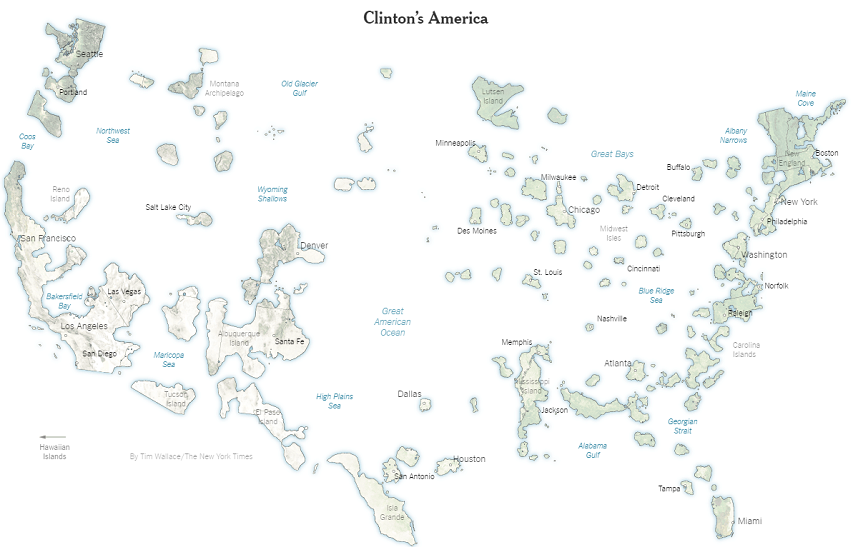
The New York Times analyzed the voting patterns from the 2016 presidential election and outlined the distinctive areas where Democratic and Republican voters dominated. The Republican map looks mostly like the continental US with a few urban voids, but the Democratic map looks like an elaborate archipelago of islands in a wide open seascape:

the-liberal-archipelago-of-2016

November 18, 2016

Scott Alexander – “You are still crying wolf”

Filed under: Media — Tags: , , , , , — Nicholas @ 03:00

Donald Trump is President-elect, but he didn’t get there by pandering to white supremacist and racist voters, but you’d never know that by how his campaign was reported in the media. Scott Alexander says that the media still hasn’t learned its lesson and is still crying wolf:

Back in October 2015, I wrote that the media narrative of Trump as “the white power candidate” and “the first openly white supremacist candidate to have a shot at the Presidency in the modern era” were being fabricated out of thin air. I said that “the media narrative that Trump is doing some kind of special appeal-to-white-voters voodoo is unsupported by any polling data”, and predicted that:

    If Trump were the Republican nominee, he could probably count on equal or greater support from minorities as Romney or McCain before him.

Well, guess what? The votes are in, and Trump got greater support from minorities than Romney or McCain before him. You can read the Washington Post article, Trump Got More Votes From People Of Color Than Romney Did, or look at the raw data (source)

We see that of every racial group, the one where Trump made the smallest gains over Romney was white people. I want to repeat that: the group where Trump’s message resonated least over what we would predict from a generic Republican was the white population.

Nor was there some surge in white turnout. I don’t see official numbers yet, but by eyeballing what data we have it looks very much like whites turned out in lower numbers to vote in 2016 than they did in 2012, 2010, and so on.

Of course, the media quickly responded to all of this undeniable and freely available data with articles like White Flight From Reality: Inside The Racist Panic That Fueled Donald Trump’s Victory and Make No Mistake: Donald Trump’s Win Represents A Racist “Whitelash”.

I stick to my thesis from October 2015. There is no evidence that Donald Trump is more racist than any past Republican candidate (or any other 70 year old white guy, for that matter). All this stuff about how he’s “the candidate of the KKK” and “the vanguard of a new white supremacist movement” is made up. It’s a catastrophic distraction from the dozens of other undeniable problems with Trump that could have convinced voters to abandon him. That it came to dominate the election cycle should be considered a horrifying indictment of our political discourse, in the same way that it would be a horrifying indictment of our political discourse if the entire Republican campaign had been based around the theory that Hillary Clinton was a secret Satanist. Yes, calling Romney a racist was crying wolf. But you are still crying wolf.

I avoided pushing this point any more since last October because I didn’t want to look like I was supporting Trump, or accidentally convince anyone else to support Trump. But since we’re past the point where that matters anymore, I want to present exactly why I think this is true.

I realize that all of this is going to make me sound like a crazy person and put me completely at odds with every respectable thinker in the media, but luckily, being a crazy person at odds with every respectable thinker in the media has been a pretty good ticket to predictive accuracy lately, so whatever.

(more…)

“I know that nationalism has broken loose in American politics”

Filed under: Politics, USA — Tags: , , — Nicholas @ 02:00

Colby Cosh ruminates on the US presidential election and wonders if the American civil religion is dying:

To me, Trump’s election indicates a fragmentation of intellectual tendencies in American life. The American political system, thought of as a system, imposes a strong structural requirement for voters to resolve themselves into two parties. During the Cold War, everyone was ordinarily defined, as a voter, by his position on the Cold War. Everything in electoral politics was dove vs. hawk in disguise.

The Cold War ended, and there was no crisis of similar size and urgency to take its place: it looked like the “culture war” would do, but the “clash of civilizations” took centre stage after 9/11, and now … what is the main axis, the statisticians’ “first principal component,” in American politics? What we are witnessing is probably the process of deciding on one. Trump haters and lovers must both admit he cuts across the traditional lines of politics, sometimes with elliptical or even contradictory policy statements.

Nobody is too sure what he is going to do as president. What his voters are sure of is that he stands for a positive attitude toward America, a determination to be explicit about acting on its interests in foreign and immigration policy, and a can-do, businesslike spirit toward practical social difficulties. There is an intellectual tendency on the left, an ultra-progressive tendency that has grown accustomed to a fast-moving wave of social victory, that is only capable of interpreting all this as the pretext for a return of endemic overt racism — the monster they see under every bed. Those progressives are behaving right now, for all the world, like a navel-gazing doomsday cult that has seen its projected Zero Day zoom by without the faithful being lifted into the air.

« Newer PostsOlder Posts »

Powered by WordPress