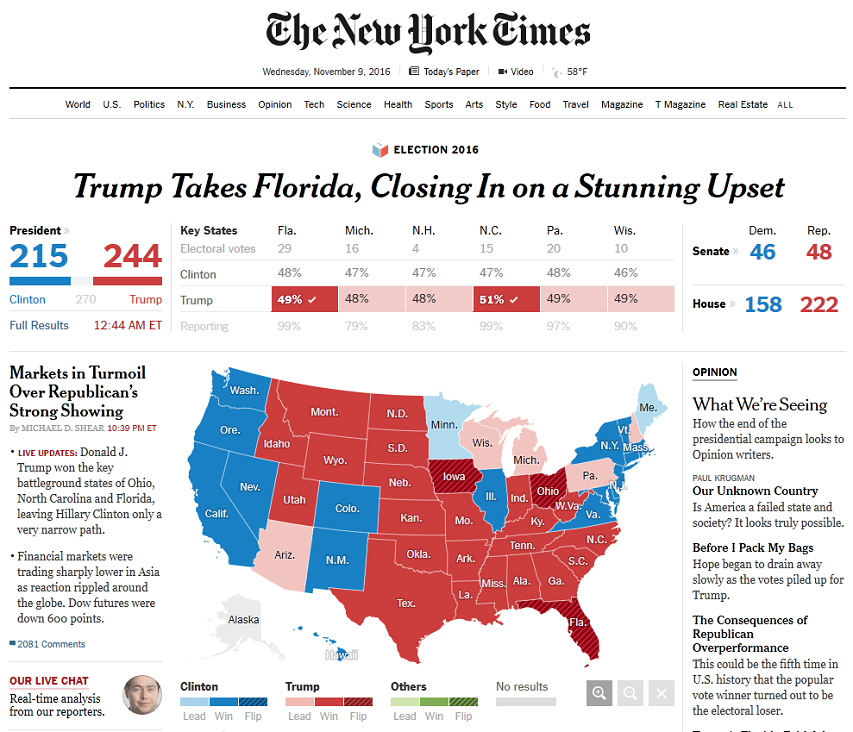
The most exhausting thing about our politics these days — other than the never-ending presidential election itself — is the obsession with “shaping the narrative.” By that I mean the effort to connect the dots between a selective number of facts and statistics to support one storyline about the state of the union.
Narrative-building is essential for almost every complicated argument because it’s the only way to get our pattern-seeking brains to discount contradictory facts and data. Trial lawyers understand this implicitly. Get the jury to buy the story, and they’ll do the heavy lifting of arranging the facts in just the right way.
[…]
I’m not naive. Crafting stories to serve political purposes is as old as politics itself. But the problem seems to be getting worse. Perhaps it’s because our country is so polarized and our media environment so balkanized and instantaneous. Politicians and journalists alike feel compelled to make facts serve some larger tale in every utterance. The reality is that life is complicated and every well-crafted narrative leaves out important facts.
Jonah Goldberg, “Narrative-Building Has Become a Political Obsession”, National Review, 2016-09-28.
October 17, 2016
QotD: The “narrative”
October 16, 2016
Trump supporters aren’t who you think they are
An interesting article in, of all places, the Guardian discusses where Trump support comes from and why the media has difficulty identifying or covering them in a realistic fashion:
Hard numbers complicate, if not roundly dismiss, the oft-regurgitated theory that income or education levels predict Trump support, or that working-class whites support him disproportionately. Last month, results of 87,000 interviews conducted by Gallup showed that those who liked Trump were under no more economic distress or immigration-related anxiety than those who opposed him.
According to the study, his supporters didn’t have lower incomes or higher unemployment levels than other Americans. Income data misses a lot; those with healthy earnings might also have negative wealth or downward mobility. But respondents overall weren’t clinging to jobs perceived to be endangered. “Surprisingly”, a Gallup researcher wrote, “there appears to be no link whatsoever between exposure to trade competition and support for nationalist policies in America, as embodied by the Trump campaign.”
Earlier this year, primary exit polls revealed that Trump voters were, in fact, more affluent than most Americans, with a median household income of $72,000 – higher than that of Hillary Clinton or Bernie Sanders supporters. Forty-four percent of them had college degrees, well above the national average of 33% among whites or 29% overall. In January, political scientist Matthew MacWilliams reported findings that a penchant for authoritarianism – not income, education, gender, age or race –predicted Trump support.
These facts haven’t stopped pundits and journalists from pushing story after story about the white working class’s giddy embrace of a bloviating demagogue.
In seeking to explain Trump’s appeal, proportionate media coverage would require more stories about the racism and misogyny among white Trump supporters in tony suburbs. Or, if we’re examining economically driven bitterness among the working class, stories about the Democratic lawmakers who in recent decades ended welfare as we knew it, hopped in the sack with Wall Street and forgot American labor in their global trade agreements.
But, for national media outlets comprised largely of middle- and upper-class liberals, that would mean looking their own class in the face.
The faces journalists do train the cameras on – hateful ones screaming sexist vitriol next to Confederate flags – must receive coverage but do not speak for the communities I know well. That the media industry ignored my home for so long left a vacuum of understanding in which the first glimpse of an economically downtrodden white is presumed to represent the whole.
H/T to John Donovan who comments “I’m pretty sure I don’t share this Kansan’s policy preferences, but I find her view here refreshing.”
September 15, 2016
QotD: Hubert Humphrey’s presidential aspirations
Toward the end of the Civil Rights movement in the 1960s, the governor of Georgia was a white trash dingbat named Lester Maddox – who is still with us, in one crude form or another – and when the curtain finally falls on George Wallace, he will probably go down in history as the Greatest Thief of them all. Wallace was the first Southern politician to understand that there are just as many mean, stupid bigots above the Mason-Dixon Line as there are below it, and when he made the shrewd decision to “go national”‘ in 1968, he created an Alabama-based industry that has since made very rich men of himself and a handful of cronies. For more than a decade, George Wallace has bamboozled the national press and terrified the ranking fixers in both major parties. In 1968, he took enough Democratic votes from Hubert Humphrey to elect Richard Nixon, and if he had bothered to understand the delegate selection process in 1972, he could have prevented McGovern’s nomination and muscled himself into the number two spot on a Humphrey-Wallace ticket.
McGovern could not have survived a second-ballot shortfall in Miami that year, and anybody who thinks the Happy Warrior would not have made that trade with Wallace is a fool. Hubert Humphrey would have traded anything, with anybody, to get the Democratic nomination for himself in 1972 …… and he’ll be ready to trade again, this year, if he sees the slightest chance.
And he does. He saw it on the morning after the New Hampshire primary, when five percent of the vote came in as “uncommitted.” That rotten, truthless old freak was on national TV at the crack of dawn, cackling like a hen full of amyls at the “wonderful news” from New Hampshire. After almost four years of relatively statesmanlike restraint and infrequent TV appearances that showed his gray hair and haggard jowls – four long and frantic years that saw the fall of Richard Nixon, the end of the war in Vietnam and a neo-collapse of the U.S. economy – after all that time and all those sober denials that he would never run for president, all it took to jerk Hubert out of his closet was the news from New Hampshire that five percent of the Democratic voters, less than 4,000 people, in that strange little state had cast their ballots for “uncommitted” delegates.
To Humphrey, who was not even entered in the New Hampshire primary, this meant five percent for him. Never mind that a completely unknown ex-governor of Georgia had won in New Hampshire with more than 30% of the vote; or that liberal Congressman Morris Udall had finished a solid but disappointing second with 24%; or that liberal Senator Birch Bayh ran third with 16%……. None of that mattered to Hubert, because he was privy to various rumors and force-fed press reports that many of the “uncommitted” delegates in New Hampshire were secret Humphrey supporters. There was no way to be sure, of course – but no reason to doubt it, either; at least not in the mushy mind of the Happy Warrior.
His first TV appearance of the ’76 campaign was a nasty shock to me. I had been up all night, tapping the glass and nursing my bets along (I had bet the quinella, taking Carter and Reagan against Udall and Ford) and when the sun came up on Wednesday I was slumped in front of a TV set in an ancient New England farmhouse on a hilltop near a hamlet called Contoocook. I had won early on Carter, but I had to wait for Hughes Rudd and the Morning News to learn that Ford had finally overtaken Reagan. The margin at dawn was less than one percent, but it was enough to blow my quinella and put Reagan back on Cheap Street, where he’s been ever since …… and I was brooding on this unexpected loss, sipping my coffee and tapping the glass once again, when all of a sudden I was smacked right straight in the eyes with the wild-eyed babbling spectacle of Hubert Horatio Humphrey. His hair was bright orange, his cheeks were rouged, his forehead was caked with Mantan, and his mouth was moving so fast that the words poured out in a high-pitched chattering whine …… “O my goodness, my gracious …… isn’t it wonderful? Yes, yes indeed……. O yes, it just goes to show…. I just can’t say enough…….”
No! I thought. This can’t be true! Not now! Not so soon! Here was this monster, this shameful electrified corpse – and raving and flapping his hands at the camera like he’d just been elected president. He looked like three iguanas in a feeding frenzy. I stood up and backed off from the TV set, but the view was no different from the other side of the room. I was seeing The Real Thing, and it stunned me……. Because I knew, in my heart, that he was real: that even with a five percent shadow vote in the year’s first primary, where his name was not on the ballot, and despite Jimmy Carter’s surprising victory and four other nationally known candidates finishing higher than “uncommitted,” that Hubert Humphrey had somehow emerged from the chaos of New Hampshire with yet another new life, and another serious shot at the presidency of the United States.
Hunter S. Thompson, “Fear and Loathing on the Campaign Trail ’76: Third-rate romance, low-rent rendezvous — hanging with Ted Kennedy, Jimmy Carter, and a bottle of Wild Turkey”, Rolling Stone, 1976-06-03.
September 12, 2016
The impossible choice facing American voters in November
Tamara Keel wraps it up nicely:
Democrats seem baffled that their candidate isn’t galloping away with this thing.
So, my Democrat friends, you know how you’re all “Jesus, how could the Republicans pick someone so incredibly loathsome? Are they stupid?” Pretty much that right back at you.
Just like the Republican primaries managed to select the only candidate who could possibly get beaten by the Lizard Queen from Zeta Reticuli, your unDemocratic Superdelegate Logrolling Festival managed to turn up the one candidate in your party who might lose to Cheeto Jesus.
Both major parties are, ironically, in a place where the best thing that could happen to their electoral chances is for the headliner on their ticket to suffer a sudden heart attack.
September 6, 2016
Could this be a winning strategy for Il Donalduce?
Jay Currie suggests a three-part plan that might bring about a Trump victory in November:
First, announce that a Trump administration will decriminalize marijuana.
Second, announce that every single person serving time for marijuana related offences is going to be pardoned on condition that they spend a three month intensive period in a pre-employment boot camp. And announce that, from the day Trump takes office, any criminal record for marijuana offences will be expunged as of right and right now.
Third, commit serious federal resources to creating paths to employment for the people who have either been in jail or who have had criminal records as a result of pot convictions.
You can picture Trump saying, “Let’s bring our kids, and their fathers, home.”
The last twenty years have been about incarcerating black people and Latinos for all sorts of crimes. Some of that is justified, but a lot of it has been felony marijuana arrests which should have been traffic tickets but got bumped because of priors, plea bargains and three strikes laws. It’s time for that to stop.
People’s children, husbands and wives have been sent to prison for a reason that an increasing number of states think is wrong. Washington, Colorado, Oregon and Alaska have legalized recreational pot and the federal government has gone along. Medical marijuana is legal in many other states. More states have either medical marijuana or recreational marijuana on the ballot in November.
The Donald does not have to say pot is a good thing. In fact, if he is smart he will say it is a bad thing and that he does not want any sensible American to use it; but it should not be a criminal thing because, if it is, there will be a disproportionate impact on black, Latino and poor white communities. That is just a fact.
August 27, 2016
Scott Adams finds a silver lining to the 2016 presidential race
I didn’t think it was possible, but Scott Adams points out two unexpectedly positive things that have come to pass despite the two leading candidates for the office of President of the United States being two of the most obnoxious and polarizing human beings ever to enter the race:
Hillary Clinton has already broken the ultimate glass ceiling. I see no discussion – in private or in public – about the role of her gender. Clinton did that for you and your daughters. She took gender off the table for the most important job in the land. It doesn’t matter who gets elected now. Clinton already made the gender sale. In 2016, nearly all American citizens believe a woman can, and will, be president. Because of Hillary Clinton. That’s a big deal.
I know that some of you think Clinton “cheated” because she used the advantage of her husband’s presidency to seek her own destiny. But keep in mind that ALL successful people exploit their unique advantages. Clinton just did it better. She isn’t here by accident.
Meanwhile, Donald Trump turned the GOP into a pro-LGBTQ organization. No one saw that coming. And I think it is sticking. That’s a big deal.
So, while we were watching the two most odious personalities on the planet hurl lies and insults at each other, those two odious personalities were bringing civilization toward the light. And succeeding.
Don’t lose that.
August 16, 2016
Would Trump pull the US out of NATO?
Tom Kratman regretfully says no:
The last several months have seen repeated claims and variants on claims that presidential candidate Donald Trump wants to, and intends to, pull the United States out of NATO. Hillary Clinton made the claim on 28 March of this year, repeating a version of it on 8 May on Face The Nation.
Sad to say, Trump hasn’t said we need to pull out; would that he had. Instead, he’s made far weaker calls to “reconsider” our role in NATO, and to restructure or reform NATO to deal with modern threats, like terrorism, rather than Cold War threats, like the former Soviet Union and Warsaw Pact. These were couched in terms generally reasonable and factual; to paraphrase, NATO other than the US doesn’t pay its fair share.
I’m not so concerned with what politicians may say – and Trump’s become one now – who are vying for political office. See, for example, Hillary’s lies about what Trump actually said, cited above. I’m far more concerned with what they should do following election. In this particular case, though what Hillary has claimed of Trump is a lie, it’s a lie he should follow through on.
NATO has rarely pulled its weight in the past, nor is it pulling its weight in the present. Of twenty-eight NATO countries, only five meet their defense spending goal of two percent of GDP. Even that is begging the question, though; because none of them, not one, come near to our level of spending. Britain, for example, with a GDP of 2.679 trillion, spends about fifty-two billion, or just over two percent. France’s defense budget runs under two percent. Germany, Europe’s largest economy, disgracefully, spends a mere thirty-seven billion, or just over one percent. Some smaller NATO countries, the Netherlands, for example, spend about what Germany does.
We, conversely, spend about three times what Germany does, and even more than that if one tallies in a number of indirect expenditures, like the VA, on which we spend more than twice Germany’s entire defense budget.
Frankly, all of NATO is on a kind of moral defense welfare and has been pretty much since inception.
[…]
But the Truman Doctrine! The Truman Doctrine!
I know a lot of people must have missed it, but the Truman Doctrine wasn’t designed to contain Russia. Neither should one be taken in by flighty rhetoric presented to congress. The Truman Doctrine arose in the context of containing communism. That was done. Communism is no longer an international threat (and if we can keep the Hildebeast out of the White House we may be able to keep it from becoming a domestic threat, too).
But we need European troops!
Some of them have been, indeed, excellent. I am thinking especially of the UK’s, Canada’s, Australia’s, and Denmark’s. I am not thinking of Germany’s, the reports on whom, such as I have seen, are almost uniformly wretched, and I am not thinking of France’s, the reports on which are mixed. However, in accord with their defense budgets, those troop slices were objectively small, and they generally did not come with logistic self-sufficiency. In other words, in huge part, we had to provide the transportation and other support to keep them in the field in Afghanistan and Iraq, and that, especially in Afghanistan, where our own logistic capability was badly strained.
That was bad enough, but there is something much worse. There has grown up over the decades since the Second World War a regime of treaties, advancing what is often called “International Humanitarian Law” – IHL – and purporting to subordinate the law of war to it. Some of those claims are so preposterous as to be unbelievable, except that many, many of the world’s elites do believe in them and do force us to subordinate our own laws to them. A discussion of IHL is beyond the scope of this column. Note, however, two aspects of it that have arisen, the International Criminal Court, created by what is called “the Rome Statute,” and the Protocols Additional to Geneva Convention IV. The former subverts national sovereignty by placing it subordinate to unelected, partisan, largely left wing, jurists. The latter were specifically designed and pushed forward by the former Soviet Union to undermine the west.
We accept neither of these and, in fact, have a conditional declaration of war in place, the American Servicemembers Protection Act, should anyone try to grab our troops for trial before the ICC. Unfortunately, our “allies,” for the most part, have signed onto these obscenities. What that means is that we are constrained from acting with the full rigor of the law of armed conflict by the presence of allies, for whom, should we act in accordance with the law of war but against IHL, makes them complicit in what are, by their own domestic laws, war crimes. This constraint is intolerable, a rotten, stinking albatross tied around our necks. And this is what makes the presence of allied NATO troops not worth the bother, even when those troops are superb.
August 13, 2016
If Trump actually wanted to lose, what would he be doing differently?
I think the jury is still out over whether Donald Trump really wants to win the presidency. Back when he entered the race, several people pointed out just how close he had been to the Clintons for decades, and floated the idea that his role wasn’t to win but to make it possible for Hillary to win (by crippling or eliminating anyone on the GOP bench who could beat her in the general election). Since he won the Republican nomination, he has consistently made unforced errors that allowed the media to concentrate their fire on him, especially when something came up that might have hurt Clinton. Maybe Scott Adams will explain how this is actually Trump’s version of the “rope a dope” strategy, but right now it looks like Trump is doing everything he can to lose the election.
At Never Yet Melted, David Zincavage says that Trump’s supporters have been played as suckers:
Donald Trump isn’t a conservative. Donald Trump is not a down-home American like you. Donald Trump is a conniving, cynical New Yorker. He’s 70 years old, fabulously wealthy, already famous and already living a completely sybaritic life-style. For him, moving from one of his luxury residences to the White House and having to be president would be like moving down-market in housing and getting a full-time job. It would be a real bummer.
He is not into personal sacrifice. Donald Trump cares about political ideas the way I care about Olympic soccer matches. Donald Trump has no real personal political ideas or preferred policy agenda at all. He’s just a businessman, a total pragmatist.
Donald Trump is not your buddy and he is no kind of patriot. Trump likes money, tail, and Trump, period.
So we’re watching him campaign. He carelessly contradicts himself. He routinely takes one position and then the opposite one. He constantly offends rival candidates and significant potential voting blocs. He does exactly as he pleases, casually taking time away from campaigning, often spending no money, doing no advertising and no fund-raising. He behaves like a crazy person, defying convention, political correctness, and rather frequently ordinary good manners and civility as well. He says something embarrassing or outrageous several times a week.
One is obliged to conclude that either Donald Trump is crazy and the most incompetent candidate for office in human history, or he is motivated by something other than winning.
Since we know that Trump is a close friend of the Clintons, on the whole, I like best the theory that contends that Trump has really just been running, all along, in order to kill Republican chances in what ought to have been a landslide Republican year and to make possible the impossible: Hillary’s election.
He’s having lots of fun. He’s soaking up the limelight and laughing at all the dopes supporting him, while mischievously dropping another turd in the electoral punchbowl every now and then and watching the commentariat have fits over what they think is a gaffe.
Update: After I had this post queued up for Saturday morning, I noticed this tweet from Megan McArdle:
If the Clintons *had* cooked up a scheme w/Trump to get the nomination & dump the election, how would that look different from what we got?
— (((Megan McArdle))) (@asymmetricinfo) August 11, 2016
July 28, 2016
Scott Adams: Hillary is “selling past the close”
Noted Clinton supporter* Scott Adams thinks Hillary is making a major persuasion mistake in her campaign:
… that brings us to a concept called “Selling past the close.” That’s a persuasion mistake. Clinton has already sold the country on the idea that a woman can be president. Sales experts will tell you that once the sale is made, you need to stop selling, because you have no chance of making things better, but you might give the buyer a reason to change her mind.
Obama understood how to avoid selling past the close. At some point during Obama’s first presidential election campaign the country mentally agreed that an African-American could be their next president. So Obama accepted the sale and talked about other stuff. If he had dwelled on race, and his place in history, he would have risked making things worse. So he stayed quiet on race (mostly) and won. Twice.
Clinton is taking a different approach. As Michelle Obama said, we now take for granted that a woman can be president. That sale is made. But Clinton keeps selling. And that’s an enormous persuasion mistake.
I watched singer Alicia Keys perform her song Superwoman at the convention and experienced a sinking feeling. I’m fairly certain my testosterone levels dropped as I watched, and that’s not even a little bit of an exaggeration. Science says men’s testosterone levels rise when they experience victory, and drop when they experience the opposite. I watched Keys tell the world that women are the answer to our problems. True or not, men were probably not feeling successful and victorious during her act.
Let me say this again, so you know I’m not kidding. Based on what I know about the human body, and the way our thoughts regulate our hormones, the Democratic National Convention is probably lowering testosterone levels all over the country. Literally, not figuratively. And since testosterone is a feel-good chemical for men, I think the Democratic convention is making men feel less happy. They might not know why they feel less happy, but they will start to associate the low feeling with whatever they are looking at when it happens, i.e. Clinton.
* He endorses Clinton for his personal safety. He says neither candidate actually aligns with his views. He also says he doesn’t vote (but he lives in California where Clinton will likely have a huge surplus of votes anyway).
July 25, 2016
July 24, 2016
QotD: Literally every Republican presidential candidate (so far)
Every 4 years the GOP nominee is literally Hitler. A few years later — sometimes, as in Mitt Romney’s case, as few as 4 years after he was accused of giving a woman cancer — that formerly-Hitler nominee becomes the standard of once-great GOP nominees to which the current nominee fall short.
Glenn Reynolds, “LIZ CROKIN: Trump Does The Unthinkable”, Instapundit, 2016-07-11.
July 21, 2016
QotD: The economic folly of mercantilism
At the heart of [Trump’s] argument is the belief that selling to countries is good and buying from them is bad, the crude mercantilist fallacy that Adam Smith’s Wealth of Nations debunked in the same year that America embraced the Declaration of Independence. Smith, the brilliant British political economist, argued that unless people start eating gold bullion, the point of wealth is to buy not sell; to consume not produce. If China starts shipping free plasma TVs to America, a few American companies may be thrown out of business, but American consumers will be better off. What’s more, they’ll be able to spend their savings on goods from other companies. The only folks that protectionist policies benefit are crony capitalists who face less competition — the very thing that Trump says he’s fighting.
Shikha Dalmia, “Donald Trump’s free-trade follies”, The Week, 2016-06-30.
July 20, 2016
The New Yorker calls Gary Johnson “The Libertarians’ Secret Weapon”
In the current issue of The New Yorker, Ryan Lizza introduces readers to the Libertarian Party’s presidential candidate:
Johnson and Weld were set to appear that evening in a CNN town-hall special, which, it was later estimated, was seen by almost a million people. The stakes for Johnson were high. When pollsters include Johnson with Donald Trump and Hillary Clinton in their surveys, he has been the choice of roughly ten per cent of respondents, and in a Times/CBS News poll released last week he hit twelve per cent. If his standing in the polls rises to fifteen per cent, he will likely qualify to participate in the Presidential debates. “If you’re not in the debates, there’s no way to win,” Johnson said. “It’s the Super Bowl of politics.” Johnson has many flaws as a candidate, but being unlikable is not one of them. If he is allowed to debate Trump and Clinton, the two most unpopular presumed nominees in decades, then the most unpredictable election in modern times could get even weirder.
[…]
There hasn’t been a serious challenge from a third-party Presidential candidate since 1992, when Ross Perot, the eccentric Texas billionaire, ran as an independent and bought hours of TV time to educate voters about the large federal budget deficit. Perot won entry into the Presidential debates and received nineteen per cent of the vote against Bill Clinton and George H. W. Bush. Bush blamed Perot for his loss, though the best analyses of the race concluded that Perot had drawn equal numbers of voters from Bush and Clinton.
This year, the unpopularity of Clinton and Trump has created an opportunity for Johnson to at least match Perot’s impressive showing. Last week, Republican delegates in the Never Trump movement attempted to change the rules for the Republican National Convention, in a failed effort to deny Trump the nomination. For anti-Trump conservatives still searching for an alternative, Johnson may be the only option. On the left, anti-Clinton Democrats, including some determined supporters of Bernie Sanders, would prefer a candidate who is more socially liberal and noninterventionist than Clinton.
“We have arguably the two most polarizing candidates,” Johnson told me. “Hillary has to go out and she has to appeal to this ‘everything’s free, government can accomplish anything, what can you give us’ constituency. She’s doling it out as fast as she can. Trump is appealing to this anti-abortion, anti-immigration, ‘bomb the hell out of them, lock them up, throw away the key’ constituency.”
Johnson is charming and more transparent than most politicians — sometimes to a fault — and has a knack for putting a happy face on the rougher edges of libertarianism. Weld has a shabby-genteel bearing and a boarding-school sarcasm that comes across as both appealing and arrogant. Together, Johnson and Weld represent the first Presidential ticket with two governors since 1948, when the Republicans nominated Thomas Dewey, of New York, and Earl Warren, of California. One of the Johnson-Weld campaign slogans is “A Credible Alternative to ClinTrump.”
July 2, 2016
New Johnson/Weld TV spot gets plaudits
Nick Gillespie calls it “masterful” and asks if it’s the greatest presidential ad ever. I think it’s pretty good, but unlike actual voting Americans, I’m not inundated with political advertising 24/7/365, so perhaps I’m not the best judge of what is and is not effective for US elections:
Are #youin? Check out our new video — and spread it around. #election2016 #TeamGov pic.twitter.com/9X6iNNzZW2
— Gov. Gary Johnson (@GovGaryJohnson) June 30, 2016
June 24, 2016
The Brexit surprise
I had expected a narrow Remain victory in yesterday’s referendum, but had I been eligible to vote, I’d have voted to Leave. The initial reports I saw certainly made it seem as if Remain had squeaked out a narrow victory, but I was delighted to see my hometown voting convincingly to Leave at over 65%. The revolt of Labour voters probably was the deciding factor in the final result … the Tories had been having trouble for years trying to keep their EU skeptic wing quiet for fear they’d decamp to UKIP, but Labour seemed to have their supporters well in hand. Yet Middlesbrough and many other Labour ridings in the North East were the ones who came out most strongly for Brexit.
David Cameron has announced that he’ll be resigning (as is proper, under the circumstances), so it might be former London mayor Boris Johnson who ends up leading the negotiations with the EU. Jeremy Corbyn hasn’t indicated whether he will also resign over the result, but it would be difficult for him to continue to lead Labour after Labour’s voters came down for the Leave side against their own party’s recommendations. At Samizdata, Brian Micklethwait shared some thoughts:
Re the Jo Cox murder. Many Remainers used this horror to imply that voting Leave was like voting in favour of MPs being murdered. (The Remainers who refrained from using this argument were not so audible.) I surmise that (a) some potential Leavers were persuaded, (b) some potential Leavers were angered and caused to vote Leave having only previously been thinking about it, and (c) quite a few continued to move towards Leave for reasons unrelated to the Jo Cox murder, but in silence. When the Cox murder happened, there was a shift towards Leave taking place. I surmise that this continued to flow, but underground, so to speak. Minds continued to move, but people stopped telling the pollsters. But, they’ve told them now.
[…]
Next, I refer honorable readers to these graphs (which I also wrote about in this posting here). These graphs say: (1) that when the government takes charge of something the immediate effects are often quite good, but in the long run less good, and then bad, and then very bad; and (2) that a piece of market liberalisation has the opposite effect, disruptive and unsettling at first, but then better, and in the long run unimaginably better. This explains why people so often vote for the government arrangement, against their long-term interests. Voters often have a short-term problem and are begging for a short-term fix. But these “Alpha Graphs” also explain something else, which is that when voters think that they are choosing between (1) bad now and bad in the future, or (2) bad now and better in the future, they are capable of voting in their long-term interest because long-term interest is all that there is on offer. Once governmentalism, so to speak, gets towards the far end of its graph and things are getting worse, really quite fast, and will go on getting worse no matter what, the decision changes radically. The only question is: Will the bad news ever stop? All of this now seems relevant to the Referendum debate. “Europe” was, for many, bad and getting worse. Brexit will also be bad, but eventually, better. If you think those two things, Brexit wins. And Brexit did win, with the people in a terminally bad way voting for it most heavily, and the people, like these people, who are now getting by or better voting for Remain, because they have something or a lot to lose.
It was assumed by Remainers that every time another London and/or Global Grandee came out for Remain, that helped the Remain cause. But for many, the unhappiness of such persons about the idea of Leave was a Leave feature rather than a Leave bug.
Speaking of London grandees, Eddie Izzard, dressed like a loon on Question Time, did not, I surmise, help the Remain cause. I mean, he really didn’t help. Imagine (as lucky old libertarian me living comfortably in London only can imagine) being staunch Labour but long-term unemployed, in Wigan or some such place. And you see on your TV some London Labour-Luvvie comedian, cross-dressed like a cross between Margaret Thatcher, Victoria Wood and Benny Hill, arguing for Remain. You’d vote Leave just to shove a stick up this thoughtless, frivolous, openly-contemptuous-of-everything-you-believe-in idiot’s arse, no matter how much more unemployed it might make you. (See above about not having anything to lose. If you have nothing left to lose, or if you merely feel this, punitive voting becomes one of your few remaining pleasures. (More Izzard related ruminations by me here.))
Tim Worstall on the economic implications of Brexit now that it’s a reality:
As to the longer term economic impact there’s all sorts of dire predictions of imminent recession. And this really just doesn’t ring true. The last time sterling fell like this, in 1993, it set off Britain’s longest ever peacetime economic boom. A lower exchange rate is generally taken to be stimulatory to an economy. Sure, there’s something called the J-Curve which means that it might not be immediately so (the idea being that it takes time for people to change their trade habits, meaning that higher import prices and lower export ones might take 18 months to work through into the real economy) but it really is the standard economic position that a decline in the exchange rate boosts the domestic economy. That’s why the IMF always recommends it for economies in trouble.
That is, the very thing that people are worrying about, a Brexit induced recession, is dealt with by the very thing that people are worrying about, a decline in the sterling exchange rate. These markets things do in fact work.
As to what happens in the near future in proper economic terms the answer is, well, nothing. Since the last revision of the European Treaty there is a procedure laid out for how a country leaves the EU. And it is that everything remains exactly as it was yesterday for the two years it takes to negotiate what will happen next. The only thing that will be influencing things is uncertainty about how those negotiations will pan out. That uncertainty being something which, again, is rather well dealt with by this current fall in sterling. Make investing in British assets cheap enough and people will continue to do it.
And to that long term. I think the long term effects are going to be, as long as we follow sensible economic policies post-Brexit, beneficial to the UK economy. Partly on the Patrick Minford grounds, that leaving the EU allows us to take that one sensible trade stance, unilateral free trade, which being in the EU prevents us from taking. But more than that I am absolutely convinced that the generally slow growth of the advanced economies is nothing to do with Larry Summers’ secular stagnation. Nothing to do with inadequate demand, with slow technological growth, not Robert Gordon’s analysis. Rather, it is the accretion of regulation of the economy that is responsible. And leaving the EU means that Britain can free itself from much to all of that – if it so desires of course.
This does not mean getting rid of the welfare state, doesn’t mean some laissez faire capitalism red in tooth and claw. Just very much less paper pushing and the asking of bureaucratic permission to do things. Just rather more of that Uber idea, move fast and break things. If you prefer, economic growth depends not so much on people innovating but there being space not controlled by the previous rules for people to innovate into. And recreating that space is something that Brexit will allow us to do.