Quotulatiousness

July 9, 2025

NATO secretary general Mark Rutte – Trump’s biggest European fanboy?

Filed under: Europe, Military, Politics, USA — Tags: , , — Nicholas @ 03:00

I don’t often encounter positive reactions to US President Donald Trump from the other side of the pond, but Paul Wells makes a case here for Mark Rutte, the current secretary general of the NATO alliance, being utterly sincere in his regard for his American “daddy”:

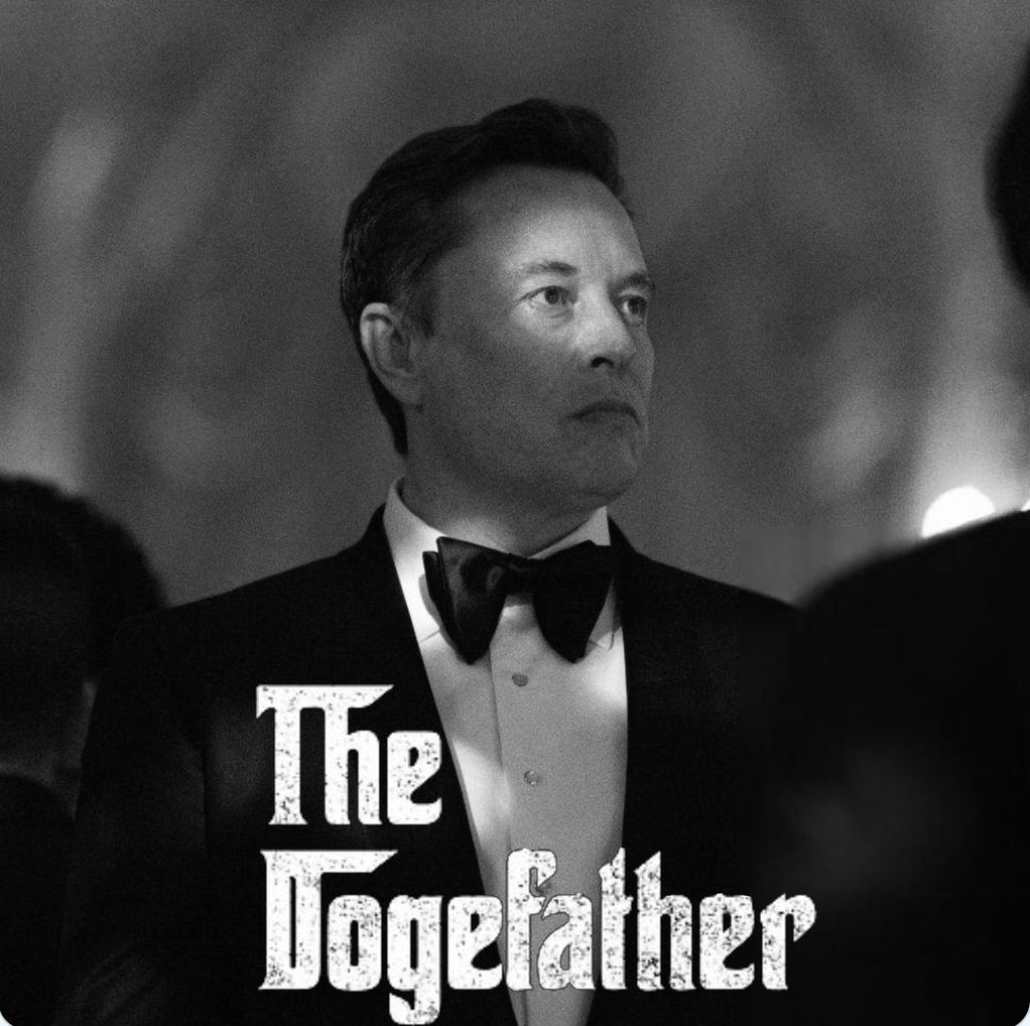
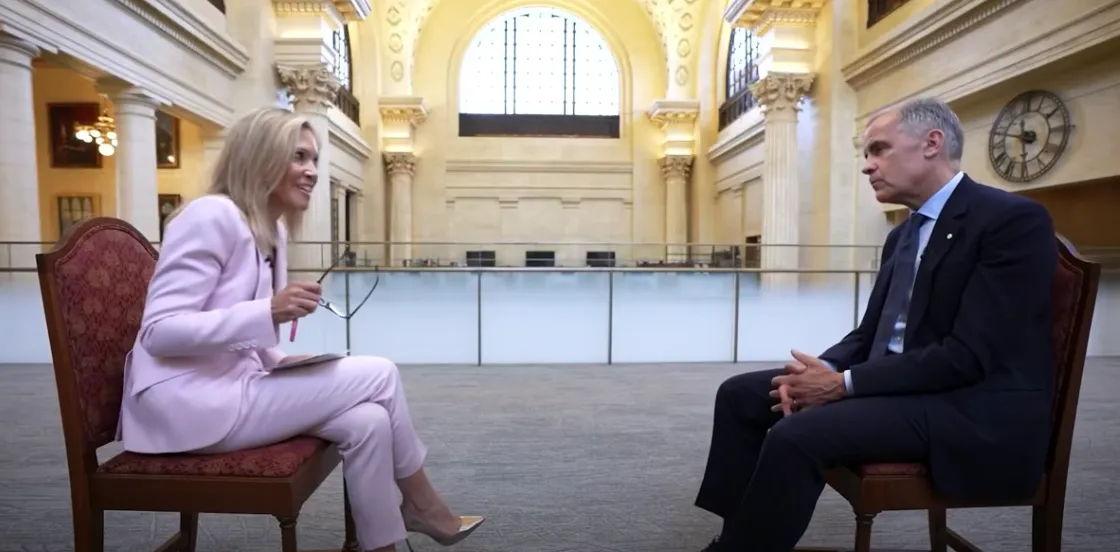
Mark Rutte, the NATO secretary general.
Photo from Paul Wells’ substack

I haven’t seen much commentary about Mark Rutte’s weekend interview with the New York Times. It’s quite an interview. If the NATO secretary general is faking his enthusiasm for Donald Trump, he’s really committing to the bit.

I’m going to quote Rutte’s remarks in greater detail than you sometimes get, because what really stands out over the 36-minute podcast that resulted from the Times interview is Rutte’s doggedness. He doesn’t simply treat the US president as a containable problem, as European security experts sometimes do, but as nothing less than a full NATO partner and, indeed, as the hero of the alliance’s revitalization.

“President Trump deserves all the praise,” he tells interviewer Lulu Garcia-Navarro, a longtime NPR foreign correspondent before she joined the Times, “because without his leadership, without him being re-elected president of the United States, the 2% this year and the 5% in 2035 — we would never, ever, ever have been able to achieve agreement on this.”

Does he regret that Trump posted what the AP and a lot of others called a “fawning” text message in which Rutte wrote to Trump, “Europe is going to pay in a BIG way, as they should, and it will be your win”? “Not at all, because what was in the text message is exactly as I see it.”

Is the integrity of NATO’s defense perimeter solid? “But it’s not that the Estonians are left to themselves. It would be the full force of NATO, including the full backup of the United States, which will come to the rescue. Putin knows this.”

Garcia-Navarro keeps pushing. Full backup of the United States, she says? You bet, Rutte says. In “everything I’ve discussed over the last six months with the new U.S. administration” there is “absolutely no shiver of a doubt that the U.S. is completely committed to NATO, is completely committed to Article 5,” the Alliance’s collective-defence principle.

Isn’t there a “fundamental disconnect” between the way Trump views the world and the commitments needed to make NATO work? Rutte answers: Nope! “President Trump put in place an excellent foreign-policy team, including Marco Rubio and Pete Hegseth,” he offers.

But “what we are seeing,” Garcia-Navarro insists, perhaps in reference to this or this, “is the United States pulling back from Europe.”

“I really have to correct you,” Rutte insists in turn. “The United States is not pulling away from Europe.”

Where does Rutte stand on the credibility and prospects of Russia-Ukraine peace talks? “With the risk that I’m again praising President Trump: He is the one who broke the deadlock with Putin. When he became president in January, he started these discussions with Putin, and he was the only one who was able to do this. This had to happen.”
July 1, 2025

Like a cheap suit, Canada folds under Trumpian pressure on the Digital Services Tax grab

Filed under: Cancon, Government, Media, Politics, USA — Tags: , , , , , — Nicholas @ 05:00

A couple of days back, I characterized Prime Minister Mark Carney’s determination to push ahead with the Digital Services Tax “insane”, as it was overwhelmingly likely to trigger a strong reaction from the Trump administration. As it did. So, finally recognizing they were in a no-win situation, the federal government announced at the last minute that they wouldn’t be demanding the literally billions of dollars from the US “tech giants” after all. Michael Geist can legitimately say “I told you so” on this issue:

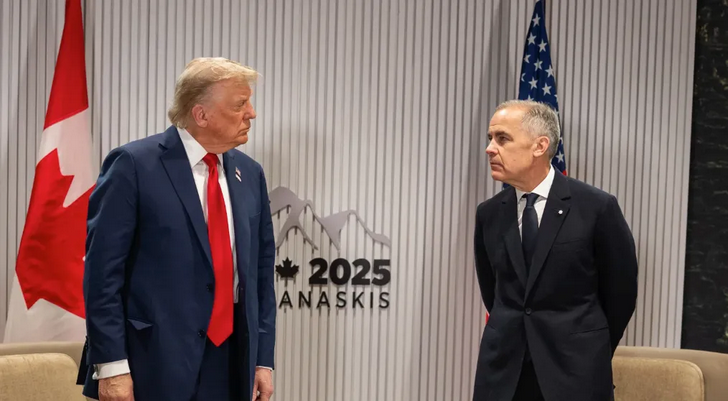
President Trump Attends G7 Summit in Canada by White House https://www.whitehouse.gov/gallery/president-trump-attends-g7-summit-in-canada/ CC BY 3.0 US

After years of dismissing the warnings of likely retaliation, the Canadian government caved last night on the digital services tax. Faced with the prospect of the U.S. suspending trade negotiations, Finance Minister François-Philippe Champagne announced that the government would drop the DST altogether, payments scheduled for Monday would be cancelled, and legislation will be forthcoming to rescind the legislation that created it in the first place. Over the weekend, I wrote about the repeated warnings that the DST was a serious trade irritant with the U.S. that cut across party and presidential lines. While ignoring the risks was bad enough, I argued that Canada played its DST card too early. Rather than delaying implementation in the hopes of incorporating it into a broader trade deal with U.S., it marched ahead, leading to an entirely predictable response from U.S. President Donald Trump. That left Canada in a no-win situation: stick with the DST but face the prospect of higher tariffs or embarrassingly drop the DST (and $7.2 billion in revenue over five years) with only restarting negotiations that were on until government overplayed its hand to show for it.

It is hard to overstate how badly the government managed the DST issue over the past five years. It alienated allies by pushing ahead with the DST despite efforts at an international deal at the OECD, stood alone in rejecting an extension of a moratorium on new DSTs, made the DST retroactive which solidified opposition, and continually downplayed the concerns of successive U.S. Presidents and Members of Congress from both sides of the aisle. Meanwhile, when companies began passing along the costs of the DST to Canadian businesses, it did nothing. And when they urged the government to delay implementation to at least allow for the issue to be incorporated into a broader trade pact, it ignored the advice.

At every step, there were better options. This year, the likelihood that the DST would come to a boil was obvious to anyone who was paying attention. But rather than following the UK strategy, which managed to salvage a smaller DST (2% rather than 3%) as part of a bigger agreement that includes a commitment to support UK digital access to the U.S. market and to negotiate a larger digital trade deal, Canadian officials seemingly assumed that the U.S. was bluffing and would not retaliate.

If this sounds familiar, it is because the Canadian government misreading the tech sector has become a hallmark of its policy. Talk tough, practically dare companies and foreign governments to respond, and then frantically seek an exit strategy when they do. This was the case with the Online News Act and Meta’s blocking of news links, with the government’s AI regulation which new Minister of AI Evan Solomon says will not be re-introduced, with the Online Harms bill, and now with the DST.

The Food Professor explains what Trump got right in his Trade War

On the social media site formerly known as Twitter, Dr. Sylvain Charlebois, aka @FoodProfessor explains how Trump’s Trade War strategy is working out for US interests, in contrast to the Trudeau/Carney governments’ approach:

The Globalism Hangover: What Trump’s Trade War Got Right

“Trump’s bombastic style aside, his nationalist approach to trade and food policy is forcing global institutions to justify their existence — and that’s a conversation Canada can no longer afford to ignore.”

For the past six months, President Donald Trump’s trade policies have been widely mocked, criticized, and condemned. Some of it is certainly warranted. The Wall Street Journal, for instance, recently likened his tariff-heavy approach to global trade as a direct path toward another Great Depression. But data out of the United States tells a more nuanced story — one that challenges conventional wisdom.

Despite persistent headwinds, the U.S. economy continues to outperform expectations. The Federal Reserve Bank of Atlanta projects second-quarter GDP growth at 3.8%. In May, the U.S. economy added 139,000 jobs, outpacing forecasts, while inflation remained subdued at 0.1% month-over-month and 2.4% annually. The U.S. trade deficit has been cut nearly in half, pointing to stronger export performance and a rebalancing of trade relationships.

Canada, by contrast, is showing signs of economic strain. The national economy is shrinking, manufacturing is struggling under U.S. trade pressure, and food inflation is outpacing general inflation. In short, our economy is not keeping pace—despite our public criticism of the Trump administration.

To make matters worse, the Trump administration has now halted all trade negotiations with Canada, signaling that our bilateral economic relationship holds little strategic value for Washington. For the U.S., Canada is no longer a priority — especially under a Carney-led government that has visibly pivoted toward Europe, a market still heavily invested in maintaining close ties with the United States. From an agri-food standpoint, this shift is consequential: access to our largest trading partner is narrowing, while Ottawa appears more focused on diplomatic optics than on securing stable, competitive trade channels for the Canadian agrifood economy.

This is the one thing the ‘Elbows Up’ crowd never understood — and still doesn’t. We’re not in a trade war with the U.S. There’s no war to be won. For Trump, this is about a realignment of the global order, plain and simple — one centered entirely on American supremacy.

Love him or loathe him, Trump is not destroying the U.S. economy — not yet, anyway. His unapologetically nationalist agenda extends far beyond tariffs. He has withdrawn U.S. support from key global institutions such as the WHO and is threatening to sever ties with others, including NATO and several UN-affiliated agencies. Among them is the Food and Agriculture Organization (FAO), the UN’s most authoritative body on food security.

At a recent event in Brazil, a senior FAO official acknowledged that fundraising dynamics have shifted. In the Trump era, governments are asking harder questions: Why should we fund the FAO? What domestic benefit does it provide? What used to be assumed support is now conditional — and arguably, more accountable.

This shift isn’t unique to Washington. Many countries are quietly aligning with the U.S. position, scrutinizing globalist institutions with renewed skepticism. Transparency and accountability are byproducts of this anti-globalist sentiment — something not inherently negative.

For decades, globalism pushed the world to believe that trade liberalization was the only viable path to growth and prosperity. It became conventional wisdom. But globalism has made some nations — and some people — richer, while leaving others behind. In the process, domestic sectors, including agriculture, were often sidelined or sacrificed in the name of global efficiency.

The problem with globalism, particularly in agri-food policy, is its tendency to pursue uniformity over relevance. Canada, for example, adopted the carbon tax under a globalist climate agenda that often overlooks the vital role food producers play in feeding people. Instead of being supported, the sector is too often vilified as a problem. But agriculture is not a liability — it is a necessity.

Trump’s message — wrapped, of course, in provocative and often abrasive language — is that one-size-fits-all global policies rarely work. Nations have different socio-economic realities, and those should come first. While cooperation is essential, so is recognizing local and regional priorities. In this sense, his “America First” approach is not without logic — especially when it seems to be yielding short-term economic gains.

For Canada’s agri-food sector, the lesson is clear: striking a better balance between global commitments and national imperatives is overdue. We should not abandon multilateral cooperation, but we must stop anchoring policy to global agendas we have little influence over. Instead, let’s define what works for Canadians — what supports our farmers, protects our food security, and reflects our unique landscape — while keeping the broader global context in view.

We are not there yet. But if this moment of disruption sparks a more realistic and regionally attuned approach to food policy, we’ll be better for it.

June 30, 2025

DOGE couldn’t address the structural problems with the US government

At the Foundation for Economic Education, Mohamed Moutii looks at the reasons DOGE was unable to come close to achieving the lofty goals it was launched with:

DOGE’s biggest failure was its inability to deliver its promised sweeping transformation. From the start, its $2 trillion savings target was unrealistic. Cutting nearly 30% from a $7 trillion budget was never feasible, especially with politically untouchable programs like Social Security, Medicare, Medicaid, and Defense off the table.

Musk’s claim that eliminating waste alone could close the gap didn’t hold up. While most budget experts support cutting inefficiencies, they agree that waste isn’t the main driver of the fiscal crisis. Even slashing all discretionary spending would save only $1.7 trillion. The real pressure comes from mandatory programs, which account for nearly two-thirds of the budget, leaving only a quarter of spending truly up for debate.

As reality set in, Musk’s savings claims shrank from $2 trillion to just $150 billion. While DOGE cites $170 billion saved, independent estimates suggest closer to $63 billion, less than 1% of federal spending, with many claims either inflated or unverifiable. Some savings were credited to long-canceled contracts. Though headline-grabbing layoffs and cuts were made, they were often botched, forcing agencies to rehire staff or reverse course. Meanwhile, federal spending rose by $166 billion, erasing any gains. Trump’s fiscal agenda worsens the outlook with the first-ever $1 trillion defense budget, sweeping tax cuts, and protected entitlements — all while annual deficits approach $2 trillion.

Yet DOGE’s failures ran deeper than mere fiscal naiveté. What began as Musk’s role as a “special government employee” quickly expanded into an unchecked exercise of executive power, raising constitutional alarms. His team reportedly accessed classified data, redirected funds, and sidelined entire agencies — actions taken without Senate confirmation, potentially in violation of the Appointments Clause of the Constitution. Legal pushback swiftly followed, with fourteen states suing Trump and Musk over the constitutionality of Musk’s White House-granted authority.

Meanwhile, glaring conflicts of interest became impossible to ignore. Musk’s companies — X, SpaceX, and Tesla — hold $38 billion in federal contracts, loans, tax breaks, and subsidies while facing over 30 federal investigations. His push to dismantle regulatory agencies like the Consumer Financial Protection Bureau (CFPB) — while X launches the “X Money Account“, a mobile payment service subject to CFPB oversight — only deepened concerns. Musk was legally obligated to separate his business dealings from government decisions. One major result has been the impact on Musk’s reputation. Once hailed as a visionary for his promotion of electric cars, he is now viewed unfavorably by many former fans.

June 29, 2025

Carney’s insane determination to keep the Digital Services Tax

One of the most noted features of Prime Minister Mark Carney’s attitude toward, well, everything is his unwillingness to take the concerns of his opponents into account. He seems to feel that he always knows best and therefore any opposition is therefore, by his definition, wrong. The government had been warned by pretty much every observer that the attempt to impose a protectionist digital service levy had incredibly high chances of triggering blowback … and it has:

Mark Carney’s thought process when he encounters dissent, probably

In other words, you can have many reactions to the current DST battle, but surprise should not be one of them. Canada pushed ahead despite efforts at an international agreement on the issue and later dismissed the increasing friction over the issue with the U.S., which has been signalling its opposition to the DST for many years. Donald Trump has taken action, but his views are not dissimilar from Joe Biden’s on the issue nor Members of Congress from both parties. Further, the companies directly affected by the rules have been similarly responsive. For example, Google began levying a 2.5% DST fee on Canadian advertisers last year in anticipation of the DST taking effect in 2025, thereby passing along much of the DST cost to Canadian businesses and consumers.

To be clear, Canada is free to adopt whatever tax policies it wants and tech companies should pay their fair share of taxes. Ensuring tech companies collect and remit sales taxes on digital sales and services is now well established in Canada. But the government’s policy of “making web giants pay” by going above taxes all companies pay with a percentage of revenues to support Canadian film and television, millions for the news sector, and now the DST was always going to spark a reaction.

Further, the Canadian DST is exceptionally complex, covering a wide range of digital revenues that occur in Canada. The baseline applicability is for companies that generate 750 million euros (about C$1.1 billion) in global revenue of which at least $20 million is digital services revenue in Canada. Digital services revenue can arise from (1) online marketplace services revenue (which would cover an Ebay, Airbnb or Uber), (2) online advertising services revenue (Google or Microsoft), (3) social media services revenue (Facebook or TikTok), and (4) user data revenue (any company that collects and sells user data). Targeting these services means there is a lot stake, estimated by the Parliamentary Budget Officer at $7.2 billion over five years.

Other countries have DSTs, but Canada was the only one to introduce one despite an agreement to institute a moratorium on new DSTs years ago at the OECD. And then it was one of the only countries to reject an extension of that moratorium. The government insisted it would move ahead without delays and indicated it was confident it could avoid retaliation.

Given the trade tensions with the U.S. since the election of Donald Trump, unilaterally dropping the DST in the midst of a trade battle did not make much sense as we needed policy certainty under a broader deal. In other words, the DST was a card we had to play as part of a negotiation. But once we played that card by announcing the tax would take effect next week, it virtually guaranteed the U.S. would respond as it did. The priority should have been a broader deal. The government could have adopted a Trump-style delay for a month to give more time for negotiations. It could have have followed the UK model of weaving it into a broader agreement and committing to a larger digital trade deal. Instead, the government continued years of dismissing the trade risks associated with the DST, potentially creating bigger economic problems in the process.

Dan Knight on how Ottawa deliberately baited Trump, despite all the warnings that this was an incredibly stupid idea:

Donald Trump has officially walked away from the negotiating table. The trigger? Canada’s ill-conceived Digital Services Tax (DST) — a reckless, retroactive grab for revenue targeting U.S. tech firms. Trump isn’t mincing words: he’s calling it a “blatant, discriminatory attack” on American innovation, and now he’s moving to punish Canada economically for it.

So what exactly is this tax?

The Digital Services Tax, passed by the Liberal government and implemented under Mark Carney’s leadership, applies a 3% levy on revenue — not profits — earned by large digital firms operating in Canada. And it’s retroactive. That means it’s being applied to earnings from as far back as January 1, 2022, with companies forced to make lump-sum payments by June 30, 2025.

This tax specifically targets companies with global revenue of at least 750 million and Canadian digital revenue of at least CAD 20 million. Translation: It’s a direct hit on American giants like Google, Amazon, Meta, Airbnb, and Uber, and it spares Canadian firms and EU-based entities from equivalent exposure. It’s not tax fairness — it’s protectionism with a smiley-face sticker.

Trump has responded in kind. As of June 27, all trade negotiations with Canada are suspended. Retaliatory tariffs — already mounting since February — are set to escalate. Trump is drawing a red line, and he’s daring Canada to cross it.

What’s at stake?

Everything. Canada sends over 75% of its exports to the United States. We’re talking about nearly a trillion dollars in annual trade. With Trump now actively leveraging tariffs and ending negotiations, entire sectors — from automotive to agriculture, energy to manufacturing — are in the crosshairs.

Already this year, Trump has slapped 25% tariffs on Canadian imports, with specific hits to steel, aluminum, vehicles, and auto parts, and 10% tariffs on Canadian oil, gas, and potash. These moves have already disrupted markets. Ending trade negotiations is a body blow to an already wobbly Canadian economy — still reeling from Trudeau-era mismanagement and Carney’s corporate globalist agenda.

So who could have seen this coming?

Almost everyone.

The oddity of Donald Trump’s personal “golden share” in US Steel

Filed under: Business, Government, Japan, USA — Tags: , , — Nicholas @ 04:00

In the National Post, Colby Cosh points out the weirdest element of President Trump’s deal with Nippon Steel for the takeover of venerable US Steel:

A “golden share” is a special kind of equity that gives its holder veto power over specified corporate decisions. It is often used in privatizations to give governments some vestige of control over corporate entities originally created by the state (or, in Canada, the Crown) for public purposes. In this unusual case, the U.S. government is magically gaining a golden share in exchange for permitting the sale of one private company to another. The government will be given the right to choose some U.S. Steel board directors, to forbid any name change, and to veto factory closures, offshoring, acquisitions and other moves.

As the Cato Institute immediately pointed out, this is a de facto nationalization of U.S. Steel — the sort of thing that would have had Cold War conservatives climbing the walls and hooting about socialism. But at least socialism professes to be social! Yesterday a lefty energy reporter named Robinson Meyer was nosing around in the revised corporate charter for the newly-acquired U.S. Steel, and he discovered a remarkable detail that the Cato folks had missed: the decision powers of the golden share have been legally assigned to Donald Trump in person and by name for the duration of his presidency. Only after Trump has left the White House do those golden-share powers revert to actual U.S. government departments (Treasury and Commerce).

The stench of banana-republicanism here is truly overwhelming. Again, any species of government foreign-investment review is bound to have a personal character, but such decisions are not supposed to involve the legally explicit assignment of a valuable corporate asset to the decision-maker in his own person. Can this be described as anything but legalized, open bribery — assuming that U.S. courts will find it legal if the terms of sale are challenged? Where in the U.S. Constitution, or in the history of the United States, can any warrant for this extraordinary behaviour conceivably be found? And will unholy bargains of this nature soon become routine?

June 26, 2025

NATO members “commit” to a new 5% defence spending target

Filed under: Cancon, Europe, Military, USA — Tags: , , , , , , — Nicholas @ 03:00

As many predicted, just as Canada finally gets around to at least pretending to meet the 2% defence spending target we agreed to over a decade ago, those goalposts get moved:

So today the leaders of Nato convene for a landmark summit:

NATO countries agree to increase defence spending to 5%

That headline isn’t strictly accurate. Member states have apparently agreed to commit to a target of 5% by 2035, to mark the start of the fourteenth anniversary of the Ukraine war. Which means that, as always with Nato, they’ll all look butch at the photo-op, and then they’ll do bugger all. Even the “commitment” to a “target” is too much for Spain, which has secured an opt-out.

But hang on a minute: Nato has been at war — or at proxy-war — with Russia for three-and-a-half years now. So it’s been on a war-footing, supposedly, for seven-eighths of the length of the First World War. How’s that war-footing going? Per Nato’s head honcho, Mark Rutte (the woeful former Dutch PM — ask our pal Eva Vlaardingerbroek), earlier this month:

    The Russian army is developing its war capabilities by multiple times more than that of NATO despite having an economy 25 times smaller, NATO’s secretary general has warned …

    “The Russians, as we speak are reconstituting themselves at a rapid pace and producing four times more ammunition in three months than the whole of NATO in a year,” said Rutte.

That’s a rather confusing way of putting it; what he means is: the Russians (who, as Mark Levin assures us, “scare nobody”) produce more ammunition in three weeks than the whole of Nato does in a year. Can even Nato be that worthless?

Taking the Secretary-General at his word, if you’re wondering why the Pentagon has to divert ammo marked for Israel to Ukraine and then divert it back from Ukraine to Israel … well, let’s do what everybody else does and dredge up the only historical analogy anybody knows — not the First World War, but the Second (see Levin’s “Iranian Nazi regime”): We’re asked to believe that Nato needs longer than the US was in the Second World War for to move to a war-production footing.

To be sure, supply chains are always difficult: Iran’s threat to close the Strait of Hormuz could have seriously impacted McDonald’s need to recall the hash browns it sent to Montenegro and divert them to Kiribati.

Trump gets something very basic: Flying the highest of high-tech weaponry seven thousand miles to drop down a ventilation shaft opening the size of a dishwasher is the kind of brilliant, dazzling one-off only the United States can do. But what next? Almost all geopolitical conflicts start with a bit of shock-&-awe (Pearl Harbor, even the assassination of the Archduke) and then dwindle down to old-school wars of attrition – as the United States should certainly know after taking twenty years to lose to goatherds with fertiliser, and three years to lose to “a gas station masquerading as a country” (thank you, John McCain). In wars of attrition, old-fashioned unglamorous things become important, like the ability to manufacture bullets in a timely manner. The basic arithmetical calculations are not complex: Don’t get into a long war with an enemy whose stock of long-range ballistic missiles outnumbers your surface-to-air missiles.

So Trump had the narrowest window of opportunity, and used it.

On the other side, the last week-and-a-half mostly revealed the shallowness of the War Party. You’ll recall, for example, that Ted Cruz got into a spat with Tucker over the actual population of Iran. Last week, a UK podcast had a brief discussion on The US Army-Marine Corps Counter-Insurgency Field Manual, which notes the following (foot of page xxvi):

    The troop demands are significant. The manual’s recommendation is a minimum of twenty counterinsurgents per 1,000 residents.

That’s roughly what the British had in Malaya. Which they won, by the way. Twenty-two years ago, a couple of weeks after the fall of Saddam, I stopped on the shoulder of the main western highway from Jordan to Baghdad to fill up from an enterprising Iraqi who’d retrieved some supplies from a looted petrol station and was anxious to sell them to any passing Canadian tourists. As he was topping off, I asked him how agreeable he found the western soldiery. He grinned a big toothless grin and pointed to a chopper that had just come up over the horizon to hover above our heads. Then he said: “Americans only in the sky.”

We did not win that one, you’ll recall. Instead, we created an Iranian client-state.

That’s why Ted Cruz’s breezy indifference when Tucker asked him the population of Iran was so revealing. The senator told Tucker that it doesn’t matter whether the population of Iran is eighty million or a hundred million. Really?

Because, per the Pentagon’s own field manual, the latter figure would require finding an extra 400,000 troops. Oh, wait. If it’s a Nato mission, the other members could muster 127 guys between them, so it would only require 399,873 extra Americans.

Even if the public were minded to put one-and-a-half million pairs of boots on the ground, it couldn’t do it. “Americans only in the sky” equals what an Australian prime minister told me, after a flying visit to the troops in Afghanistan, was “the Crusader fort mentality”.

It doesn’t work. The political divide in America is between, crudely, Trumpians and neocons. The former are anti-war; the latter are pro-war … but a way of war that doesn’t work.

June 12, 2025

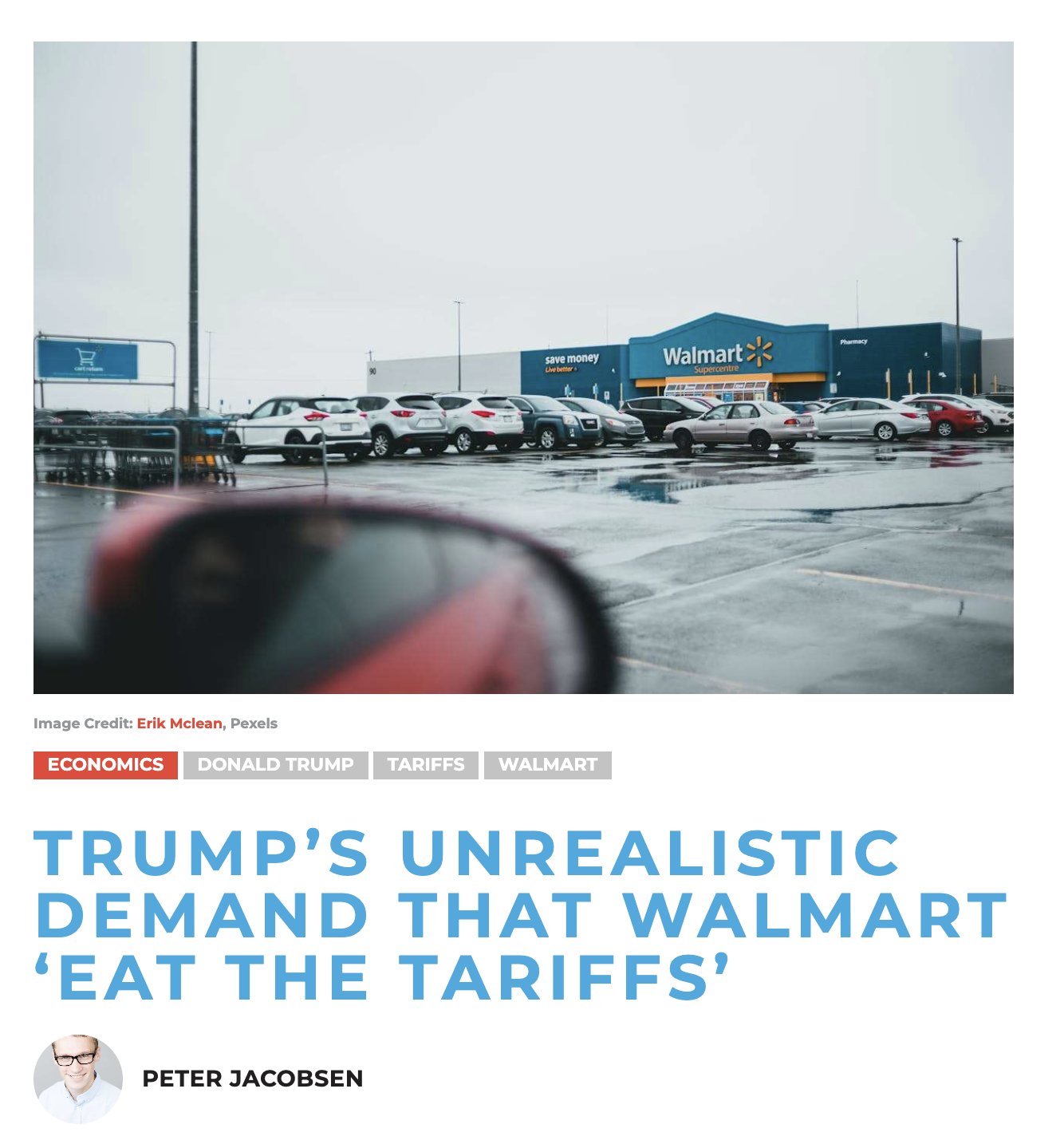
Why it’s economically impossible for Walmart to “eat the tariffs” as Trump demands

Filed under: Business, Economics, Government, Politics, USA — Tags: , — Nicholas @ 04:00

At FEE, Peter Jacobsen shows the clear financial reason why Walmart and other big US retailers are passing along the price increases due to Trump’s tariffs rather than “eating them”:

Recently, a post from President Trump on Truth Social went viral. An attempt to convince retail giant Walmart to keep prices down despite the tariffs, it read:

    Walmart should STOP trying to blame Tariffs as the reason for raising prices throughout the chain. Walmart made BILLIONS OF DOLLARS last year, far more than expected. Between Walmart and China they should, as is said, “EAT THE TARIFFS”, and not charge valued customers ANYTHING. I’ll be watching, and so will your customers!!!

Trump’s demand here is, simply put, unreasonable, and it reflects a basic misunderstanding of how pricing decisions are made in a market economy. Let’s unpack why.

Walmart’s Thin Margins

The biggest problem with the President’s view is that it doesn’t pass a basic numbers test. To break it down, let’s look at Walmart’s financials.

It’s true that Walmart generates billions of dollars in revenue each year, but revenue alone doesn’t tell us how much Walmart makes.

To understand that, we need to consider profit, which accounts for the company’s costs. More specifically, we want to look at Walmart’s net profit margin, because that’s an extremely important indicator of whether Walmart could realistically “eat the tariffs”.

Depending on the source, Walmart’s net profit margin is somewhere between 2% and 3%. Let’s split the difference and say it’s 2.5%. What does that mean?

That means, if Walmart sells you $1 of goods, it only keeps 2.5 cents in profit. That’s right, 97.5 cents goes toward inventory, employee wages, store maintenance, and a variety of other operating costs.

Put another way, if you spend $100 at Walmart, they make $2.50 in profit.

Now let’s say you buy a $100 television that Walmart imports. A $20 tariff is imposed — an added cost Walmart has to pay to import the TV. Before the tariff, Walmart was making $2.50 in profits. After the tariff, it’s now taking a $17.50 loss.

The only way Walmart can still sell this TV is by raising the price.

At this point, a tariff supporter might respond: “The easy way to fix this is to buy US-made TVs instead!”

Sure — you can avoid tariffs by only buying domestic, but the problem is that domestic TVs tend to be more expensive. If they weren’t, Walmart wouldn’t be importing them in the first place. So even if Walmart pulls international TVs off the shelves and replaces them with US-made ones, the prices still increase.

Here’s the key point: “eating” the tariffs is not an option. Walmart operates on slim margins, barely making pennies on the dollar — there isn’t room to eat 20% cost increases!

June 4, 2025

“Asshole Britain”

Filed under: Britain, Cancon, Media, Politics, USA — Tags: , , , , — Nicholas @ 05:00

In The Line, Greg Quinn indulges in a bit of struggle sessioning about his earlier disagreements with the editors of The Line about Britain and Canada (protip: don’t search for images to go along with that particular headline, especially if you have “safe search” filters turned off):

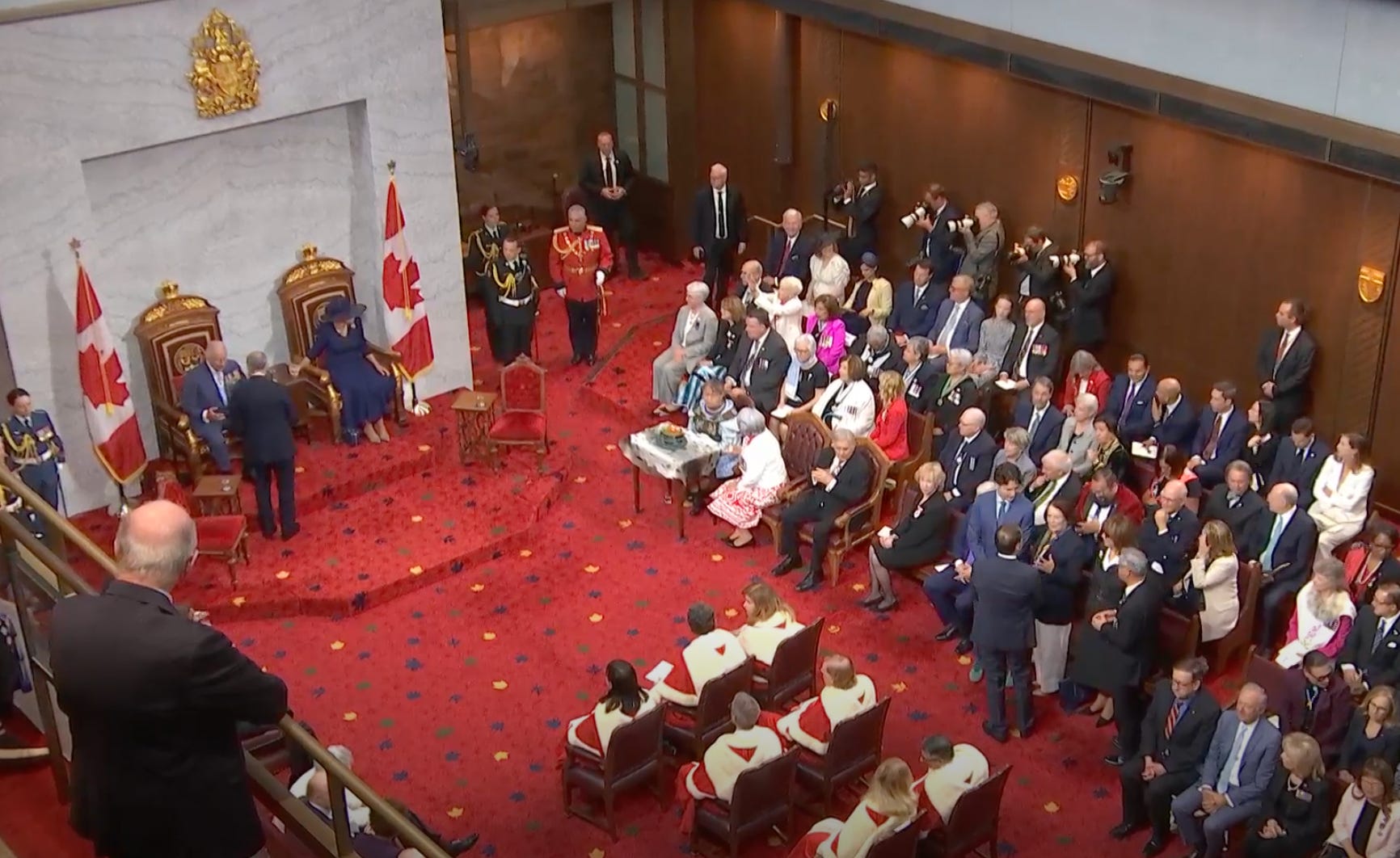
Yeah, let’s go with an inoffensive photo of His Royal Majesty and his Canadian First Minister chatting in the Senate chamber, rather than anything remotely to do with the headline of this post.
Photo by Paul Wells from his Substack

On February 12th of this year, I wrote in The Line about how my country, the United Kingdom, had “ghosted” Canada by refusing to come out strongly in reaction to U.S. President Donald Trump’s egregious attacks on the country and his calls for it to become the 51st state. In writing that piece, I didn’t beat around the bush — I called the U.K.’s actions what they were at the time: cowardice and sycophancy.

Since February, there have been a few (many?!) developments in Canada’s — and the world’s — relationship with President Trump.

Not least among these are Matt Gurney and Jen Gerson’s depiction (or technically, implication) of the U.K. as “Asshole Britain”. As other regular Line readers will know, “Asshole Canada” or “Maximum Canada” is an idea the editors floated here some months ago, where they asserted that Canada should abandon its typical desire to be seen as a global do-gooder and simply assert its national interests, vigorously and unapologetically, and if other countries, even allies, object, well, to hell with them. Editor Gurney, in a recent podcast, cited the just-concluded visit of His Majesty the King to Canada to deliver the Throne Speech — the first time a monarch has done so since 1977 — as an example of that. Prime Minister Mark Carney issued the invite to the King despite obvious discomfort with the idea among senior officials in my government.

Carney didn’t care. The King is the sovereign of Canada, too, and Carney didn’t let British discomfort deter him.

I have to say that HM the King’s speech was a blinder and (in its own royal diplomatic way) left no doubt as to where His Majesty’s sympathies lie and how he supports Canada’s sovereignty and independence. Whether you are a royalist or a republican, the fact that HM the King made the trip and read the speech should be welcomed. And I entirely agree with the editors here — Canadians should and must ignore the comments from the U.K. Who cares? HM the King was acting in his capacity as Canada‘s monarch — the views of anyone in the U.K. (government or otherwise) are irrelevant.

I wish I could condemn Jen and Matt for their (again, implied) characterization of the U.K. — Britain has needed no urging to unapologetically assert its own interests in this revived era of Trump. But I can’t. They are absolutely correct. And every day that passes, I’m sorry to say that the U.K. becomes more and more “Asshole Britain” when it comes to its relationship with Canada and the U.S.

The reasons remain much the same as I identified before: cowardice and sycophancy. To that, I’d now like to add venality. We think we have a special relationship with the U.S., as demonstrated by our recent trade agreement — except the impact of that agreement is open to some question. We seem to be afraid of saying anything that might upset President Trump, in case he reacts. Although we fail to understand that upsetting the President does not follow a rational process. He could (and does) get upset and react extremely easily at the simplest and most unexpected of things.

The President continues to make unacceptable claims against Canada, including reiterating his call for it to become the 51st state shortly after the King’s visit concluded. His latest iteration of this includes claims that Canada could save U.S.$61 billion it “should” be charged for the so-called Golden Dome (what is it with adjectives and this President?) if it joins the U.S. This, of course, fails to grasp the simple strategic fact that if you want a defence shield like this over North America, then you’re going to have to use sensors and other infrastructure on Canadian soil. Is he expecting to be provided that land for free?

By continuing to refuse to stand up to President Trump and clearly express our support for Canada, we are submitting to his attempts to divide and rule those of us who remain like-minded. At its worst, we are now venal — selling out to the president.

Instead, we should be standing true to our roots — as defenders of the free market and democracy. We should be leading the way, and we should be building an alliance of those who continue to share our values.

That is what we should be doing. That we aren’t is nothing short of a disgrace.

Update: Fixed broken link to Greg Quinn’s article. Doh!

May 31, 2025

Depending on how you read the tea leaves, are all the signed treaties now to be ignored?

Filed under: Cancon, Government, History — Tags: , , , , , — Nicholas @ 04:00

In The Free Press Rupa Subramanya discusses King Charles’s land acknowledgement at the start of the Throne Speech earlier this week:

Mark Carney joins our visiting King in the traditional Making of the Small Talk.
Photo by Paul Wells from his Substack

Canadians have a fondness for land acknowledgments, [NR: while some of us think they’re merely virtue signalling on steriods which will end up causing more mischief in the long run] which have now become common at police press conferences, on Air Canada flights, at hockey games, and even at a Taylor Swift concert.

But nothing has caused more commotion than the spectacle of King Charles III opening the 45th legislative session of Parliament on May 27 with a land acknowledgment, when he declared from his throne: “I would like to acknowledge that we are gathered on the unceded territory of the Algonquin Anishinabe people. This land acknowledgment is a recognition of shared history as a nation.”

People will point out that King Charles’s speech was written by Canadian prime minister Mark Carney’s government (true) and that as the monarch he was being respectful to Canadian traditions (fine). But there is something deeply funny about the literal King of England talking about the lands his predecessors brutally conquered centuries ago like they’re still up grabs.

Kicking off Parliament with a speech is a time-honored tradition, but it’s rare for the monarch to deliver it in person, and is normally delivered by the governor general, Canada’s official stand-in for the king. The reason the king was there was to push back against the idea that Canada is for sale.

“There is no better way to assert Canada’s sovereignty than by inviting the sovereign,” said Philippe Lagassé, a constitutional expert at Carleton University in Ottawa, Ontario. “Carney invited the king as part of his renewed emphasis on Canadian nationalism rooted in our institutions and history.” (Unlike the U.S., which broke from Britain in 1776, Canada remained a colony until 1867, when it became a constitutional monarchy with a British-style parliamentary system and the UK monarch as head of state.)

Lagassé added that Carney’s invite to Charles was also likely done to “leverage President Trump’s affection for the king in Canada’s favor.”

Trump may love the monarchy, but Canadians have traditionally been indifferent towards it. But that’s changing, thanks to Trump’s “51st state” rhetoric.

According to a recent poll, 66 percent of Canadians now believe the monarchy helps set the country apart from the United States, up from 54 percent in April 2023. In 2023, 67 percent thought the royal family should have no formal role in Canadian society; today, that number has dropped to 56 percent.

In his speech, King Charles didn’t mention Trump by name, but the subtext was hard to miss: “Canada faces another critical moment. Democracy, pluralism, the rule of law, self-determination, and freedom are values which Canadians hold dear, and ones which the government is determined to protect.”

“U.S. libertarians [are] the best friends Canada doesn’t know it has”

In the National Post, Colby Cosh sings the praises of American libertarians for their work in trying to dismantle some of Donald Trump’s dubiously Constitutional extensions of presidential power:

The James L. Watson Court of International Trade Building at 1 Federal Plaza in Lower Manhattan, New York City.
Photo by Americasroof via Wikimedia Commons.

The U.S. Court of International Trade (CIT) issued a decision Wednesday that annuls various salvos of surprise economic tariffs, including ones on Canada, that have been enacted by President Donald Trump since his inauguration in January. I won’t lie to you: I had the same initial reaction to this consequential news that you probably did, which was “Hooray!” and then “Huh, there’s a U.S. Court of International Trade?”

This court is surely unfamiliar even to most Americans, no doubt because much of its work involves settling issues like “Do hockey pants count as ‘garments’ or ‘sports equipment’ under customs law?” Nevertheless, the CIT does have exclusive jurisdiction over civil actions involving U.S. trade law. It’s just that no president has ever before rewritten the tariff schedule of the republic in the half-mad fashion of a child taking crayons to a fresh-painted wall.

The American Constitution, from day one, has unambiguously assigned the right to set international tariffs to Congress. Congress is allowed to delegate its powers to the president and his agents for limited or temporary purposes, but it can’t abandon those powers to him altogether. Defining this legal frontier is what the CIT was asked to do, and their demarcation of it will now swim upward through higher appellate courts (its decision has been put on hold in the meantime).

The lawsuit was actually two parallel suits raising overlapping objections to the tariffs. One was brought forward by 12 U.S. states, and the other was filed by a group of tariff-exposed American businesses, including manufacturers of bikes, electronics kits and fishing equipment. The latter set of plaintiffs was roped together by the usual posse of heroic libertarians and legal originalists, including George Mason University law prof Ilya Somin.

About 24 hours after Trump originally announced the “Liberation Day” worldwide tariffs, Somin quickly blogged about how insanely unconstitutional the whole idea was, and concluded his article essentially by saying “I’m darn well gonna do something about this nonsense”. I don’t mean to suggest he deserves primary credit; I only intend to call attention, once again, to U.S. libertarians being the best friends Canada doesn’t know it has.

May 29, 2025

The King of Canada

Filed under: Britain, Cancon, Government, History — Tags: , , , , , , — Nicholas @ 04:00

In the National Post, Colby Cosh tweaks the berries of the tiny number of dedicated Canadian republicans:

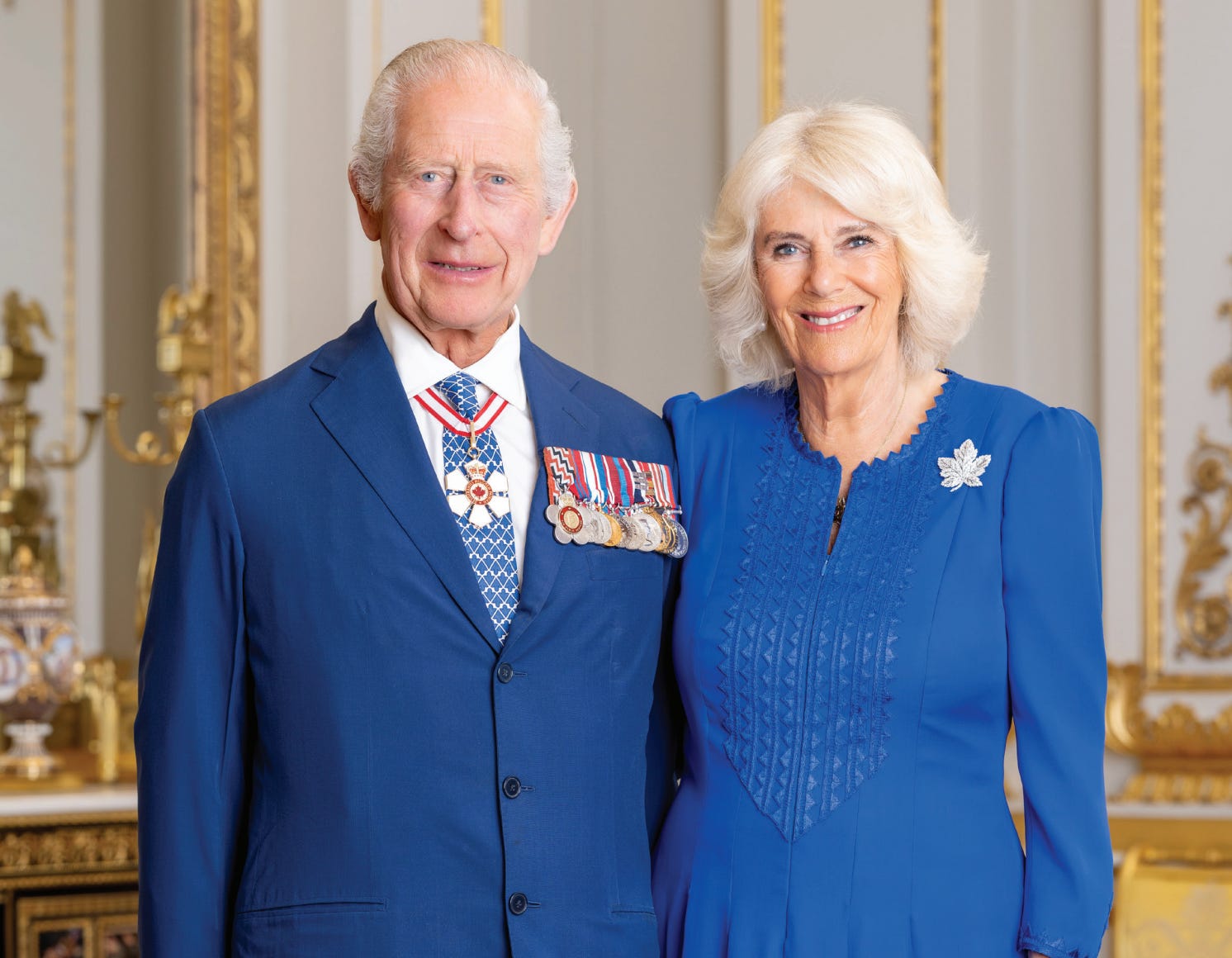
King Charles III and Queen Camilla, official portrait by Millie Pilkington.

The Post and other Canadian organs have been full of conscious praise for our unusual absentee monarchy lately, what with the King being in the capital to give the throne speech in person. But Canadian republicans must be hoping that our people will instinctively reject the spectacle, and at least see the genuine need for that blessing without which no sovereign state can hope to be taken seriously — a president.

There are rumblings about behind-the-scenes diplomatic tensions between Canada and the United Kingdom over the royal visit, rumblings which the Sunday Times (of London) put in print this weekend. The crux of the story is that Canada and the U.K. are not quite using the same playbook in dealing with the volatile and cutthroat Trump administration.

Sir Keir Starmer’s Labour government is applying lots of soft-soap, using Trump’s fondness for the British monarchy and its highly ornamented nature as a means of getting special treatment in trade negotiations. Meanwhile, Canada and its government hope to use the presence in Canada of Canada’s King as a subtle way of asserting independence, determination and strength as we bear the economic blows of Trumpian whim.

And — wait for it — the crazy part is, THOSE TWO KINGS ARE THE SAME EXACT DUDE. WHAAAT?

To a republican, this seems like a mystery concocted to obfuscate a logical weakness in the system. No doubt they see it just the same way an atheist looks at the centuries of early Christian debate over the Holy Trinity. It’s not exactly as though the U.K. and Canada are at war, or as though there is any overt disharmony between the two states. But the monarchists have to concede at least this much: when mutually sovereign countries have a shared head of state, you do in fact end up with the exotic possibility that George XIV of Canada might one day, in theory, have to issue a declaration of war on George XIV of Great Britain and Northern Ireland. This is baked into the improvised post-Imperial ontology of our government and of Britain’s.

This is why Canadian monarchists are so fussy about the independent constitutional footing on which the Canadian Crown rests. We do this, implicitly insisting that our system of government was reinvented in 1931, while at the same time arguing that the advantages of monarchy include antiquity, historical continuity and the preservation of a special bond between Commonwealth realms. Perhaps we are sneaky imperialist (or racist) hypocrites. Perhaps we just feel that those advantages are legitimate and important, and that the Statute of Westminster is an optimum compromise that preserves them while guaranteeing our sovereign freedom of action in the interplay of governments.

May 28, 2025

The Throne Speech

Filed under: Cancon, Media, Politics, USA — Tags: , , , , , — Nicholas @ 03:00

On his Substack, Paul Wells reports on the first Throne Speech delivered by the reigning monarch since the 1970s:

Mark Carney joins our visiting King in the traditional Making of the Small Talk.
Photo by Paul Wells from his Substack

We’re like Charlie Brown with Lucy’s football, or I guess, since the new PM is said to prefer British spellings, Charlye Brownne with Lewsey’s Foote Ball. Each generation of Canadian leadership tries to find a new way to make throne speeches exciting. These attempts are forever doomed, because no generation of Canadian leadership is exciting and because the format — a statement of intent from a dignitary who is forbidden to harbour autonomous intent — tends to short-circuit the delivery.

This time the delivery mechanism was the King of Canada, Charles Philip Arthur George, popping over from his secondary residence at Buckingham. His French tops Mary Simon’s, though his Inuktitut is shaky. He did his best to sound excited, or resolute, about the CBSA’s “new powers to examine goods”.

A quarter-century ago the reliably impish John Fraser told me he was preparing a book called Eminent Canadians that would survey recent developments in four Canadian institutions. The institutions he’d selected were the office of the Prime Minister; the Globe and Mail; the Anglican Church; — and here Fraser urged me to guess the fourth. Canadian institution? I dunno, the armed forces? The NHL? “The Crown”, Fraser said with a twinkle. Thus was I prepped for this week’s extended round of you-know-he’s-really-the-king-of-Canada browbeating.

This throne speech was like many before it, though out of deference for the deliverer it was on the short side, 21 pages tucked inside wide margins. In substance it was a paraphrase of Mark Carney’s already-semi-legendary Single Mandate Letter for cabinet ministers. There were sections on redefining Canada’s relationship with the United States; on internal trade; on crimefighting and national defence; and on “spending less and investing more”, which, I mean, we’ll see.

The mandate letter seems to have supplanted the Liberal election platform as the main blueprint for Carney’s action. The two aren’t wildly incompatible, but the mandate letter/throne speech is streamlined and puts stuff in different order.

I saw two surprises big enough to make me write today, but first I want to point to a few elements that are worth noting in the less-surprising stuff. That’s right, I’m trying to be useful, not just smart-assed, so here’s a way to thank me. […]

First, Carney (through His Majesty) makes claims for the “new economic and security relationship with the United States” that seem unrealistic. He expects “transformational benefits for both sovereign nations”. But surely any cross-border negotiation can only be, at best, an exercise in damage control? Any security costs that would be newly borne by Canada would represent a net cost. Trade arrangements short of the substantially free trade we’ve enjoyed for 40 years will also represent a net cost. The point of seeking “one Canadian economy” and taking relations with third countries more seriously is to offset the cost of a degraded Canada-US relationship, no?

Under “more affordable”, the throne speech repeats campaign promises for income-tax cuts and cuts to GST on new homes. The list of tangible financial benefits to individuals doesn’t go much past that. “The Government will protect the programs that are already saving families thousands of dollars every year. These include child care and pharmacare.” “Protect” is an old Ottawa word meaning “not extend”.

The goals for the “one Canadian economy” now include “free trade across the nation”, at both federal and provincial levels of government, “by Canada Day”. Which is 34 days away. The staffing and mandate of another new entity, a single-wicket “Major Federal Project Office”, may end up mattering more to this government’s success and Canada’s prosperity than the name of the PM’s next chief of staff, so put an asterisk next to that.

The government repeats a mysterious claim I’ve found shaky since Carney became a Liberal leadership candidate. It “will take a series of measures to catalyse new investment to create better jobs and higher incomes for Canadians. The scale of the Government’s initiative will match the challenges of our times and the ambitions of Canadians.” The challenges of our times, at least, are large.

So again: if the Canada Infrastructure Bank, the Canada Growth Fund and the Freeland-Sabia investment tax credits are sufficient to catalyse (British spelling) new investment, why duplicate them?

And if they haven’t worked, why keep them?

May 22, 2025

Trump, “the American Mussolini”, versus ever-so-democratic Mark Carney

Filed under: Cancon, Government, Media, Politics, USA — Tags: , , , , , — Nicholas @ 03:00

In the National Post, John Robson contrasts the authoritarian dictator at the helm of the American ship of state with our peaceful, democratic, and fully accountable to the voters prime minister:

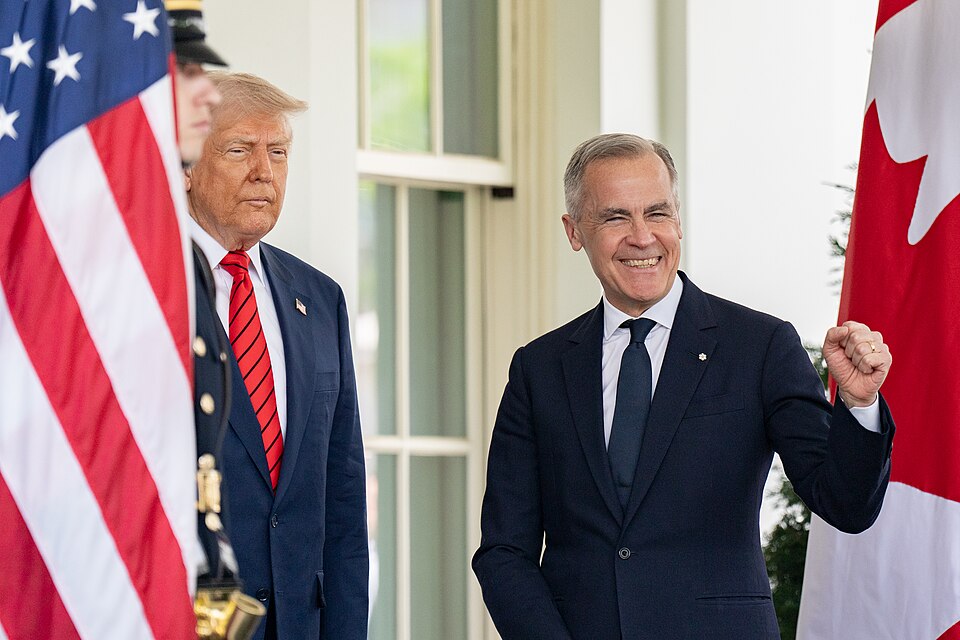
President Donald Trump greets Prime Minister of Canada Mark Carney, Tuesday, May 6, 2025, at the West Wing entrance of the White House.
(Official White House Photo by Gabriel B Kotico)

It was the best of budgets, it was the worst of budgets, it was the age of restraint, it was the age of profligacy, it was the epoch of the legislature, it was the epoch of the executive, it was the season of open debate, it was the season of closed doors, it was the spring of Canada, it was the winter of America. Or possibly the other way around.

The confusion arises because as a patriotic Canadian I keep hearing how U.S. President Donald Trump is an American Mussolini who has abolished the last vestiges of the old Republic, so we should drink rye not bourbon or some other decisive action easily performed while sitting down. Yet the news media mysteriously insist that the Bad Orange Man is having trouble getting his budget through some quaint relic called the United States Congress while Green Mark Carney isn’t bothering to get his spending plans rubber-stamped by some quaint relic called the Canadian Parliament. How can it be?

Tuesday’s the Morning newsletter from the New York Times, which is no MAGA outlet, reads: “Speaker Mike Johnson has a math problem. He wants to pass a megabill before Memorial Day to deliver President Trump’s legislative agenda.” But with only three spare votes in the House, “there are way more than three G.O.P. dissenters, and they don’t agree on what the problem is. Some think the cuts to Medicaid are too large. Others think they’re too small. Some want to purge clean-energy tax breaks. Others want to preserve them because their constituents have used them.”

Likewise The Atlantic, part of the thundering herd of independent liberal American minds, says: “The struggle to pass Donald Trump’s second-term agenda in Congress has never been between Republicans and Democrats … it’s been a battle between the House and Senate GOP, between moderates and hard-liners, and, most salient, between Republicans and reality.”

Egad. What manner of rambunctious folly is this? Open debate within the Maximum Leader’s own party? Dictatorship! By contrast here in decorous Canada can someone remind me which inane or malicious measures from former prime minister Justin Trudeau were ever put at risk by the principled courage, truculence or mere pandering even of his NDP coalition non-partners, let alone the trained seals in red?

Periodically one would bark. But which ever bit? To be sure, as the Canadian Press noted on Sunday, “Prime Minister Mark Carney says the Liberal government will present a federal budget in the fall, allowing time for clarity on some key economic and fiscal issues to emerge”. But if there’s going to be a brawl, it will be inside his office, or head, with his finance minister promising to brush aside Parliament with an “economic statement” before Carney overrode him, saying the government would introduce “a much more comprehensive, effective, ambitious, prudent budget in the fall”.

May 21, 2025

Canadian voters got fooled again

Filed under: Cancon, Media, Politics, USA — Tags: , , , , — Nicholas @ 03:00

Roxanne Halverson on Canadian voter gullibility that Mark Carney and the Liberals took full advantage of in the election campaign:

Offer not applicable in Canada, apparently.

Liberals voters on your elbows up crusade — do you feel foolish, do you feel shamed? Are you ready to admit that you were duped? That you were played like the fiddle in the Devil went down to Georgia. How does it feel to know that you fell for Mark Carney’s fear mongering fabricated crisis that made him Prime Minister. Or is your Trump Derangement Syndrome so severe that you cannot recognize how the Liberals used it and used you to win an election they didn’t deserve to win. It wouldn’t be so bad if only you had to pay the price, but unlike the phony COVID mantra, of we’re all in this together, we really are all in this nightmare together for another possible four years of Liberal rule and corruption, and we’re all going to pay the price. That includes those of us who didn’t get fooled again, but most of us are the same ones who also didn’t get fooled in the last three elections that gave the country the Liberals under Justin Trudeau for a decade of destruction.

Did you see the interview Prime Minister Mark Carney did with Sky News Australia?

You really should watch it. Because in it he admits what those of us who didn’t vote for him knew, and what he, himself also knew. There was never any real threat from Trump to annex Canada. And when pushed on it by the Sky News interviewer Samantha Washington who asks if he inflated the threat as political tool to inflame voters who hated Donald Trump, Carney dances around it saying one minute it wasn’t a threat and the next minute, well he thought it was and so did the Canadian people and well maybe he did use it to kind of stir them up. Essentially he was trying to dodge the fact that he lied and knew all along that Trump wasn’t really going to make Canada the 51st state.

So, let’s begin with the Trump threat — the existential threat to the existence of our country! According to Carney, Trump “wanted to take Canada, he wanted to break it“. But when asked by Washington about that ‘existential threat’, Carney walked it back. In his words, “No the existence is not at stake, it was more of economic crisis, and had a heavy element of national security comes with it, the extent to which we will be cooperating with others, particularly with the United States“.

Now wait a minute, Carney told voters — the elbows uppers — that Canada’s existence was at stake. And now he’s adding in a national security element? I don’t recall Trump ever saying anything about invading Canada or threatening our national security, in fact it was quite the opposite, he said the United States would always protect Canada for any foreign threat. His interest in national security had to do with Canada’s porous border and the fentanyl trade that the Liberals chose to ignore. This response is a typical Carney word salad dancing around answering the question. Something he seems to have in common with his predecessor Justin Trudeau. But at its core, he says, no Canada’s existence was never in danger.

Yet, he repeatedly told crowds at rallies that the US wanted to break us, when it was really just an economic crisis — something Canada has faced many times before, often due to bad Liberal policies.

But that’s what Mark Carney, with the help of his cartel media echo chamber, drummed into the heads of the elbows up crowd during his leadership campaign and during his entire election campaign. Trump was going to come and take our country — “he wants our resources, he wants our land, and he wants our water“.

Now here’s another word salad, walking back the ‘threat’ from Trump. When Washington asked him why he met with Trump when he was still disrespecting Canada by talking about making it the 51st state, even during their meeting in the Oval Office, which he said it, as she described it, “right to your face“. According to Carney this was ‘different’, and then he delivers another word salad because apparently, “Trump was expressing a desire … he had shifted from an expectation to a desire for that to happen. He was also coming from a place where he recognized that that wasn’t going to happen. I made it clear to him in that context.”

« Newer PostsOlder Posts »

Powered by WordPress