
The Tank Museum
Published on 31 Mar 2017The thirty-fourth Tank Chat, this time presented by Curator David Willey after some help from Eli. https://youtu.be/T33hp0J-LAw
Britain’s Main Battle Tank for twenty years, Chieftain was one of the first true Main Battle Tanks, designed to replace both medium and heavy tanks in front line service.
To find out more, buy the new Haynes Chieftain tank manual. https://www.myonlinebooking.co.uk/tan…
Support the work of The Tank Museum on Patreon: ► https://www.patreon.com/tankmuseum
Or donate http://tankmuseum.org/support-us/donate
August 13, 2018
Tank Chats #34 Chieftain | The Tank Museum
Comments Off on Tank Chats #34 Chieftain | The Tank Museum
July 29, 2018
A poor tank, a useless tank, and the worst tank in the world
Lindybeige
Published on 10 Jul 2018Tigers? Why talk about Tigers when one can talk about tanks that were even worse? More tank banter with The Chieftain.
Support me on Patreon: https://www.patreon.com/LindybeigeA low-tech tank with fragile armour, a tank that never saw the enemy, and the tank used to teach how not to build tanks. Thanks to Nicholas Moran (AKA The Chieftain) and Matt Sampson, the cameraman at Bovington Tank Museum.
The third of these three segments was shot with my new camera, and it really shows.
Lindybeige: a channel of archaeology, ancient and medieval warfare, rants, swing dance, travelogues, evolution, and whatever else occurs to me to make.
▼ Follow me…
Twitter: https://twitter.com/Lindybeige I may have some drivel to contribute to the Twittersphere, plus you get notice of uploads.
Facebook: https://www.facebook.com/Lindybeige (it’s a ‘page’ and now seems to be working).
Google+: “google.com/+lindybeige”
website: http://www.LloydianAspects.co.uk
Comments Off on A poor tank, a useless tank, and the worst tank in the world
July 20, 2018
Tank Chats #33 Panzer III | The Tank Museum
The Tank Museum
Published on 11 Mar 2017The thirty-third Tank Chat, this time presented by Curator David Willey. Including a fascinating insight into pre-Second World War German tank production and how the Panzer III worked alongside its fellow Panzers.
To find out more, buy the new Haynes Panzer III tank manual. https://www.myonlinebooking.co.uk/tan…
The Panzer III was conceived in 1934 as the principle combat tank of the Panzer divisions. The Museum’s Panzer III went into action in the North African theatre of war and is believed to have been captured at the Battle of Alam Halfa.
Support the work of The Tank Museum on Patreon: ► https://www.patreon.com/tankmuseum
Or donate http://tankmuseum.org/support-us/donate
Comments Off on Tank Chats #33 Panzer III | The Tank Museum
July 4, 2018
Tank Chats #32 Cromwell | The Tank Museum
The Tank Museum
Published on 24 Feb 2017The thirty second in a series of short films about some of the vehicles in our collection, presented by The Tank Museum’s historian David Fletcher MBE. The Second World War, British, Cromwell tank was one of the fastest tanks of the war.
Comments Off on Tank Chats #32 Cromwell | The Tank Museum
May 31, 2018
Admiral David Beatty: “There seems to be something wrong with our bloody ships today”
One of the outcomes of the Battle of Jutland was that naval opinion finally crystalized over the notion of battle cruisers: the loss of three British battle cruisers during the battle (and near-loss of a fourth) proved to most that the design was flawed and that this class of ships should never have sailed into battle against real battleships. A recent post at Naval Gazing begs to differ on this judgement:
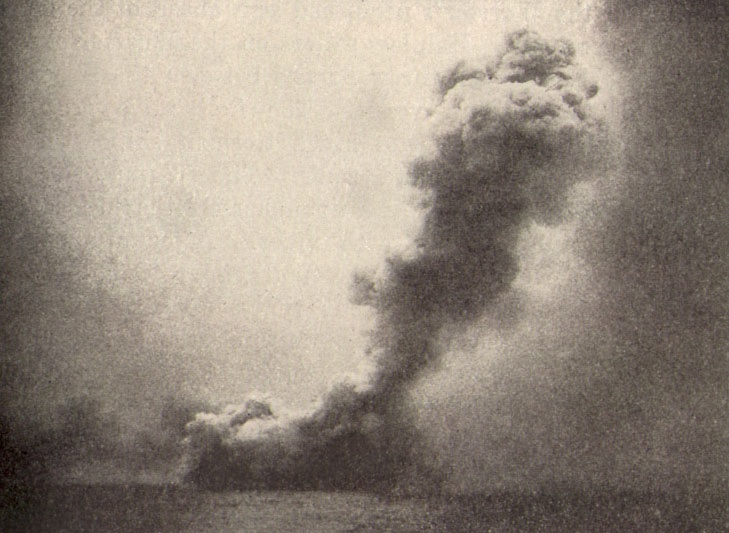
Explosion that sank HMS Queen Mary at the Battle of Jutland, 31 May 1916
Image via Wikimedia Commons.
David Beatty’s famous remark about the destruction of two of his ships by catastrophic magazine explosions during the Battle of Jutland sums up the traditional attitude towards one of the battle’s most famous aspects. Of the 3,326 men aboard the battlecruisers Indefatigable, Queen Mary, and Invincible, only 17 survived. It’s long been believed that the ships themselves were to blame, as they were built with only relatively light armor. Shells supposedly penetrated to the magazines and set them off. Recent research has revealed that this was not the case, and the ships were lost primarily due to defects in operation, not design.
The basic problem with the conventional theory is that no German shell penetrated deep enough into the surviving ships to have been able to set off a magazine if it had hit one. The magazines take up a minority of a battlecruiser’s deck, so if such hits were common, then at least a few of the surviving ships should have seen shells reach their machinery. Instead, German shells were found to detonate with 16-24′ of their first impact with the structure. At the 20° angle the shells were falling at at the time, this puts them no more than 8 feet below the upper deck upon detonation. The only case where shell fragments reached magazine was a hit on Barham at 1758 when fragments from a 12″ shell penetrated the deck over the 6″ magazine. Despite leaving a 12″x15″ hole in the 1″ deck, the fragments had no effect on the powder stored under it.
So is there a different potential cause, one that happened to a surviving ship? A survey of the damage to Beatty’s battlecrusiers reveals a promising candidate. A hit on a turret, such as the one suffered by HMS Lion, could cause a flash to propagate down into the magazine, which would then deflagrate in precisely the manner seen during the battle. A careful examination of Lion‘s damage shows that she came very close to suffering the same fate.
Turret explosions are hardly unknown aboard warships, either as a result of accident or enemy action, and a great deal of care goes into making sure that they don’t set off the magazines. Powder is stored in metal cans or tanks, and flashproof doors and other interlocks are used to make sure that fire does not reach the magazines. Unfortunately, the British had systematically undermined these protections in the search for rate of fire and ammunition capacity, and their magazine practices during the battle can only be described as suicidal.
After the Battle of Dogger Bank, Beatty decided that the reason he was unable to destroy the German battlecruisers was insufficient rate of fire. Not only would opening fire early and firing quickly lead to early hits, but it would also distract the German gunners. However, the British were not particularly confident in their long-range fire control, and began to stuff extra cordite into the handling rooms and other spaces that had been designed to provide flash protection. This was made much worse by a other changes intended to increase rate of fire. Normally, the cordite cases were kept sealed until just before the charges are sent to the gun, but the crews chose to open many of the cases early, take some cordite out of the cases before battle to make it easy to access, and even stored extra charges completely unprotected. In a final effort to make the turrets as dangerous as possible, the majority of the anti-flash safety doors were removed.
The only ship which strongly resisted this trend was Lion, and the efforts of her Gunner, Alexander Grant, deserve most of the credit. When Grant came aboard, he found the situation described above, and quickly reintroduced the traditional magazine safety regulations with the support of Lion‘s captain, Ernle Chatfield. He managed to train the magazine crews to the point where they could provide cordite to the guns faster than the guns could fire it, while observing full safety procedures.
Comments Off on Admiral David Beatty: “There seems to be something wrong with our bloody ships today”
May 24, 2018
Tank Chats #30 M3 Grant | The Tank Museum
The Tank Museum
Published on 27 Jan 2017The thirtieth in a series of short films about some of the vehicles in our collection presented by The Tank Museum’s historian David Fletcher MBE.
Tanks of this type were first used in Western Desert in 1942. The M3’s were mechanically reliable, but soon superseded by Sherman.
Comments Off on Tank Chats #30 M3 Grant | The Tank Museum
May 16, 2018
Crusader Tank | Animated History
The Armchair Historian
Published on 25 Jun 2016
Comments Off on Crusader Tank | Animated History
May 12, 2018
The Disaster That Changed Engineering: The Hyatt Regency Collapse
Tom Scott
Published on 13 Mar 2017Today’s guest video is from Grady at Practical Engineering! Go subscribe: https://www.youtube.com/user/gradyhillhouse
The Hyatt Regency Hotel collapse was a disaster that changed engineering: it’s taught in colleges and universities as a way to make it clear: you check and double-check everything. Something that seems like a subtle change can cause a catastrophic failure if it’s not thoroughly checked first!
Comments Off on The Disaster That Changed Engineering: The Hyatt Regency Collapse
April 30, 2018
The Ferdinand: What Not To Do When Building a Tank
Potential History
Published on 11 Mar 2018A brief history of the VK 45.01 (P), or the Porsche Tiger, and the disaster it later became.
Comments Off on The Ferdinand: What Not To Do When Building a Tank
April 29, 2018
Tank Crew Training – More German Tank Prototypes I OUT OF THE TRENCHES
The Great War
Published on 28 Apr 2018Chair of Wisdom Time!
Comments Off on Tank Crew Training – More German Tank Prototypes I OUT OF THE TRENCHES
April 8, 2018
Tank design: two overlooked aspects
Lindybeige
Published on 6 Apr 2018I discuss a trait of tank armament that deserves more attention, and The Chieftain contributes his own tank design aspect that gets underestimated.
Comments Off on Tank design: two overlooked aspects
April 7, 2018
Captain Eric ‘Winkle’ Brown discusses Luftwaffe Aircraft
spottydog4477
Published on 23 Apr 2014Captain Eric ‘Winkle’ Brown discusses Luftwaffe Aircraft
Comments Off on Captain Eric ‘Winkle’ Brown discusses Luftwaffe Aircraft
April 1, 2018
QotD: Modularity
I was able to repair my sewer system because everything in it was modular. The pipe leading out of the house was made up of identical sections of fired clay pipe put together like legos. They were made of durable stuff, and they were installed to work using gravity alone. They worked for over one hundred years despite the efforts of dozens of people to screw them up in the interim. If they were a unitary system of some sort, and they failed, I would have been forced to replace them as a unitary system. To translate, that would have meant moving into a cardboard box behind a strip mall dumpster.
I could fix the broken components, and leave the others alone. Don’t underestimate the importance of this concept. In housing, everyone desires everything to be unitary, and wants it to be brand new forever. I can’t fix a modern house. I’m a dolt, but that’s not why I can’t fix it. In general, everything to do with a modern house can be replaced, but it can’t be fixed. If your hardwood strip flooring is worn, you can sand it and refinish it and get another fifty years out of it. If someone puts a coal out on your Pergo floor, you can lump it, or you can replace it. It’s sold as permanent. In real life, “permanent” really means “disposable.” The word “sustainable” is similar. It really means “in need of massive, permanent subsidy.”
Sippican, “You May Not Believe This, But ‘Weapons-Grade Nuts’ Is the Name of My Psychedelic Furs Tribute Band. But I Digress”, Sippican Cottage, 2016-03-16.
Comments Off on QotD: Modularity
March 27, 2018
German WW1 Prototype Tanks Of 1918 I THE GREAT WAR On The Road
The Great War
Published on 26 Mar 2018Get Our New Oberschlesien Tank Poster: http://bit.ly/PanzerOberschlesien
The German Tank Museum: https://www.youtube.com/DasPanzermuseum
While the German Army only fielded 20 A7V tanks during World War 1, they understood the potential of the tank and started working on different designs in the last year of the war. Some designs like the LKII almost got deployed while the Sturmpanzerwagen Oberschlesien or the Krupp-Protze never left the prototype stage.
Comments Off on German WW1 Prototype Tanks Of 1918 I THE GREAT WAR On The Road
March 23, 2018
Tank Chats #25 Mark VIII | The Tank Museum
The Tank Museum
Published on 12 Aug 2016In the 25th Tank Chat David Fletcher explores the First World War Mark VIII tank. The Mark VIII tank, also known as The International was a joint project between the British and American forces, following their entry into the war. Once the designs had been refined massive orders were placed in 1918 and then swiftly cancelled with the end of the war. In the end six Mark VIII tanks were built for Britain of which The Tank Museum’s is the sole surviving example.
http://tankmuseum.org/museum-online/vehicles/object-e1949-363
Comments Off on Tank Chats #25 Mark VIII | The Tank Museum


