Quotulatiousness

April 28, 2020

Tank Chats #68 T-34 | The Tank Museum

Filed under: History, Military, Russia, Weapons, WW2 — Tags: , , , , , — Nicholas @ 02:00

The Tank Museum
Published 9 Mar 2019

The T-34 is an iconic Soviet Second World War tank. It was the most produced tank of WW2 and remains a symbol of Russian sacrifice in the Great Patriotic War.

David Willey talks about both the T-34/76 and T-34/85 variants, used in World War Two.

Many thanks to RecoMonkey for providing many of the modern images of the T-34 https://www.recomonkey.com/

Support the work of The Tank Museum on Patreon: ► https://www.patreon.com/tankmuseum

Visit The Tank Museum SHOP: ► https://tankmuseumshop.org/
Twitter: ► https://twitter.com/TankMuseum
Tiger Tank Blog: ► http://blog.tiger-tank.com/
Tank 100 First World War Centenary Blog: ► http://tank100.com/ #tankmuseum #tanks #tankchats

April 26, 2020

Where have all the airships gone? | James May’s Q&A (Ep 8) | Head Squeeze

Filed under: Britain, Germany, History, Military, Technology, WW1 — Tags: , — Nicholas @ 02:00

BBC Earth Lab
Published 21 Feb 2013

James May talks us through the rise and fall of airships.

James May’s Q&A:
With his own unique spin, James May asks and answers the oddball questions we’ve all wondered about from “What Exactly Is One Second?” to “Is Invisibility Possible?”

April 24, 2020

Mauser-Norris Prototype: Origins of the Mauser Legacy

Filed under: Business, Europe, France, Germany, History, Military, Weapons — Tags: , , , , — Nicholas @ 02:00

Forgotten Weapons
Published 10 Jan 2020

http://www.patreon.com/ForgottenWeapons

https://www.floatplane.com/channel/Fo…

Cool Forgotten Weapons merch! http://shop.bbtv.com/collections/forg…

Today we are looking at one of the rarest and earliest rifles built by Paul and Wilhelm Mauser, a design which would set in motion all the events that led to the Mauser company becoming one of the great world leaders in small arms. The Mauser brothers were born in Oberndorf am Necker in the Kingdom of Württemberg, sons of a gunsmith. They would take up their father’s trade and were creative and intelligent boys, but opportunities were limited in the small, rural town of Oberndorf. In 1865 they presented a rifle to the Austrian Army in Vienna for trials, where it was rejected. However, it was noticed by an American sales rep for the Remington Company, a man named Samuel Norris. Norris saw the potential in the Mauser brothers’ design to convert needlefire rifles to metallic cartridges, and he signed a deal with the brothers to further develop the system.

The Mausers moved to Liege Belgium to do their work, and within just a few years they were making rifles for Norris. This example is based on a Chassepot, as Norris hoped to sell the conversion system to the French Army. That deal was rejected, however (the French were happy sticking with paper cartridges as of 1868), and Norris’ plans began to unravel when the Remington company discovered that he was making dealings in his own name instead of for them. The Mauser brothers ended up walking away from the deal with ownership of the patents they had filed with Norris, and when they submitted the design to the Prussians a process began which would result in the Mauser Model 1871 being adopted. From there, their talents would lead to the whole line of Mauser repeating rifles culminating in the Model 1898, arguably the pinnacle of the bolt action military rifle.

Thanks to the Liege Arms Museum for access to film this for you! If you are in Belgium, definitely plan to stop into the museum, part of the Grand Curtius. They have a very good selection of interesting and unusual arms on display. Further thanks to the Paul Mauser Archive for helping to arrange this filming!

https://www.grandcurtius.be

http://www.paul-mauser-archive.com

Contact:
Forgotten Weapons
6281 N. Oracle #36270
Tucson, AZ 85740

April 22, 2020

The REAL Heroes of the M1 Carbine – not “Carbine” Williams

Filed under: History, Military, USA, Weapons, WW2 — Tags: , , , — Nicholas @ 04:00

Forgotten Weapons
Published 21 Apr 2020

http://www.patreon.com/ForgottenWeapons

https://www.floatplane.com/channel/Fo…

Cool Forgotten Weapons merch! http://shop.bbtv.com/collections/forg…

The Hollywood-spawned mythos of the M1 Carbine is that it was created by David Marshall “Carbine” Williams. The reality is far different. In real life, Williams was talented, but short-tempered, stubborn, and unable to work effectively as part of a team — and a cohesive, cooperative team is what the M1 Carbine required.

While Williams was off sulking about how the work was being done wrong, a team of Winchester machinists and engineers including William Roemer and Fred Humiston were actually making it happen.

The most impressive anecdote of the whole story, to me, is from when the solitary Winchester prototype broke its bolt in the middle of the final testing. Fred Humiston was representing Winchester at the trials, and he was told that if he could provide a new bolt within 24 hours the gun could continue the trials — but he could not take the gun off the testing ground. So Humiston went back to the Winchester shop and made a new bolt from memory (no drawings yet existed for the gun) and without being able to test-fit it in the gun. When he returned the next day, his new bolt dropped in perfectly, and the gun went on to win the trials. That is an epic feat of skill, and it is really a shame that he does not get more recognition for it.

Contact:
Forgotten Weapons
6281 N. Oracle #36270
Tucson, AZ 85740

April 17, 2020

Prototype Mauser 1917 Trench Carbine

Filed under: Germany, History, Military, Weapons, WW1 — Tags: , , , — Nicholas @ 02:00

Forgotten Weapons
Published 20 Dec 2019

http://www.patreon.com/ForgottenWeapons

Cool Forgotten Weapons merch! http://shop.bbtv.com/collections/forg…

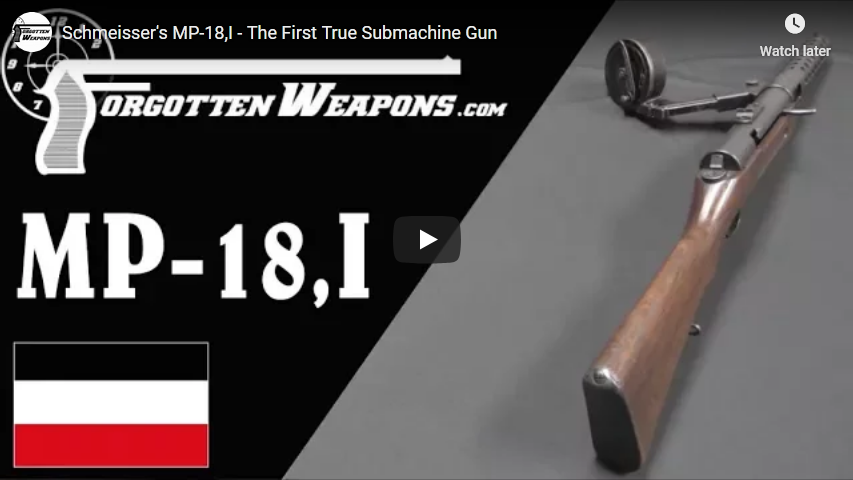
In the latter stages of World War One, the German military was looking for new arms for its Sturmtruppen. Without a reliable self-loading rifle design to use, they instead focused on pistol-caliber arms. The first to be used was the existing P08 artillery Luger, fitted with a drum magazine. At the very end of the war, these were being replaced by Bergmann MP-18,I submachine guns. But there was another gun that was tested but not adopted — the 1917 trench carbine variation of Mauser’s C96 “Broomhandle” pistol. Only about 40 of these guns were made as prototypes and trials models, and they were not adopted for reasons that are not entirely clear (but cost is probably a significant element). Only a few examples survive, and they vary substantially in their details. In addition, they are substantially different from both standard C96 pistols and also the sporting carbines made before the war.

All the 1917 trench carbines used a magazine developed from the 1906/08 pistol; an excellent double-stack, double-feed type. Magazines of 10, 20, and 40-round capacity were made, although all known examples were only semiautomatic (the full-auto Schnellfeuer Mausers would not come until the early 1930s).

Contact:
Forgotten Weapons
6281 N. Oracle #36270
Tucson, AZ 85704

April 14, 2020

Curator at Home | Tanks: 100 Years of Evolution | The Tank Museum

Filed under: Books, History, Military, Weapons — Tags: , , , — Nicholas @ 06:00

The Tank Museum
Published 12 Apr 2020

Join The Tank Museum’s Curator, David Willey, at home, as he reviews the book: Tanks – 100 Years of Evolution by Richard Ogorkiewicz.

Support the work of The Tank Museum on Patreon: ► https://www.patreon.com/tankmuseum
Visit The Tank Museum SHOP & become a Friend: ► https://tankmuseumshop.org/

Twitter: ► https://twitter.com/TankMuseum
Instagram: ► https://www.instagram.com/tankmuseum/
Tiger Tank Blog: ► http://blog.tiger-tank.com/
Tank 100 First World War Centenary Blog: ► http://tank100.com/

April 13, 2020

Choosing the Right Joinery | Paul Sellers

Filed under: Woodworking — Tags: , , — Nicholas @ 04:00

Paul Sellers
Published 9 Apr 2020

Understanding joinery can be confusing, especially is this so when industry confuses the issues by introducing terms like dowel joint, biscuit joint and domino joint.

I hope that we can all see to it that the art of true joinery remains as both the industry and the non-industry standard that preserves the skilled work of artisans working these three joints into their projects. I also hope that this video helps everyone to understand why there is a difference.

For a beginner friendly guide on the basic joints, see our FREE courses on Common Woodworking:
Dovetail: https://bit.ly/3e12edT
Mortise and Tenon: https://bit.ly/2x1f8YF
Housing Dado: https://bit.ly/2Vi2JHY
——————–

Want to learn more about woodworking?

Go to Woodworking Masterclasses for weekly project episodes: http://bit.ly/2JeH3a9

Go to Common Woodworking for step-by-step beginner guides and courses: http://bit.ly/35VQV2o

http://bit.ly/2BXmuei for Paul’s latest ventures on his blog

April 12, 2020

Tank Chats #67 Covenanter | The Tank Museum

Filed under: Britain, History, Military, Weapons, WW2 — Tags: , , , — Nicholas @ 02:00

The Tank Museum
Published 22 Feb 2019

Historian David Fletcher MBE talks through the Second World War British Cruiser tank, the Covenanter. Otherwise known as Tank Cruiser Mark V** A13.

Support the work of The Tank Museum on Patreon: ► https://www.patreon.com/tankmuseum

Visit The Tank Museum SHOP: ► https://tankmuseumshop.org/
Twitter: ► https://twitter.com/TankMuseum
Tiger Tank Blog: ► http://blog.tiger-tank.com/
Tank 100 First World War Centenary Blog: ► http://tank100.com/ #tankmuseum #tanks #tankchats

April 10, 2020

M1 Carbine: A Whole New Class of Weapon

Filed under: History, Military, USA, Weapons, WW2 — Tags: , , , — Nicholas @ 04:00

Forgotten Weapons
Published 9 Apr 2020

http://www.patreon.com/ForgottenWeapons

https://www.floatplane.com/channel/Fo…

Cool Forgotten Weapons merch! http://shop.bbtv.com/collections/forg…

The United States developed the M1 carbine very quickly at the beginning of World War Two, once the German “blitzkrieg” made it clear that highly mobile enemy forces could threaten rear echelon troops in a modern war. The M1911 pistol was seen as a difficult weapon to use well, and a light carbine would offer much greater effectiveness with less training. It was estimated that 500,000 would be needed, and more than 6 million were eventually produced during the war. The M1 Carbine would equip drivers, artillery crews, mortar men, headquarters staff, paratroops, and many more.

The M1 Carbine was developed by Winchester, but they were not participants in the first round of trials, Instead, their design came about when Rene Studler (head of the Ordnance Department) saw Winchester’s “M2” rifle prototype, a lightweight .30-06 intended to compete with the M1 Garand. He urged them to scale it down for the light rifle trials then ongoing in 1941, and Winchester complied. The design used a Garand-like rotating bolt and a gas tappet system designed by David Marshall Williams for the .30-06 rifle. The new carbine was cobbled together in less than two weeks, and is a truly fantastic achievement.

Thanks to InterOrdnance / Royal Tiger Imports for providing this M1 Carbine for filming!

Contact:
Forgotten Weapons
6281 N. Oracle #36270
Tucson, AZ 85740

Char 2C – The World’s Biggest Operational Tank

Filed under: France, History, Military, Weapons, WW1, WW2 — Tags: , , — Nicholas @ 02:00

Mark Felton Productions
Published 15 Nov 2019

Find out the unbelievable story of the biggest operational tanks in history – the French Char 2C, and their peculiar fate.

Help support my channel:
https://www.paypal.me/markfeltonprodu…
https://www.patreon.com/markfeltonpro…

Disclaimer: All opinions and comments expressed in the ‘Comments’ section do not reflect the opinions of Mark Felton Productions. All opinions and comments should contribute to the dialogue. Mark Felton Productions does not condone written attacks, insults, racism, sexism, extremism, violence or otherwise questionable comments or material in the ‘Comments’ section, and reserves the right to delete any comment violating this rule or to block any poster from the channel.

Credits: YouTube Creative Commons; WikiCommons; Google Commons; Mark Felton Productions
Music: “Pursuit” and “Dogma” licenced to iMovie by Apple, Inc.

H/T to @AnonymousFred514 for the link.

April 1, 2020

Curator’s Tank Museum Tour: Tank Story Hall – WW1 | The Tank Museum

Filed under: Britain, Europe, France, Germany, History, Military, WW1 — Tags: , , , , , — Nicholas @ 05:00

The Tank Museum
Published 31 Mar 2020

Join Curator David Willey as he takes you on a tour of The Tank Museum’s Tank Story Hall, which houses over 30 key vehicles from Little Willie to Challenger 2. In this section he looks at the First World War vehicles and gives you a potted history of WW1.

Support the work of The Tank Museum on Patreon: ► https://www.patreon.com/tankmuseum
Visit The Tank Museum SHOP & become a Friend: ► https://tankmuseumshop.org/

Twitter: ► https://twitter.com/TankMuseum
Instagram: ► https://www.instagram.com/tankmuseum/
Tiger Tank Blog: ► http://blog.tiger-tank.com/
Tank 100 First World War Centenary Blog: ► http://tank100.com/
#tankmuseum #tanks

March 18, 2020

How Does It Work: Roller Delayed Blowback

Filed under: Germany, Weapons, WW2 — Tags: , , — Nicholas @ 06:00

Forgotten Weapons
Published 17 Mar 2020

http://www.patreon.com/ForgottenWeapons

https://www.floatplane.com/channel/Fo…

Cool Forgotten Weapons merch! http://shop.bbtv.com/collections/forg…

Roller delayed blowback originated in the Mauser company R&D department when engineers were attempting to design a roller-locked version of the G43 rifle. They found that when the bolt bounced in automatic fire, the system would sometimes work without being fully locked. With some refinement, this became the roller delayed system, and would have been used in the StG-45 rifle if the war had gone longer. After the war, the system was applied to prototype French arms, then to the Spanish CETME program which eventually became the German G3 rifle. The system would see use primarily as the basis of a whole family of arms from Heckler & Koch, although it has been used in a few other places.

Mechanically, the system uses an angled “locking” wedge to put a mechanical disadvantage on a pair of rollers that must retract into the bolt head before it can move rearward. The combination of the wedge angle and the mass of the bolt carrier assembly are carefully calculated to delay the action from opening until pressure is reduced to a safe level. These systems do typically open faster than locked actions, though, and generally require the use of chamber fluting to ensure reliable extraction.

Contact:
Forgotten Weapons
6281 N. Oracle #36270
Tucson, AZ 85740

March 11, 2020

How Does It Work: Roller Locking

Filed under: Technology, Weapons — Tags: , , , , — Nicholas @ 04:00

Forgotten Weapons
Published 10 Mar 2020

http://www.patreon.com/ForgottenWeapons

https://www.floatplane.com/channel/Fo…

Cool Forgotten Weapons merch! http://shop.bbtv.com/collections/forg…

Roller locking is a system that is not used in many guns and often confused with roller-delayed blowback — which is understandable, given the similarities between the systems. Roller locking was first developed as a modification of the German G43 rifle, and it is really a sub-type of flapper locking mechanism. It was most significantly used in the MG42, and also in the Czech vz.52 pistol. In essence, it uses rollers in place of flaps to lock the bolt and barrel securely together during firing, and depends on an external system (short recoil, in the case of the MG42 and vz.52) to unlock before it can cycle.

Contact:
Forgotten Weapons
6281 N. Oracle #36270
Tucson, AZ 85740

March 9, 2020

British Submachine Gun Overview: Lanchester, Sten, Sterling, and More!

Filed under: Britain, History, Military, Weapons, WW2 — Tags: , , , — Nicholas @ 02:00

Forgotten Weapons
Published 12 Mar 2017

Armament Research Services (ARES) is a specialist technical intelligence consultancy, offering expertise and analysis to a range of government and non-government entities in the arms and munitions field. For detailed photos of the guns in this video, don’t miss the ARES companion blog post:

http://armamentresearch.com/british-sub-machine-gun-development-an-overview/

Great Britain was one of the few countries that went into World War Two with virtually no submachine gun development. Not every country had an issued SMG by 1939, but virtually everyone had at least been working on experimental concepts — except the British. It was only with the outbreak of hostilities that the need for such a weapon suddenly became apparent and its acquisition became a military priority.

This was solved by acquiring and copying the German MP28/II, which was quickly followed by a simplification program that would lead to the MkI, MkI*, and ultimately MkII and MkIII Sten guns. The Stens were truly exceptional studies in simplification, getting down to a mere 5.5 man-hours of production time. Only after the threat of immediate German land invasion had subsided was the Sten allowed to become a little bit user-friendly, in the MkV guise.

At the end of WW2, the British were finally able to scrap the Sten (known to be a compromise gun all along) and replace it with something with more finesse. Tests were run on the MCEM series, on BSA guns, on interesting prototypes like the double-stack-magazine Vesely V42 — but it was George Patchett’s much improved Sten which would be chosen and come to be known as the Sterling SMG (named after its manufacturer).

A couple of corrections to the video:

— The MP28 was designed by Schmeisser, not Bergmann.

— The MCEM-2 was designed by Polish engineer Lt. Jerzy Podsendkowski. The -2 version of the MCEM was completed during WW2; it was the -4 and -6 versions that were post-war.

— George Lanchester was chief engineer at Sterling and ran the Lanchester project, but was not actually the lead designer himself.

http://www.patreon.com/ForgottenWeapons

Cool Forgotten Weapons merch! http://shop.bbtv.com/collections/forg…

If you enjoy Forgotten Weapons, check out its sister channel, InRangeTV! http://www.youtube.com/InRangeTVShow

February 29, 2020

Forced-Air Cooling in an Experimental Ross Machine Gun

Filed under: Cancon, History, Military, Weapons, WW1 — Tags: , , , , , — Nicholas @ 04:00

Forgotten Weapons
Published 28 Feb 2020

http://www.patreon.com/ForgottenWeapons

https://www.floatplane.com/channel/Fo…

Cool Forgotten Weapons merch! http://shop.bbtv.com/collections/forg…

In addition to building three main patterns of straight-pull bolt action rifle for the Canadian military and the commercial market, Sir Charles Ross also experimented with self-loading rifles. Starting with a standard Ross Mk III, this experimental rifle has a gas piston and trigger to allow automatic fire and a very neat forced-air cooling system. A one-way ratchet mechanism (now broken, unfortunately) spins the fan when the bolt cycles, pushing air into a barrel shroud similar to that of a Lewis gun. This rifle was most likely made in 1915 or 1916 with an eye to a military light machine gun or automatic rifle contract — which never happened.

Thanks to the Canadian War Museum for providing me access to film this Ross for you!

https://www.warmuseum.ca

Contact:
Forgotten Weapons
6281 N. Oracle #36270
Tucson, AZ 85740

« Newer PostsOlder Posts »

Powered by WordPress