Quotulatiousness

June 19, 2013

The press and Rand Paul

Filed under: Liberty, Media, Politics, USA — Tags: , , , , , — Nicholas @ 11:03

In The Atlantic, Conor Friedersdorf looks at the mainstream media’s obsession with Rand Paul’s (to borrow a time-worn term from Canadian politics) “hidden agenda”:

Critiques of democracy are as old as the excesses of the Athenian variety. Here’s a classic: The unmediated masses are as capable of doing an injustice as any aristocracy or tyrant. In America, it’s acceptable to say, as shorthand, that we’re living in a Western liberal democracy. But the fact is that we live in a federal, constitutional republic, because the Framers mistrusted democracy, and the vast majority of Americans retain a great part of that mistrust. We’ve extended the franchise, amended the Constitution to permit the direct election of senators, and we’re likely to eventually abandon the electoral college and elect presidents by the popular vote. But there is broad, deep support for anti-democratic features of our system, like the Bill of Rights.

All of this is totally uncontroversial — unless it is uttered by Senator Rand Paul, the national politician most likely to evoke irrational paranoia from the political press. Serial anti-libertarian Jonathan Chait is the latest to demonstrate this truth in an unintentionally revealing item at New York.

Here’s how he begins:

    The most unusual and interesting line in Julia Ioffe’s highly interesting profile of Rand Paul is Paul’s confession, “I’m not a firm believer in democracy. It gave us Jim Crow.” Of course, that’s an awfully strange way to condemn Jim Crow, which arose in the distinctly undemocratic Apartheid South (it was no coincidence that the dismantling of Jim Crow and the granting of democratic rights to African-Americans happened simultaneously).

This is an uncharitable beginning. If a scholar of political thought said of ancient Athens, “I’m not a firm believer in democracy — it required slavery, war, or both, to subsidize the lower classes while they carried out their civic duties,” no one would think that a strange formulation — it is perfectly coherent to talk about democracy in places that didn’t extend the franchise universally, given how the term has been used and understood for two thousand years of political history.

[. . .]

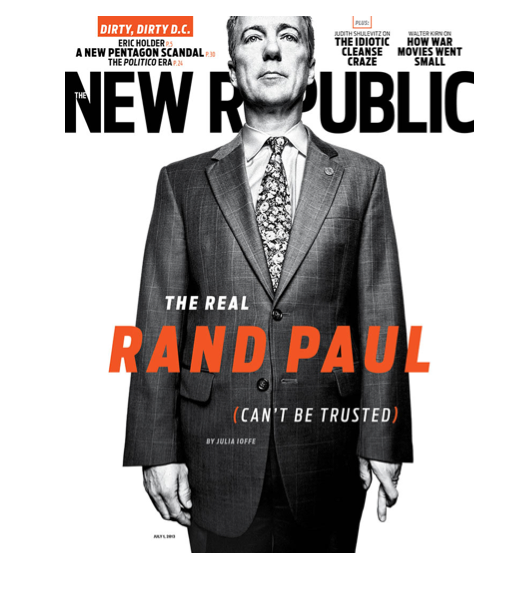
What Chait did is hardly unique. In the political press, it happens again and again: libertarian leaning folks are portrayed as if they’re radical, extremist ideologues, even when they’re expressing ideas that are widely held by Americans across the political spectrum. Here is the absurd cover The New Republic chose for the issue in which the Paul profile appears:

TNR Rand Paul cover

This would seem to imply that, relative to other politicians, the guy who went on Rachel Maddow to discuss the nuances of his take on the Civil Rights Act is the one hiding his “real” self from us. Remember the conservatives who kept saying, “Obama is hiding something — he’s not one of us”? That magazine cover is what it looks like when liberals cave to a similar pathology.

June 10, 2013

Daniel Ellsberg on rolling back an “executive coup” against the US constitution

Filed under: Government, Liberty, Media, USA — Tags: , , , , , — Nicholas @ 09:14

In the Guardian, Daniel Ellsberg explains why the Snowden leak is so important:

In my estimation, there has not been in American history a more important leak than Edward Snowden’s release of NSA material — and that definitely includes the Pentagon Papers 40 years ago. Snowden’s whistleblowing gives us the possibility to roll back a key part of what has amounted to an “executive coup” against the US constitution.

Since 9/11, there has been, at first secretly but increasingly openly, a revocation of the bill of rights for which this country fought over 200 years ago. In particular, the fourth and fifth amendments of the US constitution, which safeguard citizens from unwarranted intrusion by the government into their private lives, have been virtually suspended.

The government claims it has a court warrant under Fisa — but that unconstitutionally sweeping warrant is from a secret court, shielded from effective oversight, almost totally deferential to executive requests. As Russell Tice, a former National Security Agency analyst, put it: “It is a kangaroo court with a rubber stamp.”

For the president then to say that there is judicial oversight is nonsense — as is the alleged oversight function of the intelligence committees in Congress. Not for the first time — as with issues of torture, kidnapping, detention, assassination by drones and death squads — they have shown themselves to be thoroughly co-opted by the agencies they supposedly monitor. They are also black holes for information that the public needs to know.

The fact that congressional leaders were “briefed” on this and went along with it, without any open debate, hearings, staff analysis, or any real chance for effective dissent, only shows how broken the system of checks and balances is in this country.

June 4, 2013

LCBO intransigence triggers constitutional challenge

Filed under: Bureaucracy, Business, Cancon, Law, Liberty — Tags: , , , , , — Nicholas @ 11:02

This is kinda fascinating:

What started out as a simple privacy commissioner complaint has turned into a constitutional challenge of the validity of the Liquor Control Board of Ontario (LCBO) — and this time the Board has only itself to blame for the brouhaha, proving once again that Ontario’s LCBO is so far out of touch with the realities of today’s world, it’s downright scary. At a time when they should be thinking about transitioning out of the alcohol business, the Ontario provincial government and the LCBO seem to be clinging to its very existence with even more tenacity and verve than before. They’re like the old boxer clinging to past glories who just has to show you the right hook he can still throw — yet only ends up throwing out his shoulder. In the LCBO’s case, the word “Control” won’t be pried away from its “cold dead hands” anytime soon… or will it? In its most recent fight, the LCBO is proving it is a government entity most in need of being on the chopping block — if not the auction block — of government institutions that should be moved over to the private sector.

[. . .]

Why the LCBO has chosen to play hardball over such a trivial matter is incomprehensible; according to reports, the LCBO has decided to appeal the order and has asked that the records be sealed in the process. This seems to contravene common sense. “A government entity has chosen to spend hundreds of thousands of taxpayers’ dollars to fight an order by the Privacy Commissioner whose sole purpose is to make these decisions,” Porter says.

Now fed up with the collection of information, Porter and his team have decided to question the entire existence of the LCBO as it contravenes the Constitution Act of 1867 by challenging the Importation of Intoxicating Liquors Act (IILA) itself — which bans the free flow of goods (including alcohol, wine and beer) between the provinces. The argument hinges on Section 121: “All articles of Growth, Produce or Manufacture of any one of the Provinces shall, from and after the Union, be admitted free into each of the other Provinces.” This challenge could, and would if successful, lead to the downfall of the LCBO. Social networks were abuzz with the news about the challenge. Alfred Wirth, president and director at HNW Management Inc., applauded the news on Facebook: “Any progress towards competition among merchandisers is to be appreciated – even if it’s for domestically-produced products. Several years ago, when I questioned why Ontario couldn’t privatize the LCBO, the then Minister of Health said that alcoholic beverages were a crucial health matter which the province had to control. Despite the risk of people (including underage youth) freezing to death during our cold Ontario winters, he did not explain why the sale of crucial winter coats could be entrusted to Sears, the Bay, etc…” While Porter himself posted an analogy to cigarettes: “How about this one. Cigarettes are so dangerous that you cannot advertise them on TV, print, billboards or even display them behind a counter… but they can be sold at any store. Alcohol is so dangerous that it has to be sold at a government store with specially-trained people… but the government itself floods the market with advertising and even publishes a free magazine where 50 per cent of the content is about consuming the product.”

Energy lawyer Ian Blue has joined the Vin de Garde team for the action. I interviewed Blue in 2010 about the IILA, which is now under fire. Here’s what Blue had to say: “The law that gives provincial liquor commissions a monopoly and the power they have, is federal law, the Importation of Intoxicating Liquors Act; it’s highly arguable that the law is unconstitutional. It’s also pretty apparent to government constitutional lawyers, who are knowledgeable in these matters… [If the Supreme Court of Canada] takes a hard look at the IILA, and if they do an intellectually honest interpretation, the IILA probably cannot stand up to constitutional scrutiny.”

In 2009, lawyer Schwisberg commented to me when speaking about the IILA: “The very underpinning of Canada’s liquor regulatory system is unconstitutional. Isn’t that a mind blower?” Blue said: “There is nothing natural or logical about the existing system. It bullies, fleeces and frustrates wine producers and the public… If the IILA were to fall… wine producers could probably make quantum leaps of progress towards a fairer and more rational system of liquor and wine distribution in Canada.”

May 30, 2013

The real reason we’re getting wall-to-wall senate scandal coverage

Filed under: Cancon, Government, Media — Tags: , , , , , , — Nicholas @ 08:41

Colby Cosh suspects we may be on the receiving end of a massive distraction attempt:

I’m starting to half-believe the theory that the Senate expense scandal was cooked up to cover other problems for the Conservative Party of Canada. The broad main effect of the Senate fracas so far has been to exasperate the hell out of everybody. Mike Duffy’s bad behaviour presents the public with the frustrating conundrum that only the Senate can make rules for or punish errant senators, and that the major features of the Constitution (including that one) are probably immune from formal amendment for the next hundred years or so. Stephen Harper’s statutory end-run proposals for permitting Senate elections and tightening term limits are currently awaiting scrutiny by the Supreme Court; if the court rejects his measures, he can argue that they represented at least a fillip of attainable accountability, which they do, and that it is not his fault they were bounced.

In modern history, providing convenient excuses for inaction by elected politicians is about 45 per cent of the court’s function. And, at that, maybe it is okay to notice that the court, now crowded with Harper appointees, is as much an audience for Duffy’s antics as the rest of us. On top of all this, the whole mess invited Justin Trudeau, following cues like a good drama teacher, to plunge headlong into the trap of not only defending the Senate, but defending it on the specific grounds that Quebec is beneficially overrepresented therein.

If people are pulling faces at the Senate, that’s a win for the Conservative party. But perhaps more importantly, it’s a boost for the New Democrats, who have a clear “dynamite it” position on the Senate that they have advocated pretty consistently for half a century. Keeping the seat counts of the NDP and the Liberals roughly level with each other is the paramount strategic axiom for the Tories from now until (at least) 2015.

Most Canadians over the age of 40 would rather do almost anything other than watch another attempt at constitutional wrangling … we saw what happened the last couple of times the feds and the provinces tried re-rigging things to their preference.

May 28, 2013

Unseemly worship of the military state

Filed under: History, Liberty, Military, USA — Tags: , , , , — Nicholas @ 07:21

L. Neil Smith received one of the many email chain letters from a conservative acquaintance about “thanking a veteran” and indulged in a bit of fisking:

So with all that in mind, let’s consider the Memorial Day claims my friend sent to me, and I can only hope he’ll be my friend after this.

“It is the veteran, not the preacher, who has given us freedom of religion.”

The truth is that neither the veteran nor the preacher ever gave us such a right, it is ours, under natural law, the very moment we are born. It can certainly be suppressed, and has been other places in the world, and here, as well — ask any Mormon — but this government hasn’t fought a war to defend any American’s rights since the Revolution.

“It is the veteran, not the reporter, who has given us freedom of the press.”

Once again, not so. When the War of 1812 “broke out” — the U.S. was attempting to bestow the blessings of American life upon Canada whether Canada wanted them or not — and people objected (New England nearly seceded over it) people were accused of “sedition”, a charge that should be impossible under the First Amendment, and thrown in jail.

Later, Abraham Lincoln used the Army to smash the printing presses of his political opposition and intimidate voters during the 1864 election.

“It is the veteran, not the poet, who has given us freedom of speech.”

Freedom of speech and of the press are natural rights, as well, which governments in general, and the American government in particular, have always regarded as a threat. If any single individual can be thanked for it, that honor belongs to John Peter Zenger (look him up). At some point, the establishment press became so corrupt, concealing or excusing government atrocities, that they became a part of government, and a new press — the Internet — had to evolve in its place.

“It is the veteran, not the campus organizer, who has given us freedom to assemble.”

Having once been a “campus organizer” myself, I am well aware how little we had to do with defending the right to assemble, and how very badly it was done. But please, don’t be ridiculous. Two words: Kent State.

“It is the veteran, not the lawyer, who has given us the right to a fair trial.”

Actually, to the extent that any human institution is responsible for the right to a fair trial, it’s a thousand years of English Common Law.

“It is the veteran, not the politician, Who has given us the right to vote.”

A dubious gift, at best, but it didn’t come from any politicians or veterans. Thank the Greeks, and don’t forget the Basques, whose methods of self-government were consciously imitated by the Founding Fathers.

I like and admire veterans, My dad was a vet and his dad before him. But name any war the United States ever fought to defend American rights.

May 24, 2013

The first amendment applies to everyone, not just the professional media

Filed under: Law, Liberty, Media, USA — Tags: , , — Nicholas @ 08:33

Jonah Goldberg on the bits of the first amendment that the mainstream media tends to forget about:

“Congress shall make no law respecting an establishment of religion, or prohibiting the free exercise thereof; or abridging the freedom of speech, or of the press; or the right of the people peaceably to assemble, and to petition the Government for a redress of grievances.”

That’s the full text of the First Amendment. But (with apologies to the old Far Side comic), this is what many in the press, academia, and government would hear if you read it aloud: “Congress shall make no law respecting an establishment of religion, blah blah blah, or abridging the freedom of the press, blah blah blah blah.”

[. . .]

The press can always be counted upon not just to speak up for itself, but to lavish attention on itself. “We can’t help that we’re so fascinating,” seems to be their unspoken mantra.

And that’s fine. What’s not fine is the way so many in the press talk about the First Amendment as if it’s their trade’s private license.

The problem is twofold. First, we all have a right to commit journalism under the First Amendment, whether it’s a New York Times reporter or some kid with an iPhone shooting video of a cop abusing someone.

I understand that professional journalists are on the front lines of the First Amendment’s free-press clause. But many elite outlets and journalism schools foster a guild mentality that sees journalism as a priestly caste deserving of special privileges. That’s why editorial boards love campaign-finance restrictions: They don’t like editorial competition from outside their ranks. Such elitism never made sense, but it’s particularly idiotic at a moment when technology — Twitter, Facebook, Tumblr, Vine, etc. — is democratizing political speech.

May 4, 2013

Ron Paul on the so-called “Marketplace Fairness Act”

Filed under: Business, Economics, Government, USA — Tags: , , , , , , — Nicholas @ 09:28

As you probably guessed, he’s against it:

David French, Senior Vice President of the National Retail Federation, the major industry group lobbying for the so-called “Marketplace Fairness Act,” (more aptly named the “National Internet Tax Mandate”) recently commented that “…the law [governing Internet sales] today is a 20th-century interpretation of an 18th-century document…” Mr. French’s comments are typical of those wishing to expand government power beyond the limits established by the United States Constitution.

[. . .]

The National Internet Tax Mandate overturns the Supreme Court’s 1992 Quill v. North Dakota decision that states can only force businesses to collect sales tax if the business has a “physical presence” in the state. Quill represented a rare instance where the Supreme Court properly interpreted the Commerce Clause. Thanks to the Quill decision, the Internet has remained a tax-free zone, though some states require consumers to later pay taxes on products they purchased online. This freedom has helped turn the Internet into a thriving and dynamic sector of the economy, to the benefit of entrepreneurs and consumers.

Now that status is threatened by an alliance of big business and tax-hungry state governments seeking new powers to force out-of-state business to collect state sales taxes. Far from updating the Constitution to fit the needs of the 21st century, the National Internet Tax Mandate is a throwback to 18th century mercantilism.

The National Internet Tax Mandate will raise the costs of doing business over the Internet. Large, established Internet companies, such as Amazon, can absorb these costs, whereas their smaller competitors cannot. More importantly, the Mandate’s increased costs and regulations could prevent the creation and growth of the next Amazon.

April 22, 2013

The “public safety exception” to Miranda is a really bad idea

Filed under: Law, Liberty, USA — Tags: , , , , — Nicholas @ 09:33

In Techdirt, Mike Masnick explains why this Obama administration innovation should not be perpetuated:

  1. Suspending basic rights and due process out of fear is exactly the kind of thing that people attacking the US want to see. Showing that we can’t live up to our most basic rights and principles in the face of a terrorist attack gives those who hate us that much more incentive to keep going. It’s not just a sign of weakness, but an encouragement for those who seek to undermine our society. In fact, it takes a step in that very direction by showing that the government is willing to throw out the rules and principles when it gets a little scared by a teenager.
  2. The slippery slope here is steep and extremely slick. There are no rules on when the DOJ can suddenly ignore Miranda. It gets to decide by itself. This is an organization with a long history of abusing its power, now allowed to wipe out one of the key protections for those they’re arresting, whenever it sees fit. The whole point of the ruling in Miranda is that it should not be up to law enforcement. A person’s rights are their rights.
  3. The part that really gets me: if anything, this opens up a really, really stupid line of defense for Dzokhar Tsarnaev if he ever faces a criminal trial. His lawyers will undoubtedly claim that the arrest and interrogation was unconstitutional due to the lack of (or delay in) Miranda rights. Why even open up that possibility of a defense for him?
  4. The guy has lived in the US for many years — chances are he actually knows the fact that he has the right to refuse to speak. So, we’re violating our principles, basic Constitutional due process, and opening up a massive opening for a defense, to avoid telling him something he likely already knows.

It’s been said before and it’ll be said again, but turning ourselves into a paranoid police state without basic rights means that those who attack us are winning. We should be better than that, and it’s a shame that our leaders have no problem confirming for the rest of the world that we’re not. What a shame.

April 18, 2013

Slowing down the urge to “do something” is a feature, not a bug

Filed under: Law, Liberty, Politics, USA — Tags: , , , , , — Nicholas @ 09:23

David Harsanyi discusses the (limited) mechanisms the US constitution put in place to prevent the whims of temporary majorities being imposed on the country:

To begin with, whether Democrats like it or not, this issue concerns the Constitution — where stuff was written down for a reason. That’s not to say that expanding background checks or banning “assault rifles” would be unconstitutional (though you may believe they both should be). It’s to say that when you begin meddling with protections explicitly laid out in the founding document, a 60-vote threshold that slows down stampeding legislators is the least we deserve.

The Founding Fathers worried that “some common impulse of passion” might lead many to subvert the rights of the few. It’s a rational fear, one that is played out endlessly. Obama, who understands how to utilize public passion better than most, flew some of the Newtown families to Washington for a rally, imploring Americans to put “politics” aside and stop engaging in “political stunts.”

[. . .]

I’m not operating under the delusion that any of this is good national politics for Republicans — though the arguments about obstructionism’s dooming the GOP are probably overblown. No doubt, when the next disaster hits — and it will — Democrats will blame the overlords at the National Rifle Association and Republicans for the act of a madman. That’s life.

But generally speaking, it’d be nice if Congress occasionally challenged the vagaries of American majority “instinct.” Though it might seem antithetical to their very existence, politicians should be less susceptible to the temporary whims, ideological currents and fears of the majority. Theoretically, at least, elected officials’ first concern is the Constitution. And if the need for gun control is predicated chiefly on the polls taken immediately after a traumatic national event, they have a perfectly reasonable justification to slow things down. In fact, if Washington internalizes the 60-vote threshold as a matter of routine, voters should be grateful. Considering Washington’s propensity to politicize everything and its increasingly centralized power (what your health care looks like is now up for national referendums, for instance), this might be the only way left to diffuse democracy.

March 28, 2013

Challenging Prohibition-era federal laws

Filed under: Cancon, Law, Liberty, Wine — Tags: , , , , — Nicholas @ 09:57

Michael Pinkus updates us on a hopeful sign that we may soon see the end of one of Canada’s surviving Prohibition-era laws:

Almost two years ago I published in these very pages an interview I did with Ian Blue, a lawyer who had turned his focus to liquor laws, constitutional issues and even more importantly, the Importation of Intoxicating Liquors Act (IILA). Now, many think the law was struck down but in fact there was just an amendment made to the federal law that now allows you to carry a certain amount of booze for personal use across provincial borders without fear of being charged by your provincial liquor board. So why am I bringing up this “ancient history” — well it seems the constitutional challenge that Ian was hoping for has finally got a name and a voice in the form of Vin de Garde wine club, and the challenge is going forward — before you blindly blow this off as another soon-to-be failed attempt to challenge the power and might of the LCBO I suggest we revisit the interview, the article and the issues that surround it; there seems to be more relevance here than ever before. This is going to get very interesting.

    Have you ever been out to British Columbia and brought back a couple of bottles of wine? Better yet, have you ever driven across the border to Quebec and brought back a case of beer? If you have done either of these things then you my friend are a felon, capital F-E-L-O-N. That’s all according to the Importation of Intoxicating Liquors Act (IILA) of 1928, which is still on the books and very much in use by our liquor board (the LCBO). What it boils down to is, you can travel to Cuba and bring back 2 bottles of rum, go stateside and return with two bottles of wine, go to Mexico and carry back 4 cervesas; but you can’t cross Canadian provincial borders carrying any booze back with you. So, who’s ready to turn themselves in?

    Not so fast says lawyer Ian Blue, who has been looking into the matter for us. Ian is an energy lawyer who found himself in a conversation with fellow lawyer, Arnold Schwisberg, about the IILA and like an ear-worm (a song that won’t leave your head) Ian couldn’t stop thinking about the absurdity of the Act. “The constitutional issues around inter-provincial and international sales of energy have equipped me admirably to look at the IILA … it stuck with me until I wrote my paper on the subject ‘On the Rocks’.” Ian subsequently wrote a second article on the same topic (On the Rocks; The Gold Seal Case: A Surprising Second Look); both appear in Advocate Quarterly.

    [. . .]

    “Liquor boards would continue to exist, their power would just be diminished,” but they would definitely put up a fight, “You’re fighting entrenched interests, so if you’re diminishing their power they’re going to fight to try and keep it.”

    How big a fight? “I would be fighting 10 sets of lawyers one each from every attorney general’s department; probably 10 sets of lawyers from the provincial liquor commission; and probably lawyers from the police associations,” estimates Ian, but that’s just the tip of the iceberg. “What [a win] would mean is that if I wanted to have a private liquor store I could set one up and I could buy directly from the wineries in Niagara or British Columbia or foreign countries. Nova Scotia restaurants could order wines from Ontario. It would just loosen up the system. [It] doesn’t mean licentiousness; the province could still legislate standards for people who work in liquor stores, store hours, security, all safe drinking training, all that stuff; it’s just that you would not need to have liquor and wine sold through publicly funded liquor stores; being sold to you by unionized staff on defined benefit pension plans.”

    But what about those who claim a loss of provincial revenue as their argument for keeping the liquor boards as is? According to winelaw.ca, “The Provincial Governments make their money regardless of whether the sale is made in a government store or a private store. In fact, the revenue that government makes from liquor on a per capita basis for 2007/2008 was as follows: $192 for BC [a mix of private and government stores], $190 for Alberta [all private stores], and $139 for Ontario.”

March 17, 2013

EFF press release on the win on National Security Letters

Filed under: Government, Law, Liberty, USA — Tags: , , , , — Nicholas @ 09:32

The EFF posted more information about the court decision that National Security Letters violate the constitution:

The controversial NSL provisions EFF challenged on behalf of the unnamed client allow the FBI to issue administrative letters — on its own authority and without court approval — to telecommunications companies demanding information about their customers. The controversial provisions also permit the FBI to permanently gag service providers from revealing anything about the NSLs, including the fact that a demand was made, which prevents providers from notifying either their customers or the public. The limited judicial review provisions essentially write the courts out of the process.

In today’s ruling, the court held that the gag order provisions of the statute violate the First Amendment and that the review procedures violate separation of powers. Because those provisions were not separable from the rest of the statute, the court declared the entire statute unconstitutional. In addressing the concerns of the service provider, the court noted: “Petitioner was adamant about its desire to speak publicly about the fact that it received the NSL at issue to further inform the ongoing public debate.”

“The First Amendment prevents the government from silencing people and stopping them from criticizing its use of executive surveillance power,” said EFF Legal Director Cindy Cohn. “The NSL statute has long been a concern of many Americans, and this small step should help restore balance between liberty and security.”

March 16, 2013

First big blow against the cult of secrecy

Filed under: Government, Law, Liberty, USA — Tags: , , , , , — Nicholas @ 10:32

The “most transparent administration” may be forced to be a bit more transparent after a US federal judge declared National Security Letters to be unconstitutional:

Ultra-secret national security letters that come with a gag order on the recipient are an unconstitutional impingement on free speech, a federal judge in California ruled in a decision released Friday.

U.S. District Judge Susan Illston ordered the government to stop issuing so-called NSLs across the board, in a stunning defeat for the Obama administration’s surveillance practices. She also ordered the government to cease enforcing the gag provision in any other cases. However, she stayed her order for 90 days to give the government a chance to appeal to the Ninth Circuit Court of Appeals.

“We are very pleased that the Court recognized the fatal constitutional shortcomings of the NSL statute,” said Matt Zimmerman, senior staff attorney for the Electronic Frontier Foundation, which filed a challenge to NSLs on behalf of an unknown telecom that received an NSL in 2011. “The government’s gags have truncated the public debate on these controversial surveillance tools. Our client looks forward to the day when it can publicly discuss its experience.”

[. . .]

NSLs are written demands from the FBI that compel internet service providers, credit companies, financial institutions and others to hand over confidential records about their customers, such as subscriber information, phone numbers and e-mail addresses, websites visited and more.

NSLs are a powerful tool because they do not require court approval, and they come with a built-in gag order, preventing recipients from disclosing to anyone that they have even received an NSL. An FBI agent looking into a possible anti-terrorism case can self-issue an NSL to a credit bureau, ISP or phone company with only the sign-off of the Special Agent in Charge of their office. The FBI has to merely assert that the information is “relevant” to an investigation into international terrorism or clandestine intelligence activities.

March 5, 2013

Coming soon: the Police-Industrial Complex

Filed under: Law, Liberty, Media, USA — Tags: , , , , , — Nicholas @ 00:01

Radley Balko interviewed by Vice:

How did 9/11 alter the domestic relationship between the military and police?

It really just accelerated a process that had already been in motion for 20 years. The main effect of 9/11 on domestic policing is the DHS grant program, which writes huge checks to local police departments across the country to purchase machine guns, helicopters, tanks, and armored personnel carriers. The Pentagon had already been giving away the same weapons and equipment for about a decade, but the DHS grants make that program look tiny.

But probably of more concern is the ancillary effect of those grants. DHS grants are lucrative enough that many defense contractors are now turning their attention to police agencies — and some companies have sprung up solely to sell military-grade weaponry to police agencies who get those grants. That means we’re now building a new industry whose sole function is to militarize domestic police departments. Which means it won’t be long before we see pro-militarization lobbying and pressure groups with lots of (taxpayer) money to spend to fight reform. That’s a corner it will be difficult to un-turn. We’re probably there already. Say hello to the police-industrial complex.

Is police reform a battle that will have to be won legally? From the outside looking in, much of this seems to violate The Posse Comitatus Act of 1878. Are there other ways to change these policies? Can you envision a blueprint?

It won’t be won legally. The Supreme Court has been gutting the Fourth Amendment in the name of the drug war since the early 1980s, and I don’t think there’s any reason to think the current Court will change any of that. The Posse Comitatus Act is often misunderstood. Technically, it only prohibits federal marshals (and, arguably, local sheriffs and police chiefs) from enlisting active-duty soldiers for domestic law enforcement. The president or Congress could still pass a law or executive order tomorrow ordering U.S. troops to, say, begin enforcing the drug laws, and it wouldn’t violate the Constitution or the Posse Comitatus Act. The only barrier would be selling the idea to the public.

February 28, 2013

“All rights guaranteed under the Canadian Charter of Rights and Freedoms are subject to reasonable limitations”

Filed under: Cancon, Law, Liberty — Tags: , , , , , — Nicholas @ 10:03

The Supreme Court of Canada demonstrated a lack of belief in the value of free speech in yesterday’s Whatcott ruling:

The very first line in the Supreme Court’s calamitous decision in the case of Saskatchewan (Human Rights Commission) v. Whatcott gives a clue to where it is going. “All rights guaranteed under the Canadian Charter of Rights and Freedoms,” it declares, “are subject to reasonable limitations.”

This is a legal truism, but as always it is as important what the Court did not say. It did not choose to begin a ruling on an important freedom of speech case with a ringing affirmation of the importance of free speech, or what an extraordinary thing it is to place restrictions upon it.

Indeed, in its haste to get on with the limiting, it did not even pause to properly quote the section of the Charter that grants the state such authority. The Charter “guarantees” the rights set out in it, Section 1 declares, “subject only to such reasonable limits prescribed by law as can be demonstrably justified in a free and democratic society.” The limits don’t just have to be reasonable. They have to be “demonstrably justified.”

Where the Court’s view of such limits is expansive and approving, the Charter is grudging (“only”) and cautious (“demonstrably”). That’s as it should be. If we accept the bedrock premise of a free society, that government is its servant and not its master, then it is up to the state, always, to ask the citizens’ permission before it intrudes on their liberty, and to prove its necessity: it is never the citizen’s obligation to show why he may remain unmolested. That spirit is lamentably absent from the Court’s reasoning.

February 27, 2013

Parliamentary Budget Officer conducting “constitutional vandalism”

Filed under: Cancon, Government, Law, Media — Tags: , , , , — Nicholas @ 11:58

Senator Anne Cools is displeased by the PBO’s ongoing legal and media campaign against the Federal government:

An independent senator says the parliamentary budget watchdog, Kevin Page, overstepped his mandate by taking the government to court in a battle for spending figures, and the Senate should force Page to withdraw the legal proceedings.

In a speech to the Senate Tuesday, Sen. Anne Cools argued that Page’s regular comments to reporters and more recent comments to his international counterparts about his battles with the government over spending figures were “provocative and inflammatory public statements” that are “intolerable and unacceptable.”

Page’s actions, Cools argued, were tantamount to contempt of Parliament, were a breach of parliamentary privilege and were affecting the Senate’s credibility to carry out its functions.

“Contemptuous and un-parliamentary,” she said of Page’s actions and comments, “they are constitutional vandalism.”

“They are inappropriate conduct from a Library officer under the direction of the Speakers of the Senate and the House of Commons. This Senate cannot accept this and should take some ‘shock-no-more’ actions.”

« Newer PostsOlder Posts »

Powered by WordPress