Quotulatiousness

August 21, 2023

QotD: Effrontery, snake oil and TV preachers

Filed under: Business, Media, Quotations, USA — Tags: , , , , — Nicholas @ 01:00

… effrontery has made great strides as a key to success in life, and indeed quite ordinary people now employ it routinely. There are consultants in effrontery training who not only commit it themselves but teach others how to commit it, and charge large sums for doing so. There was a time when self-praise was regarded as no praise, rather the reverse; but now it is a prerequisite for advancement.

The other day I was sent a video of a young woman — elegant, attractive, and very self-confident — giving a seminar on how other young women, one of them the daughter of a friend, could and should change their lives for the better. In a way, I admired the leader of the seminar’s effrontery (just as I secretly admire Thomas Holloway’s). She spoke in pure, unadulterated clichés, practically contentless, but with such force of conviction that, if you discounted what she actually said, you might have thought that she was a person of profound insight with a vocation for imparting it to others. Her audience was as lambs to the slaughter, or at least to the fleece; they had paid a large sum of money to listen to mental pabulum that would make the recitation of a bus timetable seem intellectually stimulating.

On catching glimpses in the past of American television evangelists, it was always a cause of wonderment to me that anyone could look at or listen to them without immediately perceiving their fraudulence. This fraudulence was so obvious that it was like a physical characteristic, such as height or weight or color of hair, or alternatively like an emanation, such as body odor (incidentally, pictures of Guevara always suggest, to me at any rate, that he smelled). How could people fail to perceive it? Obviously, many did not, for the evangelists were very successful — financially, that is, the only criterion that counted for them.

But the attendees of the seminar of which I saw a video clip were well educated, and still they did not perceive the vacuity, and therefore the fraudulence, of the seminar that they attended at such great expense to themselves.

But was not my own surprise at their gullibility a manifestation of my own gullibility, in supposing that intelligence and education make a man wise, rather than more sophisticated in his foolishness?

But at least most of their victims were uneducated, relatively simple folk.

Theodore Dalrymple, “The Way of Che”, Taki’s Magazine, 2017-10-28.

August 8, 2023

QotD: The British imperial educational “system”

The history of “education”, of the university system, whatever you want to call it, is long and complicated and fascinating, but not really germane. Like all human institutions, “educational” ones grew organically around what were originally very different foundations, the way coral reefs form around shipwrecks. Oversimplifying for clarity: back in the day, “schools” were supposed to handle education […] while universities were for training. That being the case, very few who attended universities emerged with degrees — a man got what training he needed for his future career, and unless that future career was “senior churchman”, the full Bachelor of Arts route was pretty much pointless.

(At the risk of straying too far afield, let’s briefly note that “senior churchman” was a common, indeed almost traditional, career path for the spare sons of the aristocracy. Well into the 18th century, every titled parent’s goal was “an heir and a spare”, with the heir destined for the title and castle and the spare earmarked for the church … but not, of course, as some humble parish priest. It was pretty common for bishops or abbots, and sometimes even cardinals, to be ordained on the day they took over their bishoprics. See, for example, Cesare Borgia. Meanwhile the illiterate, superstitious, brutish parish priest was a figure of satire throughout the Middle Ages and Renaissance. A guy like Thomas Wolsey was hated, in no small part, precisely because he was a commoner who leveraged his formal education into a senior church gig, taking a bunch of plum positions away from the aristocracy’s spare sons in the process).

That being the case — that schools were for education, universities for training — the fascinating spectacle of some 18 year old fop fresh out of Eton being sent to govern the Punjab makes a lot more sense. His character, formed by his education (in our sense), was considered sufficient; he’d pick up such technical training as he needed on the job … or employ trained technicians to do it for him. So too, of course, with the army, and the more you know about the British Army before the 20th century, the more you’re amazed that they managed to win anything, much less an empire — the heir’s spare’s spare traditionally went into the army, buying his commission outright, which meant that quite senior commands could, and often did, go to snotnosed teenagers who didn’t know their left flank from their right.

Alas, governments back in the days were severely under-bureaucratized, meaning that the aristocracy lacked sufficient spares to fill all the technician roles the heirs required in a rapidly urbanizing, globalizing world… which meant that talented commoners had to be employed to fill the gaps. See e.g. Wolsey, above. The problem with that, though, is that you can’t have some dirty-arsed commoner, however skilled, wiping his nose on his sleeve while in the presence of His Lordship, so universities took on a socializing function. And so (again, grossly oversimplifying for clarity) the “bachelor of arts” was born, meaning “a technician with the social savvy to work closely with his betters”. A good example is Thomas Hobbes, whose official job title in the Earl of Devonshire’s household was “tutor”, but whose function was basically “intellectual technician” — he was a kind of man-of-all-work for anything white collar …

At that point, if there had been a “system” of any kind, what the system’s designers should’ve done is set up finishing schools. The “universities” of Oxford, Cambridge, etc. are made up of various “colleges” anyway, each with their own rules and traditions and house colors and all that Harry Potter shit. Their Lordships should’ve gotten together and endowed another college for the sole purpose of knocking manners into ambitious commoners on the make (Wolsey might actually have had something like this in mind with Cardinal College … alas).

But they didn’t, and so the professors at the traditional colleges were forced into a role for which they were not designed, and unqualified. That tends to happen a lot — have you noticed? It actually happened to them twice, once with the need for technicians-with-manners became apparent, and then again when the realization dawned — as it did by the 1700s, if not earlier — that some subjects, like chemistry, require not just technicians and technician-trainers, but researchers. Hard to blame the “system” for this, since of course there is no “system”, but also because such a thing would be ruinously expensive.

Hence by the time an actual system came into being — in Prussia, around 1800 — the professors awkwardly inhabited the three roles we started with. The Professor of Chemistry, say, was supposed to conduct research while training technicians-with-manners. As with the pre-machinegun British army, the astounding thing is that they managed to pull it off at all, much less to such consistently high quality. They were real men back then …

Severian, “Education Reform”, Rotten Chestnuts, 2020-11-17.

July 31, 2023

2023 compared with the world of C.M. Kornbluth’s “Marching Morons”

Filed under: Government, USA — Tags: , , , , , , — Nicholas @ 04:00

John C. Wright on what he calls our “incompetocracy”:

The conceit of the C.M. Kornbluth story “The Marching Morons” (Galaxy, April 1951) is that low-IQ people, having less practical ability to plan for the future, will reproduce more recklessly hence in greater numbers than high-IQ people, leading to a catastrophic general decline in intelligence over the generations.

A small group of elite thinkers tries, by any means necessary, to maintain a crumbling world civilization being overrun by an ever increasing underclass of morons.

In this morbid and unhappy little short story, the solution to overpopulation was the Final Solution, that is, mass murder of undesirables followed by the murder of the architect of the solution.

The eugenic genocide is played for laughs, as the morons are herded aboard death-ships, told they are going on vacation to Venus. The government forges postcards to their widows and orphans to maintain the fraud, which the morons are too stupid to penetrate.

You may recognize a similar conceit from the film Idiocracy (2006), written and directed by Mike Judge. Unlike the short story, no solution is proposed for the overpopulation of undesirables.

No one seems to note the absurd self-flattery involved in entertaining Malthusian eugenicist fears: no one regards himself as a moron unworthy of reproduction. Margaret Sanger did not volunteer to sterilize herself on the grounds that she was a moral cripple suffering from Progressive mental illness, hence unfit.

It is only the working man, the factory hand, the field hand, who is unfit, and usually he is an immigrant from some Catholic hence illiterate nation, with a fertile wife and a happy home.

The happy Catholic with his ten children will not die alone, empty and unloved, in some sterile euthanasia center in Canada, like the Progressive will, and so the Progressive hates the happy father like Gollum hates the sun.

The self-flattery is absurd because, first, IQ is not genetic — if it were, average IQ scores for a given bloodline would not change over two generations. Darwinism allows for genetic changes only over geologic eras.

Second, education in the modern day is inversely proportional to intelligence. No intelligent man would or does subject himself to the insolent falsehoods of college indoctrination: we are too independent in thought to be allowed to pass.

Third, a truly intelligent man, if he thought his bloodline was in danger of being outnumbered and swamped, rather than trying to inflict infertility on the competition, would seek the only intelligent solution compatible with honesty and decency: lifelong monogamy in a culture that forbids contraception and encourages maternity. He would, indeed, become Catholic, and attempt to evangelize his neighbors likewise.

A truly intelligent man would accept rather than reject the divine injunction to be fruitful and multiply. The idea of overpopulation is and always was a Progressive scare tactic, meant to undermine and control the underclass. It is the tactic of making the poor feel poorly for trying to use resources and grow rich. It is the politics of enforced poverty.

Why else would billionaires on private jets fly to Davos to eat steak dinners over wine, in order to pressure peons to ride bikes and eat bugs?

Our salvation is that they cannot even do that right. These James Bond style villains who are committing slow genocides with experimental injections, with wars against farming, against guns, against police, against oil drilling, against nuclear energy, and against family life, have not sacrificed the billions their dark and ancient gods crave dead, but this is due only to their lack of skill and organization.

July 8, 2023

QotD: The amputation of the soul

Filed under: Books, Britain, Quotations, Religion — Tags: , , , — Nicholas @ 01:00

Reading Mr Malcolm Muggeridge’s brilliant and depressing book, The Thirties, I thought of a rather cruel trick I once played on a wasp. He was sucking jam on my plate, and I cut him in half. He paid no attention, merely went on with his meal, while a tiny stream of jam trickled out of his severed œsophagus. Only when he tried to fly away did he grasp the dreadful thing that had happened to him. It is the same with modern man. The thing that has been cut away is his soul, and there was a period — twenty years, perhaps — during which he did not notice it.

It was absolutely necessary that the soul should be cut away. Religious belief, in the form in which we had known it, had to be abandoned. By the nineteenth century it was already in essence a lie, a semi-conscious device for keeping the rich rich and the poor poor. The poor were to be contented with their poverty, because it would all be made up to them in the world beyound the grave, usually pictured as something mid-way between Kew Gardens and a jeweller’s shop. Ten thousand a year for me, two pounds a week for you, but we are all the children of God. And through the whole fabric of capitalist society there ran a similar lie, which it was absolutely necessary to rip out.

Consequently there was a long period during which nearly every thinking man was in some sense a rebel, and usually a quite irresponsible rebel. Literature was largely the literature of revolt or of disintegration. Gibbon, Voltaire, Rousseau, Shelley, Byron, Dickens, Stendhal, Samuel Butler, Ibsen, Zola, Flaubert, Shaw, Joyce — in one way or another they are all of them destroyers, wreckers, saboteurs. For two hundred years we had sawed and sawed and sawed at the branch we were sitting on. And in the end, much more suddenly than anyone had foreseen, our efforts were rewarded, and down we came. But unfortunately there had been a little mistake. The thing at the bottom was not a bed of roses after all, it was a cesspool full of barbed wire.

It is as though in the space of ten years we had slid back into the Stone Age. Human types supposedly extinct for centuries, the dancing dervish, the robber chieftain, the Grand Inquisitor, have suddenly reappeared, not as inmates of lunatic asylums, but as the masters of the world. Mechanization and a collective economy seemingly aren’t enough. By themselves they lead merely to the nightmare we are now enduring: endless war and endless underfeeding for the sake of war, slave populations toiling behind barbed wire, women dragged shrieking to the block, cork-lined cellars where the executioner blows your brains out from behind. So it appears that amputation of the soul isn’t just a simple surgical job, like having your appendix out. The wound has a tendency to go septic.

The gist of Mr Muggeridge’s book is contained in two texts from Ecclesiastes: “Vanity of vanities, saith the preacher; all is vanity” and “Fear God, and keep His comandments: for this is the whole duty of man”. It is a viewpoint that has gained a lot of ground lately, among people who would have laughed at it only a few years ago. We are living in a nightmare precisely because we have tried to set up an earthly paradise. We have believed in “progress”. Trusted to human leadership, rendered unto Caesar the things that are God’s — that approximately is the line of thought.

Unfortunately Mr Muggeridge shows no sign of believing in God himself. Or at least he seems to take it for granted that this belief is vanishing from the human mind. There is not much doubt that he is right there, and if one assumes that no sanction can ever be effective except the supernatural one, it is clear what follows. There is no wisdom except in the fear of God; but nobody fears God; there fore there is no wisdom. Man’s history reduces itself to the rise and fall of material civilizations, one Tower of Babal after another. In that case we can be pretty certain what is ahead of us. Wars and yet more wars, revolutions and counter-revolutions, Hitlers and super-Hitlers — and so downwards into abysses which are horrible to contemplate, though I rather suspect Mr Muggeridge of enjoying the prospect.

George Orwell, “Notes on the Way”, Time and Tide, 1940-03-30.

July 5, 2023

Intersectionality showdown

Filed under: Education, Media, Politics, USA — Tags: , , , , , — Nicholas @ 04:00

Chris Bray on the major break in progressive solidarity caused by non-white American Muslims’, Ethiopian Christians’, and Peruvian Catholics’ unexpected reaction to woke teachers wanting to sexually indoctrinate their children:

We’re wading through this culture war sewage because we have a political class that’s deliberately pumping it into the culture to keep us from noticing that, how can I put this in a sophisticated way, they suck.

But this really tedious maneuver is increasingly leading to moments like this — and Twitter still won’t let Substack writers embed tweets, so click to watch video, but here’s the substance of the thing:

The fake conflict is increasingly likely to be a dozen sanpaku-eyed AWFL’s against a thousand genuinely multicultural parents, battling over insane questions like the “book bans” that remove highly explicit sexual content from elementary school libraries. In 2023, the culture war is rapidly cooking down to STOP PREVENTING US FROM TALKING TO YOUR EIGHT YEAR-OLDS ABOUT SUCKING DICK, YOU NAZIS.

If you’ve never read what I wrote about Jim Jones and the Peoples Temple, please take a moment to go read this. About 900 people died at Jonestown in 1978, but Jones started in Indianapolis in the 1950s. He moved his church to a rural property in California, and then to Guyana, by constantly telling his parishioners that they were threatened by hostile forces outside the church that were maneuvering to destroy them. The frequent recourse to invented threats is a sign of a sick movement, not a sign of something the grows and flourishes.

That’s where we are. We’re watching a sick thing die. The question, now, is how long it takes to die, and how much damage it does in its death throes. But the increasingly hysterical tone, against an increasingly matter-of-fact response — a thousand parents saying calmly that no, we won’t let you inflict this curriculum on our children — suggests that the inflection point is getting closer.

June 1, 2023

QotD: “The Puritans were the SJWs of their day”

Predestination is Calvinism’s fundamental doctrine. To the Calvinist, all human effort is utterly futile, since nothing we could ever possibly do could affect our salvation, or lack thereof, which was decreed by God long before the foundations of the world were laid. How the hell you get from “all human effort is futile” to “we must totally remake society” is above my pay grade, feel free to check Walzer if you want to give it a go, but it’s obvious that the Calvinists did get there — see the English Civil Wars, which themselves were a sideshow to the whole charming episode we pros call The Period of the Wars of Religion, 1517-1648.

The Puritans, as English Calvinists were called, wrote difficult prose, but in translation it sounds shockingly modern. The Puritans were the SJWs of their day, obsessed with their own pwecious widdle selves. They didn’t get around to making up xzheyr own pronouns, but they did give themselves self-righteous new names — when Ben Johnson called his caricature Puritan Zeal-of-the-Land Busy he got big laughs, but he wasn’t really joking, they really did stuff like that. To be a Puritan requires two things: An obsessive focus on the tiniest micro-movements of your own soul …

… and an equally obsessive focus on forcing other people to disclose the tiniest micro-movements of their souls. There’s nothing anyone could ever do, so trivial that a Puritan could in good conscience overlook it. Calvin’s Geneva was the closest thing to a police state 16th century technology allowed, and when their turn came, Oliver Cromwell and the boys gave importing it to England the old college try. And, of course, Plymouth Bay Colony started as a Puritan police state …

Ideology, then, removes the distinction between public and private. You can’t simply say you’re a Puritan, you really have to BE one — constantly, perfectly, since there’s nothing that Puritanism doesn’t touch. And the only way to do that, of course, is to do everything in full public view at all times. Calvin did — as Walzer remarks, John Calvin, the man, is almost completely absent from Calvin’s writings. (Unlike Luther, whose idiosyncratic, not to say lunatic, personality comes through in practically every sentence). Calvin achieved that clear windowpane prose Orwell claimed was the mark of a great writer — nothing between audience and subject at all. Calvin would, indeed, take the remark that he’s almost a complete cipher, personally, as a very high compliment.

Severian, “Ideology II”, Rotten Chestnuts, 2020-11-09.

May 12, 2023

TL;DR Edition Of All 66 Books Of The Bible

Filed under: Books, Humour, Religion — Tags: , — Nicholas @ 02:00

The Babylon Bee
Published 3 Feb 2023

With The TL;DR Edition of the Bible, you can forget about reading through the Bible in a year — now you can read through the Bible in about five minutes!
(more…)

May 8, 2023

Father Ted as Ireland’s answer to Fawlty Towers

Filed under: Europe, History, Humour, Media, Religion — Tags: , , , — Nicholas @ 03:00

Conor Fitzgerald on the tragically short run of the classic Irish comedy Father Ted:

Fondly remembered and occasionally quoted, Father Ted has its place in the broad canon of the British sitcom. But in Ireland, even 25 years since its finale, it has always been so much more. Its status is closer to Fawlty Towers in England or Cheers in the United States: the national sitcom, a piece of light entertainment that nevertheless Says Something Meaningful About Us.

Not only was Father Ted one of the few successful TV representations of Ireland, it was made during Ireland’s version of the Swinging Sixties, our flux decade of the Nineties. The accelerating collapse of the Church and the exposure of longstanding political corruption coincided with the dawn of the Celtic Tiger years, lending peripheral Ireland a sense of self-conscious modernity. It was a unique national turning point, where our 19th-century past seemed to co-exist with our 21st-century future. In reflecting this upheaval, Father Ted has become not just a social historical document, but a portent of where Ireland stands today.

It’s not the sort of thing that national epics are normally made of. The programme is about three Catholic Priests — Fathers Ted Crilly, Dougal McGuire, and Jack Hackett — on Craggy Island, a remote settlement off the west coast of Ireland. All three priests have been exiled to this purgatory by the terrifying Bishop Len Brennan (their misdemeanours are never referred to directly, but Ted often makes oblique reference to the fact that “the funds were only resting in my account”). Most episodes revolve around an absurdist version of Church life, Ted’s schemes to escape the island and their interactions with the island’s townsfolk.

Rarely for domestic Irish TV, it was a sitcom written by Irish people and it was set within a central Irish institution, the Catholic Church. And the dearth of representations of Irish people in entertainment meant it crystallised many Irish archetypes for the first time. Ireland itself hadn’t always been a welcoming place for satirists. Ted star Dermot Morgan knew this well — his major project before Ted had been a political comedy radio show named Scrap Saturday, which upset all the wrong people, and was eventually cancelled amid allegations of political interference.

Unlike Scrap Saturday, Ted never sought to be political or self-consciously “relevant”. But Craggy Island is a capsule of Irish life at this time of major social change — not least for gender relations and the Church. Take one married couple, John and Mary, who own the corner shop on Craggy Island. They contrive to show a winsome, loving front to the priest whenever they encounter him, but turn to violent bickering once his back is turned. At one point, Mary tries to drown John in a bucket of water; at another, Father Ted comes into the shop and finds John has locked Mary in a cupboard. When he leaves, they’re arguing over a shotgun.

This peck-and-scratch marriage is still funny, but in 2023 the laughter it provokes is nervous. It’s a product of an Irish society still processing the reality of divorce, only legalised by a referendum in Ireland in 1995, the same year Ted first aired. Though it was not uncommon at that time for people to separate, the divorce campaign had been ugly and emotional. One billboard for No bore the slogan “Hello divorce, goodbye daddy”. The referendum was passed by the tiny margin of 9,000 votes.

Divorce was only one step in the very gradual withering of religious power in Ireland — far more gradual than the rest of Europe. Remember that abortion was only legalised in Ireland five years ago. When Ted was broadcast, the Church was formally still one of the central pillars of Irish life, but its authority rang hollow. Priests often felt like administrators of a vanished country. And on remote Craggy, Ted, Dougal and Jack mirror this directly. All good sitcoms feature characters who are trapped, but Ted is doubly so: first on his island; and second in an institution people are coming to see as irrelevant. He is still an essential member of the community, more than just a ceremonial functionary for weddings and funerals. But it’s just not clear what the essential thing he does is anymore, beyond being a common reference point that deserves token respect.

May 6, 2023

Face-palm-worthy Coronations of the past

Filed under: Britain, History — Tags: , , , , , , , — Nicholas @ 05:00

I’m sure almost everyone — except the tiny number of Republicans in England — hopes for a smooth and spectacular Coronation for His Majesty King Charles III, there are plenty of examples of past Coronations that were anything but:

The Imperial State Crown, worn by the British monarch in the royal procession following the Coronation and at the opening of Parliament.
Wikimedia Commons.

Whereas so many traditions are 19th-century inventions, as any student of history knows, the coronation of Britain’s monarch is a rare example of a truly ancient custom, dating to the 10th century in its structure and with origins stretching back further, to the Romans and even Hebrews. As Tom Holland said on yesterday’s The Rest is History, it is like going to a zoo and seeing a woolly mammoth.

It is a sacred moment when the sovereign becomes God’s anointed, an almost unique state ceremony in a secular world. The custom originates with the late Roman emperors, associated with Constantine the Great and certainly established by the mid-fifth century in Constantinople. In the West, and following the fall of that half of the empire, barbarian leaders were eager to imitate imperial styles (a bit like today). Germanic and Celtic tribes had ceremonies for new leaders in which particular swords were displayed, a feature of later rites, but as they developed the practice of kingship, so their rituals began to imitate the Roman form.

[…]

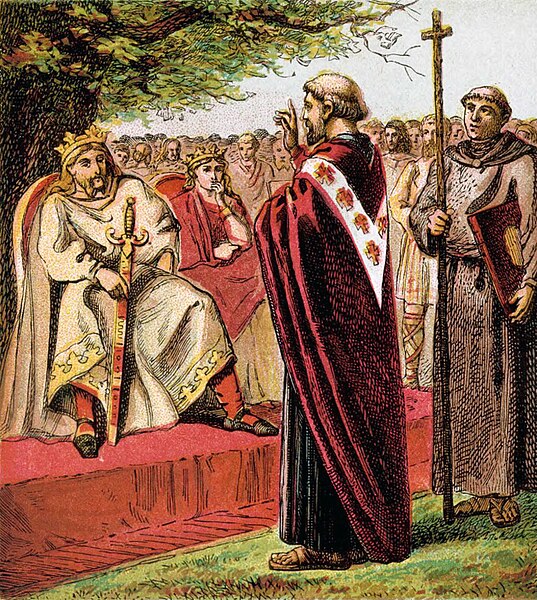
Athelstan, the first king of England, had been crowned in 925 at Kingston, a spot where seven kings of England had been enthroned. Perhaps the most notorious was Edwig, a 16-year-old whose proto-rock star qualities were not appreciated at the time of his coronation in 955. Indeed he failed to turn up, and when Bishop Dunstan marched to the king’s nearby quarters to drag him along, he found the teenager in bed with a “strumpet” and the strumpet’s mother.

However, Edwig died four years later, and Dunstan was elevated to Canterbury, became a saint and, through chronicles recorded by churchmen, got his version of history.

This reign might seem impossibly distant and obscure, yet it was under Edwig’s brother Edgar that the current coronation format was established. Edgar was a powerful king, and the last of the Anglo-Saxon rulers to live a happily Viking-free existence. His coronation on 11 May 973 was an illustration of his strength, and also his aspirations. Held at Bath, most likely because of its association with Rome, it involved a bishop placing the crown on the king’s head, in the Carolingian style, and would become the template for the ceremony for his direct descendent Charles III.

But not all coronations would run so smoothly. After Edgar’s death his elder son Edward was killed in possibly nefarious circumstances, and his stepmother placed her son Ethelred on the throne. Ethelred’s reign was plagued by disaster, and it was later said in the chronicles — the medieval equivalent of “and then the whole bus clapped” Twitter tales — that Bishop Dunstan lambasted the boy-king for “the sin of your shameful mother and the sin of the men who shared in her wicked plot” and that it “shall not be blotted out except by the shedding of much blood of your miserable subjects”.

This would have been merely awkward, whereas many coronations ended in riot or bloodshed. The most notorious incident in English history occurred on Christmas Day 1066: Duke William got off to a bad start PR-wise when his nervous Norman guards mistook cheers for booing and began attacking the crowd, before setting fire to buildings.

[…]

Perhaps the most scandalous coronation took place at the newly completed St Paul’s Cathedral in February 1308. The young queen, Isabella, was the 12-year-old daughter of France’s King Philippe Le Bel, and had inherited her father’s good looks, with thick blonde hair and large blue, unblinking eyes. Her husband, Edward II, was a somewhat boneheaded man of 24 years whose idea of entertainment was watching court fools fall off tables.

It was a fairy tale coronation for the young girl, apart from a plaster wall collapsing, bringing down the high altar and killing a member of the audience, and the fact that her husband was gay and spent the afternoon fondling his lover Piers Gaveston, while ignoring her. Isabella’s two uncles, who had made the trip from France, were furious at the behaviour of their new English in-law, though perhaps not surprised.

[…]

One of the most disastrous coronations occurred during the Hundred Years’ War. Inspired by Joan of Arc, in 1429 the French had beaten the English at the Battle at Patay, after which their leader Charles VII entered Reims and was crowned at the spot where the kings of France had been enthroned for almost a thousand years. In response, on 26 December 1431 the English had their candidate, the 10-year-old Henry VI, crowned King of France at Notre-Dame in Paris, where one road was turned into a river of wine filled with mermaids, and Christmas plays were performed on an outdoor stage.

Unfortunately, the coronation was a complete mess. The entire service was in English, the weather was freezing, the event rushed, too packed, filled with pickpockets, and worst of all the English made such bad food that even the sick and destitute at the Hotel-Dieu complained they had never tasted anything so vile.

May 2, 2023

QotD: The musical importance of the city of Córdoba

Filed under: Europe, History, Media, Quotations — Tags: , , , , , , , — Nicholas @ 01:00

Which city is our best role model in creating a healthy and creative musical culture?

Is it New York or London? Paris or Tokyo? Los Angeles or Shanghai? Nashville or Vienna? Berlin or Rio de Janeiro?

That depends on what you’re looking for. Do you value innovation or tradition? Do you want insider acclaim or crossover success? Is your aim to maximize creativity or promote diversity? Are you seeking timeless artistry or quick money attracting a large audience?

Ah, I want all of these things. So I only have one choice — but I’m sure my city isn’t even on your list.

My ideal music city is Córdoba, Spain.

But I’m not talking about today. I’m referring to Córdoba around the year 1000 AD.

I will make a case that medieval Córdoba had more influence on global music than any other city in history. That’s probably not something you expected. But even if you disagree — and I already can hear some New Yorkers grumbling in the background — I think you will discover that the “Córdoba miracle,” as I call it, is an amazing role model for us.

It’s a case study in how communities foster the arts — and in a way that benefits everybody, not just the artists.

[…] a thousand years before New Orleans spurred the rise of jazz, and instigated the Africanization of American music, a similar thing happened in Córdoba, Spain. You could even call that city the prototype for all the decisive musical trends of our modern times.

“This was the chapter in Europe’s culture when Jews, Christians, and Muslims lived side by side,” asserts Yale professor María Rosa Menocal, “and, despite their intractable differences and enduring hostilities, nourished a complex culture of tolerance.”

There’s even a word for this kind of cultural blossoming: Convivencia. It translates literally as “live together.” You don’t hear this term very often, but you should — because we need a dose of it now more than ever. And when scholars discuss and debate this notion of Convivencia, they focus their attention primarily on one city: Córdoba.

It represents the historical and cultural epicenter of living together as a norm and ideal.

Even today, we can see the mixture of cultures in Spain’s distinctive architecture, food, and music. These are both part of Europe, but also separate from it. It is our single best example of how the West can enter into fruitful cultural dialogue with the outsider — to the benefit of both.

Ted Gioia, “The Most Important City in the History of Music Isn’t What You Think It Is”, The Honest Broker, 2023-01-26.

April 18, 2023

QotD: The worldview of the fanatic

Filed under: History, Media, Politics, Quotations, Religion, USA — Tags: , , , , — Nicholas @ 01:00

More importantly, though, this is the logical endpoint of “democracy”, and now everyone gets to see it firsthand. In theory, democracy works by channeling competing vices. If men were angels, no government would be necessary, James Madison said, but since they’re not the best we can do is incentivize bad people to do good things in pursuit of their own selfish interest. It’s a nice thought, but it can only work (if, indeed, it can work) in a culture like Madison’s, in which public men are concerned about their dignity, honor, and posthumous reputation.

Obviously none of those hold in Current Year America, since they were all invented by the Pale Penis People, and even if they weren’t, they can’t matter to atheists anyway — one only defends one’s dignity and honor if one believes he’ll be called to account for them, and who’s going to do the accounting? There is no God, and as for the bar of History, what could that possibly matter to a cultural marxist? To them, as to their Puritan forbears, “history” is really soteriology. The past is nothing but a catalog of freely chosen error. For the fanatic, “history” begins anew each dawn, because why study endless iterations of Error when you already have the Truth?

Severian, “The Stakeholder State”, Rotten Chestnuts, 2020-01-22.

April 8, 2023

Russia’s Last Crusade – The Crimean War 1853-1856

Real Time History
Published 7 Apr 2023

The Crimean War between the Ottoman Empire and Russia (and later the UK and France) has been called the last crusade and the first modern war at the same time.
(more…)

March 28, 2023

WEIRD World – basing all our “assumptions about human nature on psych lab experiments starring American undergraduates”

Jane Psmith reviews The WEIRDest People in the World: How the West Became Psychologically Peculiar and Particularly Prosperous by Joseph Henrich:

Until 2002, diplomats at the United Nations didn’t have to pay their parking tickets. Double-parking, blocking a fire hydrant, blocking a driveway, blocking an entire midtown Manhattan street — it didn’t matter; when you have diplomatic plates, they let you do it. In the five years before State Department policy changed in November 2002, UN diplomats racked up a whopping 150,000 unpaid parking tickets worth $18 million in fines. (Among other things, the new policy allowed the city to have 110% of the amount due deducted from the US foreign aid budget to the offending diplomats’ country. Can you believe they never actually did it? Lame.) Anyway, I hope you’re not going to be surprised when I say that the tickets weren’t distributed evenly: the nine members of Kuwait’s UN mission averaged almost 250 unpaid tickets apiece per year (followed by Egypt, Chad, Sudan, Bulgaria, and Mozambique, each between 100 and 150; the rest of the top ten were Albania, Angola, Senegal, and Pakistan). The UK, Canada, Australia, Denmark, the Netherlands, Sweden, and Norway had none at all. The rest of the rankings are more or less what you’d expect: for example, Italy averaged three times as many unpaid tickets per diplomat as France and fifteen times as many as Germany.

What did the countries with the fewest unpaid parking tickets have in common? Well, they generally scored low on various country corruption indexes, but that’s just another way of saying something about their culture. And the important thing about their culture is that these countries are WEIRD: western, educated, industrialized, rich, and democratic. But they’re also, in the grand scheme of human history, weird: their inhabitants think differently, behave differently, and value different things than most humans. Among other things, WEIRD people are individualistic, nonconformist, and analytical. They — okay, fine, we — are particularly hard-working, exhibit low time preference, prefer impersonal rules we apply universally, and elevate abstract principles over contextual and relationship-based standards of behavior. In other words, WEIRD people (as Joseph Henrich and his colleagues pointed out in the influential 2010 paper where they coined the phrase) are outliers on almost every measure of human behavior. Wouldn’t it be silly for an entire academic discipline (and therefore an entire society ideologically committed to Trusting The Experts) to base all its assumptions about human nature on psych lab experiments starring American undergraduates? That would give us a wildly distorted picture of what humans are generally like! We might even do something really dumb like assume that the social and political structures that work in WEIRD countries — impersonal markets, constitutional government, democratic politics — can be transplanted wholesale somewhere else to produce the same peace and prosperity we enjoy.

Ever since he pointed out the weirdness of the WEIRD, Henrich has been trying to explain how we got this way. His argument really begins in his 2015 The Secret of Our Success, which I reviewed here and won’t rehash. If you find yourself skeptical that material circumstances can drive the development of culture and psychology (unfortunately the term “cultural Marxism” is already taken), you should start there. Here I’m going to summarize the rest of Henrich’s argument fairly briefly: first, because I don’t find it entirely convincing (more on that below), and second, because I’m less interested in how we got WEIRD than in whether we’re staying WEIRD. The forces that Henrich cites as critical to the forging of WEIRD psychology are no longer present, and many of the core presuppositions of WEIRD culture are no longer taken for granted, which raises some thought-provoking questions. But first, the summary.

Henrich argues that the critical event setting the West on the path to Educated, Industrialized, Rich, and Democratic was the early medieval western Church’s ban on cousin marriage. That might seem a little odd, but bear in mind that most of the humans who’ve ever lived have been enmeshed in incredibly dense kin networks that dictate obligations, responsibilities, and privileges: your identity is given from birth, based simply on your role as a node in an interdependent network. When societies grow beyond the scale of a family, it’s by metaphorically extending and intensifying these kinship bonds (go read our review of The Ancient City for more on this). These kinship networks perpetuate themselves through marriage, and particularly through marriage to relatives, whether blood or in-laws, to strengthen existing connections. Familial or tribal identities come first, before even the claims of universal religions, as when Wali Khan, a Pakistani politician, phrased his personal allegiances as “I have been a Pashtun for six thousand years, a Muslim for thirteen hundred years, and a Pakistani for twenty-five.” You could imagine Edwin of Northumbria or Childeric saying something pretty similar.

Then, beginning in the 4th century, the western Church began to forbid marriages to relatives or in-laws, the kinship networks began to wither away, and alternative social technologies evolved to take their place. In place of the cousin-marriers’ strong tight bonds, conformity, deference to traditional authority, and orientation toward the collective, you get unmoored individuals who have to (or get to, depending on your vantage point) create their own mutually beneficial relationships with strangers. This promotes a psychological emphasis on personal attributes and achievements, greater personal independence, and the development of universalist social norms. Intensive kinship creates a strong in-group/out-group distinction (there’s kin and there’s not-kin): people from societies with strong kinship bonds, for instance, are dramatically more willing to lie for a friend on the witness stand. WEIRD people are almost never willing to do that, and would be horrified to even be asked. Similarly, in societies with intensive kinship norms, you’d be considered immoral and irresponsible if you didn’t use a position of power and influence to benefit your family or tribe; WEIRD people call that nepotism or corruption and think it’s wrong.

March 13, 2023

QotD: The components of an oath in pre-modern cultures

Filed under: Europe, History, Quotations, Religion — Tags: , , , , , — Nicholas @ 01:00

Which brings us to the question how does an oath work? In most of modern life, we have drained much of the meaning out of the few oaths that we still take, in part because we tend to be very secular and so don’t regularly consider the religious aspects of the oaths – even for people who are themselves religious. Consider it this way: when someone lies in court on a TV show, we think, “ooh, he’s going to get in trouble with the law for perjury”. We do not generally think, “Ah yes, this man’s soul will burn in hell for all eternity, for he has (literally!) damned himself.” But that is the theological implication of a broken oath!

So when thinking about oaths, we want to think about them the way people in the past did: as things that work – that is they do something. In particular, we should understand these oaths as effective – by which I mean that the oath itself actually does something more than just the words alone. They trigger some actual, functional supernatural mechanisms. In essence, we want to treat these oaths as real in order to understand them.

So what is an oath? To borrow Richard Janko’s (The Iliad: A Commentary (1992), in turn quoted by Sommerstein [in Horkos: The Oath in Greek Society (2007)]) formulation, “to take an oath is in effect to invoke powers greater than oneself to uphold the truth of a declaration, by putting a curse upon oneself if it is false”. Following Sommerstein, an oath has three key components:

First: A declaration, which may be either something about the present or past or a promise for the future.

Second: The specific powers greater than oneself who are invoked as witnesses and who will enforce the penalty if the oath is false. In Christian oaths, this is typically God, although it can also include saints. For the Greeks, Zeus Horkios (Zeus the Oath-Keeper) is the most common witness for oaths. This is almost never omitted, even when it is obvious.

Third: A curse, by the swearers, called down on themselves, should they be false. This third part is often omitted or left implied, where the cultural context makes it clear what the curse ought to be. Particularly, in Christian contexts, the curse is theologically obvious (damnation, delivered at judgment) and so is often omitted.

While some of these components (especially the last) may be implied in the form of an oath, all three are necessary for the oath to be effective – that is, for the oath to work.

A fantastic example of the basic formula comes from Anglo-Saxon Chronicles (656 – that’s a section, not a date), where the promise in question is the construction of a new monastery, which runs thusly (Anne Savage’s translation):

    These are the witnesses that were there, who signed on Christ’s cross with their fingers and agreed with their tongues … “I, king Wulfhere, with these king’s eorls, war-leaders and thanes, witness of my gift, before archbishop Deusdedit, confirm with Christ’s cross” … they laid God’s curse, and the curse of all the saints and all God’s people on anyone who undid anything of what was done, so be it, say we all. Amen.” [Emphasis mine]

So we have the promise (building a monastery and respecting the donation of land to it), the specific power invoked as witness, both by name and through the connection to a specific object (the cross – I’ve omitted the oaths of all of Wulfhere’s subordinates, but each and every one of them assented “with Christ’s cross”, which they are touching) and then the curse to be laid on anyone who should break the oath.

Of the Medieval oaths I’ve seen, this one is somewhat odd in that the penalty is spelled out. That’s much more common in ancient oaths where the range of possible penalties and curses was much wider. The Dikask‘s oath (the oath sworn by Athenian jurors), as reconstructed by Max Frankel, also provides an example of the whole formula from the ancient world:

    I will vote according to the laws and the votes of the Demos of the Athenians and the Council of the Five Hundred … I swear these things by Zeus, Apollo and Demeter, and may I have many good things if I swear well, but destruction for me and my family if I forswear.

Again, each of the three working components are clear: the promise being made (to judge fairly – I have shortened this part, it goes on a bit), the enforcing entity (Zeus, Apollo and Demeter) and the penalty for forswearing (in this case, a curse of destruction). The penalty here is appropriately ruinous, given that the jurors have themselves the power to ruin others (they might be judging cases with very serious crimes, after all).

Bret Devereaux, “Collections: Oaths! How do they Work?”, A Collection of Unmitigated Pedantry, 2019-06-28.

March 10, 2023

Having solved all other problems, Congress now investigates … (checks notes) … the Protestant Reformation

Filed under: Government, Humour, Religion, USA — Tags: , , , — Nicholas @ 05:00

Chris Bray respectfully outlines some of the questions the honourable Congressmen Congresspersons Congressentities Representatives would be likely to pose to the witnesses:

Martin Luther nails his 95 theses to the door of All Saints Church in Wittenberg, 1517.
Painting by Ferdinand Pauwels (1830-1904) via Wikimedia Commons.

1.) Mr. Luther, you — sorry, having trouble with my reading glasses. It says here you … mailed 95 feces to a door? Do you feel that it was appropriate to put something like that in the mail?

2.) Mr. Calvin, sir, you have raised numerous objections to the elevation of the host. Shouldn’t you be equally concerned about the elevation of the hostess? Don’t you feel that gendered terms are problematic?

3.) For all the witnesses, I’m told you wish to choose your own pastures. Isn’t that a question best left to the farmers?

4.) Gentlemen, you apparently propose to dissolve the monasteries. But most of them are, in my understanding, made out of big rocks, with very solid walls. Wouldn’t that take a prohibitive amount of acid to dissolve those? Have you done an EIR?

5.) I must very candidly inform the witnesses that I cannot agree to your premise, and I frankly find it absurd to say that faith alone is the cause of salivation. Do you have credentials in the science of digestion?

« Newer PostsOlder Posts »

Powered by WordPress