Quotulatiousness

May 19, 2020

QotD: Amour-propre

Filed under: Books, France, Humour, Quotations — Tags: , , , , — Nicholas @ 01:00

The French have this wonderful word, amour-propre, so much better than our English “self-love.” It comes, with its edge, from La Rochefoucauld, his urbane and scintillating Maxims in the seventeenth century. It is the arch-flatterer, “more artful than the most artful of mankind.” In parallel, it comes from Blaise Pascal, who observes that Christianity is the only cure. Then it comes again through Jean-Jacques Rousseau, in the “enlightened” eighteenth century, who thought the primitive savages incapable of amour-propre, because they lacked the gilt-framed mirrors of sophisticated society, in which their pride might be reflected. He imagines it the source of all corruption; and with some authority, for he was himself among the most corrupt of men — this Rousseau who taught us all to “blame society.”

Really there is nothing new under the sun, and the concept comes much earlier from Saint Augustine of Hippo who in his City of God calls it in Latin, amor sui, and puts it about the centre of his review of human tawdriness. That, in turn, is how it came to Pascal: via the French Augustinians, with whom Pascal was in thick, about the time he was writing his Lettres provinciales. One might add, contre Rousseau (and perhaps with Joseph de Maistre) that it goes back farther, to Adam and Eve.

Ye devill appeals to Eve’s amour-propre. She then appeals to Adam’s. That’s how this whole wretched mess got started. Note that this couple predeceased all Rousseau’s noble savages, and that the field anthropologists have since discovered that the primitive tribal types are a lot like us. Which is to say, bad, in many colourful ways, and quite invariably self-regarding.

David Warren, “Amour-propre”, Essays in Idleness, 2016-06-01.

May 6, 2020

QotD: The French philosophes and the “lower orders”

Filed under: France, History, Liberty, Politics, Quotations, Religion — Tags: , , , — Nicholas @ 01:00

Apart from the different philosophical status they assigned to reason and virtue, the one issue where the contrast between the British and French Enlightenments was sharpest was in their attitudes to the lower orders. This is a distinction that has reverberated through politics ever since. The radical heirs of the Jacobin tradition have always insisted that it is they who speak for the wretched of the earth. In eighteenth-century France, they claimed to speak for the people and the general will. In the nineteenth century, they said they represented the working classes against their capitalist exploiters. In our own time, they have claimed to be on the side of blacks, women, gays, indigenes, refugees, and anyone else they define as the victims of discrimination and oppression. Himmelfarb’s study demonstrates what a façade these claims actually are.

The French philosophes thought the social classes were divided by the chasm not only of poverty but, more crucially, of superstition and ignorance. They despised the lower orders because they were in thrall to Christianity. The editor of the Encyclopédie, Denis Diderot, declared that the common people had no role in the Age of Reason: “The general mass of men are not so made that they can either promote or understand this forward march of the human spirit.” Indeed, “the common people are incredibly stupid,” he said, and were little more than animals: “too idiotic — bestial — too miserable, and too busy” to enlighten themselves. Voltaire agreed. The lower orders lacked the intellect required to reason and so must be left to wallow in superstition. They could be controlled and pacified only by the sanctions and strictures of religion which, Voltaire proclaimed, “must be destroyed among respectable people and left to the canaille large and small, for whom it was made.”

Keith Windschuttle, “Gertrude Himmelfarb and the Enlightenment”, New Criterion, 2020-02.

April 30, 2020

QotD: Nietzsche’s criticism of Christianity (and Judaism)

Filed under: History, Middle East, Quotations, Religion — Tags: , , , , — Nicholas @ 01:00

It is Nietzsche’s chief thesis that most of the so-called Christian morality of today is an inheritance from the Jews, and that it is quite as much out of harmony with the needs of our race and time as the Mosaic law which prohibits the eating of oysters, clams, swine, hares, swans, terrapin and snails, but allows the eating of locusts, beetles and grasshoppers (Leviticus, XI, 4-30). Christianity, true enough, did not take over the Mosaic code en bloc. It rejected all these dietary laws, and it also rejected all the laws regarding sacrifices and most of those dealing with family relations. But it absorbed unchanged the ethical theory that had grown up among the Jews during the period of their decline — the theory, to wit, of humility, of forbearance, of non-resistance. This theory, as Nietzsche shows, was the fruit of that decline. The Jews of David’s day were not gentle. On the contrary, they were pugnacious and strong, and the bold assertiveness that seemed their best protection against the relatively weak peoples surrounding them was visualized in a mighty and thunderous Jehovah, a god of wrath and destruction, a divine Kaiser. But as their strength decreased and their enemies grew in power they were gradually forced into a more conciliatory policy. What they couldn’t get by force they had to get by a show of complaisance and gentleness — and the result was the renunciatory morality of the century or two preceding the birth of Christ, the turn-the-other-cheek morality which Christ erected into a definite system, the “slave-morality” against which Nietzsche whooped and railed nearly two thousand years afterward.

H.L. Mencken, “Transvaluation of Morals”, The Smart Set, 1915-03.

April 29, 2020

Haile Selassie – The New Messiah – WW2 Biography Special

Filed under: Africa, History, Italy, Military, Religion, WW2 — Tags: , , , , , , — Nicholas @ 06:00

World War Two
Published 28 Apr 2020

Haile Selassie was the Emperor of the Ethiopian Empire. He led the country against the Italians in the Second Italo-Ethiopian War after which he is exiled to Britain.

Join us on Patreon: https://www.patreon.com/TimeGhostHistory
Or join The TimeGhost Army directly at: https://timeghost.tv

Follow WW2 day by day on Instagram @World_war_two_realtime https://www.instagram.com/world_war_t…
Between 2 Wars: https://www.youtube.com/playlist?list…
Source list: http://bit.ly/WW2sources

Hosted by: Indy Neidell
Written by: Isabel Wilson
Director: Astrid Deinhard
Producers: Astrid Deinhard and Spartacus Olsson
Executive Producers: Astrid Deinhard, Indy Neidell, Spartacus Olsson, Bodo Rittenauer
Creative Producer: Joram Appel
Post-Production Director: Wieke Kapteijns
Research by: Isabel Wilson
Edited by: Karolina Dołęga
Sound design: Marek Kamiński

Colorizations by:
Dememorabilia – https://www.instagram.com/dememorabilia/
Adrien Fillon – https://www.instagram.com/adrien.colo…
Klimbim – https://klimbim2014.wordpress.com/

Sources:
National Museum of the U.S. Navy

Music:
“Other Sides of Glory” – Fabien Tell
“The Unexplored” – Philip Ayers
“March Of The Brave 10” – Rannar Sillard
“Deviation In Time” – Johannes Bornlof
“Epic Adventure Theme 3” – Håkan Eriksson
“Heroes On Horses” – Gunnar Johnsén
“Deviation In Time” – Johannes Bornlof

Archive by Screenocean/Reuters https://www.screenocean.com.

A TimeGhost chronological documentary produced by OnLion Entertainment GmbH.

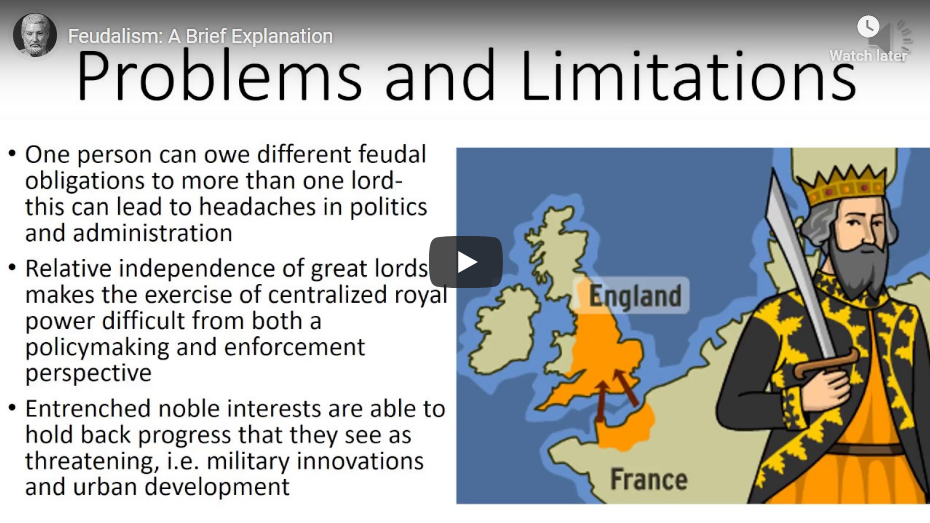
Feudalism: A Brief Explanation

Thersites the Historian
Published 26 Oct 2017

In this video, I try to bring order to the chaos that is feudalism and render it comprehensible.

April 27, 2020

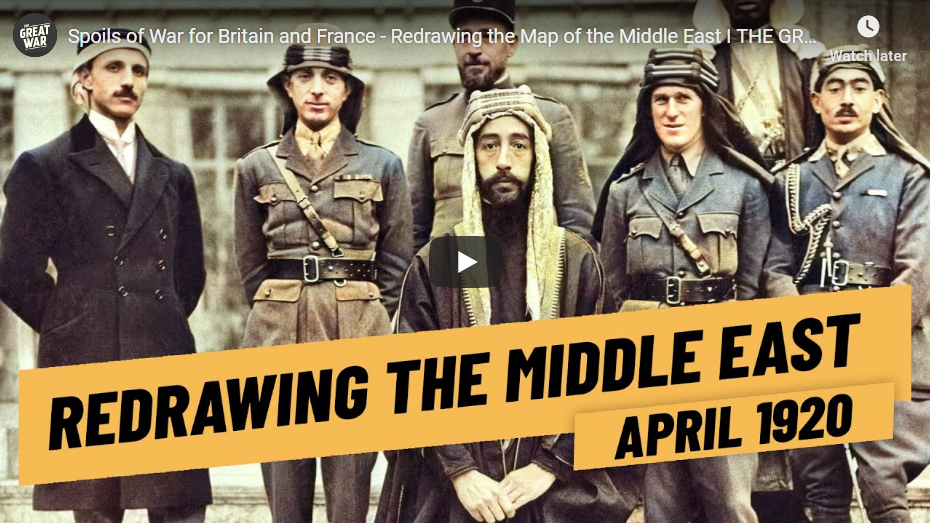
Spoils of War for Britain and France – Redrawing the Map of the Middle East I THE GREAT WAR 1920

The Great War
Published 25 Apr 2020

Sign up for Curiosity Stream and Nebula – and get 40% off annual plans right now: https://curiositystream.com/thegreatwar

100 years ago at the conference of San Remo, one thing became clear: Great Britain and France wanted control over the Middle East. Justified by the fighting in the previous years and painted as “liberators” of the Middle Eastern minorities, the new map of the Middle East emerged – under the cover of the League of Nations Mandate system.

» SUPPORT THE CHANNEL
Patreon: https://www.patreon.com/thegreatwar
Merchandise: https://shop.spreadshirt.de/thegreatwar/

» SOURCES
Karsh, Efraim & Karsh, Inari, Empires of the Sand: The Struggle for Mastery in the Middle East 1789-1923, (Cambridge, MA : Harvard University Press, 1999)

“Dans Le Levant” Le Temps, August 31, 1919 issue, https://gallica.bnf.fr/ark:/12148/bpt…

Lloyd George, David, Memoirs of the Peace Conference, (New Haven : Yale University Press, 1939) vol. 2

“Mounted Rifles Units” New Zealand History, https://nzhistory.govt.nz/war/aucklan…

Paris, Timothy J. Britain, The Hashemites and Arab Rule 1920-1925, (London : Frank Cass, 2003)

Provence, Michael, The Last Ottoman Generation and the Making of the Modern Middle East, (Cambridge : Cambridge University Press, 2017)

O’Neill, Robert, Official History of Australia in the War of 1914–1918, Volume VII – The Australian Imperial Force in Sinai and Palestine, 1914–1918, (Australian War Memorial, 1941)

“King-Crane Commission Digital Collection” Oberlin College Library. http://dcollections.oberlin.edu/cdm/s…

» SOCIAL MEDIA
Instagram: https://instagram.com/the_great_war
Twitter: https://twitter.com/WW1_Series
Reddit: https://reddit.com/r/TheGreatWarChannel

»CREDITS
Presented by: Jesse Alexander
Written by: Jesse Alexander
Director: Toni Steller & Florian Wittig
Director of Photography: Toni Steller
Sound: Toni Steller
Editing: Toni Steller
Mixing, Mastering & Sound Design: http://above-zero.com
Maps: Daniel Kogosov (https://www.patreon.com/Zalezsky)
Research by: Jesse Alexander
Fact checking: Florian Wittig

Channel Design: Alexander Clark
Original Logo: David van Stephold

A Mediakraft Networks Original Channel

Contains licensed material by getty images
All rights reserved – Real Time History GmbH 2020

April 7, 2020

Leopold II of Belgium: The Biggest Coverup In European History

Filed under: Africa, Europe, History — Tags: , , , , , — Nicholas @ 06:00

Biographics
Published 26 Sep 2018

Credits:
Host – Simon Whistler
Author – Shannon Quinn
Producer – Jack Cole
Executive Producer – Shell Harris

March 31, 2020

Third Crusade | 3 Minute History

Jabzy
Published 25 Jul 2015

Thanks to Xios, Alan Haskayne, Lachlan Lindenmayer, William Crabb, Derpvic, Seth Reeves and all my other Patrons. If you want to help out – https://www.patreon.com/Jabzy?ty=h

March 27, 2020

QotD: “Jesus was a socialist”

Filed under: Government, Politics, Quotations, Religion — Tags: , , , , — Nicholas @ 01:00

Christ taught giving. Giving means taking ones own property and passing it on to someone in need. Nowhere did he advocate taking from others by force and “redistributing” it. He certainly did not advocate taking from others, using what’s taken to fund a huge government bureaucracy, and pass out a pittance of the remainder to the poor (have to justify that bureaucracy somehow).

Nowhere in the Bible is there a passage similar to this:

    And I say unto you, take up your sword and shew it to the rich man and say unto him “give to me your wealth that it might care for the poor, lest I smite you to the Earth.”

    And when the wealthy man has given up his wealth, take it and pay for a multitude of scribes and pharisees and learned doctors of the law and say unto them, “use this wealth to provide for your hire, but only this, save a pittance thereof and give it unto the poor so that we may noise about this good work and stand in the marketplace speaking loudly of these alms we give.”

    And when this is done, say unto the people “Behold, we have cared for the poor. Now give us more of your wealth that we may continue to do so and to do other things.”

    And if any dare to resist you, lay your hands upon him and chain him and cast him into a dungeon.

    And in all this way shall you show unto the people your mercy and kindness.

When people advocate socialism enforced by government, they are advocating using force to take from some to give to others. Nowhere in his teachings did Christ advocate that. Nowhere.

This is where some people say “but Christ said Render unto Caesar.” Yes. He did. In response to a question intended to trap him. Context matters. Christ had rising popularity among the masses which concerned the Jewish leadership greatly. So they planted the question of whether they should give tribute to Caesar. If Christ had simply said “yes” he would have lost his popular audience and his ministry would have died right there. If he had said “no”, he would likely have been arrested (“we caught him forbidding tribute to Caesar” was one of the charges the Sanhedrin laid against him when handing him over to the Romans for execution). And his ministry would have died right there. Instead, he asked for an example of the tribute money, asked whose picture was on it, and gave his famous answer. And if people followed him in that, the Roman reprisal, destruction of Jerusalem, and diaspora would have occurred before much of Christ’s mission was fairly begun. If you accept his divinity, you have to accept that he knew this and gave the answer that allowed him to complete his mission.

But did “render unto Caesar” mean an endorsement of everything that tax funds were used for? Did he endorse gladiatorial games? Wars of conquest? The capture and importation of slaves? The use of government troops to put down slave revolts? Let’s not be absurd. Just because the Roman government did something with tax monies, or modern governments do something with it, “Render unto Caesar” is not an endorsement of that use.

Government is force, pure and simple. That’s essentially a definition of government: the legitimizing of the use of force. Socialism imposed by government has nothing to do with Christian charity. It is, in fact, very nearly the exact opposite, wearing a mask to confuse the unwary.

David L. Burkhead, “The “Christian Left”, The Writer in Black, 2018-01-08.

March 26, 2020

The Boxer Rebellion l HISTORY OF CHINA

Filed under: Britain, China, France, Germany, History, Japan, Military, Religion, Russia — Tags: , , — Nicholas @ 02:00

IT’S HISTORY
Published 26 Aug 2015

The Boxer Rebellion was one of China’s biggest uprisings against the unwanted European, US-American and Japanese imperialism. Distrust and tensions marked all contacts with foreigners. Secret societies were formed to propagate against the enemy. The Yihequan, also known as Boxers, quickly rose to one of the biggest organisations in Northern China. Masters of close combat, they mainly targeted converted Chinese Christians and attacks increased wildly in the 1880s. From 1900 Empress Dowager Cixi was less and less opposed to the Rebellion, as she hoped to fight back foreign influence. Shortly after, even the Chinese Army started helping the rebels and foreigners were fought, killed or driven out. Consequently, an alliance of the imperial powers sent in 50,000 soldiers to end the massacre. Tough reprisals and treaties followed. Learn all about the Boxer Rebellion on IT’S HISTORY.

» JOIN OUR COMMUNITY FOR MORE HISTORY KNOWLEDGE!
Follow us on Twitter: http://twitter.com/thehistoryshow
Your photos on Instagram: https://instagram.com/itshistorychannel

» SOURCES
Videos: British Pathé (https://www.youtube.com/user/britishp…)
Pictures: mainly Picture Alliance
Content:
Harrington, Peter: Peking 1900: The Boxer Rebellion, Osprey Campaign
Bodin, Lynn: The Boxer Rebellion, Men-at-Arms
http://www.historyofwar.org/articles/…
http://www.chinafolio.com/chinas-last…

» ABOUT US
IT’S HISTORY is a ride through history – Join us discovering the world’s most important eras in IN TIME, BIOGRAPHIES of the GREATEST MINDS and the most important INVENTIONS.

» HOW CAN I SUPPORT YOUR CHANNEL?
You can support us by sharing our videos with your friends and spreading the word about our work.

» CAN I EMBED YOUR VIDEOS ON MY WEBSITE?
Of course, you can embed our videos on your website. We are happy if you show our channel to your friends, fellow students, classmates, professors, teachers or neighbors. Or just share our videos on Facebook, Twitter, Reddit etc. Subscribe to our channel and like our videos with a thumbs up.

» CAN I SHOW YOUR VIDEOS IN CLASS?
Of course! Tell your teachers or professors about our channel and our videos. We’re happy if we can contribute with our videos.

» CREDITS
Presented by: Indy Neidell
Script by: Dan Hungerford
Directed by: Daniel Czepelczauer
Director of Photography: Markus Kretzschmar
Music: Markus Kretzschmar
Sound Design: Bojan Novic
Editing: Markus Kretzschmar

A Mediakraft Networks original channel
Based on a concept by Florian Wittig and Daniel Czepelczauer
Executive Producers: Astrid Deinhard-Olsson, Spartacus Olsson
Head of Production: Michael Wendt
Producer: Daniel Czepelczauer
Social Media Manager: Laura Pagan

Contains material licensed from British Pathé
All rights reserved – © Mediakraft Networks GmbH, 2015

March 22, 2020

QotD: The notion of Hell

Filed under: Humour, Quotations, Religion — Tags: , , — Nicholas @ 01:00

I know we all follow the theological debates within Catholicism about which saint got in touch with which angel to channel which biblical dead person — don’t they have a show on CNN that goes over each week’s highlights? — but one thing you never do, in Catholicism, Protestantism, or Pentecostal Snake-Handlingism, for that matter, is say there’s no hell.

Because that would be Jewish. The Jews have never cared that much about hell. They grudgingly admit that it’s probably there, but it’s just this place that, after you die, you feel intense shame before God for all the times you yelled at your wife or failed to stuff two dollars into the self-parking kiosk. The Hebrew word for hell is “Gehenna,” which is the name of the garbage dump outside Jerusalem that (a) smelled bad, and (b) was always on fire. I can imagine generations of parents using it as a threat to their unruly children: “If you don’t straighten up right this minute, I’m gonna throw you into the smelly garbage dump with the smoke cloud over it!”

So when the Christians come along, they take Gehenna and run with it. They use the name Gehenna to mean hell, and that’s not just trash burning out there, it’s demons and human souls, and it burns forever because it’s mixed with brimstone, which does indeed smell bad when you burn it. Actually brimstone turns red and burns blue, so if you’ve got brimstone out there, you’ve got a blood red gelatinous mass with a blue flame, or what the great preachers call …

The Lake of Fire.

[…]

At any rate, the reason the Catholic press got their cassocks in a bunch is that, over the past half century or so, a lot of theologians have been saying, “Maybe we got the whole hell thing wrong.” They’ve looked back over the appropriate scriptures and decided that, after you die, you don’t get thrown into the flaming garbage dump, you just vanish from all human history, as though you never existed. There’s no memory or trace of you, you’re erased from the universe.

And this might be what the Pope said he believes. After Eugenio reported their conversation, the Vatican scrambled around and issued statements saying that, no, the Pope didn’t go outside the catechism and they were just chewing the fat and please everybody let’s not get carried away. Yes, Gehenna is real. Yes, the Pope believes in hell. Yes, the Pope is Catholic.

Joe Bob Briggs, “Pope Forgets the Lake of Fire”, Taki’s Magazine, 2018-06-21.

March 19, 2020

Second Crusade | 3 Minute History

Filed under: France, History, Middle East, Military, Religion — Tags: , , , , , — Nicholas @ 02:00

Jabzy
Published 14 May 2015

Thanks for the 5,000 subs

March 18, 2020

A classic “dirty book” of the late Middle Ages

Filed under: Books, Health, History — Tags: , , , — Nicholas @ 03:00

I’m not well read in the classics, being much more of a history reader myself, so I didn’t know anything about The Decameron. Arthur Chrenkoff provides a helpful thumbnail of the book:

“A Tale from the Decameron” by John William Waterhouse (1916).
Image from the Lady Lever Art Gallery via Wikimedia Commons.

Giovanni Boccaccio had written The Decameron in the aftermath of the Black Death pandemic of 1348, which carried away somewhere around one third of the European population. The book is set in a monastery, where seven young women and three young men, the Millennials of the day, self-quarantine themselves for ten days to avoid the plague and while away their days (there was no internet in those days, you see) telling each other stories, ten each day, all based around a chosen theme, such as love that ends happily or the tricks that women play on men. Many of the stories are a bit dirty, which is why The Decameron was put on the Catholic Church’s index of prohibited books; more interestingly, it was also banned in Australia until 1973, on pretty similar grounds.

March 17, 2020

QotD: The luck of the Irish

Filed under: Europe, Humour, Quotations — Tags: , — Nicholas @ 01:00

Making dark comments about the likelihood of an unhappy outcome is the way we Irish Catholics deal with anxiety, dread, and uncertainty. It’s our special pact with God: If we expect the worst, obsess about it, worry about it, drink about it, indulge in black humor, and honestly convince ourselves that something awful is going to happen, then God will step in and prevent said awful thing from happening just to mess with our heads. But you have to sincerely expect the worst, not just go through the motions. It’s when you expect good things to happen or keep happening — when you presume upon God — that bad things happen. Remember what happened when the Irish presumed upon all those potatoes?

Dan Savage, “Welcome Black”, AndrewSullivan.com, 2005-08-08.

March 14, 2020

History Summarized: Ethiopia

Overly Sarcastic Productions
Published 13 Mar 2020

Ethiopian History gets started early and just keeps on going. From the dawn of humanity itself through the medieval period and into the modern day, the history of the kingdom at the end of the Blue Nile is full of surprises.

SOURCES & Further Reading: Harold Marcus A History of Ethiopia and John Jackson’s Ethiopia and the Origins of Civilization, see also Kenneth Vickery’s lecture “Ethiopia: Outpost of Christianity” and William Cook’s lecture “The Rock-Hewn Churches of Ethiopia” via The Great Courses.

This video was edited by Sophia Ricciardi AKA “Indigo”. https://www.sophiakricci.com/

Our content is intended for teenage audiences and up.

PATREON: https://www.Patreon.com/OSP

DISCORD: https://discord.gg/h3AqJPe

MERCH LINKS: https://www.redbubble.com/people/OSPY…

OUR WEBSITE: https://www.OverlySarcasticProductions.com
Find us on Twitter https://www.Twitter.com/OSPYouTube
Find us on Reddit https://www.Reddit.com/r/OSP/

« Newer PostsOlder Posts »

Powered by WordPress