
seangabb
Published 18 Apr 2021In 400 AD, the Roman Empire covered roughly the same area as it had in 100 AD. By 500 AD, all the Western Provinces of the Empire had been overrun by barbarians. Between April and July 2021, Sean Gabb explored this transformation with his students. Here is one of his lectures. All student contributions have been removed.
More by Sean Gabb on the Ancient World: https://www.classicstuition.co.uk/
Learn Latin or Greek or both with him: https://www.udemy.com/user/sean-gabb/
His historical novels (under the pen name “Richard Blake”): https://www.amazon.co.uk/Richard-Blak…
July 16, 2022
Barbarian Europe: Part 1 – A Lurking Menace
Comments Off on Barbarian Europe: Part 1 – A Lurking Menace
June 6, 2022
Very convenient – “Only the cabinet can invoke the Emergencies Act, and if only the cabinet can be privy to the information that informs that decision, only the cabinet can judge whether the cabinet got it right”
In the free-to-cheapskates portion of The Line‘s weekly dispatch, the editors discuss the lack of evidence that the federal government was actually justified in its invokation of the Emergencies Act in February to break up the Freedom Convoy 2022 protests in Ottawa:
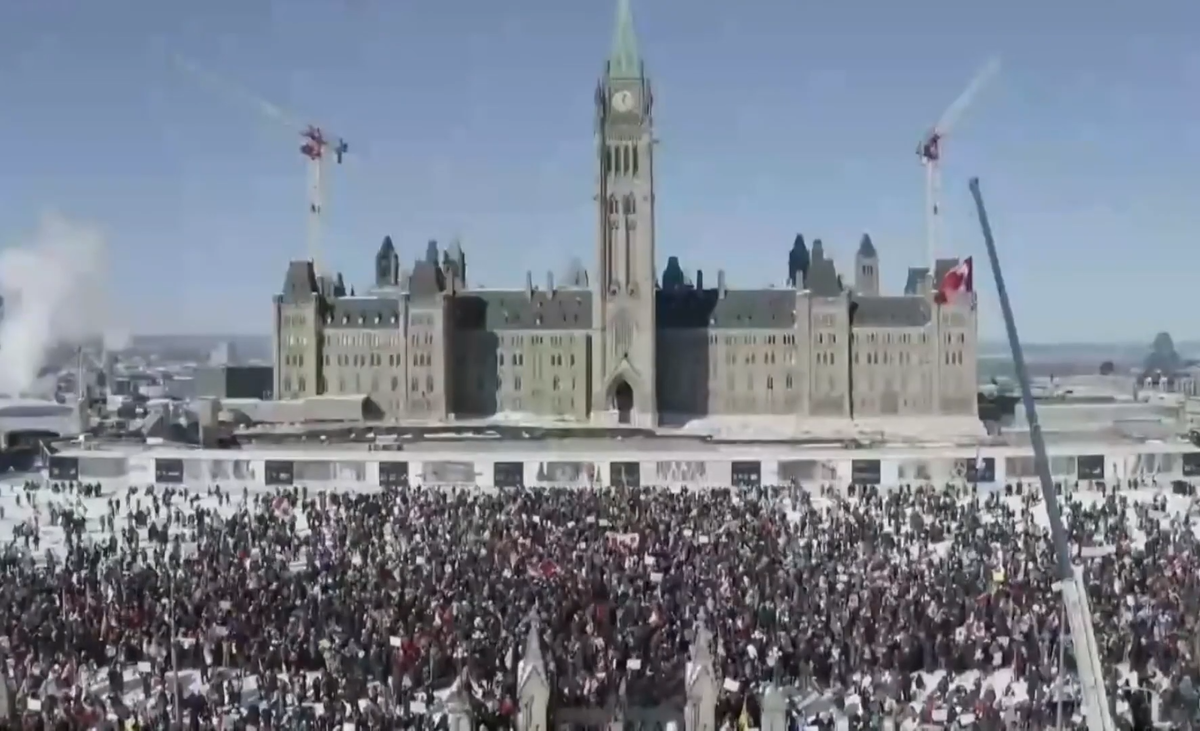
A screenshot from a YouTube video showing the protest in front of Parliament in Ottawa on 30 January, 2022.
Photo via Wikimedia Commons.
Your Line editors always understood that the situation in Ottawa (and at the borders) was indeed a crisis. We never doubted that. It was a very serious challenge that required a very serious response. But we have never seen the case for invoking the Emergencies Act. Under the law, which is very clear, a public-order emergency can only be invoked when the emergency cannot be met under existing laws. We really don’t know what, if anything, convinced Prime Minister Justin Trudeau and his cabinet that we had reached that point.
We have always been reasonable about this. The government may well be in possession of classified information that is not publicly known that convinced them, in good faith, that that condition had been met.
The problem is, they’re asking us to take it on their say-so. The position of the federal government thus far, as regards the inquiries and parliamentary reviews that are automatically triggered by invoking the act, is that they will not necessarily disclose all of the information that was known to the cabinet, and they may treat internal discussions as protected by cabinet confidentiality. This is setting up a perfect little loop of zero accountability. Only the cabinet can invoke the Emergencies Act, and if only the cabinet can be privy to the information that informs that decision, only the cabinet can judge whether the cabinet got it right.
You see the problem, right? As noted above, maybe they know something we don’t, and acted reasonably. Or maybe, under enormous political pressure, the PM whipped out the Emergencies Act to show us how big it is. That would be entirely within his character.
Do we think that’s what happened? We don’t know. Can we rule it out? No.
One of the only things the feds have yet said about their decision to invoke the Emergencies Act was that they did it because the police said it was necessary. But [former Ottawa Police Chief Peter] Sloly now says he never asked for it. The interim chief who succeeded him has said the same. The RCMP has said they did not ask for it. Who does that leave?
Maybe it was the OPP. Maybe it was one of the police agencies that patrols parliament itself. We don’t know. They just want us to take their word for it.
We’re sorry, but we don’t. The Emergencies Act is far too powerful to ever be invoked by a government on the basis of, “Trust us”. That’s not how things work in a democracy. And it should alarm all Canadians that the Liberals seem not to realize this, or are at least hoping that you don’t.
Comments Off on Very convenient – “Only the cabinet can invoke the Emergencies Act, and if only the cabinet can be privy to the information that informs that decision, only the cabinet can judge whether the cabinet got it right”
May 25, 2022
“What is a reasonable general concern?”
In The Line, Paula Simons has a concern that I think is quite reasonable:
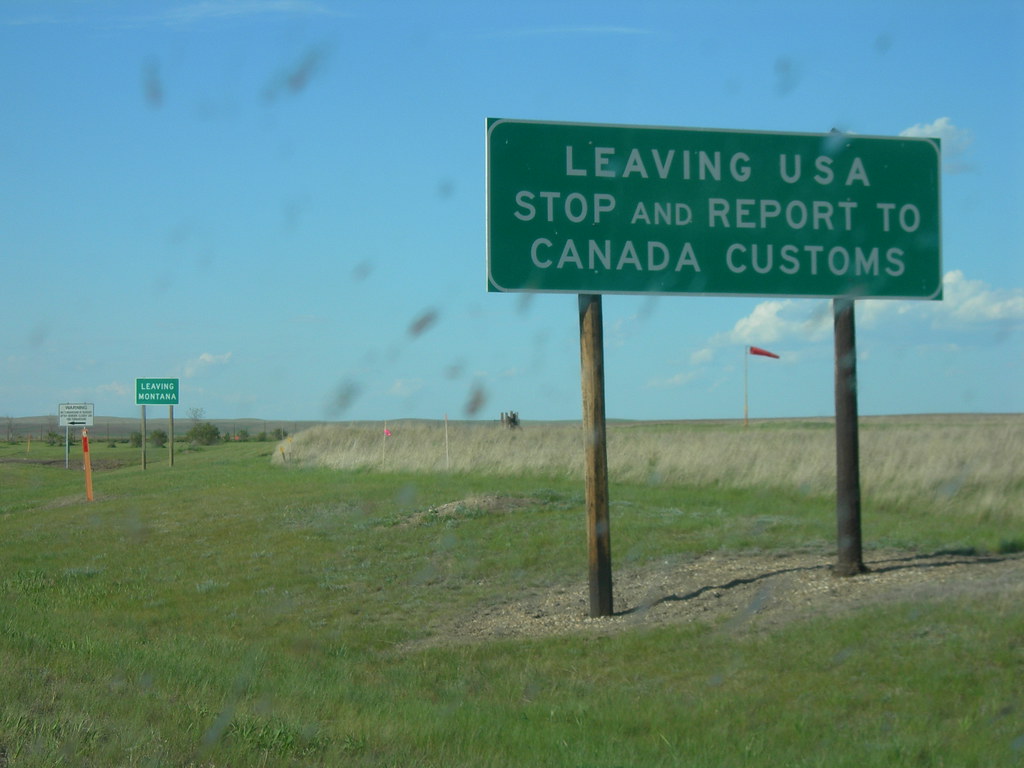
“Canadian Border Sign” by jimmywayne is licensed under CC BY-NC-ND 2.0


What is a reasonable general concern?
That’s not a rhetorical question. I really don’t know the answer. I’m not sure anyone else does, either.
And that’s exactly the problem with Bill S-7, a new piece of government legislation, which amends both the Customs Act and the Preclearance Act.
Bill S-7 set a new standard to allow border services officers to search through our cellphones, laptops, tablets, Apple Watches and other personal computers. If the bill passes, it will allow officers who feel a “reasonable general concern” to search through the emails, documents, texts, instant messages, photos or videos stored on our digital devices, to look for evidence that we may have violated customs regulations.
Reasonable general concern. Or, as it says in the French-language draft of the bill, “des préoccupations générales raisonnables“.
It’s an absolutely novel legal threshold. That phrase, be it in English or French, doesn’t appear anywhere else in Canadian criminal or civil law. It’s not a standard borrowed from any other country. It’s a brand new legal test to authorize an invasive search of your most private personal records and correspondence.
A reasonable concern, one might intuit, is a lower standard than a reasonable suspicion, because a concern is less grave, less specific, than a suspicion.
But a general concern? A general preoccupation?
That sounds even more vague, more subjective, than a good old-fashioned hunch or inkling.
It seems counter-intuitive, to put it mildly, to create a lower, broader standard to search our private data on our private devices than to search our conventional mail, or our suitcases, or our car trunks. Yet that is exactly what Bill S-7 does.
How did we get here? The answer is an ironic one.
Back in 2020, the Alberta Court of Appeal ruled unanimously that portions of the Customs Act were unconstitutional.
The court found the act violated the protection against unreasonable search and seizure, because it allowed for what the court called “suspicion-less and unlimited” searches of our personal digital devices.
That violation, held the court, could not be saved by section 1 of the Charter, because it allowed unfettered and unrestricted access to people’s most personal and intimate information, and because it allowed the state almost unlimited latitude to dig around in the what the court called our “biographical core of identity”.
Comments Off on “What is a reasonable general concern?”
March 4, 2022
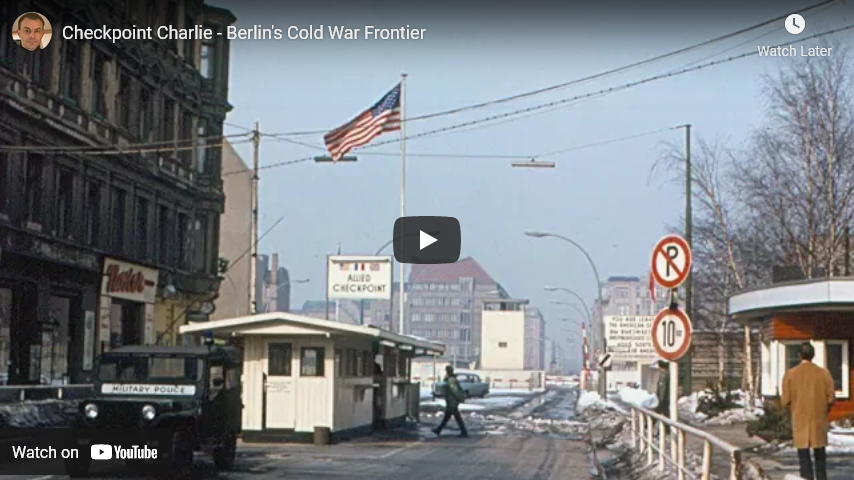
Checkpoint Charlie – Berlin’s Cold War Frontier
Mark Felton Productions
Published 4 Dec 2018The history of Checkpoint Charlie, the most famous of Berlin’s East-West crossing points and the focus of a serious standoff between the US and Soviet Union in 1961 that could have led to World War III.
Support Mark at Patreon for $1 a Month!
https://www.patreon.com/markfeltonpro…
Comments Off on Checkpoint Charlie – Berlin’s Cold War Frontier
February 15, 2022
“Freedom”. You proles keep using that word. The CBC doesn’t think it means what you think it means
In Monday’s NP Platformed newsletter, Colby Cosh considers what this mysterious and esoteric word “freedom” seems to mean to the CBC:
A screenshot from a YouTube video showing the protest in front of Parliament in Ottawa on 30 January, 2022.
Photo via Wikimedia Commons.
You may have heard that truck-driving protesters have taken over downtown Ottawa and several important border crossings here in Canada. These festive but obstructive people often claim, it is said, to be seeking some esoteric substance known as “freedom”. NP Platformed, unable to locate this “freedom” in the conventional periodic table, consulted a range of chemists in search of expert advice.
One suggested that the word was plainly a misspelling of “friedium”, implying the existence of an element or other matter known only to the Germans. Several hypothesized a molecular relationship with the abolished industrial refrigerant “freon”, raising questions about whether the Montreal Protocol has been subverted. Firm conclusions eluded our quest, but we are sure that a royal commission of inquiry will eventually be convened to get to the bottom of it all.
CBC News, confronted with the same information, did not appeal to the good old exact sciences for help. Instead, its reporters rang up every “hate” expert in their Rolodex of left-wing academics. This yielded tidbits of wisdom, such as this one: freedom “is a term that has resonated … You can define it and understand it and sort of manipulate it in a way that makes sense to you and is useful to you, depending on your perspective.” We’re pretty sure our chemical theories are less stupid than whatever this is supposed to be, but it does bear the imprimatur of Ontario Tech University, the renowned (checks notes) Oshawa-based home of the (checks notes again) Ridgebacks.
The CBC’s obtuse explanation of how the word “freedom” has been used in the past by fascist nasties, and absolutely nobody else in the annals of history, is rightly coming in for plenty of heckling. NP Platformed couldn’t resist joining in, but we would observe that this news copy bears signs of an actual journalistic crisis. If you are paying attention, you have heard about, or even seen video of, the torrents of abuse received by CTV and Global news reporters visiting the “Freedom Convoy” in Ottawa. One can only imagine the fear and frustration of CBC News employees, who know that they are much more attractive targets for misbehaviour — being a recognized part of the Ottawa blob that hinterland protesters are in town specifically to torment and terrorize.
Most of them are no doubt staying well clear of the protests, and for the public broadcaster to develop good sources within an amorphous CBC-hating right-wing movement is a plain impossibility. What’s left is Rolodex journalism. We did a lot of it back in the day, at the late, legendary Alberta Report — which, in our time, was vigorously hated by somewhere between half and two-thirds of the population of Alberta.
Comments Off on “Freedom”. You proles keep using that word. The CBC doesn’t think it means what you think it means
February 13, 2022
Update on that “small fringe minority … holding unacceptable views”
First up, David Warren has a few “little truths” to share:
A screenshot from a YouTube video showing the protest in front of Parliament in Ottawa on 30 January, 2022.
Photo via Wikimedia Commons.
My mind is in Ottawa, and all other places in Canada and abroad where people are struggling to get their lives back — now, before they die. These people are overwhelmingly the self-employed, and workers in small businesses: such as truck drivers, who bought their own rigs. They have consistently been made to pay in many ways for government lockdown measures, and are generally despised by the “laptop class”, who cannot lose their jobs, and work from home.
Few people in the Big City (which includes Toronto and Ottawa) have ever met a trucker, or would think of chatting with him. They may patronize small “boutique” operations, for conspicuous consumption. But Amazon drivers deliver their regular goods, and their services, too, are mostly dialled up.
True, the Batflu has sometimes interfered with their holiday bookings, so I must add, boo hoo.
A Rasmussen report on public opinion recently showed that in America, three-quarters of Democrats supported vaccine mandates, more than half thought those who refuse should be fined, and almost half would give them gaol sentences. Nearly a third thought the “vaccine hesitant” should have their children taken away. As Californicators, and the inhabitants of most urban constituencies, seldom have children, this can be received with rolling eyeballs. For luckily, there are Republicans in the more rural places, whose votes are sometimes counted.
Ottawa (outside “the Valley”) offers a caricature of this point of view. I recall my days as a columnist, published in the Ottawa Citizen. (Eventually, I was deleted.) To walk downtown was to invite verbal assaults by those who recognized my mug in the paper. Some were actually friendly, and said hiya. But I was often called a fascist, or something else obscene, by people who didn’t notice I was human. “Are you David Warren?” the grim inquiry would come. I tried to counter it with some jest. (“It depends: do you like David Warren?”) This might cause my assailant great pain. (Humour is violence, as every Leftist knows.) But it was tiresome for both of us.
One may check election results from the middle of that town, to learn that a large majority of its inhabitants vote Liberal, in the manner of zombies. One thinks of The Invasion of the Body Snatchers.
Rex Murphy (paywalled, unfortunately, so no link) suggests that things are desperate within the imperial capital thanks to the ravaging barbarians beseiging Caesar Justin:
How deep is the terror in our once cozy capital? I am told there are certain fine bakeries in Ottawa where it is no longer possible to get a fresh croissant. There are advisories warning about heading out alone to go to yoga classes. And there are rumours that DoorDash delivery from the better Italian restaurants can take over an hour. It is a horror, a scene too grim for the human mind to grasp, or the human heart to bear. In occupied Ottawa, you may, unasked, be offered soup. Where is the United Nations? Is the Security Council asleep?
Not to despair completely, however, as Canadians know that when the politicians fail, the police stand idle and the military are still, they have the Ottawa press gallery.
It is they who alerted us to the Confederate flag guy. The tribunes of the CBC have been all over him. There’s hardly been a report without the mention of a Confederate flag at the protest. Mention of the wildly more numerous Canadian flags have been wisely subdued.
The national press have been unmatched in getting the word out on what the brigands and racists and misogynists and white supremacists and yobs and Islamophobes and louts have inflicted on our national capital. With strong earplugs and stouter hearts, they have braved the chaos, enduring “taunts”. They shuffled past parked transport trucks, some of them with Alberta drivers in the cabs!
But the real glory belongs further up. The fact that Canada is, for the moment at least, still functioning as a country is a miracle due to the steel will and captivating oratory of our resolute prime minister. Much like England in those tenebrous days of 1939, our country has found its Churchillian voice.
In the free exerpt from his Weekly Dish newsletter, Andrew Sullivan admits that despite acquiring deep knowledge and understanding of Canadian culture from the invaluable South Park, he did not see the truckers’ protest coming:
To be honest, I didn’t quite see the Canadian truckers coming. I’ve watched a lot of Canada coverage over the years (mainly via South Park, I concede) and the whole anti-vaxxer, campfire-burning, horn-tooting, macho revolt among our gentle neighbors to the north nonetheless took me by surprise.
Rob Ford was a harbinger, I guess. It’s as if the ancient, manly, lumberjacky Canadian id was finally roused from its cultural slumber by a soy-boy prime minister, forcing truckers to take a jab or forfeit their livelihood. And some reports suggest that the vaccine issue seems just the proximate trigger for the rage, and not the real source — a rage which has been steadily building for some time, especially in the pandemic, in the most progressive-left country on the planet.
And there’s something very blue-collar male about this populist anger. Trump, of course, identified the testosterone tribe he helped define and rally:
I can tell you I have the support of the police, the support of the military, the support of the Bikers for Trump — I have the tough people, but they don’t play it tough — until they go to a certain point, and then it would be very bad, very bad.
You can see similar “tough people” fault-lines in the other recent Covid contretemps involving Joe Rogan. The millions of men (71 percent male, and evenly split between high school and college grads) who listen to Rogan’s legendary podcast have rallied to him, even as the media establishment has been waging a fully-flexed campaign against him and some of his Covid coverage. There’s something about masking — chin-diapers — and mandating vaccines, and vaccines themselves, that some men seem to find feminizing.
February 11, 2022
Ottawa in the year of the honk
At SDA, Kate shares part of an email she sent to a friend who works in the national media:

We watched pipelines get cancelled, LNG plants yanked, Caledonia thrown to the wolves — and Spendy McBlackface take a knee over some dead guy in Minneapolis.
Did the national media and professional left really think the business of bringing government and industry to a standstill would always remain the exclusive jurisdiction of Liberal rent-a-mobs?
And that’s the real problem, yes? There’s no one to call them off. Think about that. The professional protests of the left have structure, a chain of command and big money funders to direct them.
These protests don’t. They’re completely organic, which means they can spread and grow without the help of a Soros backed foundation. And it’s fucking glorious.
In The Line, Matt Gurney‘s latest update from Ottawa:
At the start of this week, I spent two days among the protesters in downtown Ottawa, wandering the lines of trucks on Wellington, on Kent, and the other roads all around Parliament Hill. I’ve tried to convey for readers what it’s like to be there — at least, what it’s been like for me to be there. This is a complicated protest and a complicated event. It has layers.
Are there good, frustrated people just trying to be heard in the crowd? Yes. Are there bad people in the crowd, including some who’ve waved hate symbols and harassed or attacked others? Yes. Are there people taking careful care of the roads, sweeping up trash and shovelling ice and snow off the sidewalk? Yes. Are there hard men milling about, keeping a wary eye on anyone who seems out of place? Yes. Is it a place where some people are having good-natured fun? Yes. Is it a place some other people would rightly be afraid to go? Yes. And so on.
But it’s even more complicated than it looks. And Ottawa Police Services chief Peter Sloly wants you to know that.
Sloly is in a tough spot. I don’t honestly know the backstory of the how and why the Ottawa protest was allowed to settle into the downtown core the way it did. It was obviously a massive intelligence and planning failure, but what kind of failure? And whose? Did they not have enough information? Bad information? Did they have good information that, for whatever reason, they didn’t accept or trust? That’s not the sort of thing you can discover wandering the site. But I can tell you that some of the protesters themselves are surprised by how easy it was for them to set up shop.
I have the terrible feeling, and I’ve spoken with five separate sources in government roles or in adjacent security positions who all confirmed this, that Sloly is one of the damn few people in Ottawa who understands the situation he’s in, and he’s trying to get everyone else to notice, or at least to catch up to his understanding. My sources, alas, seem to think that most others involved in decision-making are only just now starting to realize the enormity of the challenge in the capital. Sloly figured it out last week.
The chief is very political. I say that with no disrespect. Becoming the chief of a major police force isn’t something that happens because you catch the most bad guys. It happens because you’re good at working your way up through the power structures of a very particular institution. Sloly talks like a politician. But if you listen closely, and if you follow along across his briefings, you start to see a theme. From the moment he first mentioned that there might not be a policing solution to this protest, and hinted that we need the armed forces, he’s been signalling to the public that Ottawa, as a city, has lost control of itself. That’s a blunt description, but as I noted in a Twitter thread after a pretty remarkably stark Ottawa Police Services Board meeting on the weekend, Sloly was clear: the city needs to be rescued. It has lost control, it is outnumbered, and it cannot fix this problem with the resources on hand.
Comments Off on Ottawa in the year of the honk
January 10, 2022
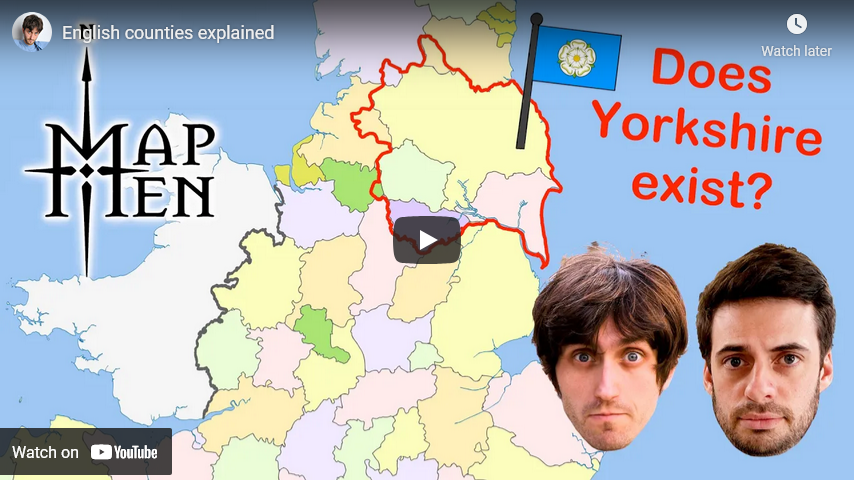
English counties explained
Jay Foreman
Published 13 Sep 2021BUY MAP MEN MUGS, T-SHIRTS, POSTERS ETC…
http://www.mapmenmerch.comSEE NEW EPISODES EARLY, AND BEHIND-THE-SCENES EXTRAS…
http://www.patreon.com/jayforemanWritten, presented and edited by
JAY FOREMAN https://www.twitter.com/jayforeman
MARK COOPER-JONES https://www.twitter.com/markcooperjonesAD, Camera, Props and Costumes
JADE NAGI https://www.twitter.com/jade_nagihttps://commons.wikimedia.org/wiki/Fi…
Maximilian Dörrbecker (Chumwa), CC BY-SA 3.0 https://creativecommons.org/licenses/…, via Wikimedia Commons
I wouldn’t say it explains why my home town seemed to move from county to county every few years since my family emigrated, but at least it provides a few clues about the changes.
Comments Off on English counties explained
December 30, 2021
HogmaNO! Scottish government warns Scots not to cross the border to celebrate Hogmanay
In Scotland, one of the traditions of the winter is Hogmanay (spelled umpteen different ways), the last day of the old year, but Scottish public health and government officials are trying to keep the Scots away from the English border this year:
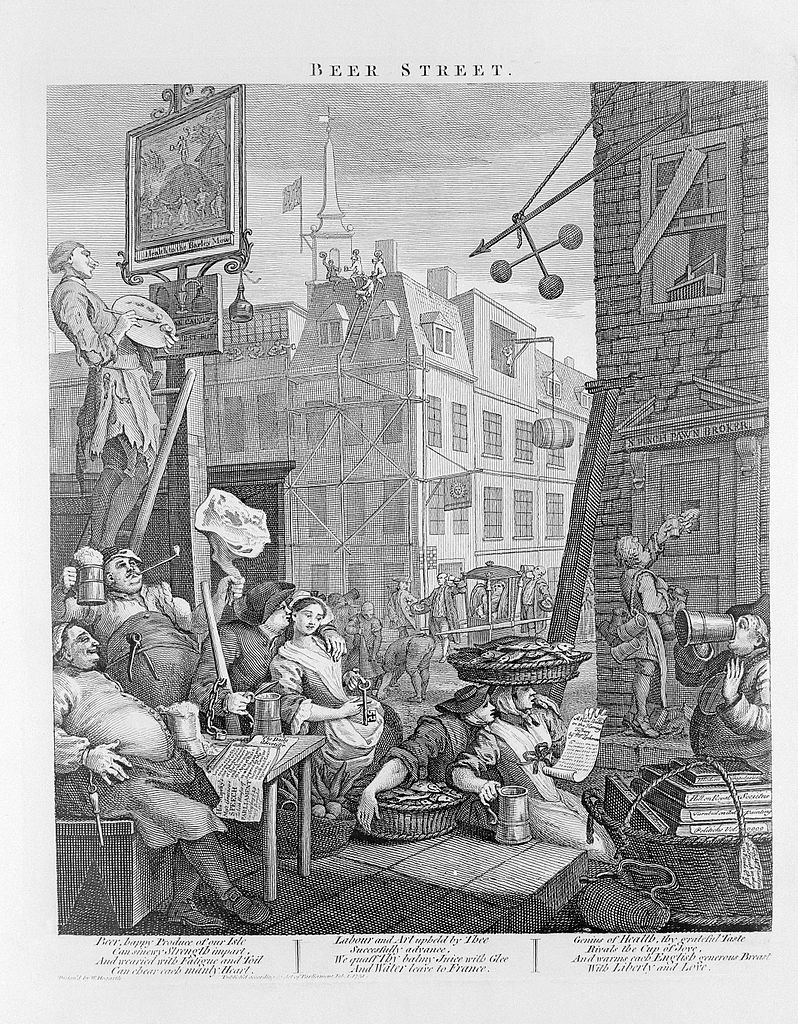
Scots have been urged not to travel to England for new year celebrations to get around the more stringent Covid-19 restrictions north of the border.
There is no travel ban currently in place to stop people going to England, where nightclubs are still open.
But Deputy First Minister John Swinney said doing so would go against the “spirit” of Scottish Covid-19 measures.
He said travelling would be “the wrong course of action” due to the “serious situation” with the Omicron variant.
Case numbers in Scotland hit “alarming” record highs over Christmas and Boxing Day, with the faster-spreading strain now accounting for the majority of all infections.
First Minister Nicola Sturgeon — who is to update MSPs in a virtual sitting of the Scottish Parliament on Wednesday afternoon — said she expected the figures to rise even more in the days ahead.
Scots have been encouraged to stay at home as much as possible, and to limit any social gatherings to no more than three households.
Large events such as Edinburgh’s traditional Hogmanay street party have been cancelled, with extra curbs in hospitality settings and nightclubs shut down entirely.
Clubs remain open south of the border, where no new restrictions are being imposed, but Mr Swinney told BBC Breakfast that he would “discourage” anyone from travelling to England to see in the new year.
He said: “People are free to make their own judgments. But what we have got recognise is that Omicron is a serious threat to absolutely everybody within our society and we have all got to take measures to protect ourselves by limiting our social contacts and connections and by complying with the restrictions we have in place.
Despite the Scottish government’s warnings, English pubs along the (currently) undefended border are expecting over a hundred thousand thirsty Scots to invade on the 31st:
English border pubs are expecting upwards of 100,000 Scottish and Welsh revellers to cross into England on New Year’s Eve amid mounting anger at Nicola Sturgeon and Mark Drakeford for cracking down on festivities.
Comments Off on HogmaNO! Scottish government warns Scots not to cross the border to celebrate Hogmanay
December 23, 2021
Cheshire and Durham in the English Parliament
In his end-of-the-year Age of Invention newsletter, Anton Howes looks at two of the historic counties of England that lacked Parliamentary representation until surprisingly late dates:
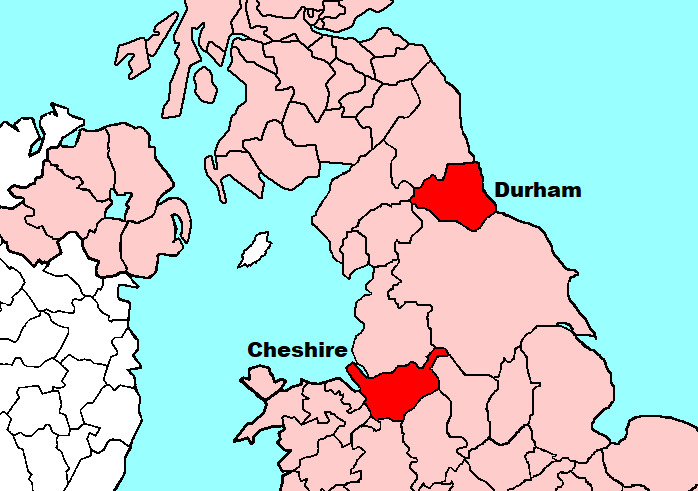
Cheshire and Durham (post-medieval boundaries: English county boundaries have varied wildly over the centuries).
Base map by Hogweard at Wikimedia Commons.
England, compared to other parts of Europe, is often said to have been remarkably centralised early on. France, for example, in the late eighteenth century had some thirteen or so regional parliaments, while Britain just had the one. Scotland’s separate parliament was famously dissolved in 1707, with the official union of Scotland with England. Wales gained representation at the English parliament at Westminster from 1536. So far so expected.
But less well-known is that the county of Cheshire — some of it now disappeared under Greater Manchester — used to have an entirely separate parliament of its own, and was not represented at Westminster until 1543. Arguably, it has about as much historical claim to a national assembly today as Wales. Rule of Cheshire was even, very briefly, included among the various titles of the monarch. Richard II, as well as being king of England, was in 1397-99 also styled “Prince of Chester”. He drew his personal bodyguard from among the men of Cheshire too. So whatever happened to Cheshire nationalism?
On a related note: the mantra “no taxation without representation” looms large in the history of American independence. But parts of England itself had gone unrepresented for decades too. County Durham, traditionally ruled by its prince-bishop, was not represented by any MPs in the House of Commons at all until 1654. And as it only gained representation under the revolutionary Protectorate, this was undone upon the restoration of the monarchy in 1660. The county would not be represented again until 1675.
Why? One might argue that the bishop of Durham, who sat in the House of Lords, could be considered its parliamentary representative. But he was not elected, and most importantly had little say over the matter of parliamentary taxation, which was controlled by the Commons. Before 1603 this was not much of an issue, as county Durham was exempt from various taxes because it was near the hostile Scottish border. But the accession of James VI of Scotland to become king of England meant that the hostile border suddenly disappeared. County Durham thus became subject to parliamentary taxation without having any say over those taxes at all — a situation that they then had to bear for over sixty years! Where were the Durham revolutionaries?
Comments Off on Cheshire and Durham in the English Parliament
November 26, 2021
The more government tries to do, the less well it does everything
In what I suspect will be a long, long series of stories illustrating government’s ever-increasing appetite for control and decreasing ability to competently discharge its authority, Matt Gurney says he remembers to the day when he realized the Canadian government didn’t have a clue in an emergency. ANY emergency:
It seems a very long time ago now, but let me set the stage for you: this was just days after March 12th, the Thursday most North Americans seem to agree marked the real beginning of it all here — the day the NBA and NHL suddenly shut down and, in Toronto at least, the schools closed. Though the prime minister wouldn’t officially ask Canadians to come home from abroad for a few more days, thousands were landing at our airports each day. The federal government had said that enhanced screening had been established to meet them. Sadly, this wasn’t exactly, you know, true. I knew this for a fact: I’d been out of the country with my wife and children, arriving home the day before Joly’s press conference. I’d expected screening, questions, temperature checks, pamphlets, PA announcements — to be blunt about this, I expected a gigantic hassle. Hell, I wanted to be hassled and sternly ordered home for 14 days of isolation. Nope! Here’s how I described our arrival in a column in the National Post:
[We] were processed by an automated kiosk with a touchscreen (that is hopefully being regularly cleaned). It scanned our passports and took photos of my wife and I — our children, being under 12, were exempt from photographing. Alongside the usual questions about value of purchased goods and whether we’ll be visiting a Canadian farm, there was a question asking whether we had recently visited Iran, Italy or China’s Hubei province. I (honestly) clicked no. The kiosk printed out a form, which I handed to a customs officer. He glanced at it, asked where we were returning from, looked at our passports for the barest moment, and welcomed us home. [The] entire process took barely six minutes.
No questioning about symptoms. No temperature screening. No information about mandatory 14-day self-isolation. No signage, or at least not obvious signage. No multi-language pre-recorded PA announcements with public health details. My wife did see a pamphlet listing COVID-19 symptoms, but nothing about self-isolation was noted. (Photos have circulated on Twitter claiming to show updated pamphlets given out at airports containing self-isolation information; we did not receive one on Saturday night.)
Our hassle-free arrival, to be clear, was not what was supposed to be happening. Worse, the federal government really seemed to have no idea what the facts on the ground actually were. Bill Blair was tweeting out complete nonsense that had absolutely no relation to what was actually happening. Provinces and cities were surging their own people to the airports to assert some order, since the federal government was clearly completely incapable of getting a handle on the situation, probably because it was blissfully unaware that there was a situation.
So that was bad.
But the next day, our first day back, was when it got really scary.
Joly had been at a cabinet meeting, and afterward, tried to project confidence and calm. She was full of smiles when she addressed the media, saying that there’d be announcements to come the next day. The Globe and Mail‘s Marieke Walsh, doing a vastly better job containing her temper than I would have, demanded to know why Canadians sitting at home were being teased about an announcement instead of just told what the announcement was. Joly had no real answer to that really, really good question, and just tried to smile her way through it, until David Lametti tried to save her by lavishing praise on the leadership of … Patty Hajdu, our then-health minister.
Read that paragraph again. Joly. Lametti. Hajdu. It’s a miracle any of us are still alive.

Comments Off on The more government tries to do, the less well it does everything
October 12, 2021
Worthless Paper Money – German Hyper-Inflation Starts After WW1 I THE GREAT WAR 1921
The Great War
Published 8 Oct 2021Sign up for Curiosity Stream and get Nebula bundled in and SAVE 26%: https://curiositystream.com/thegreatwar
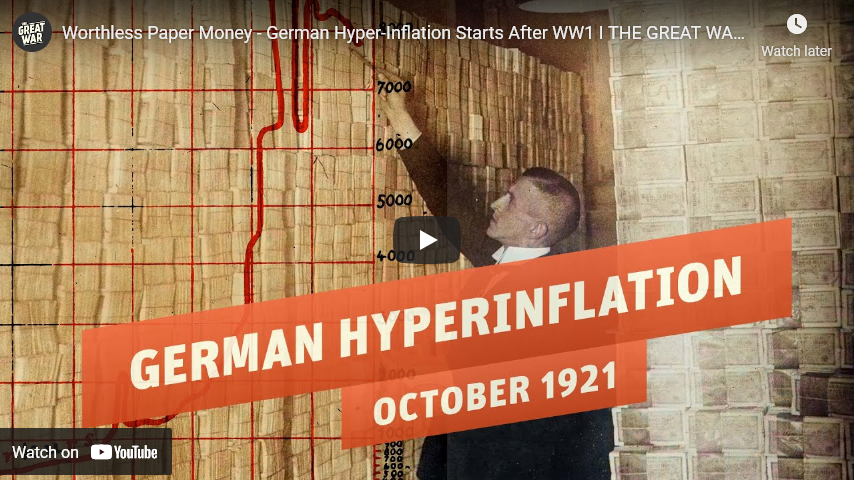
The German post-WW1 economy was under pressure: the loss of territory, the war bonds issued during the war and the reparations under the Treaty of Versailles. All this lead to a downward spiral of rising inflation and living costs for German citizens.
» SUPPORT THE CHANNEL
Patreon: https://www.patreon.com/thegreatwar
Shop: https://www.realtimehistory.net» OUR PODCAST
https://realtimehistory.net/podcast – interviews with World War 1 historians and background info for the show.» BUY OUR SOURCES IN OUR AMAZON STORES
https://realtimehistory.net/amazon *
*Buying via this link supports The Great War (Affiliate-Link)» SOURCES
Feldman, Gerald: Vom Weltkrieg zur Weltwirtschaftskrise. Studien zur deutschen Wirtschafts-und Sozialgeschichte 1914-1932. 1984.Fergusson, Adam: Das Ende des Geldes. Hyperinflation und ihre Folgen für die Menschen am Beispiel der Weimarer Republik, 1975.
Grosch, Waldemar: Deutsche und polnische Propaganda während der Volksabstimmung in Oberschlesien 1919-1921. 2002.
Lewek, Peter: Arbeitslosigkeit und Arbeitslosenversicherung in der Weimarer republik 1918-1927. 1989.
Michalczyk, Andrezej: Celebrating the nation: the case of Upper Silesia after the plebiscite in 1921.
Neubach, Helmut: Die Abstimmung in Oberschlesien am 20. März 1921. 2002.
» MORE THE GREAT WAR
Website: https://realtimehistory.net
Instagram: https://instagram.com/the_great_war
Twitter: https://twitter.com/WW1_Series
Reddit: https://reddit.com/r/TheGreatWarChannel»CREDITS
Presented by: Jesse Alexander
Written by: Jesse Alexander
Director: Toni Steller & Florian Wittig
Director of Photography: Toni Steller
Sound: Toni Steller
Editing: Jose Gamez
Motion Design: Philipp Appelt
Mixing, Mastering & Sound Design: http://above-zero.com
Maps: Daniel Kogosov (https://www.patreon.com/Zalezsky)
Research by: Jesse Alexander
Fact checking: Florian WittigChannel Design: Yves Thimian
Contains licensed material by getty images
All rights reserved – Real Time History GmbH 2021
Comments Off on Worthless Paper Money – German Hyper-Inflation Starts After WW1 I THE GREAT WAR 1921
August 22, 2021
QotD: Woodrow Wilson, wrong on many things, but quite right on this one thing
Woodrow Wilson was wrong about many things, but he was a veritable hedgehog about One Big Thing: the principle of national self-determination. When it came to his dream of the League of Nations, Wilson was a utopian romantic; but on the question of how to draw national political boundaries, he was a Founding Father of what may be called National Realism.
National Realism comprehends and respects the perhaps tragic, but nevertheless undeniable, fact that most people are deeply attached to collective identities and aspirations. It accepts as both natural and important that psychological well-being would be rooted in a terroir, a set of traditions or other mythologies about who people are and where they come from, that can serve as a source of meaning and self-understanding, as well as social cohesion. It acknowledges that nationalism is a fixture of modern social and political reality.
The idea that a self-described people should have the right to determine its own collective destiny was once considered progressive. Nineteenth-century liberal nationalists like Giuseppe Mazzini in Italy and Ernest Renan in France saw in the nation-state the fullest political expression of peoplehood, a true source of law and legitimacy, a celebration of diversity, and a font of culture, art, and human flourishing. The idea of national self-determination also resonated with the American Founding and with the Declaration of Independence, which proclaimed that governments derive their powers from the consent of the governed and found in Natural Law the right for one people to “dissolve the political bands which have connected it with another, and to assume among the powers of the earth the separate and equal station to which the Laws of Nature and of Nature’s God entitle them.” For good or ill, the French Revolution had awakened modern ethnic self-awareness among European peoples, and ever since, nationalism has been the most robust political force in international affairs. Nationalism is a property of modern nation states, the same way that gravity is a property of physical matter. It is unwise to underestimate its power.
Diversity is now, supposedly, the primus inter pares of our political values. But ethnic and racial diversity, in all its colorful pageantry, is traditionally associated with empires, not republics. Diversity brings to mind Barbara Tuchman’s description of Queen Victoria’s Diamond Jubilee, with its splendid processions of Royal Nigerian Constabulary, Borneo Dyak Police, turbaned and bearded Lancers of Khapurthala and Badnagar, Zaptichs from Cyprus with their tasseled fezzes and black-maned ponies, Houssas from the Gold Coast, Chinese from Hong Kong, and Malays from Singapore, all paying homage to the great monarch. Imperial Rome was an equally spectacular kaleidoscope of nations and religions. By contrast, republican Rome was merely, austerely, Roman.
As a good Progressive, Wilson understood that modern democratic government is incompatible with multi-ethnic empire. But it took the cataclysmic breakdown of the Old World empires in the meat-grinder of World War I to bring the idea of national self-determination into political focus. It would be wise to remember that that civilization-shattering conflict was blamed in large part on the lack of congruence between state and ethnic boundaries. Most of Wilson’s famous Fourteen Points, outlined 101 years ago this month, were dedicated to correcting this discrepancy on the basis of national self-determination.
E.M. Oblomov, “The Case for National Realism: Diversity is the hallmark of empires, not democracies”, City Journal, 2019-01-02.
Comments Off on QotD: Woodrow Wilson, wrong on many things, but quite right on this one thing
August 17, 2021
Opening Battles of the Franco-Prussian War: Saarbrücken, Wissembourg, Wörth I GLORY & DEFEAT Week 4
realtimehistory
Published 5 Aug 2021Support Glory & Defeat: https://realtimehistory.net/gloryandd…
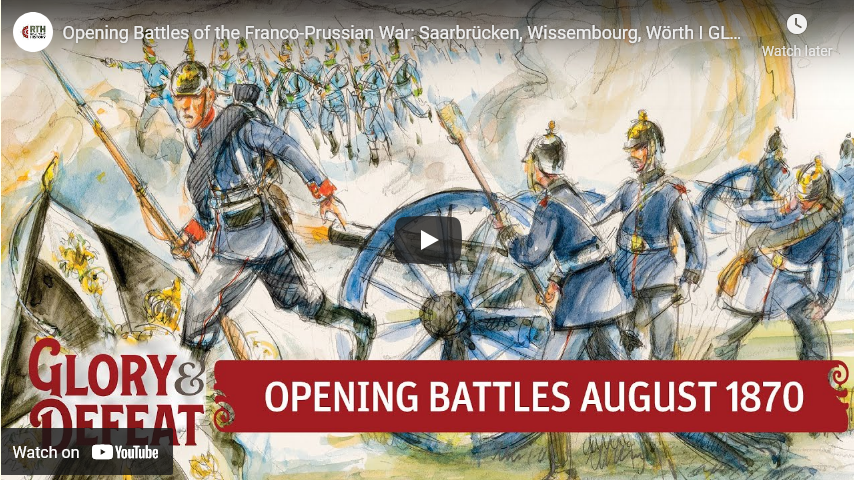
Early August 1870 saw the first series of opening battles of the Franco-Prussian War. The Battle of Saarbrücken was the only battle of the entire war fought on German soil, the following Battle of Wissembourg, the Battle of Wörth and the Battle of Spicheren happened right after and gave a glimpse of the carnage to come.
» THANK YOU TO OUR CO-PRODUCERS
John Ozment
James Darcangelo
Jacob Carter Landt
Thomas Brendan» OUR PODCAST
https://realtimehistory.net/podcast – interviews with historians and background info for the show.» LITERATURE
Arand, Tobias: 1870/71. Die Geschichte des Deutsch-Französischen Krieges erzählt in Einzelschicksalen. Hamburg 2018Bourguinat, Nicolas/Vogt, Gilles: La guerre franco-allemande de 1870. Une histoire globale. Paris 2020
Gall, Lothar (Hrsg.): Deutschland Archiv. Deutsche Geschichte in Dokumenten. O.O., o. J. (2007)
Mährle, Wolfgang: “Das württembergische Heer im Deutsch-Französischen Krieg 1870/71“, in: Nation im Siegesrausch. Württemberg und die Gründung des Deutschen Reichs 1870/71, hrsg.v. Wolfang Mährle. Stuttgart 2020. S. 45-64.
Milza, Pierre: L’année terrible. La guerre franco-prussienne septembre 1870 – mars 1871. Paris 2009
Roux, Georges: La Guerre de 1870. Paris 1966
» SOURCES
Bazaine, François-Achille: Episoden aus dem Krieg von 1870 und der Belagerung von Paris. Berlin 1884Chuquet, Arthur: La guerre 1870/71. Paris 1895
Engel, o.V.: Die Verluste der deutschen Armeen an Offizieren und Mannschaften im Kriege gegen Frankreich 1870 und 71. Berlin 1872
Engels, Friedrich: Der Deutsch-Französische Krieg. Sechzig Artikel aus der ‘Pall Mall Gazette’. Berlin (Ost) 1957
Goncourt, Edmond de: Journal. Bd. 5. 1869-1872. Leipzig 2013
Henderson, George: The battle of Spicheren, August 6th 1870, and the events that preceded it – a study in practical tactics. London 1891
Klein, Karl: Fröschweiler Chronik. Kriegs- und Friedensbilder aus dem Jahre 1870/71. Illustrierte Jubelausgabe. München 1897
Kriegsgeschichtliche Abtheilung des Großen Generalstabs (Hg.): Der deutsch-französische Krieg 1870/71. Erster Theil. Erster Band. Berlin 1874
Kühnhauser, Florian: Erinnerungen eines Soldaten des königlich bayerischen-Infanterie-Leib-Regiments. Partenkirchen 1898
Le Faure, Amédée: Atlas de la guerre 1870/71. Paris 1875
Meisner, Heinrich Otto (Hrsg.): Kaiser Friedrich III. Das Kriegstagebuch von 1870/71. Berlin, Leipzig 1926
Pietsch, Ludwig: Von Berlin bis Paris. Kriegsbilder 1870-1871. Berlin 1871
» OUR STORE
Website: https://realtimehistory.net»CREDITS
Presented by: Jesse Alexander
Written by: Cathérine Pfauth, Prof. Dr. Tobias Arand, Jesse Alexander
Director: Toni Steller & Florian Wittig
Director of Photography: Toni Steller
Sound: Above Zero
Editing: Toni Steller
Motion Design: Philipp Appelt
Mixing, Mastering & Sound Design: http://above-zero.com
Maps: Battlefield Design
Research by: Cathérine Pfauth, Prof. Dr. Tobias Arand
Fact checking: Cathérine Pfauth, Prof. Dr. Tobias ArandChannel Design: Battlefield Design
Contains licensed material by getty images
All rights reserved – Real Time History GmbH 2021
Comments Off on Opening Battles of the Franco-Prussian War: Saarbrücken, Wissembourg, Wörth I GLORY & DEFEAT Week 4
August 10, 2021
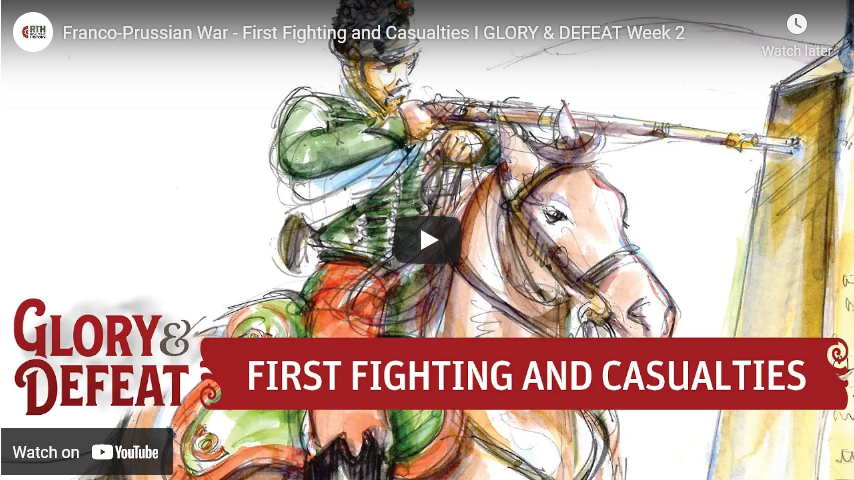
Franco-Prussian War – First Fighting and Casualties I GLORY & DEFEAT Week 2
realtimehistory
Published 22 Jul 2021Support Glory & Defeat: https://realtimehistory.net/gloryandd…
With the official declaration of war from France, Prussia mobilizes and calls in the defensive alliances with the other German states within the North German Confederation but also with Bavaria, Württemberg and Baden. And while the bigger armies still assemble, the first skirmishes happen near the French border.
» OUR PODCAST
https://realtimehistory.net/podcast – interviews with historians and background info for the show.» LITERATURE
Arand, Tobias: 1870/71. Der Deutsch-Französische Krieg erzählt in Einzelschicksalen. Hamburg 2018Arand, Tobias / Bunnenberg, Christian (Hrsg.): Karl Klein. Fröschweiler Chronik. Kriegs- und Friedensbilder aus dem Krieg 1870. Kommentierte Edition. Hamburg 2021
Bourguinat, Nicolas / Vogt, Gilles: La guerre franco-allemande de 1870. Une histoire globale. Paris 2020
Howard, Michael: The Franco-Prussian War. London 1961
Milza, Pierre: L’année terrible. La guerre franco-prussienne septembre 1870 – mars 1871. Paris 2009
» SOURCES
Becker, Josef (Hrsg.): Bismarcks spanische «Diversion« 1870 und der preußisch-deutsche Reichsgründungskrieg. Bd. III. Paderborn, München, Wien, Zürich 2003
Bebel, August / Bernstein, Eduard (Hrsg.): Der Briefwechsel zwischen Friedrich Engels und Karl Marx. Bd. IV. Stuttgart 1921
Fontane, Theodor: Krieg gegen Frankreich, Bd. 1. Berlin 1873
Napoléon III: Proclamation de l’Empereur. Paris, 23. Juillet 1870
» OUR STORE
Website: https://realtimehistory.net»CREDITS
Presented by: Jesse Alexander
Written by: Cathérine Pfauth, Prof. Dr. Tobias Arand, Jesse Alexander
Director: Toni Steller & Florian Wittig
Director of Photography: Toni Steller
Sound: Above Zero
Editing: Toni Steller
Motion Design: Philipp Appelt
Mixing, Mastering & Sound Design: http://above-zero.com
Maps: Battlefield Design
Research by: Cathérine Pfauth, Prof. Dr. Tobias Arand
Fact checking: Cathérine Pfauth, Prof. Dr. Tobias ArandChannel Design: Battlefield Design
Contains licensed material by getty images
All rights reserved – Real Time History GmbH 2021
Comments Off on Franco-Prussian War – First Fighting and Casualties I GLORY & DEFEAT Week 2


