Quotulatiousness

November 11, 2019

The Berlin Wall – A Street Party With Sledgehammers – Extra History

Filed under: Europe, Germany, History, Politics, Russia — Tags: , , , , , , — Nicholas @ 06:00

Extra Credits
Published 9 Nov 2019

Thanks to World of Tanks for sponsoring this episode. Download the game on PC and use the invite code CHECKPOINTC to claim your $15 starter pack https://tanks.ly/2NoVfjx.

The Berlin Wall has become a symbol of the Cold War. It encircled West Berlin, separating it from the Soviet-controlled East Berlin, placed to try and stop the flood of skilled professionals leaving to the West. Multiple US presidents had penned speeches about tearing down the wall, to no effect. But the Wall did fall. As the USSR underwent massive reforms and the Velvet Revolution was underway, East Germany was undergoing its own reform. And one clerical oversight in a press conference will destroy the Wall for good.

Update: Austin Bay linked to a column he wrote in 2009 on the 20th anniversary of these events.

Many in the West, including the U.S., believed that the communists had history on their side. The wry debate reply from the defeatist lefties favoring unilateral U.S. nuclear disarmament was “better Red than dead.” For decades — I repeat, decades — this crowd had a media pulpit from which its self-proclaimed intelligentsia preached the moral equivalency of the U.S. and the Soviet Union, and at times dropped the all pretense and fingered the U.S. as the “fascist state” and global oppressor.

In the language of the defeatist left, the U.S. was the jailer, the warmonger, the threat to world peace.

The Berlin Wall’s collapse exposed that Big Lie, as did the documented moral, political, economic and ecological wretchedness of the Soviet Union. Unfortunately, we still hear echoes of this “blame America” cant lacing al-Qaida propaganda and the lectures of hard-left reactionaries like Bill Ayers. The great anti-American lies of the Cold War are recast as the great anti-American lies of the War on Terror.

Breaching the wall in 1989 was bloodless, but the Cold War certainly wasn’t. World War III did not break out along the intra-German border and produce a nuclear conflagration, but the Cold War’s battles on the periphery (e.g., Greece, Korea, Vietnam, El Salvador, Angola, Afghanistan) were expensive, fatiguing and deadly.

October 2, 2019

“When the next American Civil War starts…”

Filed under: Military, Politics, USA — Tags: , , , , — Nicholas @ 05:00

David Warren goes all soothsayery and predicts the course and outcome of a potential Red-versus-Blue armed conflict arising from the current Red-versus-Blue verbal conflict:

When the next American Civil War starts, I imagine it will look something like Hong Kong: a big melee spreading through all public spaces (I note that USA is bigger than Hong Kong). But there will be fairly limited casualties, at first, each of which will become the subject of unrestrained media outrage, until the media collapse under physical reprisals. Later, the better and better armed demonstrators, on both sides, will tactically “evolve.” The surveillance state itself will begin to disintegrate, and with it any hope of restoring public order, through agencies such as police, courts, and prisons. Things like border surveillance will be abandoned, with immediate consequences, but as the attraction of going to the States diminishes, no one will mind. More noticeably, the economy will break down. Because the American military was designed chiefly to defend against foreign powers, on a very large scale — and the threat will instead be domestic and scattered — the Army will be (at first) effectively neutralized. Isolated firefights between Democrat and Republican soldiers will escalate to firefights between ships and aeroplanes, but these will end fairly quickly as a Pentagon dictatorship seizes control. Within a year, I expect, though only a small part of their arsenal will prove useful, bullet-enforced curfews will restore relative peace to the streets. I don’t expect the death toll to be more than a few hundred thousand, at least from direct conflict as the guns come out. Interruptions of food supply, and the spread of disease, will cost much more — but possibly less (proportionately) than in the last Civil War, in which both sides were better organized.

That it will have spread to Canada, I cannot doubt, developing from the refugee crisis across “the world’s longest undefended border,” as snowflakes of all descriptions, by their millions, run for their lives, then resume their clashes up here. Mexico would also suffer from this “white flight,” except, the chaos from Mexican cartels’ energetic efforts to reclaim significant parts of Texas, California, and the Southwest, would have the paradoxical effect of ending the outbound refugee traffic there. For the most part, other foreign countries would avoid direct engagement. Instead, Islamist and Socialist regimes around the world would be busy consolidating their own local positions, sparking numerous “little wars” by their attempts at regional expansion. Each would be settled as the larger and more ruthless power won.

Still, I shouldn’t expect the anarchy to continue. Tyranny quickly fills a vacuum of authority (moral as well as material), and answers to the growing demand for safety. Nothing, of course, will be learnt from the adventure, and I should think that within a decade or less, resistance to the new President-for-Life will have all but evaporated.

August 30, 2019

EFF sues Homeland Security over illegal GPS vehicle trackers

Filed under: Government, Law, Liberty, USA — Tags: , , , , — Nicholas @ 03:00

Kieren McCarthy on a recent lawsuit by the Electronic Frontiers Foundation:

The Electronic Frontier Foundation (EFF) has sued the US Department of Homeland Security to find out more about a program where, it is claimed, officers secretly stick GPS trackers on vehicles they are suspicious of as they come through the border.

The EFF has made repeated freedom of information act (FoIA) requests about the program’s policies but has been stonewalled, with Homeland Security’s responses claiming any information would contain “sensitive information” that could lead to “circumvention of the law.”

The foundation’s main concern is that Homeland Security is carrying out its secret tracking without a warrant, or even anything beyond a single officer’s suspicion. And it points to a recent US Supreme Court decision where it ruled that warrantless GPS tracking was unconstitutional under the Fourth Amendment.

Details of the program came to light last year when customs officers revealed in court filings that they had used GPS trackers without a warrant at the border. Since then the EFF has tried to find out what the policies and procedures are for deciding when a vehicle can be tagged. The relevant authorities have not been keen to go into any detail.

There’s another legal precedent too: a California court ruled that government officials’ use of GPS devices to track two suspected drug dealers without getting a warrant violated the Supreme Court decision, made in 2012, and was government misconduct.

May 18, 2019

Tim Worstall lists the benefits of a hard Brexit

Filed under: Britain, Economics, Europe — Tags: , , , , — Nicholas @ 05:00

In the Continental Telegraph, Tim Worstall responds to a demand for a list of the benefits of a hard Brexit:

1) How will you protect UK business from dumping?

We won’t. The aim, purpose and intention of trade is to gain access to those things which Johnny Foreigner makes better, cheaper, faster – pick any two of three – than our own domestic producers do. Given that the aim of an economy is to make the people, consumers, as well off as the constraints of the real world allow, we wouldn’t protect domestic producers from anything. Shape up or go bust.

As even the Treasury’s briefing on the costs and benefits of Brexit said, competition from trade is exactly what incentivises domestic producers to become more productive.

So, we don’t protect from dumping and the people of Britain become richer. The problem with this is?

2) What will you do for those who lose their jobs because the businesses that employ them are undermined by WTO rules?

Exactly the same as we do for anyone else who loses their job for any other reason. The economy destroys some 10% of all jobs every year – some 3 million – and another 10% are generated newly as well. That’s just what labour market churn is. We have a welfare system for the interim and people who lose jobs because of Brexit or WTO do exactly as everyone else, get another job with the welfare state as the backstop.

And it’s important to note how new job creation works. It isn’t that we must plan what those jobs are before the old disappear. It’s the availability of the newly employable labour which generates the testing of what should be done next.

3) What will you do on the Northern Ireland border?

Lie.

We have pointed this out before:

Our answer should be “Yes.” We agree that we are leaving, that we have put in place that hard border. Then we do absolutely nothing above what we already do. People come and go as they wish, carrying what goods they can, and we do nothing. Except, as we already do, we keep an eye on those moving things on an industrial scale and have our little customs and tax chats with them away from that line on the map.

What other people wish to do on their side of that line is entirely up to them. We will do, as we’ve always done when in our right minds, what is useful and beneficial to us. It’s somewhat unfashionable these days to talk of the empire but it’s still true that we had it. Often because we’re rather good at this lying, cheating and dissembling. We should carry on. So, there’s the border, as it is today. And?

May 8, 2019

Your electronic devices and the Canadian Border Services Agency

Filed under: Cancon, Law, Liberty, Technology — Tags: , , , , , , — Nicholas @ 03:00

A few years ago, many civil libertarians were upset that the US government allowed warrantless searches of electronic devices at the border, but it was less well known that the Canadian Border Services Agency does the same at the Canadian border:

According to the CBSA, it has the right to search electronic devices at the border for evidence of customs-related offences — without a warrant — just as it does with luggage.

If travellers refuse to provide their passwords, officers can seize their devices.

The CBSA said that between November 2017 and March 2019, 19,515 travellers had their digital devices examined, which represents 0.015 per cent of all cross-border travellers during that period.

During 38 per cent of those searches, officers uncovered evidence of a customs-related offence — which can include possessing prohibited material or undeclared goods, and money laundering, said the agency.

While the laws governing CBSA searches have existed for decades, applying them to digital devices has sparked concern in an era where many travellers carry smartphones full of personal and sometimes very sensitive data.

A growing number of lawyers across Canada argue that warrantless digital device searches at the border are unconstitutional, and the practice should be stopped or at least limited.

“The policy of the CBSA of searching devices isn’t something that is justifiable in a free and democratic society,” said Wright who ran as a Green Party candidate in the 2015 federal election.

“It’s appalling, it’s shocking, and I hope that government, government agencies and the courts, and individual citizens will inform themselves and take action.”

April 26, 2019

QotD: European jokes about the neighbours

Filed under: Europe, France, Humour, Quotations — Tags: , , — Nicholas @ 01:00

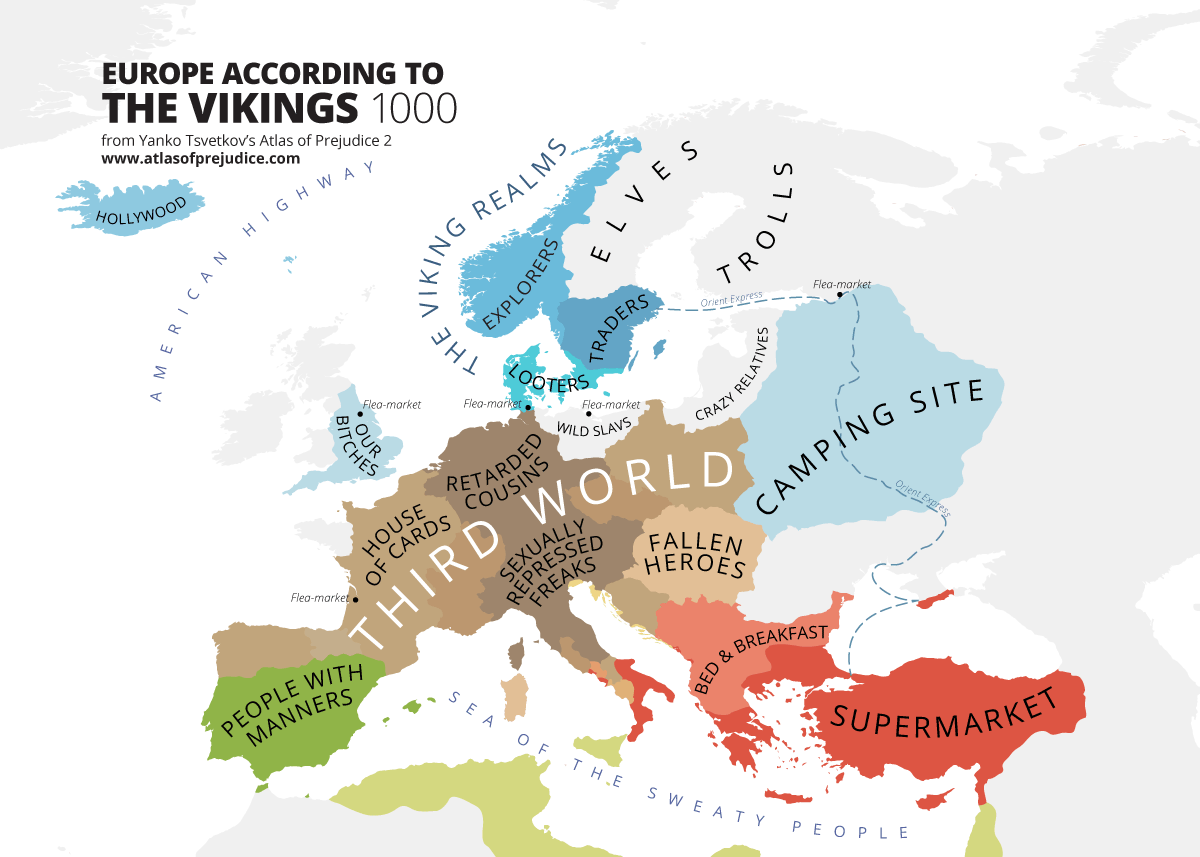
… it is also the Finns who snicker at overbearing Swedes (“What’s the difference between the Swedes and the Finns? The Swedes have got nice neighbours”); and the Portuguese, who mock Spanish arrogance (“In a recent survey, 11 out of 10 Spaniards said they felt superior to the others”).

There are the Irish, who joke about buttoned-up Brits (“What’s the English definition of a thrill? Having an After Eight at 7.30”); and the Poles, who have a go at the Germans for pretty much anything (“German footballers are like German food: if they’re not imported from Poland they’re no good”).

Making fun of our best enemies, said Romain Seignovert, who has just published a book on the jokes Europeans tell about their neighbours, is a great European tradition. “We are a big, diverse community with a centuries-long common history of highs and lows, and our humour reflects that,” he says.

[…]

There is a deeper point. Ultimately, Seignovert said, laughing at our neighbours is “recognising, even celebrating, our particularities. It shows we’re not indifferent. Europe isn’t just political and economic, it’s also cultural – about all these nations, living together. The EU hasn’t made enough of that.”

That may be true. But Seignovert, remember, is French, so what he says should clearly not be taken too seriously. In the words of one particularly fine Belgian quip: “How does a Frenchman commit suicide? By shooting 15cm above his head, right in the middle of his superiority complex.”

Jon Henley, “‘Crude, but rarely nasty’: The jokes Europeans tell about their neighbours”, The Guardian, 2016-05-08.

April 14, 2019

British diplomatic blunders in history – German unification

Filed under: Britain, Europe, Germany, History — Tags: , , , , , — Nicholas @ 05:00

An interesting article in Vox, suggesting that the gradual unification of all the German principalities, electorates, duchies, counties, bishoprics, free cities, and miscellaneous other semi-independent bits and bobs of the Holy Roman Empire was not inevitable and that — absent British blundering after the Napoleonic wars — it would have produced a very different 20th century:

The Holy Roman Empire in 1789, before Napoleon “rationalized” hundreds of smaller entities into the Confederation of the Rhine.
Image from Wikimedia Commons.

The boundaries of states are the heart of many recent debates, be it the European refugee crisis, the Transatlantic Trade and Investment Partnership (TTIP), or Brexit (Snower and Langhammer 2019). After decades of stability, today we are again seeing heated discussions about the shape and extent of political borders. Clearly, borders are neither naturally given nor random. In Europe and elsewhere, the current state borders have been formed and changed over centuries, sometimes peacefully, often in bloody wars. In Huning and Wolf (2019), we look at the formation of the German nation state led by Prussia and trace it back to a change in borders decided at the Congress of Vienna in 1814/15.

In a nutshell, we have two findings:

  • First, the geographic position of a state can be a crucial factor for institutional change and development.
  • Second, the formation of the German Zollverein in 1834 under Prussian leadership was a truly European story, involving Britain, the Russian Empire, and the Belgian revolution of 1830/31. We show in particular that the Zollverein formed as an unintended consequence of Britain’s intervention in 1814/15 to push back Russian influence over Europe.

In theory, why would the geographic position of a state relative to that of other states matter? Intuitively, it should matter as long as the costs of trade and factor flows depend on their routes. If a large share of my trade has to pass the territory of one or several neighbours, my trade and trade policy will depend on the trade policy of my neighbours. Moreover, if tariffs are levied not only on imports but also on transit trade, as was general practice until the Barcelona Statute of 1921 (Uprety 2006), policymakers face the problem of multiple marginalisation, which is well known from the literature on supply chains. In our work, we provide a simple theoretical framework (in partial equilibrium) to show how the location of a revenue maximising state planner will affect its ability to set tariffs. Some states can increase their tariff revenue at the expense of their hinterland. Next, we show that a customs union can be beneficial for a group of states exactly because it solves the problem of multiple marginalisation.

A major challenge to testing our idea empirically is that a state’s political boundaries (and hence its location) do not change very often, and if they do, the change is unlikely to be unrelated to trade or factor flows. However, the formation of the German Zollverein in 1834 can be considered as a quasi-experiment. Let us briefly revisit this historical episode. At the end of the Napoleonic wars of 1792-1814/15, only Russia and the UK were left as major military powers. Habsburg, Prussia, and the defeated France attempted to consolidate their positions at the expense of the many smaller states that had just about survived the wars, notably the former allies of Napoleon such as Saxony and Poland. Overall, the negotiations at the Congress of Vienna in 1814 were dominated by military-strategic considerations between the two great powers. Russia wanted to expand westwards, Prussia was desperate to annex the populous Kingdom of Saxony, which bordered Prussia in the south and would create a large and coherent territory. To this end, Prussia was willing to give up not only her Polish territories to Russia, but also her positions and claims on the Rhineland (Müller 1986). This met stiff resistance from Britain, joined by Habsburg and France, which feared a new Russian hegemony on the continent – the ‘Polish Saxon question’. After weeks of diplomatic struggle, the outcome was a division of Saxony, another division of Poland and Prussia being established as the “warden of the German gate against France” (Clapham 1921: 98). Figure 1 shows the result of these negotiations.

H/T to Continental Telegraph for the link.

March 2, 2019

Post WW1 Violence Theory – Paris Peace Conference I BEYOND THE GREAT WAR

The Great War
Published on 28 Feb 2019

In our first episode of our new format BEYOND THE GREAT WAR Jesse answers two questions. The first one is in regards to the Brutalization Theory that tries to explain the level of violence during and after the First World War. In our second question, we talk about the start of the Paris Peace Conference 100 years ago.

» SUPPORT THE CHANNEL
Patreon: https://www.patreon.com/thegreatwar
Merchandise: https://shop.spreadshirt.de/thegreatwar/

» SOURCES
Audoin-Rouzeau, Stéphane and Annette Becker. 14-18, retrouver la guerre (Npp : Gallimard, 2000).

Depechin, Annie. “La conférence de la paix,” in Stéphane Audoin-Rouzeau and Jean-Jacques Becker, eds. Encyclopédie de la Grande guerre 1914-1918 (Paris : Bayard, 2013): 935-948.

Gerwarth, Robert. “The Continuum of Violence,” in Jay Winter, ed. The Cambridge History of the First World War, vol. 2: The State (Cambridge: Cambridge University Press, 2014): 638-662.

Gerwarth, Robert. The Vanquished. Why the First World War Failed to End, 1917-1923 (Penguin, 2017).

Konrad, Helmut. “Drafting the Peace,” in Jay Winter, ed. The Cambridge History of the First World War, vol. 2: The State (Cambridge: Cambridge University Press, 2014): 606-637.

Mosse, George. Gefallen für das Vaterland. Nationales Heldentum und namenloses Sterben (Stuttgart: Klett-Cotta, 1993). English version: Fallen Soldiers. Reshaping the Memory of the World Wars (New York: Oxford UP, 1990).

Prost, Antoine. “Les limites à la brutalisation : tuer sur le front occidental, 1914-1918,” Vingtième Siècle. Revue d’histoire (2004/1 no 81) : 5-20. Accessed at https://www.cairn.info/revue-vingtiem…

Sharp, Alan. “The Paris Peace Conference and its Consequences,” in in 1914-1918 online. International Encyclopedia of the First World War. https://encyclopedia.1914-1918-online…

»CREDITS

Presented by: Jesse Alexander
Written by: Jesse Alexander
Director: Toni Steller & Florian Wittig
Director of Photography: Toni Steller
Sound: Toni Steller Editing: Toni Steller
Mixing, Mastering & Sound Design: http://above-zero.com
Motion Design: Christian Graef – GRAEFX
Maps: Daniel Kogosov (http://patreon.com/Zalesky)
Research by: Jesse Alexander
Fact checking: Florian Wittig
Channel Design: Alexander Clark
Original Logo: David van Stephold

A Mediakraft Networks Original Channel

Contains licenced material by getty images
All rights reserved – Real Time History GmbH i.Gr. 2019

From the comments:

The Great War
1 day ago

ICYM the special message at the end of the video: THANK YOU FOR 1 MILLION SUBSCRIBERS! And we also hope you like our new format BEYOND THE GREAT WAR. It will also replace what used to be special episodes and biographies. Just ask us a question about a person, event or country and we will see that we answer it in the same depth that our special episodes had. Simple as that.

January 10, 2019

A timely reminder about the dangers of expanding government power

Filed under: Government, Liberty, Politics, USA — Tags: , , , , — Nicholas @ 05:00

At Coyote Blog, Warren Meyer points out to the Republicans that if it was bad during the last presidency, it’s just as bad during this one:

Dear Republicans:

The last thing we need now is even more expansion of executive power. I remember when, gosh it was like only two or three years ago, you Republicans were (rightly) bemoaning Obama’s executive actions as unconstitutional expansions of Presidential power. You argued, again rightly, that just because Congress did not pass the President’s cherished agenda items, that did not give the President some sort of right to do an end-around Congress.

But now, I hear many Republicans making exactly the same arguments on the wall that Obama made during his Presidency, with the added distasteful element of a proposed declaration of emergency to allow the army to go build the wall.

[…]

I can pretty much guarantee you that if Trump uses this emergency declaration dodge (and maybe even if he doesn’t now that Republicans have helped to normalize the idea), the next Democratic President is going to use the same dodge. I can just see President Warren declaring a state of emergency to have the army build windmills or worse. In fact, if Trump declares a state of emergency on a hot-button Republican issue, Democratic partisans are going to DEMAND that their President do the same, if for no reason other than tribal tit for tat.

November 29, 2018

The Kerch Strait stand-off

Filed under: Military, Russia — Tags: , , , , , — Nicholas @ 03:00

The Russians are attempting to cut off Ukrainian access to the Sea of Azov, cloaking that action in standard disinformation to claim that Ukraine is the aggressor, etc. Shoshana Bryen outlines the situation at the moment:

Satellite view of the Kerch Strait via Google Maps

Every story has a starting point. Don’t start with the Russian capture this week of two (or three) Ukrainian ships and the injury to three (or six) Ukrainian sailors. The Russian habit is to do as it likes with smaller countries and then announce that the other guy did it (or it never happened at all). That is the story of the Russian war in Ukraine and the 2014 illegal annexation of Crimea, and that is the Russian story of the Ukrainian ships – two ships, not three, three injured not six; anyhow, Ukraine was sailing out of its lane.

Start instead with the bridge over the narrow Kerch Strait that opened earlier in 2018. It is the only entrance to the Azov Sea from the Black Sea, spanning the Taman Peninsula in Russia and the Kerch Peninsula in Crimea. Earlier plans for the bridge were completed between Russia and Ukraine, but that was before the Russians occupied Crimea. There is an agreement for Ukrainian passage to its two ports along the Azov Sea, but Ukraine has complained that the bridge is the beginning of a blockade that would ultimately control or end Ukrainian shipping. There have been delays for Ukrainian ships passing through, sometimes days, and oh, by the way, the bridge is very low – nearly flat – over the water, meaning that Ukrainian ships over 115 feet can’t pass at all. And now there is a Russian ship parked under the bridge, blocking traffic.

It is estimated that Ukrainian shipping through the strait is down nearly 25% since the bridge opened – as the Ukrainians feared and as the Russians planned.

Austin Bay looks at the military and diplomatic side:

Closing the Kerch Strait effectively blockades Berdyansk and Mariupol, two Ukrainian ports on the Sea of Azov’s north coast.

In 2015, while visiting Crimea, Vladimir Putin himself said he hoped there would be no “full-scale direct clashes” between Ukrainian and Russian forces.

But on Nov. 25, Russia’s war against Ukraine escalated as verifiably Russian coast guard forces under the command of the Russian Federal Security Service intercepted (rammed says Ukraine), boarded and seized two verifiably Ukrainian naval vessels and a Ukrainian tugboat. The 24 Ukrainians on board the ships became Russian prisoners.

The Kremlin claimed the Ukrainian vessels had conducted “dangerous maneuvers” in Russian territorial water.

Putin’s Kremlin specializes in adding complex twists to blatant falsehoods. There is no evidence the Ukrainian ships did anything but try to avoid being intercepted. Russian territorial water? To buy that you must accept Russia’s illegal seizure of the peninsula. However, the strait is an internationally recognized waterway open to transit by commercial shipping and naval vessels. Kerch is comparable to other straits around the globe, like the Strait of Hormuz at the mouth of the Persian Gulf. Iran routinely threatens to close Hormuz to shipping, but to do so would violate freedom of navigation and constitute an act of war.

Defense One reported that Kiev had informed Moscow that its naval vessels would transit the strait. Moreover, the Russians who boarded the Ukrainian ships were special operations commandos.

The Ukrainian ships were making a legal transit. As recently as 2003, Russia guaranteed Ukraine’s right to transit the strait. The 2003 treaty made the strait and Sea of Azov shared territory.

Like invading Crimea, the Russian seizure of Ukrainian ships is a calculated act of war. Russia has now anchored an oil tanker in the main sealane beneath the bridge, blocking all ship traffic.

Ukrainian Foreign Minister Pavlo Klimkin said ramming a Ukrainian vessel was an “act of armed aggression” and that Russia had violated “the freedom of maritime traffic.” He also cited specific articles in the United Nations Convention on the Law of the Sea that “bans the obstruction of peaceful transit across the Kerch Strait.”

Several articles referenced the possibility that NATO would … do something. Other than the usual diplomatic protests, I doubt that there’s much NATO can do in a situation like this. Direct military action should not even be considered an option (not that it’ll stop the odd wild-eyed editorial writer), as NATO does not have a direct interest at risk here. All western nations do have an interest in preserving and upholding freedom of the seas, but Russia knows that the west won’t likely risk getting into a shooting war over incidents like this.

You can get a very useful list of links including the current Kerch Strait confrontation from MILNEWS.ca.

June 25, 2018

Differences between the United States and the “idealized” United States of Europe

Filed under: Bureaucracy, Europe, Law, Liberty, USA — Tags: , , , — Nicholas @ 03:00

Tim Worstall, in the Continental Telegraph:

There are those who think – urge, wish for perhaps – the European Union is or should become the United States of Europe. Lots of central bureaucratic control, the nation states left as just the remnants of once independent countries like the US states are these days. In some ways the two systems are very much the same already. No US state has any control at all over trade across its own border. Nor does any EU one. Trade is an issue solely the competence of the central organisations, respectively Washington DC and Brussels. Equally, both systems use this central control of trade and trade only to expand that central control.

In the US there was a case that Federal control of trade meant that the Feds got to decide who could grow wheat where and when. The usual sort of planning idiocy led to the Feds telling farmers who could grow how much and when. One farmer claimed he was only growing for his own consumption and this shouldn’t be limited. The centre (the Supreme Court) disagreed, the crux being that if he didn’t grow for his own consumption he would buy, this affected inter-state commerce, he had to obey the Feds. The EU takes this a step further. The Single Market rules are nominally about trade. Anything legal to be buying and selling in one place is such in all is a reasonable explanation of the nub of the matter. Sure, exceptions and all that. But this then smuggles into all law that continental (Roman Law really) idea that what is legal to do is something that the legislation defines. Instead of that Common Law idea that legislation, the law even, defines what it is illegal to do all other things being legal.

Once this is accepted then of course the next step is that there must be regulation of all things so as to tell people what it is legal to do. In this manner all sorts of things get smuggled in. Vacuum cleaner motors must be limited to a certain size or power. Because those whose lives are unfortunate enough that they’ve time to spare to be concerned about legislation on such matters note that they can be and thus incorporate their trivialities into legislation. The extent of this reach is larger than you think. The underlying legal, not political, justification for recycling targets is that some countries – Holland, where digging a hole gains nothing but wet boots – don’t have space for landfill. This would put them at a disadvantage if other countries do have the space, therefore all must recycle.

Giving the centre power always, but always, means an extension of the centre’s power. The two systems aren’t so different then.

June 24, 2018

Europe and the refugees

Filed under: Africa, Europe, Government, Italy, Law, Middle East, Politics — Tags: , , , , — Nicholas @ 05:00

Theodore Dalrymple on the various European governments’ attitudes and actions on the refugee problem:

Europe, despite its Union, is as divided as ever. Recently, when Italy’s new right-wing government — anxious to prove its credentials — refused to allow a boat carrying 629 African migrants to dock in Italy, Spain’s new left-wing government — equally anxious to do the same — accepted the boat. When the French president, Emmanuel Macron, criticized the Italians for their decision, the Italian government accused the French of hypocrisy, inasmuch as they had refused to take more than 9,000 migrants from Italy that they had previously agreed to accept.

This story is revealing in several aspects. The first is that, whatever attitude governments take to the migrants, no one truly believes that they are more of an asset than a liability. Madrid’s action, for example, was taken on “humanitarian” grounds, rather than because it believed that Spain would benefit from the migrants’ presence. When European leaders discuss the migrant question, it is always in terms of sharing the burden, not the assets, equitably. No one speaks of foreign investment in this way, which suggests that European politicians believe, whether rightly or wrongly, that the free movement of people and capital are different in an important way.

The leaders speak of sharing the burden, then, and are incensed when countries such as Hungary and Poland refuse point-blank to take any migrants from Africa or the Middle East. But I have never seen mentioned in this context the question of where the migrants themselves want to go. They might as well be inanimate toxic waste as far as the discussion is concerned, rather than human beings with wishes, desires, ambitions, and so forth. They are but pawns in a political game. Hungary, for example, is deemed duty-bound to take x number of migrants: no one asks whether x number of migrants can be found who want to go to Hungary. Nor is the question ever discussed in public whether Hungary, having open borders, would be held responsible for making the migrants stay there once they had arrived. Short of penning them in, how exactly would you keep them in Hungary, or in Poland?

June 11, 2018

L. Neil Smith on the Koch brothers and the libertarian movement

Filed under: Liberty, Politics, USA — Tags: , , , — Nicholas @ 03:00

In the latest issue of the Libertarian Enterprise, L. Neil Smith discusses his experiences working with the Koch brothers:

It says here that David Koch is retiring. In case you don’t know, he is the younger of two oil billionaire brothers associated with the libertarian movement who bankrolled the Cato Institute, and whom “progressives” love to hate, automatically blaming them for what little they don’t blame Donald Trump for.

Genuine libertarians and conservatives don’t like them much, either, for a variety of reasons. My own first is that I served on the 1977 Libertarian Party National Platform Committee with Charlie, David’s older brother and found him to be a timid, unimaginative soul, more concerned with credibility and respectability than with truth or principle. At the time, the think-tank he and his brother created was attempting to turn the LP into a wholly-owned subsidiary (David ran in 1980 for Vice President with Ed Clark), and I didn’t like that, either.

The Koch brothers are also open-borderists, siding with establishment Republicans like that smirk-weasel Paul Ryan who want an imported servant-class they can abuse. I’ve changed my mind on that issue for good and sufficient reasons, and they ought to be good and sufficient for the Koch Brothers, too, if they were really libertarians. American culture is unique and wonderful; I do not want to see it changed or destroyed as the cultures of Sweden and England are being, by uncontrolled mass immigration. Letting a lot of Third Worlders into the United States of America is like letting a lot of Californians into Colorado. Pretty soon it’ll be just like the mess they made and left behind.

We have a saying here: “Don’t Californicate Colorado”.

David is retiring, it says here, due to an extremely long bout with prostate cancer. It does not say what his prognosis is. My own father, whom I miss every day, fought prostate cancer for six ghastly years and died. I’m sorry David has it now; I would not wish that fate on anybody.

But the reason I’m writing this is to speak the truth, to a great big pile of money, if not to power. The Kochs don’t have power because they don’t have a clue how to spend money politically, and, among other counter-productive follies, they threw their dough away with all four hands, supporting a think-tank incapable of reaching the people by the millions the way Donald Trump has. I have never known anyone who read a paper produced by the Cato Institute or listened to a lecture given by one of their wonks — except other wonks.

May 24, 2018

The Hamas pay scale for freelance protest attendees

Filed under: Media, Middle East — Tags: , , , , , — Nicholas @ 03:00

Barbara Kay in the National Post:

Illuminating the validity of Col. Kemp’s statement, the Monday edition of the Wall Street Journal published an op ed by Israeli Brig. Ronen Manelis, spokesman for the IDF, titled “The Truth about Hamas and Israel.” In it Manelis reveals the depths of Hamas cynicism. Hamas provided free transportation to the security fence for all Gazans, including women and children. They were paid $14 a head or $100 per family to attend. The injured received $500. That’s pretty abominable. So’s this: Hamas gave everyone with a video camera VIP access to “the show,” and free wifi too to make sure no injury went unrecorded (both real and fake: one video shows an “injured” victim borne away on a stretcher hopping off completely unscathed when presumably out of camera range.)

According to Manelis, the “protest” theme was a complete fabrication: “The IDF had precise intelligence that the violent riots were masking a plan of mass infiltration into Israel in order to carry out a massacre against Israeli civilians.” Hamas operatives were dressed as civilians. On Facebook Hamas had posted maps for operatives indicating the fastest route from the border to nearby Israeli homes, schools and daycare centres. That’s abominable.

Manelis states that IDF soldiers “acted with courage and restraint, following strict rules of engagement to ensure minimum civilian injury and loss of life while still protecting the border.” The optics did not favour Israel, naturally, because the truth can’t make much headway when an enemy is prepared to put its own women and children in harm’s way, calculatedly using their bodies for propaganda purposes.

The IDF policy was indeed to warn first and shoot as a defensive action. Their first priority was, quite rightly, self-defence and defence of Israeli civilians. And as Manelis writes, “The soldiers of the IDF won this week by keeping Israeli families safe and by stopping Hamas from accomplishing its stated goals.”

But yeah, Hamas is winning the propaganda war, and the proof is that even a seasoned and objective journalist like Terry Glavin is so frustrated with the human cost of this reckless, feckless and essentially futile act of jihad, that he’s essentially asking Israel to find a way to stop it, as if there were some magical, casualty-free solution the IDF could employ, if only it chose to, in defending a border against a rabid mass of suicide-prone enemies.

Israel is constantly subjected to double standards — by the UN, by biased journalists, by anti-Semites on social media.

May 22, 2018

“[Hamas] knows there is a market for stories of Palestinian pain, and it is happy to flood that market”

Filed under: Media, Middle East — Tags: , , , , , , , — Nicholas @ 05:00

In Spiked, Brendan O’Neill explains why Hamas is so willing to literally sacrifice Palestinian lives for media coverage:

A 2007 map of the West Bank and Gaza, showing Israeli settlements
Via Wikimedia Commons

It is becoming increasingly clear that Hamas pushes Gaza’s people into harm’s way because it knows their suffering will strike a chord across the West. Because it knows images of their hardship will be shared widely, wept over, and held up as proof of the allegedly uniquely barbarous nature of the Jewish State. Hamas knows there is a hunger among the West’s so-called progressives for evidence of Palestinian pain, and by extension of Israeli evil, and it is more than willing to feed this hunger.

The clashes at the Gaza border, in which more than 60 Palestinians were killed and hundreds injured, cannot be viewed in isolation from Western liberals’ peculiar and disproportionate obsession with Israel. It now seems undeniable that this was no instinctive, grassroots protest, but rather one that was carefully orchestrated by Hamas. As a New York Times reporter described it, after midday prayers clerics and leaders of Hamas ‘urged thousands of worshippers to join the protests’. And Hamas’s urging was littered with false claims. It told people ‘the fence had already been breached’ and Palestinians were ‘flooding into Israel’. This was a lie. A Washington Post reporter details how Hamas’s leaders told people to keep attacking the border fence because ‘Israeli soldiers [are] fleeing their positions’. In truth, as Hamas knew only too well, the IDF was reinforcing its positions.

Israel had made clear, including in an airdrop of leaflets, that anyone who sought to dismantle the fence in Gaza, the de facto border between this part of Palestine and Israel, risked coming to harm. And still Hamas encouraged the protesters to strike at the fence. Still it sought to swell the angry ranks by pleading with people to go from their mosques to the border. Why would it do this? Why would the governing party of a territory knowingly put that territory’s citizens into serious danger?

This is the rub. This is the central question. And the answer is a disturbing one: Hamas does this because it knows it will benefit politically and morally if Palestinians suffer. It knows there is a market for stories of Palestinian pain, and it is happy to flood that market.

Writing in the New York Times last week, Matti Friedman, a former AP desk editor in Jerusalem, touched upon this trade in Palestinian horror. He said that during his years reporting from the Middle East he even developed a certain respect for Hamas’s ‘keen ability to tell a story’. Hamas’s great insight was to recognise that the vast majority of the Western media wanted ‘a simple story about villains and victims’, says Friedman. Most Western reporters and commentators weren’t interested in nuance and certainly not in any reading of events that might seek to understand the Israeli position. No, they wanted stories of ‘dead human beings’, made dead by ‘unwarranted Israeli slaughter’, says Friedman.

« Newer PostsOlder Posts »

Powered by WordPress