The hoplite phalanx was the common fighting style of essentially all Greek poleis. It was not unique to Sparta.
That comes with all sorts of implications. The Spartans used the same military equipment as all of the other Greeks: a thrusting spear (the dory), a backup sword (a xiphos or kopis; pop-culture tends to give Spartans the kopis because it looks cool, but there is no reason to suppose they preferred it), body armor (either textile or a bronze breastplate), one of an array of common Greek helmet styles, and possibly greaves. We might expect the Spartiates – being essentially very wealthy Greeks – to have equipment on the high end of the quality scale, but the Perioikoi, and other underclasses who fought with (and generally outnumbered) the Spartiates will have made up the normal contingent of “poor hoplites” probably common for any polis army.
Xenophon somewhat oddly stops to note that the Spartiates were to carry a bronze shield (kalken aspida; Xen. Lac. 11.3 – this is sometimes translated as “brass” – it is the same word in Greek – but all Greek shield covers I know of are bronze). This is not the entire shield, as in [the movie] 300 – that would be far too heavy – but merely a thin (c. 0.25mm) facing on the shield. It’s odd that Xenophon feels the need to tell us this, because this was standard for Greek shields. Perhaps poorer hoplites couldn’t afford the bronze facing and used a cheaper material (very thin leather, essentially parchment, is common in many other shield traditions) and Xenophon is merely noting that all of the Spartiates were wealthy enough to afford the fancy and expensive sort of shield (it has also been supposed that elements of this passage have dropped out and it would have originally included a complete panoply, in which case Xenophon is just uncharacteristically belaboring the obvious).
The basics of the formation – spacing, depth and so on – also seem to have been essentially the same. The standard depth for a hoplite phalanx seems to have been eight (-ish; there’s a lot of variation). The Spartans seem to have followed similar divisions with a fairly wide range of depths, perhaps trending towards thinner lines in the fourth century than in the fifth, though certainty here is difficult. The drop in depth may be a consequence of manpower depletion, but it may also indicate a greater faith held by Spartan commanders of their line’s ability to hold. Depth in a formation is often about morale – the deeper formation feels safer, which improves cohesion.
It’s hard to say if the Spartan phalanx was more cohesive. It might have been, at least for the Spartiates. The lifestyle of the Spartiates likely created close bonds which might have aided in holding together in the stress of combat – but then, this was true of essentially every Greek polis to one degree or another. The best I can say on this point is that the Spartan battle record – discussed at length below – argues against any large advantage in cohesion.
That said, the Spartan battle order does seem to have been notably different in two respects:
First: it had a much higher ratio of officers to regular soldiers. This was clearly unusual and more than one ancient source remarks on the fact (Thuc. 5.68; Xen. Lac. 11.4-5, describing what may be slightly different command systems). Each file was under the command of the man in front of it (Xen. Lac. 11.5). Six files made an enomotia (commanded by an enomotarchos); two of these put together were commanded by a pentekonter (lit: commander of fifty, although he actually had 72 men under his command); two of those form a lochos (commanded by a lochagos) and four lochoi made a mora, commanded by a polemarchos (lit: war-leader) – there were six of these in Xenophon’s time. Compared to most Greek armies of the time, that’s a lot of officers, which leads to:
Second: it seems to have been able to maneuver somewhat more readily than a normal phalanx. This follows from the first. Smaller tactical subdivisions with more command personnel made the formation more agile. Xenophon clearly presents this ability as exceptional, and it does seem to have been (Xen. Lac. 11.4). Hoplite armies victorious on one flank often had real trouble reorganizing those victorious troops and wheeling them to flank and roll up the rest of the line (e.g. the Athenians at Delium, Thuc. 4.96.3-4). The Spartans were rather better at this (e.g. at Mantinea, Thuc. 5.73.1-4). They also seem to have been better at marching and moving in time.
Now, I do not want to over-sell this point. We’re comparing the Spartans to other hoplite forces which – in the fifth century especially – were essentially dumbfire missiles. The general (or generals) point the phalanx at the enemy, hit “go” and then hope for the best. Really effective command – what Everett Wheeler refers to as the general as “battle manager” – really emerges in the fourth century, mostly after Spartan power was already broken (E. Wheeler, “The General as Hoplite” in Armies of Classical Greece, ed. Wheeler (2007)). While “right wing, left wheel” is hardly the most complicated of maneuvers (especially given that the predictable rightward drift of hoplite armies in battle meant that it could be planned for), compared to the limitations of most hoplite forces, it marked the Spartans out as unusually adept.
More complicated Spartan maneuvers often went badly. Spartan forces at Plataea (479 – Hdt. 9.53) failed to effectively redeploy under orders, precipitating an unintended engagement. Plugging a gap in the line once the advance was already underway, but before battle was joined (something Roman armies did routinely) was also apparently beyond the capabilities of a Spartan army (Thuc. 5.72). While the Spartans are often shown in popular culture with innovative tactical formations – like the anti-cavalry wedge or anti-missile shield-ball (both of which, to be clear, are nonsense) formations in 300 – in practice the Spartan army was tactically uncreative. Like every other hoplite army, the Spartans formed a big rectangle of men and smashed it into the front of the enemy’s big rectangle of men. Notably, as we’ll see, the Spartans made limited and quite poor use of other arms, like light infantry or cavalry, even compared to other Greek poleis (and the bar here is very low, Greek combined arms, compared to say, Roman or Macedonian or Persian combined arms, was dismal). If anything, the Spartans were less adaptable than other hoplites.
Bret Devereaux, “Collections: This. Isn’t. Sparta. Part VI: Spartan Battle”, A Collection of Unmitigated Pedantry, 2019-09-20.
July 8, 2022
QotD: Sparta’s vaunted hoplite phalanx differed little from hoplite armies from other Greek cities
July 5, 2022
The Republic of China’s “Porcupine strategy”
Originally published in the New York Sun and reposted by the New English Review, Conrad Black believes any attempted amphibious invasion of Taiwan will become the worst invasion outcome since the Athenians assaulted Syracuse in 414-413 BC:
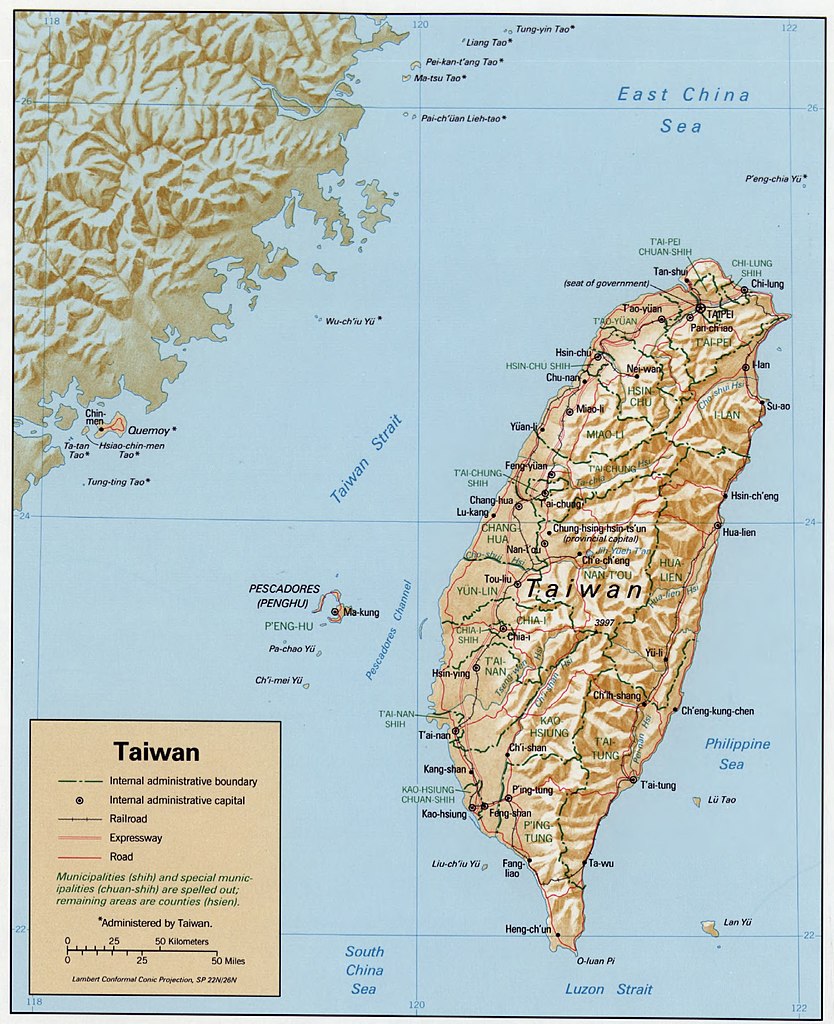
Taiwan relief map.
Library of Congress Geography & Map Division via Wikimedia Commons.
There has for some time been a good deal of flippant talk about a Communist Chinese invasion of the Republic of China on Taiwan, as if that would be a simple military undertaking. It seems to be inadequately appreciated that Taiwan has thought of little else for many years, and is, unlike Ukraine, a very prosperous and technologically sophisticated country that is armed to the teeth with the most advanced American weaponry, and has plotted out a defense in depth that is called its “porcupine strategy”.
Though it is probably accidental, “porcupine” is the word applied to Switzerland by Adolf Hitler in 1941, when, after careful analysis by the German General Staff, he concluded Swiss defenders would inflict a much larger number of casualties on a German invasion force than could possibly be justified by the occupation of the country. (It can be lamented that more recent Western strategists did not apply the same test to Afghanistan.)
Comparisons with Ukraine are inapplicable, other than the fanatical determination of the defenders. Most obviously, Taiwan is not only an island but the Formosa Straits are three to four times as wide as the English Channel from the southern British ports to the beaches of Normandy. The People’s Republic of China would have no choice but to attack amphibiously as they could not possibly imagine success with fewer than 500,000 combat soldiers and no force remotely as large could be parachuted onto Taiwan.
A strike force of 500,000 would probably have to be supplemented by a follow-up force at least as large, all conveyed in a huge armada of slow and vulnerable craft. Taiwan has been supplied with the precise ground and air-launched missiles that the Ukrainians have used to such deadly effect in the Black Sea, including the sinking of the Russian flagship, the heavy missile cruiser Moskva.
Taiwan has a front-line Air Force of about 300 of the latest fully equipped fighter and interceptor aircraft that along with shore batteries could rain a dense and prolonged fire of missiles upon any invasion fleet. Such a fleet, even in the best of weather, would plod through open water for at least ten hours. They would be sitting, or at least slowly moving, ducks throughout that journey. It brings to mind the conclusion of one of Churchill’s Demosthenean addresses in the autumn of 1940: “We are still awaiting the long-promised invasion; so are the fishes.”
June 30, 2022
What’s the military version of the saying “Get woke, go broke”?
Chris Bray on the largely self-inflicted damage suffered by the US Army during the last few years, leading to (among other things) significant recruiting shortfalls:
The American military is running a social trust test for the larger society, and the results are remarkably clear.
Remember that the Biden administration opened with an ideological assault on the armed forces, ordering a training stand-down to harangue servicemembers about politics.
[…]
While the public framing was vague, the training wasn’t: It ran in a single direction. Servicemembers reporting on their “extremism” training to members of Congress described sessions in which the military warned them against white nationalism and the dangers of far-right sentiment, but didn’t mention Antifa (or ISIS, but whatever), hammering the January 6 narrative but deflecting questions about riots and arson in the summer of 2020. In uniform, troops did “privilege walks” and unpacked their white privilege in supervised discussions. Extremism, it turns out, is only one kind of thing, on a single end of the political spectrum.
Pursuing the theme of politically purified armed forces, three retired US Army generals published an op-ed in the Washington Post calling for a political commissariat in the American military: “In addition, all military branches must undertake more intensive intelligence work at all installations. The goal should be to identify, isolate and remove potential mutineers; guard against efforts by propagandists who use misinformation to subvert the chain of command; and understand how that and other misinformation spreads across the ranks after it is introduced by propagandists.” More domestic political spying will make our institutions healthy, they explained.
[…]
The result of woke leadership, politicized military service, Covid vaccine mandates that decline to take safety concerns and religious objections into account, and wars fought for no point or objective:
[…]
And a generation shrugs.
The military is only the most obvious, most centralized example of a burgeoning withdrawal from institutions crippled by lost trust. Nationwide, undergraduate college enrollment declined by 662,000 in a single year. Meanwhile, public school enrollment in California is imploding. The LAUSD, which was closing in on 800,000 students twenty years ago, is now moving in the other direction, and closing in on 400,000.
Institutions can shit on people, and push them past their limits, and make absurd and unkind demands of them. Until they can’t.
There will be more of this.
June 29, 2022
QotD: How Cadet Che shows that West Point isn’t West Point anymore
Bad as that is, there’s much worse. Notice the passivity of it all. What were any of the parties involved trying to accomplish? If Cadet Che had wanted to get kicked out of the service (as it seems finally happened, according to the linked article), there are a million easier ways. In fact, cadets at West Point are volunteers. The Army makes a big production out of this: If you can’t hack it at the Point, you’re simply not officer material. All it takes is a letter to the commandant, and you’re out — Cadet Che could’ve been drinking beer with his fraternal socialist comrades at Big State 24 hours after turning in his resignation.
Even the kid’s form of “protest” was passive. There’d be a certain utility, I suppose, for the Revolution if the kid had written “I’m a Communist sleeper agent” on the inside of his hat — evidently our standards are so lax that we don’t do basic background checks on our potential military officers. But he didn’t write that. Instead, he wrote “Communism will win,” a passive, bloodless statement … and that’s it.
The passivity is the truly terrifying part. A West Point graduate is among the elite if anyone is — he has command of at least a platoon of heavily armed trained killers, and the radio one of them carries has the power to call in armor, air strikes, cruise missiles … and yet, not “I’m a communist,” not “¡Viva la Revolución!,” not even “Lenin lives!” Just … “communism will win.” How, comrade?
Severian, “The Man of the Hour”, Rotten Chestnuts, 2019-05-22.
June 6, 2022
“I ask, sir, what is the militia? It is the whole people except for a few public officials”
George Mason, quoted in the title of this post, had a very expansive view of the US militia. Most Americans of the day did not seem to share this view, as Chris Bray explains:
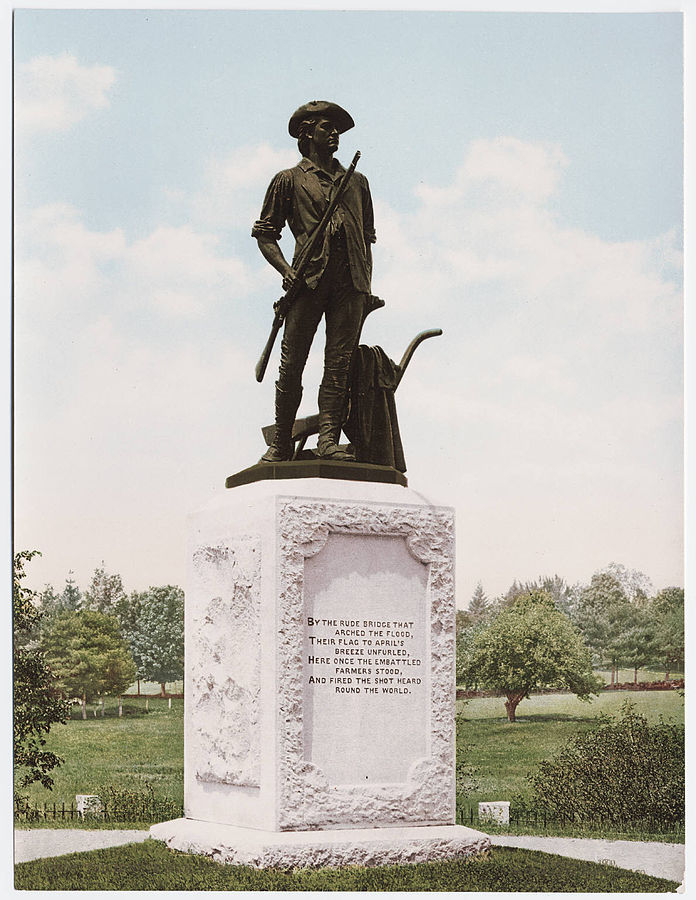
How Congress may have visualized the individual minutemen who would compose the militia of the United States after 1792.
Postcard image of French’s Concord Minuteman statue via Wikimedia Commons.
In the second Militia Act of 1792, Congress defined a uniform militia in all of the states:
That each and every free able-bodied white male citizen of the respective States, resident therein, who is or shall be of age of eighteen years, and under the age of forty-five years (except as is herein after excepted) shall severally and respectively be enrolled in the militia … That every citizen, so enrolled and notified, shall, within six months thereafter, provide himself with a good musket or firelock, a sufficient bayonet and belt, two spare flints, and a knapsack, a pouch, with a box therein, to contain not less than twenty four cartridges, suited to the bore of his musket or firelock, each cartridge to contain a proper quantity of powder and ball … and shall appear so armed, accoutred and provided, when called out to exercise or into service, except, that when called out on company days to exercise only, he may appear without a knapsack.
So, by federal law, every military-age white male in the country (except men who were exempted by the states, like clergymen) had to report to the local militia commander to be enrolled in their local company, and had to own a long list of equipment, and had to show up to train with that equipment when ordered.
They mostly didn’t. For decades, states reported their militia enrollment to the War Department, and it sometimes appeared that some states, by trying really hard, sometimes almost made it to something in the neighborhood of half participation. In 1826, the Barbour Board — named after Secretary of War James Barbour — evaluated the unmistakable failure of the federally defined uniform militia, and suggested trying again with a smaller group of select militiamen. The board’s report was universally ignored, because by 1826 the federal government, like, couldn’t even: Everyone knew the model of widely shared militia service had failed.
Historians have usually described the failure of universal white male militia service in the early republic as a top-down policy blunder in which political leaders didn’t try hard enough to make the thing work. But a marginal historian named Chris Bray, in a dissertation that generated no excitement of any kind in academia, argued that the universal white male militia obligation was doomed by something else: widespread irritation and popular resistance. The militia obligation reached into the lives of militiamen in ways they didn’t expect and wouldn’t tolerate, so they stopped showing up.
There are many different ways to tell this story, but let’s do it quickly.
QotD: Eisenhower’s D-Day speech to the troops
Soldiers, Sailors and Airmen of the Allied Expeditionary Force!
You are about to embark upon the Great Crusade, toward which we have striven these many months. The eyes of the world are upon you. The hopes and prayers of liberty-loving people everywhere march with you. In company with our brave Allies and brothers-in-arms on other Fronts, you will bring about the destruction of the German war machine, the elimination of Nazi tyranny over the oppressed peoples of Europe, and security for ourselves in a free world.
Your task will not be an easy one. Your enemy is well trained, well equipped and battle-hardened. He will fight savagely.
But this is the year 1944! Much has happened since the Nazi triumphs of 1940-1. The United Nations have inflicted upon the Germans great defeats, in open battle, man to man. Our air offensive has seriously reduced their strength in the air and their capacity to wage war on the ground. Our Home Fronts have given us an overwhelming superiority in weapons and munitions of war, and placed at our disposal great reserves of trained fighting men. The tide has turned! The free men of the world are marching together to Victory!
I have full confidence in your courage, devotion to duty and skill in battle. We will accept nothing less than full Victory!
Good Luck! And let us all beseech the blessing of Almighty God upon this great and noble undertaking.
Dwight D. Eisenhower, June 6th, 1944
I’ve highlighted an image of the signed document itself to show the various components of the ancient battle speech (following my numbering above): [https://acoupdotblog.files.wordpress.com/2020/06/breaking-down-the-speech.png?w=689]
Apart from a slight alteration of the order, it is not hard to assign this speech to the same genre as Sallust’s Catiline speech or even Thucydides’ speeches at Delium (Thuc. 4.92-95). As we’ll see, it is certainly not the case that there is no other way to structure a pre-battle exhortation (although, I should note that the standard text of the other famous pre-D-Day General’s speech, Patton’s speech to the Third Army, hits the same notes, but with more words – mostly profanity). But this is the standard structure of a battle speech in the Western literary canon, and speeches with this standard structure, or variations of it, appear frequently.
I think a reader might particularly be caught by the emphasis on a section stressing how formidable the enemy is and how great the danger is (“He will fight savagely”). That seems an odd thing to stress! But it is an important part of the structure of these speeches; it is almost never left out. When paired with the general’s own cause for hope, acknowledging the fearsome nature of the enemy and the general terror of battle is a way to inoculate the soldiers against the seizing fear of battle. The Greeks saw the fear of battle as two distinct elements, deimos (δεῖμος) – the creeping dread before a battle, and phobos (φόβος) – the sudden paralyzing panic in combat, the sharp fear that causes men to flee. If the encouragement of the speech (and the general’s presence) is meant to defuse deimos, openly discussing the fearfulness of the enemy (but couching it in terms of how it may be overcome) is meant to rob phobos of his sting. You do your soldiers no favors by concealing from them the terror they will experience regardless.
Now the bulk of Eisenhower’s D-Day order is dedicated to the fourth part, stating the ground for encouragement, generally framed by the reasons the general is confident despite how fearsome the enemy is. One form of encouragement is a recounting of the noble deeds of the soldiers themselves. One of the marks of good generalship for the Romans was if a general could go up and down the line, calling out individual soldiers and reminding them of great deeds they had performed (Caesar does this, for instance; note Catiline’s opponent, Marcus Petreius encourages his soldiers this way, calling out each one – his is an army of veterans – by name, 59.4). Alternately – especially for a fairly green army where no one has done any great deeds yet – the general might stress the great valor of their forefathers, or the honor of their city or state. The emotion being touched here is pretty clearly pride, tapping into a desire not to let one’s self, one’s community or one’s comrades down. That’s an effective rhetorical tactic; as we’ve discussed, the fear of shame is an effective combat motivator (where so many other motivations fail). Appealing to pride is a good way to arouse that fear of shame, as the two emotions are deeply connected. Alternately, a general may not a superiority in numbers, materiel, tactical position; he may discuss his battle-plan and how it is likely to bring victory. For forces defending on their own ground, the home-field advantage may be stressed.
You want to understand the “fearsome enemy” motif and the “grounds for encouragement” motif working best as a pair.
Consider it this way: you are about to take a very important test. If I, having already taken the test, tell you “oh, don’t worry, the test is easy,” that will help dispel your dread (deimos) before it, but when you sit down with the test paper and read the (quite difficult) questions, the seizing fear (phobos) hits you, and your overall performance is reduced. That seizing panic clouds your thoughts and costs you vital time; in a battle, it might cause you to flee or get you killed. But if I tell you “the test is hard, but (you’ve studied effectively/you can pick up points on XYZ section/etc.)” it not only diminishes the dread before the test, but serves to mentally prepare you for the shock of seeing the real thing. Indeed, I turn your fearful mind into my friend – when the real thing fails to live up to your worst nightmares, you’ll draw confidence from that. When the test turns out to be exactly like I said, the encouragement carries more weight because of the reliability of the warning. I am not dispelling your fear – because this is battle and everyone is afraid and no words can take that away – I am mentally preparing you for your fear. There’s an element of CBT in this: validate the emotion, suggest more helpful ways to think about it, and direct the mind towards behavioral solutions.
Finally, I think it is worth noting what is not generally here. While the speaker is likely to reflect on glorious deeds of the soldiers, or other soldiers like them, or their ancestors, there is generally not a focus on how fearsome or scary or strong they are because no one feels scary or strong when they are terrified. “You’ve done this before” is a good line (so is “our people have always beaten their people”) but “Remember, we are lions” is not. No one feels like a lion when they are receiving indirect fire and cannot fire back; no one feels like a lion when their buddy just went down next to them and there’s nothing they can do about it. Remember: the purpose of the speech isn’t to pump someone up before the charge, it is to emotionally prepare them for the moment when the emotional momentum of the charge is spent and the fear of death comes crashing in to replace it.
Likewise, while “the cause” often figures into such speeches, it does so as a subordinate element; some kind of group membership – the nation, the polis, the legion, comrades-in-arms – is often more prominent (note how Eisenhower’s speech crafts concentric circles of groups that the listener belongs to, watching and depending on the listener; “liberty-loving people everywhere” -> “the United Nations” and “our Allies” -> “our homefront” -> finally “us” and “we”). While it took until the late 1940s for group-cohesion-theory to really emerge on its own, these sorts of speeches show an awareness of what seems to be a timeless truth: the cause may get you to the battle, but only comrades will hold you in it when the dying starts (on this, note especially J. McPherson, For Cause and Comrades (1997)).
Bret Devereaux, “Collections: The Battle of Helm’s Deep, Part VII: Hanging by a Thread”, A Collection of Unmitigated Pedantry, 2020-06-12.
June 4, 2022
Falklands Conflict Aftermath | The global impact of a 74-day conflict
Imperial War Museums
Published 1 Jun 2022The Falklands Conflict of 1982 only lasted for 74 days, but it had lasting consequences which continue to be felt today. Prior to 1982, Margaret Thatcher’s government was planning major defence cuts including withdrawing the military from the South Atlantic. Instead, they spent nearly £3 billion defending British sovereignty of the Falkland Islands, and to this day maintain a garrison there. What was the effect of this short conflict for Argentina, Britain and the Falkland Islands, and what impact did it have around the world?
Correction: The video states that Port Stanley was granted city status in 2002, this should be 2022.
Thanks for watching IWM’s 5 part series on the Falklands Conflict. Please like and subscribe for more, and let us know in the comments below what you’d like to see next.
Explore and licence the archive films in this video: https://film.iwmcollections.org.uk/c/…
CREDITS
Mount Pleasant images, Crown copyright, April 2022
Margaret Thatcher images © University of Salford Press Office
Landmine clearance photos via Safe Lane Global
Sound effects via ZapSplat
June 2, 2022
For Queen and Country (2010)
emptyangel
Published 14 Jun 2011“Documentary following the Grenadier Guards as they prepare to lead the 2010 Trooping the Colour. But these men have had precious little time to prepare; as fighting soldiers, they have just spent six months on the front line in Afghanistan’s Helmand Province. This is the story of how one and a half thousand men and women join together to create one of the greatest military ceremonies on earth. It is a ceremony with just one standard: Excellence.”
May 24, 2022
History of Rome in 15 Buildings 10. Santa Sabina
toldinstone
Published 2 Oct 2018Through some combination of military disasters, barbarian migrations, social change, and dynastic bad luck, the Western Roman Empire collapsed in the fifth century. In this tenth episode of our History of Rome, focused on the church of Santa Sabina, we will consider some of the implications of this crisis.
If you enjoyed this video, you might be interested in my book Naked Statues, Fat Gladiators, and War Elephants: Frequently Asked Questions about the Ancient Greeks and Romans. You can find a preview of the book here:
https://toldinstone.com/naked-statues…
If you’re so inclined, you can follow me elsewhere on the web:
https://www.reddit.com/r/AskHistorian…
https://www.instagram.com/toldinstone/To see the story and photo essay associated with this video, go to:
https://toldinstone.com/santa-sabina/Thanks for watching!

May 18, 2022
QotD: Sparta’s excellent military reputation was not matched by actual battlefield excellence
That is one of the core things we can learn from Sparta: a reputation for military excellence can often be more valuable than the excellence itself – real or imagined. A powerful army can only fight one battle at a time, but the idea of a powerful army can intimidate any number of enemies all at once. […] when Sparta was forced to turn from intimidation to force, it ran out of force with frightening speed.
Those who have been here for a while may already be wondering, “Wait, though – this is the guy who is always telling us that winning battles isn’t as important as achieving strategic objectives and who is always on about logistics and operations! What about that?” I think that actually goes a long way to explaining how an army with a modest advantage in tactics and organization ends up without a winning record. […] I want to stress something here: the horrors of Spartan society cannot be justified on the grounds they produced superior soldiers, because they quite evidently did not. Sparta’s actual military record was, in fact, depressingly average. Only the reputation was special; the men were just men.
Bret Devereaux, “Collections: This. Isn’t. Sparta. Part VI: Spartan Battle”, A Collection of Unmitigated Pedantry, 2019-09-20.
May 16, 2022
Look at Life — The Flying Soldier (1965)
PauliosVids
Published 20 Nov 2018A look at helicopter training within the British Army.
May 9, 2022
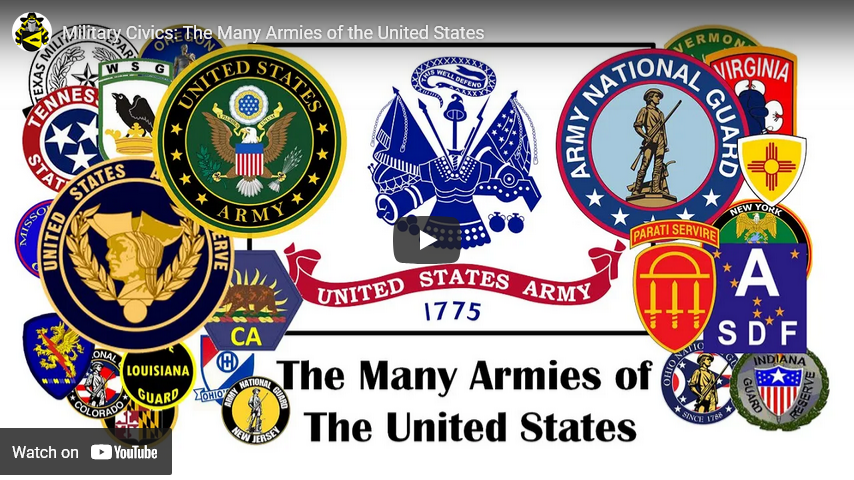
Military Civics: The Many Armies of the United States
The Chieftain
Published 19 Dec 2020There are just shy of a hundred official land component military organizations in the United States of America, each with their own unique legal structure and chain of command. In this video, I try to break down the details for you. It also seems to have taken several days for someone to observe I have the branches in the wrong sequence, Marines go before Navy.
Improved-Computer-And-Scout Car Fund:
Patreon: https://www.patreon.com/The_Chieftain
Direct Paypal https://paypal.me/thechieftainshat
Subscribestar: https://www.subscribestar.com/the_chi…
May 3, 2022
History of Rome in 15 Buildings 07. The Column of Marcus Aurelius
toldinstone
Published 27 Sep 2018Roman troops file in neat lines over raging rivers and trackless mountains. They crush barbarian forces in battle after battle, leaving fields of corpses in their wake. Villages burn, captives weep – and the lonely figure of the philosopher-emperor leads his legions to victory. So the spiraling reliefs of the Column of Marcus Aurelius, subject of the seventh episode in our History of Rome, represent the brutal conflict that turned back the first wave of the barbarian invasions.
If you enjoyed this video, you might be interested in my book Naked Statues, Fat Gladiators, and War Elephants: Frequently Asked Questions about the Ancient Greeks and Romans. You can find a preview of the book here:
https://toldinstone.com/naked-statues…
If you’re so inclined, you can follow me elsewhere on the web:
https://www.reddit.com/r/AskHistorian…
https://www.instagram.com/toldinstone/To see the story and photo essay associated with this video, go to:
https://toldinstone.com/the-column-of…Thanks for watching!

April 23, 2022
QotD: The “Modern System” of combat
The modern system assumes that any real opponent can develop enough firepower to both obliterate any fixed defense (like a line of trenches) or to make direct approaches futile. So armies have to focus on concealment and cover to avoid overwhelming firepower (you can’t hit what you can’t see!); since concealment only works until you do something detectable (like firing), you need to be able [to] move to new concealed positions rapidly. If you want to attack, you need to use your own firepower to fix the enemy and then maneuver against them, rather than punching straight up the middle (punching straight up the middle, I should note, as a tactic, was actually quite successful pre-1850 or so) or trying to simply annihilate the enemy with massed firepower (like the great barrages of WWI), because your enemy will also be using cover and concealment to limit the effectiveness of your firepower (on this, note Biddle, “Afghanistan and the Future of Warfare” Foreign Affairs 82.2 (2003); Biddle notes that even quantities of firepower that approach nuclear yields delivered via massive quantities of conventional explosives were insufficient to blast entrenched infantry out of position in WWI.)
That means that modern system forces are focused on cover and concealment in defense, but on mobility – often very rapid mobility – in attack. The doctrines that developed to operationalize variations on the modern system (Bewegungskrieg, Deep Battle, AirLand Battle, and so on) all relied (intentionally or not) on pushing the tempo of an attack beyond the ability of a defender to coordinate a defense, on the theory that this would produce tactical and even operational collapse. That theory, it turns out, works very well, but it comes with some costs (I should note here I am stretching the definition of Biddle’s “modern system” a bit and also glossing over a lot of detail in maneuver warfare doctrines).
The thing is, embracing the Modern System is hard. Actually pulling this off requires a relatively high degree of training. It also requires delegating a lot of authority down to lower officers and NCOs. You need both because individual small units need to keep moving and maneuvering even when they may not have time to get direct orders from above, and they need the freedom to respond to local conditions and utilize local terrain, often down to the squad or fireteam level. In turn, that means it is really hard to do if your common soldiers are undertrained, simply illiterate, or if (as in an authoritarian regime) you can’t trust your officers with any kind of independence. Modern authoritarian “coup-proofing” makes it practically impossible to actually implement the modern system effectively (which is part of why most tin-pot dictators produce such poor military performance; though note that not all authoritarian regimes need to coup-proof in this way).
It’s also expensive. Getting the mobility to pull this off on the operational level means mechanizing almost everything in your army, so that the infantry and artillery can keep up with the advance units and so that the logistics can keep up with them. Doing that requires a lot of command sophistication, but it also just requires a ton of hardware. Everything needs to be motorized, mechanized and portable, and then all of that needs to be tied into radio communications, GPS, and so on. And because you’re delegating authority down to smaller and smaller units, those units need all of that expensive communications, and so on. All of that hardware costs a fortune.
But – and this is the core of Biddle’s argument – when modern system armies encounter armies that have not implemented the modern system in conventional pitched battle, the result is generally a crushingly one-sided affair. That’s going to matter a lot for the analysis going forward: so far, it doesn’t seem possible to hold territory (meaning not fighting as guerillas, but actually engaging in positional warfare in the Maoist sense) with a non-modern system army against a modern system army. Non-modern system armies that try get pretty badly wrecked. The 1991 Iraq war is the traditional case study in just how badly wrecked: the coalition (using the modern system) took 292 KIA; 776 WIA compared to the Iraqi Army (without the modern system) suffering 25,000+ KIA and 75,000+ WIA. That stunning lopsidedness is going to matter a lot for the argument going forward.
Bret Devereaux, “Collections: Why Don’t We Use Chemical Weapons Anymore?”, A Collection of Unmitigated Pedantry, 2020-03-20.
April 18, 2022
Once upon a time, the American military wanted to know precisely nothing about the sex lives of servicemen
Yet another trip into a far distant past, this time in the US armed forces, long before the Current Year:
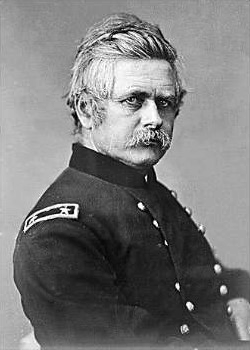
General Edward Ord (1818-1883), the designer of Fort Sam Houston, saw action in the Seminole War, the Indian Wars, and the American Civil War.
Undated photo from before 1883 via Wikimedia Commons.
For much of its history, the American military has had an aversion to hearing in any official way about the sexual conduct of servicemembers. In one of the US Army’s most notorious 19th-century legal conflicts, Captain Andrew Geddes reported from a remote post in Texas that Lieutenant Louis Orleman had been forcing his teenaged daughter to have sex; in a written statement to his commanding officer, Geddes wrote that Orleman “had been having sexual intercourse with her for the past five years, or since she was thirteen years of age, and that he had placed a loaded revolver to her head, threatening that he would blow out her brains if she did not consent to his horrible desires.” Thus informed, then-Brigadier General Edward Ord convened a court-martial — to conduct a trial of Captain Geddes, for putting such an appalling thing in writing.
As Louise Barnett concludes in her book about the trial, “acknowledging the possibility of incest by bringing charges against Orleman would have officially validated and magnified a scandal that would have haunted the Army, and the Department of Texas, for years to come. Fortunately for Orleman, this course of action was unthinkable because incest itself was unthinkable in America in 1879.”
Similarly, a rich and colorful history of the early American navy attempts to count recorded acts of sodomy at sea, and finds them buried in euphemism within official reports of sailor misconduct: “improper conduct too base to mention”, or “filthy conduct”, or “improper conduct on the berth deck”. As the historian James Valle has written, naval courts-martial finding themselves hearing testimony about shipboard sodomy tended to adjourn quickly, or to end testimony and immediately vote to acquit — after which the accused tended to vanish from a ship’s rolls, without explanation, the very next time the ship made port. “Consequently,” Valle concludes, in the early republic “not one navy man was ever convicted of homosexuality by a formal court-martial.” Herman Melville mentioned the unmentionable by writing, in White Jacket, of complaints regarding shipboard acts “from which the deck officer would turn away with loathing.” They didn’t want it to happen, but if it happened, they didn’t want to know about it.
The exceptions are, you know, interesting. In the early years of the Cold War, the sudden arrival of the threat posed by nuclear weapons and the emerging political power of the Eastern Bloc produced a moral panic in which security officials in the federal government hunted communists by looking for homosexuality; the “lavender scare” ran alongside the red scare. And so, as Elizabeth Lutes-Hillman has written, the Cold War military justice system became endlessly obsessed with sexual difference, throwing aside the usual disinclination to take notice of sexual behavior in the ranks: “Courts-martial instead became a performance of military values for the culture at large, setting the boundaries of deviant behavior for the armed forces, and so, to a certain extent, for the American body politic.” To drag that language about the performance of values down to the plane of action, Lutes-Hillman reports the example of the shore patrol in Norfolk, Virginia, which proudly reported in the late-1950s that it had caught 231 sailors in acts of sodomy by drilling holes in the wall of the local YMCA.
Putting all of that together, the American military has mostly preferred to avert its eyes from the sexual behavior of servicemembers, except in moments of transition and political crisis. If the armed forces are really interested in the question of which bed you spent the weekend in, Private Snuffy, something different is happening. For something more than 200 years, the default message from a company commander on Friday afternoon has generally been, “Handle your business, don’t interrupt my weekend with a phone call from a police department, and you’d best be in formation when the flag goes up on Monday morning.” Normal is the view that servicemembers are grown-ups whose intimate matters aren’t military business. Historically, if the armed forces officially have sex on the brain, something has been disrupted; anxiety and disorder outside the military have seeped into the ranks.
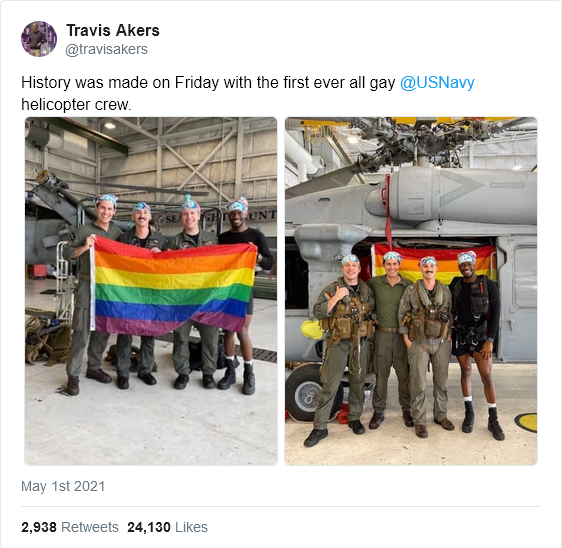
Now. To go back to an example from last year, this:
… suggests a number of obvious questions, starting with how did the United States Navy know this? Is this liberation, or is it intrusion? (BREAKING: The Department of the Navy proudly announces which helicopter pilots are into dudes, and stand by for detailed information on which surface warfare officers are bi-curious. We’re still asking around on that one, so.) It’s like the shore patrol is drilling holes in the wall at the YMCA again, but this time it’s so they can bus in a cheering section. The chain of command is right outside your door, you guys, and we hear what you’re doing in there, and OH MY GOD WE’RE SO PROUD OF YOU DO YOU NEED SOME CONDOMS? The Department of Defense isn’t a regular mom, it’s a cool mom.