Historia Civilis
Published 12 Jun 2015Patreon | http://historiacivilis.com/patreon
Donate | http://historiacivilis.com/donate
Merch | http://historiacivilis.com/merch
Twitter | http://historiacivilis.com/twitter
Website | http://historiacivilis.comMusic is Beethoven’s “Sonata No. 11 in B Flat Major Op. 22” – I. Allegro con brio. Performed by Daniel Veesey
December 3, 2021
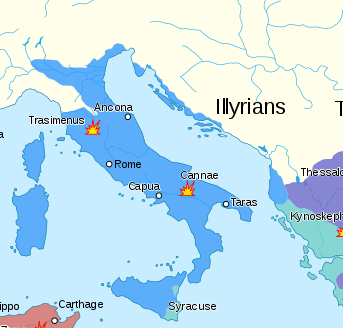
The Battle of the Trebia River (218 B.C.E.)
November 26, 2021
QotD: English working class culture
… in all societies the common people must live to some extent against the existing order. The genuinely popular culture of England is something that goes on beneath the surface, unofficially and more or less frowned on by the authorities. One thing one notices if one looks directly at the common people, especially in the big towns, is that they are not puritanical. They are inveterate gamblers, drink as much beer as their wages will permit, are devoted to bawdy jokes, and use probably the foulest language in the world. They have to satisfy these tastes in the face of astonishing, hypocritical laws (licensing laws, lottery acts, etc., etc.) which are designed to interfere with everybody but in practice allow everything to happen. Also, the common people are without definite religious belief, and have been so for centuries. The Anglican Church never had a real hold on them, it was simply a preserve of the landed gentry, and the Nonconformist sects only influenced minorities. And yet they have retained a deep tinge of Christian feeling, while almost forgetting the name of Christ. The power-worship which is the new religion of Europe, and which has infected the English intelligentsia, has never touched the common people. They have never caught up with power politics. The “realism” which is preached in Japanese and Italian newspapers would horrify them. One can learn a good deal about the spirit of England from the comic coloured postcards that you see in the windows of cheap stationers’ shops. These things are a sort of diary upon which the English people have unconsciously recorded themselves. Their old-fashioned outlook, their graded snobberies, their mixture of bawdiness and hypocrisy, their extreme gentleness, their deeply moral attitude to life, are all mirrored there.
The gentleness of the English civilization is perhaps its most marked characteristic. You notice it the instant you set foot on English soil. It is a land where the bus conductors are good-tempered and the policemen carry no revolvers. In no country inhabited by white men is it easier to shove people off the pavement. And with this goes something that is always written off by European observers as “decadence” or hypocrisy, the English hatred of war and militarism. It is rooted deep in history, and it is strong in the lower-middle class as well as the working class. Successive wars have shaken it but not destroyed it. Well within living memory it was common for “the redcoats” to be booed at in the streets and for the landlords of respectable public-houses to refuse to allow soldiers on the premises. In peace-time, even when there are two million unemployed, it is difficult to fill the ranks of the tiny standing army, which is officered by the country gentry and a specialized stratum of the middle class, and manned by farm labourers and slum proletarians. The mass of the people are without military knowledge or tradition, and their attitude towards war is invariably defensive. No politician could rise to power by promising them conquests or military “glory”, no Hymn of Hate has ever made any appeal to them. In the last war the songs which the soldiers made up and sang of their own accord were not vengeful but humorous and mock-defeatist. The only enemy they ever named was the sergeant-major.
George Orwell, “The Lion And The Unicorn: Socialism and the English Genius”, 1941-02-19.
November 11, 2021
In memoriam
A simple recognition of some of our family members who served in the First and Second World Wars:
The Great War
Private William Penman, Scots Guards, died 16 May, 1915 at Le Touret, age 25
(Elizabeth’s great uncle)- Private Archibald Turner Mulholland, Argyll & Sutherland Highlanders, mortally wounded 25 September, 1915 at Loos, age 27
(Elizabeth’s great uncle) - Private David Buller, Highland Light Infantry, died 21 October, 1915 at Loos, age 35
(Elizabeth’s great grandfather) - Private Harold Edgar Brand, East Yorkshire Regiment. died 4 June, 1917 at Tournai.
(My first cousin, three times removed) - Private Walter Porteous, Durham Light Infantry, died 4 October, 1917 at Passchendaele, age 18
(my great uncle) - Corporal John Mulholland, Argyll & Sutherland Highlanders, wounded 2 September, 1914 (shortly before the First Battle of the Aisne), wounded again 29 June, 1918, lived through the war.
(Elizabeth’s great uncle)
The Second World War
- Flying Officer Richard Porteous, RAF, survived the defeat in Malaya and lived through the war
(my great uncle) - Able Seaman John Penman, RN, served in the Defensively Equipped Merchant fleet on the Murmansk Run (and other convoy routes), lived through the war
(Elizabeth’s father) - Private Archie Black (commissioned after the war and retired as a Major), Gordon Highlanders, captured at Singapore (aged 15) and survived a Japanese POW camp
(Elizabeth’s uncle) - Elizabeth Buller, “Lumberjill” in the Women’s Land Army in Scotland through the war.
(Elizabeth’s mother) - Trooper Leslie Taplan Russon, 3rd Royal Tank Regiment, died at Tobruk, 19 December, 1942 (aged 23).
Leslie was my father’s first cousin, once removed (and therefore my first cousin, twice removed).
For the curious, the Commonwealth War Graves Commission the Royal British Legion, and the Library and Archives Canada WW1 and WW2 records site provide search engines you can use to look up your family name. The RBL’s Every One Remembered site shows you everyone who died in the Great War in British or Empire service (Canadians, Australians, New Zealanders, South Africans and other Imperial countries). The CWGC site also includes those who died in the Second World War. Library and Archives Canada allows searches of the Canadian Expeditionary Force and the Royal Newfoundland Regiment for all who served during WW1, and including those who volunteered for the CEF but were not accepted.
In Flanders fields the poppies blow
Between the crosses row on row,
That mark our place; and in the sky
The larks, still bravely singing, fly
Scarce heard amid the guns below.We are the Dead. Short days ago
We lived, felt dawn, saw sunset glow,
Loved and were loved, and now we lie
In Flanders fields.Take up our quarrel with the foe:
To you from failing hands we throw
The torch; be yours to hold it high.
If ye break faith with us who die
We shall not sleep, though poppies grow
In Flanders fields.Lieutenant Colonel John McCrae, MD Canadian Army Medical Corps (1872-1918)
H.G. Wells – The Outline of History – The Great War
Thersites the Historian
Published 5 Mar 2021In this video, we look at H.G. Wells’ coverage of World War I, from the war’s outbreak to the Armistice. Here, we see Wells at his most passionate and he makes a few controversial claims as well as sharing a couple of his personal experiences as a Londoner dealing with German air raids and celebrating the Armistice.
Patreon link: https://www.patreon.com/thersites
PayPal link: paypal.me/thersites
Discord: https://discord.gg/QCaXXFr
Brave Browser: https://brave.com/noa557
Twitter link: https://twitter.com/ThersitesAthens
Minds.com link: https://www.minds.com/ThersitestheHis…
Steemit/dtube link: https://steemit.com/@thersites/feed
BitChute: https://www.bitchute.com/channel/jbyg…
QotD: War and human capital
… perhaps there is a parallel between the state of human capital in the American elite [today] and the German elite during the war. The German soldiers were the best in the world, but the people further up the line were not the best tacticians. At the upper reaches, the strategists were terrible in all sorts of ways, starting with Hitler, who was laughably inept at running a war. Winning was never an option, but the Germans could have avoided total obliteration if they had better leaders.
The blame for this is always put on Hitler and that’s a good place to start, but the Germans had a brain power problem throughout the planning layer. This is obvious in how they went about making tanks. Instead of going for a tank that was cheap and easy to produce by a civilian workforce, they tried to build tanks that were complex and required specialists to produce. The effects of allied bombing raids were amplified by this strategic blunder in production planning. This is a very basic error in planning and execution.
One possible cause of this was that the middle-aged men who would have been sorting these production and design problems had died during the Great War. The German army tended to “use up” their units, rather than cycle them in and out of lines. That meant that a lot of experience with supply and logistics was lost in the trenches. The British and the Americans rotated units in and out of the lines, thus they came out of the war with a vast number of people with experience in the nuts and bolts of war fighting.
The current ruling class needs the Germans to be seen as the ultimate in super villains, but the truth is the Germans were dumb about a lot of important things. The Russians came up with sloped armor, for example, and the Germans never bothered to steal the idea, even after Kursk. The Germans got their hands on the Churchill tank, but never bothered to learn anything from it. They never learned from the Americans how to use communications to coordinate their artillery and their armor.
In many respects, the story of the tank in the war is a great proxy for the story of human capital and cultural intelligence. The Germans had the best trained military on earth, but they lacked human capital in the strategy and tactics layer. Either the culture was unable to produce it or there was simply not enough smart people to create the necessary smart fraction. That was ultimately why Germany was wiped from the map. It’s probably why no new culture has arisen from that place on the map either.
The Z Man, “Tanking It”, The Z Blog, 2019-03-01.
November 10, 2021
QotD: Pershing and Prohibition
Despite its profound effects on American society – and the modern romanticization of the era as one of speakeasies, flappers, and pinstriped gangsters – Prohibition had surprisingly little resonance within the U.S. Army.
There are two primary reasons for this. First, the Army had been living under various forms of prohibition long before the 18th Amendment’s ratification. In 1832, during the Black Hawk War, Illinois militiamen consumed their entire two-week issue of whiskey by the campaign’s second day. When Black Hawk attempted to surrender that day, the drunken militia instead attacked, and in the ensuing “Battle of Stillman’s Run” Black Hawk and his roughly fifty warriors routed the 275 militiamen. Consequently, Andrew Jackson’s Secretary of War Lewis Cass eliminated the whiskey ration.
As the temperance movement gained increasing influence, in 1890, Congress banned “intoxicating beverages” to enlisted men at military posts located in states, territories, or counties with local prohibition laws. The Army considered beer and light wines to be non-intoxicating, however, and allowed their sale and consumption at the post commander’s discretion. Congress subsequently expanded Army prohibition with the so-called Canteen Act of 1901, which forbade “the sale of, or dealing in, beer, wine or any intoxicating liquors by any person in any post exchange or canteen or army transport or upon any premises used for military purposes by the United States.” When America entered World War I, Congress extended alcoholic prohibition beyond the Army’s post boundaries. The Selective Service Act of May 1917 prohibited intoxicating beverages “in or near military camps” – which the War Department implemented by establishing a prohibition zone five miles wide around each post – and made it illegal to sell to any serviceman in uniform. (The Army once again skirted the bill’s intent by permitting beverages with less than 1.4 percent alcohol-by-volume). Thus, the 18th Amendment had little legal impact on the US. Army.
More importantly, perhaps, was the fact that like millions of their civilian counterparts, most officers and enlisted men simply chose to ignore the Volstead Act’s enforcement of Prohibition. When General Pershing became Army Chief of Staff, each day after leaving the War Department he enjoyed staying up late with his aides, drinking, talking about his youth, and joking. Once when he and George Marshall were traveling on a train together and enjoying a bottle of Scotch, Pershing suggested they offer some to Senator George Moses in the next car. Pouring a little into a glass, they proceeded to where Pershing thought Moses was sleeping in a Pullman. “Senator Moses,” whispered Pershing as he scratched a berth’s closed green curtain. When there was no answer, Pershing raised the curtain, only to discover not Senator Moses, but an angry woman who cried: “What do you want?” Pershing dropped the curtain and bolted down the aisle like a frightened schoolboy, pushing Marshall ahead of him and spilling the scotch. “I had a hard time keeping out of his way,” Marshall said, “because he was running up my back. But we got to the stateroom and got the door shut. Then he just sat down and laughed until he cried.” Finally, wiping his eyes, Pershing noticed a little Scotch remained in the glass and mischievously suggested Marshall return and try it again. Not on your life, Marshall replied. “Get another aide.”
Benjamin Runkle, “‘What a Magnificent Body of Men Never to Take Another Drink’: The U.S. Army and Prohibition”, Real Clear Defense, 2019-01-16.
November 8, 2021
Look at Life — Rendered Safe (1962)
November 2, 2021
Sandhurst 1975 – The Royal Military Academy
British Army Documentaries
Published 21 Feb 2021Filmed in 1975, this documentary is set at Sandhurst, the officer training academy. It follows a group of young men preparing for a life of leadership in the Army. These “managers of violence” will be expected to perform to the very highest of traditions of the British Army and be prepared to apply their professionalism on British soil should the need arise.
© 1975
This production is for viewing purposes only and should not be reproduced without prior consent.
This film is part of a comprehensive collection of contemporary Military Training programmes and supporting documentation including scripts, storyboards and cue sheets.
All material is stored and archived. World War II and post-war material along with all original film material are held by the Imperial War Museum Film and Video Archive.
October 28, 2021
There are bad generals, there are evil generals, and (in a class of his own) there’s Luigi Cadorna
Earlier this month, Bret Devereaux took the time to give WW1 Italian general Luigi Cadorna the attention he richly deserved as the worst general of that war (which also included the strong Austrian contender Conrad von Hötzendorf), and certainly must be considered to be in the running as the worst general in military history:

Luigi Cadorna, Marshal of Italy, Chief of Staff of the Italian Army, 1914-1917.
Photo via Wikimedia Commons.
This week we’re going to break from our normal fare and take a bit of a lark. I thought I ought to substantiate the nearly endless shade towards Luigi Cadorna, Italian Army Chief of Staff from 1914-1917 (though I realize after writing this that what I actually ought to have done is just told the same bad joke about Cadorna 11 times in a row and let that stand as the explanation). I said that Cadorna was my pick for the worst general of World War I. Now, as I noted at the time, there is some stiff competition for that position. While I argued that the tactical problem of trench warfare probably wasn’t solvable by any general, that doesn’t mean that some generals didn’t perform better than others under the difficult conditions imposed by the stalemate.
Now I should be clear here what I mean by “worst general”. What I am assessing here is the fellow who was worst at generaling, rather than the worst human being who happened to be a general. That latter prize probably goes to İsmail Enver Pasha, Ottoman Minister of War from 1914 to 1918, a vain, arrogant strutting sort of man who not only utterly botched the only battle in which he commanded directly (Sarikamish, Dec. 1914 – Jan 1915) but who also then blamed his defeat (falsely) on the Armenians and subsequently instigated and played a key role in the Armenian genocide. He then sold his services to the Soviets, before betraying them to side with the Basmachi movement, which didn’t go particularly well either.
We are also here not investigating to see which WWI leader made the single worst decision. As I’ve noted before, the worst decision in the First World War was having a First World War, though the responsibility for that is diffused across multiple different leading figures.
Luigi Cadorna didn’t, to my knowledge, perpetrate any genocides, though as we’ll see, he was cruel and unreasonable. Nor did he bring Italy to war. The son of Count Raffaele Cadorna (who had led the army which captured Rome, completing the unification of Italy), Cadorna’s political connections, particularly to the king Victor Emmanuel III, made him functionally impossible to remove from command after he was made chief of staff in 1914. For his part, Cadorna seems to have spent about as much time fighting a political battle in Rome as he did fighting the actual war on the Isonzo; Cadorna insisted at the outset that he would only accept the job if he was given unfettered, complete authority. As we’ll see, that complete authority is not going to come with complete responsibility for outcomes. But in any event, this is a good illustration of Cadorna’s personality: bitter, arrogant and callous, but with a cruel authoritarian streak and a profound conviction that all of his mistakes were someone else’s fault.
[…] Cadorna has a small, fragile and relatively weak army to work with. Conscription would eventually put millions more Italians in the ranks (and slowly make the equipment situation less of a disaster), but of course everyone else was doing that too and even then it was clear from a simple exercise in demography that Italy’s manpower reserves were likely to be brittle. An equally simple exercise in economic statistics would suggest that while Italy’s army might be made minimally sufficient in equipment (the Italians eventually end up deploying well over a thousand artillery pieces on the Isonzo front, though the quality of their artillery never matched what was available on either side of the Western Front), it would never be excellent. Strategically then, Cadorna had the one army; it was small and weak and it was also effectively all Italy had. Moreover Italy, only recently unified (recall, Cadorna’s father had been directly involved!) was still politically fragile itself and might not take well for horrible casualties. So Cadorna’s army had to be husbanded carefully, spent only in great need and for great benefit.
Instead of doing literally any of that, Cadorna opted to pursue the highest operational tempo of any front of the war. I can’t stress this enough: between May 1915 and October 1917, the French launched (or supported) four offensives (Second Artois, Third Artois/Second Champagne/Loos, the Somme and the Nivelle Offensive; I’m not counting Second Arras as that was a Commonwealth operation in which the French had little part), plus being on the defensive at Verdun. Of course there were lots of minor operations too, but that’s five major operations on the Western Front, where the French were almost totally focused. In contrast, in that same time frame, Cadorna – who again, has the smallest, weakest major army – launches eleven (11)(eleven)(XI)(1011)(I𐤗)(ΙΑ)(eleven!?!) offensives on the Isonzo River.
[…]
Because Cadorna thought that discipline and morale were the key components of victory (and also because he seems to have just generally been a cruel, uncaring and authoritarian person) he attempted to enforce both in his army through coercion and cruelty. Cadorna executed around 750 men for cowardice (to my knowledge the highest rate in any army of the war), presided over a military justice regime that convicted something like 3.6% of his army of one disciplinary charge or the other. He dismissed an incredible total of 217 officers during his tenure, frequently because he felt they were not committed enough or aggressive enough and when his army began to fall apart at Caporetto, he ordered the summary execution of officers whose units retreated. It turns out that actually adopting a “the beatings will continue until morale improves” command style does not actually improve morale.
October 18, 2021
Strategikon – Army Manual of the Eastern Roman Empire
Kings and Generals
Published 30 Mar 2021The Kings and Generals animated historical documentary series on the evolution of the Roman Army continues with the second episode of the series on the Army of the Eastern Roman Empire – the Byzantine Empire. In this episode, we’ll focus on Strategikon of Maurice – the army manual that defined the structure, training and tactics of the Byzantine army.
Support us on Patreon: http://www.patreon.com/KingsandGenerals or Paypal: http://paypal.me/kingsandgeneral
We are grateful to our patrons and sponsors, who made this video possible: https://docs.google.com/document/d/1o…
The video was made by Arb Paninken http://bit.ly/2Ow3oC8, while the script was developed by Matt Hollis. This video was narrated by Officially Devin (https://www.youtube.com/user/OfficiallyDevin)
✔ Merch store ► https://teespring.com/stores/kingsand…
✔ Patreon ► https://www.patreon.com/KingsandGenerals
✔ Podcast ► Google Play: http://bit.ly/2QDF7y0 iTunes: https://apple.co/2QTuMNG
✔ PayPal ► http://paypal.me/kingsandgenerals
✔ Twitter ► https://twitter.com/KingsGenerals
✔ Instagram ► http://www.instagram.com/Kings_GeneralsProduction Music courtesy of Epidemic Sound: http://www.epidemicsound.com
#Documentary #Byzantines #Romans
Look at Life — The Rocket Age Lancers (1961)
October 6, 2021
QotD: British military incompetence
There is much in England that this explains. It explains the decay of country life, due to the keeping-up of a sham feudalism which drives the more spirited workers off the land. It explains the immobility of the public schools, which have barely altered since the ‘eighties of the last century. It explains the military incompetence which has again and again startled the world. Since the ‘fifties every war in which England has engaged has started off with a series of disasters, after which the situation has been saved by people comparatively low in the social scale. The higher commanders, drawn from the aristocracy, could never prepare for modern war, because in order to do so they would have had to admit to themselves that the world was changing. They have always clung to obsolete methods and weapons, because they inevitably saw each war as a repetition of the last. Before the Boer War they prepared for the Zulu War, before the 1914 for the Boer War, and before the present war for 1914. Even at this moment hundreds of thousands of men in England are being trained with the bayonet, a weapon entirely useless except for opening tins. It is worth noticing that the navy and, latterly, the Air Force, have always been more efficient than the regular army. But the navy is only partially, and the Air Force hardly at all, within the ruling-class orbit.
It must be admitted that so long as things were peaceful the methods of the British ruling class served them well enough. Their own people manifestly tolerated them. However unjustly England might be organized, it was at any rate not torn by class warfare or haunted by secret police. The Empire was peaceful as no area of comparable size has ever been. Throughout its vast extent, nearly a quarter of the earth, there were fewer armed men than would be found necessary by a minor Balkan state. As people to live under, and looking at them merely from a liberal, negative standpoint, the British ruling class had their points. They were preferable to the truly modern men, the Nazis and Fascists. But it had long been obvious that they would be helpless against any serious attack from the outside.
George Orwell, “The Lion And The Unicorn: Socialism and the English Genius”, 1941-02-19.
September 20, 2021
QotD: English jingoism
In England all the boasting and flag-wagging, the “Rule Britannia” stuff, is done by small minorities. The patriotism of the common people is not vocal or even conscious. They do not retain among their historical memories the name of a single military victory. English literature, like other literatures, is full of battle-poems, but it is worth noticing that the ones that have won for themselves a kind of popularity are always a tale of disasters and retreats. There is no popular poem about Trafalgar or Waterloo, for instance. Sir John Moore’s army at Corunna, fighting a desperate rear-guard action before escaping overseas (just like Dunkirk!) has more appeal than a brilliant victory. The most stirring battle-poem in English is about a brigade of cavalry which charged in the wrong direction. And of the last war, the four names which have really engraved themselves on the popular memory are Mons, Ypres, Gallipoli and Passchendaele, every time a disaster. The names of the great battles that finally broke the German armies are simply unknown to the general public.
The reason why the English anti-militarism disgusts foreign observers is that it ignores the existence of the British Empire. It looks like sheer hypocrisy. After all, the English have absorbed a quarter of the earth and held on to it by means of a huge navy. How dare they then turn round and say that war is wicked?
It is quite true that the English are hypocritical about their Empire. In the working class this hypocrisy takes the form of not knowing that the Empire exists. But their dislike of standing armies is a perfectly sound instinct. A navy employs comparatively few people, and it is an external weapon which cannot affect home politics directly. Military dictatorships exist everywhere, but there is no such thing as a naval dictatorship. What English people of nearly all classes loathe from the bottom of their hearts is the swaggering officer type, the jingle of spurs and the crash of boots. Decades before Hitler was ever heard of, the word “Prussian” had much the same significance in England as “Nazi” has to-day. So deep does this feeling go that for a hundred years past the officers of the British Army, in peace-time, have always worn civilian clothes when off duty.
George Orwell, “The Lion And The Unicorn: Socialism and the English Genius”, 1941-02-19.
August 23, 2021
Canadian Army Ranks 1939-1945
HandGrenadeDivision
Published 6 Sep 2019A brief video describing the ranks used by the Canadian Army in the Second World War, with an equally brief introduction to the General Staff system.
Further reading and resources regarding the Canadian Army of the Second World War:
Service Publications
canadiansoldiers.com
http://www.canadiansoldiers.com
Department of National Defence Directorate of History and Heritage
August 18, 2021
The Conscripts and Conscientious Objectors of World War Two – WW2 Special
World War Two
Published 17 Aug 2021In keeping with their ideals of personal liberty, Britain and the United States have historically maintained relatively small armies made up of volunteer soldiers. When Germany and Japan mobilize huge numbers of well-trained conscripts and sweep across Europe and Asia, the democratic allies devote huge resources to closing the gap, while respecting the rights of those who object to fighting on moral grounds.
(more…)