
Herodotus’ work was well known, even in antiquity, and he set the tone for all subsequent retellings of the Persian wars (despite the frequent complaints by later ancient authors that Herodotus’ reliability was – let’s say, complicated. I don’t want to give the wrong impression: Herodotus is a valuable source, just one that – like all sources – has his own agenda at play). The Spartan reputation thus seems to be the product of half a century spent fighting far, far weaker opponents, combined with one very skilled propagandist with an agenda.
That reputation was already deeply held even by the early stages of the Peloponnesian War, such that Thucydides notes that “Nothing that happened in the war so shocked the Greeks so much as” the surrender of 120 Spartiates at Pylos/Sphacteria, instead of dying with their weapons in their hands (Thuc. 4.40.1). The Athenians had, in the event, managed to trap a force of Spartans – Spartiates and other Laconians – on an island and harassed them with arrow fire from a distance, never closing with them, until the Spartans surrendered. This is, I must stress, in the context of a war that obliterated entire poleis, shredded the diplomatic fabric of Greece and was by far the largest war between Greeks that any of them knew of. But this, the shattering – if just for a moment – of the Spartan reputation, that was what shocked people. The image of Sparta – whatever the reality – was that deeply set.
Thucydides, amusingly, relates that some Greeks were so shocked that they couldn’t believe it, and one ally of Athens inquired to the Spartiates – then held as captives in Athens – if perhaps what had happened was that all of the brave men (you know, the real Spartiates) had been felled by the arrows, to which the Spartans responded, “an arrow would be worth a great deal if it could pick out noble and good men from the rest, in allusion to the fact that the killed were those whom the stones and the arrows happened to hit” (Thuc. 4.40.2).
Bret Devereaux, “Collections: This. Isn’t. Sparta. Part VI: Spartan Battle”, A Collection of Unmitigated Pedantry, 2019-09-20.
October 23, 2022
QotD: Sparta’s military reputation in the Peloponnesian War
October 22, 2022
QotD: OCS in the era of the snowflake
But — and this is the point — college these days is the END of what you might call the “special snowflake” pipeline.
They can put medicos through that “just learn where to stick the insignia” course because medicos aren’t line officers, are never expected to be line officers, and will probably never come within 500 miles of the sound of gunfire. Kids recruited out of college, on the other hand, are going into line units. What kind of Special Snowflake is going to put up with even a tiny fraction of the chickenshit even the loosest army in the world is going to put them through?
And it doesn’t help sticking them with the service troops, because in any army I’ve ever heard of, the chickenshit is actually much worse in the rear with the gear. All of which is the deepest possible affront to a Snowflake’s amour propre, which is why xzhey will never sign up …
… or, worse, consider the kind of Snowflake that would sign up. I think “a Dunning-Krugerrand who is also a diagnosable sadist” would probably cover it.
Think of what that must do to morale … and from that, to effectiveness in general.
Severian, “Alt Thread: Officer Psychology”, Founding Questions, 2022-07-12.
October 9, 2022
SIG M5 Spear Deep Dive: Is This a Good US Army Rifle?
Forgotten Weapons
Published 3 Jun 2022The NGSW (Next Generation Squad Weapon) program began in 2017 to find a replacement for the M4, M249, and the 5.56mm cartridge. It came to a conclusion in April 2022 with the formula acceptance of the SIG M5 rifle, M250 machine gun, Vortex M157 optic, and the 6.8x51mm cartridge. SIG released a handful of civilian semiauto M5 / Spear rifles and thanks to Illumin Arms I have one to examine.
The rifle (Spear is its commercial designation; M5 is the military one) is an evolution of the SIG MCX, which is in turn an evolution of the AR-15 and AR-18 systems. The MCX moved the recoil spring assembly into the top of the upper receiver, allowing the use of a folding stock. It also had very easily swapped barrels and a suite of fully ambidextrous controls. Scaled up to AR-10 size and chambered for 6.8x51mm, the MCX became the Spear.
That new cartridge (commercial designated .277 SIG Fury) is designed to produce high muzzle velocities out of a short barrel (the M5 has a 13 inch barrel). It does this by boosting the operating pressure up to an eye-watering 80,000psi, which required the development of hybrid case using a stainless steel case head. This allows the case to handle those pressures safely. The currently available commercial ammunition is loaded to lower pressure, however. Much of the military and civilian use of this rifle will be done with downloaded training ammunition, which uses a conventional all-brass case.
Both the M5 and M250 were ordered by the Army with suppressors on every weapon, a significant advancement in Army policy. The can is another SIG development, entirely made using additive manufacturing and designed specifically to prevent gas blowback into shooters’ faces (which is succeeds at wonderfully).
Overall, I believe the M5 / Spear is an excellent rifle — soft shooting, reliable, and very accurate. However, that does not mean it is the right rifle for the Army. Will its ability to defeat modern body armor prove worth the tradeoff in extra soldier combat load weight and reduced ammunition capacity? Only time will tell…
(more…)
QotD: The Paras in peacetime … the “Millwall of the British Army”
The Regimental history is littered with gallantry awards and tales of valour that are both inspirational and humbling to read. There is no doubt that within their world, the airborne infantryman can, when deployed on operations, be a ferocious foe, who few would wish to tangle with. The problem is that this aggression and drive is not something that is commonly needed outside of military operations, and the chances of these occurring are in ever shorter supply.
After a period when there were opportunities for deployments and kinetic action in Afghanistan and Iraq, the call for missions for Paratroopers is, currently, slim. Designed as a force intended to be ready to go when called, their leadership have to balance off maintaining an aggressive “ready for anything” mentality, coupled with trying to keep the behaviour of their people under manageable control.
Sir Humphrey, “Values, Standards, and Leadership in the Internet Age”, Thin Pinstriped Line, 2022-06-18.
October 7, 2022
QotD: King Agis IV’s and King Cleomenes III’s failed reform attempts in Sparta after 371BC
Thus the Spartan state might grant marginal, borderland to small groups of freed helots – the neodamodes and the Brasidioi – but actually bringing up the military strength of the polis in full could only be achieved by de-consolidating the kleroi – the best, most productive land (because you can only support so many hoplites on disputed, marginal land). This is one thing, of course, that the wealthy Spartiates who dominated the state were unwilling to do. The mothakes and hypomeiones, pushed to the edges of Spartan society, might be brought in to make up the difference, but unless they were made equals – homoioi – this was a recipe for instability, as seen with Lysander and Cinadon. This is the other thing the Spartiates were unwilling to do – if I had my guess, because for the poor Spartiates who still clung to their status (and might still use the Apella to block reform, even if they couldn’t use it to propose reform), that status differential was just about the only thing they had (apart from all of the slave labor they enjoyed the benefits of, of course).
(A different polis might have tried to make up this difference by either hiring large numbers of mercenaries, or arming its own people at state expense, as a way of using the fortunes of the rich to fund military activity without expanding the citizenry. But, as Aristotle notes – (we’ll come back to this when we talk about Spartan war performance) the public finances of Sparta were pitiful even by ancient standards – for precisely the same reason that deconsolidating the kleroi was politically impossible: the state was dominated by the wealthy (Arist. Pol. 2.1271b). With no real source of wealth outside of landholding and all of the good land held by the Spartiates, it seems that Sparta – despite being by far the largest polis in Greece and holding some of the best farmland outside of Thessaly, was never able to raise significant revenue.)
Instead, the clique of wealthy Spartiates arrayed about the kings did nothing, decade on decade, as the Spartiate citizen body – and the military power of Sparta – slowly shrank, until at least, in 371 it broke for good. But what is perhaps most illustrative of the dysfunction in the Spartan political system is the sad epilogue of efforts in the second half of the third century (in the 240s and 220s) to finally reform the system by two Spartan kings.
The first effort was by Agis IV (r. 245-241; Plut. Agis). By the time Agis came to power, there were only a few hundred Spartiate households. Agis tried to reform through the system by redividing all of the kleruchal land into 4,500 plots for Spartiates and another 15,000 for the Perioikoi (who might also fight as Hoplites). Agis gets the Apella to support his motion – his offer to put his own royal estates into the redistribution first earns him a lot of respect – but the Gerousia, by a narrow margin, rejects it. Agis is eventually politically isolated and finally executed by the Ephors (along with his mother and grandmother, who had backed his idea) – the first Spartan king ever executed (I have left out some of the twists and turns here. If you want to know Plutarch has you covered).
Cleomenes III (r. 235-222) recognizes what Agis seemingly did not – reform to the Spartan system could not happen within the system. Instead, he stages a coup, having four of the five Ephors murdered, exiled eighty citizens – one assumes these are wealthy and prominent opponents – and possibly had the other king assassinated (Plut. Cleom. 8, 10.1; Plb. 5.37). Cleomenes then redistributed the kleroi into 4,000 plots and made his own brother his co-king (Plut. Cleom. 11), essentially making him a tyrant in the typical Greek mold. He then set about continuing his war with the neighboring Achaean League in an effort to re-establish Spartan hegemony in the Peloponnese and presumably retake Messenia (which by that point was free and part of the Achaean league).
It was far, far too late. Had this been done in the 380s or even the 350s, Sparta might well have resumed its position of prominence. But this was the 220s – Macedon had dominated Greek affairs now for a century and the Antigonids – the dynasty then ruling in Macedon – had no intention of humoring a resurgent Sparta. In 224, a Macedonian army marched into the Peloponnese in support of Sparta’s enemies and in 222 it smashed the Spartan army flat at Sellasia, almost entirely wiping out the Spartiate citizen body – new and old – in the process (Plutarch claims only 200 adult Spartiate males survived, Plut. Cleom. 28.5). The victorious Macedonian – Antigonis III Doson – for his part re-crippled Sparta: he occupied it, restored its constitution to what it had been before Cleomenes and then left, presumably content that it would not threaten him again (Plut. Cleom. 30.1). The time when a state with a citizen body in the few thousands could be a major player had been over for a century and the great empires of the third century were in no mood to humor self-important poleis who hadn’t gotten the message.
Bret Devereaux, “Collections: This. Isn’t. Sparta. Part V: Spartan Government”, A Collection of Unmitigated Pedantry, 2019-08-29.
September 30, 2022
History Re-Summarized: The Roman Empire
Overly Sarcastic Productions
Published 16 Sept 2022
The plot twist of Rome is that it was always a mess, now sit back and enjoy the marble-covered mayhem.This video is a Remastered, Definitive Edition of three previous videos from this channel — “History Summarized: The Roman Empire”, “History Hijinks: Rome’s Crisis of the Third Century”, and “History Summarized: The Fall of Rome”. This video combines them all into one narrative, fully upgrading all of the visuals and audio, with a substantially re-written script in parts 1 and 3.
(more…)
September 29, 2022
Considering weird possible scenarios in Ukraine
In The Line, Matt Gurney walks through some until recently unimaginable outcomes of the Russian invasion of Ukraine:
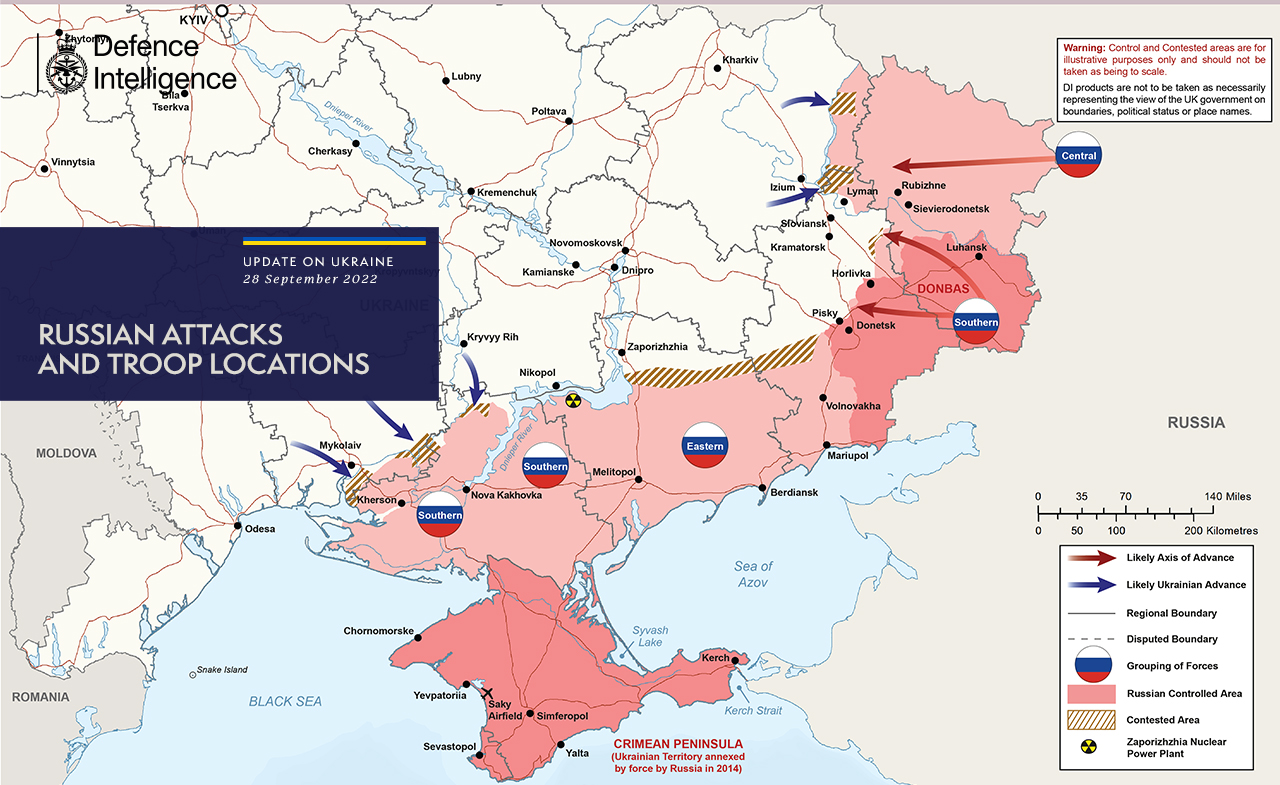
It’s probably time for us to start thinking through some weird possible scenarios for what’s happening in Russia. Because the spectrum of what could happen is a lot broader than it seemed only six months ago.
But let’s start with an important exercise in accountability. In previous commentary, I predicted a lot of things well: that Ukrainian resistance would be very effective, that Russia would have major logistics problems, that the Russians would use mass artillery fire against civilians in place of military advances. I was quick to grasp that Ukraine was overperforming and that Russia was struggling early in the conflict.
But getting some details right didn’t help me avoid blowing the conclusion: I thought Russia would win. Not a total victory, but I thought Russia would seize a lot more of the country before its logistical problems and Ukrainian resistance brought their offensives to a halt, leaving Ukraine with some kind of rump state in the west. I certainly didn’t believe in February that Russia could lose, and I never would have believed that Ukraine could actually win on the battlefield, as it now seems more than capable of doing.
I don’t know if I underestimated Ukrainian capabilities, per se. I always expected them to fight bravely and well, and understood the lethality of modern man-portable weapons against tanks and armoured vehicles. It’s probably closer to the mark to say that I overestimated Russia’s capabilities — I was a cynic on their military and expected it to perform badly, but it’s somehow fallen well short of my already low expectations. It is absolutely delightful to be wrong on this one, but readers deserve the truth: I expected Russia’s military to perform better and grab a much bigger chunk of Ukraine before having to stop in the face of logistical dysfunction and Ukrainian resistance. Part of me wonders if the Russians themselves are surprised by how hollowed out their military had become.
With that on the record, let’s flash forward to the present. As noted above, Ukraine now seems fully able to win the war. As I write this, Ukrainian forces are on the move again in the northeast, and seem to be encircling Russian positions in occupied Lyman. If able to complete this latest manoeuvre, Ukrainian forces will cut off a large force of Russian troops and will also seize control of an important local rail junction, threatening Russian logistics (such as they are) in the surrounding area. Perhaps more importantly to the overall conduct of the war, Russia’s effort to mobilize 300,000 men for the war is running into obvious challenges. Men of military age are fleeing the country. Reports from Russia reveal that the army has little in the way of equipment and weapons for the new draftees, and no system in place to train them. There have been comically bizarre stories of infirm old men getting call-up notices, and of draftees being sent to the front after only a day or two of training … at best.
This isn’t a solution to Putin’s problems. It’s a new problem being created in real time. Even if Putin can find 300,000 men, it seems unlikely he can equip them, and even less likely that he can train them. Whether or not he can transport what men he does round up into the battle area is an open question, as is whether or not he can supply them once they get there.
This is the long way of saying something I’ll now just state bluntly: Russia is losing. Putin’s latest actions reveal that he knows he’s losing. If the mobilization flops, as seems likely, he’ll be losing even worse than he was losing before, and he’ll have damn few options to turn that around.
And this is why we need to start thinking through some weird scenarios.
September 25, 2022
QotD: Sparta’s military reputation as “the best warriors in all of Greece”
That reputation could be a real military advantage. Greek hoplite armies arranged themselves right-to-left according to the status of each polis‘ army (poleis almost always fight in alliances). Since Sparta was always the leader of its alliance, the Spartan king and his force always took the right – opposite the weakest part of the enemy army. You may easily imagine the men facing the Spartans – they know the Spartan reputation for skill (and do not have the advantage of me telling them it is mostly hogwash) and by virtue of where they are standing know that they do not have the same reputation. Frequently, such match-ups resulted in the other side running away before the Spartans even got into spear’s reach (e.g. Thuc 5.72.4).
There’s a story in Xenophon, embedded in the larger Battle of Lechaeum, which I think illustrates the point well. Early on, the Argives (the men of Argos, always the enemy of Sparta) meet and rout a group of Sicyonians (who are allies of Sparta). A passing Spartan cavalry company under a Pasimachus sees this and rushes in; getting off their horses, they grab the Sicyon shields (marked with the city’s sigma) and advance against the Argives. But whereas later in the battle the arrival of the Spartans will trigger panic and retreat, here the Argives do not know they are fighting Spartans (because of the shields) – and so they advance with confidence; Pausimachus with his small force is crushed. As he attacks Pausimachus declared (according to Xenophon), “By the two gods, Argives, these Sigmas will deceive you” (Xen. Hell. 4.4.10; the “two gods” or “twin gods” here are Castor and Pollux).
I rather think that Pausimachus was deceived by the lambda his own shield may have carried (there is debate about if Spartan shields always had the lambda device, I tend to think they did not). Pausimachus expected to surprise the Argives with his Spartan skill. Instead, he found out – fatally – that the magic was never in the Spartan, it was in the image of Sparta that lived in the mind of his opponent.
Bret Devereaux, “Collections: This. Isn’t. Sparta. Part VI: Spartan Battle”, A Collection of Unmitigated Pedantry, 2019-09-20.
September 8, 2022
QotD: Pre-modern armies could not march much faster than 8-12 miles per day … on good days
For reference on how much time this can eat up, 1950s US Army marching regulations (this is again FM21-18 “Foot Marches”) suggest that “battle groups or smaller” (800 men or less, generally – so small, fast-moving infantry) can “under favorable conditions” (read: good, modern paved roads in good weather) make 15-20 miles in a continuous eight hour march. A forced march – marching longer than 8 hours and at a higher than normal pace – can cover more ground (c. 35 miles in a day in some cases) but such a pace will wear out an infantry force fast.
At the end of the day, the army needs to arrive at its planned camp site [early] enough to make camp. Cooking needs to be done. Food that was foraged by flanking units needs to get to the camp, be recorded and stored (or processed and eaten) – speaking of which, note that we haven’t even discussed flankers, scouts and foraging parties. Wages may need to be paid, paperwork needs to be done. In many armies, the camp will need to be fortified – the Romans built a wood-palisade fortified camp every night on the march. And then everyone goes to sleep around 9pm. And that, to be clear, is when everything works like clockwork – which it never does.
For a large army, the breaking camp, waiting to begin marching, waiting for the last man to arrive, dealing with pack animals and wagons slices a few hours off of that eight hour march routine. All of which is why a normal large body of infantry moves something closer 8-12 miles per day than the 24 miles (8 hours x 3.1mph) per day implied by Wikipedia’s Average Human Walking Speed.
Historians doing studies of campaigns thus tend to use these sorts of rule-of-thumb speeds without much feeling the need to explain why armies move so slow because I think they expect that most of their readers are either fellow historians or former soldiers and in either case, already know. These rules of thumb, in turn, derive from staff planning in the age when armies still mostly walked to war (especially the 1800s and early 1900s): those staff office planners would have (and presumably still do have) elaborate tables of how many men can move how fast over what sort of roads in what kind of weather – because bad staff work multiplied over massive armies can mean catastrophic logistics and timing failures (see: Frontiers, Battle of the (1914) for examples).
If anything, for a medieval army of conscripts, fresh from a successful battle, with a long supply-train moving off of the main roads, 12 miles per day is actually quite fast. Large armies with lots of wagons often strayed into single-digit marching speeds. And, to be clear, marching speeds are highly variable based on terrain and the rest.
Bret Devereaux, “New Acquisitions: How Fast Do Armies Move?”, A Collection of Unmitigated Pedantry, 2019-10-06.
August 30, 2022
A cynical (or realistic) view of the fighting in Ukraine
Severian put up a guest post at Founding Questions from “Pickle Rick” analyzing a recent article in the Marine Corps Gazette on the Russo-Ukrainian War so far:
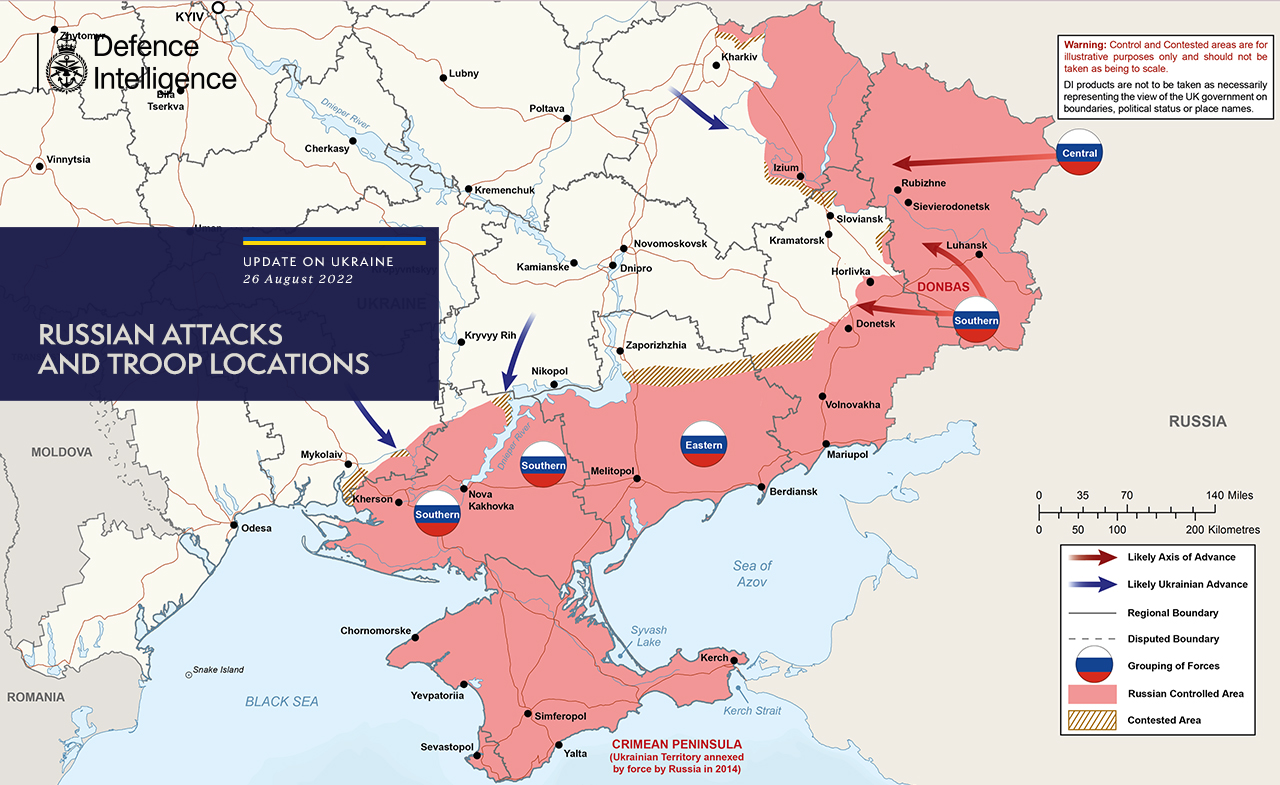
Marinus divides Russian operations, and operational goals, thus tactics, into three discrete geographic parts. Northern Raiding and feints realized through mobile warfare, Southern Occupation through clear and hold, and Central Attrition operations through artillery firepower.
1. Northern operation. Marinus’s central thesis is that the Northern operation was a giant raid, intended to fix Ukrainian commanders’ attention on the threat to Kiev, and prevent them from reinforcing their defenses in the south. In this, mobile warfare, using the battalion tactical group, was the main strategy used. Marinus posits that taking and holding Kiev was never a goal in this operation. Left unsaid in his assessment were two key points that go beyond his narrower operational focus.
First, I’m sure that the Ukrainian Army’s top command was likely not in complete control of defensive strategy or deployment. Zelensky, the Ukrainian Auto Parts King — (“I make politics for the Ukrainian working man, because that’s who I am, and that’s who I care about!”), and his American “advisors” were. Note that we have no idea who Ukrainian General Marshall is, who his Supreme Commander Eisenhower is, or his battlefield Patton is, even if one existed. I mean, we got fawning coverage of President Comedian, looking tough in his cammies on TV, a lot — by which I mean every fucking day, a mythical fighter ace, the “Ghost of Keeeeeev”, but nobody wanted to manufacture a real hero Uke general, steadfastly leading his troops with steely eyed resolve from the front?
C’mon, that’s Propaganda 101. Shit, even Big Red let Marshal Zhukov ride a white horse at the Victory Parade.
I don’t think that is inadvertent. The goons at State and the Clown Intelligence Agency, having engineered one coup, sure as fuck don’t want an actual no shit popular hero, ethnically Ukrainian general to be a viable political alternative to the UAPK they handpicked and installed after this clown folds the Big Top. (Francisco Franco, Kemal Ataturk, or Wladislaw Sikorski say hi from history!). To hear it from the Ministry of Propaganda, Zelensky is commanding the troops himself, and that’s for once likely not far from the truth. It’s Zelensky being “advised” by whatever retards from [Washington DC] who are actually commanding the Ukes, which brings me neatly into my next point — Putin and his generals initiated this feint to Kiev precisely because they correctly predicted that Zelensky and his American masters would expect it and react to it as they did, regardless of anything the Ukrainian generals said.
Why is that, you might ask? Because that is the only strategy that AINO’s Very Clever Boys, Girls and Trannies can conceive of, and the only way they conduct war. Send in the Air Force to blow up everything in an enemy capital, launch a blitzkrieg style invasion aimed at cutting off the enemy army, encircling it, forcing the unmotivated piss poor enemy conscripts to surrender in place or die trying to pull back, and driving on to the capital to pull down the statues of the recently deceased or deposed Dear Leader who was The Next Hitler, declare victory, then institute Regime Change and Operation Endless Occupation. Putin and the rest of his generals are just stupid vodka fueled gopnik Ivans, and couldn’t possibly be headfaking us and outsmarting us. We went to West Point and Harvard, and are automatically the Best and Brightest. Remember when the MoP and the Fistagon were squeeing like little girls at those incompetent Ivans floundering about within artillery range of Keeeev, and the 100 mile long convoy that everyone saw “stuck” on the road to the Sacred Capital, that was so visible and obvious you could see the fucker from space, that just sort of disappeared, along with the great and decisive Battle of Keeeeev that was going to be a bloody defeat for the evil Russians?
You’ll never hear anyone ever admit it, but they just got posterized because their hubris and arrogance was exactly the thing [Putin] used against them.
маскировка (Maskirovka), you stupid fucks, is a Russian MILITARY CONCEPT, and you forgot it. Check yo self before you wreck yo self, as von Clausewitz wrote. Master P didn’t fight your war, he fought a modern Kabinettskreige and that is fought for an entirely different set of objectives, as we will see below.
2.Southern operation. This is the forgotten stepchild of the war so far, but quietly could be the one front with the longest lasting strategic effects. Marinus disposes of this front relatively quickly, noting that it really is operationally the bread and butter of traditional warfare, take ground and hold ground, move on to the next objective. Strategically, this is different from ground taken in the northern front or even parts in the central, however.
The object here is permanent occupation and Russification to deny the rump state of Ukraine any coastline and landlock it. This, unlike territory in the north or even in the Donbass, is not a bargaining chip on the table at the peace talks. Denying this to the Ukrainians after the war prevents them from ever “inviting” any US Navy ships into the Black Sea to base themselves at a Ukrainian port and serve as a potential casus belli, hamstrings Ukraine from seaborne economic activity with Turkey across the Black Sea, thus making sure whatever left of Ukraine is unable to function without massive land route economic as well as military aid, making it a drain, not an asset, to Globohomo and AINO.
[…]
3. Central operation. Marinus here details the real decisive front in the war, calling it “Stalingrad in the East” (Clunky, since Stalingrad was a very different kind of battle, but it has name recognition as a byword for the Eastern Front and the Russian way of war). Honestly, it is far more like a giant Battle of Verdun, but only for one side.
Here is where I’m going to proclaim how happy my artilleryman’s heart is […] because Marinus says that in the Russian way of winning wars, you can’t spell PARTY without ARTY. Not Special Operations Operating Operationally, not drone warfare “fought” by fatass pimply nerds in some air conditioned room half a world out of danger, not bombs away from 30,000 feet, or armored divisions imitating Rommel. Fucking old school howitzers, chucking metric tons of high explosive on infantry, dropping regimental sized TOT and Shake and Bake when they get in the open. I predicted that here in the beginning of the war and a lot of you can look that shit up if you don’t believe me. Guess we ain’t obsolete anymore, assholes.
Everything the Russians are doing in the Donbass and Central front, operationally and tactically, hinges around artillery as the decisive arm, the fulcrum that the other arms orbit around, which is very, very different than the American way of war. Again, as in the north, the Americans “advising” the Ukes had never, literally never in living memory, faced an enemy with air superiority and firepower superiority, much less both combined. They have absolutely no answer for it.
How did Rome defend its empire? ⚔️
HistoryMarche
Published 29 Apr 2022🚩 In this video we analyze the three defensive strategies the Roman Empire deployed from c.27BC to 350 AD, as described in Edward Luttwak’s book The Grand Strategy of the Roman Empire.
(more…)
August 13, 2022
QotD: Erich von Manstein
In the Britain of the Sixties, a certain mystique still attached to the generals of the Third Reich. In their stylish uniforms and their gleaming jackboots, they had swaggered. Only two, Keitel and Jodl, were executed at Nuremberg; the rest got away with murder.
Even some of those who were convicted of war crimes had friends in high places. One of the most prominent was Erich von Manstein, the architect of many German victories both in the Battle of France and on the Eastern front. He was also complicit in the genocide of more than a million Jews and others by the Nazi Einsatzgruppen in Ukraine.
Yet Churchill was among those who successfully campaigned to have Manstein’s 18-year sentence reduced to 12, of which he served only four.
Manstein’s memoir Verlorene Siege (translated as Lost Victories) appeared in 1958, a key text in the mythology that depicted the Wehrmacht as “clean” and laid the blame for war crimes on Hitler. Konrad Adenauer, the first chancellor of the postwar Federal Republic, also played his part in the rehabilitation of Manstein, on the grounds that West German rearmament required a sharp distinction between the Nazis and an untainted military tradition as the basis for the new Bundeswehr.
Daniel Johnson, “The moral blindness of Putin’s generals”, The Critic, 2022-05-10.
August 11, 2022
QotD: Logistical limits to Spartan military action against Athens
During the first phase of the Peloponnesian War, called the Archidamean war, after the Spartan king who conducted it, Sparta invaded Attica functionally every year in an effort to inflict enough agricultural devastation that the Athenians would be forced to come out and fight […] The core problem is that it just isn’t possible to do a meaningful amount of damage in the short campaigning season before the army has to go home.
And I want to be clear just how long they bang their head against this rock. The Spartans invade in 431, besiege a minor town, accomplish nothing and leave (Thuc. 2.18-20), and in 430 (Thuc. 2.47), in 429, because of a plague in Athens, they instead besiege tiny Plataea (Thuc. 2.71ff) and then leave, but in 428 they’re back at it in Attica (Thuc. 3.1), and in 427 (Thuc. 3.26), and in 426 but turn back early due to earthquakes (Thuc. 3.89). But they’re back again in 425 (Thuc. 4.2), leaving each time when supplies run out. Sparta mounts no attack in 424 because Athenian naval raiding forces them to keep the army at home (Thuc. 4.57); in 423 they have a year-long truce with Athens (Thuc. 4.117). They only finally suggest the creation of a permanent base in Attica in 422/1 (Thuc. 5.17) but the war ends first (they’ll actually fortify a small outpost, Decelea, only when the war renews in 413).
Thucydides is in several cases (e.g. Thuc. 3.1.3) explicit that what causes these armies to fail and disperse back home is that they run out of supplies. They are two days – on foot! – from a major friendly trade port (Corinth), and they run out of supplies. Their last invasion was six years after their first and they still had not resolved the logistics problem of long-term operations in what is effectively their own backyard.
Bret Devereaux, “Collections: This. Isn’t. Sparta. Part VII: Spartan Ends”, A Collection of Unmitigated Pedantry, 2019-09-27.
July 12, 2022
QotD: Greek city-state logistics in the time of the Peloponnesian War
Greek logistics in this period in general were very limited compared to either Macedonian or Roman logistical capabilities in subsequent centuries, or contemporary Persian logistics capabilities. Ironically, the most sustained study of classical Greek logistics concerns the campaigns of Xenophon (J.W. Lee, A Greek army on the March (2008)), meaning that it concerns not polis amateurs but an army of mercenary professionals, and yet compared to what the Macedonians would be able to do (see D.W. Engels, Alexander the Great and the Logistics of the Macedonian Army (1978)) half a century later in the same terrain, even these Greek logistics – probably the gold standard of their time – are astoundingly underdeveloped.
Put very briefly: Greek armies seem to have had relatively little carrying or logistics capacity. They did not seem to have generally moved with sufficient engineering tools or materials for effective field fortification or siege warfare. This is compounded by their inability to mill grain on the move (something Macedonian and Roman armies could do), which compounds problems of using local supply. You can eat unmilled grain (it can be roasted or boiled into porridge, but this is less than ideal. What they do tend to have is a high number of non-combat personal servants (precisely the sort of fellows good Roman or Macedonian generals drive out of the camp as soon as possible), who impose additional logistics burdens without much increasing the operational range or endurance of the army. Consequently, Greek armies struggled to stay out in the field throughout the year, whereas Roman and Macedonian armies were routinely capable of year-round campaigning.
Bret Devereaux, “Collections: This. Isn’t. Sparta. Part VII: Spartan Ends”, A Collection of Unmitigated Pedantry, 2019-09-27.
July 8, 2022
The Russian way of war
In First Things, George Weigel identifies what we’ve learned about the Russian “way of war” from the ongoing conflict with Ukraine:
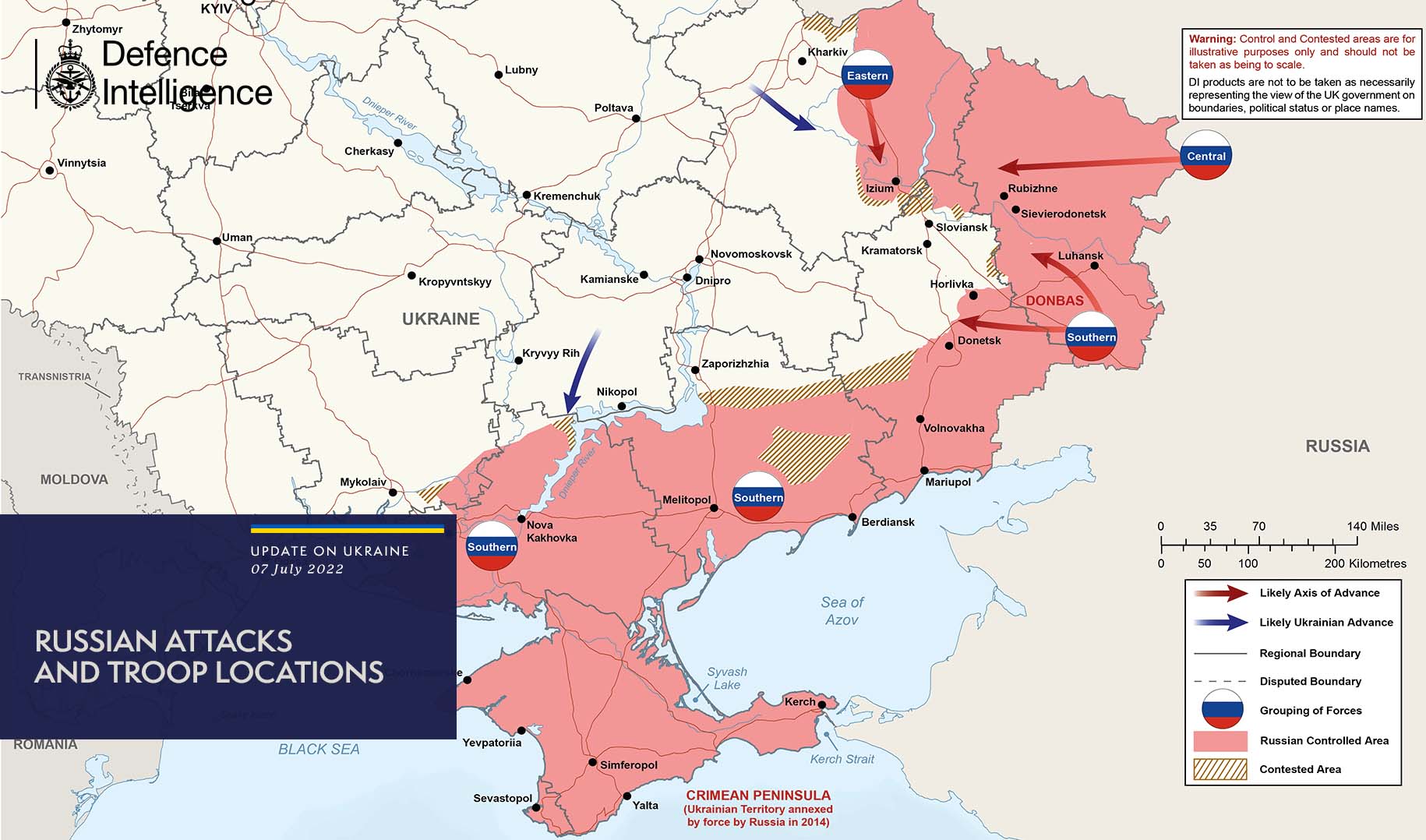
Four and a half months after Russia invaded Ukraine on the Orwellian pretext of displacing a “Nazi” regime — a regime that enjoys a democratic legitimacy absent from Russia for two decades — what have we learned about, and from, the Russian way of war?
We have learned that the Russian way of war is inept strategically, tactically, and logistically: an army using inferior equipment, bereft of competent non-commissioned officers, and replete with ill-trained draftees; an army that relies on brute force to bludgeon its way toward its objectives. We have learned that the Russian way of war willfully obliterates cities and deliberately destroys economic infrastructure. We have learned that the Russian way of war targets hospitals and schools, cultural and educational institutions, churches, synagogues, and mosques in an attempt to eradicate a culture and a nation that Russian president Vladimir Putin insists has no right to exist, save as a Russian vassal. Thus the twenty-first-century Russian way of war breathes the spirit of eighteenth-century imperialism, with President Putin comparing himself to that quintessential Russian imperialist, Peter the Great, and telling schoolchildren asked to name Russia’s borders in a geography bee that “the borders of Russia never end”.
We have learned that the Russian way of war is insensible to casualty rates, its own army’s and Ukraine’s. We have learned that the Russian way of war includes abandoning the Russian dead or disposing of their remains in mobile cremation units, so that body bags don’t flood the home front and raise questions about the wisdom of Putin and his generals. We have learned that the Russian way of war includes the humiliation, torture, and probable execution of prisoners of war. We have learned that the Geneva Conventions on the humane treatment of POWs mean no more to the Russian military and its political masters than does the Fifth Commandment.
We have learned that the Russian way of war includes the use of cluster munitions and unguided missiles specifically forbidden by international law. Thus the Russian way of war systematically violates the two in bello (war-fighting) principles of the just war tradition: proportionality of means (no more force than necessary to achieve a legitimate military objective) and discrimination (non-combatant immunity). We have learned that the Russian way of war features widespread rape, gross theft, and the summary execution of civilians, as well as kidnapping civilians in Russian-occupied territories, relocating them, and attempting to coerce them into renouncing their Ukrainian allegiance.
We have learned that the Russian way of war includes illegal blockades of Ukrainian ports to prevent grain shipments, thus threatening starvation in Third World countries. We have learned that the Russian way of war includes energy blackmail, threats of nuclear-weapons use, and blatant bullying of other countries, including Lithuania and Kazakhstan.


