Quotulatiousness

September 12, 2020

Sizing The Drawer Components | The Cabinet Project #20 | Free Online Woodworking School

Filed under: Tools, Woodworking — Tags: , , , — Nicholas @ 04:00

Matt Estlea
Published 8 Sep 2020

In this video, I’ll show you how to size the drawer components to place yourself in the best possible position for all the steps we will face further down the line. As always, ensure components are perfectly square, exactly the same length, and fit snugly within the cavity.
_________________________________________________________________

Support what I do by becoming a Patron! This will help fund new tools, equipment and cover my overheads. Meaning I can continue to bring you regular, high quality, free content. Thank you so much for your support! https://www.patreon.com/mattestlea

Don’t want to commit to a monthly direct debit but still want to help out? That’s fine!
You can make a one time donation here: www.mattestlea.com/donate
You can donate us biscuits here: www.mattestlea.com/wishlist
_________________________________________________________________
BUY THE WOODWORKING BIBLE HERE:
www.mattestlea.com/the-woodworkers-manual
_________________________________________________________________

SOCIAL MEDIA
Instagram: www.instagram.com/mattestlea
Twitter: www.twitter.com/mattestlea
Patreon: www.patreon.com/mattestlea
Pinterest: www.pinterest.com/mattestlea
LinkedIn: www.linkedin.com/in/matt-estlea-b6414b11a/
_________________________________________________________________
See what tools I use here: www.mattestlea.com/equipment
My Website: www.mattestlea.com
_________________________________________________________________

My name is Matt Estlea, I’m a 24 year old Woodworker from Basingstoke in England and my aim is to make your woodworking less s***.

I come from 5 years tuition at Rycotewood Furniture Centre with a further 1 year working as an Artist in Residence at the Sylva Foundation. I now teach City and Guilds Furniture Making at Rycotewood as of September 2018.

If you’re interested in studying at Rycotewood, view their courses here:
www.mattestlea.com/rycotewood

I also had 5 years of experience working at Axminster Tools and Machinery where I helped customers with purchasing tools, demonstrated in stores and events, and gained extensive knowledge about a variety of tools and brands. I discontinued this at the start of 2019 to focus solely on video creation and teaching.

During the week, I film woodworking projects, tutorials, reviews and a viewer favourite ‘Tool Duel’ where I compare two competitive manufacturers tools against one another to find out which is best. I also have a Free Online Woodworking School which you should definitely check out!

www.mattestlea.com/school

I like to have a laugh and my videos are quite fast paced BUT you will learn a lot, I assure you.

Lets go make a mess.

Andrew Sullivan on a “genetic case for communism”

Filed under: Books, Education, Politics, Science, USA — Tags: , , , , , — Nicholas @ 03:00

Actually, this isn’t the case Sullivan himself is making, but he’s summarizing a recent book by Fredrik deBoer, The Cult of Smart: How our broken education system perpetuates social injustice:

There aren’t many books out there these days by revolutionary communists who are into the genetics of intelligence. But then there aren’t many writers like Freddie DeBoer. He’s an insistently quirky thinker who has managed to resist the snark, cynicism and moral preening of so many others in his generation — and write from his often-broken heart. And the core of his new book, The Cult of Smart, is a moral case for those with less natural intelligence than others — the ultimate losers in our democratic meritocracy, a system both the mainstream right and left have defended for decades now, and that, DeBoer argues, gives short shrift to far too many.

This isn’t a merely abstract question for him. He has grappled with it directly. As a school teacher he encountered the simple, unavoidable fact that some humans are more academically gifted than others, and there’s nothing much anyone can do about it. He recalls his effort to teach long division to a boy who had managed to come a long way socially (he’d gone from being a hell-raiser to a good student) but who still struggled with something as elemental as long division: “At one point he broke into tears, as he had several times before … I exhaled slowly and felt myself give up, though of course I would never tell him so. I tried to console him, once again, and he said, ‘I just can’t do it.’ And it struck me, with unusual force, that he was right.”

What DeBoer tries to do is explain how our current culture and political system is geared to torment, distress and punish this kid for no fault of his own. “This is the cult of smart,” DeBoer proclaims. “It is the notion that academic value is the only value, and intelligence the only true measure of human worth. It is pernicious, it is cruel, and it must change.” It has become un-American — or perhaps it always was? — to say that an individual has natural limits, that, even with extremely hard work, he won’t always be able to realize his dreams. And this is not because of anything he has done or failed to do — but simply because of his draw in the genetic lottery of life. The very American cult of education is supposed to end this injustice — except that it doesn’t, because it can’t, and its brutal logic actually exposes and entrenches the least defensible inequality of all, the inequality of nature.

This genetic reality — in fact, the very idea of nature existing at all — is currently a taboo topic on the left. In the most ludicrously untrue and yet suffocatingly omnipresent orthodoxy of our time, critical theory leftists insist that everything on earth is entirely socially constructed, that all inequality is a function of “oppressive systems”, and that human nature itself is what John Locke called a “white paper, void of all characters” — the famous blank slate. Freddie begs to differ: “Human behavioral traits, such as IQ, are profoundly shaped by genetic parentage, and this genetic influence plays a larger role in determining human outcomes than the family and home environment.”

People are not just born unequally and unfairly into class, and culture, and place, they are inherently unequal in various ways in their very nature: “not everyone has the same ability to do calculus; not everyone has the same grasp of grammar and mechanics … we can continue to beat our heads against the wall, trying to force an equality that just won’t come. Or we can face facts and start to grapple with a world where everyone simply can’t be made equal.” And this is not a counsel of despair. What Freddie is arguing is that, far from treating genetic inequality as a taboo, the left should actually lean into it to argue for a more radical re-ordering of society. They shouldn’t ignore genetics, or treat it as unmentionable, or go into paroxysms of fear and alarm over “eugenics” whenever the subject comes up. They should accept that inequality is natural, and construct a politics radical enough to counter it.

[…]

This genetic case for communism can leave a reader a little disoriented, I have to say, if only for its novelty. But it is more coherent, it seems to me, than a leftism that assumes that genes are irrelevant to humans and society, that the ultimate goal is to be as smart and thereby wealthy as possible, and that we can set up an educational system where everyone, regardless of their genetic inheritance, can succeed or fail by their own efforts. What sounds like a meritocratic dream is, in practice, a brutal and unforgiving formula for most who can’t achieve it — and has obviously failed if its task is to foster equality. In fact, mass education appears to have increased the gulf between rich and poor. As Freddie notes, “education is not a weapon against inequality; it is an engine of inequality.”

Shooting the ZB-26: A Jewel of an Interwar Light Machine Gun

Forgotten Weapons
Published 27 Oct 2017

Sold for $34,500 (transferrable).

Today we have a chance to do some shooting with a ZB-26, a German-occupation 8mm light machine gun made at Brno in Czechoslovakia. The ZB-26 does not get nearly as much attention as LMGs made by the better known powers during the war, but it is an excellent weapon. In addition to being adopted by the Czech military, the gun was sold to about two dozen other countries and used in significant numbers by the Waffen SS.

As one would expect form its reputation, the ZB was smooth, reliable, and very controllable. For all the reasons discussed in yesterday’s history and disassembly video [here], it is a top notch firearm.

http://www.patreon.com/ForgottenWeapons

Cool Forgotten Weapons merch! http://shop.bbtv.com/collections/forg…

If you enjoy Forgotten Weapons, check out its sister channel, InRangeTV! http://www.youtube.com/InRangeTVShow

QotD: A toast, of sorts

Filed under: Britain, Quotations, Randomness — Tags: — Nicholas @ 01:00

From the Hundred Year War to the Crimea
With a lance and a musket and a Roman spear
To all of the men who have stood with no fear
In the service of the King

“The Card Cheat” by The Clash (written by Topper Headon, Mick Jones, Joe Strummer, and Paul Simonon)

September 11, 2020

Ecuadorian-Peruvian War: The War That Had Nothing to do with World War Two – WW2 Special

Filed under: Americas, History, Military — Tags: , , , , — Nicholas @ 06:00

World War Two
Published 10 Sep 2020

While the Second World War grows ever more destructive, some nations take advantage of the global chaos to settle old disputes. In Peru and Ecuador, long standing territorial disputes turn violent.

Join us on Patreon: https://www.patreon.com/TimeGhostHistory
Or join The TimeGhost Army directly at: https://timeghost.tv

Follow WW2 day by day on Instagram @ww2_day_by_day – https://www.instagram.com/ww2_day_by_day
Between 2 Wars: https://www.youtube.com/playlist?list…
Source list: http://bit.ly/WW2sources

Hosted by: Indy Neidell
Written by: Francis van Berkel
Director: Astrid Deinhard
Producers: Astrid Deinhard and Spartacus Olsson
Executive Producers: Astrid Deinhard, Indy Neidell, Spartacus Olsson, Bodo Rittenauer
Creative Producer: Joram Appel
Post-Production Director: Wieke Kapteijns
Research by: Marlon William Londono and Lewis Braithwaite
Edited by: Mikołaj Cackowski
Sound design: Marek Kamiński
Map animations: Eastory (https://www.youtube.com/c/eastory)

Colorizations by:
Carlos Ortega Pereira, BlauColorizations, https://www.instagram.com/blaucolorizations
Mikolaj Uchman

Sources:
David Rumsey Map Collection, David Rumsey Map Center, Stanford Libraries
ecured.cu
From the Noun Project: Artillery by Creative Mania, engineer by Eucalyp, company soldiers by Andrei Yushchenko, Horse by RIZCA

Soundtracks from the Epidemic Sound:
Rannar Sillard – “March Of The Brave 4”
Johannes Bornlof – “The Inspector 4”
Fabien Tell – “Last Point of Safe Return”
Reynard Seidel – “Deflection”
Philip Ayers – “Trapped in a Maze”
Johannes Bornlof – “Deviation In Time”

Archive by Screenocean/Reuters https://www.screenocean.com.

A TimeGhost chronological documentary produced by OnLion Entertainment GmbH.

Canadian government heading toward “the worst of all worlds on Internet regulation”

Filed under: Business, Cancon, Government, Media — Tags: , , , , — Nicholas @ 05:00

Michael Geist on the bull-headed determination of the Canadian federal government — and specifically Heritage Minister Steven Guilbeault — to “solve” a problem by introducing savagely anti-consumer internet regulations:

Canadian Heritage Minister Steven Guilbeault, 3 February 2020.
Screencapure from CPAC video.

The harm that will come from these policy choices is difficult to overstate. By focusing the tax burden on sales taxes rather than technology company revenues, consumer costs will go up and the company profits will be left untouched. The CRTC powers will lead to years of hearings and follow-on litigation, yielding few tangible benefits for creators. The mandated Cancon contributions will spark trade wars and make Canada a less attractive market for new services leading to fewer choices and less competition, while the link licensing requirement will result in blocked sharing of news articles on social media sites that hurts both Canadians and media organizations. All the while, the issues that really matter – privacy, anti-competitive behaviour, online hate, misinformation, a fair share of tech corporate profits – are left largely untouched.

How did the government end up with the worst of all worlds on Internet regulation?

The starting point was the 2015 election in which it committed to no new Netflix taxes (prompted by a Conservative pledge on the issue) and subsequent consultations on everything from copyright to digital cultural policy. The result was then-Heritage Minister Melanie Joly struggling to honour the no-tax commitment, while satisfying increasingly vocal demands from some stakeholders for one. Those calls increased after the results of her cultural policy consultation were released, which largely focused on a rejection of new Internet taxes and support for net neutrality.

In the aftermath of the Cambridge Analytica scandal, worries about Russian election interference, and Christchurch massacre broadcast live online, the policy winds shifted and the government was clearly looking to become more active on the Internet regulation file. That led to Election Act provisions that were generally viewed as successful. It also paved the way for a 2019 election platform that was far aggressive on social media and the Internet, with commitments to address everything from privacy to hate speech online.

[…]

If the government were to address the real concerns, there would be long-overdue privacy reforms, a more aggressive approach on competition issues, measures to address online hate and misinformation, and pursuit of a global agreement on fair taxation of technology company revenues. If it wants to support increased film production from indigenous groups or help the news sector, it can make those policy choices and use general tax revenues without creating a massive regulatory infrastructure.

Instead, it is turning to the harmful policies noted above that raise consumer costs (digital sales taxes), regulate online Cancon with mandated spending requirements (even though the industry has record production led by Netflix), dispense with any pretense of maintaining net neutrality, lead to blocked sharing of news articles (mandated licence for social media sites merely for linking to news content), and result in services avoiding the Canadian market (market interference in payments from services such as Spotify). Much of this will be overseen by the newly empowered CRTC, leading to lengthy hearings that primarily benefit lawyers. After having badly mishandled Canadian digital policy, the government now seems content to take a pass on the important issues and leave the controversial non-issues to the regulator and the courts.

“Carolus Rex” – Charles XII of Sweden – Sabaton History 084 [Official]

Filed under: Europe, History, Media, Military, Russia — Tags: , , , , , — Nicholas @ 04:00

Sabaton History
Published 10 Sep 2020

In 1697, just 15 years old, Charles XII ascended to the Swedish throne. By the grace of God, he was anointed King — Carolus Rex. Charles would not ask for obedience, nor would he make any concessions to his rule. His authority was divine and his judgment law. Determined to rule the Swedish Empire with absolute power, Charles set out to restore the might and glory of the kingdom.

Support Sabaton History on Patreon: https://www.patreon.com/sabatonhistory

Listen to “Carolus Rex” on the album Carolus Rex:
Carolus Rex (English Version) – https://music.sabaton.net/CarolusRexEN
Carolus Rex (Swedish Version) – https://music.sabaton.net/CarolusRexSE

Watch the Official Live Video of Carolus Rex here:
https://www.youtube.com/watch?v=WhA9B…

Listen to Sabaton on Spotify: http://smarturl.it/SabatonSpotify
Official Sabaton Merchandise Shop: http://bit.ly/SabatonOfficialShop

Hosted by: Indy Neidell
Written by: Markus Linke and Indy Neidell
Directed by: Astrid Deinhard and Wieke Kapteijns
Produced by: Pär Sundström, Astrid Deinhard and Spartacus Olsson
Creative Producer: Maria Kyhle
Executive Producers: Pär Sundström, Joakim Brodén, Tomas Sunmo, Indy Neidell, Astrid Deinhard, and Spartacus Olsson
Community Manager: Maria Kyhle
Post-Production Director: Wieke Kapteijns
Editor: Karolina Dołęga
Sound Editor: Marek Kaminski
Maps by: Eastory – https://www.youtube.com/c/eastory
Archive: Reuters/Screenocean – https://www.screenocean.com
Sources:
Osipov Georgiy and Nokka Tarajan from Wikimedia
Nationalmuseum
All music by: Sabaton

An OnLion Entertainment GmbH and Raging Beaver Publishing AB co-Production.

© Raging Beaver Publishing AB, 2019 – all rights reserved.

Without the Battle of the Teutoburg Forest, European history would have been radically different

Filed under: Europe, Germany, History, Military — Tags: , — Nicholas @ 03:00

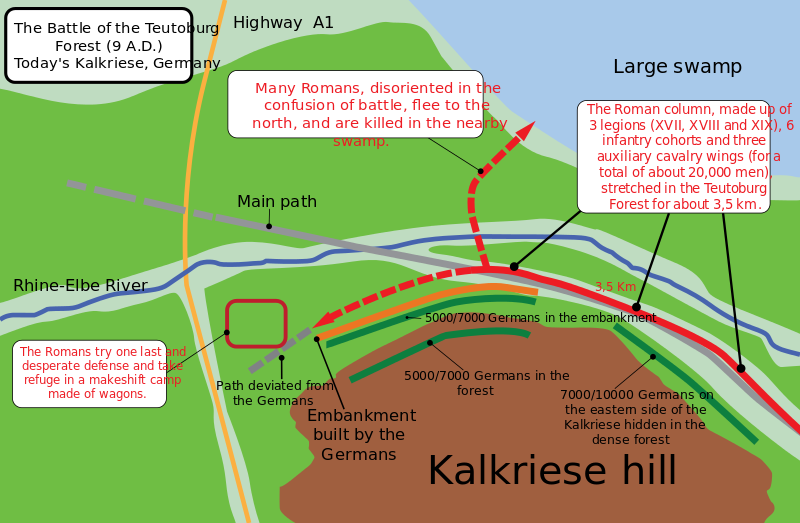
The folks at UnHerd are starting a series of “alt histories” to help explore the inflection points of history that may have led to a very different world, like the outcome of the Imperial Roman disaster in Germany’s Teutoburger Wald in 9AD:

Map showing a tactical overview of the Battle of Teutoburg Forest including troop movement.
Map by Cristiano64 originally for a non-English Wikipedia page, which explains the weird translated captioning.

If history teaches us anything it’s that we should expect the unexpected. But history, unlike the news, is something that’s already happened. Historians, unlike journalists, see events in the rearview mirror. As a result, they’re rather prone to deterministic explanations. For instance, there’s the Whig view of history with its narratives of ever-increasing freedom. Marxists, meanwhile, situate historical events within an overarching process of class struggle. Indeed, from millenarians to environmentalists to the friends and foes of the Anglosphere, everyone’s trying to bend the arc of history.

[…]

For instance, why didn’t the Roman Empire conquer the German lands beyond the Rhine? A determinist might reach for some geographical explanation — the territory was inhospitable and the locals scary. And yet similar obstacles didn’t stop the the Romans from assimilating Britannia, so why not Germania too?

Well, because three Roman legions were wiped out at the Battle of the Teutoburg Forest, that’s why — and there was nothing pre-determined about that catastrophe. It required the mother of all ambushes, made possible by the extreme cunning of the German chieftain Arminius and the extreme gullibility of the Roman commander Varus. It could easily not have happened – and thus, untraumatised by such an unexpected and total defeat, the Romans might have extended the northern frontier to the Elbe or beyond.

What would a Romanised Germania have meant for the rest of history? It’s impossible to say, but we can imagine an unRomanised Gaul. The existence of France (and the French language) as we know it today depends on the fact that, two thousand years ago, the Romans conquered Gaul, but not Germania. Had things gone differently, French (and therefore British and therefore American) history would have developed along a very different path.

What this example also tells us is just how much of history depends on the character, abilities and decisions of particular individuals (contrast the ruthless brilliance of Julius Caesar in the case of Gaul with the trusting foolishness of Varus in the case of Germania). There’s something called the great man theory of history. It was a 19th Century idea and deeply unfashionable today, but while the individuals who change the course of history aren’t necessarily “great” or, indeed, men — there’s no doubting their existence.

They don’t have to be heroes or villains. In fact, they don’t have to have much authority of any kind. Their impact doesn’t even have to be the result of a deliberate decision. They just have to do the right (wrong) thing in the right (wrong) place at the right (wrong) time. For instance, someone, somewhere, did something that introduced the Covid-19 virus to the human population. Whether that was eating a bowl of bat soup or dropping a test tube in a laboratory we’ll probably never know; but whatever it was, it made all the difference.

That’s why we can’t leave alt history to the historians alone. While some of them might see merit in exploring counterfactuals, their commitment to academic rigour acts as a constraint upon their speculations. Quite right too, but there’s also a case for letting our imaginations run riot — and for that we need story-tellers.

JS Izumo, Japan’s largest warship

Filed under: Japan, Military — Tags: , , — Nicholas @ 02:00

AMANO Jun-ichi
Published 12 Jun 2016

https://en.wikipedia.org/wiki/JS_Izumo

At open-house of the Japan Maritime Self-Defense Force Yokosuka Naval Base.
On June 11, 2016.

#JMSDF #MSDF

From the Wikipedia entry:

JS Izumo (DDH-183) is a helicopter carrier with a planned future conversion into an aircraft carrier. Officially classified as a multi-purpose operation destroyer, she is the lead ship in the Izumo class of the Japan Maritime Self-Defense Force (JMSDF). She is the second warship to be named for Izumo Province, with the previous ship being the armoured cruiser Izumo (1898).

The ruling Liberal Democrat Party announced in May 2018 that it favours converting Izumo to operate fixed-wing aircraft. The conversion was confirmed in December 2018 when Japan announced the change of its defense guidelines. Upon the completion of the process, Izumo will be the first Japanese aircraft carrier since World War II.

QotD: “Karen” and other stereotypes

Filed under: Humour, Media, Quotations, USA — Tags: , , — Nicholas @ 01:00

When I first saw the name “Karen,” used in the plural, apparently for a whole class of women, I did not look it up. Context told me that I wouldn’t have to; that a Karen was simply the updated term for what I formerly knew as a Becky. There are related, more focused terms, such as “Trixie” for a Karen from upscale white Chicago, and so forth. It is one of many reasons to celebrate the black urban lexical culture from which it emerged. The image of a passive-aggressive blonde, with a pony tail, disputing her order at Starbucks, comes quickly to mind. She will be married to a “Chad” whom she met in law school.

I love stereotypes. They help us understand what the Greeks called syndromes, carrying them beyond the narrow world of medical jargon. “Karen” began as the stereotype for the woman who “wants to see the manager,” but was soon extended through a gallery of related traits. One thinks affectionately through a shortlist of the Karens one has known. For the Christian, it can impact one’s prayer life. (I found myself once praying for a certain Karen Surname, then spontaneously extending it to “Karens everywhere,” with a memorial for the Beckies. I noticed as I searched my memory that many of these Karens were biologically male.)

And today I wonder, as I have often done, at the genius of colloquial language, and the unerring way with which it uncovers fresh stereotypes, that enhance our perception of reality, in a way like painting and the other fine arts. (In a lost portrait, Leonardo depicted a Karen of the Renaissance.)

David Warren, “Karens & their kind”, Essays in Idleness, 2020-06-10.

September 10, 2020

Is The War Ending? – Oil Crisis and UN Intervention | The Suez Crisis | Part 3

TimeGhost History
Published 9 Sep 2020

As Israel nears victory in Operation Kadesh, Britain and France are fighting a losing war of their own on the frontlines of the global political scene. The UN are staunchly against Britain and France’s involvement, and if the duo aren’t careful, another superpower may soon enter the fray, one with the intention of a war of more than just words.

Join us on Patreon: https://www.patreon.com/TimeGhostHistory

Hosted by: Indy Neidell
Written by: Francis van Berkel
Director: Astrid Deinhard
Producers: Astrid Deinhard and Spartacus Olsson
Executive Producers: Astrid Deinhard, Indy Neidell, Spartacus Olsson, Bodo Rittenauer
Creative Producer: Joram Appel
Post-Production Director: Wieke Kapteijns
Research by: Francis van Berkel
Image Research: Shaun Harrison & Daniel Weiss
Edited by: Daniel Weiss
Sound design: Marek Kamiński
Maps: Ryan Weatherby

Colorizations:
– Mikolaj Uchman
– Daniel Weiss – https://www.facebook.com/The-Yankee-C…
– Carlos Ortega Pereira (BlauColorizations) – https://www.instagram.com/blaucolorizations
– Norman Stewart – https://oldtimesincolor.blogspot.com/
– Jaris Almazani (Artistic Man) – https://instagram.com/artistic.man

Sources:
National Archives NARA
Images from the UN News and Media
1960s Soviet Film “Egypt our Arab Ally”

From the Noun Project:
– Letter by Bonegolem
– soldier by Wonmo Kang
– Oil Tank by Mangsaabguru

Soundtracks from Epidemic Sound:
– “Devil’s Disgrace” – Deskant
– “As the Rivers Collapse” – Deskant
– “Invocation” – Deskant
– “Call of Muezzin” – Sight of Wonders
– “Crying Winds” – Deskant
– “On the Edge of Change” – Brightarm Orchestra
– “Where Kings Walk” – Jon Sumner
– “Divine Serpent” – Deskant
– “Synchrotron” – Guy Copeland
– “Dunes of Despair” – Deskant

Archive by Screenocean/Reuters https://www.screenocean.com.

A TimeGhost chronological documentary produced by OnLion Entertainment GmbH.

From the comments:

TimeGhost History
2 days ago
We took a long time to settle on a title for this episode because so much happens. Nasser promises a people’s war; the entirety of Western Europe faces an oil crisis; America looks like it might sanction its allies; Israel almost calls the whole thing off; the first-ever international Peacekeeping Force is proposed at the UN; the list goes on. Complicated stuff but this is why our realtime format is so important. Something as crazy as the Suez Crisis can only be adequately understood if you go through it step-by-step. Otherwise, it just becomes an incomprehensible mass of information.

Want to ensure we can carry on doing stuff like this? Join the TimeGhost Army https://www.patreon.com/TimeGhostHistory

How To Hinge The Door | The Cabinet Project #19 | Free Online Woodworking School

Filed under: Tools, Woodworking — Tags: , — Nicholas @ 04:00

Matt Estlea
Published 7 Sep 2020

In this video, I show you how to hinge the door of the cabinet to achieve an equal shadow gap surrounding the edge.

Learn How To Clean Up Hinges Here:
https://mattestlea.com/free-online-wo…
_________________________________________________________________

Support what I do by becoming a Patron! This will help fund new tools, equipment and cover my overheads. Meaning I can continue to bring you regular, high quality, free content. Thank you so much for your support! https://www.patreon.com/mattestlea

Don’t want to commit to a monthly direct debit but still want to help out? That’s fine!
You can make a one time donation here: www.mattestlea.com/donate
You can donate us biscuits here: www.mattestlea.com/wishlist
_________________________________________________________________
BUY THE WOODWORKING BIBLE HERE:
www.mattestlea.com/the-woodworkers-manual
_________________________________________________________________

SOCIAL MEDIA
Instagram: www.instagram.com/mattestlea
Twitter: www.twitter.com/mattestlea
Patreon: www.patreon.com/mattestlea
Pinterest: www.pinterest.com/mattestlea
LinkedIn: www.linkedin.com/in/matt-estlea-b6414b11a/
_________________________________________________________________
See what tools I use here: www.mattestlea.com/equipment
My Website: www.mattestlea.com
_________________________________________________________________

My name is Matt Estlea, I’m a 24 year old Woodworker from Basingstoke in England and my aim is to make your woodworking less s***.

I come from 5 years tuition at Rycotewood Furniture Centre with a further 1 year working as an Artist in Residence at the Sylva Foundation. I now teach City and Guilds Furniture Making at Rycotewood as of September 2018.

If you’re interested in studying at Rycotewood, view their courses here:
www.mattestlea.com/rycotewood

I also had 5 years of experience working at Axminster Tools and Machinery where I helped customers with purchasing tools, demonstrated in stores and events, and gained extensive knowledge about a variety of tools and brands. I discontinued this at the start of 2019 to focus solely on video creation and teaching.

During the week, I film woodworking projects, tutorials, reviews and a viewer favourite ‘Tool Duel’ where I compare two competitive manufacturers tools against one another to find out which is best. I also have a Free Online Woodworking School which you should definitely check out!

www.mattestlea.com/school

I like to have a laugh and my videos are quite fast paced BUT you will learn a lot, I assure you.

Lets go make a mess.

The TRUTH about woodworking saws

Filed under: Tools, Woodworking — Tags: , , — Nicholas @ 03:00

Rex Krueger
Published 9 Sep 2020

Do you really throw some saws away?!? Which ones? Which ones can you sharpen? Let’s find out!

More video and exclusive content: http://www.patreon.com/rexkrueger
(more…)

Could a Tankgewehr Really Take Out a British MkIV Tank?

Filed under: Germany, History, Military, Weapons, WW1 — Tags: , , — Nicholas @ 02:00

Forgotten Weapons
Published 6 May 2017

The Tankgewehr antitank rifle was developed by the Mauser company and adopted by the Imperial German military as an emergency measure to counter the introduction of tanks to the WW1 battlefield. The question is, did they really work? Could a 13.2mm AP bullet from a Tankgewehr really perforate the armor of a British tank? Well today we find out!

The armor on a British tank was steel plate of 6mm, 8mm, and 12mm thickness, through-hardened to Brinell 440-480. We have replicated this with a plate of AR450 (ie, Brinell 450) armor, which we will be shooting at a distance of 50 yards. The ammunition we are using is original 1918 production German AP, and the rifle is a Tankgewehr captured by Allied troops late in the war and brought home as a souvenir.

This video was only made possible with help from three very helpful folks:

MOA Targets provided the steel (and on short notice!): https://www.moatargets.com

Mike Carrick of Arms Heritage Magazine provided use of the T-Gewehr: https://armsheritagemagazine.com

Hayes Otoupalik provided the original ammunition: http://www.hayesotoupalik.com

Cool Forgotten Weapons merchandise! http://shop.bbtv.com/collections/forg…

http://www.patreon.com/ForgottenWeapons

If you enjoy Forgotten Weapons, check out its sister channel, InRangeTV! http://www.youtube.com/InRangeTVShow

QotD: The power and wisdom of the voters

Filed under: Politics, Quotations, USA — Tags: , — Nicholas @ 01:00

According to American theory, all power is in the hands of the plain people, and according to American legend they always exercise it wisely. The theory, of course, is almost as absurd as the legend. The plain people, in fact, can only exert their power through agents, and in the election of those agents they seldom face a clear choice between a good candidate and a bad one, or a wise idea and a foolish one. In the normal case both candidates are frauds and both ideas are idiotic.

H.L. Mencken, Minority Report, 1956.

« Newer PostsOlder Posts »

Powered by WordPress