Quotulatiousness

January 2, 2022

In 1978, E.O. Wilson was “the only scientist in modern times to be physically attacked for an idea”

Filed under: History, Politics, Science — Tags: , , , , — Nicholas @ 03:00

In the current year, I suspect many, many scientists have been physically attacked for advocating unpopular ideas. In Quillette, Alice Dreger publishes an interview she had with Wilson in 2009:

Edward O. Wilson in February 2003.
PLoS image by Jim Harrison via Wikimedia Commons.

Alice Dreger: I know you’ve spoken about it many times before, but I would like to begin by asking you about the session at the 1978 AAAS [American Association for the Advancement of Science] conference during which you were rushed on the stage and a protester emptied a pitcher of water onto your head. By all accounts, the talk you then gave was very measured. How on Earth were you able to remain so calm after being physically assaulted?

Edward O. Wilson: I think I may have been the only scientist in modern times to be physically attacked for an idea. The idea of a biological human nature was abhorrent to the demonstrators and was, in fact, too radical at the time for a lot of people — probably most social scientists and certainly many on the far-Left. They just accepted as dogma the blank-slate view of the human mind — that everything we do and think is due to contingency, rather than based upon instinct like bodily functions and the urge to keep reproducing. These people believe that everything we do is the result of historical accidents, the events of history, the development of personality through experience.

That was firmly believed in 1978 by a wide part of the population, but particularly by the political Left. And it was thought at the time that raising the specter of a biological basis for human behavior was not only wrong, but a justification for war, sexism, and racism. Biological gender differences could justify sexism, and any imputation that we evolved a human nature, or that human qualities might differ from one race to another, was dangerously racist.

So, furious ideologically based opposition had built up in 1978. That opposition had been fanned by a small number of academics including [paleontologist] Stephen Jay Gould and [evolutionary biologist] Richard Lewontin and two or three others on the Harvard faculty who thought this was a very dangerous idea and said so. These people helped organize the so-called “Science for the People” movement, or the branch of it called the “Sociobiology Study Group”. Their purpose was to discredit me personally for having brought up such a dangerous and destructive idea.

In fact, at that meeting, InCAR — the International Committee Against Racism — held up signs condemning me and sociobiology and racism in general. Of course, racism never even entered my thinking in developing these ideas. Anyway, after they dumped the water on me, amazingly, they returned to their seats while I was drying myself off. A couple of people then made short speeches — most notably Stephen Gould, of all people, the guy whose agitation and inflammatory essays had been partly responsible for all this. He addressed the demonstrators and said, in effect, that while he fully understood their motivation, violence was not the right way to achieve their goals.

As for me, I don’t know why, but I just get calm under a lot of stress. I’ve been in that sort of stressful situation many times, especially in the field. I started thinking to myself, this is probably going to be an historical moment, and it is very interesting. I wasn’t in the least doubt that my science was correct. I knew this was a kind of aberration. I understood the source because I knew the people who had been the chief thinkers, the ideological leaders. An astonishingly good percentage of them were on the faculty at Harvard. I wasn’t concerned this would come to anything in the long term.

So, someone found a paper towel and I dried my head. As soon as things settled down, I just read my talk. I knew things were going to work out — there was so much evidence accumulated already for a somewhat programmed human brain. By then, it was already coming from many directions, including genetics and neuroscience. There was no doubt about where things would go. There may be hold-outs but the inevitable conclusion from neuroscience and anthropology and genetics is for this way of thinking. [American anthropologist] Nap[oleon] Chagnon was present and he was certainly a leader in thinking about human nature and how valuable it is, and what its motivations are, by studying groups like the Yanomamö.

I knew history was on my side. I was young enough that I thought I would live through a good part of it. I was annoyed! But I wasn’t under stress in an extreme way. Before going home, I went to the next session, at which an anthropologist made the mistake of stating that I believe every cultural difference has a genetic basis, so that I am a racist. Of course, I rebutted that, but that was the kind of thing being exchanged at that meeting.


The Schmeisser MP41: A Hybrid Submachine Gun

Filed under: Germany, History, Military, Weapons, WW2 — Tags: , , , — Nicholas @ 02:00

Forgotten Weapons
Published 2 Sep 2017

Most people think that the MP41 is simply an MP40 in a wooden stock, but this is actually not the case — and unlike the MP40, the MP41 can be accurately called a Schmeisser — because it was Hugo Schmeisser who designed it.

The MP41 is actually a combination of the upper assembly of an MP40 with the lower assembly of an MP28 — the gun which was Schmeisser’s improved version of the MP18 from World War One. Where the MP40 fires only in fully automatic mode, the MP41 has a push-through selector switch located above the trigger which allows either semi-auto or full auto function.

For the typical user, however, this mechanical distinction is not particularly important, as the MP41 handles very much like the MP40. It has the same relatively low 500 rpm rate of fire, and weighs about 8.2 pounds (3.7kg). It uses the same magazines as the MP40, although the magazines made and sold with the MP41 were marked “MP41”. As with many other SMG designs, the MP41 was never formally adopted by the German military. In this case, the majority of MP41 production (26,000 guns in 1941 and another 1,800 or so in 1944) went to Romanian troops.

http://www.patreon.com/ForgottenWeapons

Cool Forgotten Weapons merch! http://shop.bbtv.com/collections/forg…

If you enjoy Forgotten Weapons, check out its sister channel, InRangeTV! http://www.youtube.com/InRangeTVShow

QotD: Female preference for dominant males

Filed under: Health, Quotations — Tags: , , , — Nicholas @ 01:00

In what follows, I will argue that sexual selection liberated sexual dominance from its coercive, ancestral demons. Specifically, I posit that ancestral women, when faced with the prospect of mating with a coercive and dominant man, a non-coercive and non-dominant man, or a non-coercive albeit dominant man, usually opted for the third option.

The first reason for this is the value of male dominance in competition with other males. Specifically, if a man exhibits dominance during courtship and copulation, he is signalling his ability to successfully compete with other men for social status in male hierarchies. Women are attracted to high-status men because such men are either genetically superior, have the resources necessary to invest in a woman and her children, or both. Although some degree of sexual conflict between men and women is expected, a man’s non-coercive dominance during courtship and copulation may say something about his ability to stand his ground in interactions with other men.

The second reason that women prefer dominant men is the fact that other women prefer dominant men. This is not a tautology. My high school American History teacher, Ms. Gibbs, once told us an anecdote about Benjamin Franklin. It was said that old kite-flying Ben would surround himself with average looking women at dinner parties so as to grab the attention of the more attractive ones. Whether true or not, Ben Franklin’s supposed exploits are supported by research on what makes men attractive. Specifically, women are attracted to men whom other women — especially physically attractive women — find attractive. So, if other women find dominant men attractive, it would benefit a woman to mate with a dominant man because any son born of such a union would inherit his father’s dominance and thereby help to spread his mother’s genes. This hypothesis — the so-called sexy-son hypothesis — suggests that whatever other benefits a man might accrue through his dominance, it is simply enough for women to consider it “sexy” for it to be sexually selected into the male line of our species.

Most of the time, however, traits that are preferred by members of the opposite sex communicate something important about the bearer of those traits in addition to sexiness per se. As I will elaborate in my discussion of sexual subordination, sexually selected traits are often selected by prospective sex partners because they are honest, costly signals of an individual’s genetic status. So, for example, a man who is capable of exhibiting dominance, while curbing it just enough to not come off as coercive, may be communicating something important about his physical and psychological state. Specifically, if a man is able to toe the fine line of sexual dominance (and even exhibit a certain amount of passionate aggression) without veering over into the danger-zone of coercion, he may be a good catch, indeed. The subtlety, tact, and finesse required to accomplish this should not be dismissed. As it happens, being a successful “dom” (i.e., a sexually dominant or sadistic individual in the BDSM scene) requires such subtlety, tact, and finesse. As Philip Miller and Molly Devon write in Screw the Roses, Send Me the Thorns:

    The ideal [dominant] controls himself, so that he might control his submissive. He will, as a stern dominant, cause tears to flow, and as lover, kiss them away … He understands that to own a woman, one must court the mind with intelligence and humor; win the spirit with compassion and warmth; and take the body with determined strength … He is the honorable sadist who uses pain to extend the bounds of pleasure, vigilant that no harm comes of the hurt.

Understanding the evolution of consensual sexual dominance is half the battle. As BDSM practitioners are never tired of saying, the “sub” (i.e., the submissive or masochistic individual in a BDSM interaction) is just as active a participant as the dom. Some further assert that the sub actually controls the scene and that it is the dom who has to read or intuit the needs, desires, fears, discomforts, and pleasures of the sub.

Gregory Gorelik, “What Sadomasochism Can Teach Us About Human Sexuality”, Quillette, 2017-04-04.

January 1, 2022

“Auld Lang Syne” on Bagpipes – The Snake Charmer

Filed under: Media — Tags: — Nicholas @ 04:00

TheSnakeCharmer
Published 8 Dec 2021

Playing “Auld Lang Syne” on Bagpipes to bid farewell to this year and welcome the new year. “Auld lang syne” lyrics are meaningful that warms the heart up every time, thanks to Robbie Burns. One of the “Auld lang syne” is one of the most popular New Year song. I took inspiration for this by the beautiful versions of Dan Fogelberg. I hope you enjoy and play my version as your Christmas and New Year’s songs.

Stream/Buy the song:
Spotify – https://open.spotify.com/album/2hdC9M…
Apple music – https://music.apple.com/us/album/auld…
Available on all streaming and download platforms

Find me on:
Spotify – The Snake Charmer
Instagram – thesnakecharmerbagpiper
Twitter – thsnakecharmer

Music Produced by Karan Katiyar
Filmed by Karan Katiyar
Edited by Archy Jay

#Auldlangsyne #Bagpipes #Newyearsong

Merry Olde England

Filed under: Britain, History, Media — Tags: , , , , , — Nicholas @ 03:00

Sebastian Milbank on the often disparaged nostalgic view of “the good times of old England”:

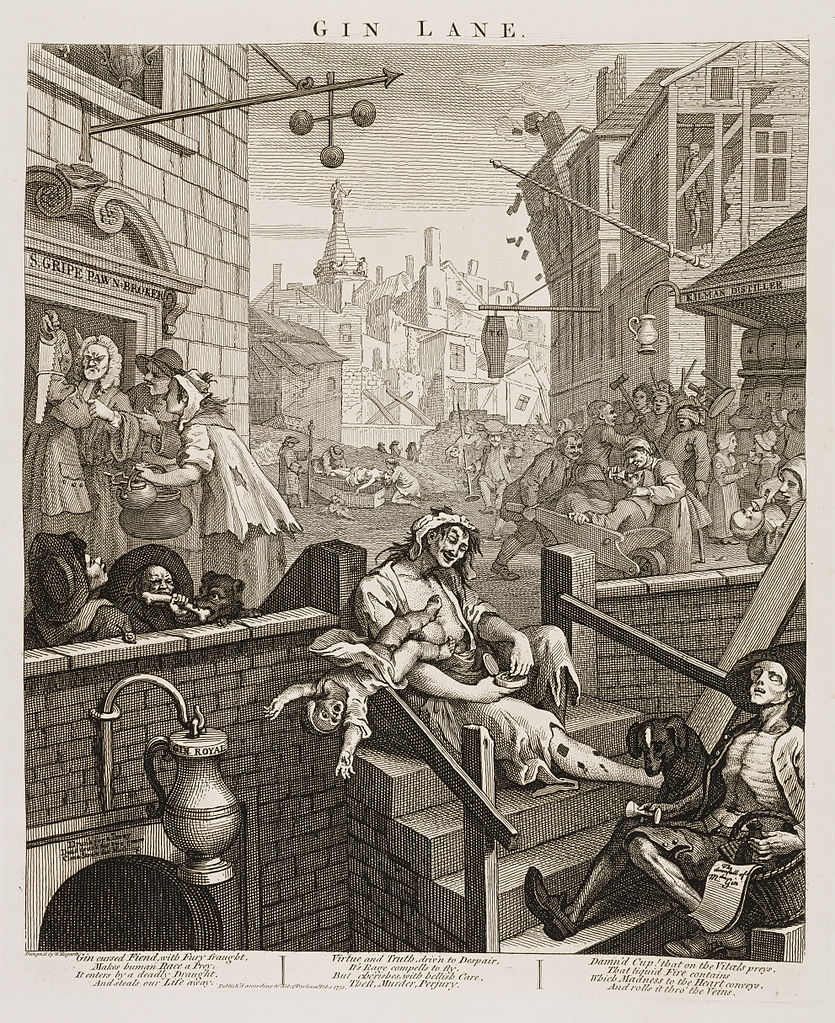
Gin Lane, from Beer Street and Gin Lane. A scene of urban desolation with gin-crazed Londoners, notably a woman who lets her child fall to its death and an emaciated ballad-seller; in the background is the tower of St George’s Bloomsbury.
The accompanying poem, printed on the bottom, reads:

Gin, cursed Fiend, with Fury fraught,
Makes human Race a Prey.
It enters by a deadly Draught
And steals our Life away.
Virtue and Truth, driv’n to Despair
Its Rage compells to fly,
But cherishes with hellish Care
Theft, Murder, Perjury.
Damned Cup! that on the Vitals preys
That liquid Fire contains,
Which Madness to the heart conveys,
And rolls it thro’ the Veins.

Wikimedia Commons.

The decadence and excess of the city is of a piece with puritanical restraint

William Wordsworth wrote:

They called Thee Merry England, in old time;
A happy people won for thee that name
With envy heard in many a distant clime;
And, spite of change, for me thou keep’st the same
Endearing title, a responsive chime
To the heart’s fond belief; though some there are
Whose sterner judgments deem that word a snare
For inattentive Fancy, like the lime
Which foolish birds are caught with. Can, I ask,
This face of rural beauty be a mask
For discontent, and poverty, and crime;
These spreading towns a cloak for lawless will?
Forbid it, Heaven! and Merry England still
Shall be thy rightful name, in prose and rhyme!

Merry England is an easily mocked concept in today’s society, but in my view it carries a perennial insight: that the decadence and excess of the city is of a piece with puritanical restraint. Both apparently opposite features reflect an urban sophistication and the ruling imperative of commerce. The moneymaking frenzy of cities like London gave rise to excessive consumption and the relaxing of prior moral and social norms. Yet the 17th century Puritans were in large part cityfolk, alienated from rural tradition and well represented amongst bankers, merchants and urban middle class trades and professions.

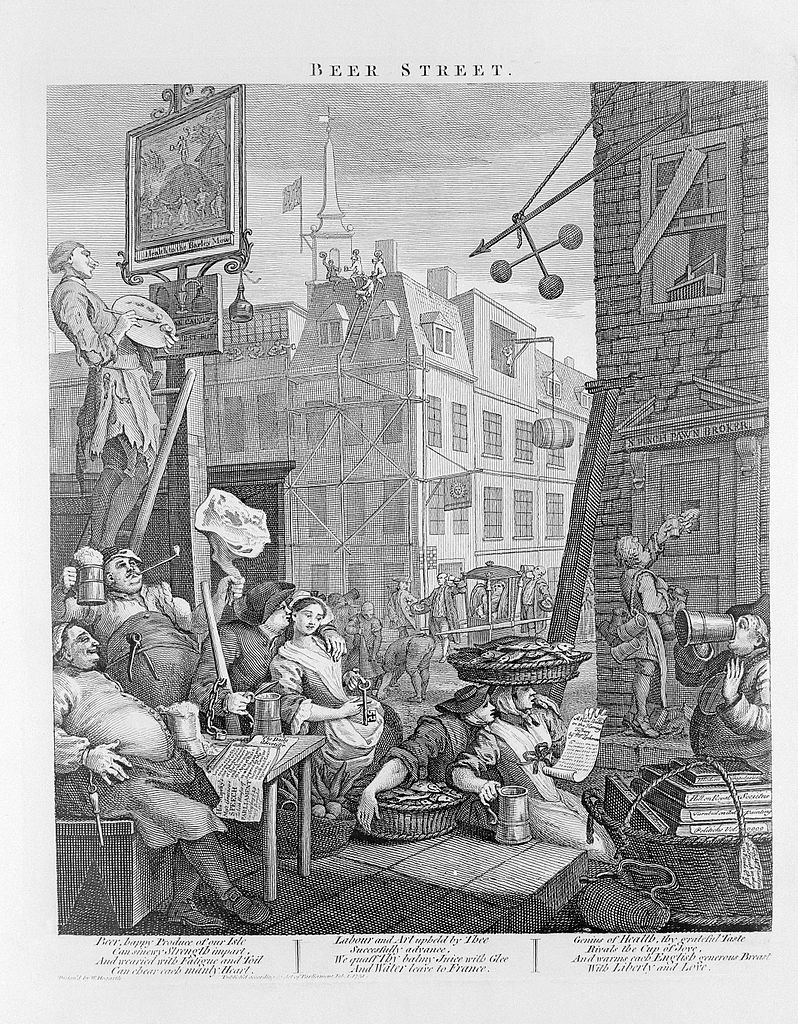
William Hogarth’s most famous engraving is Gin Lane, which shows a street filled with people immiserated by the gin craze, a child toppling out of its mother’s arms, emaciated figures dying in the open, madmen dancing with corpses, a pawn-shop with the grandeur of a bank eagerly sucking in objects of domestic industry and converting them into gin money. Less well known is the image that accompanied it, the engraving Beer Street. In this latter engraving, plump and prosperous individuals pause from their labour to receive huge foaming mugs of ale, buxom housemaids flirt with cheerful tipplers, bright inn signs are painted, buildings are going up, and the pawn-shop is going out of business.

Merry England is an image of a society centred on human life and happiness rather than the demands of commerce. Here labour and rest both have their place: noble objects like a fine building and a bounteous meal are provided by hard work, but once completed, time is devoted to appreciating and relishing the finished product. Decoration and adornment are the outward sign of this; they are by their nature a form of abundance. The finite object of labour and production thus gives rise to an infinite realm of feast, celebration, adornment and signification. This enchanted public sphere, shaped to the human person, is limitless within its limits, and points beyond itself to the truly limitless and eternal world of the transcendent.

In the commercially determined sphere of modernity, it is instead work and consumption that are rendered limitless. The objects have become entirely ones of consumption — there is no limit to the consumption of gin, which stands in for all consumer objects. Hogarth shows us the humane objects of household industry — the good cooking pots, the tongs, the saw and the kettle — replaced with money. Liquidity is everywhere, capital has broken down the social order, removing all distinctions of sex, age and class. Now all persons and all things are joined together by a single seamless system of predation.

The alternative that many advocated to this situation was embodied in the Temperance movement: a Puritan-dominated enterprise which saw drinking as a threat to industry as well as the spiritual and moral health of the nation. This is a deep tendency in the British character: the impulse to look upon poverty and distress as a culpable disease and to preach individual self-restraint as the cure. Puritans were often well-to-do, literate townspeople, whose collective refusal to participate in dancing, drama, drinking, gambling, racing and boxing not only set them apart from the boisterous lower orders, but also from the quaffing, hunting, hawking and whoring nobility.

A 4000 Year Old Recipe for the Babylonian New Year

Filed under: Food, History, Middle East, Religion — Tags: , , , — Nicholas @ 02:00

Tasting History with Max Miller
Published 29 Dec 2020

Help Support the Channel with Patreon: https://www.patreon.com/tastinghistory
Tasting History Merchandise: crowdmade.com/collections/tastinghistory

For further reading on these recipes visit: https://www.academia.edu/40639453/Foo…

Follow Tasting History here:
Instagram: https://www.instagram.com/tastinghist…
Twitter: https://twitter.com/TastingHistory1
Reddit: r/TastingHistory
Discord: https://discord.gg/d7nbEpy

Tasting History’s Amazon Wish List: https://www.amazon.com/hz/wishlist/ls…

LINKS TO INGREDIENTS & EQUIPMENT**
Canon EOS M50 Camera: https://amzn.to/3amjvwu
Canon EF 50mm Lens: https://amzn.to/3iCrkB8
Le Creuset Dutch Oven 7.25 qt: https://amzn.to/3mLkWJF

LINKS TO SOURCES**
https://www.academia.edu/40639453/Foo…
Gojko Barjamovic: https://nelc.fas.harvard.edu/people/g…
Myths from Mesopotamia translated by Stephanie Dalley: https://amzn.to/2Kvzr7b
Babylon by Paul Kriwaczek: https://amzn.to/37GJRJT
The Oldest Cuisine in the World by Jean Bottéro: https://amzn.to/2Jf1eIm
The Babylonian Akitu Festival by Svend Aage Pallis: https://amzn.to/2M5hZa7
The Babylonian New Year Festival by Karel Van Der Toorn: https://brill.com/view/book/edcoll/97…

**Amazon offers a small commission on products sold through their affiliate links, so each purchase made from this link, whether this product or another, will help to support this channel with no additional cost to you.

Editor: WarwicSN – https://www.youtube.com/WarwicSN
Subtitles: Jose Mendoza

DISH NAME
ORIGINAL c.1740BC RECIPE (From The Yale Babylonian Tablets)
Tuh’u sirum saqum izzaz me tukan lipia tanaddi tusammat tabatum sikara susikillum egegerum kisibirrum smidu kamunum alutum tukammas-ma karsum hazannum teterri kisibirrum ina muhhi sipki tusappah suhutinnu kisibirrum isarutu tanaddi.

Tuh’u. Lamb leg meat is used. Prepare water. Add fat. Sear. Add in salt, beer, onion, arugula, cilantro, samidu, cumin, and beets. Put the ingredients in the cooking vessel and add crushed leek and garlic. Sprinkle the cooked mixture with coriander on top. Add suhutinnu and fresh cilantro.

MODERN RECIPE
INGREDIENTS
– 1lb (450g) Leg of Lamb Chopped into bite size pieces.
– 3-4 Tablespoon Oil or Rendered Fat
– 1 ½ teaspoons Salt
– 2 Cups (475ml) Water
– 12 oz (350ml) Beer – (A sour beer and German Weissbier are recommended, but any non-hoppy beer will suffice)
– 1 Large Onion Chopped
– 2 Cups Arugula Chopped
– 3/4 Cup Cilantro Chopped
– 2 Teaspoons Cumin Seeds crushed
– 2 Large Beets (approx. 4 cups) Chopped
– 1 Large Leek Minced
– 3 cloves Garlic,
– 1 Tablespoon Dry Coriander Seeds
– Additional Chopped Cilantro for garnish
– Samidu* (Something akin to 1 Persian Shallot)
– Suhutinnu* (Something akin to Egyptian Leek for garnish)
*These ingredients have no definite translation; the shallot and leek are the best guesses of scholars at Yale and Harvard Universities)

METHOD
1. Add the oil/fat to a large pot and set over high heat. Sear the lamb for several minutes in the oil until lightly browned.
2. Add the onions and let cook for 5 minutes, then add the beets and let cook for 5 minutes. Then add the salt, beer, arugula, cilantro, samidu (shallot) and cumin and bring to a boil. Mash the garlic into a paste and mix with the leek, then add to the pot.
3. Lower heat to medium and let simmer for approximately 1 hour, or until the beets and meat are cooked to your liking.
4. Once cooked, dish it into a bowl and sprinkle with coriander seeds. Garnish with fresh cilantro and suhutinnu (leek)

PHOTO CREDITS
Crocus: By Safa.daneshvar – Own work, CC BY-SA 3.0, http://bit.ly/3hfNN7F
Statue of Nabu: By Osama Shukir Muhammed Amin FRCP(Glasg) – Own work, CC BY-SA 4.0, http://bit.ly/2KodVkV
Temple of Nabu at Borsippa: Osama Shukir Muhammed Amin FRCP(Glasg), CC BY-SA 4.0 https://creativecommons.org/licenses/…, via Wikimedia Commons
Ishtar Gate: Joyofmuseums, CC BY-SA 4.0 https://creativecommons.org/licenses/…, via Wikimedia Commons
King Marduk-zakir-shumi: By Osama Shukir Muhammed Amin FRCP(Glasg)Throne Dais of Shalmaneser III at the Iraq Museum.jpg, CC BY 4.0, http://bit.ly/3nMw22j

#tastinghistory #babylon #akitu

QotD: Heinlein’s “Crazy Years”, Alfred Korzybski’s General Semantics, and modern times

While Heinlein (as far as I know) supplied no rationale for the advent and the recession of the craziness in the Crazy Years, A.E. van Vogt was freer with his speculations: insanity, either of individuals or of peoples, in van Vogt’s stories (and perhaps in the theories of Alfred Korzybski, who discovered or invented General Semantics) is caused by a fracture or disjunction between symbol and object. When your thoughts, and the thing about which you think, do not match up on a cognitive level, that is a falsehood, a false belief. When the emotions associated with the thought do not match to the thing about which you think, that is a false-to-facts association, which can range from merely a mistake to neurosis to psychosis, depending on the severity of the disjunction. You are crazy. If you hate your sister because she reminds you of your mother who beat you, that association is false-to-facts, neurotic. If you hate your sister because you have hallucinated that you are Cinderella, that association is falser-to-facts, more removed from reality, possibly psychotic.

The great and dire events of the early Twentieth Century no doubt confirmed Korzybski in the rightness of this theory. Nothing prevents a race of people from contracting and fomenting a false-to-facts belief: the fantasies of the Nazi Germans, pseudo-biology and pseudo-economics combined with the romance of neo-paganism, stirred the psyche of the German people for quite understandable reasons. From the point of view of General Semantics, the Germans had divorced their symbols from reality, they mistook metaphors for truth, and their emotions adapted to and reinforced the prevailing narrative. They told themselves stories about Wotan and the Blood, about being betrayed during the Great War, about needing room to live, about the wickedness of Jewish bankers and shopkeepers, about the origin of the wealth of nations — and they went crazy.

The Russians, earlier, and for equally psychological and psychopathic reasons told themselves a more coherent but more unreal story about history and destiny, taken from a Millenarian cultist named Marx, and they were, on an emotional level even if not on a cognitive level, convinced that shedding the blood of millions would bring about wealth as if from nowhere. And, because they used the word “scientific” to describe their brand of socialism, they actually thought their play-pretend neurotic story was a scientific theory that had been discovered by rigorous ratiocination — and they went crazy.

Berlin was bombed into submission during the Second World War, and the Berlin Wall collapsed along with the Soviet Empire at the end of the Cold War. But the modern methods of erecting false-to-facts dramas appealing to mass psychology, once discovered, did not fall when their practitioners fell: scientific socialism, naziism, fascism, communism, all have in common the subordination of word-association to political will. All these doctrines have a common ancestor, which is the social engineering theory of language: if you change the connotation of word, so the theory runs, you change the connotations of thoughts. General Semantics says that if an individual, or whole people en mass, adopt deliberately false beliefs, supported by deliberately manipulative word-uses, he or they will have increasingly unrealistic and maladaptive behaviors. Introduce Political Correctness, ignore factual correctness, and the people will go crazy.

The main sign of when madness has possessed a crowd, or a civilization, is when the people are fearful of imaginary or trivial dangers but nonchalant about real and deep dangers. When that happens, there is gradual deterioration of mores, orientation, and social institutions — the Crazy Years have arrived.

John C. Wright, “The Crazy Years and their Empty Moral Vocabulary”, John C. Wright, 2019-02-18.

December 31, 2021

German Artillery Shells Paris Into Submission I GLORY & DEFEAT

Real Time History
Published 30 Dec 2021

Sign up for Curiosity Stream and get Nebula bundled in and SAVE 26%: https://curiositystream.com/realtimeh…

The new year 1871 is about to bring upon a new German Empire. German leadership, especially Bismarck, is exceedingly frustrated with the dragged out Franco-Prussian War that the Germans have all but won for months now. The decision is finally made to bombard Paris into submission and the German guns surrounding Paris open fire.

» THANK YOU TO OUR CO-PRODUCERS
John Ozment, James Darcangelo, Jacob Carter Landt, Thomas Brendan, Kurt Gillies, Scott Deederly, John Belland, Adam Smith, Taylor Allen, Rustem Sharipov, Christoph Wolf, Simen Røste, Marcus Bondura, Ramon Rijkhoek, Theodore Patrick Shannon, Philip Schoffman, Avi Woolf,

» OUR PODCAST
https://realtimehistory.net/podcast – interviews with historians and background info for the show.

» LITERATURE
Arand, Tobias: 1870/71. Der Deutsch-Französische Krieg erzählt in Einzelschicksalen. Hamburg 2018

Bourguinat, Nicolas and Gilles Vogt: La guerre franco-allemande de 1870. Une histoire globale. Paris 2020

Gouttman, Alain: La grande défaite. 1870-1871. Paris 2015

https://www.volksbund.de/nachrichten/… (zuletzt besucht am 21.11.2021)

» SOURCES
Allorant, Salomé u.a. (Hrsg.): La République au défi de la guerre. Lettres et carnet de lAnnée terrible (1870-1871). Amiens 2015

Goncourt, Edmond de: Journal des Goncourts. II.1. 1870-1871. Paris 1890

Hérisson, Maurice d’: Journal d’un officier d’ordonnance. Paris 1885

Meisner, Heinrich Otto (Hrsg.): Kaiser Friedrich III. Kriegstagebuch von 1870/71. Berlin, Leipzig 1926

N. N. (Htrsg.): Bismarcks Briefe an seine Gattin aus dem Kriege 1870-71. Stuttgart, Berlin 1903

Pflugk-Hartung; Julius von: Krieg und Sieg 1870-71. Bd. I. Kulturgeschichte. Berlin 1896

Schikorsky, Isa (Hrsg.): “Wenn doch dies Elend ein Ende hätte”. Ein Briefwechsel aus dem Deutsch-Französischen Krieg 1870/71. Köln, Weimar, Wien 1999

Zeitz, Karl: Kriegserinnerungen eines Feldzugsfreiwilligen aus den Jahren 1870 und 1871. Altenburg 1905

» OUR STORE
Website: https://realtimehistory.net

»CREDITS
Presented by: Jesse Alexander
Written by: Cathérine Pfauth, Prof. Dr. Tobias Arand, Jesse Alexander
Director: Toni Steller & Florian Wittig
Director of Photography: Toni Steller
Sound: Above Zero
Editing: Toni Steller
Motion Design: Philipp Appelt
Mixing, Mastering & Sound Design: http://above-zero.com
Maps: Battlefield Design
Research by: Cathérine Pfauth, Prof. Dr. Tobias Arand
Fact checking: Cathérine Pfauth, Prof. Dr. Tobias Arand

Channel Design: Battlefield Design

Contains licensed material by getty images
All rights reserved – Real Time History GmbH 2021

Let the Hunger Games Begin – WAH 049 – December 1942, Pt. 2

Filed under: China, Europe, Germany, History, India, Military, WW2 — Tags: , , , , — Nicholas @ 04:00

World War Two
Published 30 Dec 2021

The world learns more details of the War Against Humanity in Occupied Poland, while in China and India starvation looms.
(more…)

Hogmanay Shortbread from 1779

Filed under: Britain, Food, History — Tags: , , , — Nicholas @ 02:00

Tasting History with Max Miller
Published 28 Dec 2021

Use my exclusive link here https://cen.yt/TastingHistory5 to get $15 off your first three bags.

Support the Channel with Patreon ► https://www.patreon.com/tastinghistory
Merch ► crowdmade.com/collections/tastinghistory
Instagram ► https://www.instagram.com/tastinghist…
Twitter ► https://twitter.com/TastingHistory1
Tiktok ► TastingHistory
Reddit ► r/TastingHistory
Discord ► https://discord.gg/d7nbEpy
Amazon Wish List ► https://amzn.to/3i0mwGt

Send mail to:
Tasting History
PO Box 766
Burbank, CA 91503

LINKS TO SOURCES**
Cookery, and Pastry, as Taught and Practised by Mrs Maciver by Susanna Maciver: https://amzn.to/3EmSPcm
The Little Book of Hogmanay by Bob Pegg: https://amzn.to/30RAmqO

**Some of the links and other products that appear on this video are from companies which Tasting History will earn an affiliate commission or referral bonus. Each purchase made from these links will help to support this channel with no additional cost to you. The content in this video is accurate as of the posting date. Some of the offers mentioned may no longer be available.

Subtitles: Jose Mendoza | IG @ worldagainstjose

PHOTO CREDITS
Shortbread fingers: Dave Souza – Own work, CC BY-SA 2.5, https://commons.wikimedia.org/w/index…
Black Bun: IMBJR, CC BY-SA 3.0 https://creativecommons.org/licenses/…, via Wikimedia Commons

MUSIC CREDIT
“Achaidh Cheide – Celtic” by Kevin MacLeod is licensed under a Creative Commons Attribution 4.0 license. https://creativecommons.org/licenses/…
Source: http://incompetech.com/music/royalty-…
Artist: http://incompetech.com/

#tastinghistory #hogmanay #shortbread

QotD: Justin Trudeau … “virtue-signalling made flesh”

Filed under: Cancon, Media, Politics, Quotations — Tags: , , , — Nicholas @ 01:00

Are there any photos of Canadian PM Justin Trudeau where he isn’t in blackface? I’m struggling to remember the last time I saw one. There he was again yesterday, this wokest of world leaders, this darling of centrist Twitter, covered in black facepaint and sticking his tongue out. You know, like those dark-skinned foreigners do. The pic is from an Arabian Nights fancy-dress party – man, the bourgeoisie are weird – that Trudeau attended in 2001, when he was 29. Twenty-nine. If you’re on the cusp of 30, at the dawn of this new millennium, and you still don’t know it’s wrong to don blackface, there’s something wrong with you.

This is only the latest in a long line of Trudeau blackface scandals, of course. The man appears to have spent a significant chunk of his younger years blacked up. There are three blackface incidents that we know of. There could be more. As one headline put it: “Trudeau says he can’t recall how many times he wore blackface make-up.” Imagine blacking up so often you can’t remember all the times you did it. Trudeau’s defenders say it was youthful daftness. Really? I don’t know a single person who has ever blacked up. I know people who have done daft things, of course. But not that.

Trudeau’s penchant for blackface is very odd. He puts it down to the fact that he has always been “more enthusiastic about costumes than is sometimes appropriate“. Riiight. It is mostly a matter for Mr Trudeau and his conscience, of course, as to why he was black-painting his face – and, in one incident, his tongue too – well into his twenties. But it’s a matter for all of us who inhabit the online world as to why Trudeau has never been cancelled, or even seriously threatened with cancellation, for doing something that would be ferociously denounced as racist if anyone else on earth had done it.

Brendan O’Neill, “The never-ending ridiculousness of Justin Trudeau”, Spiked, 2021-09-21.

December 30, 2021

The Cursus Honorum of the late Roman Republic

Filed under: Bureaucracy, Europe, Government, History — Tags: , , , , — Nicholas @ 05:00

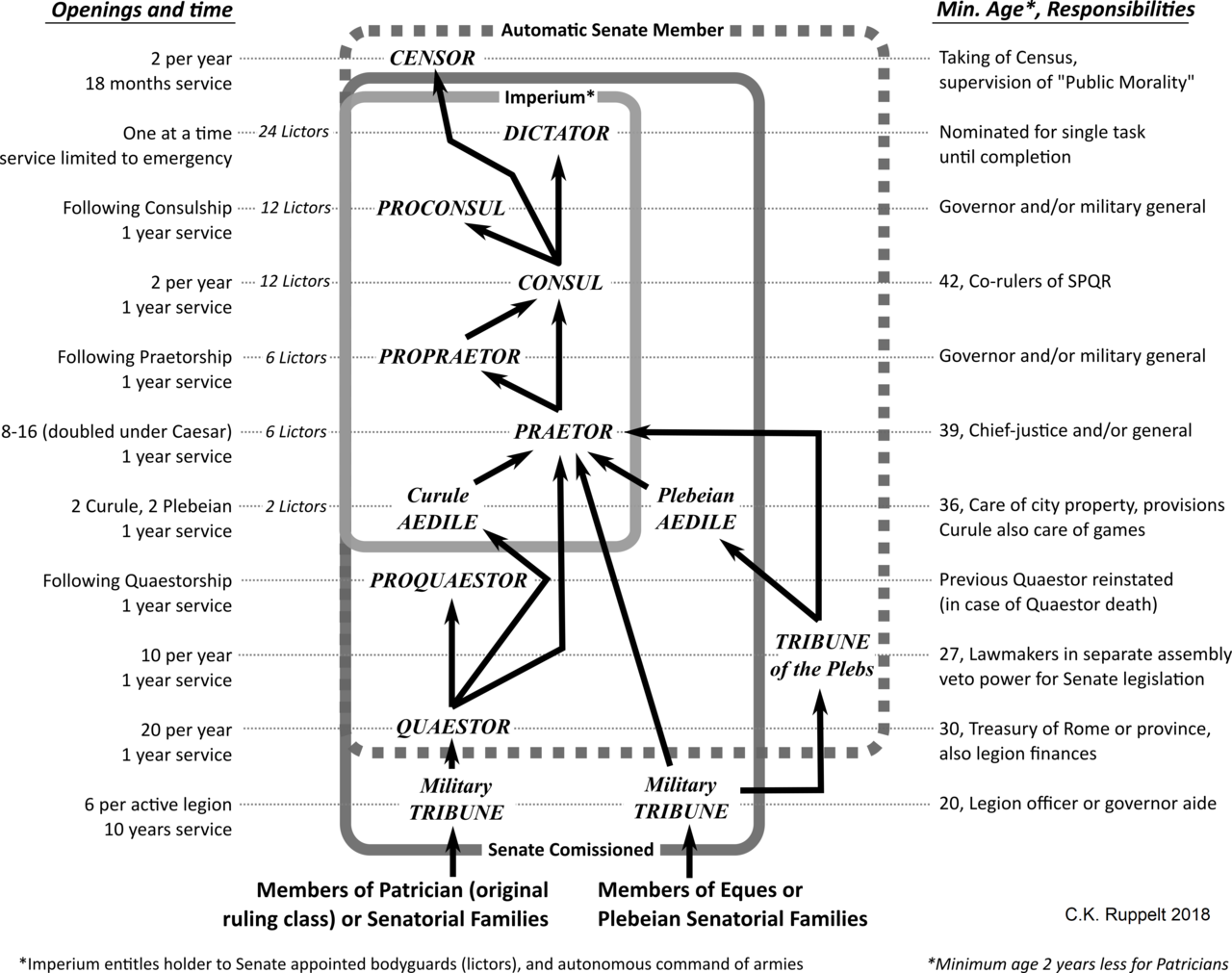
At Founding Questions, Severian notes that the Cursus Honorum — the formal “career path” for ambitious men in the late Roman Republic was a remarkably effective process … that ended up being a victim of its own success:

Ahhh, God bless the autists at Wiki, they’ve got it down to a chart:

This is from Caesar’s time, and since one of this blog’s main themes is the confusion between process and outcome, let’s put it right up front: This system, the cursus honorum, was designed to produce men like Julius Caesar …

… and you can take that in either sense.

Caesar is one of the most mulled-over men in history, but nobody seriously doubts that he was at least competent at pretty much everything. Maybe he didn’t make the big list of “Greatest Pontifices Maximi” (or however the Latin goes), but he wasn’t a disgrace to the toga, either. If it was a public function in the Late Roman Republic, Caesar was at least decent at it.

And that’s what the cursus honorum was designed to do. It was a three-fer: It gave you competent public officials, but it also gave young ruling class men some seasoning. Most importantly, it was a way of nurturing talent that also hedged against the Peter Principle. If you want to argue that that makes it a four-fer, go nuts, but the point is, it was a pretty good system … up to a point, and if you’re a regular reader, you know what that point is: The Dunbar Number, at which point relationships become too complex to be managed personally, and bureaucratic structures replace them.

One wishes later governments had something like this — if a guy starts out as a quaestor and discovers he can’t handle it, he’ll bring that knowledge with him to the Senate. (Of course, if he can’t even manage to get elected to that, he’ll know full well his level of talent, and he’ll sit down and shut up on the Senate’s back benches). Note too that the bottom rung is military service — since at that time legionaries were all militia, the voters got a good look at you where it really matters, right from the beginning.

By the time a man reaches the top, then, he has intimate experience of ALL the public offices. Not only that, but he’s well known to everyone who matters, since in between the various offices he’s in the Senate, making connections (or out in the provinces, making other — but no less valuable — connections). A consul, then, is pretty much by definition omnicompetent. He did a good enough job in all the previous public offices that he didn’t disqualify himself for the top slot. Also, he’s been thoroughly vetted — everyone who matters, at pretty much every level of society, has had a good look at him (or, at worst, has a good friend who has had a good look at him).

Obviously it wasn’t a perfect system. Rome had her share of inept consuls, because people are people and sometimes “promotion to your level of incompetence” means “promotion to the very top job”. But for the most part it worked well, and even if a guy turned out to be a dud as consul, well, what can you do? Everyone had at least a reasonable expectation that he’d be able to handle it, which is pretty much the best one can consistently achieve in human affairs. Not only that, but because of the candidate’s long experience and careful vetting, you had a much better than average chance of getting a real winner …

… a man like Caesar, who is at minimum competent at everything, and outstanding at lots of things.

The Story Of Sir Arthur Currie: From Gunner To General | The Great War With Norm Christie | Timeline

Timeline – World History Documentaries
Published 28 Dec 2021

Military historian Norm Christie presents a four-part series examining the First World War from a Canadian perspective. As he begins his journey through the historic battlefields of France and Belgium, Christie focuses on the career of General Sir Arthur Currie, a soldier who rose through the ranks from humble gunner in 1897 to lead the Canadian Corps to several victories during the conflict which began in 1914.

📺 It’s like Netflix for history… Sign up to History Hit, the world’s best history documentary service and get 50% off using the code ‘TIMELINE’ http://bit.ly/3a7ambu

You can find more from us on:

https://www.instagram.com/timelineWH

Any queries, please contact owned-enquiries@littledotstudios.com

Note: The original YouTube title said “from Gunman to General”. Perhaps in British usage, “gunman” is a variant of “gunner” (an artilleryman), but in Canadian usage the word “gunman” almost invariably means armed criminal or terrorist, and while Sir Arthur’s career had its difficulties, he was never a criminal.

HogmaNO! Scottish government warns Scots not to cross the border to celebrate Hogmanay

Filed under: Britain, Government, Health — Tags: , , , , , , — Nicholas @ 03:00

In Scotland, one of the traditions of the winter is Hogmanay (spelled umpteen different ways), the last day of the old year, but Scottish public health and government officials are trying to keep the Scots away from the English border this year:

Scots have been urged not to travel to England for new year celebrations to get around the more stringent Covid-19 restrictions north of the border.

There is no travel ban currently in place to stop people going to England, where nightclubs are still open.

But Deputy First Minister John Swinney said doing so would go against the “spirit” of Scottish Covid-19 measures.

He said travelling would be “the wrong course of action” due to the “serious situation” with the Omicron variant.

Case numbers in Scotland hit “alarming” record highs over Christmas and Boxing Day, with the faster-spreading strain now accounting for the majority of all infections.

First Minister Nicola Sturgeon — who is to update MSPs in a virtual sitting of the Scottish Parliament on Wednesday afternoon — said she expected the figures to rise even more in the days ahead.

Scots have been encouraged to stay at home as much as possible, and to limit any social gatherings to no more than three households.

Large events such as Edinburgh’s traditional Hogmanay street party have been cancelled, with extra curbs in hospitality settings and nightclubs shut down entirely.

Clubs remain open south of the border, where no new restrictions are being imposed, but Mr Swinney told BBC Breakfast that he would “discourage” anyone from travelling to England to see in the new year.

He said: “People are free to make their own judgments. But what we have got recognise is that Omicron is a serious threat to absolutely everybody within our society and we have all got to take measures to protect ourselves by limiting our social contacts and connections and by complying with the restrictions we have in place.

Despite the Scottish government’s warnings, English pubs along the (currently) undefended border are expecting over a hundred thousand thirsty Scots to invade on the 31st:

English border pubs are expecting upwards of 100,000 Scottish and Welsh revellers to cross into England on New Year’s Eve amid mounting anger at Nicola Sturgeon and Mark Drakeford for cracking down on festivities.

The Army’s Labor Union: Winchester 94s for the Loyal Legion of Loggers & Lumbermen

Filed under: History, Military, USA, Weapons, WW1 — Tags: , , , , , , — Nicholas @ 02:00

Forgotten Weapons
Published 30 Aug 2021

http://www.patreon.com/ForgottenWeapons

https://www.floatplane.com/channel/Fo…

Cool Forgotten Weapons merch! http://shop.forgottenweapons.com

Today we have a rifle from a really neat forgotten corner of American military history. During World War One, the Pacific Northwest was the source of prime lumber, in particular Sitka Spruce that was ideal for aircraft production. The US military wanted that spruce for its own aircraft, and there was also massive demand from France and the UK for their production as well. As part of the American war effort, the Signal Corps (which oversaw military aviation) set about increasing spruce production severalfold.

The Corps sent a Colonel to investigate what would be necessary to do this, and he found that logging work was being significantly disrupted by labor union organizing, ranging from strikes to active sabotage. In response, the Army essentially created its own labor union, the Loyal Legion of Loggers and Lumbermen which both provided some of the labor reforms sought by groups like the IWW and also succeeded in massively increasing timber output for the war. The LLLL is a mostly-forgotten organization, and most of the documentation on it is from very left-wing organizations that paint it as a government attempt to quash labor rights. The reality appears to be far more nuanced, with several very legitimate reforms instituted in good faith. Unfortunately, the best reference on this period is completely out of print, Soldiers and Spruce: Origins of the Loyal Legions of Loggers & Lumberman by Harold Hyman (https://amzn.to/3lErrRC).

At any rate, part of the effort included the creation of the Spruce Production Division — 25,000 soldiers (mostly with backgrounds in logging and lumber) to Vancouver. They were seconded to private logging companies with Army-subsidized wages, but retained a military structure and officer corps. The Signal Corps purchased about 1,800 Winchester Model 1894 rifles in .30-30 caliber to arm a segment of the Division for security and military police type duties. Winchester 94s were in production and readily accessible, and the Division’s mission did not justify giving them Enfield or Springfield rifles needed by troops in Europe. These Winchesters were marked with a “US” property stamp and flaming bomb, and had serial numbers between 835,000 and 853,000 (specific numbers are not known because Winchester’s records form this period were destroyed). When the war ended, the guns (along with the Division’s other equipment) were sold as surplus, and they are found to this day in the Northwest. Many are in poor condition from decades of hard use, and they can be difficult to identify (and are also faked …) but they are a really neat artifact of a long-forgotten part of World War One history.

Contact:
Forgotten Weapons
6281 N. Oracle 36270
Tucson, AZ 85740

« Newer PostsOlder Posts »

Powered by WordPress