
Drachinifel
Published 26 Feb 2020A quick look at the origins of a vital part of the ship’s maintenance crew, and some notable examples.
(more…)
September 23, 2022
A Short History of Ships Cats – Floating Felines, Maritime Moggies and Kleptomaniac Kittens
Comments Off on A Short History of Ships Cats – Floating Felines, Maritime Moggies and Kleptomaniac Kittens
QotD: Ron DeSantis for Caesar?
Oswald Spengler suggests that we’re in for a period of Caesarism, which is warlord rule that maintains the trappings of the old system. It might be as simple as [Mussolini]’s old litmus test: Do the trains run on time? But, since this is Clown World, fake and gay: Are the lights on for more than two days running?
Ron DeSantis, for example, has gotten a lot of Grillers’ panties moist, and while that’s one of the strongest possible arguments for the proposition that he’s just another Swamp Thing — Ace of Normies might not remember how hard he used to squeeeee for fucking Paul Ryan, but I do — it’s nonetheless true that Ron DeSantis has acted at least kinda sorta like … what’s the word?
Ah yes: An adult.
Ron DeSantis’s response to Covid was pretty much exactly what even the most flaming moonbat liberal governor would’ve done as late as 1990, because there were still some grownups in politics back then. Now that the entire Swamp is filled with autistic Mean Girls with PMS, the State can’t carry out even its most basic functions. Governors still have real power […], and there are a few of them that aren’t totally retarded, and so I’d imagine we’ll see a period of retail-level Caesarism — the lights are on three days a week in Nebraska; quick, everybody load up the Conestoga wagon and head for Omaha!
Severian, “Friday Mailbag”, Founding Questions, 2022-06-17.
Comments Off on QotD: Ron DeSantis for Caesar?
September 22, 2022
RAF Coastal Command vs U-Boats
The History Guy: History Deserves to Be Remembered
Published 5 Oct 2020The contest between aircraft and U-Boats during the Second World War was one of competing technological innovations, culminating with a decisive struggle in the summer of 1943. The History Guy tells the forgotten story of the development of anti-submarine warfare and the contest between the aircraft of RAF Coastal Command and U-Boats of the Kriegsmarine in the Bay of Biscay.
(more…)
Comments Off on RAF Coastal Command vs U-Boats
Waking – or shaking – NATO’s freeloaders (like Canada)
CDR Salamander has a proposal to encourage cheapskate freeloaders like Justin Trudeau’s Canada (although it didn’t start with him … Canada has been freeloading militarily since the early 1970s) to take on more like a fair share of NATO’s needs:
President Vladimir Putin on Wednesday ordered Russia’s first mobilisation since World War Two and backed a plan to annex swathes of Ukraine, warning the West he was not bluffing when he said he’d be ready to use nuclear weapons to defend Russia.
In the biggest escalation of the Ukraine war since Moscow’s Feb. 24 invasion, Putin explicitly raised the spectre of a nuclear conflict, approved a plan to annex a chunk of Ukraine the size of Hungary, and called up 300,000 reservists.
This should not be a shock to anyone. If it is, perhaps you should consider investing your time in cat-blogging.
It should bring to the front that NATO can no longer allow unserious nations to play like they are anything but security free-riders. They need to contribute their fair share or pay some consequence. Alliances have benefits and responsibilities. You should not have one without the other.
While percentage of GDP is an imperfect measure of contribution, it is better than all the other ones. It is as simple benchmark of national effort.
As these are the best numbers we have, let’s look at 2021 and then forward.
It is amazing that after all Russia has shown Western Europe — both of its nature and the nature of modern warfare — that so many of our NATO allies continue to slow walk defense spending, doing the very minimum to be a full and fair partner in the alliance.
Russian victory — however they define it — or Russian defeat — however Ukraine defines it — will not change the geography or nature of Russia. She is not going anywhere.
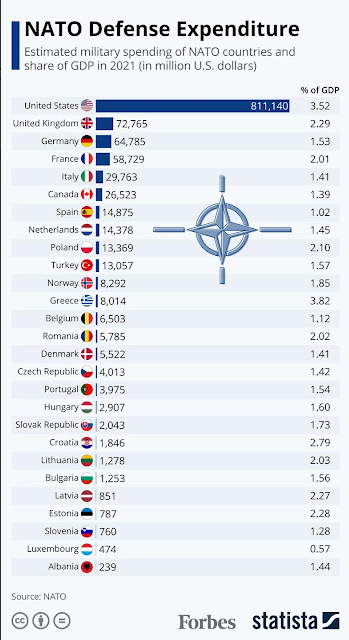
So, what’s to be done to encourage nations like Canada to put up or shut up? This might help:
“Out years” are where dragons live, so anyone not on guide-slope to 2%+ by the end of 2023 – when one way or another the Russo-Ukrainian War should be over – will find someway to not get there in a wave of excuses and bluffing.
We should call their bluff.
As such, and this is generous, we need to finally pursue PLAN SALAMANDER for NATO “Flags-to-Post” that I first proposed almost six years ago.
In NATO, General and Flag Officer billets are distributed amongst nations in a rather complicated way, but this formula is controlled by NATO – and as such – can be changed.
Entering argument: take the present formula for “fair distribution” and multiply by .75 any nation that spends 1.5% to 1.99% GDP on defense. Multiply by .5 any nation that spends between 1.25% to 1.499%. Multiply by .25 1.0% to 1.240%. If you fall below 1%, you get nothing and your OF5 (Col./Capt) billets are halved.
1.25x for 2.01%-2.25%. 1.5X for 2.26%-2.75%; 1.75x for 2.76% -3.0%. 2x for +3.01%.
The math gets funky when a lot of people get over 2%, but we can refine it later. Doesn’t cost a penny and will unquestionably get the attention of those nations. Trust me on this. By January 1st, 2024 no more excuses. A small and symbolic punishment, but a good start that may be all that is needed. This is not the second half of the 20th Century any more.
Comments Off on Waking – or shaking – NATO’s freeloaders (like Canada)
Why Electronic Voting Is Still A Bad Idea
Tom Scott
Published 9 Dec 2019We still shouldn’t be using electronic voting. Here’s why.
(more…)
Comments Off on Why Electronic Voting Is Still A Bad Idea
California’s Central Valley of despair
At Astral Codex Ten, Scott Alexander wonders why California’s Central Valley is in such terrible shape — far worse than you’d expect even if the rest of California is looking a bit curdled:

Here’s a topographic map of California (source):
You might notice it has a big valley in the center. This is called “The Central Valley”. Sometimes it also gets called the San Joaquin Valley in the south, or the the Sacramento Valley in the north.
The Central Valley is mostly farms — a little piece of the Midwest in the middle of California. If the Midwest is flyover country, the Central Valley is drive-through country, with most Californians experiencing it only on their way between LA and SF.
Most, myself included, drive through as fast as possible. With a few provisional exceptions — Sacramento, Davis, some areas further north — the Central Valley is terrible. It’s not just the temperatures, which can reach 110°F (43°C) in the summer. Or the air pollution, which by all accounts is at crisis level. Or the smell, which I assume is fertilizer or cattle-related. It’s the cities and people and the whole situation. A short drive through is enough to notice poverty, decay, and homeless camps worse even than the rest of California.
But I didn’t realize how bad it was until reading this piece on the San Joaquin River. It claims that if the Central Valley were its own state, it would be the poorest in America, even worse than Mississippi.
This was kind of shocking. I always think of Mississippi as bad because of a history of racial violence, racial segregation, and getting burned down during the Civil War. But the Central Valley has none of those things, plus it has extremely fertile farmland, plus it’s in one of the richest states of the country and should at least get good subsidies and infrastructure. How did it get so bad?
First of all, is this claim true?
I can’t find official per capita income statistics for the Central Valley, separate from the rest of California, but you can find all the individual counties here. When you look at the ones in the Central Valley, you get a median per capita income of $21,729 (this is binned by counties, which might confuse things, but by good luck there are as many people in counties above the median-income county as below it, so probably not by very much). This is indeed lower than Mississippi’s per capita income of $25,444, although if you look by household or family income, the Central Valley does better again.
Of large Central Valley cities, Sacramento has a median income of $33,565 (but it’s the state capital, which inflates it with politicians and lobbyists), Fresno of $25,738, and Bakersfield of $30,144. Compare to Mississippi, where the state capital of Jackson has $23,714, and numbers 2 and 3 cities Gulfport and Southhaven have $25,074 and $34,237. Overall Missisippi comes out worse here, and none of these seem horrible compared to eg Phoenix with $31,821. Given these numbers (from Google), urban salaries in the Central Valley don’t seem so bad. But when instead I look directly at this list of 280 US metropolitan areas by per capita income, numbers are much lower. Bakersfield at $15,760 is 260th/280, Fresno is 267th, and only Sacramento does okay at 22nd. Mississippi cities come in at 146, 202, and 251. Maybe the difference is because Google’s data is city proper and the list is metro area?
Still, it seems fair to say that the Central Valley is at least somewhat in the same league as Mississippi, even though exactly who outscores whom is inconsistent.
Comments Off on California’s Central Valley of despair
QotD: In my 20s … and in my 40s
Me in my 40s: Sleeps with head at slightly different angle than usual. Spends 3 weeks taking painkillers for neck pain whilst sobbing and wondering if my life will ever be the same again.
Amanda (@Pandamoanimum), Twitter, 2022-06-13.
Comments Off on QotD: In my 20s … and in my 40s
September 21, 2022
Jonathan Kay on cultural appropriation
In Quillette, Jonathan Kay put together “a somewhat lengthy manifesto” on the topic of cultural appropriation in response to a request from Robert Jago who wanted to do an interview with Kay on this issue:
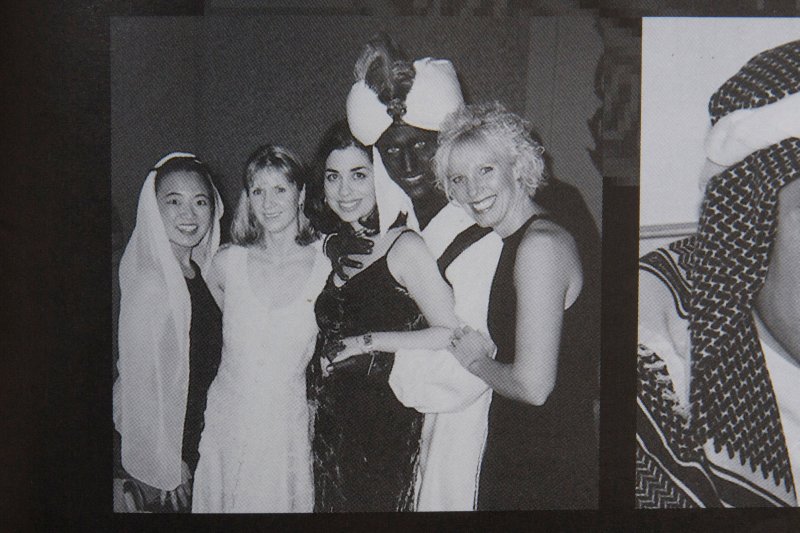
Justin Trudeau (Canada’s most prolific cultural appropriator) with dark makeup on his face, neck and hands at a 2001 “Arabian Nights”-themed party at the West Point Grey Academy, the private school where he taught.
Photo from the West Point Grey Academy yearbook, via Time
“Cultural appropriation” typically gets defined in a way that depends on whether one is defending it or denouncing it. If you’re defending it, you prefer to look at the big picture: Every new kind of art form, literary genre, style of dress, or cuisine typically represents a mix of inherited and borrowed elements. Shakespeare’s sonnets were written in an Iambic pentameter that Chaucer had “appropriated” from the French and Italians. So if Indigenous or African poets want to appropriate it from the English, no one has any basis for complaint. If you define cultural appropriation in this big-picture way, the concept isn’t just permissible. It’s artistically necessary, and indeed inevitable.
But if you’re denouncing cultural appropriation, on the other hand, the argument is more persuasive when your frame of reference is small, local, and community-rooted. I’m thinking of the (white) novelist or film director who passes through a region, and hears some garbled version of folklore that relates to a nearby Indigenous community. The guy thinks, “Oh wow, that’ll make a great novel” (or TV show, movie, etc.), and then makes a mint without consulting (let alone cashing in) the Indigenous community.
So the debate over cultural appropriation is like a lot of debates: It’s really easy to win if you get to define the terms. And since both sides pick definitions that suit them, it can become a dialogue of the deaf.
Indeed, there’s often no dialogue at all. Rather, both sides are apt to retreat into apocalyptic language about, respectively, (a) totalitarian censorship, and (b) white supremacist (cultural) genocide. This is absolutist language that leaves no room for nuance or discussion.
The cultural-universalism side of this dialogue is represented by people like me. I write about every topic under the sun, and so I get my back up when someone tells me that I’ve got to “stay in my lane”. My whole career is built around hopscotching from one idea to the next without worrying (much) about who gets offended. For me, the imposition of rules on what people are allowed to write about isn’t just an annoyance. It’s an existential threat to the creative faculties.
But if you’re on the other end of this — say, you’re a member of a small Indigenous community whose history and folklore have yet to be recorded or celebrated in any definitive form — you don’t care about some white guy in Toronto whining about how he can’t do the equivalent of wearing a sombrero on Cinco de Mayo. A small First Nations community might get only one real shot at telling its story to the world. If that shot gets used up by an outsider who strip-mines the locals’ oral history for a bestseller, that can no doubt feel like existential threat to one’s cultural autonomy. It’s like: “So you took our land, punished us for using our own language, sent our kids to residential schools, and now all we really have left is our culture, and you want to steal that, too?”
There’s this trite expression that often gets trotted out these days: Intent doesn’t matter, only the harm you cause. But of course, intent does matter. And if an author, director, or artist intends to respectfully and accurately include a community’s story in his or her work, then, for me, that’s very much a mark in their favour. That said, I absolutely do not think that this means there is an obligation to “honour” or “uplift” the community in question — let alone express “solidarity” or “allyship” with them. Doing so means you’re writing activist propaganda. What I mean, rather, is that you shouldn’t be intending to mock or belittle whole swathes of humanity.
The problem is that, in Canadian cultural circles at least, this isn’t really the standard that’s applied. I’ve spoken to a number of Canadian writers who, out of the best of intentions, invest their own funds in “sensitivity readers” — a process that can be not only expensive and time-consuming, but also creatively ruinous, since these consultants often are bursting with ideas about how to turn your novel or movie into a specimen of the above-referenced activist propaganda. I know one woman, in particular — a novelist — who appeared before a First Nations tribal council, and got its official permission to include a character in her book whose identity related to their community. But then a community member, someone not even involved with the band leadership, went after the woman and tried to smear her as racist. This is after she’d dotted every I and crossed every T of the sensitivity-reader process.
Comments Off on Jonathan Kay on cultural appropriation
The Medieval Saint Diet
Tasting History with Max Miller
Published 20 Sep 2022
(more…)
Comments Off on The Medieval Saint Diet
Pierre Poilievre’s (very modern) modern family
In The Line, Rahim Mohamed discusses how the Poilievre family makes it difficult for Liberal propagandists to portray Poilievre as some sort of ultra-nationalist white supremacist (as they clearly would if they could):

Pierre and Ana Poilievre at a Conservative leadership rally, 21 April, 2022.
Photo by Wikipageedittor099 via Wikimedia Commons.
This is a critical moment for any new party leader. Poilievre need only look at his most immediate predecessor, Erin O’Toole, for an example of how quickly it can go wrong. After tacking to the right of rival Peter MacKay to win the party’s 2020 leadership race, O’Toole pivoted sharply to the centre once Conservative party leader, courting labour unions, calling himself a “progressive conservative” and backtracking on a promise to protect the conscience rights of pro-life doctors and nurses. O’Toole’s “authenticity problem” remained a storyline throughout his rocky tenure at the helm of the Conservative party.
Poilievre executed, successfully, an uncommonly combative and partisan frontrunner campaign, making any notion of a centrist pivot a total non-starter. He has tacked even further to the right than O’Toole did as a leadership candidate: branding moderate rival Jean Charest “a Liberal”, sparring with Leslyn Lewis over who supported this winter’s convoy protests first, leading “defund the CBC” chants at his rallies; and, perhaps most brazenly, promising to bar federal ministers from attending the World Economic Forum (a bête noire of far-right conspiracy theorists).
So how will Poilievre (re-)introduce himself to Canadian voters? If his first week as Conservative party leader is any indication, his telegenic, multicultural and decidedly “modern” family will be central to his efforts to cast himself in a softer, more prime ministerial light.
After the results of the leadership vote were announced, the first person to address Conservative party members was not the party’s new leader himself, but his Venezuelan-born wife Ana. Ana Poilievre (née Anaida Galindo) delivered a confident and well-received set of introductory remarks, cycling effortlessly between English, French and Spanish throughout the five-minute-long address.
The most effective moments of Ana Poilievre’s speech centred on her family’s hardscrabble journey from a comfortable middle-class existence in pre-Chavez Venezuela to precariously living paycheque-to-paycheque in the East End of Montreal. “My father went from wearing business suits and managing a bank to jumping on the back of a truck to collect fruits and vegetables,” she reminisced with her family in attendance; adding, “there is no greater dignity than to provide for your own family” to one of the loudest rounds of applause of the evening. These words captured the Galindo family’s distinct immigrant story, yet undoubtedly resonated with thousands of immigrants and first-generation Canadians across the country. (My own parents, for what it’s worth, were forced to start from scratch after being exiled from their birth country of Uganda as young adults.)
Pierre Poilievre returned to this theme in the victory speech that followed: “my wife’s family not only raised this incredible woman, but they came to this country … with almost nothing; and they have since started businesses, raised kids, served in the military, and like so many immigrant families, built our country.” He went on to thank members of his own family, including his (adoptive) father’s same-sex partner Ross and his biological mother Jackie (who gave Poilievre up for adoption after having him as a teenager). “We’re a complicated and mixed-up bunch … like our country,” he later joked.
All kidding aside, no major federal party leader has ever had a family that looks more like Canada. Members of Poilievre’s extended family span multiple nationalities and speak English, French and Spanish as first languages. He has a South American wife, an adoptive father who is in a relationship with another man, and a biological mother who’s young enough to be his sister — Pierre Poilievre is basically a character from the hit sitcom Modern Family. The governing Liberals, who have made identity politics central to their party brand and spent the past seven months trying to connect Poilievre to white supremacism, should be worried.
Comments Off on Pierre Poilievre’s (very modern) modern family
Radom’s Vis 35: Poland’s Excellent Automatic Pistol
Forgotten Weapons
Published 9 Feb 2016In the 1920s Poland began looking for a new standard military pistol, and tested a variety of compact .380s. The representative from FN brought along an early iteration of the High Power (along with their other entry) even though it was much too large and heavy to meet the Polish requirements. After a couple iterations of testing, it became clear to the Polish Ordnance officers that the High Power was a much more effective service pistol than the compact guns they had been instructed to look for.
Lo and behold, the ultimate choice was a domestic design based largely on the High Power (a direct deal with FN was not an option after Poland’s relationship with FN had suffered through problems with the wz.28 version of the BAR). Toss in a delay to redesign the early decocking mechanism to satisfy the Cavalry (who didn’t realize that the decocker wasn’t actually meant to be used, but rather to just add another claim to the patent), and by 1935 the pistol was finished and formally adopted.
The Vis 35 is one of the best automatic pistols of WWII in terms of both handling and quality. In total 46,000 were made pre-war for Poland’s military, and German occupation forces built another 300,000+ during the war.
(more…)
Comments Off on Radom’s Vis 35: Poland’s Excellent Automatic Pistol
QotD: Why postwar western economic and humanitarian “interventions” almost always failed
Prior to the Cold War, America’s interference in other countries’ internal affairs was practically nonexistent outside of the Caribbean where America’s preoccupation was with the stability in the region. What went on in Egypt, Thailand, Argentina, or Greece was none of our business, nor did we frankly care. However, having just survived the cataclysm of WWII, and the realization that Communism was a danger bent on world domination, and that each country that became Communist made that possibility much more likely changed that laissez faire attitude 180 degrees. Whereas NATO was formed for the purpose of deterring a military attack on Western Europe by the Soviet Union (the generals mentally fighting the last war as is always the case, not realizing that the war now was ideological and propagandistic rather than military), diplomats began to question how to best combat Communist insurgencies in the Third World. The arrived (wrong) conclusion was that the reason a country became Communist was because the dirt-poor people were so desperate that they became Marxists in order to improve their lives, so if the West helped poor countries economically Communists could not gain a foothold. As such, they ignored the fact that most Communist movements are organized and headed not by poor people, but by a cadre of power-hungry middle-class intellectuals.
As has been mentioned, the first approach was with foreign aid. The second was with military intervention, in Korea, Vietnam, Santo Domingo, Grenada, and Lebanon. Although such interventions were mostly successful, they carried a heavy price as American blood was spilled in foreign countries. America’s supposed allies hardly helped at all, including the citizens of the countries (Korea and Vietnam) that themselves were in danger of being conquered by Communist forces.
Armando Simón, “Schlimmbesserung“, New English Review, 2022-06-16.
Comments Off on QotD: Why postwar western economic and humanitarian “interventions” almost always failed
September 20, 2022
Hannah Arendt in postwar Germany
In Quillette, Roger Berkowitz discusses what Hannah Arendt found when talking to Germans after the Second World War, which she characterized as their collective “escape from reality”:
In 1949, when Hannah Arendt (1906–1975) went to Germany as part of the New York-based Jewish Cultural Reconstruction Commission, she was struck by the way the Germans showed an “at times vicious refusal to face and come to terms with what really happened”. This “escape from reality”, as Arendt named it, meant that the reality of the Holocaust and the death factories was spoken of as a hypothetical. And when the truth of the Holocaust was admitted, it was diminished: “The Germans did only what others are capable of doing”.
The Germans, at times, simply denied the facts of what had happened. One woman told Arendt that the “Russians had begun the war with an attack on Danzig”. What Arendt encountered was a “kind of gentleman’s agreement by which everyone has a right to his ignorance under the pretext that everyone has a right to his opinion”. The underlying assumption for such a right is the “tacit assumption that opinions really do not matter”. Opinions are just that, mere opinions. And facts, once they are reduced to opinions, also don’t matter. Taken together, this led to a “flight from reality”.
The focus of Arendt’s lifelong engagement with the human flight from reality was her encounter with ideologies, specifically Nazism and Bolshevism. In The Origins of Totalitarianism and other texts (especially her essay, “On the Nature of Totalitarianism“), Arendt defines an ideology as a system that seeks to explain “all the mysteries of life and the world” according to one idea. Nazism is an ideology that blames economic disaster, political loss, and the evils of modernity on the Jews — inhuman flotsam who must be exterminated to allow a master race to flourish. Bolshevism, on the other hand, “pretends that all history is a struggle of classes, that the proletariat is bound by eternal laws to win this struggle, that a classless society will then come about, and that the state, finally, will wither away”. The bourgeoisie are not simply class traitors, they are a dying class, and killing them only supports a law of history. As ideologies, both Nazism and Bolshevism insist on explaining the events of the world according to theories “without further concurrence with actual experience”. The result, Arendt argues, is that such ideologies bring about an “arrogant emancipation from reality”.
Because an ideology “looks upon all factuality as fabricated”, it “no longer knows any reliable criterion for distinguishing truth from falsehood”. As reality recedes, ideologies organize society to transform their ideas into living reality. If antisemitism as an ideology says that all Jews are beggars without passports, the fact of wealthy and established Jews must be eliminated. If Bolshevism says that the bourgeoisie are corrupt, they must admit their corruption or be killed. The realization of such ideological realities can be accomplished, of course, through terror.
But even before a totalitarian movement takes power and mobilizes the secret police in the machinery of terror, ideological movements can employ propaganda to deny and nullify facts, or change them. The Nazis, she writes, “did not so much believe in the truth of racism as desire to change the world into a race reality”. Similarly, the Bolshevist ideology that classes were dying was not something real, but something that had to be made real. The purges and terror that Stalin unleashed were supposed to “establish a classless society” by exterminating all social groups that might develop into classes. In both instances, the purpose of the ideology was to transform a mere opinion — race consciousness or class consciousness — into the “the lived content of reality”.
The point, as Arendt concludes, is that “ideological consistency reducing everything to one all-dominating factor is always in conflict with the inconsistency of the world, on the one hand, and the unpredictability of human actions, on the other”. What ideology demands is that man — an unpredictable and spontaneous being — cease to exist as such, that all humans be subjected to laws of development that follow ideological truth. That is why the turn from an unreliable reality to coherent fantasy requires an absolute elimination of human spontaneity and freedom.
Comments Off on Hannah Arendt in postwar Germany
The Byzantine Empire: Part 4 – Justinian, The Hand of God
seangabb
Published 1 Jan 2022Between 330 AD and 1453, Constantinople (modern Istanbul) was the capital of the Roman Empire, otherwise known as the Later Roman Empire, the Eastern Roman Empire, the Mediaeval Roman Empire, or The Byzantine Empire. For most of this time, it was the largest and richest city in Christendom. The territories of which it was the central capital enjoyed better protections of life, liberty and property, and a higher standard of living, than any other Christian territory, and usually compared favourably with the neighbouring and rival Islamic empires.
The purpose of this course is to give an overview of Byzantine history, from the refoundation of the City by Constantine the Great to its final capture by the Turks.
Here is a series of lectures given by Sean Gabb in late 2021, in which he discusses and tries to explain the history of Byzantium. For reasons of politeness and data protection, all student contributions have been removed.
(more…)
Comments Off on The Byzantine Empire: Part 4 – Justinian, The Hand of God
Pierre Poilievre and the role of the Governor of the Bank of Canada
In The Line, Jen Gerson looks at new Conservative leader Pierre Poilievre’s threat to fire the head of the Bank of Canada if and when he becomes Prime Minister:

Conservative leader Pierre Poilievre at a Manning Centre event, 1 March 2014.
Manning Centre photo via Wikimedia Commons.
In May, Poilievre claimed that Macklem was “surrendering his independence” to the government of the day by using quantitative easing — printing money — to ease the COVID economic crisis. During the party’s English-language debate in Edmonton, Poilievre also said he would fire the governor if he ascended to prime minister.
This, very rightly, ticked off a lot of people. The governor of the Bank of Canada ought to be independent of daily partisan machinations for very good reason; we don’t want the person setting inflation targets to be subject to political pressure, otherwise we would risk a lot more money printing to pay for social programs in the short term, and devaluation of our currency in the long term. So threatening to fire the governor because he or she failed to hew to an incoming government’s wishes is a bad idea. We want that person to stay above the partisan fray.
A Conservative ought to understand this better than most.
Further, much of our inflationary woes is the result of international supply chain issues, which is something beyond the governor’s control. The bank’s defenders have been quick to make this point. Looking at overall increase in the monetary supply, including the significant amounts of money that was pumped into the economy for pandemic relief measures, in addition to the thwack of cash sitting on the banks’ books in the form of potential debt, I suspect that this argument is still highly debatable.
Regardless, the response to Poilievre’s comments from the bank itself was interesting. Although he didn’t call for the firing of his boss, Paul Beaudry, the deputy governor of the Bank conceded that Poilievre had at least a smidgen of a point.
“The aspect that we should be held accountable is exactly right,” Beaudry told a news conference in June. “Right now we completely understand that lots of Canadians can be frustrated at the situation,” he said. “It’s difficult for a lot of people. And we haven’t managed to keep inflation at our target, so it’s appropriate [that] people are asking us questions.”
Macklem himself acknowledged that he had misjudged the possibility for a serious inflationary period back in April. He deserves praise for admitting this! It’s difficult for people in senior roles to admit they were wrong and seek to course correct. One might even argue that his humility on this point demonstrates a personality that is particularly well-suited for his role.
So I want to reiterate that I think threatening to fire Tiff Macklem is a bad idea. It directly undermines the independence of his office, and it places blame on the bank for inflation, when the causes of that inflation are, at best, not his fault, and at worst, still not perfectly understood.
That said — again, messing with the independence of the bank is bad, m’kay — there is a historical precedent for this kind of institution-meddling chicanery. The last politician to threaten an unpopular Bank of Canada governor for political gain was that notable far-right populist … Jean Chrétien. That was back in 1993, in a situation that almost perfectly mirrors the economic and political dynamics of today.
In the ’90s, the incumbent Conservatives had appointed Bank of Canada governor John Crow, who had set interest rates to about seven per cent in order to keep inflation in check. If that figure, which is closer to historical norms than we like to remember, makes you eye your mortgage renewals a little warily, so it should. The Liberals, who were gunning to take over the government from the Conservatives, had argued that Crow’s obsession on maintaining low inflation had worsened a recession; they wanted Crow to prioritize reducing Canada’s unemployment rate instead.
Of course, if that sounds like a potential prime minister taking swipes at an ostensibly independent agent of the Bank of Canada, well, that’s because that’s exactly what it was. And media at the time recognized this at the time.
I think this is another case of a politician indulging in a bit of “bad policy but good politics” rhetoric. Unless he actually means it…
Comments Off on Pierre Poilievre and the role of the Governor of the Bank of Canada


