
Queen’s Own Rifles of Canada Regimental Museum
Published 30 Nov 2020See the evolution of the rifleman’s uniform throughout most of our history.
You can also read more about this evolution on our Museum website:
https://qormuseum.org/history/timelin…
(more…)
September 20, 2022
The Evolution of the Rifleman’s Uniform 1860-1990’s
Comments Off on The Evolution of the Rifleman’s Uniform 1860-1990’s
QotD: Why purple was such a rare colour in the flags of the pre-industrial era
Today, we are used to the effectively infinite range of colors offered by synthetic dyes, but for pre-modern dye-workers, they were largely restricted to colors that could be produced from locally available or imported dyestuffs. If you wanted a given color of fabric, you needed to be able to find something in the natural world which, when broken down could give you a chemical pigment that you could transfer to your fabric in a durable way. That put real limits on the colors which could be dyed and the availability of those colors. Some colors simply couldn’t be produced this way – a good example were golden or metallic colors. If something in a dress was to be truly golden (and not merely yellow), the only way to do that prior to synthetic dyes and paints was to use actual gold, weaving small strands of ultra-thin gold wire into the cloth or embroidering designs with it. Needless to say, that was something only done by the very wealthy. Alternately, if the dye for a given hue or color came from something rare or foreign or difficult to process (for instance, in all three cases, Tyrian or royal purple, which came from the murex sea snails – if you have ever wondered why no country has purple as a national color this is why, before synthetic dyes, coloring your flags and uniforms purple would have been bonkers expensive), then it was going to be expensive and rare and there just wasn’t much you could do about that.
Bret Devereaux, “Collections: Clothing, How Did They Make It? Part IVa: Dyed in the Wool”, A Collection of Unmitigated Pedantry, 2021-04-02.
Comments Off on QotD: Why purple was such a rare colour in the flags of the pre-industrial era
September 19, 2022
There’s a difference between “caring what kids think” and “pandering for kids’ attention and affection”
Rob Henderson wonders why so many adults these days are clearly desperate for the approval of young people:

During my recent re-watch of the entirety of Mad Men, which takes place in the 1960s, a recurring thought entered my mind: This was the last generation where young adults behaved like they were older than their real age. Don Draper is around thirty-five at the start of the series, and carries himself in a more adult manner than many 45 year olds today.
Recently, Abigail Shrier quoted a physician and psychologist who stated that “Fifty years ago, boys wanted to be men. But today, many American men want to be boys”.
Until the early 1960s, young people acted older than their actual age. Now, older adults pretend to be younger than their actual age.
Which is perhaps one reason why boomers are so easy to mock. They don’t act their age.
[…]
About two years later, I was at a breakfast gathering with some other students on campus. Our guest was a former governor and presidential candidate. He was gracious, and spent most of the time answering questions from students.
And in his answers, he continually returned to variations of the same response: “We screwed up, and it’s up to you guys to fix it. I’m so happy to see how bright you all are and how sharp your questions have been, because you will fix the mistakes my generation made.”
This mystified me. This guy was well into his sixties, with a lifetime of unique experiences in leadership roles, was telling a bunch of 20-year-olds (though I was a little older) that older adults are relying on them.
In the military, we thought of those senior to us as the leaders. It was okay to give feedback, of course. Commanding officers would regularly consult lower ranking and enlisted members to see what was working and what could be improved. But that happens only after getting through the filter of the initial training endeavors.
I remember in the first week of basic training, our instructor declared, “I don’t want any of you [expletive] thinking you are doing anyone a favor being here. I could get rid of all of you clowns and have your replacements here within the hour.” (This was 2007, well before the recruitment crisis).
My 17-year-old brain heard that thought, yeah, he’s probably right. I thought of the bus loads of other ungainly young guys I saw stepping off and being confronted with “Pick ’em up, and put ’em down” and other mind games from the instructors while waiting in the endless in-processing lines.
So then I got to college and learned that even though any seat, at least at selective schools, can be filled immediately with a bright applicant (top colleges reject thousands of them each year), students are never ejected for disrespecting professors or anyone else. In the military the first message was, you are a peon and less than nothing and we can easily have you replaced (this changes as you advance in rank, of course — at least to some degree). In college, the first message was, you are amazing and privileged and a future leader (and marginalized and erased) and you will never lose your position here among the future ruling class. That feeling of whiplash will forever linger in my mind.
[…]
Older adults crave validation from the youth, which is one reason they are mocked. Young people sense their desire to be seen as cool and deprive them of this by taunting them.
This desire for esteem may be why older adults won’t exert any authority in response to energetic young conflict entrepreneurs who yell at them or threaten them.
Older adults want to be on the side of youth. So desperate to pencil themselves out of the “old” category. Every parent wants to be the “cool parent”, every professor wants to be the “cool” professor. You can be cool and still be an authority figure. Maybe decades of imbibing the worst of U.S. pop culture made everyone forget this.
Comments Off on There’s a difference between “caring what kids think” and “pandering for kids’ attention and affection”
Albania – Hitler’s Latest Ally? – WAH 078 – September 18, 1943
World War Two
Published 18 Sep 2022The German Nazi Genocide of the Jews surpasses four million deaths, while the Soviet Union and US step up oppression against some their own citizens.
(more…)
Comments Off on Albania – Hitler’s Latest Ally? – WAH 078 – September 18, 1943
“… the Royal Family has always seemed less like a business enterprise than a giant open-air prison”
The editors at The Line have a rather unusual view of the monarchy, or perhaps more accurately, of the Royal Family itself:
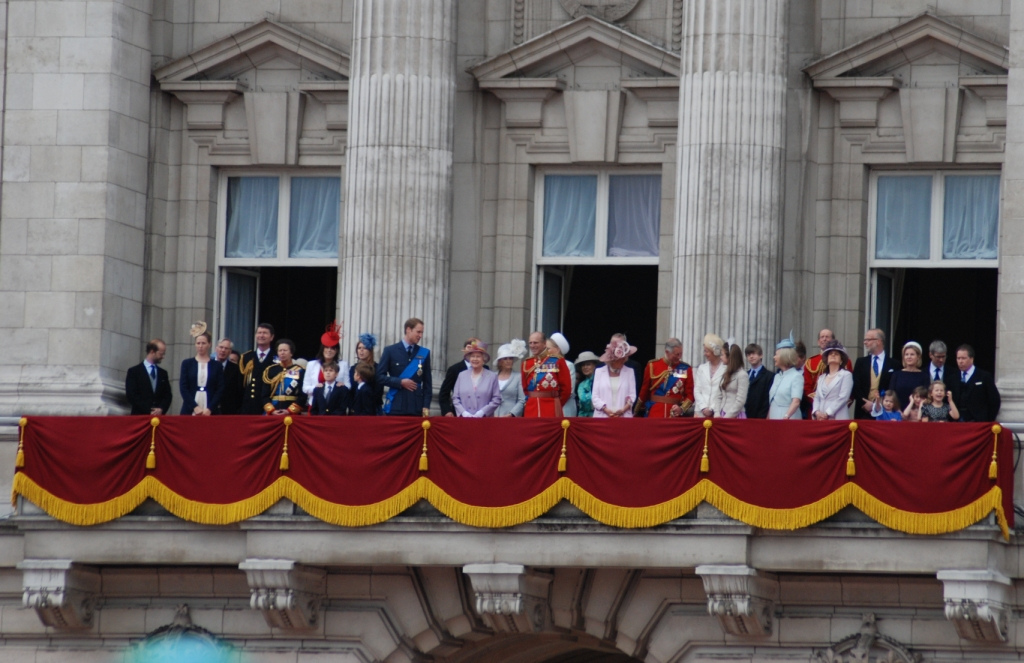
The Royal Family at Buckingham Palace for the Trooping of the Colour, 30 June, 2015.
Photo by Robert Payne via Wikimedia Commons.
We have a soft spot for the monarchy, here at The Line. We believe that as an organizing principle of our system of government, the Crown provides a decent balance between effectiveness and accountability. And while the idea of our head of state residing in a foreign country seems perverse, as a practical matter the physical distancing of the sovereign in London, and the institutional distancing via the Governor General, helps Canada sidestep what would otherwise be yet another occasion for national recrimination.
So, call it two cheers for the monarchy.
That the Queen was a model of duty, decorum and discretion throughout her long reign is undeniable, and there’s not much to add on that front that hasn’t been spread over square miles of newsprint over the past week. By the same token, she and her husband raised a rather problematic set of boys, of whom the best (Edward) that can be said is that he’s a nullity. But again, there’s been more written on this than one could safely consume in a lifetime.
But we’d like to say a few things about the Royal Family itself. The Royals have long described themselves not as a family, but as The Firm — a corporate entity and business enterprise that has extensive land holdings. It pokes its fingers in countless pies, and employs an army of secretaries and assistants and advisers and servants. It has been described as an enormous, bureaucratically organized machine that dictates and determines the lives of its members.
Yet to us, the Royal Family has always seemed less like a business enterprise than a giant open-air prison. A well-funded and nicely appointed prison to be sure, but a prison nonetheless.
What’s the difference between a complicated overbearing bureaucracy and a jail? Where does the line between compliance end and incarceration begin? It can be hard to say, but the key difference can be found in whether or not you have the right of exit. As Harry put it in his infamous interview with Oprah Winfrey: “My father and my brother, they are trapped. They don’t get to leave.”
But beyond that, it is found in how you treat those who try to change things, or more importantly, those who try to escape. Diana tried to change things, and got destroyed for her efforts. Her second son has attempted an escape, and he’s paying an enormous price.
Diana was no saint obviously, and Harry is a dim fellow who married poorly and has not always exercised the best judgment. But who could, under the circumstances? How could any human be reasonably expected to behave properly, to act normally, to judge wisely, given the insane combination of internal pressure, public expectation and media scrutiny that is a non-negotiable part of the royal package? A panopticon is no less carceral for being well-funded.
With the accession of Charles to the throne as King Charles III, there have been a number of articles published running through the main plot points of his life, with a great deal of focus on his romantic life, his marriage to Diana, and ultimately his reunion with the great love of his life, Camilla. What is remarkable is to read about the number of women he proposed to, prior to Diana, who saw the monarchy for what it was, and turned him down. It’s a testament to how much Camilla must really love the old fart that she prefers a life imprisoned with him than free without.
Comments Off on “… the Royal Family has always seemed less like a business enterprise than a giant open-air prison”
City Minutes: Crusader States
Overly Sarcastic Productions
Published 13 May 2022Crusading is one thing, but holding your new kingdoms is a much trickier business. See how the many Christian states of “Outremer” rolled with the punches to evolve in form and function over multiple centuries.
(more…)
Comments Off on City Minutes: Crusader States
QotD: Representative government
Hawaiian judges are our kakistocracy‘s public face, but all the decisions that matter are made long before the hacks in black get involved. As we know, we Americans commit, on average, three felonies a day. If, when, and how these come to the State’s attention are almost completely random. This is true for any law, actually, and because it is, it’s not really an exaggeration to say that your livelihood, and often your actual freedom, depends on what side of the bed the cop got up on this morning.
If The Authorities notice you when they’re in a good mood, you skate. If The Authorities are in a bad mood, though — tired, hung over, had a fight with the spouse, whatever — you’re screwed. What actually happens to you depends on the lawyers, a.k.a the most incestuous little fraternity on the planet. Whether they choose to prosecute or not, and for what, and what deals they make over a drink or seven determine what happens to you once you get in front of hizzoner … who, of course, is also butt-buddies with all the lawyers who appear in his chambers, since he was one of them not too long ago and they remain his entire social circle.
Who in his right mind could possibly agree to this? No, forget “right mind” — it’s simply not possible for anyone, not even someone as far out on reality’s fringes as the SJWs, to consent to this. Those “people” (in the strict biological sense) think houseplants have human rights, but not even they would agree to have their life’s course determined by two dimbulbs with great hair and ugly neckties cutting deals with each other in a dive bar.
But so long as we fetishize the form of “representative government,” it can’t be otherwise. As folks in Our Thing never tire of pointing out, had The People ever been consulted about our preferences, at any time after 1963, we’d still be living in a White Christian nation with a solid manufacturing base and a minuscule military footprint. If it were possible to throw the bums out, we would’ve thrown out every bum on every ballot since at least Calvin Coolidge. But we can’t throw the bums out, because the process is rigged.
Severian, “Form > Process > Outcome”, Rotten Chestnuts, 2019-09-06.
Comments Off on QotD: Representative government
September 18, 2022
Forget #GamerGate already, here’s #NAFO!
At Samizdata, Perry de Havilland briefly recaps the story of #gamergate and the incomprehension of the “official” gaming press and PR departments of gaming companies that their actions to ridicule and shutdown the “racist/sexist/homophobe” #gamergate activists not only failed but drew more attention to the #gamergate issue, and compares it to a new instance of the same phenomenon:
Fast forward to 2022 and behold #NAFO: the North Atlantic Fellas Organisation.
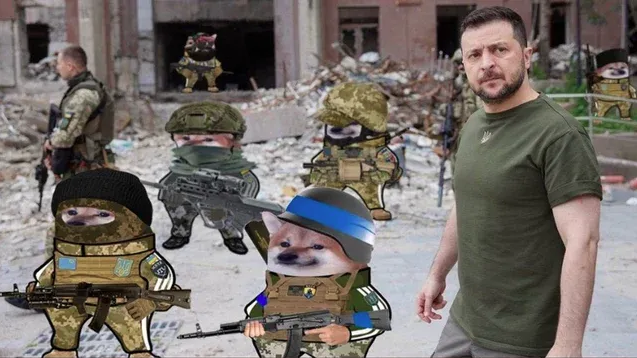
And who are “the fellas”? A large and growing online pack of attack dogs countering, dare I say smothering, official Russian troll factory output, as well as other pro-Kremlin talking heads online. And their mascots are daft cartoon dogs (variations of a Shiba Inu to be precise). If journalistic collusion was a constant target of #GamerGate, the Russian troll farms are the modern analogy to that, constantly targeted and smothered by NAFO posting either pro-Ukrainian counter-narratives or just ridiculing or flagging up pro-Russian ones.
Many people, particularly those operating within institutions, don’t understand #NAFO for same reason PR departments of various video games companies & press outlets didn’t (and still don’t) understand #GamerGate.
Is #NAFO engaged in “information warfare”? Absolutely. They even get a shout out from the Ukrainian Ministry of Defence. But they are not managed out of an office in Langley, Virginia nor by some adjunct of the Ukrainian intelligence services. #NAFO is a hashtag, a phenomena, it isn’t “run” by anyone, because it doesn’t need to be. Like GamerGate, NAFO is a confluence of the motivated willing in every timezone on the planet.
And just as GamerGate had a single original trigger, which was then largely forgotten as the “movement” grew and started attacking larger more juicy prey, NAFO started as a fund raising effort for the Georgian Legion (a now battalion sized unit of about 600 within the Ukrainian army made up mostly of Georgian volunteers). At blinding speed, NAFO rapidly morphed into a wider distributed online effort supporting Ukraine in the “information space”.
Comments Off on Forget #GamerGate already, here’s #NAFO!
Jailbreak! Mussolini on the Loose Again! – WW2 – 212 – September 17, 1943
World War Two
Published 17 Sep 2022
(more…)
Comments Off on Jailbreak! Mussolini on the Loose Again! – WW2 – 212 – September 17, 1943
“King Eeyore”
In the latest edition of the SHuSH newsletter, Kenneth Whyte recounts some of the anti-Carolean gossip from the early years of King Charles:
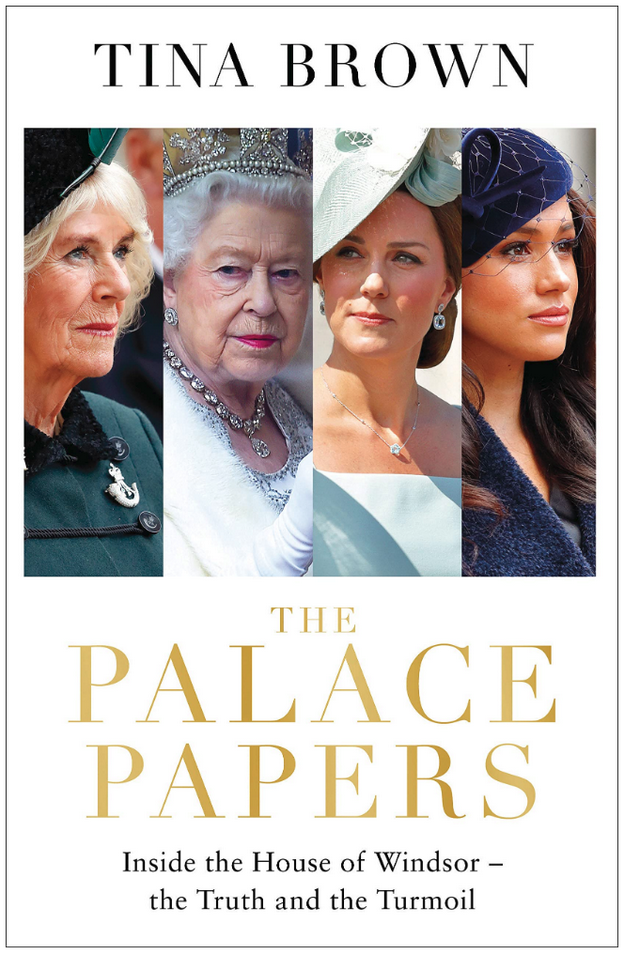
My library of royalist literature is thin, but I did find Tina Brown’s The Palace Papers on the shelf. Published last spring, it chronicles the recent history of the House of Windsor and while it treats the whole cast of characters — Elizabeth, Philip, Margaret, Charles, Anne, Andrew, Edward, William, Kate, Harry, Meghan — much is revealed about the new king.
Charles, writes Brown, the former Vanity Fair and New Yorker editor, was never a happy fellow. She calls him “Prince Eeyore”. He “felt bruised by his childhood and miserable school days, misunderstood by his domineering father, and deprived of an emotional connection with his mother”. Among the “brutalities” he endured in his youth: his schoolmates at Gordonstoun beat him with pillow because he snored.
Although an indifferent student, he attended Cambridge where he read anthropology and archaeology. In 1969, a year before graduating, his mother crowned him Prince of Wales. He spent his early twenties in the Royal Air Force and the Royal Navy, distinguishing himself in the latter service by lowering an anchor without noticing on his chart the presence of a telecommunications cable linking Ireland and Britain. “It was snagged,” writes Brown, “and the two divers send down to dislodge it nearly drowned.” Charles earned a “stern rebuke”.
Having done his military duty, he devoted himself to polo, windsurfing, and test-driving prospective wives. Charles’s royal status made him an obvious catch, writes Brown, who judges that his “Dumbo ears were offset by his excellent tailoring and debonair polo prowess.”
Finding a wife proved difficult, not least because of his affinity for married women. At one point he was sleeping with both Camilla Parker Bowles, wife of Andrew Parker Bowles, and Dale “Kanga” Harper, wife of his buddy, Lord Tyron. “In the mid-seventies,” says Brown, “both married women were on call for the Prince while their husbands looked the other way.”
That’s not exactly true. Both men seemed pleased to lay down their wives for their country, as the joke went at the time. Charles was godfather to Tom Parker Bowles, son of Andrew and Camilla Parker Bowles, and also to a middle child of the Tyron’s who, naturally, was named Charles.
What Camilla and Kanga had in common were game personalities and maternal instincts that accommodated the Prince’s “sentimentality and tantrums, and needs to be soothed and amused”.
It wasn’t until 1981, at the age of 32, that the Prince of Wales made his choice of a bride. It was famously awful for all concerned. He married twenty-year-old Diana Spencer who bore him an heir, William, in 1982, and a spare, Harry, in 1984. Brown reports that Charles behaved properly in the marriage until the birth of Harry who, to his disappointment, was not a girl. “Oh God,” he said, “it’s a boy … and he’s even got red hair.”
He was back with Camilla in no time. Diana ratted him out to the author Andrew Morton in 1992 and Charles unwittingly confirmed his infidelity the next year in a notorious telephone conversation with Camilla in which he said that he wanted to “live inside your trousers or something”. You know the rest.
Comments Off on “King Eeyore”
Austria’s Take on the Uzi: Steyr MPi-69
Forgotten Weapons
Published 13 May 2022
(more…)
Comments Off on Austria’s Take on the Uzi: Steyr MPi-69
QotD: Late night TV’s negative impact on US national culture (aka “Clown nose on, clown nose off”)
Shows like Saturday Night Live, the Daily Show, late night television …
They take the news, spin it through a comedy filter, and present it to the masses. This presents an easily digestible, and thus easily believable, simplified and polarized view of events, that their viewers are then encouraged to apply to the news that is coming from real news sources. Anyone who objects to this is “overreacting, or doesn’t have a sense of humor” and thus is dismissed as irrelevant.
And thus the culture of lies continues, and gets ramped up as it spreads.
It’s sickening.
James Resoldier, posting to MeWe‘s “Hoyt’s Huns” group, 2022-06-16. (private group, so no public URL available)
Comments Off on QotD: Late night TV’s negative impact on US national culture (aka “Clown nose on, clown nose off”)
September 17, 2022
Is it still a conspiracy theory if more than 50% of Canadians believe it?
Chris Selley posted a link to this rather eye-opening Abacus Data poll summary by Bruce Anderson and David Coletto:
We recently completed nationwide surveying among 1500 Canadians. The focus was on the levels of trust people have in institutional sources of information, and belief in conspiracy theories. This is the first in a series called “Trust & Facts: What Canadians Believe”
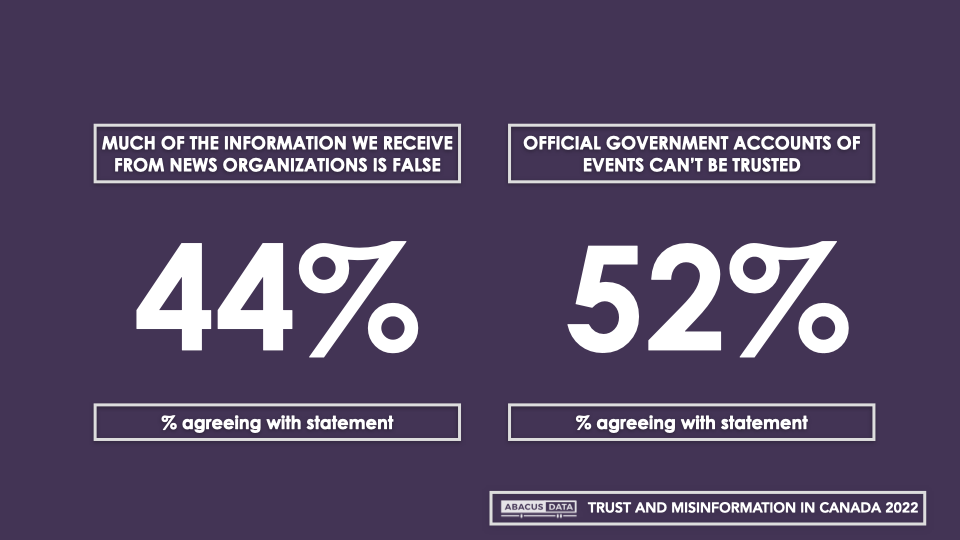
44% THINK MUCH OF THE INFORMATION FROM NEWS ORGANIZATIONS IS FALSE
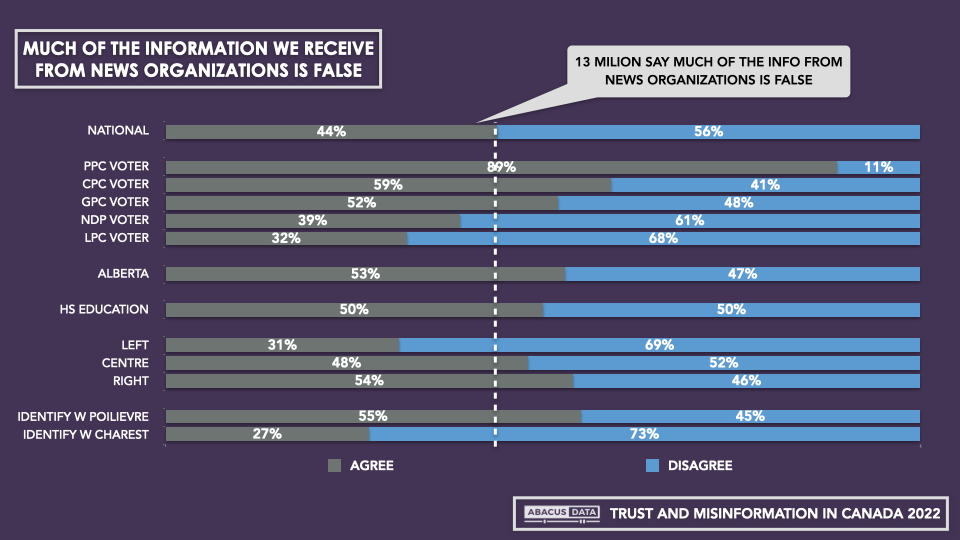
Almost half of those interviewed found themselves agreeing with the statement “much of the information we receive from news organizations is false”.
While this means a majority of Canadians have some trust in news organizations, more than 13 million adults (extrapolating 44% to an adult population of 29.5 million) don’t.
Those with no post-secondary education, Alberta residents and those on the right show greater mistrust. But by far the biggest differences are visible when we look at party affinity. The vast majority of People’s Party supporters don’t trust news organizations and a (smaller) majority – 59% – of Conservative voters feel the same way.
Among those who think Pierre Poilievre is the Conservative leadership candidate who best reflects their views, 55% don’t trust media information, while among those who identify with Jean Charest the proportion is much lower, at 27%.
52% THINK OFFICIAL GOVERNMENT ACCOUNTS OF EVENTS CAN’T BE TRUSTED
More than half of those interviewed found themselves agreeing with the statement “official government accounts of events can’t be trusted”
As with trust in news organizations, those with no post-secondary education, Alberta residents and those on the right showed markedly higher levels of mistrust in government.
Majorities of People’s Party, Conservative and Green Party voters indicate mistrust. Those on the left and Liberal voters show higher levels of trust.
Comments Off on Is it still a conspiracy theory if more than 50% of Canadians believe it?
A royal assault on free speech | The spiked podcast
spiked
Published 16 Sep 2022Tom, Fraser and Ella discuss the clampdown on republican protesters. Plus: the Ukrainian counteroffensive and the madness of Mermaids.
(more…)
Comments Off on A royal assault on free speech | The spiked podcast
In the wake of the Russo-Ukrainian war, Europe’s cold winter looms ahead
Andrew Sullivan allows his views on the fighting in Ukraine to be a bit more optimistic after Ukrainian gains in the most recent counter-attacks on Russian-held territory around Kharkiv:
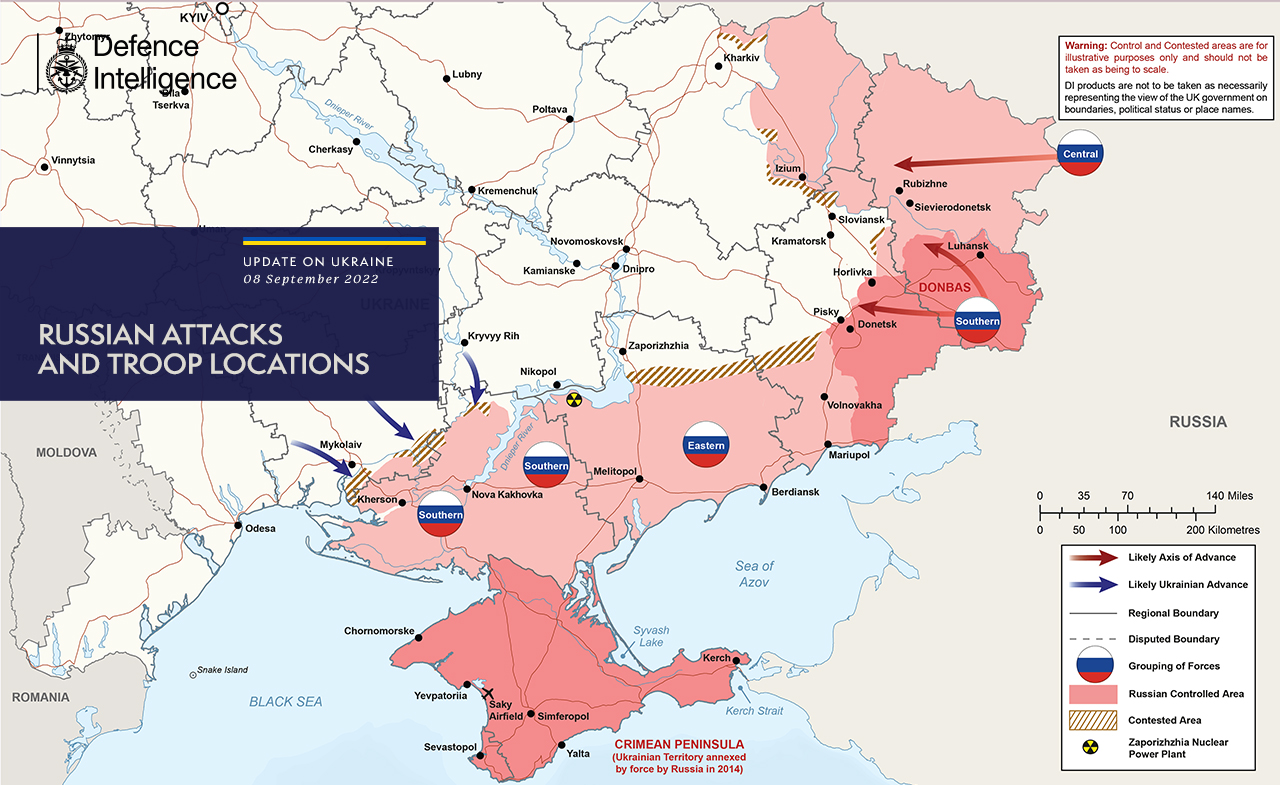
Approximate front-line positions just before the Ukrainian counter-attack east of Kharkiv in early September 2022. The MOD appears to have stopped posting these daily map updates sometime in the last month or so (this is the most recent as of Friday afternoon).
As we were going to press last week — I still don’t know a better web-era phrase for that process — Ukraine mounted its long-awaited initiative to break the military stalemate that had set in after Russia’s initial defeat in attempting a full-scale invasion. The Kharkiv advance was far more successful than anyone seems to have expected, including the Ukrainians. You’ve seen the maps of regained territory, but the psychological impact is surely more profound. Russian morale is in the toilet — and if it seems a bit premature to say that Ukraine will soon “win” the war, it’s harder and harder to see how Russia doesn’t lose it. By any measure, this is a wonderful development — made possible by Ukrainian courage and Western arms.
Does this change my gloomy assessment of Putin’s economic war on Europe, which will gain momentum as the winter drags on? Yes and no. Yes, it will help shore up nervous European governments who can now point to Ukraine’s success to justify the coming energy-driven recession. No, it will not make that recession any less intense or destabilizing. It may make it worse, as Putin lashes out.
More to the point, the Kharkiv euphoria will not last forever. September is not next February. Russia still has plenty of ammunition to throw Ukraine’s way (even if it has to scrounge some from North Korea); it is still occupying close to a fifth of the country; still enjoying record oil revenues; has yet to fully mobilize for a war; and still has China and much of the developing world in (very tepid) acquiescence. Putin is very much at bay. But he is not finished.
Europe’s scramble to prevent mass suffering this winter is made up of beefing up reserves (now 84 percent full, ahead of schedule), energy rationing, government pledges to cut gas and electricity use, nationalization of gas companies, and billions in aid to consumers and industry, with some of the money recouped by windfall taxes on energy suppliers. The record recently is cause for optimism:
The Swedish energy company Vattenfall AB said industrial demand for gas in France, the U.K., the Netherlands, Belgium and Italy is down about 15% annually.
But the use of gas by households is trivial in the summer in Europe compared with the winter — and subsidizing the cost doesn’t help conservation. Russia will now cut off all gas — which could send an economy like Italy’s to contract more than 5 percent in one year. There really is no way out of imminent, deep economic distress across the continent. Even countries with minimal dependence on Russia, like Britain, are locked into an energy market with soaring costs.
That will, in turn, strengthen some of the populist-right parties — see Italy and Sweden. The good news is that the new right in Sweden backs NATO, and Italy’s post-liberal darling, Georgia Meloni, who once stanned Putin, “now calls [him] an anti-Western aggressor and said she would ‘totally’ continue to send offensive arms to Ukraine”. The growing evidence of the Russian army’s war crimes — another mass grave was just discovered in Izyum — makes appeasement ever more morally repellent.
So what will Putin do now? That is the question. His military is incapable of recapturing lost territory anytime soon; he is desperate for allies; and mobilizing the entire country carries huge political risks. It’s striking to me that in a new piece, Aleksandr Dugin, the Russian right’s guru, is both apoplectic about the war’s direction and yet still rules out mass conscription:
Mobilization is inevitable. War affects everyone and everything, but mobilization does not mean forcibly sending conscripts to the front, this can be avoided, for example, by forming a fully-fledged volunteer movement, with the necessary benefits and state support. We must focus on veterans and special support for the Novorossian warriors.
This is weak sauce — especially given Dugin’s view that the West is bent on “a war of annihilation against us — the third world war”. It’s that scenario that could lead to a real and potentially catastrophic escalation — which may be why the German Chancellor remains leery of sending more tanks to Ukraine. The danger is a desperate Putin doing something, well, desperate.
I have no particular insight into intra-Russian arguments over mobilization, but there seems to be zero point (other than for propaganda … and that cuts both ways) to instituting a “Great Patriotic War”-style mass conscription drive at this point. The Russian army could absolutely be boosted to vast numbers through conscription. Vast numbers of untrained, unwilling young people with little military training and no particular passion to save the Rodina this time, despite constant regime callbacks to desperate struggle against Hitler in 1941-45. Pushing under- or untrained troops into battle against a Ukrainian army equipped with relatively modern western weaponry would be little more than deliberate slaughter and I can’t believe even Putin would be that reckless.
Comments Off on In the wake of the Russo-Ukrainian war, Europe’s cold winter looms ahead


