Quotulatiousness

May 5, 2023

The kinder, gentler US Naval War College

Filed under: Education, Military, USA — Tags: , , , , , , — Nicholas @ 03:00

CDR Salamander on a recent symposium at the U.S. Naval War College, showing just how much the American military has adapted itself to the Current Year:

Let’s take a look around the planet with a maritime national security lens, shall we?

  • The largest land war in Europe since WWII is raging on the north shore of the Black Sea.
  • The People’s Republic of China surpassed the United States of America as the world’s largest navy.
  • The Iranians are hijacking oil tankers willy-nilly.
  • The Western economy relies on undersea cables & pipelines we have allowed to go undefended and are now the subject of attention by mal-actors on the world stage.
  • The Navy is experiencing readiness and recruiting problems not seen since the 1970s.

There’s my top-5 off the top of my head this AM, yours may differ.

It sure seems to differ in Newport.

So, in the last week of April there was a 2-day symposium at the U.S. Naval War College, an opportune time to examine the most critically important challenges in 2023 — hopefully from a maritime perspective — wouldn’t you think?

Any conference, especially a 2-day affair with both on and off campus event locations, sure cost a lot of money and even more stacked manhours to plan, attend, participate, and manage.

We sure want to make sure the juice is worth the squeeze, right?

If you’re a regular here, you know where this is going. I warned everyone about this back in 2017. If you’re a new reader not fully up to speed on the broader portfolio we manage here at CDRSalamander, well, take a red pill and a seat.

Our war colleges are not what you think they are.

With each passing year there is less focus on war, and more on college. At the Naval War College, just getting additional time, money, faculty, and leadership focus on the “naval” portion has become a challenge with all the other ancillary agendas trying to keep pace with the cool kids cross-town at Salve Regina University.

Here’s a perfect example.

    The Naval War College (NWC) will host its 9th annual Women, Peace and Security (WPS) Symposium, 26-28 April 2023, in Newport, Rhode Island. This year’s theme is “Women, Peace, and Security in a Fragile World: Perspectives on Warfighting, Crisis Management, and Post-Conflict Transitions“.

Well, let’s go in with an open mind. Perhaps there’s something here. Hope isn’t a plan, but when the Party demands things of you, hope is often all you have.

If you voluntarily attended (I am reliably told that Party cadre informed the proles that attendance was required for staff, at least online), what kind of panel discussions would you be able to listen to? Let’s browse over the agenda.

In totally unrelated news, Brent Ramsey updates the odds on who will be promoted to be the US Navy’s next Chief of Naval Operations:

Admiral Lisa Franchetti, Vice-Chief of Naval Operations, US Navy.

Last September, the Navy promoted and installed a new Vice Chief of Naval Operations. Then Vice Admiral Lisa Franchetti got her 4th star and was appointed to the second-highest position in the Navy. Now after a scant seven months, the betting line going around D.C. is that she will likely be the next CNO based on the identity politics track record of President Biden. When President Biden had an opportunity to appoint to the Supreme Court, before assessing anyone’s qualifications, he announced that a black woman would get that seat, and he followed up on that promise. Would an identity-based selection for the Navy’s top leader be in the best interest of the Navy and the Nation? No, the nation needs and deserves the very best warrior to lead the Navy into our threatened future.

Admiral Franchetti is a journalism graduate of Northwestern University NROTC, a non-STEM degree which itself is unusual, as the Navy strongly favors STEM degrees for officers. She has a Master’s Degree in organizational management from the University of Phoenix, an online university. Her biography does not mention any war college credential. In contrast, her predecessor Admiral William Lescher had multiple commands in combat zones, was a test pilot, had multiple advanced degrees in naval technical fields and his commands won multiple combat zone merit awards. To naval professionals, for someone to have been promoted to the Navy’s highest rank and second highest position based on a NROTC commissioning source with a liberal arts degree, an online masters, no war college or combat zone credentials, would be considered inconceivable. Perhaps her success is based on a particularly spectacular service record?

Admiral Franchetti’s career path reveals sea tours on a tender, oiler, and three destroyers including command of the USS Ross (DDG-71) and command of a destroyer squadron. Her biography does not mention any of her commands received awards while she was in command.

I’m not a betting man, but if I was, I think I’d be putting down a few jellybeans on Admiral Franchetti’s next posting …


Alligator Creek: America Learns to Fight the Japanese

Filed under: History, Japan, Military, Pacific, USA, WW2 — Tags: , , — Nicholas @ 02:00

Forgotten Weapons
Published 7 Jan 2023

The Battle of Alligator Creek (aka Battle of the Tenaru) was a formative moment in the American World War Two psyche. After making an unopposed landing on Guadalcanal and taking its mostly-completed airfield at minimal cost, the US Marines had to defend their permitter on the night of August 21st, 1942.

Colonel Kiyonoa Ichiki was sent from the Japanese base at Truk with about 900 tough veteran soldiers to push the Marines off the airfield. These men had originally been slated to assault Midway Island, but the Japanese naval defeat there forced a change in plans. Ichiki was overconfident, and more concerned about retaking the islands of Tulagi, Gavutu, and Tanambogo across the straights, where Japan’s main base in the area had also been captured by Marine Raiders. Marching up the coastline towards Henderson Field, Ichiki’s men hit the thin single strand of Marine barbed wire about about 1:30am on the morning of there 21st. An intense firefight erupted, with the well dug-in Marine positions opening up with .30 caliber and .50 caliber machine guns, small arms, and 37mm canister rounds.

The fighting continued after daybreak, with Ichiki’s men digging in on the east bank of Alligator Creek. The Marines launched a two prong counterattack, with one force crossing the Creek inland and advancing down the east bank while a second group, including several Stuart light tanks, advanced across the sandbar. These two groups linked up in the early afternoon of the 21st, almost completely annihilating the Ichiki Detachment.

This was the first real land combat between American and Japanese forces in which American soldiers were able to report back on their experience. It was here that the US military as an institution learned that the Japanese would die rather than surrender, and this engagement set the American expectations for the rest of the Pacific campaign.
(more…)

QotD: Professional development activities

Filed under: Bureaucracy, Business, Education, Quotations — Tags: , — Nicholas @ 01:00

All this para-work, this ceaseless diversionary activity, is designed, or at least destined, to prevent people from carrying on their real work. By doing so, of course, it creates employment, or at least the necessity to pay people salaries: for, overall, many man-days are lost to it. And it creates pseudo-entrepreneurial opportunities for so-called consultants (often ex-employees of the organisations whose staff they now offer to train in such skills as assertiveness). It is, in effect, an exercise in Keynesian demand-management, but unlike the kind of public works that Keynes envisaged as a stimulus to a flagging economy, it leaves the country with nothing of enduring value, unless a bureaucrat with a flat-screened television and a new conservatory be called something of enduring value.

Needless to add, ceaseless “personal and professional development” is perfectly compatible with the most abysmal incompetence. Indeed, such incompetence is welcome, for it creates ever more demand for the personal and professional development that is supposedly the means to overcome it. This is what I believe is known as a positive feedback loop.

Theodore Dalrymple, “Workshops and why you must avoid them”, The Social Affairs Unit, 2009-11-18.

May 4, 2023

Despite all the evidence, Canada’s official motto doesn’t translate as “we broke it”

In The Line, Justin Ling adds more to the towering pile of evidence that “Canada is broken”:

If The Line has an editorial position, it is probably thus: Everything is broken.

This newsletter, of course, comes at the idea more earnestly than, say, the leader of the Conservative party. When my friend Matt Gurney advances that proposition, it is a lament. When Pierre Poilievre does: It’s wishful thinking.

While citizens of this country can’t always agree on what, exactly, is busted in our country, or why, or who is responsible — we can all agree, I hope, that things in this country could use a tune-up, at the very least. Canadians, after all, are imbued with a cloying optimism. An insufferable belief that things can be fixed. It’s a good thing.

Lucky for us, we have plenty of words written about how to fix much of what ails us. Because we, as a country, have a compulsive need to inquire about those problems. Our national pastime isn’t hockey, it’s the royal commission.

And we’ve got a government in office that loves to study the nature of the problem. There’s good work, these days, for the special rapporteurs and retired judges amongst us. And if you’re a Canadian that loves a good public consultation, you must be run ragged.

Yet we also have a government in office that has a pathological inability to take advice. And this problem may help explain why it feels like we’re sliding backwards.

[…]

When the government tapped an expert panel to study the use of solitary confinement in Canada’s prisons — literally torture — Correctional Services Canada blocked them from doing their job, and the public safety minister ignored their cries for help and then let their contracts lapse. Thanks to some scrutiny, the government renewed the study, then ignored it when the numbers showed they were still torturing people. Oops!

The National Security and Intelligence Committee of Parliamentarians — a body Trudeau created — warned in 2019 that Ottawa wasn’t taking foreign interference seriously, particularly when it came to China. “In short, government responses were piecemeal, responding to specific instances of foreign interference but leaving unaddressed the many other areas where Canadian institutions and fundamental rights and freedoms continue to be undermined by hostile states.” Prescient!

One of the most absurd examples is the sexual misconduct crisis in the Canadian Armed Forces. When Trudeau came into office in 2015, he had an external review on his desk from Marie Deschamps. One good external review deserves another, so the Liberals ordered one from Louise Arbour in 2022. What she found was harrowing: “We have been here before. Little seems to change.” Not only had the government failed to implement the Deschamps report, it was still failing to live up to the recommendations from the 1997 Somalia Inquiry. Fuck!

[…]

At the very centre of this tootsie-pop is, surprise, elitism. This Liberal government, armed with its paper-thin mandate, is convinced that they — and only they — are the verifiers of good ideas. And we should be grateful for whatever decision they deign to make.

If they farm out an idea to the public service, and the idea doesn’t come back in the form they envisioned, no matter: Send out the McKinsey signal. For just a few million dollars, their crack team of subject matter non-experts can prepare a PowerPoint presentation laying out the exact policy the political staff wanted in the first place.

The Liberals take a similar approach to consulting with the unwashed masses. When the government consulted the public on their plan to police “online harms,” they published a “what we heard” report that was broadly supportive of their plan.

Can we see the submissions? Journalists and academics asked. No. Came the reply.

Fierce fighting on Gallipoli … before WW1

Filed under: Europe, Greece, History, Military — Tags: , , , , — Nicholas @ 04:00

Bruce Gudmundsson outlines the operations of Ottoman Empire forces defending “Turkey in Europe” against Greek and Bulgarian invasion (in alliance with Serbia and Montenegro) in 1913:

In the English speaking world, the name Gallipoli invariably evokes memories of the great events of 1915 and 1916. A location of such strategic importance, however, rarely serves as the site of a single battles. Two years before the landings of the British, Indian, Australian, and New Zealand troops on the south-west portion of the the peninsula (and the concurrent French landings on the nearby mainland of Asia Minor near the ruins of the ancient city of Troy), Ottoman soldiers defended the Dardanelles against the forces of the Balkan League.

By the end of January of 1913, the combined efforts of Greece, Serbia, Montenegro, and Bulgaria had driven Ottoman forces from most of “Turkey in Europe”. Indeed, the only intact Ottoman formations on European soil were those trapped in the fortress of Adrianople, those holding the fortified line just west of Constantinople, and those that had recently arrived at Gallipoli.

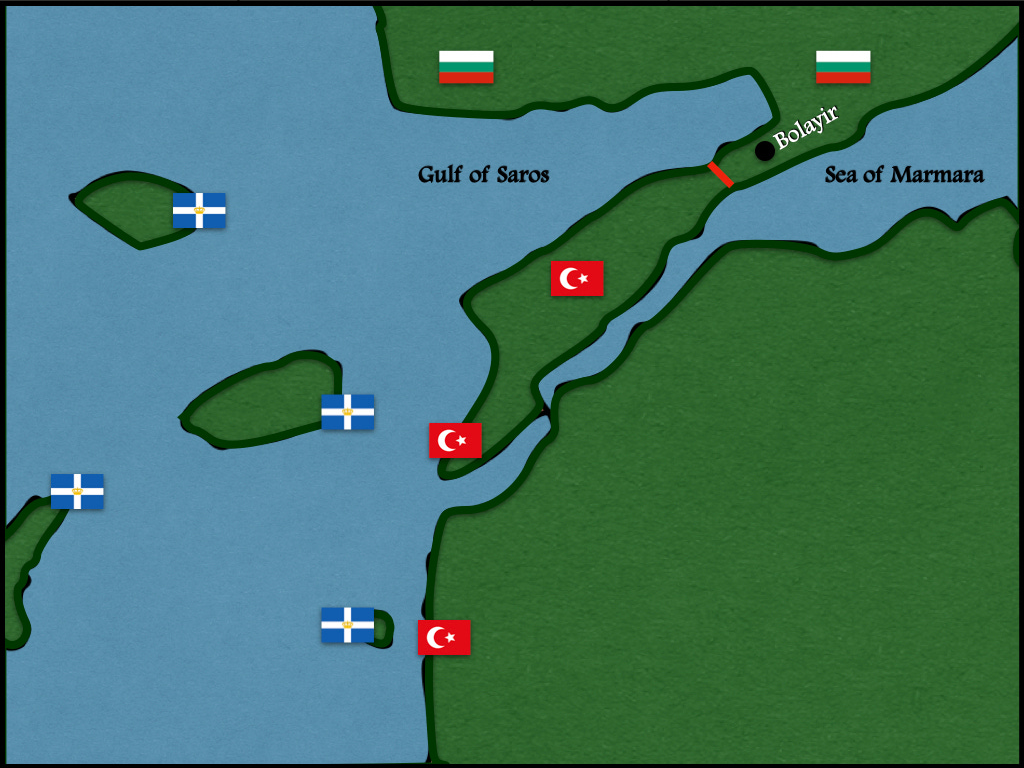
Soon after arriving, the Ottoman forces on Gallipoli began to build a belt of field fortifications across the narrowest part of the peninsula, a line some five kilometers (three miles) west of the the town of Bolayir. At the same time, they occupied outposts some twenty kilometers east of the line, at the place where the peninsula connected to the mainland.

The general situation in (and around) the Gallipoli Peninsula, 31 January 1913.

On 4 February 1913, the Bulgarians attacked. On the first day of this attack, they drove in the Ottoman outposts. On the second day, they broke through a hastily erected line of resistance, thereby convincing the Ottoman forces in front of them to evacuate Bolayir. However, rather than taking the town, or otherwise attempting to exploit their victory, they withdrew to positions some ten kilometers (six miles) east of the Ottoman earthworks.

While the Ottoman land forces returned to the earthworks along the neck of the Peninsula, ships of the Ottoman Navy operating in the Sea of Marmora located, and began to bombard, the Bulgarian forces near the coast. This caused the Bulgarians to move inland, where they took up, and improved, new positions on the rear slopes of nearby hills.

On 9 February, the Ottomans launched a double attack. While the main body of the Ottoman garrison of Gallipoli advanced overland, a smaller force, supported by the fire of Ottoman warships, landed on the far side of the Bulgarian position. Notwithstanding the advantages, both numerical and geometric, enjoyed by the Ottoman attackers, this pincer action failed to destroy the Bulgarian force. Indeed, in the course of two failed attacks, the Ottomans suffered some ten thousand casualties.

Though the Ottoman maneuver failed to dislodge the Bulgarians from their trenches, the two-sided attack convinced the Bulgarian commander to seek ground that was, at once, both easier to defend against terrestrial attack and less vulnerable to naval gunfire. He found this on the east bank of a river, thirteen kilometers (eight miles) northeast of Bolayir and ten kilometers (six miles) north of the place where the Ottoman landing had taken place.

British civil servants apparently need to have training on BDSM theory and practice

Filed under: Britain, Bureaucracy, Health — Tags: , , , — Nicholas @ 03:00

In Spiked, Malcolm Clark outlines the proposal to be discussed at a civil service union conference next month:

“Cologne BDSM 07” by CSD2006 is licensed under CC BY-SA 3.0 .

For years, the LGBT lobby has wreaked havoc across the UK’s civil service. It has helped to turn the machinery of government into a crèche for the kind of people who can’t remember what pronouns they’re using that day. But this may have just been a taster of what’s to come. Kink, it seems, is the new frontier in identity politics. Get ready to meet the “BDSM” lobby.

Next month, at its annual conference, the biggest civil-service union, PCS, will discuss a motion calling on Whitehall to set up a network for staff who are into bondage, domination and sado-masochism (BDSM). I suppose there’s one thing to be said for this daft idea. The more time these jobsworths spend slapping each other around, the less time they’ll have to humiliate and torment members of the taxpaying public.

There are a few obvious problems with this proposed BDSM staff network. For one, its advocates have called for workplace training courses about BDSM. No, I’m not making this up. The suggested courses would explain that “mutual informed consent … is needed before erotic activity is carried out”. This is a statement of the obvious to most of us. Who says entry standards for the civil service are slipping?

You may have assumed that the priority of our civil service should be carrying out the business of government, rather than BDSM advocacy. Perhaps it should be getting on top of the fact that only three per cent of hospital trusts in England hit cancer waiting-time targets in 2022? Or the fact that 360,000 people had to wait more than 10 weeks for their passport last year?

One strange thing about this demand for training courses for kink-meisters is that it flies in the face of other recent staff demands. Across Whitehall, as in private industry, advocacy groups have long insisted that Britain’s workplaces have developed a toxic culture that does not respect sexual boundaries. Reams of new guidelines have been drawn up in response. Many of these guidelines consider asking questions about someone’s sex life to be, in itself, a form of sexual harassment. Yet now we could soon have staff networks based solely around people’s private sex lives. And what would a meeting of sexual fetishists discuss if not their sex lives? The weather?

Even twenty years ago, it was a common witticism to refer to workplace meetings as “beatings”, but this is a long way past a casual joke (that yes, is probably risky to make in most modern workplaces, as someone is bound to find offence).

While looking for an appropriate image to accompany this post, I was quickly reminded why most search engines now offer varying levels of “safe” viewing.

Why British train enthusiasts hate this man – Dr. Beeching’s Railway Axe

Train of Thought
Published 27 Jan 2023

In today’s video, we take a look at one Doctor Richard Beeching, the man who ripped up a third of Britain’s railways with nothing but a pen and paper.

(more…)

QotD: Gesamtkunstwerk

Filed under: Media, Quotations, Technology — Tags: , , , , , — Nicholas @ 01:00

… it occurs to me that movies aren’t the best example of the Current Year’s creative bankruptcy — music is. Somewhere below, I joked that Pink Floyd’s album The Wall was a modern attempt at a Wagnerian Gesamtkunstwerk, a “total art work”. Wagner thought opera should be a complete aesthetic experience, that a great opera would have not just great music, but a great story in the libretto, great poetry in the lyrics, great painting in the set design, and so on, all of which would combine to something much greater than the sum of its already-excellent parts.

As I said, that’s awfully heavy for an album whose most famous song asks how can you have any pudding if you don’t eat your meat, but it’s nonetheless an accurate description of what Roger Waters was trying to do with the integrated concept album / movie / stage show. Whether or not he knew he was attempting a Gesamtkunstwerk in the full Wagnerian sense is immaterial, as is the question of whether or not he succeeded. Nor does it matter if The Wall is any good, musically or cinematically or lyrically.* The point is, he gave it one hell of a go … and nobody else has, even though these days it’d be far, far easier.

Consider what a band like Rush in their prime would’ve done with modern technology. I’m not a musician, but I’ve been told by people who are that you can make studio-quality stuff with free apps like Garage Band. Seriously, it’s fucking free. So is YouTube, and even high-quality digital cameras cost next to nothing these days, and even laptops have enough processor power to crank out big league video effects, with off-the-shelf software. I’m guessing (again, I’m no musician, let alone a filmmaker), but I’d wager some pretty good money you could make an actual, no-shit Gesamtkunstwerk — music, movie, the whole schmear — for under $100,000, easy. You think 2112-era Rush wouldn’t have killed it on YouTube?

I take a backseat to no man in my disdain for prog rock, but I have a hard time believing Neal Peart and the Dream Theater guys were the apex of rock’n’roll pretension. I realize I’ve just given the surviving members of Styx an idea, and we should all be thankful Kilroy Was Here was recorded in 1983, not 2013, because that yawning vortex of suck would’ve destroyed all life in the solar system, but I’m sure you see my point.** Why has nobody else tried this? Just to stick with a long-running Rotten Chestnuts theme, “Taylor Swift”, the grrl-power cultural phenomenon, is just begging for the Gesamtkunstwerk treatment. Apparently she’s trying real hard to be the June Carter Cash of the New Millennium™ these days, and hell, even I’d watch it.***

The fact that it hasn’t been attempted, I assert, is the proof that it can’t be done. The culture isn’t there, despite the tools being dirt cheap and pretty much idiot proof. Which says a LOT about the Current Year, none of it good.


    * The obvious comment is that Roger Waters is no Richard Wagner, but that’s fatuous — even if you don’t like Wagner (I don’t, particularly), you have to acknowledge he’s about the closest thing to a universal artistic genius the human race has produced. It’s meaningless to say that Roger Waters isn’t in Wagner’s league, because pretty much nobody is in Wagner’s league. And philistine though I undoubtedly am, I’d much rather listen to The Wall than pretty much any opera — I enjoy the symphonic bits, but opera singing has always sounded like a pack of cats yodeling to me. I’m with the Emperor from Amadeus: “Too many notes.”

    ** If you have no idea what I’m talking about, then please, I’m begging you, do NOT go listen to “Mr. Roboto.” Whatever you do, don’t click that link …

    … you clicked it, didn’t you? And now you’ll be randomly yelling “domo arigato, Mister Roboto!!” for days. You’ll probably get punched more than once for that. Buddy, I tried to warn you.

    *** Anthropological interest only. I know I’m in the distinct minority on this one, but she never turned my crank, even in her “fresh-scrubbed Christian country girl” stage. Too sharp featured, and too obviously mercenary, even back then.

Severian, “More Scattered Thoughts”, Rotten Chestnuts, 2020-10-13.

May 3, 2023

The History of the Hawaiian Luau

Filed under: Britain, Food, History, Pacific, Religion, USA — Tags: , , , — Nicholas @ 04:00

Tasting History with Max Miller
Published 2 May 2023
(more…)

The virtue-signallers work hard to keep Canada’s First Nations people in poverty

Elizabeth Nickson touches one of the real third rails of Canadian politics — the plight of far too many Canadians who happen to be trapped in a historical bind that immiserates and impoverishes them yet somehow provides a lucrative and comfortable living for their self-appointed political advocates and the bureaucrats who work hard to keep them “on the rez”:

Today, if you protest the current catastrophic regime and have anything that can be taken away, it is taken away, and your family are labelled racists. Tenured professors who raise any objection are disgraced. Any journalist who asserts inconvenient facts is slimed. Any public intellectual who attempts to turn the tide is sent to the margins and silenced.

Many of the current activists for native rights are relatively new to the country, and have little grasp of history other than the straight-up Marxism taught in schools. Because Canada is so thoroughly anti-business, agitating for government money is pretty much the only growth industry, and Canada’s natives are a rich fat pie that seems unending in its ability to feed the bureaucracy and the advocacy outfits – there are hundreds – that seek more and more and more guilt money from the Canadian people.

Not one of them seemingly ventures into a native reserve to experience the results of fifty years of Trudeau Sr’s native policy and talks to the people there. Of the 700 or so Indian “nations” — this moniker a laughably Marxist ploy in itself — few of them even have vegetables. I have spent nights on a reserve up in the north where stodge is the only food. Potatoes fired in oil that has been in use for weeks. Gristly meat. Stale Wonderbread. Recently $8 billion was given to natives because despite the budgeted $200 Billion over five years given to Indian Affairs, in a country with more water than any other country on earth times ten, Indian reserves have no clean water.

Stories are told in my family, of Mohawk camping on the kitchen floor, leaving in full dress and full war cry in order to thrill the children. We have lost this connection to a great and fascinating people, marooned on rotting reserves, a crime caused by a vicious socialist government using vulnerable people to steal the nation’s wealth.

I have been on a reserve where the houses are rotting from the inside. Everyone is sick with mold illnesses. Because Canada’s socialists have deemed that natives have no property rights and are therefore not, in fact, fully people, they can’t even legally fix their own houses, not that they have any money but from whoring and working as check-out clerks. You cannot start a business. You have no equity to borrow even $1,000 to start a business. Canada’s socialists have decided that Canada’s natives are the ideal citizenry, passive, dependent, degraded.

Other reserves I’ve visited abut enormous wealth, from which Indians are constrained. Every activity they undertake requires a permission slip and money from whatever sleazy bureaucrat supervises them, owns them, farms them. Their reserves run to brush and fire fodder, while across the road, fields and forests produce incredible riches.

It is de rigueur for any visiting dignitary, like the current Marxist pope, to apologize for the legacy of the residential schools. Two summers ago a graduate student found what she claimed was evidence of 200 buried bodies near a decommissioned school and the news rocketed around the world. Her science was called into question. The native tribe near the school refused to exhume the “bodies”, largely because if the bodies did not exist, and finding nothing would stop the current shake-down. The actual legacy of the schools was mixed, but entire generations were educated, and there are many successful graduates, who attempt to moderate the madness. They are silenced.

Crime, alcoholism, prostitution, murders, child deaths abound on the reserves. Activists have seeded so much anger and hatred that virtually no clear path out of endemic poverty exists. An ersatz democracy means there are elections, but they are clan based, which means the biggest clan always wins and then it seeks to disempower its rivals. On reserves you can tell who the Chief is: he has the big house, the $100,000 truck. His people? Rotting shacks and bangers. If you aren’t in the right clan, you have to hitchhike to the city for cancer treatments, as the uncle of a Salish friend of mine did until he died.

There is, of course, a solution. I have spoken to native chiefs in the Oil Sands and in Alaska’s Prudhoe Bay, where the tribe or band has been woven into the oil extraction process. Success is immediate, and ongoing. These men are so enthusiastic, they are giddy, which, if you know a native, is … unusual. They crow about the young people on their reserves that go on to serious graduate degrees, to hope, to family formation, to their own houses. There are such success stories across the continent, depending on an enlightened chief, a non-vulture enlightened capitalist enterprise. And courage to face down the blight of government.

Finland’s High Power Rig

Forgotten Weapons
Published 6 Jan 2023

Finland used a variety of FN pistols prior to WW2, and had already evaluated the High Power when Russian invaded and the Winter War began. With an urgent need for more arms, Finland ordered a batch of High Power pistols, which FN was happy to include with the other arms orders already being delivered to Finland. In total, the Finns bought 2,400 of them, with 900 delivered in February 1940 and 1,500 in March 1940. All of them were bought as rigs with leather holsters riveted to flat board shoulder stocks (note that a Finnish pistol with a Finnish-contract original stock is exempted form the NFA in the US, and need not be registered as a short-barreled rifle).

This delivery schedule meant that only a few were available in time to be used in the Winter War, and they saw much greater use in the Continuation War. They were particularly appreciated by the Finnish Air Force as survival weapons. This is often misinterpreted to mean that they were exclusively used by the Air Force; in fact the quantity of Finnish aircraft was small enough that only a small fraction of the pistols were issued to pilots.

Finnish contract pistols have serial numbers falling between 11,000 and 15,000 (and not all guns in that range are Finnish). The stocks were marked in large numbers with the serial number of the gun, although matching rigs are quite scarce today. Some, but not all, were later marked “SA” by the Finnish Army. During the continuation War some of the holsters were separated from the stocks, and some of the pistols had new square front sights put on (a common Finnish preference, done to Lugers as well).

About 40% of the High Powers were lost or rendered unserviceable by the end of the Continuation War. The remainder were kept in service until the 1980s, when they were replaced by the Browning Double Action and slowly sold as surplus.
(more…)

QotD: The first system of war

Filed under: History, Quotations — Tags: , , — Nicholas @ 01:00

The oldest way of war was what Native North Americans called – evocatively – the “cutting off” way of war (a phrase I am borrowing from W. Lee, “The Military Revolution of Native North America” in Empires and Indigines, ed. W. Lee (2011)), but which was common among non-state peoples everywhere in the world for the vast stretch of human history (and one may easily argue much of modern insurgency and terrorism is merely this same toolkit, updated with modern weapons). The goal of such warfare was not to subjugate a population but to drive them off, forcing them to vacate resource-rich land which could then be exploited by your group. To do this, you wanted to inflict maximum damage (casualties inflicted, animals rustled, goods stolen, people captured) at minimum risk, until the lopsided balance of pain you inflicted forced the enemy to simply move away from you to get out of your operational range.

The main tool of this form of warfare (detailed more extensively in A. Gat, War in Human Civilization (2006) and L. Keeley, War Before Civilization (1996)) was the raid. Rather than announcing your movements, a war party would attempt to advance into enemy territory in secret, hoping (in the best case) to catch an enemy village or camp unawares (typically by night) so that the population could be killed or captured (mostly killed; these are mostly non-specialized societies with limited ability to incorporate large numbers of subjugated captives) safely. Then you quickly get out of enemy territory before villages or camps allied to your target can retaliate. If you detected an incoming raid, you might rally up your allied villages or camps and ambush the ambusher in an equally lopsided engagement.

Only rarely in this did a battle result – typically when both the surprise of the raid and the surprise of the counter-raid ambush failed. At that point, with the chance for surprise utterly lost, both sides might line up and exchange missile fire (arrows, javelins) at fairly long range. Casualties in these battles were generally very low – instead the battle served both as a display of valor and a signal of resolve by both sides to continue the conflict. That isn’t to say these wars were bloodless – indeed the overall level of military mortality was much higher than in “pitched battle” cultures, but the killing was done almost entirely in the ambush and the raid.

We may call this the first system of war. It is the oldest, but as noted above, never entirely goes away. We tend to call this style “asymmetric” or “unconventional” war, but it is the most conventional war – it was the first convention, after all. It is also sometimes denigrated as primitive, but should not be judged so quickly – first system armies have managed to frustrate far stronger opponents when terrain and politics were favorable.

Bret Devereaux, “Collections: The Universal Warrior, Part IIa: The Many Faces of Battle”, A Collection of Unmitigated Pedantry, 2021-02-05.

May 2, 2023

Si vis pacem, para bellum

Filed under: Government, Military, Politics, USA — Tags: , , — Nicholas @ 03:00

CDR Salamander suggests that the “War Gods of the Copybook Headings” are not happy with us, and he’s probably right:

Relief at the entrance of the Cultural Center of the Armies (formerly the Serviceman’s Casino) of Madrid (Spain), showing the Latin phrase Si vis pacem, para bellum (If you want peace, prepare for war).
Photo by Luis Garcia (Zaqarbal) via Wikimedia Commons.

Mindsets are universal.

Yes, no one can see the future. Of course, it is easy to play “got-cha” in hindsight. Yes to all the excuses … but that isn’t the point.

Two things to keep in mind as you read the below:

  1. Our “experts” may lack broad expertise. Always question. Defer only when earned.
  2. We have a horrible record of predicting even the predictable for a whole host of reasons, most bureaucratic.
  3. At peace, assume you have leaders who can only imagine peace unless they actively demonstrate otherwise, that they will plan and act in line with their priors. When war comes, it will be up to others to fix things (as they say in the movies, “When they get in trouble, they send for the sons of bitches“.). The harder peacetime leaders are pressed by those who understand the constants of history, the less difficult the fix will be when war comes.

This is one of the virtue/vice dualities of democratic states. In peacetime, there is no political appetite for military spending and no political party will be eager to provide the opportunity to be accused of warmongering. An opposition party might briefly call attention to defects in the standing military, but only to embarrass the governing party, not because they would address the problem if they were in power. There may be widespread passive support for the military, but this isn’t represented at the ballot box because there are always far more urgent issues that drive how the voters allocate their support … and military spending is a lot of money put into things that don’t fix the roads, improve public health, address law and order concerns, or clean the environment.

Peacetime military establishments are huge bureaucracies at the best of times, and those who want to rise through the bureaucracy need to learn how use the same tools, schemes, and stratagems as in every other civil service organization. The longer a country has been at peace, the less capable the military administration will be of transitioning to a war footing. If you haven’t seen war in twenty years or more, then every officer up to the very top of the chain of command got there not for being a good soldier/sailor/airman but for being a good peacetime manager and administrator. This is totally normal, as is the massive disruption when a real war is imminent. If you’re lucky, some of those administrators-in-uniform can make the transition to being combat leaders quickly, but many of them will not be able or willing (it’s just human nature to resent and resist sudden change of long-standing practice).

Well meaning people can be wrong. Just because they are well meaning and have tenure-reputation-rank should not mean that everyone has to defer to them or their plans.

Good leaders with sound ideas and well developed plans will welcome hard questions and informed challenges.

Bad leaders with weak ideas and compromised plans will be defensive, flinty, and more often than not will resort to appeals to authority or credentialism. Those are your warning signs.

Sadly, highly isolated decision nodes — think the Transformationalists in the first half of the ’00s — don’t think they are wrong. They have filtered their information sources and filled out their staffs with either clones or the obsequious — often found in the same person.

They are the ones who have a blinkered focus on usually something far on the horizon that can’t be measured right now — but is very attractive to them for reasons of either a broader ignorance, ego, or monetary.

They don’t fully accept “risk” – they dismiss it.

In the area of national security — such a mindset and practice can create an existential crisis and it comes from hubris.

Smart people who are so convinced of their wisdom without humility will filter out any concerns, and won’t allow questions that might challenge their wisdom.

They may be right as they didn’t, mostly, get to where they were by being wrong — and they don’t consider they may not be and hedge accordingly.

Dad’s Army: What Was The Military Career of Lance Corporal Jones?

Filed under: Britain, History, Humour, Military, WW1, WW2 — Tags: , , , , — Nicholas @ 02:00

The History Chap
Published 25 Jan 2023

Lance Corporal Jack Jones is one of the most loved characters in the classic British comedy Dad’s Army. Constantly referring to his exploits in the Sudan, the North West Frontier (India) and the First World War.

So I thought I would make a short video exploring his long (& fictitious) military career.

The local butcher, Jack Jones, is a member of Walmington-on-Sea Home Guard during World War Two. This fictitious Home Guard unit are the stars of the classic BBC comedy: Dad’s Army.

What I found amazing is that the BBC created a back story for the character of Lance Corporal Jones. researching the medal ribbons that Jones wears on his Home Guard uniform I have put together a timeline of his military career in the 1st battalion, Warwickshire Regiment.

The story starts when young Jack Jones joins the Royal Warwickshire’s in 1884 as a drummer boy. He is to spend 31 years serving in the British army where he participates in the Gordon Relief Expedition, the re-conquest of Sudan under General Kitchener, the Boer War, the North West Frontier of India, and the First World War.

(more…)

QotD: The musical importance of the city of Córdoba

Filed under: Europe, History, Media, Quotations — Tags: , , , , , , , — Nicholas @ 01:00

Which city is our best role model in creating a healthy and creative musical culture?

Is it New York or London? Paris or Tokyo? Los Angeles or Shanghai? Nashville or Vienna? Berlin or Rio de Janeiro?

That depends on what you’re looking for. Do you value innovation or tradition? Do you want insider acclaim or crossover success? Is your aim to maximize creativity or promote diversity? Are you seeking timeless artistry or quick money attracting a large audience?

Ah, I want all of these things. So I only have one choice — but I’m sure my city isn’t even on your list.

My ideal music city is Córdoba, Spain.

But I’m not talking about today. I’m referring to Córdoba around the year 1000 AD.

I will make a case that medieval Córdoba had more influence on global music than any other city in history. That’s probably not something you expected. But even if you disagree — and I already can hear some New Yorkers grumbling in the background — I think you will discover that the “Córdoba miracle,” as I call it, is an amazing role model for us.

It’s a case study in how communities foster the arts — and in a way that benefits everybody, not just the artists.

[…] a thousand years before New Orleans spurred the rise of jazz, and instigated the Africanization of American music, a similar thing happened in Córdoba, Spain. You could even call that city the prototype for all the decisive musical trends of our modern times.

“This was the chapter in Europe’s culture when Jews, Christians, and Muslims lived side by side,” asserts Yale professor María Rosa Menocal, “and, despite their intractable differences and enduring hostilities, nourished a complex culture of tolerance.”

There’s even a word for this kind of cultural blossoming: Convivencia. It translates literally as “live together.” You don’t hear this term very often, but you should — because we need a dose of it now more than ever. And when scholars discuss and debate this notion of Convivencia, they focus their attention primarily on one city: Córdoba.

It represents the historical and cultural epicenter of living together as a norm and ideal.

Even today, we can see the mixture of cultures in Spain’s distinctive architecture, food, and music. These are both part of Europe, but also separate from it. It is our single best example of how the West can enter into fruitful cultural dialogue with the outsider — to the benefit of both.

Ted Gioia, “The Most Important City in the History of Music Isn’t What You Think It Is”, The Honest Broker, 2023-01-26.

« Newer PostsOlder Posts »

Powered by WordPress