
Forgotten Weapons
Published 19 May 2023In the 1950s, Remington decided that it needed an inexpensive new .22 self-loading rifle to add to its catalog. In looking at how to reduce the cost of such a rifle, they hit upon the idea of using polymer to replace the wooden furniture typically used — and to replace the metal receiver as well. Remington was owned by DuPont at the time, and DuPont had developed an excellent strong polymer which they called “Nylon” — specifically, Nylon composition number 66.
Remington engineers developed a massively complex and expensive mold to inexpensively stamp out monolithic polymer .22 rifles in the mid 1950s. They knew this design would cause concern to a large part of their market because of its non-traditional construction, and so they put the new rifles through hundreds of thousands of rounds of grueling testing. It passed these trials with flying colors, and was released in January 1959 to pretty rave reviews. By the time it was finally taken out of production in 1987, more than 1,050,000 of them had been produced — a fantastic success on a pretty big gamble.
Thanks to Dutch Hillenburg for loan of this example to show you!
(more…)
September 1, 2023
Nylon 66: Remington’s Revolutionary Plastic Rifle
QotD: Process thinking about the Russo-Ukraine war
Process thinking has goals, of course, but they’re all interpersonal. The outcomes, small-o, of Process thinking all have to do with relationships within the group. Why are there blacks in ads for camping gear, despite no black person ever having gone camping in the history of the human race? Because the set designer assumes the writer wants it, and the writer assumes that the creative director wants it, and the creative director assumes the client wants it … which he does, but only because he in turn assumes that the creative director wants it, and etc. To return it to politics, it’s all Narrative.
Combining them, consider the Ukraine Narrative as one giant ad campaign. The lack of Outcome-thinking hit all of us from the very moment it became The Current Thing. What, exactly, are we doing in Ukraine?
Note that there is a case to be made. I don’t agree with it, obviously, but I can make one, and of course it’s ruthlessly Outcome-driven: In a world where States have no friends, only interests, it is consistent with Realpolitik to weaken your rivals when it can be done at low cost and minimal risk. We’re doing to Russia what Russia (and China) did to us in Vietnam — they were quite open about aiding their fraternal socialist brothers in the struggle against Capitalism and Western Imperialism.
One can — and of course in this case would — argue that fucking around in Ukraine is neither low-cost nor low-risk, but that too is Outcome-thinking. You can persuade me, an Outcome thinker, with facts and reason. Steve Sailer is almost a caricature of an Outcome thinker at this point, and he’d be just super at demolishing my hypothetical Realpolitik argument for US aid to Ukraine.
But not only do the Process-“thinkers” in [Washington, DC] not have an Outcome in mind, it never crossed their minds to have one in the first place. This is why I keep coming back to Jaynes [Wiki]. We — normal people — keep trying to assign goals to people like Victoria Nuland. The only goals we can come up with, though, are bugfuck insane — she seems to really believe that not only can Ukraine win the current conflict, but that they’ll march all the way to Moscow, Regime-Change everyone, and invite all the Western parasites in to carve up the country …
… nothing else makes sense, but “sense” left the building with Elvis. There is no Outcome. Which is likelier:
- that she has some top secret Master Plan in a manila folder in a safe somewhere, that reads “Ukraine captures Moscow; Exxon CEO is on the first flight in”; or
- Her behavior seems purposive the way the eerily coordinated gyrations of a school of fish or a flock of birds seems purposive? It looks coordinated, but it can’t actually BE coordinated — it happens too fast for all the individual members to process the signals.
I’ve done a lot of Ukraine shit in the stoyak roundups, and I have never once seen a Victory scenario. The closest even the wildest-eyed optimist comes is very clearly Underpants Gnome shit:
- Send Wunderwaffen to Zelensky
- ???
- Victory!!!
And the third term — the crucial one, Victory — is never ever defined. Let’s assume the Wunderwaffen work and the Big Spring Counteroffensive that they’ve almost literally been advertising, Mad Men-style, goes off flawlessly. What then? At what point do we call off the dogs? Again, unless you seriously believe in Victoria Nuland’s Master Plan — a real document in a real safe, that she got Brandon’s puppeteers to forge his signature on — there simply IS no answer. Their “plan” for “victory” on the battlefield is exactly the same as Bud Light’s “plan” for “victory” with the [Dylan Mulvaney] ads.
It’s all Narrative, all Process. The only outcomes anyone involved considers are all small-o, and they’re all interpersonal. Nobody thinks about battlefield victory — the actual movement of lines on a map, let alone the reality of fighting and dying. But they obsess over being seen to believe in victory. To return to Geo. Orwell‘s commentary:
Creatives spend perhaps half their time in protracted meetings where the primary activity is herding cats, making sure everyone agrees on the current direction of things … until the direction changes, a couple of hours later.
And everyone is fine with this, because everything of importance happens interpersonally.
I’m going to reuse this quote, but this time quote it in full. Two paragraphs, and they’re long, but extremely important. Here’s the first:
The art directors and copywriters who dream up what you see in commercials tend to have a few things in common. The copywriters imagine themselves future screenwriters or novelists, the art directors imagine themselves movie directors eventually. For them, every commercial is a little self-contained movie with a plot and characters, even though no one in the real world gives fifty milliseconds of thought to the character of the TV housewife using that new dustbuster. They very seldom discuss sales, in the sense of “Will this sell more widgets?” In fact they mostly loathe “hard sell” advertising, where you emphasize price.
Emphasis mine, because the question “Will this sell more widgets?” is the definition of Outcome thinking. And if you’re trying to herd cats — as anyone who has had to endure this kind of meeting knows — measurable results are the enemy. Because I really want you to consider the answer to the following question: What’s in it for you, personally, if Acme Corp. sells a thousand more widgets?
Unless you’re a salesman on commission, the answer, for all practical purposes, is: Nothing. Maybe a small bump in your end-of-year bonus, if you get a year-end bonus, but that’s the absolute best case scenario: Another hundred bucks on a single paycheck, six months down the line.
And while I’m certainly not going to sneeze at a hundred dollars, consider what that Benjamin cost you. Half the office hates you now, because you were right. You’re smarter than them, you bastard, and now they know it. You showed them up. Oh, and you’ve also alienated the other half of the office, because what should have been a thirty minute meeting stretched for two hours because you stuck to your guns. Thanks, asshole, I got caught in rush hour and didn’t get home until 7:30. I hope you choke on your $100 bonus. (And don’t think you’re going to get any love from the people who agreed with you in the meeting from the get-go, because they’re all jealous they didn’t think of it themselves).
Now consider the second paragraph, that gets to the heart of Process thinking:
They [“creatives”] favor “conceptual” advertising, where instead of telling you why this cellphone is superior to another, they show you an ironic or cute story involving the cellphone, or maybe you merely show exciting, vibrant people dancing with the thing, with bright colors and music video tropes. This goes back to the recent discussion here of cultural conformity and “mood boards”. Mood boards have been a very big thing in advertising, even more so than twenty years ago. “Look and feel” takes precedence over most things, especially in corporate, nationwide campaigns. For example, you will see Lexus nationwide commercials where the car drives heroically through some surreal industrial or desert landscape, with extreme lighting and lots of flashy cinematography. Local dealer ads for Lexus will concentrate on terms and pricing, and art directors hate doing local dealer car ads. Not artsy enough.
“Conceptual” ads are collaborative ads. With Outcomes, you’re either right or wrong; it either sells more widgets or it doesn’t, but everyone contributes to “mood”. No one can be proven right via sales figures, but no one can be proven wrong, either. Jane sucks at Outcome-driven advertising, because none of her ads moved the sales needle. But Jane is great at “mood boards”; Jane’s a real team player; Jane makes everyone in the meeting feel special. When Jane runs the meeting, we achieve consensus in thirty minutes. When you run the meeting, Mr. Will This Sell More Widgets, it goes on for hours, and we never get the answer — IF we get the answer — until the next quarter’s sales figures come in.
Apply that to the Ukraine Narrative, and test it against Nehushtan‘s heuristics:
“We have always been at war with Eurasia”: what you have to support turns on a dime and doesn’t have to be consistent with anything that went before.
Check. What you “believe” changes as the “mood board” changes, and the “mood board” changes as the group consensus changes in the pitch meeting. We’re all susceptible to this to some degree — someone with stronger Google-fu than mine can no doubt find that old psych experiment from the Fifties, with something like Müller-Lyer lines. No doubt you recall hearing about it: They planted some kids in the crowd who insisted that the shorter lines were really longer, and since these kids were absolutely adamant in their “belief”, eventually most of the class “agreed” that the shorter lines were actually longer.
That’s all consensus stuff, Process stuff. What does it really cost me to say that the shorter line is actually the longer? If it’ll get Jane to finally shut the fuck up, ok. If Jane happens to be really popular, and especially if I think agreeing with her will get me closer to her panties, then the faster I’m going to agree. And if Jane happens to hold my entire career in her hands, and can get me kicked out of the Cloud, to wander the Cursed Earth among the Dirt People …
“Two Minutes Hate”: doesn’t matter who or what the target person is, they are always slotted into the same role, given the same attributes, and the same criticisms are made of them.
Severian, “What is Leftism? (and what to call it?)”, Founding Questions, 2023-05-30.
August 31, 2023
Disaster response plans? I’m sure they’ve established terms of reference for the to-be-appointed blue-ribbon committees to look into that … eventually
In The Line Jen Gerson discovers once again that our federal government is much more interested in making dramatic announcements — usually repeated many, many times — than in actually doing anything. Their response to her inquiry about federal disaster response planning is anything but comforting to worriers among the citizenry:

Front page of the Calgary Sun after major flooding hit downtown Calgary in June, 2013.
The clever and devoted readers of The Line will have already surmised that I am a touch neurotic, prone to catastrophize, and gifted with one of those imaginations that is perfectly capable of picturing in vivid detail every worst-case scenario playing out simultaneously.
And so, dear devotee, you will have no trouble picturing my mental state in recent months, in what will come be known as the Summer of Fire. Until next summer, anyway. Until then, it’s always fun to watch two cities burn (or come close to burning) over the course of a single weekend, eh?
Watching the long lines of cars fleeing Yellowknife, or the beachcombers lining the shores of Lake Okanagan as swathes of West Kelowna disappeared, I have to admit that my mind wandered into its darker wings.
Yellowknife and Kelowna are cities, yes, but relatively small ones: Yellowknife is remote and served by only one road, making it a particular logistical challenge to evacuate. But it’s still only a town of 20,000 people. This ought to be well within the capacity of a wealthy, organized G7 country.
What if wildfires threatened, say, Edmonton? A city of a million. How would we get everyone out? Where would they go? What would they eat?
And this line of internal paranoia brought me to the media landing page of the minister of Public Safety Canada. I have questions — to my mind, basic questions — about this country’s capacity to handle major catastrophes. They were as follows:
- What are the transportation resources typically available to facilitate an evacuation: in an emergency, how many people could we move by air or land, and how quickly?
- Does the federal government maintain stores of food or other basic goods? How much? How many people could we feed?
- Do we have the capacity to establish temporary housing for evacuees displaced by an emergency situation? If so, how many people could it hold, and for how long?
I also had a few more general queries. I am aware that they may not have been fully answerable by the federal government, but I was curious about what the response would be. Specifically:
- Are we going to rebuild everything that burns down, or do we have to accept that climate change will make some previously inhabited sections of Canada unlivable?
- What kind of resources will the federal government marshal toward hardening infrastructure to prepare for more serious floods and fires in the future? Is this a priority?
To be clear, none of these questions are “gotchas”. I was not out to catch the federal government by surprise, nor to embarrass it in any way. I don’t think any of these questions is unreasonable; in fact, I expected some fairly stock answers. That is, I expected that a federal government would keep at least a basic running inventory of things like temporary housing or food supplies. Further, I would have been perfectly content with very general answers. Perhaps some of my questions were misguided, and I would have been happy to understand that as well.
What I got was, well, I’m going to show you exactly what I got, offer a little of my own running commentary, and allow you to come to your own conclusions.
The Double Agent Saving London From the V-1 – WW2 Documentary Special
World War Two
Published 30 Aug 2023The Germans are assaulting London with waves of V-1 flying bombs. But Eddie Chapman, a career criminal, serial womaniser, and masterful double agent working for MI5’s Double Cross is fighting a secret battle to beat the bombs. When he’s done with that, he pulls the wool over the Reich’s eyes to help Britain beat the Kriegsmarine. This is Agent Zigzag.
(more…)
The sciences have replication problems … historians face similar issues
In the latest Age of Invention newsletter, Anton Howes considers the history profession’s closest equivalent to the ongoing replication crisis in the sciences:
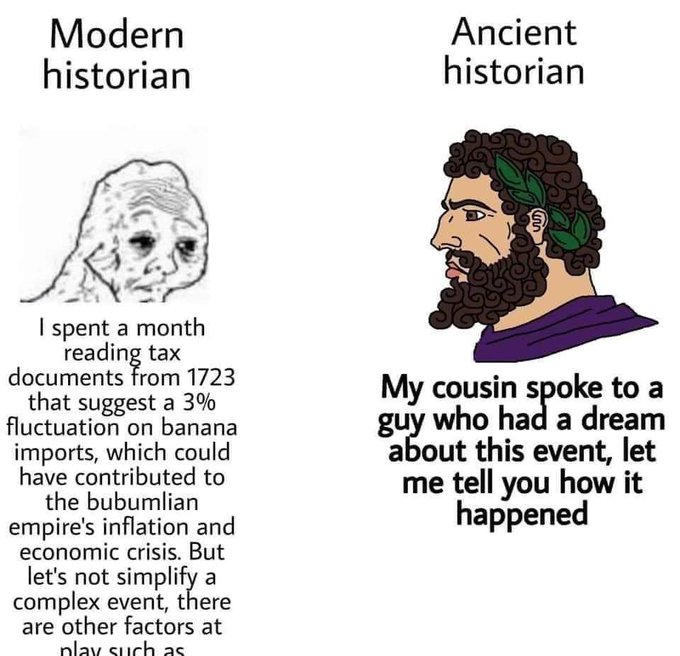
… I’ve become increasingly worried that science’s replication crises might pale in comparison to what happens all the time in history, which is not just a replication crisis but a reproducibility crisis. Replication is when you can repeat an experiment with new data or new materials and get the same result. Reproducibility is when you use exactly the same evidence as another person and still get the same result — so it has a much, much lower bar for success, which is what makes the lack of it in history all the more worrying.
Historical myths, often based on mere misunderstanding, but occasionally on bias or fraud, spread like wildfire. People just love to share unusual and interesting facts, and history is replete with things that are both unusual and true. So much that is surprising or shocking has happened, that it can take only years or decades of familiarity with a particular niche of history in order to smell a rat. Not only do myths spread rapidly, but they survive — far longer, I suspect, than in scientific fields.
Take the oft-repeated idea that more troops were sent to quash the Luddites in 1812 than to fight Napoleon in the Peninsular War in 1808. Utter nonsense, as I set out in 2017, though it has been cited again and again and again as fact ever since Eric Hobsbawm first misled everyone back in 1964. Before me, only a handful of niche military history experts seem to have noticed and were largely ignored. Despite being busted, it continues to spread. Terry Deary (of Horrible Histories fame), to give just one of many recent examples, repeated the myth in a 2020 book. Historical myths are especially zombie-like. Even when disproven, they just. won’t. die.
[…]
I don’t think this is just me being grumpy and pedantic. I come across examples of mistakes being made and then spreading almost daily. It is utterly pervasive. Last week when chatting to my friend Saloni Dattani, who has lately been writing a piece on the story of the malaria vaccine, I shared my
mounting paranoiahealthy scepticism of secondary sources and suggested she check up on a few of the references she’d cited just to see. A few days later and Saloni was horrified. When she actually looked closely, many of the neat little anecdotes she’d cited in her draft — like Louis Pasteur viewing some samples under a microscope and having his mind changed on the nature of malaria — turned out to have no actual underlying primary source from the time. It may as well have been fiction. And there was inaccuracy after inaccuracy, often inexplicable: one history of the World Health Organisation’s malaria eradication programme said it had been planned to take 5-7 years, but the sources actually said 10-15; a graph showed cholera pandemics as having killed a million people, with no citation, while the main sources on the topic actually suggest that in 1865-1947 it killed some 12 million people in British India alone.Now, it’s shockingly easy to make these mistakes — something I still do embarrassingly often, despite being constantly worried about it. When you write a lot, you’re bound to make some errors. You have to pray they’re small ones and try to correct them as swiftly as you can. I’m extremely grateful to the handful of subject-matter experts who will go out of their way to point them out to me. But the sheer pervasiveness of errors also allows unintentionally biased narratives to get repeated and become embedded as certainty, and even perhaps gives cover to people who purposefully make stuff up.
If the lack of replication or reproducibility is a problem in science, in history nobody even thinks about it in such terms. I don’t think I’ve ever heard of anyone systematically looking at the same sources as another historian and seeing if they’d reach the same conclusions. Nor can I think of a history paper ever being retracted or corrected, as they can be in science. At the most, a history journal might host a back-and-forth debate — sometimes delightfully acerbic — for the closely interested to follow. In the 1960s you could find an agricultural historian saying of another that he was “of course entitled to express his views, however bizarre.” But many journals will no longer print those kinds of exchanges, they’re hardly easy for the uninitiated to follow, and there is often a strong incentive to shut up and play nice (unless they happen to be a peer-reviewer, in which case some will feel empowered by the cover of anonymity to be extraordinarily rude).
Why New York Destroyed 3 Iconic Landmarks | Architectural Digest
Architectural Digest
Published 6 Apr 2023Michael Wyetzner of Michielli + Wyetzner Architects returns to AD, this time to look at the history and creation of three New York City landmarks that have since been demolished — but are far from forgotten. From the once (and future?) majesty of Penn Station to the New York Herald building and the original 19th-century Madison Square Garden, Michael gives expert insight into these three historic architectural landmarks, why they were laid to ruin, and what came to replace them.
(more…)
QotD: A typical polis
In any case there certainly were a lot of them. The Polis Center’s inventory counts just over a thousand archaic and classical poleis (it does not extend into the Hellenistic period), of which probably around 800-900 existed at one time. Now our vision of these poleis is necessarily a bit skewed: most were very small and leave little evidence, while the two most prominent poleis in our sources by far, Athens and Sparta, were both very unusual in their size and governing structures. That said while most poleis were very small, it doesn’t follow that most Greeks lived in very small poleis; M.H. Hansen notes ((2006), 83) that by his estimates 80% of all of the poleis housed around 35% of the polis-living population, while the top 10% largest poleis housed roughly 40%.
But the smallest poleis could be very small. A touch over 200 poleis in the inventory had territories of less than 100km2. A small polis like that might have a total population of just a few thousand, with an even smaller subset of that population consisting of adult citizen males. On the other hand, very large poleis like Athens or Sparta might have hundreds of thousands of inhabitants, though as M.H. Hansen notes in the inventory these sorts of massive poleis with territories in excess of 1,000km2 were very rare: there are just thirteen such known.
But crucially for this survey, what we’re going to see is that there some fairly common and standard polis institutions, which seem fairly common regardless of size. Indeed, the language and thinking of our Greek sources is often informed by a sort of idea of an ideal or standard polis, from which every real polis deviates in certain ways. These little communities had institutions which resembled each other, to the point that the difference between “oligarchic” or “democratic” or even “tyranical” poleis could be surprisingly slight. So that’s what we’re going to look at here: a basic sense of what a polis notionally was. And we’ll begin by looking at the parts that comprised a polis, which is going to be quite important as we go forward, since the way one structures a government depends on how one imagines the component parts being governed.
Bret Devereaux, “Collections: How to Polis, 101: Component Parts”, A Collection of Unmitigated Pedantry, 2023-03-10.
August 30, 2023
Extreme maskaholism alert!
In City Journal, John Tierney says we can safely ignore the mask-lovers latest attempt to move us back into the misery of the Wuhan Coronavirus pandemic years:

“Covid 19 Masks” by baldeaglebluff is licensed under CC BY-SA 2.0


Unfazed by data, scientific research, or common sense, the maskaholics are back. In response to an uptick in Covid cases, they’ve begun reinstating mask mandates. So far, it’s just a few places — a college in Atlanta, a Hollywood studio, two hospitals in Syracuse — but the mainstream media and their favorite “experts” are working hard to scare the rest of us into masking up yet again.
Never mind that at least 97 percent of Americans have Covid antibodies in their blood as a result of infection, vaccination, or both. Never mind that actual experts — the ones who studied the scientific literature before 2020 and drew up plans for a pandemic — advised against masking the public. Never mind that their advice has been further bolstered during the pandemic by randomized clinical trials and rigorous observational studies failing to find an effect of masks and mask mandates. Scientific evidence cannot overcome the maskaholics’ faith.
It’s tempting to compare them with the villagers in Cambodia who erected scarecrows in front of their huts to ward off the coronavirus — but that’s not fair to the villagers. Their Ting Mong, as the magic scarecrows are called, at least didn’t hurt any of their neighbors. The mask mandates imposed harms on the public that were well known before Covid, which was why occupational-safety regulations limited workers’ mask usage. Dozens of studies had demonstrated “Mask-Induced Exhaustion Syndrome“, whose symptoms include an increase of carbon dioxide in the blood, difficulty breathing, dizziness, drowsiness, headache, and diminished ability to concentrate and think. It was no surprise during the pandemic when adverse effects of masks were reported in a study of health-care workers in New York City. More than 70 percent of the workers said that prolonged mask-wearing gave them headaches, and nearly a quarter blamed it for “impaired cognition”.
A possibly toxic effect of prolonged mask-wearing, particularly for pregnant women, children, and adolescents, was identified in a review of the scientific literature published this year by German researchers. They warn that mask-wearers are rebreathing carbon dioxide at levels linked with adverse effects on the body’s cardiovascular, respiratory, cognitive, and reproductive systems. Writing for City Journal, Jeffrey Anderson summarized their conclusions: “While eight times the normal level of carbon dioxide is toxic, research suggests that mask-wearers (specifically those who wear masks for more than 5 minutes at a time) are breathing in 35 to 80 times normal levels.”
Because of research linking elevated carbon dioxide levels with stillbirths, the German researchers note, the U.S. Navy began limiting the level on its submarines when female crews began serving. The researchers warn that this level of carbon dioxide is often exceeded when wearing a mask, especially an N95 mask, and they point to “circumstantial evidence” that mask usage may be related to the increase in stillbirths worldwide (including in the U.S.) during the pandemic. They also observe that no such increase occurred in Sweden, where the vast majority of citizens followed the government’s recommendation not to wear masks.
No drug with all these potential side effects would be recommended, much less mandated, for the entire population — and a drug that flunked its clinical trials wouldn’t even be submitted for approval. Yet the Centers for Disease Control, disdaining any cost-benefit analysis, continues to recommend masking for all Americans on indoor public transportation, and for everyone living in areas with high rates of Covid transmission. At the start of the pandemic, even Anthony Fauci advised against masks because there was no evidence of their efficacy. But then, in response to media hysteria, he and the CDC went on to recommend masks anyway, and justified themselves by citing cherry-picked data and consistently flawed studies.
It’s hard to believe, but the big cabinet shuffle didn’t help Trudeau’s poll numbers
Rather the opposite, as Paul Wells explains:
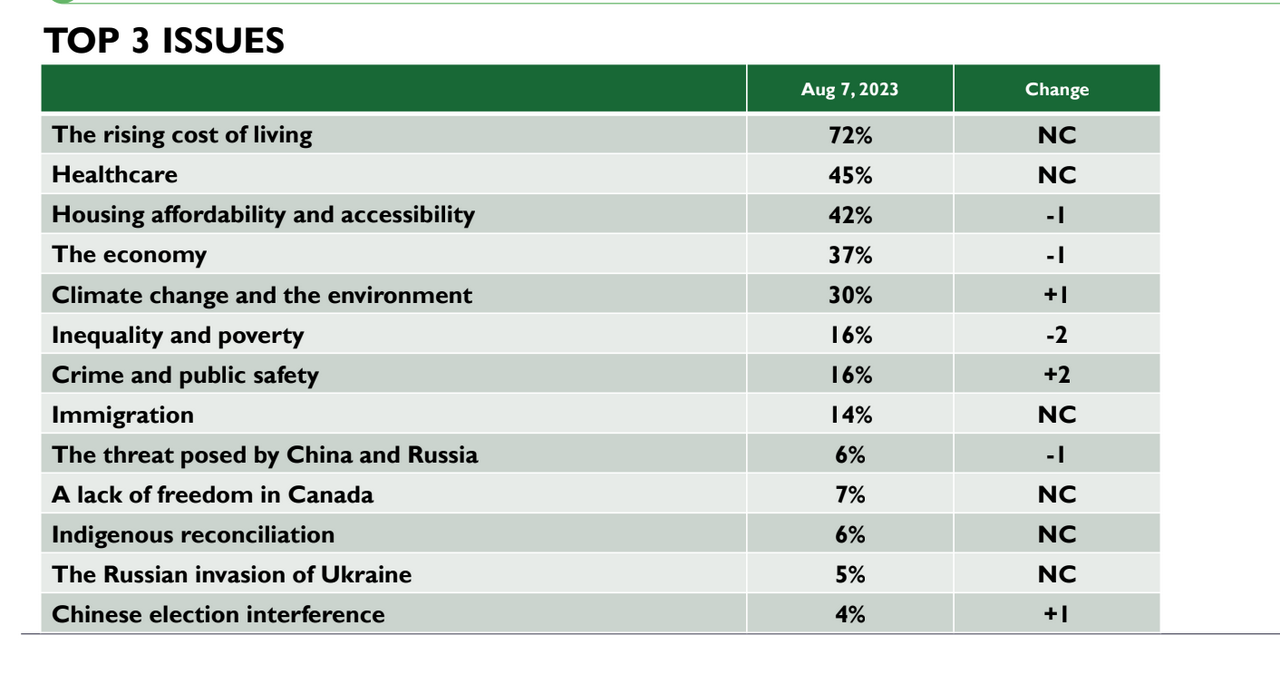
The good news for Team Trudeau is that sometimes new inertia pushes old inertia off the front pages. In June, the apparent decision to stall on an inquiry into foreign election interference seemed bold to the point of recklessness. Now the conventional wisdom barely notices it’s happened. Perhaps one explanation for Pierre Poilievre’s rise in the polls is that he is now complaining about things more Canadians care about.
From Abacus
Did somebody mention polls! For many more reasons than this, the polls are dire for the Liberals. A cottage industry sprang up over the weekend, consisting of Liberal sympathizers pointing out that polls have often been lousy at predicting the future: Dan Arnold and Tyler Meredith; Gerald Butts; David Herle. They all have this much of a point: polls don’t predict the future, opinions can change, campaigns matter. Neither you nor I know what the future holds.
And yet. If Brian Mulroney managed to overcome John Turner’s polling lead in 1986-88, it’s partly because Mulroney’s government was still new, Mulroney was much less of a known quantity than Turner, and Mulroney was able to turn Turner’s chosen issue, free trade, into a huge advantage. If Trudeau has won three times while his share of the popular vote declines, it’s partly because he was less of a known quantity in earlier elections. There’s a reason why the last leader to win four consecutive elections was Wilfrid Laurier. It’s hard.
What Trudeau used to have was agility. He was a critic of the status quo. Stephen Harper needed to have jets in the air over Iraq; Trudeau didn’t. Harper had a low cap on the number of Syrian refugees he could accept; Trudeau didn’t. Harper and Mulcair were obsessed with balanced budgets. Trudeau was less of a fuddy-duddy. He’d change everything, from the electoral system on up.
This sort of stuff is simply easier for the young leader of a third party than for a prime minister nearing a decade in office. But as their manoeuvring room and novelty wear off, incumbent leaders can usually offer compensating virtues: their experience and wisdom. Sure, he’s less exciting than before, but now he’s a surer hand.
Unfortunately, for that to work you need to be a surer hand.
The endless search for the “Easy mode” in military conflict
CDR Salamander on the search for shortcuts to military excellence, despite literal millennia of evidence that there are no such shortcuts:

As the Russo-Ukrainian War reaches its 20th month, I hope everyone has been sufficiently sobered up to stand firmly against those promoting the “72-hour War” or spin an attractive story about some transformational secret sauce that provides an “easy button” for those tasked to do the very hard work of preparing a nation for war should, and if, it were to come.
See the Battle of Hostomel if you need a recent example of where buying this wishcasting can get you.
There is a reason we have continually railed against this Potomac Flotilla mindset for the better part of two decades here — it is the self-delusion of faculty lounge theories running up against the Gods of the Military Copybook Headings reality what we have thousands of years of experience to reference.
We are not smarter than previous generations. There is no secret weapon or war winning technology — or magic beans — that will allow us to skip past the hard work of a viable strategy backed up by a properly resourced industrial capacity to build, maintain, deploy, and sustain a fighting force on the other side of the Pacific for years if needed.
Not 24-hours. Not 72-hours. Think 72-weeks to 72-months and you have your mind right.
[…]
We do no one any good allowing free run towards the national security version of the prosperity gospel, a branch of the transformationalist cult, and their “name it and claim it” attitude towards solving hard problems.
From LCS to DDG-1000, to optimal manning, to six-sigma supply nightmares, to 100-hour workweeks, to 72-hour war CONOPS, to the “Deter by Punishment,” to “1,000 ship navy,” to the offset of this POM cycle, to counter-historical excuses for … again … not doing the hard work that takes so long to bear fruit that someone else will get credit for it.
Every time we have our top leaders — smart hard working professionals with the best intentions — step up to sound more like this guy — the worse we will all be.
It degrades them and endangers everyone.
We don’t need to sell the utility of small drones being used down to the lowest levels of responsibility — it is demonstrated every day.
What we do need sold is Congress’s need to fund a revitalization of our defense industrial capacity and a focus on the naval and aerospace forces that will do most of the fighting in any expected war west of the International Dateline.
Supported by swarms of drones of all shapes and sizes.

Making A Quick Rebate | Paul Sellers
Paul Sellers
Published 21 Apr 2023Life can be simple with a few hand skills and a handful of very ordinary woodworking hand tools. Watch me and see if you couldn’t do this yourself. We try to make everything as simple as we can, and I don’t think this could be simpler.
Enjoy, and start making for a better life!
(more…)
QotD: Hairstyles of the late Ancien Régime
As the industrial revolution and various other shifts (including truly disastrous harvests) robbed those whose income came from hereditary landholding of their ancient riches and prominence, even while the court demanded a complex set of “dancing attendance” for royal favor (A policy started and encouraged by Louis XIV in part to rob the nobility of wealth and prominence, not to mention keeping their minds off rebellion) the nobility felt insecure. The fact that its ranks were being penetrated by people from the bourgeoisie, who married their children or “simply” franked the nobility’s lavish lifestyles, made the nobles feel they were losing control. Even though rank remained a thing of birth, they were in fact, in the real world, losing rank.
The response were fashions so extravagant that they make us go “Wait, what?” and must have given people headaches.
You can see where wigs came from and were fashionable, in a society without running water and/or decent shampoos. It was easier to keep your hair ridiculously short and wear wigs, which is why they’ve been part of human fashion since ever.
But it took the French revolution to come up with wigs on armatures (or hair extensions, ditto) and hairstyles that incorporated ships and, at one point, bird cages with live, singing birds.
To look at drawings or read descriptions is to go “uh, what? who ever thought that was attractive?” and also “Boy their heads must have hurt”.
Yet the competition for the most elaborate and showy hairstyle, no matter how insane, did not stop until those heads fell to Madame Guillotine thereby stilling forever their status anxiety.
Sarah Hoyt, “Is That A Ship On Your Head?”, Libertarian Enterprise, 2019-09-01.
August 29, 2023
The noble reasons New Jersey banned self-service gas stations
Of course, by “noble reasons” I mean “corrupt crony capitalist reasons“:

“Model A Ford in front of Gilmore’s historic Shell gas station” by Corvair Owner is licensed under CC BY-SA 2.0
New Jersey’s law, like Oregon’s, ostensibly stemmed from safety concerns. In 1949, the state passed the Retail Gasoline Dispensing Safety Act and Regulations, a law that was updated in 2016, which cited “fire hazards directly associated with dispensing fuel” as justification for its ban.
If the idea that Americans and filling stations would be bursting into flames without state officials protecting us from pumping gas sounds silly to you, it should. In fact, safety was not the actual reason for New Jersey’s ban (any more than Oregon’s ban was, though the state cited “increased risk of crime and the increased risk of personal injury resulting from slipping on slick surfaces” as justification).
To understand the actual reason states banned filling stations, look to the life of Irving Reingold (1921-2017), a maverick entrepreneur and workaholic who liked to fly his collection of vintage World War II planes in his spare time. Reingold created a gasoline crisis in the Garden State, in the words of New Jersey writer Paul Mulshine, “by doing something gas station owners hated: He lowered prices”.
In the late 1940s, gasoline was selling for about 22 cents a gallon in New Jersey. Reingold figured out a way to undercut the local gasoline station owners who had entered into a “gentlemen’s agreement” to maintain the current price. He’d allow customers to pump gas themselves.
“Reingold decided to offer the consumer a choice by opening up a 24-pump gas station on Route 17 in Hackensack,” writes Mulshine. “He offered gas at 18.9 cents a gallon. The only requirement was that drivers pump it themselves. They didn’t mind. They lined up for blocks.”
Consumers loved this bit of creative destruction introduced by Reingold. His competition was less thrilled. They decided to stop him — by shooting up his gas station. Reingold responded by installing bulletproof glass.
“So the retailers looked for a softer target — the Statehouse,” Mulshine writes. “The Gasoline Retailers Association prevailed upon its pals in the Legislature to push through a bill banning self-serve gas. The pretext was safety …”
The true purpose of New Jersey’s law had nothing to do with safety or “the common good”. It was old-fashioned cronyism, protectionism via the age-old bootleggers and Baptists grift.
Politicians helped the Gasoline Retailers Association drive Reingold out of business. He and consumers are the losers of the story, yet it remains a wonderful case study in public choice theory economics.
The economist James M. Buchanan received a Nobel Prize for his pioneering work that demonstrated a simple idea: Public officials tend to arrive at decisions based on self-interest and incentives, just like everyone else.
The Souls of Black Folk by W.E.B. Du Bois “runs so fantastically counter to the entire ideology of ‘decolonise'”
In Spiked, Brendan O’Neill finds himself surprised at the inclusion of a very unusual book on a list demanded by those pushing for “decolonization” of university curricula:
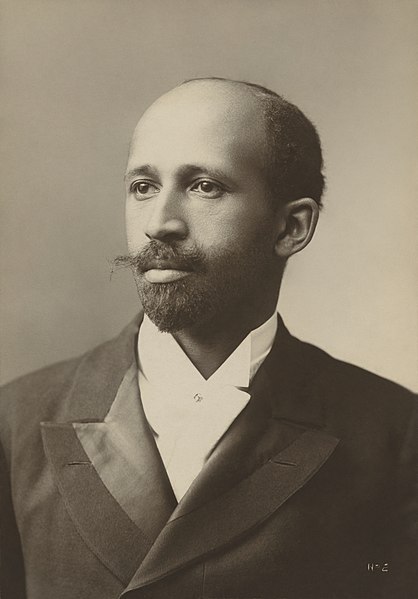
W.E.B. Du Bois by James E. Purdy, 1907, gelatin silver print, from the National Portrait Gallery which has explicitly released this digital image under the CC0 license.
Wikimedia Commons.
“Decolonise the curriculum” is a movement that wants university courses to focus less on dead white European males and more on writers of colour. Its argument is that black students need texts that speak directly to them. They need books by authors who look like them. They need books about experiences and ideas they can more readily relate to than they can the stuff written about in “high white culture”. Black students must be able to recognise themselves in what they study, we’re told, or else they’ll feel cheated and demeaned.
I was surprised to find that one of the leading decolonise movements, at the University of Edinburgh, was arguing for WEB Du Bois’ 1903 book, The Souls of Black Folk, to be included on the English curriculum. The activists said it was unreasonable to expect black students to engage with so many white authors. They also need to engage with people like Du Bois, in whose work they might “recognise themselves”. I was surprised, not because I think The Souls of Black Folk shouldn’t be on more university courses – absolutely it should. No, it’s because The Souls of Black Folk runs so fantastically counter to the entire ideology of “decolonise”. It made me wonder if these activists have even read it. Du Bois’ book contains some of the finest arguments you will ever read against the idea that high culture is a white thing that others cannot connect with.
One of my favourite passages in the book, from the chapter on what kind of education black men are fit for, touches on this very question. Here Du Bois makes his critique of those in his own time who were arguing that blacks only require basic education and industrial training. He describes his own experience of higher learning, writing:
I sit with Shakespeare and he winces not. Across the colour line I move arm in arm with Balzac and Dumas … From out the caves of evening that swing between the strong-limbed earth and the tracery of the stars, I summon Aristotle and Aurelius and they come all graciously with no scorn or condescension.
That passage, Du Bois’ moving belief that Shakespeare does not wince at him, captures a central thread of his writing: universalism. Du Bois agitates against accommodating to segregation or low expectations, and argues for the rights of “black folk” to assimilate into the spoils of civilisation; to become, as he puts it, “co-workers in the kingdom of culture”. To those in the late 1800s and early 1900s who argued that black people needed a targeted form of culture, one specific to their needs and capacities, Du Bois said: “We daily hear that an education that encourages aspiration, that sets the loftiest of ideals and seeks as an end culture and character rather than breadwinning, is the privilege of white men, and the danger and delusion of black men.”
Du Bois insisted that it is only through assimilation into the “kingdom of culture” that self-knowledge and self-improvement can truly occur. As he wrote: “Wed with Truth, I dwell above the veil.” The veil he’s referring to is the veil of colour, the one that separated blacks from whites in post-slavery America. For Du Bois, that veil was best lifted via assimilation into the American republic’s political universe and its realm of culture.
Du Bois’ critique of the notion that high culture was for white men, and would prove mystifying to black men, has sadly been superseded by an “anti-racism” with an entirely different outlook. Now, the supposedly radical stance is to believe that high culture is disorientating for black people, and possibly even damaging to their self-esteem, and therefore they require something more targeted. In short, they need release from the kingdom of culture. That, in essence, is what the decolonise movement desires: the “liberation” of non-white peoples from the cultural gains of Western civilisation. Behold the crisis of universalist belief.
A Rare World War One Sniper’s Rifle: Model 1916 Lebel
Forgotten Weapons
Published 28 Feb 2018Unlike Great Britain and Germany, the French military never developed a formal sniper doctrine during World War One — they had no dedicated schools or instruction manuals for that specialty. The three major arsenals did produce scoped sniping rifles, however, with models of 1915, 1916, and 1917 (and a post-war 1921 pattern). We have a model 1916 example here today.
The rifles were completely ordinary off-the-rack Lebels, modified simply to add scope mounts. The 1916 pattern mount used a round peg on the side of the rear sight and a bracket wrapped around the front of the receiver, which allowed the scope to be quickly and easily detached for carry in a separate pouch (similar to what other nations did, to protect the optic from damage when not in use). The rifles were issued only in small numbers (2 per company, or even 2 per battalion) and it was left to the unit commander to decide how to employ them.
This particular scope has some neat provenance of being brought home by a US soldier after the war — it came back wrapped in a period copy of Stars and Stripes magazine. The rifle is of the appropriate type, but the “N” marks on the barrel and receiver indicated French overhaul in the 1930s, precluding it from being the original rifle this scope was mounted on.
(more…)


