
Preference Falsification — If people are afraid to say what they really think, they will instead lie. Therefore, punishing speech — whether by taking offence or by threatening censorship — is ultimately a request to be deceived.
Gurwinder Bhogal, “33 concepts to survive the year”, UnHerd, 2024-01-01.
April 7, 2024
QotD: Censorship works, but not the way the censors think it does
Comments Off on QotD: Censorship works, but not the way the censors think it does
April 6, 2024
Italian Communists, the French in Indochina, and the fate of Italy’s army – WW2 – OOTF 34
World War Two
Published 5 Apr 2024What happened to Italian soldiers overseas after the fall of Mussolini? What about the French soldiers left over in Indochina after the Japanese “occupation by invitation”? And, what did the Allies think of the Italian Communist movement and its partisan forces?
(more…)
Comments Off on Italian Communists, the French in Indochina, and the fate of Italy’s army – WW2 – OOTF 34
Three AI catastrophe scenarios
David Friedman considers the threat of an artificial intelligence catastrophe and the possible solutions for humanity:

Earlier I quoted Kurzweil’s estimate of about thirty years to human level A.I. Suppose he is correct. Further suppose that Moore’s law continues to hold, that computers continue to get twice as powerful every year or two. In forty years, that makes them something like a hundred times as smart as we are. We are now chimpanzees, perhaps gerbils, and had better hope that our new masters like pets. (Future Imperfect Chapter XIX: Dangerous Company)
As that quote from a book published in 2008 demonstrates, I have been concerned with the possible downside of artificial intelligence for quite a while. The creation of large language models producing writing and art that appears to be the work of a human level intelligence got many other people interested. The issue of possible AI catastrophes has now progressed from something that science fiction writers, futurologists, and a few other oddballs worried about to a putative existential threat.
Large Language models work by mining a large database of what humans have written, deducing what they should say by what people have said. The result looks as if a human wrote it but fits the takeoff model, in which an AI a little smarter than a human uses its intelligence to make one a little smarter still, repeated to superhuman, poorly. However powerful the hardware that an LLM is running on it has no superhuman conversation to mine, so better hardware should make it faster but not smarter. And although it can mine a massive body of data on what humans say it in order to figure out what it should say, it has no comparable body of data for what humans do when they want to take over the world.
If that is right, the danger of superintelligent AIs is a plausible conjecture for the indefinite future but not, as some now believe, a near certainty in the lifetime of most now alive.
[…]
If AI is a serious, indeed existential, risk, what can be done about it?
I see three approaches:
I. Keep superhuman level AI from being developed.
That might be possible if we had a world government committed to the project but (fortunately) we don’t. Progress in AI does not require enormous resources so there are many actors, firms and governments, that can attempt it. A test of an atomic weapon is hard to hide but a test of an improved AI isn’t. Better AI is likely to be very useful. A smarter AI in private hands might predict stock market movements a little better than a very skilled human, making a lot of money. A smarter AI in military hands could be used to control a tank or a drone, be a soldier that, once trained, could be duplicated many times. That gives many actors a reason to attempt to produce it.
If the issue was building or not building a superhuman AI perhaps everyone who could do it could be persuaded that the project is too dangerous, although experience with the similar issue of Gain of Function research is not encouraging. But at each step the issue is likely to present itself as building or not building an AI a little smarter than the last one, the one you already have. Intelligence, of a computer program or a human, is a continuous variable; there is no obvious line to avoid crossing.
When considering the down side of technologies–Murder Incorporated in a world of strong privacy or some future James Bond villain using nanotechnology to convert the entire world to gray goo – your reaction may be “Stop the train, I want to get off.” In most cases, that is not an option. This particular train is not equipped with brakes. (Future Imperfect, Chapter II)
II. Tame it, make sure that the superhuman AI is on our side.
Some humans, indeed most humans, have moral beliefs that affect their actions, are reluctant to kill or steal from a member of their ingroup. It is not absurd to belief that we could design a human level artificial intelligence with moral constraints and that it could then design a superhuman AI with similar constraints. Human moral beliefs apply to small children, for some even to some animals, so it is not absurd to believe that a superhuman could view humans as part of its ingroup and be reluctant to achieve its objectives in ways that injured them.
Even if we can produce a moral AI there remains the problem of making sure that all AI’s are moral, that there are no psychopaths among them, not even ones who care about their peers but not us, the attitude of most humans to most animals. The best we can do may be to have the friendly AIs defending us make harming us too costly to the unfriendly ones to be worth doing.
III. Keep up with AI by making humans smarter too.
The solution proposed by Raymond Kurzweil is for us to become computers too, at least in part. The technological developments leading to advanced A.I. are likely to be associated with much greater understanding of how our own brains work. That might make it possible to construct much better brain to machine interfaces, move a substantial part of our thinking to silicon. Consider 89352 times 40327 and the answer is obviously 3603298104. Multiplying five figure numbers is not all that useful a skill but if we understand enough about thinking to build computers that think as well as we do, whether by design, evolution, or reverse engineering ourselves, we should understand enough to offload more useful parts of our onboard information processing to external hardware.
Now we can take advantage of Moore’s law too.
A modest version is already happening. I do not have to remember my appointments — my phone can do it for me. I do not have to keep mental track of what I eat, there is an app which will be happy to tell me how many calories I have consumed, how much fat, protein and carbohydrates, and how it compares with what it thinks I should be doing. If I want to keep track of how many steps I have taken this hour3 my smart watch will do it for me.
The next step is a direct mind to machine connection, currently being pioneered by Elon Musk’s Neuralink. The extreme version merges into uploading. Over time, more and more of your thinking is done in silicon, less and less in carbon. Eventually your brain, perhaps your body as well, come to play a minor role in your life, vestigial organs kept around mainly out of sentiment.
As our AI becomes superhuman, so do we.
Comments Off on Three AI catastrophe scenarios
The Fake (and real) History of Potato Chips
Tasting History with Max Miller
Published Jan 2, 2024The fake and true history of the potato chip and an early 19th century recipe for them. Get the recipe at my new website https://www.tastinghistory.com/ and buy Fake History: 101 Things that Never Happened: https://lnk.to/Xkg1CdFB
(more…)
Comments Off on The Fake (and real) History of Potato Chips
QotD: No navy ever has all its ships at sea at the same time
This complex world requires attention on a regular basis, both to make sure that the constituent parts still work as planned, and also to update and replace parts with more modern or better alternatives, or to provide planned upgrades. For instance, it is common for new ships entering service to undergo a short refit to add in any extra capability upgrades that may have been rolled out since construction began, and to rectify any defects.
For the purposes of planning how the fleet works, the Royal Navy looks to provide enough ships to meet agreed defence tasks. In simple terms the MOD works out what tasks are required of it, and what military assets are needed to meet them. This can range from providing a constantly available SSBN to deliver the deterrence mission through to deploying the ice patrol ship to Antarctica.
Once these commitments are understood, planners can work out how many ships / planes / tanks are needed to meet this goal. For example, it may be agreed that the RN needs to sustain multiple overseas deployments, and also be able to generate a carrier strike group too.
If, purely hypothetically the requirement for this is 6 ships, then the next task is to work out how many ships are needed to ensure 6 ships are constantly available. Usually, this has historically been at a 3:1 ratio – one ship is on task or ready to fulfill it, one is in some form of work up or other training ahead of being assigned to the role, and one is just back or in refit.
In practical terms this means that the RN never looks to get 100% of its force to sea, but rather to ensure it doesn’t fail to ensure enough ships are available to meet all the tasks that it is required to do. Consequently there is always going to be a mismatch between the number of ships owned, and the number of ships deployed.
Sir Humphrey, “Inoperable or just maintenance”, Thin Pinstriped Line, 2019-10-24.
Comments Off on QotD: No navy ever has all its ships at sea at the same time
April 5, 2024
Canada’s carbon tax – “… no emissions policy that doesn’t start with banning private jets can be called ‘fair’ with a straight face”
In The Line, Clarke Ries points out the incredibly uncomfortable truth that no matter how the federal government tries to hide it, the carbon tax regime is going to be painful and the pain is going to be absorbed much more by the rural poor than anyone else:

Minister of Environment and Climate Change Steven Guilbeault, 3 February 2020 (when he was Canadian Heritage Minister).
Screencapture from CPAC video.
Consumption taxes are a straightforwardly-effective policy tool. You simply increase the price of the resource you want to see used less and let people adapt to the simulated scarcity via ingenuity, frugality, lifestyle change, repricing their goods and services, etc. The government doesn’t dictate solutions, it lets people find their own. In the process, the consumption tax dispassionately reveals who’s making the most valuable use of that resource.
[…]
So the question remains, who uses a lot of carbon but doesn’t make a lot of money doing it? Who lives in drafty old single-family houses? Who uses archaic methods of keeping those houses warm, like furnaces that run on heating oil? Who has to drive halfway around the world to reach the nearest grocery store and halfway to the moon for the nearest medical clinic? Who’s making that drive in a battered old ride with terrible fuel economy?
The rural poor.
Not the farmers or the ranchers, who mostly make plenty of dough and often know their way around America’s higher-end resort towns, but the rural poor. The kind of people you disproportionately find in Newfoundland outports, eking out a tenuous living as they wait for the cod to return. You know, reliable Liberal voters.
Put another way, a neutrally-applied carbon tax goes after Maritimers first and hardest — forcing them to close shop on their romantic traditional lifestyle and move into apartment blocks in the nearest city, where they’ll earn more for their labour and emit less carbon doing it.
[…]
Remember: for the carbon tax to do what it says on the tin, somebody has to lose. For the carbon tax to be anything other than a purposeless pain in the ass, somebody — a lot of somebodies, frankly, if the Liberals are serious about cutting carbon emissions to 40 per cent under 2005 levels — must be forced to make significant and unpleasant lifestyle changes.
So let’s assume the Parliamentary Budget Office is right, and that Atlantic Canadians are now, after a second round of special supplements and exemptions, definitely net beneficiaries of the carbon tax. All it’s bought the Liberals is a reprise of the same question: who’s for dinner?
Who’s going to trade in their beater for bus tickets? Who’s going to raise their kids in a condo tower instead of a single-family home? Who’s going to start taking their midwinter vacation in the province next door instead of Palm Springs or Costa Rica? Who’s going to shiver on a cold night instead of raising the thermostat?
Only the most diehard of optimists could believe that the roster of ritual sacrifices will substantially consist of financially-comfortable Canadians. The people who can afford to make investments that reduce their carbon emissions without materially sacrificing their lifestyles will do so. A handful will start biking to work during the summer. Others will install solar panels on top of their detached houses — which are mostly located in neighbourhoods where you’re not even allowed to build a condo tower — and that’s going to be that.
Beneath all the aspirational language, what an effective carbon tax actually does is throw the government into a cage match with Canada’s working class. The truth behind the Liberals’ woes on this file is that as long as they’re committed to the carbon tax as a tool for fighting climate change, their only real choice is which part of the working class they land on when they come off the top rope.
In the still-ongoing “war of the sexes”, when can women just accept they’ve won and cease hostilities?
At the amusingly named Handwaving Freakoutery, you can see a scorecard for the war of the sexes that has been ongoing since I was a child and seems no closer to ending than back in the 1960s:
I say this to make it absolutely clear that unlike a lot of boorishly banal material you might encounter within the wretchedly named “Manosphere”, this is not intended to be a whiny article. I’m not complaining, nor am I calling for societal change or action. I’m simply wondering exactly how dominant female privilege has to get before they declare victory and take their boot off the necks of men. I really don’t know the answer to this question, but we’ll speculate about that below after the wall of graphs. HWFO loves graphs.
Herein we will go point by point through as many measurable societal markers as I can think of, leaving no marker unmarked, and put together a Gender War Scoreboard describing as accurate a snapshot as possible of the current state of the United States. Then we’ll close with some analysis about how badly it would have to get before the women finally just declare victory and move on. This post shall be too big for email.
To assign our score, we will look at sets of data that fall generally into two categories. For victimization ratios and similar, we’ll just look at percentage by gender. For comparing two uncapped sets of data, such as life expectancy, we’ll look at a ratio and make them both add to 100 for an apples-to-apples comparison. Then we’ll add them all up at the end to tally the score.
Salary
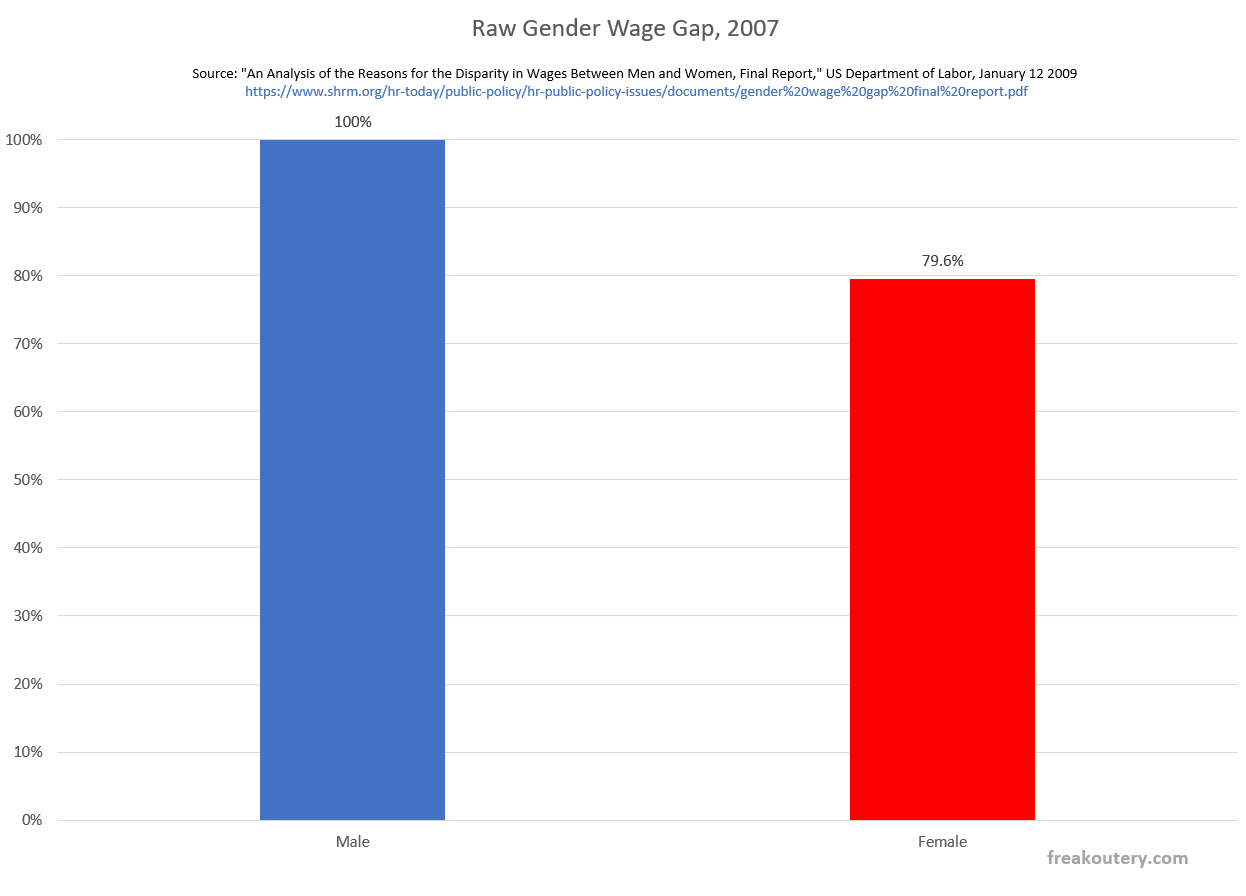
HWFO covered the gender wage gap in 2022, but I’ll summarize it here so you don’t have to read back. According to a 2008 analysis by the Department of Labor, now 16 years old, the raw gender wage gap was 20.4% in 2007:
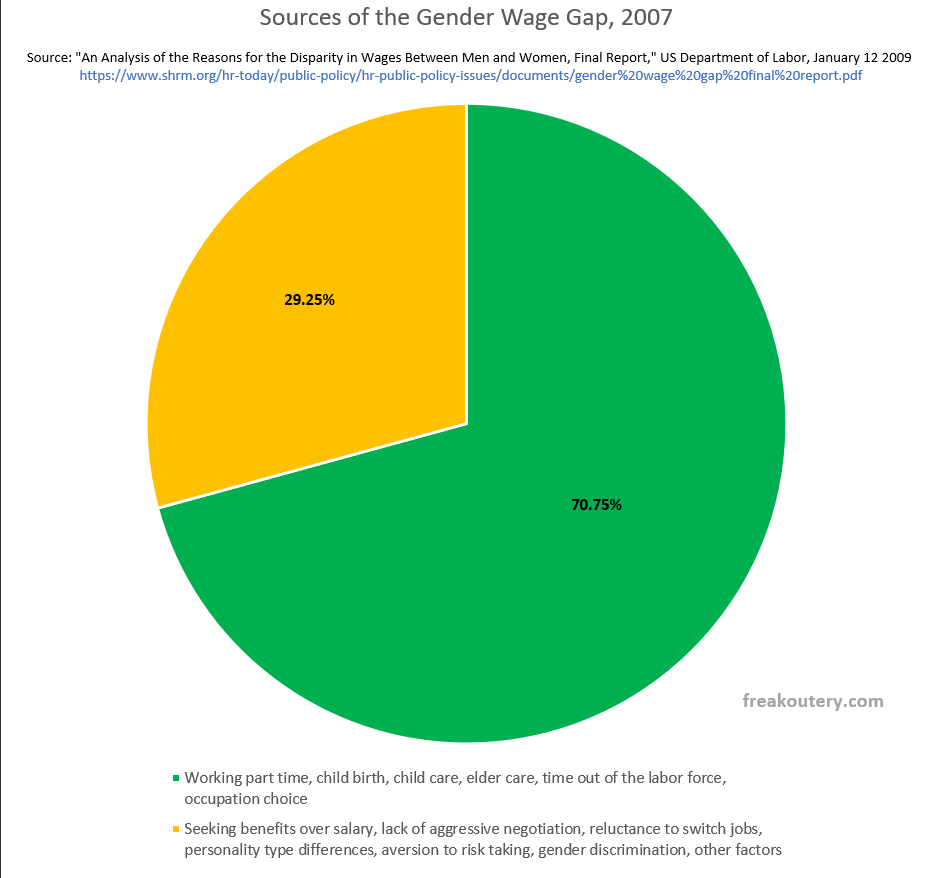
Most of the gap was explainable by career choice and lifestyle choice differences:
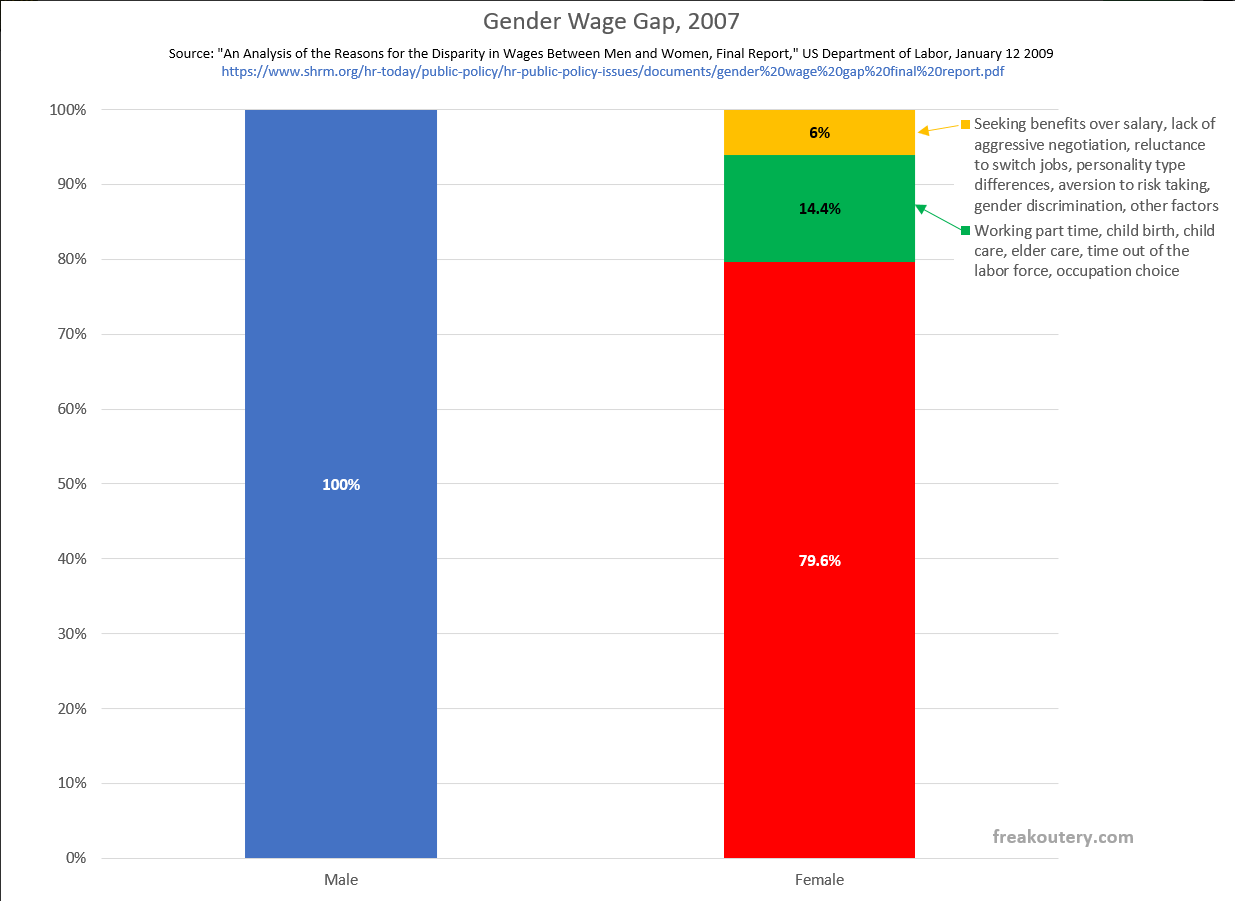
When compared properly that looks like this:
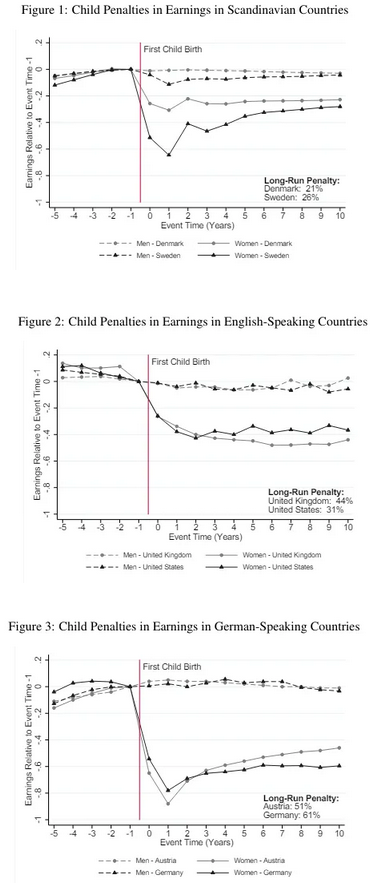
Sixteen years ago, the bits of the gender wage gap that weren’t explained by career and life choice differences only totaled 6%. This fact has been known for a decade and a half and is constantly hidden from view by Pew, the NLWC, and any other major organization that profits from the perception that this gap is large and persistent. It has also assuredly closed to narrower than that 6% in the ensuing decade and a half, but nobody’s replicated the Department of Labor analysis. Look closely at the effects in the green bar identified by the Department of Labor. “Child birth” is how you become a mother. “Child care” is something mothers do. “Working part time” is something mothers do. “Time out of the labor force” is something mothers take. “Occupational choice” is something women change when they become mothers. Here are some graphs from Kleven et al, March 2019:
The solid lines are women. In every studied area, the women make equal or more than the men do up until the birth of their first child, and then they make less. The gender wage gap difference is in the choice to have children. Women choose to make professional concessions to raise a family while the men don’t. Is this fair? Some might say no, but only if they also don’t want to be the primary caregiver for their kids. Some would say yes, for the following two reasons: (1) women choose this, especially in feminist societies, but also (2) men are punished socially for choosing this. If you do not believe me, go make two fake male Tinder profiles with identical cute photos in them, and in the bio of one say “corporate lawyer” and the other say “part time daycare worker” and see which one gets more hits. Then do the same with a female profile. Men are socially punished by women for making the career concession, women are not socially punished by men for making it.
Often when these sorts of “equal pay for equal work” studies are properly controlled for mothering and career choice, they find that men are paid less than women for equal work. Google was pretty famously forced by their neo-progressive staff to do an internal analysis of the subject, and uncomfortably discovered they were overpaying women for being women on an “equal work” basis. The results were twofold. First Google paid all the men a one time bonus, then Google quietly never investigated it again so they could get back to paying women more.
Comments Off on In the still-ongoing “war of the sexes”, when can women just accept they’ve won and cease hostilities?
“[T]oo many charlatans of this species have already been allowed to make vast fortunes at the expense of a gullible public”
Colby Cosh on his “emerging love-Haidt relationship” as Jonathan Haidt’s new book is generating a lot of buzz:

If Haidt has special expertise that wouldn’t pertain to any well-educated person, I wonder a little in what precise realm it lies. Read the second sentence of this article again: he’s a psychologist … who teaches ethics … at a business school? Note that he seems to have abandoned a prior career as an evolutionary biology pedlar, and the COVID pandemic wasn’t kind to his influential ideas about political conservatives being specially motivated by disgust and purity. Much of The Anxious Generation is instead devoted to trendy findings from “neuroscience” that it might be too kind to describe as “speculative”. (I’ll say it again until it’s conventional wisdom: a “neuroscientist” is somebody in a newly invented pseudofield who couldn’t get three inches into the previously established “-ology” for “neuro-“.)
These are my overwhelming prejudices against Haidt; and, in spite of all of them, I suspect somebody had to do what he is now doing, which is to make the strongest available case for social media as a historical impactor on social arrangements and child development. Today the economist/podcaster Tyler Cowen has published a delightfully adversarial interview with Haidt that provides a relatively fast way of boning up on the Haidt Crusade. Cowen belongs to my pro-innovation, techno-optimist, libertarian tribe: we both feel positive panic at the prospect of conservative-flavoured state restrictions on media, which are at the heart of the Haidt agenda.
But reading the interview makes me somewhat more pro-Haidt than I would otherwise be (i.e., not one tiny little bit). On a basic level, Cowen doesn’t, by any means, win the impromptu debate by a knockout — even though he is one of the most formidable debaters alive. Haidt has four key reforms he would like to see implemented politically: “No smartphones before high school; no social media before age 16; phone-free schools; far more unsupervised play and childhood independence.”
This is a fairly limited, gentle agenda for school design and other policies, and although I believe Haidt’s talk of “rewiring brains” is mostly ignorable BS, none of his age-limitation rules are incompatible with a free society, and none bear on adults, except in their capacity as teachers and parents.
The “rewiring” talk isn’t BS because it’s necessarily untrue, mind you. Haidt, like Jordan Peterson, is another latter-day Marshall McLuhan — a boundary-defying celebrity intellectual who strategically turns speculation into assertion, and forces us, for better or worse, to re-examine our beliefs. McLuhan preached that new forms of media like movable type or radio do drive neurological change, that they cause genuine warp-speed human evolution — but his attitude, unlike Haidt’s, was that these changes are certain to happen, and that arguing against them was like arguing with the clouds in favour of a sunny day. The children who seem “addicted” to social media are implicitly preparing to live in a world that has social media. They are natives of the future, and we adults are just observers of it.
Comments Off on “[T]oo many charlatans of this species have already been allowed to make vast fortunes at the expense of a gullible public”
Ero: The Croatian Uzi (With Israeli Help?)
Forgotten Weapons
Published Jan 3, 2024The best of the submachine guns made in Croatia during the Homeland War was the Ero, made by a company called Arma. The Ero is a basically perfect, parts-interchangeable copy of the Israeli Uzi that was developed in 1992 and adopted into Croatian Army service in 1993. The only really distinguishable difference between the Ero and Uzi is the Ero’s use of Croatian-language selector markings (and receiver markings). Between 15,000 and 20,000 were produced, and they remained in service long after Croatian independence was secured. They were issued to vehicle crews, military police, special forces, and reconnaissance units.
Arma was a subsidiary of a major Croatian engineering firm, and after the Ero production it developed the APS-95 Croatian AK (which is a story for another video). They were a very competent company, but the details and quality of the Ero are so good that I believe it must have been made with tacit or explicit assistance from Israel. Croatia does have a strong Jewish community, and there were rumors during the war that the technical data package for the Uzi did find its way into Croatia. There is no official acknowledgement of this happening, but it would certainly not be hard to believe. But however the development happened, the result was a very high quality submachine gun.
A big thanks to the Croatian Police Museum (Muzej Policije) in Zagreb for giving me access to film this cool piece for you! Check them out at: https://muzej-policije.gov.hr
(more…)
Comments Off on Ero: The Croatian Uzi (With Israeli Help?)
QotD: When the faculty lounge turned nasty over the electric vehicle charging stations
Not because academics are worried about anything so prole as hypocrisy — as we know, cognitive dissonance only affects the Dirt People — but because eggheads operate on a different scale of values. Bentleys etc. are what those people drive … so professors have to kick it bobo style. Thus the faculty lot is filled with Priuses (Prii?), Teslas, and so forth. Back when The Simpsons was funny, it had a throwaway joke about Ed Begley Jr. driving a car so eco-friendly, it was powered entirely by his own sense of self-regard. If they actually marketed those, every professor in America would have one … but since they don’t, the “eco-pimp my ride” competition continues unabated.
Which is hilarious for two reasons. First, there isn’t — there won’t be, there can’t be — sufficient infrastructure to support more than a token few electric vehicles (EVs). Flyover State is nothing if not eco-friendly, though, and so they fell all over themselves giving the faculty charging stations … but see above: All they could manage was one charging station per level, in one parking garage. Which naturally led to much agonizing in the Faculty Senate, not to mention the student newspaper, the town newspaper, and every boutique coffee place and head shop in College Town. How can charging station time be most equitably distributed? Does the Lesbian Negress outweigh (supply your own joke here, please) the White FTM tranny? What about the genderfluid hemophiliac Inuit? Where does the wingless golden-skinned dragonkin rank?
Severian, “Luxury Beliefs”, Rotten Chestnuts, 2021-06-03.
Comments Off on QotD: When the faculty lounge turned nasty over the electric vehicle charging stations
April 4, 2024
I feel you, Sarge …
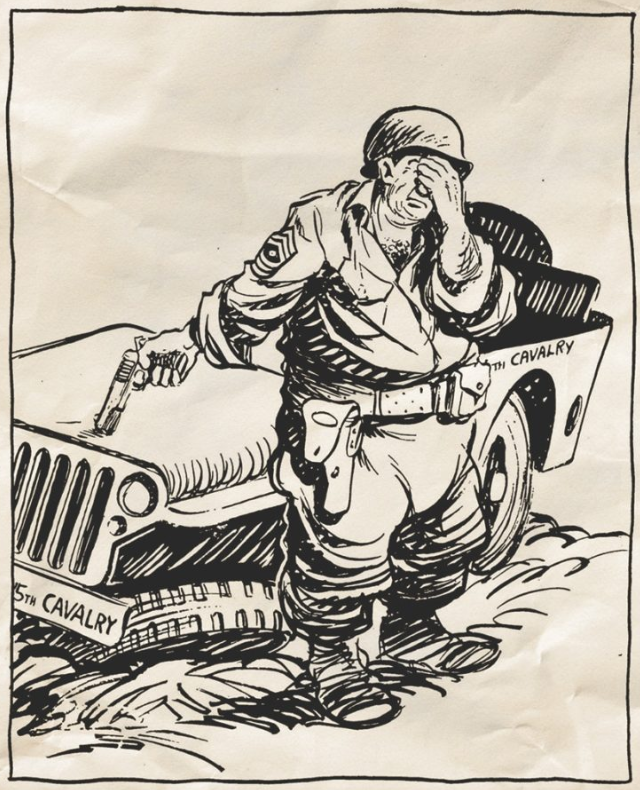
I had to take my 2006 Toyota Tacoma in to the shop on Monday because the power steering had clearly gone … turning the wheel had become an unpleasant “armstrong ungeared” experience. The initial estimate was over $5000 to fix, as it was quite an involved repair, but I swallowed hard and signed the estimate. I got a call from the shop early Wednesday afternoon, but it wasn’t the cheery “the work’s done” message I was expecting, but a much more depressing “the truck’s frame is rotted and the vehicle is probably not roadworthy”.
The initial $5000+ estimate was already going to rip the bottom out of my financial plans for the year, and there’s no chance of finding a replacement for anything even close to that price, so I’m without a personal vehicle for the first time in nearly 40 years (fortunately, Elizabeth will let me borrow her RAV4 whenever she doesn’t need it, so I’m not a permanent pedestrian).

After we took delivery of the truck on Halloween, 2005, we took a drive up to the southern reaches of Algonquin Park where I took a few photos of the new vehicle. It would rarely be this shiny again.
Honestly, this was an April Fool’s joke I never saw coming.
Boeing and the ongoing competency crisis
Niccolo Soldo on the pitiful state of Boeing within the larger social issues of collapsing social trust and blatantly declining competence in almost everything:

“Boeing 521 427”by pmbell64 is licensed under CC BY-SA 2.0


By now, most of you have heard of the increasingly popular concept known as “the competency crisis”. For those of you who haven’t, the competency crisis argues that the USA is headed towards a crisis in which critical infrastructure and important manufacturing will suffer a catastrophic decline in competency due to the fact that the people (almost all males) who know how to build/run these things are retiring, and there is no one available to fill these roles once they’re gone. The competency crisis is one of the major points brought up by people when they point out that America is in a state of decline.
As all of you are already aware, there is also a general collapse in trust in governing institutions in the USA (and all across the West). Cynicism is the order of the day, with people naturally assuming that they are being lied to constantly by the ruling elites, whether in media, government, the corporate world, and so on. A competency crisis paired with a collapse in trust in key institutions is a vicious one-two punch for any country to absorb. Nowhere is this one-two combo more evident than in one of America’s crown jewels: Boeing.
I’m certain that all of you are familiar with the “suicide” of John Barnett that happened almost a month ago. John Barnett was a Quality Control Manager working for Boeing in the Charleston, South Carolina operation. He was a “lifer”, in that he spent his entire career at Boeing. He was also a whistleblower. His “suicide” via a gunshot wound to the right temple happened on what was scheduled to be the third and last day of his deposition in his case against his former employer.
In more innocent and less cynical times, the suggestion that he was murdered would have had currency only in conspiratorial circles, serving as fodder for programs like the Art Bell Show. But we are in a different world now, and to suggest that Barnett might have been killed for turning whistleblower earns one replies like “could be”, “I’m pretty sure that’s the case”, and the most common one of all: “I wouldn’t doubt it”. No one believes that Jeffrey Epstein killed himself. Many people believe the same about John Barnett. The collapse in trust in ruling institutions has resulted in an environment where conspiratorial thinking naturally flourishes. Maureen Tkacik reports on Boeing’s downward turn, using Barnett’s case as a centre piece:
“John is very knowledgeable almost to a fault, as it gets in the way at times when issues arise,” the boss wrote in one of his withering performance reviews, downgrading Barnett’s rating from a 40 all the way to a 15 in an assessment that cast the 26-year quality manager, who was known as “Swampy” for his easy Louisiana drawl, as an anal-retentive prick whose pedantry was antagonizing his colleagues. The truth, by contrast, was self-evident to anyone who spent five minutes in his presence: John Barnett, who raced cars in his spare time and seemed “high on life” according to one former colleague, was a “great, fun boss that loved Boeing and was willing to share his knowledge with everyone,” as one of his former quality technicians would later recall.
Please keep in mind that this report offers up only one side of the story.
A decaying institution:
But Swampy was mired in an institution that was in a perpetual state of unlearning all the lessons it had absorbed over a 90-year ascent to the pinnacle of global manufacturing. Like most neoliberal institutions, Boeing had come under the spell of a seductive new theory of “knowledge” that essentially reduced the whole concept to a combination of intellectual property, trade secrets, and data, discarding “thought” and “understanding” and “complex reasoning” possessed by a skilled and experienced workforce as essentially not worth the increased health care costs. CEO Jim McNerney, who joined Boeing in 2005, had last helmed 3M, where management as he saw it had “overvalued experience and undervalued leadership” before he purged the veterans into early retirement.
“Prince Jim” — as some long-timers used to call him — repeatedly invoked a slur for longtime engineers and skilled machinists in the obligatory vanity “leadership” book he co-wrote. Those who cared too much about the integrity of the planes and not enough about the stock price were “phenomenally talented assholes”, and he encouraged his deputies to ostracize them into leaving the company. He initially refused to let nearly any of these talented assholes work on the 787 Dreamliner, instead outsourcing the vast majority of the development and engineering design of the brand-new, revolutionary wide-body jet to suppliers, many of which lacked engineering departments. The plan would save money while busting unions, a win-win, he promised investors. Instead, McNerney’s plan burned some $50 billion in excess of its budget and went three and a half years behind schedule.
There is a new trend that blames many fumbles on DEI. Boeing is not one of those. Instead, the short-term profit maximization mindset that drives stock prices upward is the main reason for the decline in this corporate behemoth.
Comments Off on Boeing and the ongoing competency crisis
See Inside Panther | Tank Chats Reloaded
The Tank Museum
Published Dec 29, 2023Chris Copson takes a detailed look inside and out, of arguably the most advanced German tank of WW2 … the Panther.
Is the Panther the formidable opponent that is was made out to be? Would the allies use such a vehicle and was it over engineered? Find out in today’s video.
00:00 Intro
00:54 Overview – Our Panther
02:41 War time variants & armour
06:06 Design
08:30 Weaponry
10:18 Crew, equipment and flaws – a look inside
17:53 Performance & conclusion
(more…)
Comments Off on See Inside Panther | Tank Chats Reloaded
QotD: What we mean by the term “indigenous”
But of course this is pedantic nitpicking (my speciality), because legally “indigenous” means “descended from the people who were there before European colonialism”: the Inuit are “indigenous” because they were in Newfoundland and Greenland when Martin Frobisher showed up, regardless of the fact that they had only arrived from western Alaska about five hundred years earlier. Indigineity in practice is not a factual claim, it’s a political one, based on the idea that the movements, mixtures, and wholesale destructions of populations since 1500 are qualitatively different from earlier ones. But the only real difference I see, aside from them being more recent, is that they were often less thorough — in large part because they were more recent. In many parts of the world, the Europeans were encountering dense populations of agriculturalists who had already moved into the area, killed or displaced the hunter-gatherers who lived there, and settled down. For instance, there’s a lot of French and English spoken in sub-Saharan Africa, but it hasn’t displaced the Bantu languages like they displaced the click languages. Spanish has made greater inroads in Central and South America, but there’s still a lot more pre-colonial ancestry among people there than there is pre-Bantu ancestry in Africa. I think these analogies work, because as far as I can tell the colonization of North America and Australia look a lot like the Early European Farmer and Bantu expansions (technologically advanced agriculturalists show up and replace pretty much everyone, genetically and culturally), while the colonization of Central and South America looks more like the Yamnaya expansion into Europe (a bunch of men show up, introduce exciting new disease that destabilizes an agricultural civilization,1 replace the language and heavily influence the culture, but mix with rather than replacing the population).
Some people argue that it makes sense to talk about European colonialism differently than other population expansions because it’s had a unique role in shaping the modern world, but I think that’s historically myopic: the spread of agriculture did far more to change people’s lives, the Yamnaya expansion also had a tremendous impact on the world, and I could go on. And of course the way it’s deployed is pretty disingenuous, because the trendier land acknowledgements become, the more the people being acknowledged start saying, “Well, are you going to give it back?” (Of course they’re not going to give it back.) It comes off as a sort of woke white man’s burden: of course they showed up and killed the people who were already here and took their stuff, but we’re civilized and ought to know better, so only we are blameworthy.
More reasonable, I think, is the idea that (some of) the direct descendants of the winners and losers in this episode of the Way Of The World are still around and still in positions of advantage or disadvantage based on its outcome, so it’s more salient than previous episodes. Even if, a thousand years ago, your ancestors rolled in and destroyed someone else’s culture, it still sucks when some third group shows up and destroys yours. It’s just, you know, a little embarrassing when you’ve spent a few decades couching your post-colonial objections in terms of how mean and unfair it is to do that, and then the aDNA reveals your own population’s past …
Reich gets into this a bit in his chapter on India, where it’s pretty clear that the archaeological and genetic evidence all point to a bunch of Indo-Iranian bros with steppe ancestry and chariots rolling down into the Indus Valley and replacing basically all the Y chromosomes, but his Indian coauthors (who had provided the DNA samples) didn’t want to imply that substantial Indian ancestry came from outside India. (In the end, the paper got written without speculating on the origins of the Ancestral North Indians and merely describing their similarity to other groups with steppe ancestry.) Being autochthonous is clearly very important to many peoples’ identities, in a way that’s hard to wrap your head around as an American or northern European: Americans because blah blah nation of immigrants blah, obviously, but a lot of northern European stories about ethnogenesis (particularly from the French, Germans, and English) draw heavily on historical Germanic tribal migrations and the notion of descent (at least in part) from invading conquerors.
One underlying theme in the book — a theme Reich doesn’t explicitly draw out but which really intrigued me — is the tension between theory and data in our attempts to understand the world. You wrote above about those two paradigms to explain the spread of prehistoric cultures, which the lingo terms “migrationism” (people moved into their neighbors’ territory and took their pots with them) and “diffusionism”2 (people had cool pots and their neighbors copied them), and which archaeologists tended to adopt for reasons that had as much to do with politics and ideology as with the actual facts on (in!) the ground. And you’re right that in most cases where we now have aDNA evidence, the migrationists were correct — in the case of the Yamnaya, most modern migrationists didn’t go nearly far enough — but it’s worth pointing out that all those 19th century Germans who got so excited about looking for the Proto-Indo-European Urheimat were just as driven by ideology as the 21st century Germans who resigned as Reich’s coauthors on a 2015 article where they thought the conclusions were too close to the work of Gustaf Kossinna (d. 1931), whose ideas had been popular under the Nazis. (They didn’t think the conclusions were incorrect, mind you, they just didn’t want to be associated with them.) But on the other hand, you need a theory to tell you where and how to look; you can’t just be a phenomenological petri dish waiting for some datum to hit you. This is sort of the Popperian story of How Science Works, but it’s more complex because there are all kinds of extra-scientific implications to the theories we construct around our data.
The migrationist/diffusionist debate is mostly settled, but it turns out there’s another issue looming where data and theory collide: the more we know about the structure and history of various populations, the more we realize that we should expect to find what Reich calls “substantial average biological differences” between them. A lot of these differences aren’t going to be along axes we think have moral implications — “people with Northern European ancestry are more likely to be tall” or “people with Tibetan ancestry tend to be better at functioning at high altitudes” isn’t a fraught claim. (Plus, it’s not clear that all the differences we’ve observed so far are because one population is uniformly better: many could be explained by greater variation within one population. Are people with West African ancestry overrepresented among sprinters because they’re 0.8 SD better at sprinting, or because the 33% higher genetic diversity among West Africans compared to people without recent African ancestry means you get more really good sprinters and more really bad ones?) But there are a lot of behavioral and cognitive traits where genes obviously play some role, but which we also feel are morally weighty — intelligence is the most obvious example, but impulsivity and the ability to delay gratification are also heritable, and there are probably lots of others. Reich is adorably optimistic about all this, especially for a book written in 2018, and suggests that it shouldn’t be a problem to simultaneously (1) recognize that members of Population A are statistically likely to be better at some thing than members of Population B, and (2) treat members of all populations as individuals and give them opportunities to succeed in all walks of life to the best of their personal abilities, whether the result of genetic predisposition or hard work. And I agree that this is a laudable goal! But for inspiration on how our society can both recognize average differences and enable individual achievement, Reich suggests we turn to our successes in doing this for … sex differences! Womp womp.
Jane Psmith and John Psmith, “JOINT REVIEW: Who We Are and How We Got Here, by David Reich”, Mr. and Mrs. Psmith’s Bookshelf, 2023-05-29.
1. aDNA works for microbes too, and it looks like Y. pestis, the plague, came from the steppe with the Yamnaya. It didn’t yet have the mutation that causes buboes, but the pneumonic version of the disease is plenty deadly, especially to the Early European Farmers who didn’t have any protection against it. In fact, as far as we can tell, in all of human history there have only been four unique introductions of plague from its natural reservoirs in the Central Asian steppe: the one that came with or slightly preceded the Yamnaya expansion around 5kya, the Plague of Justinian, the Black Death, and an outbreak that began in Yunnan in 1855. The waves of plague that wracked Europe throughout the medieval and early modern periods were just new pulses of the strain that had caused Black Death. Johannes Krause gets into this a bit in his A Short History of Humanity, which I didn’t actually care for because his treatment of historic pandemics and migrations is so heavily inflected with Current Year concerns, but I haven’t found a better treatment in a book so it’s worth checking it out from the library if you’re interested.
2. I cheated with that “pots not people” line in my earlier email; it usually gets (got?) trotted out not as a bit of epistemological modesty about what the archaeological record is capable of showing, but as a claim that the only movements involved were those of pots, not of people.
Comments Off on QotD: What we mean by the term “indigenous”
April 3, 2024
Man of his era, indeed – “we think too much of Thomas Jefferson, because we don’t see his cultural context”
Chris Bray on the sudden discovery of his dissertation topic in a quite unexpected venue:

Thomas Jefferson, 1800.
Oil portrait by Rembrandt Peale via Wikimedia Commons.
Fifteen years ago, more or less, I stumbled into a topic for a dissertation when I got frustrated and took a walk. I was in Worcester, Massachusetts, working in the archives at the American Antiquarian Society and finding just absolutely nothing at all that answered my question. So I wandered, and passed a decommissioned armory with a sign over the door that said MASSACHUSETTS MILITARY ARCHIVES. They let me poke around, and by the end of the day I was running around with my hair on fire and shouting at everybody that my dissertation was about something else, now.
State militia courts-martial in the opening decades of a new republic recorded every word, in transcripts that could run to hundreds of pages — frequently interspersed with a line that said something like, “Clerk again reminded witnesses to speak slowly.” The dozen officers who made up a militia court weren’t military professionals, but were instead the prominent farmers and craftsmen who were elected to militia office by their townsmen. So transcripts of state military trials were verbatim discussions among something like the most respected farmers of a county, or of this county and the next one over. They were not recorded debates between the great statesmen of the era. And they needed a big room where a dozen men could sit at a long table in front of the parties and the spectators, so state courts-martial tended to convene in taverns.
One more important thing: The formalization of military courts was way in the future, and there wasn’t a professional JAG Corps in the militia to run trials. State courts-martial were a lawyer-free forum. The accuser was expected to “prosecute” his case — to show up and prove the wrongdoing he had claimed to know about. And defendants were expected to personally defend themselves, questioning witnesses and presenting arguments to the court. At the end of testimony, the “prosecutor” and the defendant personally went home to write their own closing statements, and we still have these documents, tied into the back of the trial transcripts with a ribbon. Courts would stop in the evening and resume in the morning, and men accused of military offenses would show up with twenty-page closing statements in their own handwriting, with holes in the page where the pen poked through.
So: a panel of farmers, serving as local militia officers, listening to an argument between farmers who served as local militia officers, in a tavern, and we have a detailed record of every word they said.
They were magnificent. They were clear, thoughtful, fair, and logical. They had no patience at all for dithering or innuendo; they expected a man who accused another man of wrongdoing to get to it, in an ordered and serious way. Witnesses who fudged or evaded ran into a buzzsaw. The officers on the courts would interject with their own questions: Look, captain, did he say it or didn’t he? And then they wanted a serious summary of the evidence, with a consistent argument. Their thinking was structured, and they expected the same of others.
We distinguish between talking and doing, and between talkers and doers. But these men were doers in the hardest sense. Their families starved or thrived because of their work with tools and the skill in their hands. Their food came from their dirt, outside their front door. They mostly weren’t formally educated; they didn’t spend their young lives going to school. They worked, from childhood. And yet they could talk, meaningfully and carefully. They could address a controversy with measured discourse, gathering as a community to assess an institutional failure and organize a logical response. Their talking was another way of doing.
The historian Pauline Maier has written that we think too much of Thomas Jefferson, because we don’t see his cultural context. The Declaration of Independence looks to us like a startling act of political creativity, systematically describing a set of grievances and proposing an ordered response based on a clear philosophy of action. But Jefferson showed up after years of disciplined and thoughtful local proclamations on the crisis, Maier says. He was the national version of a hundred skillful town conventions, standing on the foundation of an ordered society that knew what it believed and what it meant to do about it.
Comments Off on Man of his era, indeed – “we think too much of Thomas Jefferson, because we don’t see his cultural context”


