This week, we’re looking at the Roman Senate, an institution so important that it is included alongside the people of Rome in the SPQR formulation that the Romans used to represent the republic, and yet also paradoxically it is an institution that lacks any kind of formal legal powers.
Despite that lack of formal powers, the Senate of the Roman Republic largely directed the overall actions of the republic, coordinating its strategic policy (both military and diplomatic), setting priorities for legislation, handling Rome’s finances and assigning and directing the actions of the various magistrates. The Senate – not the Pontifex Maximus1 – was also the final authority for questions of religion. The paradox exists because the Senate’s power is almost entirely based in its auctoritas and the strong set of political norms and cultural assumptions which push Romans to defer to that auctoritas [the Mos maiorum].
[…]
We should start with who is in the Senate. Now what you will generally hear in survey courses is this neat summary: the Senate had 300 members (600 after Sulla) and included all Romans who had obtained the office of the quaestorship or higher and its members were selected by the censors. And for a basic summary, that actually serves pretty well, but thinking about it for a few minutes one quickly realizes that there must be quite a bit of uncertainty and complexity underneath those neat easy rules. And indeed, there is!
First we can start with eligibility by holding office. We know that in the Sullan constitution, holding the quaestorship entitled one into entrance into the Senate. Lintott notes that the lex repetundarum of 123/4 lumped every office aedile-and-above together in a phrasing “anyone who has or shall have been in the Senate” when setting eligibility for the juries for the repetundae courts (the aim being to exclude the magistrate class from judging itself on corruption charges), and so assumes that prior to Sulla, it was aediles and up (but not quaestors) who were entitled to be in the Senate.2 The problem immediately occurs: these higher offices don’t provide enough members to reach the frequently attested 300-Senator size of the Senate with any reasonable set of life expectancies.
By contrast, if we assume that the quaestors were enrolled in the Senate, as we know them to have been post-Sulla (Cicero is a senator for sure in 73, having been quaestor in 75), we have eight quaestors a year elected around age 30 each with roughly 30 years of life expectancy3 we get a much more reasonable 240, to which we might add some holders of senior priesthoods who didn’t go into politics and the ten sitting tribunes and perhaps a few reputable scions of important families selected by the censors to reach 300 without too much difficulty. The alternative is to assume the core membership of the Senate was aediles and up, which would provide only around 150 members, in which case the censors would have to supplement that number with important, reputable Romans.
To which we may then ask: who might they choose? The obvious candidates would be … current and former quaestors and plebeian tribunes. And so we end up with a six-of-one, half-dozen of the other situation, where it is possible that quaestors were not automatically enrolled before Sulla, but were customarily chosen by the censors to “fill out” the Senate. Notably, when Sulla wants to expand the Senate, he radically expands (to twenty) the number of quaestors, which in turn provides roughly enough Senators for his reported 600-person Senate.
That leads us to the role of the censors: if holding a sufficiently high office (be it the quaestorship or aedileship) entitles one to membership for life in the Senate, what on earth is the role of the censors in selecting the Senate’s membership? Here the answer is in the sources for us: we repeatedly see the formula that the meetings of the Senate were attended by two groups: the Senators themselves and “those who are permitted to state their opinion in the Senate”. Presumably the distinction here is between men designated as senators by the censors and men not yet so designated who nevertheless, by virtue of office-holding, have a right to speak in the Senate. It’s also plausible that men who were still iuniores might not yet be Senators (whose very name, after all, implies old age; Senator has at its root senex, “old man”) or perhaps men still under the potestas of a living father (who thus could hardly be one of the patres conscripti, a standard term for Senators) might be included in the latter group.
In any case, the censors seem to have three roles here. First, they confirm the membership in the Senate of individuals entitled to it by having held high office. Second, they can fill out an incomplete Senate with additional Roman aristocrats so that it reaches the appropriate size. Finally, they can remove a Senator for moral turpitude, though this is rare and it is clear that the conduct generally needed to be egregious.
In this way, we get a Senate that is as our sources describe: roughly 300 members at any given time (brought to the right number every five years by the censors), consisting mostly of former office holders (with some add-ons) who have held offices at or above the quaestorship and whose membership has been approved by the censors, though office holders might enter the Senate – provisionally, as it were – immediately pending censorial confirmation at a later date. If it seems like I am giving short shrift to the “filling the rank” add-ons the censors might provide, it is because – as we’ll see in a moment – Senate procedure combined with Roman cultural norms was likely to render them quite unimportant. The role of senior ex-magistrates in the Senate was to speak, the role of junior ex-magistrates (and certainly of any senator who had not held high office!) was to listen and indicate concurrence with a previously expressed opinion, as we’re going to see when we get to procedure.
Bret Devereaux, “Collections: How to Roman Republic 101, Part IV: The Senate”, A Collection of Unmitigated Pedantry, 2023-09-22.
1. I stress this point because this is a common mistake: assuming that the Pontifex Maximus as Rome’s highest priest was in some way the “boss” of all of Rome’s other priests. He was not; he was the presiding officer of the college of Pontiffs and the manager of the calendar (this was a very significant role), but the Pontifex Maximus was not the head of some priestly hierarchy and his power over the other pontifices was limited. Moreover his power over other religious officials (the augures, haruspices, the quindecimviri sacris faciundis and so on) was very limited. Instead, these figures report to the Senate, though the Senate will generally defer to the judgment of the pontifices.
2. With sitting tribunes able to attend meetings of the Senate, but not being granted lifelong membership.
3. A touch higher than the 24 years a L3 Model West life table (what we generally use to simulate Roman populations) leads us to expect, but then these are elites who are likely to be well nourished and not in hazardous occupations, so they might live a bit longer.
July 12, 2024
QotD: Membership in the Senate during the Roman Republic
July 11, 2024
In Germany, flying your national flag in June is considered a “grave offence against the human dignity” of the LGBT community
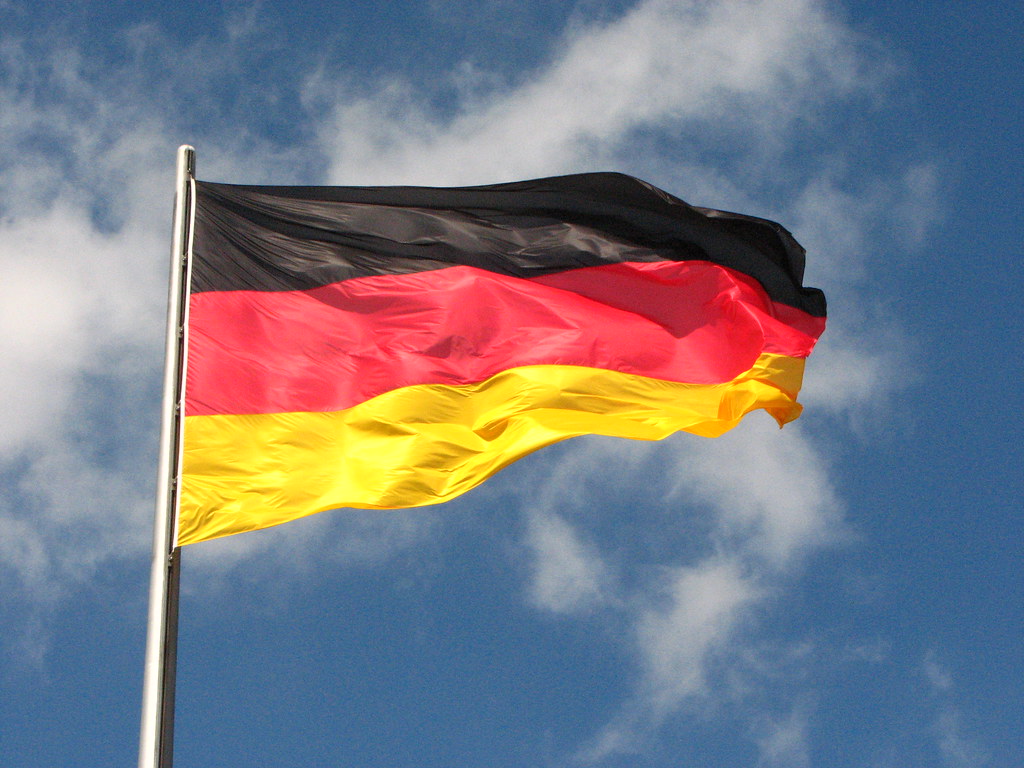
For reasons that I hope I don’t need to go into in any depth, displays of patriotism in Germany are viewed with deep suspicion by progressives and the various state and national government agencies. Even doing something like displaying the German national flag in any context other than a football match can draw official condemnation:


Many readers may not know about the German Stolzmonat, but I promise the backstory is worth it, so please bear with me.
As all of you do know, via some opaque imperial decree, every June across the Western world has become the monstrosity known as “Pride Month”. It is an occasion for the raucous celebration of every sexual minority and deviant proclivity imaginable. There are rainbow flags, lewd street parades, bizarre political speeches and all manner of astroturfed queer activism. I’m told that the festivities were massively scaled back this year in the Anglosphere, perhaps because they are awkward for elections, but on the Continent all such trends arrive very late and we had nothing but the usual excesses.
The eager flying of the rainbow colours is especially obnoxious in Germany, where the display of one’s national flag – except perhaps in a sports context – is discouraged and politically suspect. Some Germans have therefore responded to the perennial irritation of Pride Month by declaring June to be “Stolzmonat” instead. “Stolzmonat” is merely the German translation of “Pride Month”, but our clever cultural hackers have appropriated the term to indicate not gay but national pride. Those who celebrate Stolzmonat do not conduct any lavish public events and they give no speeches. Most of them simply change their social media profile pictures to present the colours black, red and gold. Now and again they also tweet the hashtag #Stolzmonat.
It’s primarily a German act of social media protest, but anybody can participate:
Enough people observe Stolzmonat to cause the corresponding hashtag to rise to the top of Twitter trends now and again. This has given the Rainbow Brigade indigestion, and as there is precious little division between the Rainbow Brigade and the German state, the domestic intelligence services of Lower Saxony have decided it is time to issue an ex cathedra condemnation of Stolzmonat – eight days after it ended. […] Below I translate this ridiculous woman’s statement. As you read, please remember that this is not just some random trans activist, but a functionary of the Lower Saxony Office for the Protection of the Constitution – an agency endowed with considerable powers to surveil and harass ordinary Germans for their alleged intellectual offences against “democracy” and the constitution:
Stop scrolling! We’re here to tell you all you need to know about the new right-wing campaign “Stolzmonat“. “Stolzmonat” is actually just the German translation of “Pride Month”. That’s what members of our queer community [1] say; they want to make the term “Stolzmonat” into what it should actually be – an expression of diversity, tolerance and strengthening of the rights of queer people.
Last year, the hashtag Stolzmonat temporarily landed at number one in the X-Trends – albeit as a polemical term of the extreme right wing. This year, the New Right in particular called for participation in Stolzmonat. The LGBTQIA+ community [2] is among the archetypal enemies of the right-wing extremist scene. In addition to discrimination against queer people, nationalism – that is to say, exaggerated national pride with simultaneous devaluation of other nations and the rejection of the values of liberal democracy – are core elements of Stolzmonat. They appropriate the German flag as a symbol for this campaign and associate it with the aforementioned elements. The new right use Queer hostility to associate themselves with existing prejudices in society and to activate ideologically like-minded people to participate in Stolzmonat. This is intended to create the impression of a large counter-movement to Pride Month. They use the hashtag and the German flag instead of the rainbow flag in their profile pictures. One of their messages: queer people are not a part of Germany. Right-wing extremists are thus pursuing a metapolitical approach [3] to exert influence on the pre-political sphere [4] and thus lay the foundation for anti-democratic positions.
There are so many dumb statements floating in this verbal morass that I don’t know where to begin. So just briefly: 1) The alphabet soup community is not “among the archetypal enemies of the right-wing extremist scene”. Pride Month has, however, became a deeply ridiculous and shallow cultural celebration of a great many things that are wrong with our society and a lot of people are extremely tired of it. 2) “Nationalism” in no way entails the “devaluation of other nations”, nor does it require the “rejection of the values of liberal democracy”. Liberal democracy grew up alongside nationalism, after all, and the Stolzmonat organisers explicitly encourage non-Germans to display their own national colours during Stolzmonat. 3) It is obviously not the point of Stolzmonat to argue that “queer people are not a part of Germany”.

“If -“, by Rudyard Kipling
Lindybeige
Published Jul 10, 2024A poem with an excellent popularity-to-title-length ratio.
The timeless classic. A father talks to his son about how to be a good man. If any son ever lived up to all the virtues described, he would certainly be impressive.
If you can keep your head when all about you
Are losing theirs and blaming it on you,
If you can trust yourself when all men doubt you,
But make allowance for their doubting too;
If you can wait and not be tired by waiting,
Or being lied about, don’t deal in lies,
Or being hated, don’t give way to hating,
And yet don’t look too good, nor talk too wise:If you can dream — and not make dreams your master;
If you can think — and not make thoughts your aim;
If you can meet with Triumph and Disaster
And treat those two impostors just the same;
If you can bear to hear the truth you’ve spoken
Twisted by knaves to make a trap for fools,
Or watch the things you gave your life to, broken,
And stoop and build ’em up with worn-out tools:If you can make one heap of all your winnings
And risk it on one turn of pitch-and-toss,
And lose, and start again at your beginnings
And never breathe a word about your loss;
If you can force your heart and nerve and sinew
To serve your turn long after they are gone,
And so hold on when there is nothing in you
Except the Will which says to them: “Hold on!”If you can talk with crowds and keep your virtue,
Or walk with Kings — nor lose the common touch,
If neither foes nor loving friends can hurt you,
If all men count with you, but none too much;
If you can fill the unforgiving minute
With sixty seconds’ worth of distance run,
Yours is the Earth and everything that’s in it,
And—which is more — you’ll be a Man, my son!
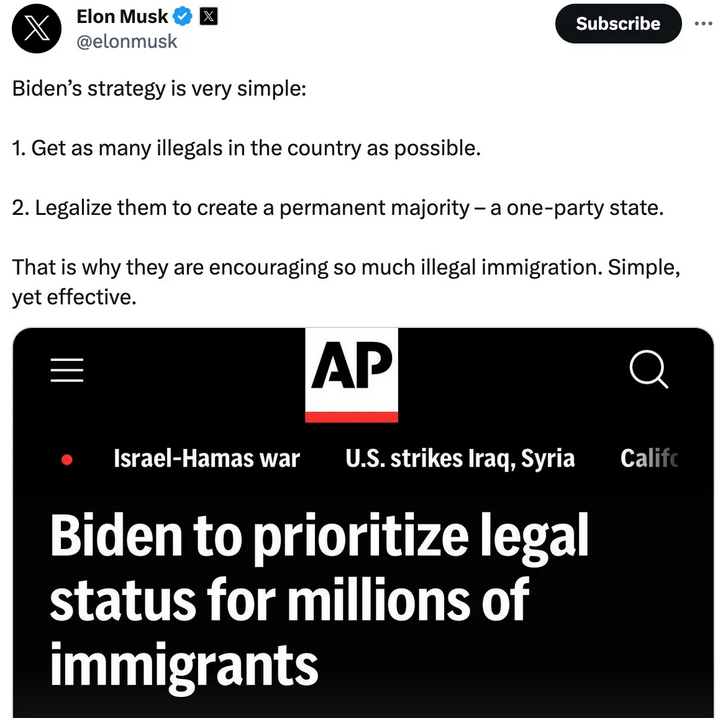
On immigration, progressives are following Brecht’s advice to “dissolve the people and elect another”
In the US, Canada, Britain, and most of western Europe the tide of immigration (legal and illegal) never seems to ebb, despite clear indications from the electorates that they’ve had enough. But perhaps progressives in each country are merely taking Bertolt Brecht’s advice for times when the people have forfeited the government’s confidence:
The problem extends far, far beyond merely glutting the labor market and lowering our wage scale, however. See, I’ve explained above why many Republicans go along with the Amnesty Express. But what about the Democrats? What’s in it for them, especially since Big Labor – whose members stand to lose a great deal because of the depression of wage levels – makes up such a prominent part of the Democrat coalition?
What the Democrats stand to win is permanent political power.
See, unlike previous waves of immigration, we are making no effort whatsoever to assimilate current immigrants to our culture and society. Instead, immigrants tend to cluster in indigestible lumps, maintaining their own cultures, languages, and ways from “the old country”. This is doubly true of illegal immigrants, who have managed to turn large swathes of many of our cities into small-scale replicas of Mexico and Morocco. This is even more troublesome because practically all of these immigrants come from places whose histories and traditions are grossly incompatible with our own. These folks don’t know about the idea of protecting life, liberty, and property through a rule of law system, so consequently they don’t CARE about such a system. They’re just here to get jobs or get welfare, for the most part.
In essence, when you import millions of people from socialistic and/or primitive Global South countries, you will end up with a socialistic, primitive Global South country of your own. And that’s what the Democrats are counting on. This is essentially what has been happening with the millions of people coming across our southern border from all over the world.
If the Democrats can get all of the 30-60 million illegals in America amnestied so that they can stay here and start their “path to citizenship”, and can bring in millions more through the various visa processes, then the Democrats are setting themselves up to be able to gain total control in about two decades – which is how long it will take for the children of all these immigrants to join the pool of voters with their parents. Further, they don’t seem to even want to have to wait that long, considering how they are opposing a bill currently before the Congress that would crack down on voting by illegal immigrants. Essentially, the Democrats – who have been unable to convince the current set of American voters to consistently elect them – want to replace us with a new set of voters, one which will vote overwhelmingly for the Democrats every election, up until we reach the point where there aren’t any more elections.
This is why I say that immigration is more important even than abortion or these other issues that people on the Right are so concerned about. Think about it. With 100 million newly-minted Democrat voters, the Democrats will be able to gain permanent control of all branches of government, at all levels, in nearly all of the states. What that means is that they will get to push through their policies at will. That means no more pro-life restrictions on infanticide. No more gun rights. No more religious liberty. No more rollback of the gay agenda. No more tax cuts or spending rollbacks. No more economic liberty. Kiss private property goodbye. THAT’S what the Democrats want – and the only way for them to get it to convince enough idiots in this country to give it to them via immigration, both legal and illegal.
So while conservatives are clawing each other’s eyes out because one candidate or the other isn’t as pro-life as they want them to be, the Democrats are setting up the playing field to replace the current American electorate with a new one from the Third World, complete with all the third world values of corruption and socialism that come with them.
Of course, for “Democrats”, read “Liberals” in Canada, “Labour” in the UK, and so on. The party labels change, but the basic beliefs are remarkably consistent across the western world (and Rishi Sunak’s just-ousted Conservatives were just as committed to open borders and mass immigration as Keir Starmer’s new Labour government).
Wittmann’s Tiger Rampage | Villers-Bocage, June 1944
The Tank Museum
Published Mar 30, 2024In the space of 15 minutes, Michael Wittmann took a single Tiger tank and stopped a major British advance, destroying 10 tanks, 10 halftracks, 8 Bren carriers, 1 scout car and a six-pounder anti-tank gun in the process. An eye-catching achievement … But was this a victory handed on a plate?
John Delaney outlines Wittmann’s audacious and decisive action at Villers Bocage against the British Desert Rats, examining its military significance. It’s become the stuff of legend. It was a gift to Nazi propagandists, who wasted no time in championing the achievements of their “tank ace”. For the British, it was an embarrassing blow to military prestige.
Wittmann got lucky. But luck runs out eventually …
00:00 | Introduction
00:42 | Arrival into Villers-Bocage
03:08 | Wittmann’s Rampage Begins
04:51 | Rampaging Through the Village
11:56 | Wittmann’s Luck Runs Out
14:09 | Was Wittmann Really a Tank Ace?
16:54 | ConclusionThis video features archive footage courtesy of British Pathé.
#tankmuseum #tankactions #johndelaney #michaelwittmann #tigertank
QotD: Armchair generals
Robert E. Lee, quoted at American Digest, 2005-08.
July 10, 2024
The four horsemen of cultural collapse
Chris Bray provides yet more examples of cultural decay and the collapse of law and order in America’s Trudeaupia, California under the loving care of Justin Trudeau’s spiritual twin, Gavin Newsom:
Today tells you about next year.
In a long history of murder in America, the historian Randolph Roth argued that violence follows other losses of trust and order. The murder rate surges in the face of “four distinct phenomena: political instability; a loss of government legitimacy; a loss of fellow-feeling among members of society caused by racial, religious, or political antagonism; and a loss of faith in the social hierarchy”.
Read that list carefully, because it should sound familiar.
Similarly, the originators of the theory of “broken windows policing” argued that peace and order grow from peace and order; neighborhoods are more likely to be calm when they’re “places where people are confident they can regulate public behavior by informal controls”. Crime follows crime; vandalism, for example, “can occur anywhere once communal barriers — the sense of mutual regard and the obligations of civility — are lowered by actions that seem to signal that ‘no one cares'”. The police commissioner William Bratton famously reduced all categories of crime in New York City subways by assigning officers to arrest turnstile jumpers who entered the system without paying. He sent a signal at the front gates.
“Broken windows” is a much-criticized theory: “He contended that the very notion of ‘disorder’ is subjective and racially fraught”. But the criticisms tend to reduce the complexity of the theory in order to “debunk” it.
Decay communicates. Disorder is a message.
The Korean War – Never Fear, MacArthur’s Here! – Week 003 – July 9, 1950
The Korean War by Indy Neidell
Published 9 Jul 2024American troops have arrived in Korea and engage the KPA — the forces of the North — in the field this week for the first time. It does not go well for them. In fact, it’s hard to imagine it going worse. The Americans are outnumbered and outgunned and are routed. In fact, the KPA are advancing all over the country, though they are taking heavy casualties themselves.
(more…)
After 1177 B.C.
Jane Psmith reviews the follow-on book from Eric Kline’s bestseller about the Bronze Age Collapse, After 1177 B.C.: The Survival of Civilizations:
Sometime around 1150 BC, the dense network of politically, economically, and culturally interdependent states around the eastern Mediterranean collapsed. In 2014, GWU archaeologist Eric Cline wrote a book about it. And then, surprisingly, it became a bestseller.
Okay, maybe it’s not that much of a surprise: most people can recognize an obvious historical analogy when it hits them over the head, and the globalized1 state system of the Late Bronze Age has extremely clear parallels to the modern day. An interconnected and cosmopolitan world? Centralized state bureaucracy? High-level diplomacy between ruling elites? A technologically complex civilization enabled by extensive international trade along lengthy and elaborate supply chains? Well, gosh, that seems remarkably familiar. An audience that had just weathered a global financial crisis (and, later, a global pandemic) was perfectly poised to appreciate Cline’s exploration of the fragility of complex systems. No wonder it sold! (A copy entered the Psmith household in early 2020 for, uh, obvious reasons.)
Cline’s basic argument in the book was that the Collapse was due not to any single cause but to a “perfect storm” of calamities: drought and accompanying famine, earthquake, internal rebellion, external invasion. These were all problems that the civilizations of the Bronze Age Mediterranean had faced and survived in the past, but under their combined onslaught the most fragile parts of the system at last began buckle. When one society disintegrated, its sudden absence from the interconnected global economy became a new stressor on its surviving neighbors — until at last, domino-like, the whole thing came down.2 It would be decades, or in some places centuries, before the standard of living returned to anything like its previous level, and it would be nearly five hundred years before an international system as complex and sophisticated as the world of the Late Bronze Age emerged.
Now, a decade after his original book, Cline has a sequel exploring what happened after the Collapse. Which civilizations were able to rebound to something approaching their former glory, which barely managed to limp along into the Iron Age, and which vanished into the sands of time? And, more importantly, why?
This is a much more difficult story to tell. The original 1177 B.C. spent much of its page count on the zenith of Bronze Age civilization, the 15th through 13th centuries BC, to explain what it was that did the collapsing. It’s a sweeping tale, full of wonderful stories and fascinating digressions into the historicity of the Trojan War (yes) and the Exodus (not archeologically substantiated) as well as being a compelling portrait of a complicated set of societies. Cline’s narrative darts from Egypt to Assyria to the Aegean to the Hittites, treating each in turn as he moves forward through time towards what we all know is coming.
But chronological framing is impossible for the sequel. There is, definitionally — there can be — no grand narrative of regional divergence after the fall of a “world-system“. The fate of Mesopotamia is no longer linked to that of Greece; there are no more Cretan envoys in New Kingdom tomb reliefs, no more battles between the Hittite Great King and the wanax of a Mycenaean palatial center, no more Uzbek tin shipwrecked off the coast of Anatolia. Once the ties are cut, each story must stand alone, and accordingly Cline gives each region its own chapter.
Alas, this is a lot less fun to read.
1. For sufficiently small values of “globe”. But larger than you might expect!
2. The revised 2021 edition apparently gives a larger role to climate factors, especially the 3.2kya megadrought, but that’s not the one I read and anyway the other elements were still present.
Two World Wars: Finnish C96 “Ukko-Mauser”
Forgotten Weapons
Published Mar 27, 2024A decent number of C96 Mauser pistols were present in Finland’s civil war, many of them coming into the country with the Finnish Jaegers, and others from a variety of sources, commercial and Russian. They were used by both the Reds and the Whites, and in both 9x19mm and 7.63x25mm. After the end of the civil war, when the military was standardizing, the C96s were handed over to the Civil Guard, where they generally remained until recalled to army inventories in 1939. They once again saw service in the Winter War and Continuation War, and went into military stores afterwards until eventually being surplussed as obsolete.
One of the interesting aspects of Finnish C96s is that many of them come from the so-called “Scandinavian Contract” batch (for which no contract has actually turned up). These appear to be guns made in 7.63mm that were numbered as part of the early production in the Prussian “Red 9” series, probably for delivery to specific German units or partner forces during World War One.
(more…)
QotD: Persuasion
Of course, like most people, I do assume that those people are wrong and I am right. (And in sober truth — can I confide in you as a friend? — I am right.)
Deirdre McCloskey, “The Rhetoric of Economics”, 1998.
Hat tip to Grant “I can take a hint” McCracken.
July 9, 2024
What it was like to visit a Medieval Tavern
Tasting History with Max Miller
Published 27 Mar 2024Medieval stew with meat, spices, and verjuice, and thickened with egg yolks
City/Region: England
Time Period: 15th CenturySome medieval taverns may have had what is called a perpetual stew bubbling away. The idea is basically what it sounds like: as stew was taken out, more ingredients would be added in so that the stew kept on stewing. In southern France, there was a perpetual stew that was served from the 15th century (around when this recipe was written) all the way up until WWII, when they couldn’t get the right ingredients.
I have opted to not make this stew perpetual, but it is delicious. The medieval flavor of super tender meat with spices and saffron is so interesting, especially with the added acidity and sweetness from the verjuice.
A note on thickening with egg yolks: if you need to reheat your stew after adding the egg yolks, like I did, they may scramble a bit. The stew is still delicious, it’s just the texture that changes a little and it won’t be quite as thick.
Vele, Kede, or Henne in bokenade
Take Vele, Kyde, or Henne, an boyle hem in fayre Water, or ellys in freysshe brothe, and smyte hem in pecys, and pyke hem clene; an than draw the same brothe thorwe a straynoure, an caste there-to Percely, Swag, Ysope, Maces, Clowys, an let boyle tyl the flesshe be y-now; than sette it from the fyre, and alye it up with raw yolkys of eyroun, and caste ther-to pouder Gyngere, Veriows, Safroun, and Salt, and thanne serve it forth for a gode mete.
— Harleian Manuscript 279, 15th Century
QotD: “No official Propaganda Department has ever been half as effective as Twitter and Facebook”
Our overlords figured that out, give credit where it’s due. No official Propaganda Department has ever been half as effective as Twitter and Facebook. But that’s a problem, too, as we’re starting to see. The problem with freelance propaganda is the free market problem of marginal utility.
Facebook and Twitter are SJW cesspools. Everyone knows this. Even your sweet old granny, who is only on Facebook to exchange pie recipes and knitting ideas, knows this, because the #WokeStapo came for knitting years back. When the “trust and safety council” goes so far as to ban the sitting President of the United States, even hermits living in remote Himalayan caves got the message — toe the Party line on social media, or else.
This reduces the value of ALL information on social media to, effectively, zero. Sure, it might be true — and propaganda, as we know, works better the closer to the truth it steers — but given that they’ve even gone after knitting, for pete’s sake, means that any even halfway sorta quasi rational person assumes everything on social media is nothing but propaganda.
Severian, “If They Were Clever”, Rotten Chestnuts, 2021-06-08.
July 8, 2024
All the conspiracists seem to find room for the Rockefellers in their theories
Elizabeth Nickson on a new book by Jacob Nordangård that illustrates just how important Rockefeller funding is to so many activists and the environmental pressure groups that deploy them:
In the climate change arena, the Rockefellers call the shots. The whole thing was their idea, they took a silly but interesting theory and amped it up with hundreds and hundreds of million of dollars. They founded institutions and linked the survival of those institutions to promoting climate change and population reduction. They adopted one likely politician after another.
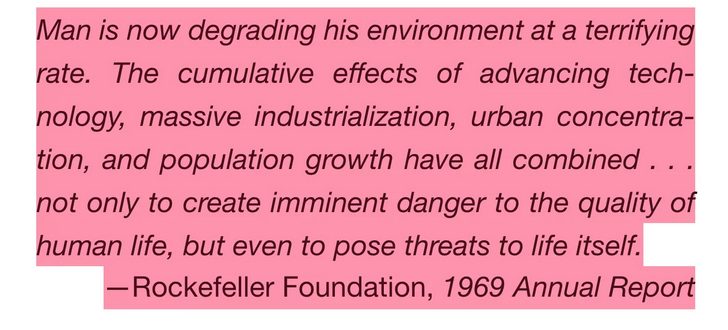
The Rockefellers have created 990 Climate Change activist organizations. They give them directions, financing, and launch them on the world. The Green Movement was started, financed, organized, and militarized by the Rockefellers. By the late 40’s the family was all in, on the same page. In the 50’s they began to stand up countless institutions, committees, university departments, university institutes, foundations, and policy shops gathered around this one idea, as below:
Let’s just pause here and recognize that the United States and Canada are 5% developed. If it were 50%, then maybe we would have reason to worry about the effects of trace gas that takes up .04% of the atmosphere, of which 3% is currently contributed to by humans. But were we to have that level of development, our science would have long ago solved the problem. Our sense of proportion, size and consequence has been twisted, propagandized via hundreds of billions of purposed dollars. And all of it is exaggerated science done by scientists compromised by Rockefeller money.
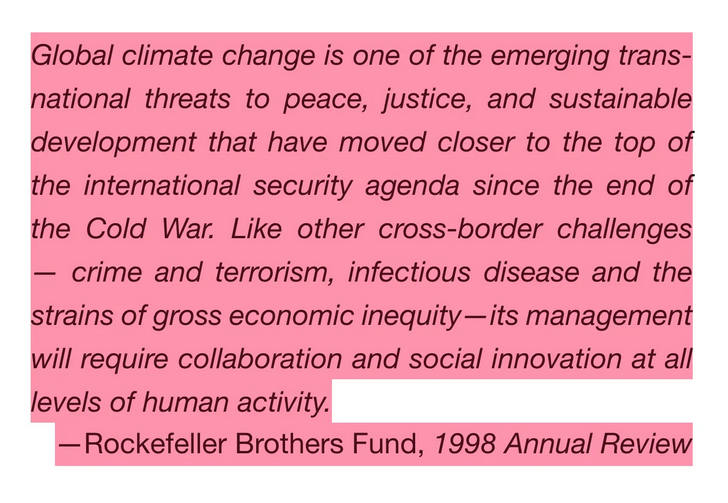
By 1998, the Rockefeller family had swept the table clean of any opposition to this one idea. Any scientist not on board with the agenda was imperiled. Any university department not working towards this one artificial goal, was in danger of being marginalized. Infiltration had begun into every media organization, every entertainment division of every major corporation. This, as stated below, would be a generational goal. For everyone. Or get off the bus.
What is evidentiary, what can be proved in a court of law, rather than opinion, however, is that the Fabians started the idea of this whole one-world, no nation state. It is clear too that after the First World War, the Fabians roped in the second generation of Rockefellers. It was a major catch. It meant they had America. And it was spiritual. It was meant to change mankind, to kill off Homo Sapiens and turn us to Homo Universalis.
The New Man would be not-Christian, quietist, and self-obsessed. The economy would trend towards zero-growth if not de-growth. There is a preponderance of data, many many publications that laid out their plans. They twisted education away from practical science, engineering and building things towards social movements, the humanities, the arts, and pleasure. And via Laurance Rockefeller’s money and organizational skill, they devised and invented the discipline of cybernetics from which the internet flows.
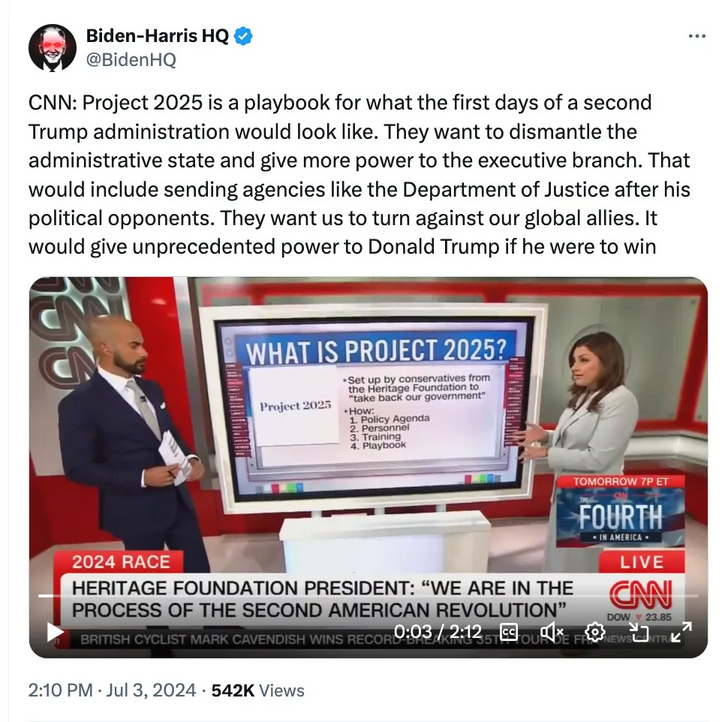
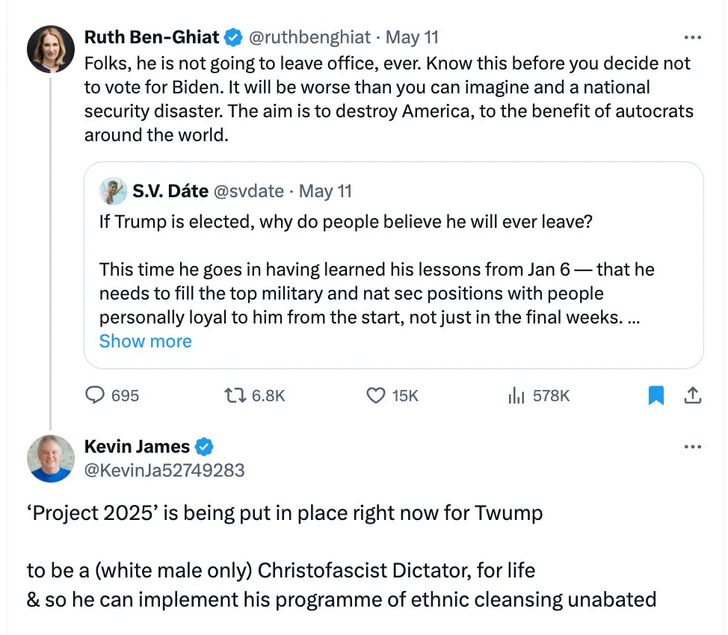
“See, Trump’s plan is … Christofascist ethnic cleansing. It’s all so obvious now, isn’t it?”
Chris Bray finds the stupid so painful that it hurts:
I was worried, a year ago, about an election-year decline into hysteria and evil. What I didn’t see was the descent into grinding moronization.
“They want to dismantle the administrative state and give more power to the executive branch.” I … can’t. I just can’t. It’s like somebody made a special kind of rice cereal for infants that replaces the rice with shit. It’s sewage gruel for toothless adult babies. It’s like saying “they want to take power away from judges and transfer it to the judicial branch”, but that doesn’t really begin to do justice to the stupidity of these statements.
Similarly, this segment on MSNBC warns that Trump is planning to “bring the agencies under the umbrella of the executive branch”.
Imagine living in a world where the Department of Commerce was part of the executive branch. And on and on and on. […]
See, Trump’s plan is … Christofascist ethnic cleansing. It’s all so obvious now, isn’t it?