World War Two
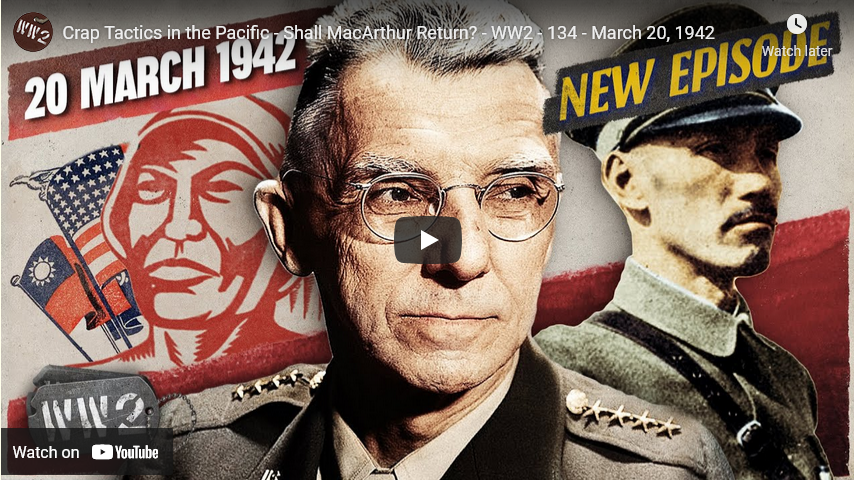
Published 20 Mar 2021MacArthur makes one of the most iconic remarks of the whole war, but considering the fact that the Philippines seem unsalvageable, it’s pretty unclear just how he’ll do it, especially since even though ever more American soldiers are arriving in Australia, the Japanese threat to Australia grows daily. Bill Slim arrives in Burma to take command of I Burma Corps, and Joe Stilwell has taken over two Chinese Nationalist armies, so the defense of Burma looks like it might go on a while longer, though the Allies are at a serious disadvantage after losing Rangoon. The Japanese, for their part, are trying to figure out how the heck they’re going to administer all the territory they’ve taken this year and bring natural resources to Japan itself. There is still scattered fighting in the USSR, but the spring muds have put pad to any major offensives for the time being. As for the British, they launch Operation Outward, a hydrogen balloon campaign over Germany. Yep, you read that right. What a week.
Join us on Patreon: https://www.patreon.com/TimeGhostHistory
Or join The TimeGhost Army directly at: https://timeghost.tvFollow WW2 day by day on Instagram @ww2_day_by_day – https://www.instagram.com/ww2_day_by_day
Between 2 Wars: https://www.youtube.com/playlist?list…
Source list: http://bit.ly/WW2sourcesWritten and Hosted by: Indy Neidell
Director: Astrid Deinhard
Producers: Astrid Deinhard and Spartacus Olsson
Executive Producers: Astrid Deinhard, Indy Neidell, Spartacus Olsson, Bodo Rittenauer
Creative Producer: Maria Kyhle
Post-Production Director: Wieke Kapteijns
Research by: Indy Neidell
Edited by: Iryna Dulka
Sound design: Marek Kamiński
Map animations: Eastory (https://www.youtube.com/c/eastory)Colorizations by:
– Mikołaj Uchman
– Daniel Weiss
– Norman Stewart – https://oldtimesincolor.blogspot.com/
– Adrien Fillon – https://www.instagram.com/adrien.colo…
– Olga Shirnina, a.k.a. Klimbim – https://klimbim2014.wordpress.com/Soundtracks from the Epidemic Sound:
– Rannar Sillard – “Easy Target”
– Jo Wandrini – “Dragon King”
– Wendel Scherer – “Time to Face Them”
– Howard Harper-Barnes – “London”
– Philip Ayers – “The Unexplored”
– Farrell Wooten – “Duels”
– Johan Hynynen – “Dark Beginning”
– Craft Case – “Secret Cargo”
– Johannes Bornlöf – “The Inspector 4”Archive by Screenocean/Reuters https://www.screenocean.com.
A TimeGhost chronological documentary produced by OnLion Entertainment GmbH.
March 21, 2021
Crap Tactics in the Pacific – Shall MacArthur Return? – WW2 – 134 – March 20, 1942
March 19, 2021
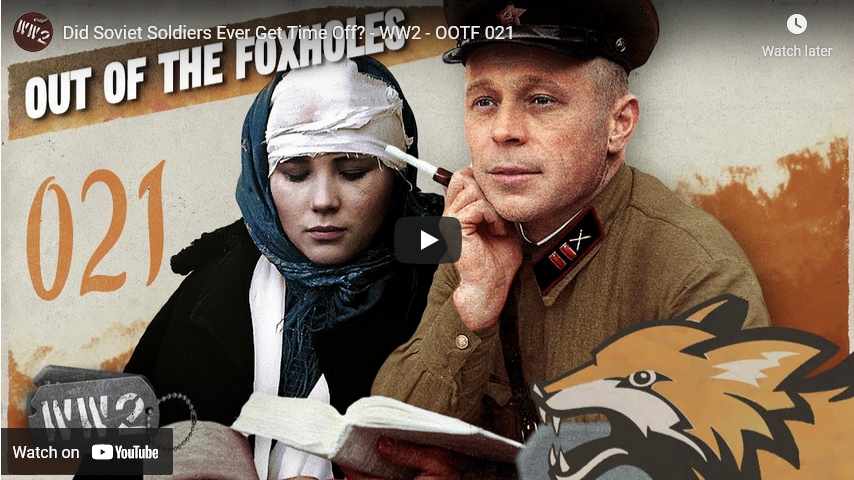
Did Soviet Soldiers Ever Get Time Off? – WW2 – OOTF 021
World War Two
Published 18 Mar 2021Ever wonder if the Kriegsmarine saw any action in the Pacific Ocean? Or if the average Soviet soldier ever got a vacation from the most destructive conflict in the history of humanity? You can find out the answers in this episode of Out of the Foxholes!
Join us on Patreon: https://www.patreon.com/TimeGhostHistory
Or join The TimeGhost Army directly at: https://timeghost.tvFollow WW2 day by day on Instagram @ww2_day_by_day – https://www.instagram.com/ww2_day_by_day
Between 2 Wars: https://www.youtube.com/playlist?list…
Source list: http://bit.ly/WW2sourcesHosted by: Indy Neidell
Written by: Lewis Braithwaite and Dennis Stepanov
Director: Astrid Deinhard
Producers: Astrid Deinhard and Spartacus Olsson
Executive Producers: Astrid Deinhard, Indy Neidell, Spartacus Olsson, Bodo Rittenauer
Creative Producer: Maria Kyhle
Post-Production Director: Wieke Kapteijns
Research by: Dennis Stepanov and Lewis Braithwaite
Edited by: Miki Cackowski
Sound design: Marek Kamiński
Map animations: Eastory (https://www.youtube.com/c/eastory)Colorizations by:
Daniel WeissSources:
David Rumsey Map Collection, David Rumsey Map Center, Stanford Libraries
Bundesarchiv
Portrait of Robert Eyssen, courtesy of Gareth Collins
Komet schematics, courtesy of Rama https://commons.wikimedia.org/wiki/Fi…
Narodowe Archiwum Cyfrowe
State Library of QueenslandSoundtracks from the Epidemic Sound:
Phoenix Tail – “At the Front”
Johannes Bornlof – “The Inspector 4”
Howard Harper-Barnes – “Prescient”
Jo Wandrini – “Puzzle Of Complexity”Archive by Screenocean/Reuters https://www.screenocean.com.
A TimeGhost chronological documentary produced by OnLion Entertainment GmbH.
March 17, 2021
Sunny Beaches, Fascist Leaders, and Nazi Spies – WW2 – Spies & Ties 01
World War Two
Published 16 Mar 2021South America is home to one of Germany’s most effective spy-networks. In Operation Bolivar, dozens of German operatives transmit information from and to the USA, Brazil, Argentina, and other South and Central American countries, giving the Abwehr and SD access to crucial information on politics, economics, and military business.
(more…)
Heavy But Effective: Britain’s No4 MkI (T) Sniper Rifle
Forgotten Weapons
Published 29 Aug 2018http://www.patreon.com/ForgottenWeapons
Cool Forgotten Weapons merch! http://shop.bbtv.com/collections/forg…
The main British sniper rifle of World War Two, and arguably one of the best looking military sniper rifles of all time, the No4 MkI (T) was something the British military knew they would want even before the No4 MkI rifle had gone into real production. The first No4 snipers were built on leftover trials rifles from Enfield, and the pattern was formally introduced in February of 1942. First use was in North Africa, but the fighting there was not really suited to sniper rifles, and the weapon’s practical combat debut was in Italy in 1943.
The No4 MkI (T) was a conversion of a standard No4 MkI rifle, using examples chosen for particular good accuracy. They were sent to Holland & Holland to have scope mount bases added and No32 telescopic sights fitted (along with cheek risers on the stocks and having the battle sight aperture ground off to allow room for the scope bell). Between 23,000 and 26,000 were made during the war, and they would continue to be used in the British military for decades, including later conversion into 7.62mm NATO L42A1 rifles [which Ian discusses here].
Contact:
Forgotten Weapons
6281 N Oracle #36270
Tucson, AZ 85704
March 16, 2021
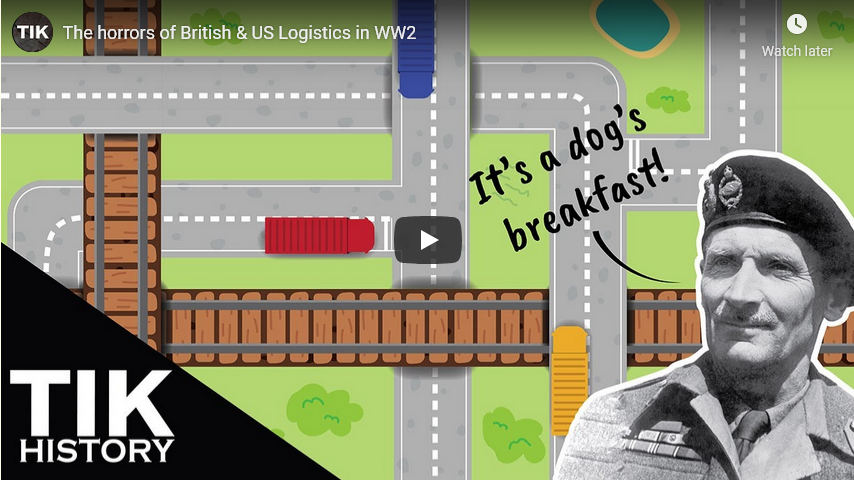
The horrors of British & US Logistics in WW2
TIK
Published 15 Mar 2021The Allies may have had a lot of resources, manpower and industry, but that didn’t mean that their logistics weren’t inefficient or a disorganized mess. Today, we’re going to look at how the British railways were disaster during WW2, how the Americans ran out of fuel on the way to Germany, and why Montgomery called the planning for the invasion of Sicily a “dog’s breakfast”.
⏲️ Videos EVERY Monday at 5pm GMT (depending on season, check for British Summer Time).
The thumbnail for this video was created by Terri Young. Need graphics? Check out her website here https://www.terriyoungdesigns.co.uk/
– – – – –
📚 BIBLIOGRAPHY / SOURCES 📚
Dunn, W. The Soviet Economy and the Red Army, 1930-1945. Praeger Publishers, 1995.
Garvey, J. Operation Husky: The Untold Story of the logistics of the Sicily Invasion. Farm Publications, Kindle 2019.
Hazlitt, H. Economics in One Lesson: The Shortest & Surest Way to Understand Basic Economics. Three Rivers Press, 1979.
MacDonald, J. Supplying the British Army in the Second World War. Pen & Sword Military, Kindle 2020.
Molony, C. The Mediterranean and Middle East, Volume V, The Campaign in Sicily 1943 and The Campaign in Italy 3rd September 1943 to 31st March 1944. The Naval & Military Press LTD 2004, first published in 1973.
Wolmar, C. Fire & Steam: How the Railways Transformed Britain. Atlantic Books, Kindle 2007.British Government, Railways Act 1921, https://www.legislation.gov.uk/ukpga/…
Full list of all my sources https://docs.google.com/spreadsheets/…
– – – – –
⭐ SUPPORT TIK ⭐
This video isn’t sponsored. My income comes purely from my Patreons and SubscribeStars, and from YouTube ad revenue. So, if you’d like to support this channel and make these videos possible, please consider becoming a Patreon or SubscribeStar. All supporters who pledge $1 or more will have their names listed in the videos. For $5 or more you can ask questions which I will answer in future Q&A videos (note: I’m behind with the Q&A’s right now, and have a lot of research to do to catch up, so there will be a delay in answering questions). There are higher tiers too with additional perks, so check out the links below for more details.
https://www.patreon.com/TIKhistory
https://www.subscribestar.com/tikhistoryThank you to my current supporters! You’re AWESOME!
– – – – –
ABOUT TIK 📝
History isn’t as boring as some people think, and my goal is to get people talking about it. I also want to dispel the myths and distortions that ruin our perception of the past by asking a simple question – “But is this really the case?”. I have a 2:1 Degree in History and a passion for early 20th Century conflicts (mainly WW2). I’m therefore approaching this like I would an academic essay. Lots of sources, quotes, references and so on. Only the truth will do.
This video is discussing events or concepts that are academic, educational and historical in nature. This video is for informational purposes and was created so we may better understand the past and learn from the mistakes others have made.
Tank Chats #99 | StuG III | The Tank Museum
The Tank Museum
Published 2 Apr 2020Here David Willey discusses the Sturmgeschütz III Self-Propelled Assault Gun, better known as the StuG III, Germany’s most numerously produced fully tracked Armoured Fighting Vehicle of the Second World War.
Support the work of The Tank Museum on Patreon: ► https://www.patreon.com/tankmuseum
Visit The Tank Museum SHOP & become a Friend: ►tankmuseumshop.org
Twitter: ► https://twitter.com/TankMuseum
Instagram: ► https://www.instagram.com/tankmuseum/
Tiger Tank Blog: ► http://blog.tiger-tank.com/
Tank 100 First World War Centenary Blog: ► http://tank100.com/
#tankmuseum #tanks #MuseumFromHome
March 15, 2021
Loaded For War — The Santa Fe Railroad In World War II
PeriscopeFilm
Published 24 May 2020Want to support this channel and help us preserve old films? Visit https://www.patreon.com/PeriscopeFilm
Visit our website www.PeriscopeFilm.comSanta Fe presents, Loaded for War. This WWII era color film presents the power of the Santa Fe railroad. While speaking of the mighty effort the trains and its myriad workers achieved during wartime, the footage is all modern and in color. The film does a great job of showing how integral our railroad system has been to the growth of these United States. “With grateful appreciation to the Office of Defense Transportation, the Army, Navy, Maritime Commission, and the shipping and traveling public, for the cooperation and genuine understanding which has made the service record here presented possible …” The film opens with a steam locomotive bearing down on the camera 1:03. The narrator speaks as the train crosses a trestle 1:10. News headlines of December 7, 1941 11:25. Steam and diesel locomotives are transformed into machines of war 1:40. Smoke fills a train yard as trains enter and are washed 2:08. A train signal shows a green light 2:25. Workers are seen in the factory 2:36. Civilians exit trains volunteering for service 2:45. A telegram is shown stating that the trainmen should, “move all available equipment to military stations without delay” 2:54. Four locomotives are shown 3:03. Crews are assigned and men work double shifts 3:45. Rail equipment is loaded by military personnel, ready to move 4:13. Flatcars are loaded with tanks and military trucks 4:52. Divisions of fighting men aboard the trains 5:09. The tanks roll down the tracks on flatcars 5:35. The wheels of war are rolling 6:14. The day by day mass movement of freight is shown at the train yard 6:48. Trains crossing country on railroad tracks 7:40. Trains service the shipyards as men work building military ships 8:00. A ship is launched 8:15. Cattle and pigs are delivered throughout the 48 states 8:37. Potatoes are tilled in the field with heavy equipment 9:00. Oranges are picked and packed in southern states 9:13. Military bombers soar through the air 9:23. Heavy machinery workers in the factories 9:48. Factories and men building artillery shells 9:55. Tanks roll off the product line and onto the railroad tracks 10:10. Locomotive struggles up a hill 10:25. Miners and their lamp hats head down the tunnels by rail 10:38. Oil fields are shown 11:15. Oil is loaded onto railway tankers 11:38. Machines digging the copper mines 12:08. The big diggers pick up 8 cubic yards of copper at a time 12:18. The railroad moves the copper to the smelters 12:31. Sulfur mines using forced steam 12:50. Sulfur is moved by train to the gunpowder makers 13:25. Logging industry is served with the railroads 14:00. Cotton and scrap metal industries are also served by rail 14:18. Old cars are being called back into use for the war effort 15:30. Locomotive number 3723 comes out of retirement by the trainmen 15:48. Various train parts are marked and taken away for repair or replacement 16:07. Men work in factories with fine-tuned machines to retool and refine old parts for new use 16:26. Old firebrick is removed and replaced 16:43. Acetylene torches are used inside the huge boilers 16:49. Huge wheels are cleaned and dipped and sprayed ready for use 17:08. Heat is used to expand the metals 17:18. Locomotive number 3723 is fully refurbished and ready for the tracks 18:05. All types of equipment need to be refurbished for the war effort 18:46. The men use heat and molten metal to reshape old parts for new use 19:00. Gears are ground with precision 19:13. The railroads motto, “let’s keep ‘em rolling” 19:24. The men work on building new track 19:35. Men using hammers to straighten out tracks 19:53. The towermen, bridge crews, conductors, station men, ticket men, dispatchers, signalmen and to the other thousands of men – give the railroad men their due 20:44. Women are also an integral part of the success of the railroad 21:07. The women work in offices but also in factories with heavy machinery and molten metal 21:21. Two women wash down a train 21:30. The wheels of war are rolling 21:40. Military men march in unison 21:47. Train caboose pulls away from the camera 22:52. A flag with 8057 turns into the American flag and waves in the breeze 23:06. The End. Santa Fe.
We encourage viewers to add comments and, especially, to provide additional information about our videos by adding a comment! See something interesting? Tell people what it is and what they can see by writing something for example: “01:00:12:00 — President Roosevelt is seen meeting with Winston Churchill at the Quebec Conference.”
This film is part of the Periscope Film LLC archive, one of the largest historic military, transportation, and aviation stock footage collections in the USA. Entirely film backed, this material is available for licensing in 24p HD, 2k and 4k. For more information visit http://www.PeriscopeFilm.com
March 14, 2021
Tumbling Capitals – MacArthur on the Run – March 13, 1942 – WW2 – 133
World War Two
Published 13 Mar 2021Rangoon in Burma falls to the invaders without a shot, the Dutch East Indies surrender 100,000 men to them at Batavia, and the Japanese land on New Guinea and begin their advance on Port Moresby. The first phase of their offensives is now over. The Philippines still hold out, their armies under siege at Bataan, but Douglas MacArthur, Allied commander there, has made his getaway, one day to hopefully return. American troops do begin landings on New Caledonia, to build a base there to begin the fight back.
Join us on Patreon: https://www.patreon.com/TimeGhostHistory
Or join The TimeGhost Army directly at: https://timeghost.tvFollow WW2 day by day on Instagram @ww2_day_by_day – https://www.instagram.com/ww2_day_by_day
Between 2 Wars: https://www.youtube.com/playlist?list…
Source list: http://bit.ly/WW2sourcesWritten and Hosted by: Indy Neidell
Director: Astrid Deinhard
Producers: Astrid Deinhard and Spartacus Olsson
Executive Producers: Astrid Deinhard, Indy Neidell, Spartacus Olsson, Bodo Rittenauer
Creative Producer: Maria Kyhle
Post-Production Director: Wieke Kapteijns
Research by: Indy Neidell
Edited by: Iryna Dulka
Sound design: Marek Kamiński
Map animations: Eastory (https://www.youtube.com/c/eastory)Colorizations by:
– Mikołaj Uchman
– Norman Stewart – https://oldtimesincolor.blogspot.com/Sources:
– bockelsound from Freesound.orgSoundtracks from the Epidemic Sound:
– Rannar Sillard – “Easy Target”
– Jo Wandrini – “Dragon King”
– Fabien Tell – “Break Free”
– Philip Ayers – “The Unexplored”
– Howard Harper-Barnes – “Underlying Truth”
– Gunnar Johnsen – “Not Safe Yet”
– Reynard Seidel – “Rush of Blood”
– Flouw – “A Far Cry”
– Philip Ayers – “Trapped in a Maze”Archive by Screenocean/Reuters https://www.screenocean.com.
A TimeGhost chronological documentary produced by OnLion Entertainment GmbH.

March 13, 2021
The Paperback Revolution
The History Guy: History Deserves to Be Remembered
Published 12 Mar 2021Sponsored by Blinkist. The first 100 people who go to https://www.blinkist.com/thehistoryguy are going to get unlimited access for one week to try it out. You’ll also get 25% off if you want the full membership.
Today, the most popular book format in the world is not a traditional hardcover book, nor an ebook, but a paperback — a format that changed the what, how, when and how much the world reads. It is history that deserves to be remembered.
This is original content based on research by The History Guy. Images in the Public Domain are carefully selected and provide illustration. As very few images of the actual event are available in the Public Domain, images of similar objects and events are used for illustration.
You can purchase the bow tie worn in this episode at The Tie Bar:
https://www.thetiebar.com/?utm_campai…All events are portrayed in historical context and for educational purposes. No images or content are primarily intended to shock and disgust. Those who do not learn from history are doomed to repeat it. Non censuram.
Find The History Guy at:
Patreon: https://www.patreon.com/TheHistoryGuy
Please send suggestions for future episodes: Suggestions@TheHistoryGuy.netThe History Guy: History Deserves to Be Remembered is the place to find short snippets of forgotten history from five to fifteen minutes long. If you like history too, this is the channel for you.
Awesome The History Guy merchandise is available at:
teespring.com/stores/the-history-guyScript by THG
#history #thehistoryguy #Books
March 11, 2021
Italy’s WW1 Heavy Machine Gun: FIAT-Revelli Modello 1914
Forgotten Weapons
Published 9 Dec 2020http://www.patreon.com/ForgottenWeapons
https://www.floatplane.com/channel/Fo…
Cool Forgotten Weapons merch! http://shop.bbtv.com/collections/forg…
Italy was the first major adopter of the Maxim heavy machine gun and had several hundred by 1914 — but wanted to have a domestic design in production as well. The Italian government and military put a lot of resources into the Perino machine gun, but kept it so secret that it was never properly tested and development was very slow. By the time war broke out, the Perino was clearly not ready for field use — and Maxims (along with other foreign designs) were no longer available for commercial sale as production was being taken up by warring nations. This led Italy to adopt a private design of Bethel Revelli in partnership with the FIAT company.
Adopted as the Modello 1914, Revelli’s machine gun was a delayed blowback system with a wedge under mechanical disadvantage holding the bolt closed long enough to safely cycle. Its most unique element was the 50-round mousetrap-type box magazine that used 10 independent stacks of 5 rounds each (a 100-round version was also made). This was a very complex magazine to produce, and much more delicate than the other machine gun feed systems in use at the time. The Revelli is also notable for being the only major machine gun of the period to have a circulating water jacket, operated by a small hand-cranked pump on the condensing tank.
The FIAT-Revelli would see service as both and aircraft and ground gun through World War 1, and was updated in 1935 to an air cooled pattern that would serve through World War 2. These guns are very scarce in the United States today, and I am grateful to the collector who owns this one for providing access to it!
Contact:
Forgotten Weapons
6281 N. Oracle #36270
Tucson, AZ 85740
March 10, 2021
Where Great Men Were Made: American Officer Training – WW2 Special
World War Two
Published 9 Mar 2021West Point and Annapolis are two of the most iconic military academies in America — maybe even the world. The two institutions have produced the men who are leading America’s fight against the Axis powers.
Join us on Patreon: https://www.patreon.com/TimeGhostHistory
Or join The TimeGhost Army directly at: https://timeghost.tvFollow WW2 day by day on Instagram @ww2_day_by_day – https://www.instagram.com/ww2_day_by_day
Between 2 Wars: https://www.youtube.com/playlist?list…
Source list: http://bit.ly/WW2sourcesHosted by: Indy Neidell
Written by: Markus Linke & Indy Neidell
Director: Astrid Deinhard
Producers: Astrid Deinhard and Spartacus Olsson
Executive Producers: Astrid Deinhard, Indy Neidell, Spartacus Olsson, Bodo Rittenauer
Creative Producer: Maria Kyhle
Post-Production Director: Wieke Kapteijns
Research by: Markus Linke
Edited by: Karolina Dołęga
Sound design: Marek KamińskiColorizations by:
– Daniel Weiss
– Mikołaj Uchman
– Norman Stewart – https://oldtimesincolor.blogspot.com/Sources:
United States Military Academy Library Digital Collection
United States Naval Academy Digital Collections
Library of Congress
New York Public Library
West Point Museum Art Collection
Imperial War Museums: IWM NYF 19427Soundtracks from Epidemic Sound:
– “Ominous” – Philip Ayers
– “The Inspector 4” – Johannes Bornlöf
– “London” – Howard Harper-Barnes
– “Please Hear Me Out STEMS INSTRUMENTS” – Philip Ayers
– “First Responders” – SkryaArchive by Screenocean/Reuters https://www.screenocean.com.
A TimeGhost chronological documentary produced by OnLion Entertainment GmbH.
From the comments:
World War Two
20 hours ago
This episode goes back to our roots of good old-fashioned military history. It’s something we’d like to start doing more of. Of course, West Point and Annapolis are the most famous, but we think that diving into the officer training of forces like the Wehrmacht or Red Army could tell us a lot about their histories. There is also a whole bunch of options for military history topics that we’d like to get into. Let us know in the comments if you have any suggestions.
March 7, 2021
The Japanese Raid Australia and the British Raid France – WW2 – 132 – March 6, 1942
World War Two
Published 6 Mar 2021The Japanese advance in Burma continues, threatening Rangoon, and also make landings on Java and New Guinea. They even go so far as an air raid on Broome, Australia. The British are making raids of their own this week, Operation Biting against Bruneval in German-occupied France. As for the Germans themselves, 100,000 of them are still surrounded by the Red Army at Demyansk, and Hitler is told that the Soviets might have enough reserves to defend against a renewed summer offensive.
Join us on Patreon: https://www.patreon.com/TimeGhostHistory
Or join The TimeGhost Army directly at: https://timeghost.tvFollow WW2 day by day on Instagram @ww2_day_by_day – https://www.instagram.com/ww2_day_by_day
Between 2 Wars: https://www.youtube.com/playlist?list…
Source list: http://bit.ly/WW2sourcesWritten and Hosted by: Indy Neidell
Director: Astrid Deinhard
Producers: Astrid Deinhard and Spartacus Olsson
Executive Producers: Astrid Deinhard, Indy Neidell, Spartacus Olsson, Bodo Rittenauer
Creative Producer: Maria Kyhle
Post-Production Director: Wieke Kapteijns
Research by: Indy Neidell
Edited by: Iryna Dulka
Sound design: Marek Kamiński
Map animations: Eastory (https://www.youtube.com/c/eastory)Colorizations by:
– Mikołaj Uchman
– Olga Shirnina, a.k.a. Klimbim – https://klimbim2014.wordpress.com/
– Cassowary Colorizations – https://www.cassowarycolor.com/
– Norman Stewart – https://oldtimesincolor.blogspot.com/Sources:
– IWM: O1962, CH 16518, IWM A 9580, IWM A 9584
– Arrow by 4B Icons from the Noun ProjectSoundtracks from the Epidemic Sound:
– Rannar Sillard – “Easy Target”
– Jo Wandrini – “Dragon King”
– Howard Harper-Barnes – “Underlying Truth”
– Fabien Tell – “Last Point of Safe Return”
– Phoenix Tail – “At the Front”
– Howard Harper-Barnes – “London”
– Flouw – “A Far Cry”
– Johan Hynynen – “Dark Beginning”
– Wendel Scherer – “Out the Window”Archive by Screenocean/Reuters https://www.screenocean.com.
A TimeGhost chronological documentary produced by OnLion Entertainment GmbH.
From the comments:
World War Two
3 days ago (edited)
CORRECTION: In this episode, Indy says that Franz Halder estimates German losses in the USSR to be up 1.5 million by March 1st. In actuality, Halder estimated them to be 1 million. A simple brain freeze when Indy was writing the script meant that he read out the incorrect statistics on the teleprompter. The vast majority of the time, our fact-checkers ensure this doesn’t happen — unfortunately, this one slipped through the cracks.MAIN COMMENT: The Japanese are still advancing seemingly everywhere, even raiding Australia. In Europe, the German death camp system sees new facilities open this month and kicks into a higher gear.
March 5, 2021
Colonial Troops Saving Their Masters – WW2 Special
World War Two
Published 4 Mar 2021Without the incredible support and sacrifice of troops from British and French colonies, the Allies would be having an even harder time withstanding the Axis onslaught. This episode looks at their formation and their fighting style.
Join us on Patreon: https://www.patreon.com/TimeGhostHistory
Or join The TimeGhost Army directly at: https://timeghost.tvFollow WW2 day by day on Instagram @ww2_day_by_day – https://www.instagram.com/ww2_day_by_day
Between 2 Wars: https://www.youtube.com/playlist?list…
Source list: http://bit.ly/WW2sourcesHosted by: Indy Neidell
Written by: Markus Linke and Indy Neidell
Director: Astrid Deinhard
Producers: Astrid Deinhard and Spartacus Olsson
Executive Producers: Astrid Deinhard, Indy Neidell, Spartacus Olsson, Bodo Rittenauer
Creative Producer: Maria Kyhle
Post-Production Director: Wieke Kapteijns
Research by: Markus Linke
Edited by: Miki Cackowski
Sound design: Marek Kamiński
Map animations: Miki Cackowski, Eastory (https://www.youtube.com/c/eastory)Colorizations by:
Daniel Weiss
Mikołaj UchmanSources:
Photo of French Saharan troops (1932), courtesy of Acln https://commons.wikimedia.org/wiki/Fi…
Archives du département du Rhône et de la métropole de Lyon
The New York Public Library – Digital Collections
USMC Archives
IWM E 11584, CBM 2264, E 6605, IND 2864, IND 2290, K 1385
Picture of Sudanese Defense Force near Kufra Oasis, courtesy of Major PJ HurmanSoundtracks from Epidemic Sound
Johannes Bornlof – “Deviation In Time”
Hakan Eriksson – “Epic Adventure Theme 3”
Phoenix Tail – “At the Front”
Philip Ayers – “The Unexplored”
Johannes Bornlof – “The Inspector 4”
Fabien Tell – “Weapon of Choice”
Reynard Seidel – “Deflection”
Fabien Tell – “Other Sides of Glory”
Philip Ayers – “Please Hear Me Out”Archive by Screenocean/Reuters https://www.screenocean.com.
A TimeGhost chronological documentary produced by OnLion Entertainment GmbH.
From the comments:
World War Two
9 hours ago
As regular viewers will know, we try to give the most complete picture of World War Two possible by diving into the multitude of people that took part and seeing it from their unique perspective.This episode is part of that effort, looking at the colonial troops who fought on the side of their imperial administrators. In a different way, our On the Homefront series is also part of that effort, and we are happy to announce that we have just got started with it again. Check out the latest episode here where Anna looks at the changing role of the Geisha in wartime Japanese society: https://youtu.be/7Y3IYsNC1WM
March 3, 2021
Geishas: World War Two Prostitutes or Entertainers? – WW2 – On the Homefront 007
World War Two
Published 2 Mar 2021The geisha class has long been a feature of Japanese society. In the 1920s, they were caught between the struggle for women’s liberation and the rising sexual demand of powerful men. This crossfire only becomes more intense as war sweeps the Pacific.
Join us on Patreon: https://www.patreon.com/TimeGhostHistory
Or join The TimeGhost Army directly at: https://timeghost.tvFollow WW2 day by day on Instagram @ww2_day_by_day – https://www.instagram.com/ww2_day_by_day
Between 2 Wars: https://www.youtube.com/playlist?list…
Source list: http://bit.ly/WW2sourcesHosted by: Anna Deinhard
Written by: Spartacus Olsson and Fiona Rachel
Director: Astrid Deinhard
Producers: Astrid Deinhard and Spartacus Olsson
Executive Producers: Astrid Deinhard, Indy Neidell, Spartacus Olsson, Bodo Rittenauer
Creative Producer: Maria Kyhle
Post-Production Director: Wieke Kapteijns
Research by: Fiona Rachel
Edited by: Karolina Dołęga
Sound design: Marek KamińskiPortrait Colorizations by:
Mikołaj UchmannSources:
– Metropolitan Museum of Art
– Rijksmuseum
– Narodowe Archiwum Cyfrowe
– Library of Congress
– National Archives NARA
– Nationaal Archief
– The Burns Archive
– Woman and Child in Kimono courtesy of Vintage Japan-esque from Flickr
– Five musicians courtesy of Adolfo FarsariSoundtracks from Epidemic Sound:
– “Paths of a Samurai” – Mandala Dreams
– “Across the Sea of Japan” – Mandala Dreams
– “Secrets Of A Geisha” – Mandala Dreams
– “Watchman” – Yi Nantiro
– “The Unexplored” – Philip Ayers
– “Heavenly Feathers” – Deskant
– “Ode To The Moon” – Joseph Beg
– “Moving to Disturbia” – ExperiaArchive by Screenocean/Reuters https://www.screenocean.com.
A TimeGhost chronological documentary produced by OnLion Entertainment GmbH.
From the comments:
World War Two
17 hours ago (edited)
With this rather dramatic topic, we are happy to revive the On the Homefront series! Considering the popular opinion on geisha in America after the Second World War, it is not surprising at all, that the first association with the word is sex. But when we looked a little further into the topic, it got clearer and clearer that originally the job of a geisha meant no such thing. Still, with the social and political tension of the early 20th century, the job of the geisha evolved further and further to prostitution. This shows once again how the war influenced many different aspects of life and how important it is to shed light on these side stages of the war in order to understand its full impact. What would interest you to know about the different Homefronts of World War II?Cheers, Fiona
March 2, 2021
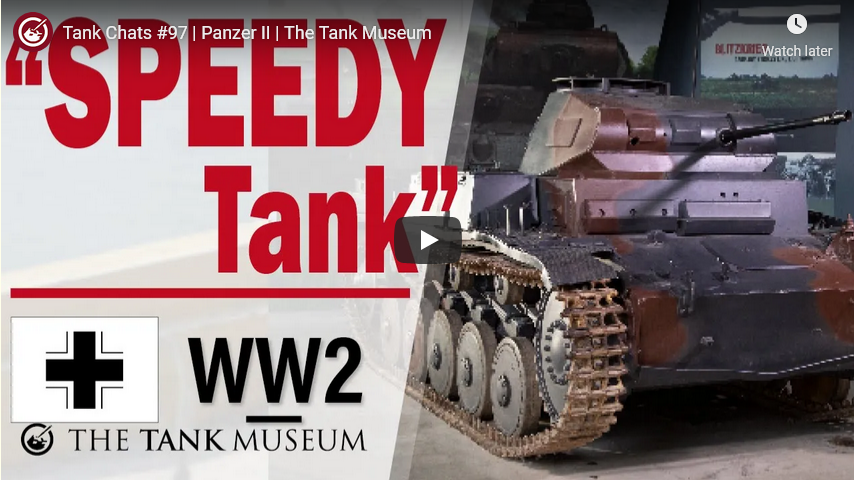
Tank Chats #97 | Panzer II | The Tank Museum
The Tank Museum
Published 20 Mar 2020Here David Willey discusses the Panzer II, a German tank which was instrumental in the early days of the Second World War, especially during the Blitzkrieg.
Support the work of The Tank Museum on Patreon: ► https://www.patreon.com/tankmuseum
Visit The Tank Museum SHOP: ►tankmuseumshop.org
Twitter: ► https://twitter.com/TankMuseum
Instagram: ► https://www.instagram.com/tankmuseum/
Tiger Tank Blog: ► http://blog.tiger-tank.com/
Tank 100 First World War Centenary Blog: ► http://tank100.com/
#tankmuseum #tanks