
A Remembrance Day slideshow using Mark Knopfler’s wonderful “Remembrance Day” song from the album Get Lucky (2009). The early part of the song conveys many British images, but I have added some very Canadian images also which fit with many of the lyrics. The theme and message is universal… ‘we will remember them’.
November 11, 2015
Mark Knopfler – “Remembrance Day”
Comments Off on Mark Knopfler – “Remembrance Day”
QotD: The meaning of Remembrance Day
The Canada of 1914 was, by modern standards, intensely monarchist and very pro-military. I wouldn’t go so far as calling the Canadians of a century ago militaristic, in fact the term was used extensively to describe contemporary German government and society. It wasn’t a compliment. Genuinely militaristic societies organize their political, economic and educational systems around military development and warfare. That has never described Canadian society except for the very brief periods of the two world wars.
For most of Canadian history the military was out of sight and out mind. It existed, it was probably necessary and when war came a flood of money and enthusiasm would be thrown at it. When the war was over the medals were handed out, everyone went home and most people tried to forget. That’s why the phrase “lest we forget” has such poignancy. Because it is human nature to forget things, especially that which is hard and unpleasant. It’s why we call it Remembrance Day. A hope, at times seemingly vain, to drive into the minds of comfortable, peaceful and prosperous Canadians their astonishing good luck.
Richard Anderson, “Monarchy and Militarism”, The Gods of the Copybook Headings, 2014-05-27.
Comments Off on QotD: The meaning of Remembrance Day
November 6, 2015
The evolution of the Royal Navy’s ship designs
This post is a nice summary of the Royal Navy’s frigates, destroyers, and cruisers from the Second World War through to the present day:
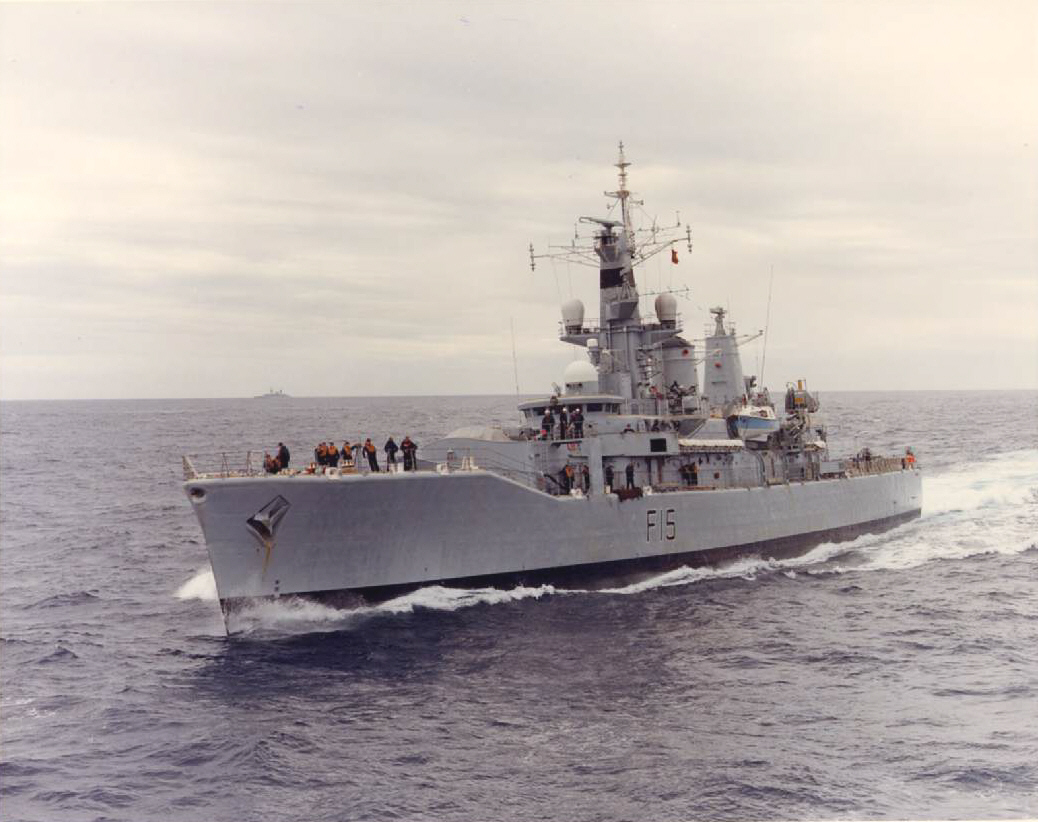
Before the Second World War the RN was predominantly a “cruiser navy”, holding down a range of global deployments with its 15 heavy and 41 light cruisers. These ships had endurance and combat power at the core of their designs, each could operate alone for extended periods, effectively defend itself in most circumstances and demonstrate the interest or resolve of the government in a particular region. The ensuing World War and the Cold War radically changed the type of warships the RN needed. Instead of cruisers built for endurance and complex warfighting the navy built a profusion of smaller frigates and destroyers, mainly to guard convoys and fight submarines close to the UK and in the North Atlantic. To carry out these tasks the navy could make do with smaller, cheaper, ships with relatively shorter legs and far less ability to act independently in high threat environments. Trade-offs like these were made in order to ensure the navy got enough escorts to protect the convoys which would be vital to Britain’s survival in the event of a war; and to hunt the Soviet ballistic missile submarines that threatened NATO. These were ships designed to act as part of a military system that would defeat the threat posed by hostile submarines. This system also included land based aircraft, anti submarine helicopters, aircraft and helicopter carriers and the enormous US/NATO SOSUS fixed sonar array. The Leander class is probably the most famous example of these sort of light frigates, operated by the RN into the early 1990s. When the immediate and pressing threat from submarines operating in the North Atlantic, be they German or Soviet, ceased to exist so the naval forces the UK had constructed to defeat them also fell by the wayside. These ships were, broadly speaking, a product of their time and a deviation from the much older structure that had served the RN well for centuries. This structure consisted of a core “battle fleet”, made up of capital ships; mainly there to act as a deterrent, supported by powerful forward deployed cruisers that conducted most of the day to day activity.
HMS Euryalus, one of 26 Leander Class frigates built for the RN
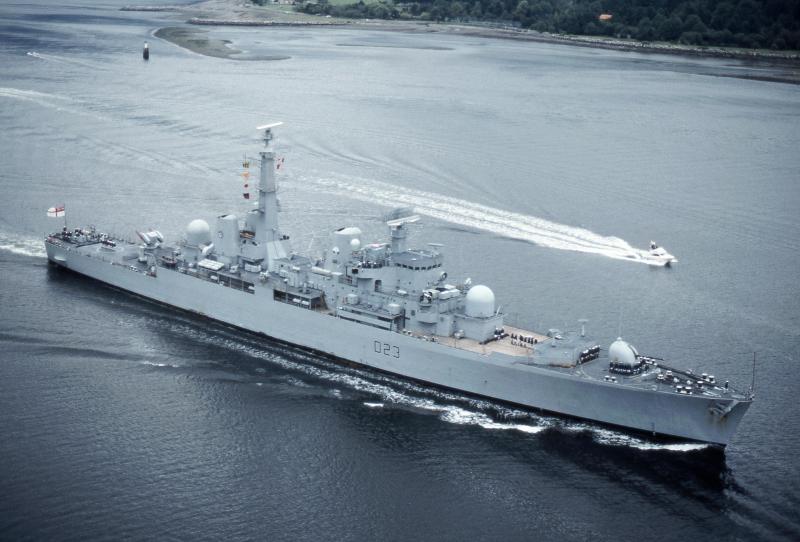
By modern standards almost all of the cheap and numerous frigates and destroyers of the past, even the excellent Leanders, would be classed as lightly armed corvettes. The simple fact was that these cheap and numerous ships sacrificed a lot of capability in order to achieve the affordability necessary to build them in numbers. They were still recognisable as frigates built in the convoy escort mold. Similarly the Type 42 anti-aircraft warfare destroyers, in service from the mid-1970s, were also a design that compromised range and armament for numbers. At only 3500 tonnes the Batch 1 Type 42s were clearly a very light and economical design. When compared with their American counterparts, the 8000 tonne Spruance class, it’s clear that these ships sacrificed range and armament for economy and numbers. Both the Leanders and the Type 42s are recognisable as frigates and destroyers, light warships designed to act in groups and alongside other warships, auxiliaries and aircraft to be effective in combat. The closest the RN came to “cruiser” designs during the Cold War were the eight County Class missile destroyers commissioned in the early 1960s and HMS Bristol, the sole survivor of the pre-1968 carrier escort programme. While these destroyer classes were cruiser-like in some aspects, they carried a far more comprehensive armament and had a greater range (in terms of fuel) than their contemporaries, they lacked the self-sustainment ability, protection, survivability and range of “true” cruisers. While Bristol was initially labelled a light cruiser by Jane’s, the Royal Navy always saw her for what she was: an oversize missile destroyer with the similar limitations to the navy’s other destroyers.
HMS Bristol, the closest the RN came to a new cruiser during the Cold War
With the later Type 22 and 23 frigates the RN moved to fewer, more individually capable, platforms. This change was partly necessitated by the introduction of a new generation of bigger towed array sonars which required larger ships to operate effectively. Despite their greatly improved self defence ability, achieved by fitting the Sea Wolf point defence missile system, these ships were still designed to be expendable escorts and lacked the endurance of cruisers. That said, these two classes signalled the start of the navy’s shift from a fleet of numerous, small and cheap escorts to fewer, larger ships capable of independent operations in a high threat environment.
Comments Off on The evolution of the Royal Navy’s ship designs
October 26, 2015
Going price for a working Enigma machine – $365,000
Lester Haines reports on a recent record auction price for an Enigma machine:
A fully-functioning four-rotor M4 Enigma WW2 cipher machine has sold at auction for $365,000.
The German encryption device, as used by the U-Boat fleet and described as “one of the rarest of all the Enigma machines”, went under the hammer at Bonham’s in New York last night as part of the “Conflicts of the 20th Century” sale.
The M4 was adopted by the German Navy, the Kriegsmarine, in early 1942 following the capture of U-570 in August 1941*. Although the crew of U-570 had destroyed their three-rotor Enigma, the British found aboard written material which compromised the security of the machine.
The traffic to and from the replacement machines was dubbed “Shark” by codebreakers at Bletchley Park. Decryption proved troublesome, due in part to an initial lack of “cribs” (identified or suspected plaintext in an encrypted message) for the new device, but by December 1942, the British were regularly cracking M4 messages.
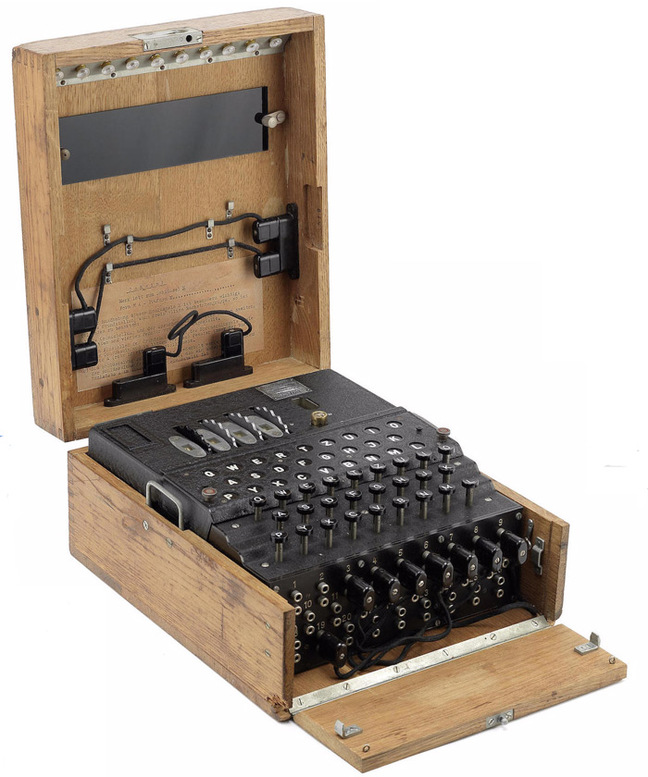
I recently read David O’Keefe’s One Day in August, which seems to explain the otherwise inexplicable launch of “Operation Jubilee”, the Dieppe raid … in his reading, the raid was actually a cover-up operation while British intelligence operatives tried to snatch one or more of the new Enigma machines (like the one shown above) without tipping off the Germans that that was the actual goal. Joel Ralph reviewed the book when it was released:
One Day in August, by David O’Keefe, takes a completely different approach to the Dieppe landing. With significant new evidence in hand, O’Keefe seeks to reframe the entire raid within the context of the secret naval intelligence war being fought against Nazi Germany.
On February 1, 1942, German U-boats operating in the Atlantic Ocean switched from using a three-rotor Enigma code machine to a new four-rotor machine. Britain’s Naval Intelligence Division, which had broken the three-rotor code and was regularly reading German coded messages, was suddenly left entirely in the dark as to the positions and intentions of enemy submarines. By the summer of 1942, the Battle of the Atlantic had reached a state of crisis and was threatening to cut off Britain from the resources needed to carry on with the war.
O’Keefe spends nearly two hundred pages documenting the secret war against Germany and the growth of the Naval Intelligence Division. What ties this to Dieppe and sparked O’Keefe’s research was the development of a unique naval intelligence commando unit tasked with retrieving vital code-breaking material. As O’Keefe’s research reveals, the origins of this unit were at Dieppe, on an almost suicidal mission to gather intelligence they hoped would crack the four-rotor Enigma machine.
O’Keefe has uncovered new documents and first-hand accounts that provide evidence for the existence of such a mission. But he takes it one step further and argues that these secret commandos were not simply along for the ride at Dieppe. Instead, he claims, the entire Dieppe raid was cover for their important task.
It’s easy to dismiss O’Keefe’s argument as too incredible (Zuehlke does so quickly in his brief conclusion [in his book Operation Jubilee, August 19, 1942]). But O’Keefe would argue that just about everything associated with combined operations defied conventional military logic, from Operation Ruthless, a planned but never executed James Bond-style mission, to the successful raid on the French port of St. Nazaire only months before Dieppe.
Clearly this commando operation was an important part of the Dieppe raid. But, while the circumstantial evidence is robust, there is no single clear document that directly lays out the Dieppe raid as cover for a secret “pinch by design” operation to steal German code books and Enigma material.
Comments Off on Going price for a working Enigma machine – $365,000
October 14, 2015
Canadian defence … a still-relevant view from ten years ago
Instapundit linked to a ten-year-old post at Albion’s Seedlings, and I noticed that the next post there is still pretty much dead-on in describing why Canada’s military is in the state we still see today. Spoiler: the post is titled “Was Canada Ever Serious? Militia and Military Since Confederation“:
Initial chapters [of Canadian Brass: The Making of a Professional Army 1860-1939 by Stephen Harris, 1988] consolidate the early periods of Canadian military history as the British military staff digested the new geopolitical realities demonstrated during the American Civil War. Canada was to be spun loose politically in 1867 but its foreign policy and defense were to remain a very strange hybrid well into the 20th century. The WW1 period in Canadian Brass is divided into pre-war, a Sam Hughes [Militia Minister] WW1 period, and a post-Hughes WW1 period. An interbellum period gets thorough coverage and then WW2 is broken out into separate Military Planning, and Training & Education chapters.
The rather shocking message of this book is that the Canadian military has been the constant butt of political interference during the last 150 years except for two brief periods: WW2 proper, and 1951-1964. During virtually all other periods of Canadian history, the permanent (professional) military forces have been starved of funds, denigrated in public by all and sundry, and then ignored completely during mobilization for wartime. The only time in Canadian history that professional pre-mobilization plans were actually used was WW2. In all other eras, professional plans were ignored and politicians turned to various militia cronies to assemble, train, lead, and transport Canadian troops.
[…]
The author suggests, therefore, that lack of professionalism in the organization of the military led to unnecessary political crises (specifically the split between Quebec and English-speaking Canada), and, in the case of the First World War, the needless slaughter of the initial Canadian divisions (because they were led by totally unqualified militia officers with political connections). The WW1 crisis created by Minister of Militia Sam Hughes was the result of a totally mythical and exaggerated memory of militia superiority in the War of 1812 and the Fenian raids of 1866, and careful news management out of the Boer War. Militia were held to be a superior in all ways to a professional force, moral and martial. Government money for militias (urban and especially rural) was a traditional source of political patronage in Canada, frustrating British military advisers and Governor-Generals for literally generations (and ruining many Brit careers in the process). Such patronage methodically starved the professional units in a nascent professional Canadian Army of training, equipment, facilities, pensions, wages and prestige. The result was a professional army that wasn’t and an oblivious overconfident citizen-soldier militia that was destined for a horrific introduction to modern war.
The casualty situation got so bad by the late fall of 1916 that Hughes was dismissed, and a new generation of Canadian officers (all political appointees but survivors of the savage Darwinian selection at the front) began to lead, and promote their junior officers out of the ranks. The impact on morale and military success from early 1917 to the end of the First World War were dramatic. Canadian reputations for combat effectiveness essentially came out of this period.
[…]
It’s clear, in retrospect, that Canadian politicians and the Canadian public have had a long-standing expectation that the British (and then the US) were going to bail them out in any serious military situation. As a result, the professional Canadian military was seen as simply another source of political largesse for the party in power. It never had to be effective, and post-1964, it actually was designed not to be used at all … unification of the three services (Army, Navy, Air Force), and endless UN peace-keeping missions were an effective way to strip combat effectiveness and combat equipment out of the Canadian military. Harris provides all the necessary context and information for that conclusion but is politic enough to avoid much further commentary.
He does writes an interesting epilogue that delicately skirts around those post-1939 issues … and avoids touching the “third rail” of military bilingualism introduced in the 60s, which further degraded esprit de corps and combat effectiveness. After all, Mr. Harris was essentially writing about his own Cold War employer at the time of publication (1988), and probably wanted to keep his job. Nonetheless, it’s pretty clear that the Liberal dismantlement of the conventional Canadian military (after tactical nukes appeared in Europe in the 60s) was yet another iteration of the political manipulation of the permanent military and a return of the good old days of “jobs for the boys.” The sorry state of today’s Canadian military (a small but excellent antiterrorist force [JTF2] to protect the elite in Ottawa, and a sprinkle of blue helmet cannon fodder without adequate air transport) is therefore very much part of a proud Canadian political tradition stretching back 135 years. It’s not a mistake. It’s on purpose.
Ten years on, we don’t do the UN peacekeeping stuff to any great extent, but even with a “pro-military” government in power for most of that time, the Canadian Armed Forces are still starved for resources and up-to-date equipment (and procurement is still seen as a way to spread government money around to “deserving” regions rather than a way of getting the best tools for the money). Thanks to our unique strategic situation, Canada can still be a military free-loader — and glories in it.
Comments Off on Canadian defence … a still-relevant view from ten years ago
October 11, 2015
Compare and contrast – Berlin in 1936, and in July, 1945
Open Culture posted these two films of Berlin, one from shortly after the Nazis came to power (the caption notes that there is footage from 1936 through 1939) and shortly after the allies took control of the German capital at the end of the war in Europe.
Here’s the “before” view:
Here’s the “after”:
I suspect I’ve posted the second video before, but I think it’s worth repeating.
Comments Off on Compare and contrast – Berlin in 1936, and in July, 1945
October 1, 2015
September 29, 2015
QotD: The “secret” of German military superiority, 1866-1945
Trevor Dupuy was a US soldier and a military historian who took a statistical approach to evaluating combat performance. He paid particular attention to casualty statistics. Casualties – in case you did not know – include deaths but also include wounded, missing and captured. They answer the general’s question: how many men do I have who are able to fight?
Of course, statistics aren’t everything. For instance, the North Vietnamese took vastly more casualties in the Vietnam War than the Americans but they still won. But all things being equal, being able to kill more of your enemy than he can kill of you is a good thing to be able to do.
In A Genius for War Dupuy enquired into the nature of the German army. He found that the statistics told a remarkable story: the German army was very good and had been for a long time. From the Franco-Prussian War to the Second World War the Germans were consistently better at killing the enemy than the enemy were at killing them.
Now you may be thinking that such comparisons might be skewed due to the Russians and Dupuy found that that the Russians were indeed every bit as bad as you might think. But even when he removed the Russian numbers Dupuy found that the Germans still held a clear and consistent superiority over the French, British and Americans. This superiority existed regardless of whether the engagement was offensive or defensive.
Chauvinists might be surprised to learn that there seems to have been no great difference between the western allies. French and British performance was more or less equal in the First World War. British and American performance was more or less equal in the second. The Americans in the First World War and the French in the Second are special cases.
Having satisfied himself that the German army was indeed superior, Dupuy asked why this was. His key finding was that there seemed to be nothing inherent in being German. Dupuy found a number of historical examples where the Germans proved to be anything but good fighters. These included largely-German units in the American War of Independence and various battles between German mercenaries and the Swiss.
So, if being German didn’t make you a good soldier what did? Dupuy’s theory was that it was all due to the German General staff. So what was so good about the General Staff? Dupuy listed several criteria. These included selection by examination, historical study and objective analysis. In other words it was an institution that thought seriously about war.
Patrick Crozier, “What Trevor Dupuy says about the German military”, Samizdata, 2015-08-24.
Comments Off on QotD: The “secret” of German military superiority, 1866-1945
August 21, 2015
Allocating the blame for “Operation Jubilee”
In a BBC post from a few years back, Julian Thompson looks at the Dieppe raid:
On 19 August 1942, a disastrous seaborne raid was launched by Allied forces on the German-occupied French port of Dieppe. Why was such a raid ever undertaken? Because, with Germany operating deep in the Soviet Union, the Russians were urging the Allies to relieve the pressure on them by opening a second front in north-west Europe.
At the same time the British Chief of Combined Operations, Rear Admiral Louis Mountbatten, was agitating for a practical trial beach landing, against real opposition, for his troops. In the face of this pressure, Churchill decided that Operation Rutter, a ‘hit and run’ raid on Dieppe, should go ahead.
[…]
Churchill and the Chiefs of Staff — the heads of the Navy, Army and Air Force, who met daily to discuss strategy and advise Churchill — were responsible for this disastrous misjudgement. But, because no written record exists of the Chiefs of Staff approving the raid in its final form, it has sometimes been suggested that it was really Mountbatten who remounted it without authorisation. This is almost certainly nonsense.
The Chiefs of Staff disliked Mountbatten, regarding him as an upstart foisted on them by Churchill, so any unauthorised action on his part would have given them the ammunition to recommend his removal. Since Mountbatten was not removed, and the Chief of the Imperial General Staff, General Sir Alan Brooke, in his frank and detailed diary, makes no mention of his having exceeded his authority, it seems unlikely that Mountbatten can be accused of mounting the raid without authority.
General Brooke was in the Middle East from 1 August 1942, returning on the 24th, after the event. This was unfortunate, for, as the most forceful and intelligent of the Chiefs of Staff, had he been in Britain in the days preceding the raid, he might have persuaded Churchill to call it off.
Much has been said since about the fact that the Dieppe raid was a necessary precursor to the great amphibious operations that were to follow, in terms of the lessons learned and experience gained. Mountbatten pursued that line all his life. But as Chief of Combined Operations, he did bear some of the responsibility for mounting the operation, so one can only comment, ‘he would say that, wouldn’t he?’
The disaster did point up the need for much heavier firepower in future raids. It was recognised that this should include aerial bombardment, special arrangements to be made for land armour, and intimate fire support right up to the moment when troops crossed the waterline (the most dangerous place on the beach) and closed with their objectives.
However, it did not need a debacle like Dieppe to learn these lessons. As judged by General Sir Leslie Hollis — secretary to the Chiefs of Staff Committee and deputy head of the Military Wing of the War Cabinet with direct access to Churchill — the operation was a complete failure, and the many lives that were sacrificed in attempting it were lost with no tangible result.
Comments Off on Allocating the blame for “Operation Jubilee”
July 13, 2015
Japan’s cross-dressing WW2 spy in China
In The Diplomat, Stephen Joyce reviews Manchu Princess, Japanese Spy: The Story of Kawashima Yoshiko, the Cross-Dressing Spy Who Commanded Her Own Army, a recent book by Phyllis Birnbaum:
Divisive figures often make the most compelling biographical subjects; and Kawashima Yoshiko is no exception. During her life and in death opinions have varied markedly. Loathed by the Chinese as a traitor, extolled by the Japanese for her talents as a spy, more recently she has even become a heroine to the LGBT community.
In Manchu Princess, Japanese Spy: The Story of Kawashima Yoshiko, the Cross-Dressing Spy Who Commanded Her Own Army, Phyllis Birnbaum provides a measured assessment of the fascinating rise and fall of this erratic, narcissistic, cross-dressing, bisexual princess.
Born in 1907 as Aisin Gioro Xianyu, Kawashima Yoshiko was the 14th daughter of Prince Su of the Qing imperial family. Soon after the establishment of the Republic of China in 1912, she was unwillingly sent to Japan to be adopted by family friend Kawashima Naniwa.
Her formative teenage years were spent in Matsumoto being educated in Japanese language and culture. It was not the happiest of upbringings. An attempted suicide and sexual assault by her new father are noted as potentially life-defining events but are hard to verify. Whatever the root cause of her discontent, in 1925 she shaved her head and started wearing men’s clothes.
In 1927 she married a Mongolian prince in a politically convenient union that quickly failed and Yoshiko soon travelled to China to pursue her dream of a honorable return to power for the Qing dynasty, beginning with Manchuria and Outer Mongolia.
With Japan increasingly active in China she soon found herself a raison d’etre: a spy in the service of the Japanese. Several incidents define her status as a spy; all are shrouded in mystery.
[…]
Although it would be hard to argue that she had a major influence over the key events of her time, Kawashima Yoshiko is a superb subject for biography and should interest all lovers of Asian history. And despite living her life in the public and media glare her essential mysteriousness remains—even in death. Did the Chinese Nationalist government execute her (as Kim Bai Fai) in 1948 or, as some would have it, did she escape and live out her last days quiet obscurity? Birnbaum concludes that the latter outcome is questionable, to say the least. Assuming she was indeed executed, her memoirs reveal a wry acceptance of her ultimate fate, despite her life aims lying in tatters.
The sheer wealth of material — autobiographies, Yoshiko’s letters, interviews, press reports, sensationalist magazine articles and official documents — with which to write a biography to some extent serves to cloud rather than illuminate the life of Yoshiko Kawashima. Much like her futile efforts to restore the Qing dynasty in China, any attempt to firmly pin down her real life story and true character seems destined to fail.
Comments Off on Japan’s cross-dressing WW2 spy in China
July 7, 2015
World of Warships open beta
I’ve been keeping an eye on World of Warships, if only due to the renderings of the various ships (as a kid, I used to love the diagrams of ships in publications like Purnell’s History of the Second World War). I doubt I have the time to play the game very much, but I’ll probably sign up for the open beta which began last week.
At Massively Overpowered, MJ Guthrie talks to the developers:
Immersion. That’s not a word you often hear associated with lobby-based PvP games. But in the case of World of Warships, the third title in Wargaming’s WWII-era trilogy, it’s more than just fitting; it’s defining. Although not a battle simulation, WoWS offers a genuinely immersive experience thanks to the historical authenticity and the level of detail in both the audio and visual departments. You’ve heard the devil is in the details? Well that’s where the immersion is, too. And now that open beta has started, more players are finally able to dive in and experience this for themselves.
To learn more about how the development team achieved such a high level of immersion, I went to the source: I visited Wargaming’s headquarters in St. Petersburg and talked with the devs who create everything you see and hear in the game. And after watching the creation process in action, I appreciated the ambiance all the more when I jumped in for a hands-on in the closed beta.
Accuracy must take second place to what the players say they want, however:
Sounds really start to shine through once you turn the music down. Although the game’s smart music slider suppresses it when you fire, try clicking it off sometime to focus on the many ambient sounds. Tohtash said that the team has already added “about 3,000″ different sounds to the game. Players will actually hear different metallic sounds from the engines and hulls when the ships change speeds and from the guns when they fire. Engines have four different sound elements (engine, turbine, resonance, and post effects), and guns have three (attack, body, and echo or tail), which combine with recoil, load, and double echo. Using the various elements, the team took care to make different caliber of guns have different sounds. On top of all the types of sounds is the fact that they are positional, changing depending on what view players are in. If your camera is too close to the gun, you will get ringing in your ears after the shot!
Artillery sounds in World of Warships are something that diverges from historical accuracy. The team has access to reference videos, but focus groups have not wanted the more accurate gunfire sounds; they favor big booming ones. Tohtash admitted that actual sounds alone are a bit dry, but once effects such as implementing the bass and the full range of frequencies are added in, the sound is richer and fuller.
July 3, 2015
QotD: “US tankers were notorious for identifying everything as a Tiger tank”
When you read unit accounts, whether it’s the actual unit after action reports or the published books, everyone talks about Tiger tanks. But in looking at it in both German records and US records, I’ve only found three instances in all the fighting from Normandy to 1945 where the US encountered Tigers. And by Tigers I mean Tiger 1, the type of tank we saw in the film [Fury]. I’m not talking King Tigers, the strange thing is that the US Army encountered King Tigers far more often than Tigers. That’s partly because there weren’t a lot of Tigers left by 1944, production ends in August 1944. There were not a lot of Tigers in Normandy, they were mostly in the British sector, the British saw a lot of Tigers. Part of the issue is that US tankers were notorious for identifying everything as a Tiger tank, everything from Stug III assault guns to Panzer IV and Panthers and Tigers.
There was one incident in August of 1944 where 3rd Armored division ran into three Tigers that were damaged and being pulled back on a train, they shot them up with an anti-aircraft half-track. And then there was a single Tiger company up in the Bulge that was involved in some fighting. And then there was one short set of instances in April 1945, right around the period of the film, where there was a small isolated Tiger unit that actually got engaged with one of the new US M26 Pershing tank units. They knocked out a Pershing and then in turn that Tiger was knocked out and the Pershing tanks knocked out another King Tiger over the following days. So I found three verifiable instances of Tigers encountering, or having skirmishes with US troops in 1944-45. So it was very uncommon. It definitely could have happened, there are certainly lots of gaps in the historical record both on the German side and the US side. I think the idea that the US encountered a lot of Tigers during WW2 is simply due to the tendency of the US troops to call all German tanks Tigers. It’s the same thing on the artillery side. Every time US troops are fired upon, it’s an 88, whether it’s a 75mm Pak 40 anti-tank gun, a real 88, a 105mm field howitzer, they were all called 88’s.
“Interview with Steven Zaloga”, Tank and AFV News, 2015-01-27.
Comments Off on QotD: “US tankers were notorious for identifying everything as a Tiger tank”
June 27, 2015
American literacy and the unanticipated boost that was World War 2
Terry Teachout makes the unusual claim that it was the Second World War that “made America literate”:
It’s said that two things about war are insufficiently appreciated by those who, like me, have not known it first-hand: 1) It is, when not terrifying, mostly dull, and 2) it is, like all human enterprises, subject to the operation of the law of unintended consequences. Few aspects of World War II better illustrate both of these points than the Armed Services Editions publishing project. Between 1943 and 1947, the U.S. Army and Navy distributed some 123 million newly printed paperback copies of 1,322 different books to American servicemen around the world. These volumes, which were given out for free, were specifically intended to entertain the soldiers and sailors to whom they were distributed, and by all accounts they did so spectacularly well. But they also transformed America’s literary culture in ways that their wartime publishers only partly foresaw — some of which continue to be felt, albeit in an attenuated fashion, to this day.
[…]
Thus, the Armed Services Editions, which were published by a civilian organization called the Council on Books in Wartime — compact, oblong, two-column-wide paperbacks that were designed to slip easily into the pockets of a uniform. They were sold to the military for six cents per volume. Since books were regarded by the U.S. government as “weapons in the war of ideas,” the military specified that nothing would be published that might “give aid and comfort to the enemy, or which may be detrimental to our own war effort,” or that was not in accord with “the spirit of American democracy.” Still, it was the Council on Books in Wartime, not the military, that chose the titles, and while a few of the longer ones were abridged, none were censored.
The first ASEs were shipped in September of 1943. About 155,000 crates of books were subsequently distributed each month. Each crate contained between 30 and 50 new titles that fell into one of the following categories:
- Mysteries, thrillers, and Western novels by such popular writers as Max Brand, James M. Cain, Raymond Chandler, W.R. Burnett, Erle Stanley Gardner, Zane Grey, Ernest Haycox, and Luke Short.
- Bestselling “blockbuster” novels, such as Henry Bellamann’s Kings Row, Edna Ferber’s So Big, Charles Jackson’s The Lost Weekend, Kenneth Roberts’s Northwest Passage, and John Steinbeck’s The Grapes of Wrath, many of which had been or would soon be turned into movies.
- Collections by humorists and writers of light verse, including five titles by Robert Benchley, six by James Thurber, and three by Ogden Nash.
- War-themed books like Bill Mauldin’s Up Front and Ernie Pyle’s Brave Men.
- Biographies, histories, memoirs, and other nonfiction titles, including Lytton Strachey’s Eminent Victorians, Virgil Thomson’s The State of Music, and Carl Van Doren’s Benjamin Franklin.
- Classic novels and poetry, some easily accessible (David Copperfield, Adventures of Huckleberry Finn), others less so (Moby-Dick, Vanity Fair).
- A modest but not exiguous complement of “serious” modern novels, short stories, poetry, and plays, most of them representative of then-current mainstream taste (Willa Cather’s Death Comes for the Archbishop, Robert Penn Warren’s All the King’s Men) but some of which were decidedly recherché (Max Beerbohm’s Seven Men, Christopher Isherwood’s Prater Violet)
As this list suggests, the ASEs were intended to please a broadly popular audience. But even the bestsellers tended to be more elevated in tone than their present-day counterparts (Somerset Maugham was represented by five novels, John P. Marquand by six). And it was taken for granted that each crate of books would always contain two or three genuinely challenging titles. The first series of ASEs, for instance, included Joseph Conrad’s Lord Jim, Herman Melville’s Typee, and H.L. Mencken’s Heathen Days. Such books were “sold” to skeptical readers with enticing flap copy, as in the case of the ASE edition of The Great Gatsby: “Its pages are filled with masterly realism, melodramatic action, searing irony, and swift romance…Here is a story that is American to the core.”
In any case, it scarcely mattered what the Council on Books in Wartime printed, for all of the ASEs were hugely popular among servicemen, so much so that they were frequently torn into pieces so that they could be shared more easily. A.J. Liebling, who covered the war in Europe for the New Yorker, even saw them on the beaches of Normandy after D-Day. “These little books are a great thing,” a Brooklyn infantryman told him. “They take you away.”
Comments Off on American literacy and the unanticipated boost that was World War 2
June 25, 2015
Building A WW2 Tank: A Defense Report On Film – 1941 Educational Documentary
Published on 20 Jun 2015
Activities at the Chrysler Tank Arsenal in Detroit. Wheel suspension units are milled, wheels ground, gun mount gears cut, armor plate put through a punch press and drill, sprocket gears cut by an arc torch, gears heat treated and immersed in oil baths, armor plate hydraulically riveted, the tanks assembled, armament installed, and the tanks lifted from the assembly line by cranes. The tanks are tested at Fort Knox, Kentucky.
Comments Off on Building A WW2 Tank: A Defense Report On Film – 1941 Educational Documentary
June 8, 2015
QotD: German troops on the Atlantic Wall
Formations transferred from the eastern front, especially Waffen-SS divisions, believed that the soldiers garrisoned in France had become soft. “They had done nothing but live well and send things home,” commented one general. “France is a dangerous country, with its wine, women and pleasant climate.” The troops of the 319th Infanterie-Division on the Channel Islands were even thought to have gone native from mixing with the essentially English population. They received the nickname of the “King’s Own German Grenadiers”. Ordinary soldiers, however, soon called it “the Canada Division”, because Hitler’s refusal to redeploy them meant that they were likely to end up in Canadian prisoner of war camps.
Anthony Beevor, D-Day: The Battle for Normandy, 2009.
Comments Off on QotD: German troops on the Atlantic Wall


