
Allied fighter-bombers continued to attack not only front-line positions, but also any supply trucks coming up behind with food, ammunition and fuel. The almost total absence of the Luftwaffe to contest the enemy’s air supremacy continued to provoke anger among German troops, although they often resorted to black humour. “If you can see silver aircraft, they are American,” went one joke. “If you can see khaki planes, they are British, and if you can’t see any planes, then they’re German.” The other version of this went, “If British planes appear, we duck. If American planes come over, everyone ducks. And if the Luftwaffe appears, nobody ducks.” American forces had a different problem. Their trigger-happy soldiers were always opening fire at aircraft despite orders not to because they were far more likely to be shooting at an Allied plane than an enemy one.
Anthony Beevor, D-Day: The Battle for Normandy, 2009.
June 7, 2015
QotD: Air power on D-Day
June 6, 2015
QotD: Getting ashore on D-Day
At 04.30 hours on the Prince Baudouin, the waiting soldiers heard the call: “Rangers, man your boats!” On other landing ships there was a good deal of chaos getting the men into the landing craft. Some infantrymen were so scared of the sea that they had inflated their life jackets on board ship and then could not get through the hatches. As they lined up on deck, an officer in the 1st Division noticed that one man was not wearing his steel helmet. “Get your damn helmet on,” he told him. But the soldier had won so much in a high card game that his helmet was a third full. He had no choice. “The hell with it,” he said, and emptied it like a bucket on the deck. Coins rolled all over the place. Many soldiers had their field dressings taped to their helmet; others attached a pack of cigarettes wrapped in cellophane.
Those with heavy equipment, such as radios and flame-throwers which weighed 100 pounds, had great difficulty descending the scramble nets into the landing craft. It was a dangerous process in any case, with the small craft rising and falling and bouncing against the side of the ship. Several men broke ankles or legs when they mistimed their jump or were caught between the rail and the ship’s side. It was easier for those lowered in landing craft from davits, but a battalion headquarters group of the 29th Infantry Division experienced an inauspicious start a little later when their assault craft was lowered from the British ship Empire Javelin. The davits jammed, leaving them for thirty minutes right under the ship’s heads. “During this half-hour,” Major Dallas recorded, “the bowels of the ship’s company made the most of an opportunity which Englishmen have sought since 1776.” Nobody inside the ship could hear their yells of protest. “We cursed, we cried and we laughed, but it kept coming. When we started for shore, we were all covered with shit.”
Anthony Beevor, D-Day: The Battle for Normandy, 2009.
May 17, 2015
The Yasukuni Shrine is part of the reason Japan can’t apologize for their historical aggressions
At The Diplomat, J. Kevin Baird looks at Japan’s continued resistance to examining their own military and diplomatic history after the First World War:
Japan faces the expectations of its friends and neighbors to express itself on the occasion of the 70th anniversary of the end of the Pacific War. Prime Minister Shinzo Abe will formulate and express those words. In doing so, he faces a dilemma. The focus of that dilemma is Yasukuni Shrine and what it speaks to regarding Japan’s view of the Pacific War. Will Japan demonstrate contrition in seeking atonement, or does it aim for exoneration by rehabilitating its Greater East Asia Co-Prosperity Sphere motivations for the Pacific War? Histories yet to be may hinge on that choice.
[…]
In 2014, Shinzo Abe rejected the idea of Japan emulating Germany’s actions, citing differing political contexts for postwar Europe versus Asia. He implied the quest for European unification somehow mandated the German approach. A divided and adversarial East Asia, it seems, made Japanese attempts at atonement futile or counterproductive. That argument may be made, but it skirts the core issue of Japan’s stance, more deeply dividing the region and entrenching adversarial national relationships. Abe and his advisors surely understand this. Japan’s ability to shape regional and world affairs, as it is fully capable of doing and aspires to do, hinges upon how it is perceived by the community of nations, especially those of East Asia. Abandoning the ideal of reconciliation over its wartime actions cannot be an option on the Japan table. What strategy for realizing their ambition is at work? It may not be contrition and atonement.
German artist Hans Haacke wrote, “Museums are managers of consciousness. They give us an interpretation of history, of how we view the world and locate ourselves in it. They are, if you want to put it in positive terms, great educational institutions. If you want to put it in negative terms, they are propaganda machines.” A museum and shrine in Tokyo may bring Abe’s strategic posture on reconciliation into sharper focus. Yushukan Museum stands on the grounds of Yasukuni Shrine. Therein is locomotive C5631, identified as the first to trundle down the Thai-Burma rail line, where more than 100,000 forced laborers and prisoners of war died in its construction.
A memorial to Indian jurist Radhabinod Pal also stands on the grounds of Yasukuni Shrine – a member of the International War Tribunal for the Far East panel of judges, he wrote of the Class A war criminals, “I would hold that every one of the accused must be found not guilty of every one of the charges in the indictment and should be acquitted on all those charges.” Pal considered the Pacific War provoked by the Americans and the war tribunals a sham. He stood utterly alone in this dissent among his 11 peer judges, but Japanese nationalists hold his views as authoritative and see Pal as a heroic figure. In 1968, Japan secretly enshrined 1,068 executed war criminals at Yasukuni as divine martyrs. Like those who did not survive the war, the executed soldiers had nobly sacrificed their lives in defense of the Japanese motherland against European Imperialism. The museum explains this defensive nature of the Pacific War. Abe and many other prominent Japanese statesmen regularly pay homage to those men.
May 11, 2015
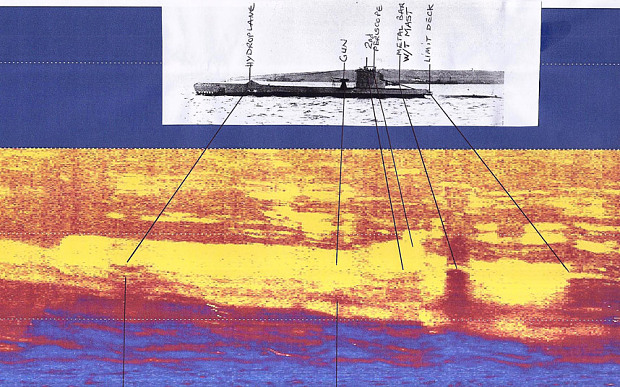
After 74 years, the remains of HMS Urge discovered off the Libyan coast
In The Telegraph a report on the discovery of a Royal Navy submarine wreck from 1942:

British U class submarine HMS Urge underway. (via Wikipedia)
A Royal Navy submarine paid for by a town holding dances and whist drives is believed to have been discovered more than 70 years after it vanished during the Second World War.
The British submarine HMS Urge was paid for by the townspeople of Bridgend, South Wales, but sunk without trace in the Mediterranean in 1942.
It disappeared while making a voyage from the island of Malta to the Egyptian city of Alexandria – and families of the 29 crew and 10 passengers never knew what happened.
For more than 70 years, its resting place has remained a mystery. But a 76-year-old scuba diver claims he has discovered its wreck 160ft (50m) below the waves off the Libyan coast.
May 10, 2015
In the Netherlands, 1945, nobody “swaggered”
David Warren on the task of the First Canadian Army after liberating The Netherlands:
It wasn’t only the liberation, but what our boys did after, in that devastated country. The Netherlands — but Canadians call her “Holland” — had suffered proportionally more than any other country the Wehrmacht had crushed and occupied, and would continue to suffer — famine — after their final defeat. The bastards blew the dikes to slow our allied advance. Breached, the lands flooded; … deaths heaped on deaths.
Victory is sweet, but there was no swagger, from the Dutch still mired in Hell.
And memorably, neither from our boys, who had liberated them. They didn’t swagger. Instead, they set down their guns and their helmets and went to work — spontaneously, voluntarily, on the enormous task of repair; of fixing the dikes and clearing the farms of salt-mud and debris. Of breaking the stones, and smoothing the roads, and shifting the rubble. The food bags, too, were starting to arrive, from Canada and the States — the tins and boxes; the cigarettes and medical supplies; and the candy, for the little children.
This wasn’t the Marshall Plan. It was three years before that. The Royal Canadian Air Force was dropping food from the sky, as fast as it could. (Our pilots read, “Thank you Canadians!” on rooftops.) Crates and drums were being discharged through the busted ports, wheat and flour from our Prairies. Yet thousands were still perishing from hunger.
And more: all the stuff sent by unorganized people, to wherever they thought it would do some good; to Germany as well as Holland; to wherever people must be desperate and starving. And back home our boys’ own families were throwing themselves into action, packing and shipping; and slipping in the letters of love and encouragement to strangers and new friends over the sea.
We were already hand-in-glove with the Dutch, from sheltering their royal family in exile. The magnificent Queen Wilhelmina, scourge of politicians (Churchill called her “the only real man” among all the exiled governors in London), no longer speaking in the nights, through the radio. For she had returned, to a rapturous welcome. And now, too, their little princess — Margriet Francisca — born in Ottawa Civic Hospital, in a maternity ward that had been declared Dutch sovereign territory for the occasion.
Every year, the tulips still come from Holland to decorate our Parliament Hill. And Dutch kids are still taught in school how to sing, “O Canada.”
April 23, 2015
Kicking Neville Chamberlain while he’s dead
Poor old Neville … he’s become such a byword for failure that they’re even comparing Barack Obama to Chamberlain. This is hardly fair to either party:
One of the hardest things to do in history is to read history in context, shutting out our foreknowledge of what is going to happen — knowledge the players at the time did not have.
Apparently Neville Chamberlain is back in the public discourse, again raised from the dead as the boogeyman to scare us away from any insufficiently militaristic approach to international affairs.
There is no doubt that Neville Chamberlain sold out the Czechs at Munich, and the Munich agreement was shown to be a fraud on Hitler’s part when he invaded the rest of Czechoslovakia just months later. In retrospect, we can weep at the lost opportunity as we now know, but no one knew then, that Hitler’s generals planned a coup against him that was undermined by the Munich agreement.
But all that being said, let’s not forget the historic context. World War I was a cataclysm for England and Europe. It was probably the worst thing to happen to Europe since the black death. And many learned folks at the time felt that this disaster had been avoidable (and many historians today might agree). They felt that there had been too much rush to war, and too little diplomacy. If someone like Britain had been more aggressive in dragging all the parties to the bargaining table in 1914, perhaps a European-wide war could have been avoided or at least contained to the Balkans.
If you’ve read my Origins of WW1 posts, you’ll probably agree that Britain alone could not have averted the First World War, although they could have stayed out of the war (which would probably have guaranteed a German victory by 1916). Unlike the attitudes in 1914, few Europeans wanted any kind of war in the late 1930s, having learned too well what the casualties of modern war could be. The idea that Chamberlain and Édouard Daladier could somehow have deterred Hitler requires an amazing lack of awareness of the political realities in Britain and France at the time … and of the state of the respective armed forces of the two nations. Neither politician could have survived the reaction if they’d forced Hitler’s hand … which might well have served Hitler’s purposes just as well as the “scrap of paper” did in the end.
In a postscript, Warren also points out that FDR could just as easily take the place of Neville Chamberlain for his own “sell out” of Poland and the rest of what became the Warsaw Pact “allies”:
Years ago in my youth I used to excoriate FDR for caving into Stalin at Yalta, specifically in giving away most of Eastern Europe. I still wish he hadn’t given his moral authority and approval to the move, but even if we stood on the table and screamed at Stalin in opposition, what were we going to do? Was there any appetite for extending the war? Zero. That is what folks who oppose the dropping of the atomic bombs on Japan get wrong in suggesting there were alternatives. All those alternatives involved a longer war and more American deaths which no one wanted.
April 20, 2015
Twice-nuked aircraft carrier sunk 80 km from San Francisco
If you’d ever wondered what happened to the ships that were used in the Bikini Atoll nuclear tests, here’s one that might surprise you:
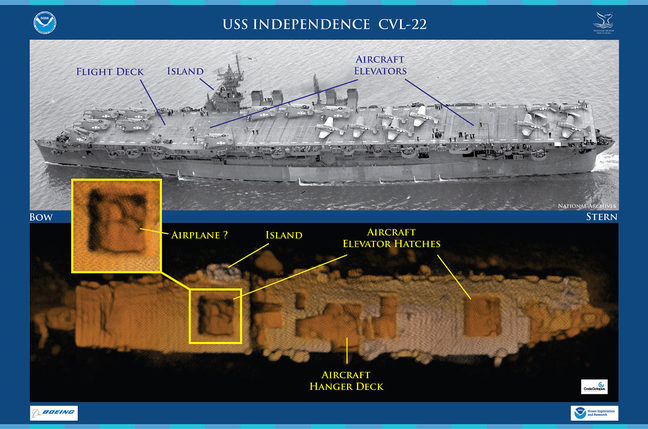
The sonar image with oranges color tones (lower) shows an outline of a possible airplane in the forward aircraft elevator hatch opening. Credit: NOAA, Boeing, and Coda Octopus
The Independence (CVL-22) was commissioned as cruiser, but adapted to become a light carrier as the demands of the Pacific war made mobile air power desirable. The ship served in the Pacific from November 1943 to August 1945, but by 1946 was deemed fit for duty as a test vessel at an atomic bomb test near Bikini Atoll. Independence was stationed less than half a mile from ground zero on a July 1st test, survived that ordeal without sinking so was nuked again on the 25th.
The US Navy then brought the vessel back to San Francisco to assess the damage, and to try nuclear decontamination techniques. By 1951 Independence was felt to be at risk of sinking, so with a colossal radioactive carcass not the sort of thing one wants near a major city it was sunk.
And so the Independence passed into history, its fate largely forgotten … until the NOAA decided to embark on a mission to “to locate, map and study historic shipwrecks in Gulf of the Farallones National Marine Sanctuary and nearby waters.” As part of that effort, Independence was found “in 2,600 feet of water off California’s Farallon Islands”, which one can find here, at what looks to be a distance of about 80kms from San Francisco.
April 16, 2015
An alliance of monsters – Hitler and Stalin, 1939-1941
In The New York Review of Books, John Lukacs reviews a new book from Roger Moorhouse documenting the brief alliance between the Nazi and Soviet regimes:
In the vast literature about Stalin and Hitler during World War II, little is said about their being allies for twenty-two months. That is more than an odd chapter in the history of that war, and its meaning deserves more attention than it has received.
Two factors were involved in this neglect. One was that after Hitler chose to conquer Russia he did not succeed; Stalin emerged as one of the supreme victors of World War II. The other was the Western Powers’ relative lack of interest in Eastern Europe. Yet the war broke out in 1939 because of Eastern Europe, as a result of the British (and French) decision to oppose the German conquest of Poland. The political earthquake of the Nazi–Soviet Pact of August 23, 1939, nine days before the outbreak of war on September 1, did not deter Britain and France from declaring war on Germany upon its invasion of Poland. This is one of the few—very few—decisions in their favor at the time. That they were reluctant in the months that followed to wage war seriously against Germany is another story.
Three quarters of a century have now passed since 1939. A fair amount has been written about the Nazi–Soviet Pact since then, mostly by Eastern European writers and historians. The Devil’s Alliance is a good account by the British historian Roger Moorhouse of what the pact meant for Hitler and Stalin—and, worse, for its victims. Perhaps the book’s most valuable part deals with the immediate consequences of the pact in 1939. Before then, obviously and stridently, Nazism and communism were outright enemies. From the very beginning of his political rise Hitler described Judaism and communism as his principal enemies. Stalin, by that time, was less of an ideologue. Like Hitler, he was a nationalist; he had little interest in international communism.
April 15, 2015
Operation Sealion, wargamed by some of the original commanders
Strategy Page has a great summary of the German plan to invade Britain and the most likely outcome if the invasion had ever been attempted:
Operation Sealion, or, in the original German Unternehmen Seelöwe, is one of the most famous “what ifs” of the Twentieth Century.
On July 16, 1940, following the collapse of France, the Dunkerque evacuation, and the rejection of his peace overtures, Adolf Hitler issued Führer Directive No. 16, which initiated preparations for an invasion of Britain. At the time, it seemed to many that if Hitler had tried an offensive across the English Channel a defenseless Britain would inevitably fall. But was it so? What were Hitler’s chances?
In 1973 historian Paddy Griffith, just beginning his career as an instructor at the Royal Military Academy Sandhurst, decided to evaluate the chances of a successful German invasion of Britain by using a wargame.
Organization. Griffith’s wargame was much more than a board with a set of counters, a rule booklet, and some dice. It was a massive multiplayer game, which Griffith later wrote about in Sprawling Wargames. Based on traditional kriegsspiel methodology, the game involved several dozen players and umpires, all isolated from each other except by means of simulated signaling. Many of the players and umpires were veterans of the war from both sides. Among them were former wartime senior German officers such as Luftwaffe fighter Generalleutnant Adolf Galland and Kriegsmarine Vice Admiral Friedrich Ruge, as well as several men from both sides who had been lower ranking offices and later risen higher, including Christopher Foxley-Norris, who had commanded a fighter squadron during the Battle of Britain and rose to air chief marshal, Sir Edward Gueritz, a junior naval officer at the time who became a rear admiral, Heinz Trettner, who had served on the staff of the German airborne forces in 1940, rose to command a parachute division by war’s end, and later served as Inspector General of the post-war German air force, and Glyn Gilbert, a junior officer in one of the defending infantry battalions in 1941, who later rose to major general.
Each side was given the same forces, operational plans, and intelligence as it had in 1940. The game was based on the assumption that the Luftwaffe had still not won the battle for air supremacy over the Channel and southern England by the time the landings were scheduled to take place, in early September, which was in fact the case. The intelligence picture greatly favored the British, who had proven much better at securing information about the enemy’s plans and force than the Germans had on their own.
There’s even a mention of the (significant) Canadian contribution to the defence of Britain after Dunkirk:
The defending forces included the 1st Canadian Division (the most well-prepared division available, full strength and fully equipped, though without combat experience), plus the less-well prepared 2nd Canadian division and partial divisions from Australia and New Zealand.
Although I haven’t read Griffith’s book, my other readings on the subject align with the eventual outcome of the wargame:
Following the game the participants took part in a general analysis. Some interesting observations and conclusions were made. The British GHQ mobile reserve had not been engaged at all. In addition, casualties to the Royal Navy had been serious, but hardly devastating; of about 90 destroyers on hand, only five had been sunk and six seriously damaged, and only three of the three dozen cruisers had been lost, and three more heavily damaged.
Compare that to the actual Royal Navy losses during the evacuation of Crete — with little to no air support from the RAF, due to extreme distance from friendly airbases:
Attacks by German planes, mainly Ju-87s and Ju-88s, destroyed three British cruisers (HMS Gloucester, Fiji, and Calcutta) and three destroyers (HMS Kelly, Greyhound and Kashmir) between 22 May and 1 June. Italian bombers from 41 Gruppo sank one destroyer (Juno on 21 May and damaged another destroyer (Imperial) on 28 May beyond repair. The British were also forced to scuttle another destroyer (Hereward) on 29 May, that had been seriously damaged by German aircraft, and abandoned when Italian motor torpedo boats approached to deliver the coup de grâce.
Damage to the aircraft carrier HMS Formidable, the battleships HMS Warspite and Barham, the cruisers HMS Ajax, Dido, Orion, and HMAS Perth, the submarine HMS Rover, the destroyers HMS Kelvin and Nubian, kept these ships out of action for months. While at anchor in Suda Bay, northern Crete, the heavy cruiser HMS York was badly damaged by Italian explosive motor boats and beached on 26 March 1941. She was later wrecked by demolition charges and abandoned when Crete was evacuated in May. By 1 June the effective eastern Mediterranean strength of the Royal Navy had been reduced to two battleships and three cruisers to oppose the four battleships and eleven cruisers of the Italian Navy
And back to the Operation Sealion summary from Strategy Page:
All participants, German as well as British, agreed that the outcome was an accurate assessment of the probable result of an actual invasion.
Oddly, the Sandhurst wargame was designed on the basis of inaccurate information. Some time after the game, additional hitherto secret documents came to light, which revealed that the Germans probably had even less chance of success than they did in game. At the time the game was designed, the true extent of British “stay behind” forces, intended to conduct guerrilla operations in the rear of the invasion forces, and the sheer scale of defensive installations that had been erected across southern England in anticipation of an invasion were still classified; there were some 28,000 pill boxes, coastal batteries, strong points, blockhouses, anti-aircraft sites, and some other installations.
So assuming Hitler had for a time been serious about invading England, his decision to call it off was probably wise.
April 13, 2015
RCAF CF-18 Hornet repainted in “Battle of Britain” theme

The 2015 CF-18 Hornet Demonstration Aircraft is unveiled at a ceremony held at 3 Wing Bagotville in Saguenay, Québec on 27 March 2015.
Image: LS Alex Roy, Atelier d’imagerie Bagotville.
BN01-2015-0186-005 (click to see full-sized image)
From the RCAF CF-18 Demo Team page:
The CF-18 Demonstration Team will commemorate the 75th anniversary of the Battle of Britain — and the courageous airmen that Prime Minister Winston Churchill dubbed the “few” — during its 2015 show season.
The special design of the demo Hornet, reflecting this theme, will be unveiled at a later date.
The summer of 1940 was a dark time for the Allies. With shocking rapidity, Adolf Hitler’s forces had overrun most of Europe. By mid-June, Allied forces had been pushed off the continent and Nazi forces were at the English Channel, preparing to invade England.
“The Battle of France is over,” said British Prime Minister Winston Churchill. “I expect that the Battle of Britain is about to begin.”
Hitler directed that the Royal Air Force (RAF) — including Canadians and members of other Commonwealth air forces fighting with or as part of the RAF — be eliminated to allow the invasion to take place. The air battle began on July 10, with Nazi attacks on British convoys, ports and coastal radar stations. One of the most savage days was August 13. A few days later Churchill praised the brave airmen in words that have echoed through the decades: “Never in the field of human conflict was so much owed by so many to so few.”
On September 15, the Germans launched a massive attack but, although the fighting was fierce, the RAF, using new tactics, was victorious. Two days later, Hitler postponed the invasion; he never again considered it seriously.
By the end of September, the Battle of Britain was over. It was the first military confrontation won by air power and Germany’s first defeat of the Second World War. More than 2,300 pilots and aircrew from Great Britain and nearly 600 from other nations participated in the Battle.
Of these, 544 lost their lives, including 23 Canadians. More than 100 Canadians flew in the battle, principally as members of the Royal Canadian Air Force’s (RCAF) No. 1 Squadron (later renamed 401 Squadron) and the RAF’s 242 “All Canadian” Squadron. An estimated 300 Canadians served as groundcrew.
It is a great honour for the RCAF and the 2015 CF-18 Demonstration Team to commemorate the dedication and sacrifice of those brave Canadian aircrew and groundcrew who stood up to tyranny and left their mark on history.
February 16, 2015
Operation CRABSTICK
Think Defence looks back at an anti-invasion project to deny airfields to German forces along the southeast coast of England after the Dunkirk evacuation and onset of the Battle of Britain:
A method was also sought to deny the runway to enemy gliders and transport aircraft and so the Canadian Pipe Mine was devised by the 1st Canadian Tunnelling Company. 50-70mm steel pipes were inserted into the ground using hydraulic pipe pushing equipment and laid in a criss cross pattern about 6ft under the surface. They were subsequently filled with explosives, usually a blasting gelignite called ‘Polar Blasting Gelignite’ which was very powerful.
They were also called McNaughton Tubes after the GOC of 1 Canadian Division who according to his biographer got the idea for using hydraulic rams from bootleggers who used the method for creating an offsite distribution point for their whiskey!
Only 9 airfields were identified for mining initially but this rose to include other locations, by the end of 1942, after the threat of invasion had receded, 30 locations were mined, not all of them airfields. It is estimated that over 40,000ft of pipe mines were installed.
During the war some of the pipe mines were made safe and removed because of the deterioration of the explosive filler but most were left in situ. After the war Canadian engineers were tasked with removal but it seems from reading different sources that records were incomplete and some doubt exists whether the clearance activity was completed. Additional clearance efforts were made, one that resulted in the death of a Ukrainian worker at one of the locations.

February 13, 2015
QotD: The Nazi leadership, Aleister Crowley and the occult
During the past four centuries, we have seen the world in semi-Epicurean terms as a great and internally consistent machine. To understand it, we observe, we question, we form hypotheses, we test, we measure, we record, we think again. The results have long since been plain. In every generation, we have added vast provinces to the empire of science. We do not yet perfectly understand the world. But the understanding we have has given us a growing dominion over the world; and there is no reason to think the growth of our understanding and dominion will not continue indefinitely.
We reject supernatural explanations partly because we have no need of them. The world is a machine. Nothing that happens appears to be an intervention into the chains of natural cause and effect. We know that things once ascribed to the direct influence of God, or the workings of less powerful invisible beings have natural causes. Where a natural cause cannot be found, we assume, on the grounds of our experience so far, that one will eventually be found. In part, however, we reject the supernatural because there is no good evidence that it exists.
[…] It seems that Hitler was a convinced believer in the occult. He took many of his decisions on astrological advice. It did him no visible good. He misjudged the British response to his invasion of Poland. He was unable to conquer Britain or to make peace. His invasion of Russia, while still fighting Britain, turned his eastern frontier from a net contributor of resources to a catastrophic drain on them. He then mishandled his relations with America. So far as he was guided by the astrologers, I hope, before he shot himself, that he thought of asking for a refund. It was the same with Himmler. Despite his trust in witchcraft, he only escaped trial and execution by crunching on a cyanide capsule made by the German pharmaceutical industry.
Turning to practitioners of the occult, I see no evidence of special success. They do not live longer than the rest of us. However they begin, they do not stay better looking. Any success they have with money, or in bed, is better explained by the gullibility of their followers than by their own magical powers.
So it was with Aleister Crowley (1875-1947) — the “Great Beast 666,” or “the wickedest man alive.” He quickly ran through the fortune his parents had left him. He spent his last years in poverty. Long before he died, he had begun to resemble the mug shot of a child murderer. Whether his claims were simply a fraud on others, or a fraud on himself as well, I see no essential difference between him and the beggar woman who cursed me in the street. He had advantages over her of birth and education. But he was still a parasite on the credulity of others.
Sean Gabb, “[Review of] Crowley: Thoughts and Perspectives, Volume Two“, Libertarian Enterprise, 2014-05-18.
February 12, 2015
World War II Relics: Juno Beach
Published on 5 Feb 2015
National Geographic television series The Sea Hunters Relics exploring the history of World War II Juno Beach.
February 8, 2015
Refuting the “Golden Age of Television” meme
A few years back, Livejournal user Squid314 took issue with the idea that we’re somehow enjoying a great era of TV programming lately:
As I mentioned in my last entry, I’ve been watching Babylon 5 lately. It’s not a perfect show, but it has one big advantage: it’s consistent and believable.
Contrast this with Doctor Who. Doctor Who is fun to watch, but if you think about it for more than two seconds you notice it’s full of plot holes and contradictions. Things that cause time travel paradoxes that threaten to destroy the universe one episode go without a hitch the next. And the TARDIS, the sonic screwdriver, and the Doctor’s biology gain completely different powers no one’s ever alluded to depending on the situation. The aliens are hysterically unlikely, often without motives or believable science, the characters will do any old insane thing when it makes the plot slightly more interesting, and everything has either a self-destruct button or an easily findable secret weakness that it takes no efforts to defend against.
[…]
So Doctor Who is not a complete loss. But then there are some shows that go completely beyond the pale of enjoyability, until they become nothing more than overwritten collections of tropes impossible to watch without groaning.
I think the worst offender here is the History Channel and all their programs on the so-called “World War II”.
Let’s start with the bad guys. Battalions of stormtroopers dressed in all black, check. Secret police, check. Determination to brutally kill everyone who doesn’t look like them, check. Leader with a tiny villain mustache and a tendency to go into apopleptic rage when he doesn’t get his way, check. All this from a country that was ordinary, believable, and dare I say it sometimes even sympathetic in previous seasons.
I wouldn’t even mind the lack of originality if they weren’t so heavy-handed about it. Apparently we’re supposed to believe that in the middle of the war the Germans attacked their allies the Russians, starting an unwinnable conflict on two fronts, just to show how sneaky and untrustworthy they could be? And that they diverted all their resources to use in making ever bigger and scarier death camps, even in the middle of a huge war? Real people just aren’t that evil. And that’s not even counting the part where as soon as the plot requires it, they instantly forget about all the racism nonsense and become best buddies with the definitely non-Aryan Japanese.
Not that the good guys are much better. Their leader, Churchill, appeared in a grand total of one episode before, where he was a bumbling general who suffered an embarrassing defeat to the Ottomans of all people in the Battle of Gallipoli. Now, all of a sudden, he’s not only Prime Minister, he’s not only a brilliant military commander, he’s not only the greatest orator of the twentieth century who can convince the British to keep going against all odds, he’s also a natural wit who is able to pull out hilarious one-liners practically on demand. I know he’s supposed to be the hero, but it’s not realistic unless you keep the guy at least vaguely human.
[…]
…and then, in the entire rest of the show, over five or six different big wars, they never use the superweapon again. Seriously. They have this whole thing about a war in Vietnam that lasts decades and kills tens of thousands of people, and they never wonder if maybe they should consider using the frickin’ unstoppable mystical superweapon that they won the last war with. At this point, you’re starting to wonder if any of the show’s writers have even watched the episodes the other writers made.
I’m not even going to get into the whole subplot about breaking a secret code (cleverly named “Enigma”, because the writers couldn’t spend more than two seconds thinking up a name for an enigmatic code), the giant superintelligent computer called Colossus (despite this being years before the transistor was even invented), the Soviet strongman whose name means “Man of Steel” in Russian (seriously, between calling the strongman “Man of Steel” and the Frenchman “de Gaulle”, whoever came up with the names for this thing ought to be shot).
So yeah. Stay away from the History Channel. Unlike most of the other networks, they don’t even try to make their stuff believable.
December 27, 2014
Who should have been the allied commanders on D-Day?
Nigel Davies ventures into alternatives again, this time looking at who were the best allied generals for the D-Day invasion (for the record, he’s quite right about the best Canadian corps commander):
The truth is that any successful high command should maximise the chances of success of any campaign by choosing the ‘best fit’ for the job.
But that is not how generals were chosen for D Day.
(I would love to start with divisional commanders, but there are way too many, so for space I will start with Corps and Army commanders, and work up to the top).
The outstanding Canadian of the campaign for instance was Guy Simonds. Described by many as the best Allied Corps commander in France, and credited with re-invigorating the Canadian Army HQ when he filled in while his less successful superior Harry Crerar was sick, Simonds was undoubtedly the standout Canadian officer in both Italy and France.Lieutenant General Guy Simonds, commander of the 2nd Canadian Corps.
He was however, the youngest Canadian division, corps or army commander, and the speed of his promotions pushed him past many superiors. He was also described as ‘cold and uninspiring’ even by those who called him ‘innovative and hard driving’. It can be taken as a two edged sword that Montgomery thought he was excellent (presumably implying Montgomery like qualities?) But his promotions seemed more related to ability than cronyism, and his achievements were undoubted.
Should he have been the Canadian Army commander instead of Crerar? Yes. Arguments against were mainly his lack of seniority, and lack of experience. but no Canadian had more experience, and lack of seniority was no bar in most of the other Allied armies.
It comes down to the simple fact that the Allied cause would have been better served by having Simonds in charge of Canadian forces than Crerar.
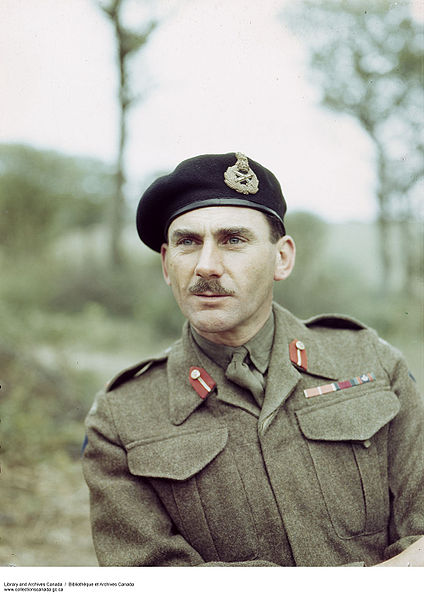
Simonds was a brilliant corps commander and (at least) a very good army commander, but he had one fatal flaw: he was no politician. Harry Crerar was a very “political” general, and played the political game with far greater talent than any other Canadian general. That got him into his role as army commander and his political skills kept him there despite the better “military” options available.


