
Drachinifel
Published 18 Nov 2023HMS Eskimo, a destroyer of the British Royal Navy, is today’s subject.
(more…)
June 13, 2025
HMS Eskimo (F75) – Guide 362
Comments Off on HMS Eskimo (F75) – Guide 362
June 10, 2025
How Moscow Got the Atomic Bomb – W2W 31
TimeGhost History
Published 8 Jun 2025In 1949, the Soviet Union detonates its first atomic bomb — years ahead of Western expectations. This episode dives into how the USSR mobilized former Nazi scientists, forced Soviet physicists into secret cities, and relied on intelligence from spies like Klaus Fuchs. While Stalin pushes for rapid progress, Beria enforces brutal discipline, and Soviet scientists race to meet an impossible deadline. The nuclear balance of power is about to shift — forever.
(more…)
Comments Off on How Moscow Got the Atomic Bomb – W2W 31
June 9, 2025
The Mighty Meteor – The World’s First Operational Jet Fighter
HardThrasher
Published 8 Jun 2025References
1. https://tinyurl.com/yc74kmed
2. Britain’s Jet Age, Guy Ellis, 2016, Amberley Publishing
3. Genius Of The Jet | The Invention Of The J… – Frank Whittle and Powerjets documentary, originally aired on the BBC
4. Meteor, Gloster’s First Jet Fighter, Steven Bond, Midland, 1985, Chpt 1
5. The British Aircraft Specifications File, Meekcombs and Morgan, 1994, p.298
6. https://en.wikipedia.org/wiki/Klimov_…
7. Most Secret Place, Johnson & Hefferman, Janes, 1983
8. https://mikesresearch.com/2020/12/25/…
9. Bond, op cit. p18
10. Bond, op cit.p34
11. QUEEN OF THE SKY: Meteor Night Fighters, U…
12. https://hushkit.net/2020/05/12/my-fav…
13. https://asn.flightsafety.org/wikibase… and https://asn.flightsafety.org/wikibase…
(more…)
Comments Off on The Mighty Meteor – The World’s First Operational Jet Fighter
Q&A: British Small Arms of World War Two
Forgotten Weapons
Published 24 Jan 2025Today’s Q&A is brought to you by the fine folks at Patreon, and by Penguin Brutality: https://www.varusteleka.com/en/search…
01:11 – Was the Vickers .50 any good, and why did the British use four different heavy cartridges instead of consolidating?
07:35 – The Sten and its single-feed magazine design
10:27 – Owen versus Sten, and German use of the Owen.
14:38 – British wartime work on an “assault rifle” sort of weapon?
15:44 – Why no British semiauto rifle during WW2? – Jonathan Ferguson on British semiauto rifle trials: Q&A 43 (feat. Jonathan Ferguson): Mil…
18:04 – EM2’s automatic bolt closure system
20:46 – Did the British use other allied weapons besides American ones?
23:15 – Is the PIAT a Destrucitve Device under US law and why?
26:07 – Bren vs Degtyarev
27:50 – Why not make the Sten in .45 to use Thompson ammo?
29:37 – Did the British get M3 Grease Guns?
31:01 – British SMG in .455?
32:03 – Sten vs Lanchester
33:26 – Was there an LSW version of the EM1/EM2 planned? EM1 Korsac: The Korsac EM1 – a British/Polish Bul…
34:25 – Why wasn’t the BESA in .303?
36:34 – Biggest British missed opportunity during the interwar period?
38:40 – British naval service small arms
41:45 – Did .280 cartridge development begin during the war?
43:24 – Impact of MP44 on British post-war small arms development?
44:25 – Gallilean sights on the Enfield
46:25 – Why is there a semiauto selector on the Sten?
49:17 – Did American soldiers use British small arms?
50:29 – Why did the British choose the Lee action over the Mauser action?
51:16 – Which was better, Sten or Grease Gun?
52:34 – Why did the whole Commonwealth not switch to the No4 Enfield?
(more…)
Comments Off on Q&A: British Small Arms of World War Two
QotD: “Defending” democracy with totalitarian methods
One of the peculiar phenomena of our time is the renegade Liberal. Over and above the familiar Marxist claim that “bourgeois liberty” is an illusion, there is now a widespread tendency to argue that one can defend democracy only by totalitarian methods. If one loves democracy, the argument runs, one must crush its enemies by no matter what means. And who are its enemies? It always appears that they are not only those who attack it openly and consciously, but those who “objectively” endanger it by spreading mistaken doctrines. In other words, defending democracy involves destroying all independence of thought. This argument was used, for instance, to justify the Russian purges. The most ardent Russophile hardly believed that all of the victims were guilty of all the things they were accused of: but by holding heretical opinions they “objectively” harmed the regime, and therefore it was quite right not only to massacre them but to discredit them by false accusations. The same argument was used to justify the quite conscious lying that went on in the leftwing press about the Trotskyists and other Republican minorities in the Spanish civil war. And it was used again as a reason for yelping against habeas corpus when Mosley was released in 1943.
These people don’t see that if you encourage totalitarian methods, the time may come when they will be used against you instead of for you. Make a habit of imprisoning Fascists without trial, and perhaps the process won’t stop at Fascists. Soon after the suppressed Daily Worker had been reinstated, I was lecturing to a working men’s college in South London. The audience were working‐class and lower‐middle‐class intellectuals — the same sort of audience that one used to meet at Left Book Club branches. The lecture had touched on the freedom of the press, and at the end, to my astonishment, several questioners stood up and asked me: Did I not think that the lifting of the ban on the Daily Worker was a great mistake? When asked why, they said that it was a paper of doubtful loyalty and ought not to he tolerated in war time. I found myself defending the Daily Worker, which has gone out of its way to libel me more than once. But where had these people learned this essentially totalitarian outlook? Pretty certainly they had learned it from the Communists themselves!
Tolerance and decency are deeply rooted in England, but they are not indestructible, and they have to be kept alive partly by conscious effort. The result of preaching totalitarian doctrines is to weaken the instinct by means of which free peoples know what is or is not dangerous. The case of Mosley illustrates this. In 1940, it was perfectly right to intern Mosley, whether or not he had committed any technical crime. We were fighting for our lives and could not allow a possible Quisling to go free. To keep him shut up, without trial, in 1943 was an outrage. The general failure to see this was a bad symptom, though it is true that the agitation against Mosley’s release was partly factitious and partly a rationalization of other discontents. But how much of the present slide to ward Fascist ways of thought is traceable to the “anti‐Fascism” of the past ten years, and the unscrupulousness it has entailed?
George Orwell, “The Freedom of the Press“, 1945 (written as the introduction to Animal Farm, but not published in Orwell’s lifetime).
Comments Off on QotD: “Defending” democracy with totalitarian methods
June 8, 2025
Day Two – Panzers Stuck in Europe‘s Biggest Traffic Jam! – Ten Days in Sedan
World War Two
Published 7 Jun 2025May 11, 1940: Our WW2 documentary continues as the Battle of France rages and German Panzers rumble through the Ardennes. The Battle of Sedan is on the horizon and Heinz Guderian has one objective: break the French defences! But all is not well for the Germans as Europe’s largest-ever traffic jam threatens to stall the Blitzkrieg.
00:00 Intro
00:51 The Ardennes Advance
08:55 The Air War
15:05 Conclusion
(more…)
Comments Off on Day Two – Panzers Stuck in Europe‘s Biggest Traffic Jam! – Ten Days in Sedan
The Canadian Retribution at Normandy | History Traveler Episode 196
The History Underground
Published 16 Feb 2022Throughout the Battle of Normandy, the Canadians of the 3rd Infantry Division and the Germans of the 12th SS Panzer Division found themselves locked in a battle of attrition that would mark some of the most vicious fighting of the entire campaign. After suffering a blow at Buron and Authie (as seen in the last episode) the fight shifted over to a place that has now become legendary in Canadian military history: Bretteville-l’Orgueilleuse. In this episode, we’re joined by Paul Woodadge of @WW2TV to show a small part of one of the most epic fights in the battle to take Normandy.
(more…)
Comments Off on The Canadian Retribution at Normandy | History Traveler Episode 196
June 7, 2025
The 12th SS Massacre of the Canadians in Normandy | History Traveler Episode 195
The History Underground
Published 9 Feb 2022In the days after D-Day, the Canadians of the 3rd Infantry Division found themselves up against the German 12th SS Panzer Division as they were making their way south through Normandy. Tragically, some of these men would find themselves as the victims of one the battle’s worst atrocities at a place called Abbey Ardenne. In this episode, we’re joining Paul Woodadge of @WW2TV as we retrace the final steps of these men as they made their way to a tragic fate at the hands of Kurt Meyer and a division of the most fanatical fighters that Germany threw into the Battle of Normandy.
(more…)
Comments Off on The 12th SS Massacre of the Canadians in Normandy | History Traveler Episode 195
June 6, 2025
“All the Little Ships” (1964 – CBC Telescope)
Royal Canadian Navy / Marine Royale Canadienne
Published 5 Jun 2025🇨🇦 Honouring 80 Years of Courage at Sea ⚓
To mark the 80th anniversary of the end of the Second World War and the Battle of the Atlantic, the Hamilton Naval Association is proud to reintroduce a long-lost Canadian treasure: “All the Little Ships”.
Originally aired in 1964 on CBC’s Telescope, this rare film features recently retired Admiral Harry DeWolf aboard HMCS Haida as he tells tales not only of HMCS Haida but of “All the Little Ships” of the wartime RCN. Never-before-seen footage shot by Bill Pugsley, a wartime officer who resigned his commission so he could serve two years on the lower deck, as a gunner, and document it.
🎥 A story of sacrifice, memory, and Canada’s naval legacy — rediscovered. A special thank you LCdr Doug Martin (Ret’d, former CO of HMCS Star).
The opinions expressed in this video are those of the original creators and do not necessarily reflect the official policy or position of the Royal Canadian Navy. Any references to outside organizations, products, or services do not constitute endorsement or affiliation.
#WeTheNavy #CanadaRemembers #HelpLeadFight
Comments Off on “All the Little Ships” (1964 – CBC Telescope)
Juno Beach Landings | D-Day Normandy June 6, 1944
World War II – Epic Battles
Published 30 Jun 2021Juno Beach was assigned to the 3rd Canadian Infantry Division and the 2nd Canadian Armoured Brigade. It was one of the five invasion beaches of Normandy on D-Day and the second deadliest beach after Omaha.
(more…)
QotD: D-Day landing on Sword Beach
Lovat had asked his personal piper, Bill Millin, to pipe his men ashore. Private Millin pointed out that this would be in breach of War Office regulations. “That’s the English War Office, Bill,” said Lovat. “We’re Scotsmen.” And so Millin strolled up and down the sand amid the gunfire playing “Hieland Laddie” and “The Road to the Isles” and other highland favorites. The Germans are not big bagpipe fans and I doubt it added to their enjoyment of the day.
There was a fair bit of slightly dotty élan around in those early hours. As I mentioned during On the Town, I knew a chap who was in the second wave of gliders from England, and nipped out just before they took off to buy up the local newsagent’s entire stack of papers — D-Day special editions, full of news of the early success of the landings. He flew them into France with him, and distributed them to his comrades from the first wave so they could read of their exploits.
But for every bit of dash and brio there were a thousand things that were just the wretched, awful muck of war. Many of those landing craft failed to land: They hit stuff that just happened to be there under the water, in the way, and ground to a halt, and the soldiers got out waist-deep in the sea, and struggled with their packs — and, in the case of those men on the Prince Henry, with lumpy old English bicycles — through the gunfire to the beach to begin liberating a continent while already waterlogged and chilled to the bone.
The building on the other side of the Bénouville Bridge was a café and the home of Georges Gondrée and his family. Thérèse Gondrée had spent her childhood in Alsace and thus understood German. So she eavesdropped on her occupiers, and discovered that in the machine-gun pillbox was hidden the trigger for the explosives the Germans intended to detonate in the event of an Allied invasion. She notified the French Resistance, and thanks to her, after landing in the early hours of June 6th, Major Howard knew exactly where to go and what to keep an eye on.
Shortly after dawn there was a knock on Georges Gondrée’s door. He answered it to find two paratroopers who wanted to know if there were any Germans in the house. The men came in, and Thérèse embraced them so fulsomely that her face wound up covered in camouflage black, which she proudly wore for days afterward. Georges went out to the garden and dug up ninety-eight bottles of champagne he’d buried before the Germans arrived four years earlier. And so the Gondrée home became the first place in France to be liberated from German occupation. There are always disputes about these things, of course: some say the first liberated building was L’Etrille et les Goélands (the Crab and the Gulls), subsequently renamed — in honour of the men who took it that morning — the Queen’s Own Rifles of Canada house. But no matter: the stylish pop of champagne corks at the Café Gondrée was the bells tolling for the Führer‘s thousand-year Reich.
Arlette Gondrée was a four-year old girl that day, and she has grown old with the teen-and-twenty soldiers who liberated her home and her town. But she is now the proprietress of the family café, and she has been there every June to greet those who return each year in dwindling numbers […] The Bénouville Bridge was known to Allied planners as the Pegasus Bridge, after the winged horse on the shoulder badge of British paratroopers. But since 1944 it has been called the Pegasus Bridge in France, too. And in the eight decades since June 6th no D-Day veteran has ever had to pay for his drink at the Café Gondrée.
Mark Steyn, “June 6th, 1944”, SteynOnline, 2024-06-06.
Comments Off on QotD: D-Day landing on Sword Beach
June 5, 2025
D-Day and the Battle of Normandy on screen
Adrian Goldsworthy. Historian and Novelist
Published 4 Jun 2025Following on from the video about tank battles on screen, we look at the coverage of D-Day and the Battle of Normandy in movie and television dramas. This will be posted two days before the 81st anniversary of D-Day. As usual, this is a little about how good they are as drama and more about the historical background.
00.00 Introduction
02.50 Churchill
11.38 “Men on a mission” movies INTRO
16.45 Female Agents
20.20 The Dirty Dozen
32.06 The Big Red One
38.10 D Day: The Sixth of June
41.58 Patton
46.00 Night of the Generals
47.48 Breakthrough (1950)
49.36 Breakthrough (1971)
50.24 Pathfinders
57.48 Overlord
01.00.00 Storming Juno
01.04.48 My Way
01.12.12 They were not divided
01.17.24 Band of Brothers
01.51.00 Saving Private Ryan
02.33.45 The Longest Day
03.00.48 Conclusion and the “Ones that got away”For the discussion of the Pegasus Bridge project:
• Fighting On Film Podcast: Pegasus Bridge S…
Comments Off on D-Day and the Battle of Normandy on screen
June 4, 2025
Remarkable Victory – The Bomber War Episode 5 – Jan to June 1944
HardThrasher
Published 28 Feb 2024In which the USAAF and RAF finally start to Get Good at their jobs and tie up their respective campaigns for literally the first time.
00:00 – 04:01 – Introduction
04:06 – 08:12 – Forward Operating Base
08:15 – 11:30 – Changes in Command
11:32 – 16:16 – Doolittle’s Plan
16:20 – 22:25 – Big Week
22:34 – 29:32 – Aftermath
29:35 – 32:06 – Berlin
32:09 – 33:59 – Overlord
34:02 – Survivor’s Club
(more…)
Comments Off on Remarkable Victory – The Bomber War Episode 5 – Jan to June 1944
June 3, 2025
Exercise Tiger: The WW2 Cover-Up Before D Day
The History Chap
Published 23 May 2024Exercise Tiger 1944, was a large-scale dress rehearsal for the D-Day landings, off the Slapton Sands in England, that went horribly wrong. Over 700 US servicemen were killed, more than were killed on Utah beach on D-Day itself! With D-Day imminent, Allied Supreme Commander, General Dwight Eisenhower, ordered the disaster to be hushed up.
Following a friendly fire incident on Slapton Sands on the 27th April 1944, a convoy carrying US troops was attacked in the early hours of the 28th by German E-Boats. In what is called the Battle of Lyme Bay, two ships in the convoy were sunk resulting in the loss of over 700 US servicemen. Whilst rumours suggest that there were many casualties resulting from the friendly fire on Slapton Sands, the US Army has always remained tight-lipped. To this day, the mystery remains as to what extent the casualty figures were covered up.
In the 1980’s, a Sherman tank was raised from the seabed. It now stands at the end of Slapton Sands (near the village of Torcross) as a memorial to the young men who died 6 weeks before D-Day during Exercise Tiger.
Chapters
0:00 Intro
0:42 D-Day 1944
1:40 Slapton Sands
2:30 Civilian Evacuation
3:22 Military Build-up
4:58 Exercise Tiger
6:07 Live Fire Disaster
7:37 Convoy T-4
9:15 Spotted by Germans
10:03 E-boat attack
11:41 Battle of Lyme Bay
14:06 Casualty Figures
14:43 D-Day Compromised?
15:37 Cover-up?
17:00 D-Day Success
18:08 Exercise Tiger Remembered
(more…)
Comments Off on Exercise Tiger: The WW2 Cover-Up Before D Day
June 2, 2025
Fighting at Yenangyaung, 17-19 April 1942
Dr. Robert Lyman on the battle at Yenangyaung between 17-19 April 1942 early in the Burma campaign:
… the Yenangyaung battle is a fascinating one, with its own small degree of controversy, I decided to lay it out in this post. A mystery of the battle is the differing accounts of the Chinese attacks on the 19th April. In the British accounts (including Bill Slim’s in Defeat into Victory) the Chinese are blamed for failing to attack in the morning as they had promised, adding further jeopardy to the fate of the encircled 1st Burma Division. But was this true? The Japanese, Chinese and American accounts differ, so I thought I’d lay out the story to allow you, dear reader, to come to your own conclusion.
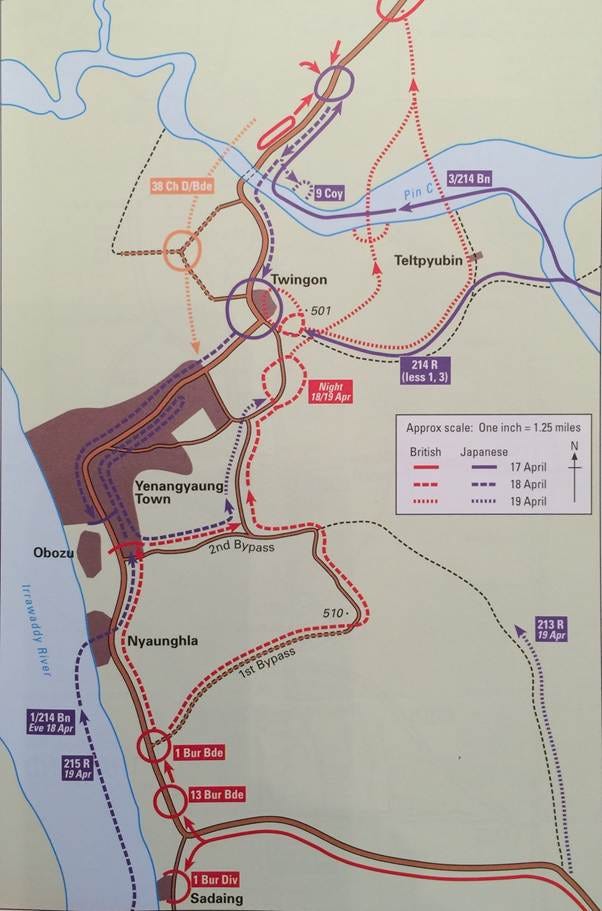
The fabulous map of Yenangyaung produced by the late Ian Lyall Grant.
The scrap at Yenangyaung was the final Corps-sized battle before the order to evacuate Burma Corps was given in early May. The Japanese had pushed out of Rangoon in mid-March, driving up the Irrawaddy on the left and against Toungoo on the right. Allied plans for the defence of Burma were inadequate, both Chinese (on the right) and Slim’s Burcorps (on the left) effectively fighting separate battles. Attempts by General Harold Alexander, the Army Commander, to control the battle and constrain the advancing Japanese ultimately came to naught. Alexander, Slim and Lieutenant General Joe Stilwell, nominally commanding the Chinese 5th Army, tried every trick in the tactical rule book to bring a halt to the relentless Japanese advance, and to destroy them in battle. After a month of fighting in which the Chinese were pushed out of Toungoo, the British lost control of Prome and an attempt to consolidate a defensive line across the country failed, the Japanese moved up the Irrawaddy in an attempt to turn the British flank, breaking in at the oilfield town of Yenangyaung on 17 April. At the time Slim’s Burma Corps was attempting to withdraw to the north from Allamyo. The Japanese infiltration into Yenangyaung cut the British in half. The 1st Burma Division was now cut off in Yenangyaung. The battle by the already weakened division (amounting to probably no more than 4,000 troops) into the Yenangyaung pocket over the period 17 and 19 April proved to be the severest trial yet faced by British troops in the short Burma campaign, the pressure applied by the Japanese exacerbated by the intense heat and the lack of water.
It was critical that Slim defeated this Japanese infiltration, rescue the 1st Burma Division from encirclement and retain the integrity of his Corps. If Yenangyaung were lost the Japanese would be free to sweep north to threaten Mandalay. It was crucial therefore that the divisional commander – Major General Bruce Scott – held on for as long as he could. But Slim had no reserve. The only hope of relief lay in assistance from the Chinese far to his right. He concluded that if he could engineer a attack into the pocket by the Chinese, across the Pin Chaung, combined with a breakout attack by 1st Burma Division, they might have a chance of escape. Nothing else looked likely to succeed.
When asked, Stilwell agreed to Alexander’s request for help to be provided to Slim, and gave him Lieutenant General Sun Lijen’s 38th Division – responsible for the defence of Mandalay – for the task. Chiang Kai-shek had given Sun responsibility for defending Mandalay. At midnight on 16 April Sun received an order from General Lo Cho-yin, “to dispatch his 113th Regiment to Kyaukpadaung, there to be commanded by the British General Slim …” Sun’s friend, Dr Ho Yungchi, recorded that by 3 a.m. he had arrived at Lo’s HQ at Pyawbe to discuss the order. Lo explained that the British were in serious trouble “in the oil town of Yenangyaung and had sent repeated requests for help”. By 6.30 a.m. it was agreed that Sun would personally take command of the 113th Regiment, while the two remaining regiments stayed to defend Mandalay. Sun and 1,121 men of 113th Regiment (commanded by Colonel Liu Fang-wu) arrived at Kyaukpadaung on the morning of 17 April.
Slim recalled: “The situation was not encouraging, and I was greatly relieved to hear that 113 Regiment of the Chinese 38th Division was just arriving at Kyaukpadaung. I dashed off in my jeep to meet their commander and give him his orders … this was the first time I had had Chinese troops under me … I got to like all, or almost all, my Chinese very much. They are a likeable people and as soldiers they have in a high degree the fighting man’s basic qualities – courage, endurance, cheerfulness, and an eye for country.”1
At Yenangyaung, Slim’s plan was for Sun’s 38th Division to attack from the north on the morning of 18th April while the 1st Burma Division, within the pocket, fought its way out. As Slim and Sun Lijen talked, discussing the details of the attack planned for the following morning Slim decided that he would place the Stuart tanks of the 7th Armoured Brigade directly under Sun’s command. It was only a move a man confident in the capabilities of his allies could make. Slim commented that “I was impressed by Sun and it was essential to gain his confidence. His division had no artillery or tanks of its own, and I was therefore arranging that all the artillery we had this side of the Pin Chaung and all available tanks should support his attack.” The commander of the British armoured brigade – Brigadier John Anstice – accepted this arrangement and according to Slim “he and Sun got on famously together”. What’s more, the soldiers worked well together too, Slim recording that the “gunners and tank crews, as is the way of British soldiers, soon got on good terms with their new comrades, and, in spite of language difficulties of an extreme kind, co-operation was, I was assured by both sides, not only close but mostly friendly.”2 Accordingly, at 6.15 a.m. on 18 April, Major Mark Rudkin of 2nd Royal Tank Regiment (2RTR) reported as instructed by Anstice to 38th Division HQ:
There was little activity except for the cooking of breakfast and it seemed most unlikely that the attack could start on time. I asked the British liaison officer with the Chinese what was happening and he informed me that as the Chinese realized that they would not be ready to attack at 0630 hours, they had put their watches back one hour, so that officially they were still attacking at 0630 though the time would in reality be 0730. They had, therefore, not lost “face” by being late.
The plan was that a troop of tanks would follow the leading troops of the leading Chinese battalion and give what support it could. Another troop was to follow the leading infantry battalion and assist the leading troop if required. The tanks would be almost entirely road bound owing to the going off the road.
At 0730 the assaulting Chinese moved forward off the ridge on a front of about four hundred yards, the leading troop keeping very close behind on the road. On foot near the tanks was a Chinese interpreter who carried out liaison between the tanks and infantry.
After advancing about half a mile the leading tank was hit by a Japanese 75-mm gun situated on the road just north of the Pin Chaung which was firing straight up 300 yards of road. The tank was disabled but there were no casualties.
The Chinese advance continued and by afternoon had almost reached the line of the ford on the Pin Chaung which was still held by the enemy. The Chinese had had heavy casualties, especially amongst officers, as it was the custom for Chinese officers to lead, whatever their rank. It was finally decided to hold positions about half a mile north of the crossing and continue the attack next day.3
With the first attack a failure, the Japanese retained their grip on both the ford and the village of Twingon. The situation for the surrounded remnants of the 1st Burma Division was desperate; the Japanese close to achieving a complete victory. Slim and Sun then worked through a plan for another attempt to be made the following morning, 19th April. This day also began badly, however. The Chinese attack was scheduled to begin at 7 a.m. British accounts subsequently recorded that a Chinese attack did not materialise at this time. Slim subsequently recorded in Defeat into Victory that the failure to attack must have been a function of the administrative difficulties faced by the Chinese. He wrote that with the Chinese “lack of signalling equipment, of means of evacuating wounded and of replenishing ammunition, and their paucity of trained junior leaders it was not surprising that to sort themselves out, reform, and start a fresh attack took time”.4 Slim was invariably impressed with what he saw of the Chinese soldier in action, but considered their support and command functions to be shockingly poor and a source of constant frustration to themselves, and to all who had occasion to operate with them.
Slim, and most other British published accounts, including the Indian and British Official Histories, record that the attack finally went in at 3 p.m., when Colonel Liu’s 113th Regiment successfully captured the ford and penetrated into Yenangyaung.5 “When the Chinese did attack they went in splendidly” wrote Slim in admiration. “They were thrilled at the tank and artillery support they were getting and showed real dash. They took Twingon, rescuing some two hundred of our prisoners and wounded. Next day, 20th April, the 38th Division attacked again and with tanks penetrated into Yenangyaung itself, repulsing a Japanese counter-attack. The fighting was severe and the Chinese acquitted themselves well, inflicting heavy losses, vouched for by our own officers.”
1. Slim, Defeat into Victory (1956), p. 63.
2. Ibid., p. 65.
3. Bryan Perrett, Tank Tracks to Rangoon: The Story of British Armour in Burma (London: Robert Hale, 1978)
4. Slim, op. cit., p. 70.
5. Bisheshwar Prasad (ed,) The Retreat from Burma 1941 – 42 (Calcutta, Combined Inter-Service Historical Section, 1954), p. 296.
Comments Off on Fighting at Yenangyaung, 17-19 April 1942


