
World War Two
Published 31 May 2025May 10, 1940. A new kind of warfare comes to the fore as a German Panzer Group rumbles through the Ardennes towards Sedan. Heinz Guderian has one goal in mind — Get to the Meuse! If he can manage that, then the Battle of France may be over before it even begins. Can the Allies hold back the armoured armada?
Chapters
01:05 German Forces
04:13 Blitzkrieg Theory, Applied
07:37 The Advance Begins
14:50 The Allied Plan
17:59 A Tight Schedule
20:57 Summary
21:16 Conclusion
(more…)
June 1, 2025
Panzers Attack! – Ten Days in Sedan
Comments Off on Panzers Attack! – Ten Days in Sedan
May 28, 2025
Masters of the Air – The Bomber War Episode 4 – 8th Air Force 1942-1943
HardThrasher
Published 6 Jan 2024If you’d like to be a cool kid, then become a Patreon or if you’d like to email me send a message to lordhardthrasher@gmail.com
0:00 Intro
4:30 We’re Going to North Africa 1st
8:36 But you’re not doing it properly
16:16 Play it Again Ira
22:30 Mid 1943 – The Crisis Begins
26:53 The Black Summer
28:03 Operation Tidal Wave
34:21 Into The Valley of Death – Schweinfurt
41:34 What Now?
48:37 Survivors Club
(more…)
Comments Off on Masters of the Air – The Bomber War Episode 4 – 8th Air Force 1942-1943
May 25, 2025
BD-44: The New Semiauto Sturmgewehr from D-K Productions
Forgotten Weapons
Published 13 Jan 2025D-K Productions is a collaboration between the German company Sport System Dittrich (SSD) and an American partner. SSD has been making reproductions of German World War Two small arms for something like 20 years — including Sturmgewehrs. Their guns are really good recreations of the 1940s originals, but there have long been issues importing them into the US. This was solved at last by forming a US company and doing the receiver manufacturing here in the States. While the company has plans to offer a whole bunch of different models, the one currently available is the BD-44, a copy of the standard production model of MP-44/StG-44.
I was really impressed by the use of not-finish-machined forgings for parts like the stacking rod and gas block, correctly duplicating the original German production. The stampings look good, and the handling matches the original guns (don’t expect it to be AR-level ergonomic!). The gut “feel” of the gun is an excellent match for an original MP-44. The 8×33 chambering and use of original magazines (alongside new-production magazines made by D-K) is the correct choice, of course.
I did not like the mismatch between the magazine well and magazine stops, and I did have a couple malfunctions in the two magazines I ran through it so far. Note that the gun I have at the range is my second one; the first one (which is what you see on the table) had consistent feed problems and D-K replaced it when I sent it back to them.
Whether the gun is worth the steep asking price is a personal decision, naturally. Hopefully this video gives you the information necessary to make your decision if you were considering getting one!
(more…)
Comments Off on BD-44: The New Semiauto Sturmgewehr from D-K Productions
May 23, 2025
Yasukuni-jinja, Japan’s most controversial historical site
Nigel Biggar on the Yasukuni-jinja in the Imperial Gardens in Toyko, where the Japanese shrine to their war dead also celebrates fourteen convicted WW2 war criminals:

The Yasukuni Shrine in the Imperial Gardens, Tokyo.
Photo by Pierre Hazan
If ever you find yourself in the centre of Tokyo, make your way to the north-west corner of the Imperial Gardens, and turn left. A few minutes will bring you to the Yasukuni-jinja, Japan’s most controversial site. This is the national shrine to the war-dead, whose two and half million resident “glorious souls” include fourteen Class A war criminals.
A hundred yards to the right of the main shrine stands a museum, the Yushukan. Upon entering it, a visitor finds himself immediately face to face with a locomotive.
Now, when an Anglo-Saxon puts together Japan, Second World War, and locomotive, he arrives at one thing only: the “Burma Railway”. This is the railway that was hacked through the Burmese jungle partly by Allied prisoners-of-war, who were treated as slave labour and perished in their thousands. Over 12,000 Westerners died — about one in five — alongside perhaps 90,000 Asians.
So our Anglo-Saxon visitor beholds the locomotive with a mixture of disbelief, rising horror, and curiosity. He approaches the machine, looking for an explanatory text. Finding it, he learns that this locomotive is one of ninety that ran along the Burma Railway. He also learns the name of the military unit responsible for the railway’s construction. But of the Allied prisoners, the slave-labour, and the number of their deaths he learns nothing at all.
The Burma Railway wasn’t Auschwitz, either in genocidal intent or in murderous scale. But it was similar in its cruel contempt for human life. So the experience of confronting this Tokyo locomotive is analogous to stepping into a museum in Berlin and being confronted by one of the trains that shipped Jews to Auschwitz, and then reading an explanation that omits any mention of its cargo or the nature of its destination. If there were such a museum in Berlin, I’d have found it.
When our Anglo-Saxon ventures deeper into the Yushukan, he eventually discovers the exhibition on the 1930s and World War Two in the Far East. And here he learns that Japan’s imperial expansion was in fact a war of liberation, waged on behalf of subjugated Asian peoples, against Western colonial domination. And he learns that, even though Japan lost the war militarily, she won it politically, since the example of her early victories over the French in Vietnam, the Americans at Pearl Harbor, and the British at Singapore helped to inspire anti-colonial movements worldwide and so succeeded in ridding the world of European empires.
He also learns that what is known outside Japan as “the Rape of Nanking” (1937-8) is referred to demurely in the museum as “the Chinese incident”. And that whereas the “Rape of Nanking” is reckoned to have involved the indiscriminate massacre by Japanese troops of about 300,000 Chinese civilians, “the Chinese incident” only involved the severe treatment of Chinese troops who had violated the laws of war by disguising themselves in civilian clothes.
Comments Off on Yasukuni-jinja, Japan’s most controversial historical site
May 21, 2025
The Butt Report – Nadir of the RAF – The Bomber War Episode 3
HardThrasher
Published 15 Dec 2023As the powers that be on YT have decided that this video is Evil and naughty they’ve removed the ads — which, like, is great from your point of view but a bit shite from mine. So if you wanted to it’d be awesome if you’d consider either hitting the Super Thanks button or consider becoming a super cool kid and joining my Pateron.
If you’d like to email me send a message to lordhardthrasher@gmail.com
In this episode, the Butt Report, what happened next and the arrival of Bomber Harris. Despite this being more than 50 minutes, I’ve skipped some detail e.g. The Singleton Report which basically said “eh – bit difficult this bombing thing” nor Tizard’s rubbishing of Cherwell’s Memorandum, nor really the detail of the Cherwell Memorandum. You’ll live. However if you want more on the subject then I recommend the Official History of Bomber Command to get more into the civil service fire fights.
(more…)
Comments Off on The Butt Report – Nadir of the RAF – The Bomber War Episode 3
May 20, 2025
The Battle of Aquino
Canadian Tank Museum
Published 13 Jan 2025You may know about AQUINO Tank Weekend at our Museum, but what was the Battle of Aquino? When did it take place? What happened to the Ontario Regiment RCAC during that action?
Enjoy this short documentary with our Curator Sam Richardson as he gives you a detailed look at the situation in May 1944 during the Italian campaign of the Second World War. Learn more about the soldiers that took part, the battle that took place and why it remains important to our Regiment and our Museum.
(more…)
Comments Off on The Battle of Aquino
May 18, 2025
Why it Sucked to be an Italian Prisoner in North Africa – WW2 Fireside Chat
World War Two
Published 17 May 2025Today, Indy and Sparty tackle some questions on the North African theatre. Why did the Italians think invading was a good idea in the first place? Was Allied treatment of Axis POWs a war crime? How did Italian and Allied tanks stack up?
(more…)
Comments Off on Why it Sucked to be an Italian Prisoner in North Africa – WW2 Fireside Chat
May 17, 2025
Battle of the Atlantic, 1939-1940
Real Time History
Published 3 Jan 2025In the summer of 1940, Great Britain is under attack in the air and at sea. German U-Boat wolf packs prowl the Atlantic and sink over a million tons of shipping. German skippers call this the “happy time” — but was the German Navy actually that successful early in the Battle of the Atlantic?
(more…)
Comments Off on Battle of the Atlantic, 1939-1940
May 14, 2025
The Bomber Mafia & The Norden Bombsight – What The Heck Happened? The Bomber War Episode 2
HardThrasher
Published 28 Oct 2023Selected Internet Sources
Target for Today (1944) – Target For Today (1944)
https://www.navsea.navy.mil/Home/Warf… – LTE Thompson, first lead scientist at Dahlgren
https://www.amazon.co.uk/Scientist-Ex… – Donald Jacobs
The Fairey Battle – Light Bomber, Hea…
https://en.m.wikipedia.org/wiki/Point…
https://en.m.wikipedia.org/wiki/Butt_…
https://en.m.wikipedia.org/wiki/Area_…
https://en.m.wikipedia.org/wiki/Casab…
https://discovery.nationalarchives.go… – Western War Plan W5a and W6Selected Bibliography
America’s Pursuit of Precision Bombing 1910-1945 – McFarland et al.
Dresden – Sinclair McKay
Dresden; Tuesday … – Fredrick Taylor
Absolute War – The Firebombing of Tokyo – Chris Bellamy
Black Snow –
Bomber Command – Max Hastings
Bomber Command’s War Against Germany, An Official History – Nobel Franklin et al.
The Bomber Mafia – Malcolm Gladwell
Undaunted and Through Adversity (Vol 1 &2) – Ben Kite
United States Strategic Bombing Survey (European War) (USSBS) Sept 1945 – Var. – https://collections.nlm.nih.gov/catal…
America’s Pursuit of Precision Bombing 1910-1945, McFarland
Big Week – James Holland
Comments Off on The Bomber Mafia & The Norden Bombsight – What The Heck Happened? The Bomber War Episode 2
May 12, 2025
(A Few of) The Many Faces of the Dutch M95 Carbine
Forgotten Weapons
Published 16 Jun 2015When the Dutch military adopted the M95 Mannlicher rifle, they made a rifle for standard infantry, and a variety of carbines for specialist troops. These included artillery, cavalry, bicycle, engineers, and colonial service carbines. During World War I they attempted to standardize these and reduce the number of different designs, but met with only limited success. By the time World War II began, there were at least 13 different variants of M95 carbine in service with the Dutch military.
Comments Off on (A Few of) The Many Faces of the Dutch M95 Carbine
May 11, 2025
Why Yugoslavia Fell in Just 11 Days?
World War Two
Published 10 May 2025In this Fireside Chat, Indy and Sparty answer questions on the German invasions of Yugoslavia and Greece. Why did the Yugoslav state fall so quickly? Why were the Greeks able to hold out so much better? And why was the airborne assault on Crete so chaotic on both sides?
(more…)
Comments Off on Why Yugoslavia Fell in Just 11 Days?
May 8, 2025
Dambusters – Was It Worth It?
HardThrasher
Published 5 May 2025The third and final part in a series on the Dambusters Raid; looking at the attacks themselves and their aftermath
(more…)
Comments Off on Dambusters – Was It Worth It?
May 7, 2025
Boldly Bombing Bugger All – The Bomber War Episode 1
HardThrasher
Published 13 Oct 2023To see more on the Fairey Battle go here – The Fairey Battle – Light Bomber, Hea… also subscribe to Rex’s channel, he’s ace
Selected Online Resources
https://en.m.wikipedia.org/wiki/Point…
https://en.m.wikipedia.org/wiki/Butt_…
https://en.m.wikipedia.org/wiki/Area_…
https://en.m.wikipedia.org/wiki/Casab…
https://discovery.nationalarchives.go… – Western War Plan W5a and W6Selected Bibliography
America’s Pursuit of Precision Bombing 1910-1945 – McFarland et al.
Dresden – Sinclair McKay
Dresden; Tuesday … – Fredrick Taylor
Absolute War – The Firebombing of Tokyo – Chris Bellamy
Black Snow –
Bomber Command – Max Hastings
Bomber Command’s War Against Germany, An Official History – Nobel Franklin et al.
The Bomber Mafia – Malcolm Gladwell
Undaunted and Through Adversity (Vol 1 &2) – Ben Kite
United States Strategic Bombing Survey (European War) (USSBS) Sept 1945 – Var. – https://collections.nlm.nih.gov/catal…
America’s Pursuit of Precision Bombing 1910-1945, McFarland
Big Week – James Holland
Comments Off on Boldly Bombing Bugger All – The Bomber War Episode 1
May 5, 2025
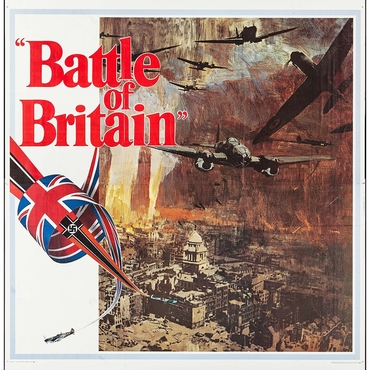
Remembering The Battle of Britain (1969)
At SteynOnline, Rick McGinnis discusses the 1969 film The Battle of Britain, which was considered a financial flop at the time it was released and only turned a profit once home VCR sales provided a new revenue stream — it was how I first watched the movie, although I do remember seeing posters for it at the cinema while it was in theatrical release.
The best recent depictions of the war – my subjective list includes Band of Brothers, The Pacific, Saving Private Ryan, Dunkirk, Das Boot, Greyhound and Letters from Iwo Jima – were mostly made with veterans advising on historical accuracy and mostly being heard. This wasn’t always the case: for at least two decades following the war, when veterans were still thick on the ground, historical accuracy was frequently sacrificed in the interest of adventure, drama, comedy or romance.
(My subjective list includes Kelly’s Heroes, The Dirty Dozen, The Guns of Navarone, D-Day The Sixth of June, Where Eagles Dare, Operation Petticoat, From Here to Eternity and Von Ryan’s Express. Not that these aren’t entertaining, enjoyable films; they just shouldn’t be considered history.)
If there was a turning point – a film that struggled and mostly succeeded in telling a plausibly accurate story about the war to audiences likely to contain not just veterans but civilians with lived memories – it was probably Guy Hamilton’s Battle of Britain, released in 1969, barely thirty years after the event it commemorates.
While in pre-production for the film, 007 producer Harry Saltzman and his co-producer (and veteran RAF pilot) Benjamin Fisz realized that their American backers at MGM were nervous about making a film about something Americans knew little about. This led to The Battle for the Battle of Britain, a short TV documentary about the film and the event that it was based on, hosted and narrated by one of the film’s stars, Michael Caine.
Included with the 2005 collector’s edition DVD of Hamilton’s film, The Battle for the Battle of Britain begins with a series of “man on the street” interviews conducted outside the American embassy in London. Older interview subjects talk vaguely about how they’d admired the British for standing alone against Nazi Germany at the time; younger ones almost unanimously admit that they don’t’ know anything about it. One woman states that she doesn’t wish to give an opinion since she works for the embassy. At the time these interviews were made the average age of a British pilot who fought in the battle and survived would have been around fifty, as the vast majority of the young men who flew to defend England in the summer of 1940 were on either side or twenty.
Making Battle of Britain felt like a duty in 1969; it attracted a cast of big stars who were willing to work for scale just to be involved, but that didn’t stop the film from going massively over schedule and over budget. Historical accuracy was so important that Saltzman and Lisz ended up collecting what became the world’s 35th largest air force, rebuilding wrecked airframes and making planes that had sat on concrete plinths outside museums and airfields flyable again.
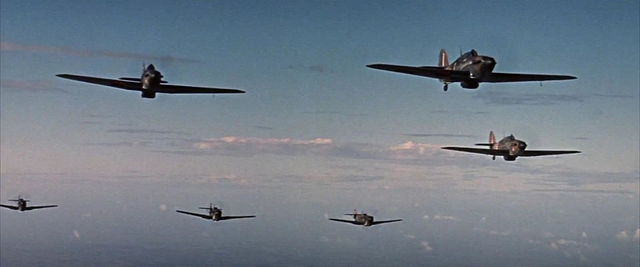
Still from The Battle of Britain
The film begins with the fall of France in the spring of 1940, and British pilots and air crew struggling to get back in the air ahead of the rapidly approaching German army. We meet the three RAF squadron leaders who will be at the centre of the action: Caine’s Canfield, Robert Shaw as the curt, intense “Skipper”, and Colin Harvey (Christopher Plummer), a Canadian married to Maggie (Susannah York), an officer in the Women’s Auxiliary Air Force.
Back across the channel we meet Sir Laurence Olivier as Air Chief Marshal Sir Hugh Dowding, the head of Fighter Command and the man who will lead the English in the air battle to come. Blunt and charmless, Dowding had the unenviable task of telling Sir Winston Churchill, only just appointed Prime Minister, that he doesn’t support his promise to send more fighter squadrons across the Channel to aid the French as they would be squandered in a lost cause and, in any case, he needs every plane and pilot he has to fight the German invasion that’s doubtless coming.
Comments Off on Remembering The Battle of Britain (1969)
QotD: English intelligentsia and the Soviet Union
It is important to realize that the current Russomania is only a symptom of the general weakening of the Western liberal tradition. Had the M.O.I. chipped in and definitely vetoed the publication of this book, the bulk of the English intelligentsia would have seen nothing disquieting in this. Uncritical loyalty to the U.S.S.R. happens to be the current orthodoxy, and where the supposed interests of the U.S.S.R. are involved they are willing to tolerate not only censorship but the deliberate falsification of history. To name one instance. At the death of John Reed, the author of Ten Days that Shook the World — a first‐hand account of the early days of the Russian Revolution — the copyright of the book passed into the hands of the British Communist party, to whom I believe Reed had bequeathed it. Some years later, the British Communists, having destroyed the original edition of the book as completely as they could, issued a garbled version from which they had eliminated mentions of Trotsky and also omitted the introduction written by Lenin. If a radical intelligentsia had still existed in Britain, this act of forgery would have been exposed and denounced in every literary paper in the country. As it was, there was little or no protest. To many English intellectuals it teemed quite a natural thing to do. And this tolerance of plain dishonesty means much more than that admiration for Russia happens to be fashionable at this moment. Quite possibly that particular fashion will not last. For all I know, by the time this book is published my view of the Soviet regime may be the generally-accepted one. But what use would that be in itself? To exchange one orthodoxy for another is not necessarily an advance. The enemy is the gramophone mind, whether or not one agrees with the record that is being played at the moment.
I am well acquainted with all the arguments against freedom of thought and speech — the arguments which claim that it cannot exist, and the arguments which claim that it ought not to. I answer simply that they don’t convince me and that our civilization over a period of 400 years has been founded on the opposite notice. For quite a decade past I have believed that the existing Russian regime is a mainly evil thing, and I claim the right to say so, in spite of the fact that we are allies with the U.S.S.R. in a war which I want to see won. If I had to choose a text to justify myself, I should choose the line from Milton:
“By the known rules of ancient liberty.”The word ancient emphasizes the fact that intellectual freedom is a deep‐rooted tradition without which our characteristic Western culture could only doubtfully exist. From that tradition many of our intellectuals are visibly turning away. They have accepted the principle that a book should be published or suppressed, praised or damned, not on its merits but according to political expediency.
And others who do not actually hold this view assent to it from sheer cowardice. An example of this is the failure of the numerous and vocal English pacifists to raise their voices against the prevalent worship of Russian militarism. According to these pacifists, all violence is evil, and they have urged us at every stage of the war to give in or at least to make a compromise peace. But how many of them have ever suggested that war is also evil when it is waged by the Red Army? Apparently the Russians have a right to defend themselves, whereas for us to do so is a deadly sin. One can explain this contradiction in only one way — that is, by a cowardly desire to keep in with the bulk of the intelligentsia, whose patriotism is directed toward the U.S.S.R. rather than toward Britain.
I know that the English intelligentsia have plenty of reason for their timidity and dishonesty; indeed, I know by heart the arguments by which they justify themselves. But at least let us have no more nonsense about defending liberty against fascism. If liberty means anything at all, it means the right to tell people what they do not want to hear. The common people still vaguely subscribe to that doctrine and act on it. In our country — it is not the same in all countries: it was not so in Republican France, and it is not so in the United States today — it is the liberals who fear liberty and the intellectuals who want to do dirt on the intellect: it is to draw attention to that fact I have written this preface.
George Orwell “The Freedom of the Press”, 1945 (written as the preface to Animal Farm, but not published in Orwell’s lifetime).
Comments Off on QotD: English intelligentsia and the Soviet Union


