Quotulatiousness

November 29, 2023

Grover Cleveland – more “republican” than any Republican alive today

Filed under: Economics, Government, History, Politics, USA — Tags: , , — Nicholas @ 03:00

Not having studied American history in school, I don’t know a lot about most American presidents, especially those of the 19th century whose names aren’t Jefferson, Jackson, or Lincoln. One of the presidents I only knew about because his name turned up in a lot of original Trivial Pursuit questions was Grover Cleveland, the only man (so far) who has ever been elected to non-consecutive terms:
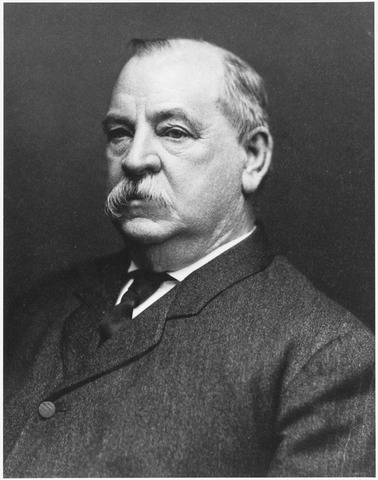
Grover Cleveland (1837-1908), President of the United States, 1885-89 and 1893-97.
Photo from the National Archives and Records Administration (NAID 518139) via Wikimedia Commons.

Cleveland won the White House in 1884 on a platform of restraining federal spending and corruption. Running for re-election in 1888, he won the popular vote but lost to Republican Benjamin Harrison in the Electoral College. A major reason he came out of retirement to run again in 1892 was the reckless spending of the Harrison administration. He beat Harrison that year and became the only man ever elected to non-consecutive terms (1885-89 and 1893-97).

I call to the reader’s attention an article ex-President Cleveland wrote three years after the end of his second term, in June 1901. Titled “The Waste of Public Money”, it was one of half a dozen he penned for The Saturday Evening Post. In this one, he referred to “a malign condition which threatens us,” an “evil” that he saw as “calamitous and destructive to our national character and integrity”.

In 1901, the federal government spent half a billion dollars over the whole year, roughly equivalent in real terms to around $12 billion today. Washington spends that much now in about half a day. Lest you think the feds were misers in 1901, ponder what Cleveland had to say in his article that year:

    Probably no one will have the hardihood to deny that the cost of our Government is excessive and wasteful, and that for this condition the heedless neglect and indifference of our people are in some degree responsible … If the aggregate mass of our people are at all blameworthy on account of the present advanced stage of public prodigality, it is largely because they overlooked and tolerated its small beginnings, when at all times they should have been vigilant and uncompromising. A self-ruling people … should constantly remember that nothing multiplies itself more abundantly than national extravagance, and that neither an individual nor a popular government can easily correct or check habits of waste.

The former president did not for a moment believe that only the politicians were to blame for excessive spending. He boldly asserted that many Americans embraced it. They were effectively bought and paid for, guilty of “accepting the bribes of selfish and personal advantage which public waste and extravagance offer”.

Cleveland was often warned by advisers to moderate his stances to avoid controversy. Biographer H. Paul Jeffers quotes him as responding once to such advice by asking, “What is the use of being elected or re-elected unless you stand for something?” When he vetoed a bill to relieve drought-stricken farmers with federal money, he made it plain that “though the people support the government, the government should not support the people”. He saw his job as upholding the Constitution and keeping the federal government in its proper place, not weakening “the bonds of common brotherhood” by robbing Peter to pay Paul.

This was a man who said what he meant and meant what he said, come Hell or high water. He spoke with a clarity of principle that makes a nation great, and the absence of which makes a great nation fail. He understood that no society in history that allowed itself to be bribed by its politicians ever survived such legal larceny.

In the final paragraphs of his June 1901 Saturday Evening Post article, Cleveland admonished his fellow Americans. With these words, he urged them to muster the character to resist being bribed with their own money:

    The lessons of extravagance and paternalism must be unlearned; economy and frugality must be reinstated; and the people must exact from their representatives a watchful care for the general welfare and a stern resistance to the demands of selfish interests, if our Government is to be an enduring and beneficent protection to a patriotic and virtuous people.

Many Americans today would undoubtedly dismiss Cleveland’s warnings as “quaint” and “old-fashioned”. They want the government to give them stuff and they don’t think much about who will pay for it. They think even less about how it corrupts the national character.


November 28, 2023

Geert Wilders

Filed under: Europe, Liberty, Media, Politics, USA — Tags: , , — Nicholas @ 03:00

Mark Steyn on the suddenly fascinating-to-American-media Dutch politician Geert Wilders, with whom he has had a long association:

Geert Wilders, leader of the Dutch Party for Freedom (PVV).
Photo by Wouter Engler via Wikimedia Commons.

Times are bad, and the respectable chaps are explicit about their eagerness to make them more so — more mass immigration, more green bollocks, more “digital identity”, more “variants” and more “public health”, more mutilation and sterilisation of your middle-schoolers …

This last week I’ve received a bazillion queries demanding to know what I make of Geert Wilders. It’s true that a lot of commentary on his victory is close to witless: in America, he is apparently “the Dutch Trump” — because they’re both, er, blond. As David Reaboi pointed out on Twitter, Wilders has been a thorn in the side of the Dutch state since the days when “Trump was donating to Democrats”. In 2005, when The Donald was still sufficiently “respectable” that Hillary Clinton attended his wedding, Wilders had already been expelled from his party for objecting to Turkish membership of the European Union.

So he’s been at this a long time – and yours truly goes back a long way with him. He did me the great honour of inviting me to write the introduction to his book, Marked for Death, which is a cracking read — not just my bit, but his parts too: Geert writes way better in English than most anglo politicians do. (We have a few copies at the SteynOnline bookstore, and I’ll even sign it for you: the perfect Christmas gift for the “far right” members of your family.)

But here’s the most relevant aspect of how Wilders was ahead of the game. I try not to let my own twelve years in the dank septic tank of Washington pseudo-justice get to me, but, as you know, for me the only salient point about this US election season is that the multitudes of prosecutors and judges of the American state are willing to torture the plain meaning of the nation’s laws in order to get Trump convicted of … something, anything, as long as it gets him banged up in gaol for the rest of his days.

This is the central fact of our increasingly post-democratic age: the criminalisation of political opposition. If you’re in European-style multi-party systems, they’ll deny you bank accounts and seize your kids’ iPads, and if necessary find twenty coppers to jump you in the street. But, if you’re in America’s bloody awful frozen two-party system, the leader of Party A will unleash the resources of the world’s most lavishly funded Deep State on the leader of Party B and persuade anyone around him to cop a plea on crimes they didn’t commit — mainly because those crimes don’t actually exist.

In that sense, rather than Geert being the Dutch Trump, Trump is the American Geert. Until Biden came along, no other settled western democracy had been as zealous as the Netherlands in prosecuting opposition politicians for their policy platforms.

November 27, 2023

The slackening pace of technological innovation

Filed under: Business, Economics, Media, Technology, USA — Tags: , , , , — Nicholas @ 04:00

Freddie deBoer thinks we’re living off the diminishing fumes of a much more innovative and dynamic era:

I gave a talk to a class at Northeastern University earlier this month, concerning technology, journalism, and the cultural professions. The students were bright and inquisitive, though they also reflected the current dynamic in higher ed overall – three quarters of the students who showed up were women, and the men who were there almost all sat moodily in the back and didn’t engage at all while their female peers took notes and asked questions. I know there’s a lot of criticism of the “crisis for boys” narrative, but it’s often hard not to believe in it.

At one point, I was giving my little spiel about how we’re actually living in a period of serious technological stagnation – that despite our vague assumption that we’re entitled to constant remarkable scientific progress, humanity has been living with real and valuable but decidedly small-scale technological growth for the past 50 or 60 or 70 years, after a hundred or so years of incredible growth from 1860ish to 1960ish, give or take a decade or two on either side. You’ve heard this from me before, and as before I will recommend Robert J. Gordon’s The Rise & Fall of American Growth for an exhaustive academic (and primarily economic) argument to this effect. Gordon persuasively demonstrates that from the mid-19th to mid-20th century, humanity leveraged several unique advancements that had remarkably outsized consequences for how we live and changed our basic existence in a way that never happened before and hasn’t since. Principal among these advances were the process of refining fossil fuels and using them to power all manner of devices and vehicles, the ability to harness electricity and use it to safely provide energy to homes (which practically speaking required the first development), and a revolution in medicine that came from the confluence of long-overdue acceptance of germ theory and basic hygienic principles, the discovery and refinement of antibiotics, and the modernization of vaccines.

Of course definitional issues are paramount here, and we can always debate what constitutes major or revolutionary change. Certainly the improvements in medical care in the past half-century feel very important to me as someone living now, and one saved life has immensely emotional and practical importance for many people. What’s more, advances in communication sciences and computer technology genuinely have been revolutionary; going from the Apple II to the iPhone in 30 years is remarkable. The complication that Gordon and other internet-skeptical researchers like Ha-Joon Chang have introduced is to question just how meaningful those digital technologies have been for a) economic growth and b) the daily experience of human life. It can be hard for people who stare at their phones all day to consider the possibility that digital technology just isn’t that important. But ask yourself: if you were forced to live either without your iPhone or without indoor plumbing, could you really choose the latter? I think a few weeks of pooping in the backyard and having no running water to wash your hands or take a shower would probably change your tune. And as impressive as some new development in medicine has been, there’s no question that in simple terms of reducing preventable deaths, the advances seen from 1900 to 1950 dwarf those seen since. To a remarkable extent, continued improvements in worldwide mortality in the past 75 years have been a matter of spreading existing treatments and practices to the developing world, rather than the result of new science.

ANYWAY. You’re probably bored of this line from me by now. But I was talking about this to these college kids, none of whom were alive in a world without widespread internet usage. We were talking about how companies market the future, particularly to people of their age group. I was making fun of the new iPhone and Apple’s marketing fixation on the fact that it’s TITANIUM. A few of the students pushed back; their old iPhones kept developing cracks in their casings, which TITANIUM would presumably fix. And, you know, if it works, that’s progress. (Only time and wear and tear will tell; the number of top-of-the-line phones I’ve gone through with fragile power ports leaves me rather cynical about such things.) Still, I tried to get the students to put that in context with the sense of promise and excitement of the recent past. I’m of a generation that was able to access the primitive internet in childhood but otherwise experienced the transition from the pre-internet world to now. I suspect this is all rather underwhelming for us. When you got your first smartphone, and you thought about what the future would hold, were your first thoughts about more durable casing? I doubt it. I know mine weren’t.

Why is Apple going so hard on TITANIUM? Well, where else does smartphone development have to go? In the early days there was this boundless optimism about what these things might someday do. The cameras, obviously, were a big point of emphasis, and they have developed to a remarkable degree, with even midrange phones now featuring very high-resolution sensors, often with multiple lenses. The addition of the ability to take video that was anything like high-quality, which became widespread a couple years into the smartphone era, was a big advantage. (There’s also all manner of “smart” filtering and adjustments now, which are of more subjective value.) The question is, who in 2023 ever says to themselves “smartphone cameras just aren’t good enough”? I’m sure the cameras will continue to get refined, forever. And maybe that marginal value will mean something, anything at all, in five or ten or twenty years. Maybe it won’t. But no one even pretends that it’s going to be a really big deal. Screens are going to get even more high-resolution, I guess, but again – is there a single person in the world who buys the latest flagship Samsung or iPhone and says, “Christ, I need a higher resolution screen”? They’ll get a little brighter. They’ll get a little more vivid. But so what? So what. Phones have gotten smaller and they’ve gotten bigger. Some gimmicks like built-in projectors were attempted and failed. Some advances like wireless charging have become mainstays. And the value of some things, like foldable screens, remains to be seen. But even the biggest partisans for that technology won’t try to convince you that it’s life-altering.

November 26, 2023

General Patton’s Metz Obsession – WW2 – Week 274 – November 25, 1944

World War Two
Published 25 Nov 2023

Metz finally falls to Patton’s 3rd Army, but boy, it’s taken some time. To the south, the Allies also take Belfort and Strasbourg, and to the north Operation Queen continues trying to reach the Roer River. The Soviets complete their conquest of the islands in the Gulf of Riga and continue advancing in Hungary to the south, but it’s the Axis Powers — the Japanese — who are advancing in China, taking Dushan and Nanning.

01:15 Operation Queen Continues
04:49 9th Army attacks toward the Roer
05:54 Pattons 3rd Army takes Metz
09:22 Allies take Belfort, Mulhouse, and Strasbourg
13:56 8th Army Attacks in Italy
15:42 Soviet advances and German indecision
18:05 Japanese take Dushan and Nanning
19:21 The fight for Peleliu ends
21:43 Notes from all over
22:23 Conclusion
(more…)

QotD: From Industrial Revolution labour surplus to modern era academic surplus

Back in Early Modern England, enclosure led to a massive over-supply of labor. The urge to explore and colonize was driven, to an unknowable but certainly large extent, by the effort to find something for all those excess people to DO. The fact that they’d take on the brutal terms of indenture in the New World tells you all you need to know about how bad that labor over-supply made life back home. The same with “industrial innovation”. The first Industrial Revolution never lacked for workers, and indeed, Marxism appealed back in its day because the so-called “Iron Law of Wages” seemed to apply — given that there were always more workers than jobs …

The great thing about industrial work, though, is that you don’t have to be particularly bright to do it. There’s always going to be a fraction of the population that fails the IQ test, no matter how low you set the bar, but in the early Industrial Revolution that bar was pretty low indeed. So much so, in fact, that pretty soon places like America were experiencing drastic labor shortages, and there’s your history of 19th century immigration. The problem, though, isn’t the low IQ guys. It’s the high-IQ guys whose high IQs don’t line up with remunerative skills.

My academic colleagues were a great example, which is why they were all Marxists. I make fun of their stupidity all the time, but the truth is, they’re most of them bright enough, IQ-wise. Not geniuses by any means, but let’s say 120 IQ on average. Alas, as we all know, 120-with-verbal-dexterity is a very different thing from 120-and-good-with-a-slide-rule. Academics are the former, and any society that wants to remain stable HAS to find something for those people to do. Trust me on this: You do not want to be the obviously smartest guy in the room when everyone else in the room is, say, a plumber. This is no knock on plumbers, who by and large are cool guys, but it IS a knock on the high-IQ guy’s ego. Yeah, maybe I can write you a mean sonnet, or a nifty essay on the problems of labor over-supply in 16th century England, but those guys build stuff. And they get paid.

Those guys — the non-STEM smart guys — used to go into academia, and that used to be enough. Alas, soon enough we had an oversupply of them, too, which is why academia soon became the academic-industrial complex. 90% of what goes on at a modern university is just make-work. It’s either bullshit nobody needs, like “education” majors, or it’s basically just degrees in “activism”. It’s like Say’s Law for retards — supply creates its own demand, in this case subsidized by a trillion-dollar student loan industry. Better, much better, that it should all be plowed under, and the fields salted.

Any society digging itself out of the rubble of the future should always remember: No overproduction of elites!

Severian, “The Academic-Industrial Complex”, Rotten Chestnuts, 2021-05-30.

November 25, 2023

“It’s not called the gender empathy gap for nothing”

Filed under: Cancon, Law, Media, USA — Tags: , , , — Nicholas @ 03:00

Janice Fiamengo on the blatant disregard for violence as long at that violence is not directed at women:

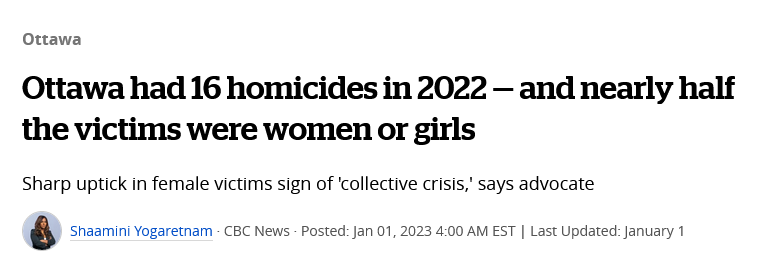
The news headline by the CBC, Canada’s state-funded broadcaster, could hardly have been more blatant: “Ottawa had 16 homicides in 2022—and nearly half of the victims were women or girls“. In other words, more than half of the victims, as is always the case, were boys and men, a state of affairs that no one at the CBC has ever found troubling enough to lament or even notice. Only when the female homicide rate approaches gender parity in one (unusual) year is it a “collective crisis”, as the subheading alleges.

It’s not called the gender empathy gap for nothing.

[Author’s note: Perhaps I should have stopped here. What more is there to say about the extraordinary indifference of most people, men and women, to violence against men and the craven desire to deny female culpability? There’s nothing new in this essay, no new angle or stats, no rousing call to action, nothing beyond the marshalling of dreary evidence and sadly sarcastic observations unlikely to change any mind or cause any gynocentric cheek to blush. I had intended to finish it in time for the International Day for the Elimination of Violence Against Men, on November 18, but was stymied partly by a sense of helpless anger, the weight of which pressed down on every sentence. The section at the end, about the death of Benjamin Rain, was the last straw.]

Feminists have long touted their concern for victims, yet that is never in shorter supply than in their one-sided discussions of violence, in which the only deaths allowed to matter are female deaths, presented for readers’ contemplation with poignant circumstances, names, and expressions of horrified sadness, as in the above-mentioned article. Dead men remain largely anonymous, and few readers could guess from the typical reports of feminist organizations that women are ever lethally violent.

Indifference to male suffering and death are the norm all over the world, of course, but the Anglophone feminist movement has markedly increased it, fudging numbers and manipulating language to focus empathy exclusively on women and girls. The CBC article devotes significant space to discussing the risible concept of femicide, a relatively recent coinage that makes no secret of its female supremacism, purporting to highlight how women and girls are killed “simply for being women” and “primarily by […] men”, as if every woman, even one killed by accident (as we’ll see), is evidence of gender bias.

The idea that women are killed because they are women is preposterous, impossible to support with evidence, and obviously intended to solidify the impression that women outnumber men as victims of murderous violence. An organization called the Canadian Femicide Observatory for Justice and Accountability provides an elaborate taxonomy of forms of femicide to drive the idea home, deliberately blurring the lines between intimate partner homicide, a favored focus, and other killings of women, which are collectively deplored as “brazen acts of hatred“.

Even a cursory reading of the details, however, exposes the vacuousness of the terminology as well as the sleight of hand by which men’s alleged misogyny is misleadingly linked to the totality of the women’s deaths. Only two of Ottawa’s seven murdered women were killed by current or former intimate partners. One of the dead women was attacked and killed by her two adult daughters (an act called “non-intimate femicide”), while another was the victim of a stray bullet that killed her by accident and was probably intended for a man (if you can believe it, the Canadian Femicide Observatory calls this type of death “associated/connected femicide”).

It is impossible to conclude that all or even most of these — certainly unfortunate — deaths can logically be said to have occurred, as the mantra holds, “due to the existence of gender norms and stereotypes, discrimination directed toward women and girls, and unequal power relations across genders“. The determination to find gender discrimination at the root of all female suffering — and thus to justify yet more programs, initiatives, and taxpayer dollars for feminist organizations, as well as more collective shaming of men — seems unstoppable.

QotD: Political language mirrors the ritualized nature of political life

Filed under: Government, Media, Politics, Quotations, USA — Tags: , , , , , — Nicholas @ 01:00

Elected officials speak in a language that’s unique to their status group. If you’ve ever tried to attend a city council or school board meeting, you’ve watched them open with the onanistic portion of the thing, handing out certificates and doing grip-and-grins. “Bob, I just want to echo your wonderful comments about this amazing program.” They see themselves first, then others of their class, then they go blind. The first duty of a public official is to take a lot of selfies.

In a crisis, they recite. We’ve all watched them do this. “This is not who we are.” “Let me be clear: Hate has no home here.” You know what they’re going to say before they say it, and you know the tone before you hear it. The current mayor of Los Angeles is very fond of “our message has been very clear” and “we’re going to link arms and stand together”, so you’re not surprised to hear her respond to a question with something like, “Well, Maria, thank you for that great question. Our message has been very clear: We’re going to link arms and stand together.” Listening to elected officials speak is qualitatively different than listening to people speak. They perform the ritual behaviours of their status group.

[…]

They become debilitated by a lifetime of ritual language. If a staffer hasn’t told them to look somber and say “I’m sorry for your loss”, they don’t know how. It isn’t a line they’ve been equipped with for the event. Hey man your kids burned to death I almost lost my Corvette once, man. All kiddin’ aside, man!

[…]

They aren’t people anymore. They can’t talk like people. They don’t have normal human affect. What’s particularly interesting is that this learned inability to read human cues is recent and narrow. Bill Clinton, as much a politician as anyone who has ever lived, had a well-known ability to see people and signal his empathy, or at least to do a brilliant job of faking it. Similarly, Donald Trump is obviously very very fond of Donald Trump, who is amazing, trust me, everybody says so, but he has a normal human ability to spontaneously bullshit with the normals. Elite disconnection isn’t inevitable.

The broken personal thing behind all the broken institutional things is a loss of basic human connection and behavior. It’s a learned disconnection, and they can’t hide it.

Chris Bray, “The Mask Becomes Your Face”, Tell Me How This Ends, 2023-08-22.

November 24, 2023

It sometimes seems that the only thing that isn’t “violence” these days is actual violence

Filed under: Health, Media, USA — Tags: , , , , , — Nicholas @ 05:00

David Sedaris at The Free Press:

“Gen Z” by EpicTop10.com is licensed under CC BY 2.0

Words, we are now regularly reminded, are violence. So too is silence. I read not long ago that capitalism is violence, as is misgendering someone. Ignoring someone is violence, but so too is paying them attention. A friend recently called on one of her assistants to deliver a statistic during a business meeting and was later charged with “casual violence”. Apparently Deborah needed to give advance warning that she was going to ask a question, one that might possibly put her employee — someone who was well paid to know stuff and be able to spew it forth — on the spot.

Who are these hothouse flowers, all so easily and consistently wounded? People whose parents never hit them, that’s who. People who don’t know what real pain is, but still want to throw the word around. When I was a child, a slap across the face was too minor to qualify as “casual violence”. It was simply what you got for talking back or holding everyone up. It never hurt all that much; what stung was the swiftness of it, the surprise. Who knew my mother could move so fast, like someone belted in the martial arts. I don’t feel like it traumatized me to be knocked around a little. Blood was rarely drawn. No limbs were broken. Could my parents have made their point without resorting to violence? Probably, but it would have taken more time, and with six kids to dress and get out the door that was a precious commodity. I see parents now who worry they’re being abusive if they don’t spend at least an hour putting their child to bed. An hour! I said to my sister, Amy, “Do you remember ever once being tucked in? Can you imagine Mom and Dad reading to us, or singing? Can you imagine them kissing us?”

“Ugh,” she said. “Stop!”

And look at us! We’re fine. We can handle stuff. We never get offended by anything.

Our parents thought we were okay, at best, and I think that really helped us in the long run. Ask someone now if they have kids, and they’re pretty much guaranteed to use the word amazing, as in “I have an amazing six-year-old daughter.”

“Amazing because she just discovered a cure for herpes or because she speaks three words of Spanish,” I always want to ask. “I mean, just how low have you set that bar?”

One of the worst things that’s happened to us as a country is that people are having fewer children — 1.8 as opposed to five 50 years ago. Sure, it’s good for the environment — fewer people means less demand for resources. The problem is that single children receive a freakish amount of love and attention. Most graduate at least twelve times before leaving high school. Their every move is recorded and celebrated, and it gives them an outsize sense of their own importance.

The solution isn’t for every couple to start having five kids again, but maybe for one chosen couple to have five, and the other four couples to go without — either have a full litter you can’t pay that much attention to, or nothing at all.

If our schools are a mess it’s in large part due to these parents who think their kids are special, who get mad if you contradict their brilliance, if you give them a bad grade or, God forbid, try to take their phones away. Had one of my teachers told my mother that I was acting up in class, she’d have said, “Thank you so much for letting me know.” Then she’d have come to wherever I was — in front of the TV, or at the side of the TV making my way to the front of it — and slapped my sister Gretchen so hard her eyes would have crossed.

“What was that for?” Gretchen would have asked.

“Oops, wrong kid,” my mother would have said. Then she’d have slapped me twice as hard to make up for her mistake.

The Man Who Started the Cold War

World War Two
Published 23 Nov 2023

What if I told you that a new conflict will sweep the globe in less than a year? It will open not with gunshots but with silent, shadowy espionage. The man who will kick off the Cold War is a quiet Canadian pilot, millionaire, and spymaster. A trusted aide to Churchill and FDR. I bet you haven’t heard this name before: William Stephenson.
(more…)

Freshwater Flattops; The Corn Belt Carriers Wolverine and Sable

Filed under: History, Military, USA, WW2 — Tags: , , , , — Nicholas @ 02:00

[NR: These fascinating lake vessels first came to my attention back in 2013 – Lake Michigan’s carrier fleet.]

Ed Nash’s Military Matters
Published 8 Aug 2023

Sources for this video can be found at the relevant article on:
https://militarymatters.online/
(more…)

November 23, 2023

Clown world is what you get when children run things in the real world

Filed under: Media, Politics, Technology, USA — Tags: , , , , , — Nicholas @ 05:00

Theophilus Chilton on the overgrown children who populate what used to be the adult world in the West:

If you’ve been around dissident Right circles for any length of time, you’re probably seen the term “clown world” used to describe the modern Western world. If you’ve paid any attention at all to the state of the world around us, you know just how apt of a description that term really is. Modernity as it is expressed today transcends the types of degeneracy and corruption that have been seen in previous decadent periods and has plumbed to nadirs of human depravity that previous generations would have literally found unspeakable because they would not have had the vocabulary to even describe them. To any rational adult observer of any previous age, no matter how dissolute, today’s western social, political, and moral situation would seem completely clownish and unserious.

That this would be the case is practically inevitable given the type of people involved within the plethora of left-wing causes and intersectionality factions. As a general rule, the political and cultural Left are very childish, not just in their behaviour, but also in their worldview, demeanor, and mindset. Any normal person who has ever dealt with them on social media (or the real world, if you’ve had the misfortune) can abundantly testify to this. Now, I’m not really talking about the “boss lefties”, the people who really run the show concerning left-wing activism. Rather, I’m describing the rank-and-file lefties who fill out the echelons of “ground level” activism – ranging from the antifa street drek to the college students whining about microaggressions to the HR representatives in multinational corporations.

I sincerely believe that to understand the psychology of those on the Left, one must approach the issue from the standpoint of juvenile behaviourism. Observing how and why children – as in actual children – act as they do will shed light on why those on the Left are the way they are. I want to emphasise that what I’m saying here isn’t meant to be the usual derogation that people on opposite sides of the political divide routinely throw at each other. I am literally saying that, for whatever reason, the stunting of the emotional and rational growth of the minds of those who are drawn to the hard core of the Left results in similarities in psyche and behaviour between the two groups.

The first and most obvious similarity revolves around the acceptance of wishful thinking as a credible alternative to verifiable reality. This manifests itself in two related ways – the willingness to believe fantasies that have no credible claims to being truth, and the concurrent unwillingness to accept legitimate evidences which disagree with those fantasies.

Anyone who has kids knows that when a small child wants to believe something, they’re going to believe it, no matter what you say or show them to the contrary. Children do this because they do not have a firm grasp on the nature of reality, since they’re still essentially learning from the world around them what reality even is. They haven’t quite learned yet “how the world works”, so to speak, hence they’re still open to “other possibilities”, and assume that if they want these possibilities to be, then they can be.

Sadly, left-wing activists and SJWs operate on essentially the same set of basic premises. Despite all evidences to the contrary, they will believe that homosexuality is normal, people can actually change their sexes, adult-child sexual relationships are healthy, large-scale third world immigration is enriching, computer simulations that predict extremes of global warming are credible reflections of actual climatological science, and so forth. Instead of accepting that arguments to the contrary can even exist, much less penetrate their self-contained fact space, leftists will attempt to mold reality to their preferences by dismissing contrary arguments with one of more “signaling phrases” (i.e. racist, sexist, transphobic, etc.). In this way, they believe they have negated the very existence of those contrary arguments, thus preserving their preferred perceptions.

Another area of similarity is seen in the social dynamics of cliquishness, which both children and leftists display in social settings. We should understand that cliquishness involves much more than the mere existence of in-groups and out-groups. Everybody has groups to which they belong and do not belong, and that is a fundamental factor in human sociability. What makes cliquishness different is that it involves the purposeful engineering of social dynamics for the objective of establishing the power of and loyalty to one or a small group of actors within a set which normally would act as a broad in-group. In other words, it functions as a way of destructively dividing a body of people who you would typically find bound together by more commonalities than differences. For children, this could be classmates within a school setting. For adults, it could mean anything from an office or church environment all the way up to the national level. Ostensibly, children at a school are all there for the same purpose. In the corporation, workers are, in theory, all supporting the company’s stated goals. Within a nation, a sense of asabiyya, of social solidarity, is supposed to obtain.

The whole purpose of left-wing activism is to destroy social solidarity, and to do so in an ever-changing and unpredictable manner. Within cliques, the accepted in-group is ever-shifting and individual members can be subject to sudden changes in status among the group based on anything from personal whim to the requirements of a newly imposed ideological orthodoxy. This is seen regularly on the Left and serves to demonstrate the fragility of the Left’s intersectionality alliance.

November 22, 2023

QotD: American universities, “sportsball”, and wealthy alumni

It is, or at least used to be, a truth universally acknowledged, that the Athletic Department was the only bastion of sanity left in higher “education”. I love watching Marxists squirm, so the start of football season was always my favorite time back in my professin’ days. Every year, the doofus Marxoid faculty would write their annual complaint about sportsball — “not germane to the purpose of a university”; “takes away too many resources from academics”; “toxic masculinity” and so forth — and every year, the President and Board of Trustees would tell the eggheads to go pound sand.

NOT, I hasten to add, because the Prez and the Trustees (hereafter: The Administration) were some kind of normal folks. Oh God no — quite the opposite, in fact. No open conservative has been hired to any position in academia for the past thirty, forty years; to make it into the ranks of The Administration, you have to be #woker than #woke. Rather, it was because The Administration were among the few mortals privy to the college’s balance sheet. Seriously, those things are more closely guarded than our nuclear launch codes … but The Administration sees them, and draws the only possible conclusion: Without sportsball, the whole university system is toast.

But alas for the bottom line, Intersectionality is a jealous god, and xzhey will have none before xzhem. The Administration knows — they must know, they can’t not know — that all the stuff that makes big league college football go comes from “boosters”, i.e. rich idiots with way more money than sense, and their corporations. But since The Administration is full of even dumber Marxists than the faculty — yeah yeah, I know, I didn’t think it was possible either — they’ve apparently decided to assume, in true Leftist style, that since the money has always just kinda, you know, been there, it will continue to, you know, somehow, someway, continue to be there.

I mean, what are those rich oilmen from Texas gonna do, not watch football?

Severian, “Ludicrous Speed Update: The NCAA”, Rotten Chestnuts, 2021-04-14.

November 20, 2023

The latest scam – Natural Asset Companies (NACs)

Filed under: Economics, Environment, Government, Politics, USA — Tags: , , , — Nicholas @ 05:00

Elizabeth Nickson on the US Securities and Exchange Commission’s plan to magic up some new ways to “financialize” national parks and other federally regulated places for the benefit of the hyper-wealthy and well-connected:

Soon to be a financially performing asset of BlackRock?
Grand Canyon of the Yellowstone, 21 June 2021. Photo by Grastel via Wikimedia Commons.

Delayed but not stopped, the U.S. government is planning a rule that allows for America’s protected lands, including parks and wildlife refuges, to be listed on the N.Y. Stock Exchange. Natural Asset Companies (NACs) will be owned, managed, and traded by companies like BlackRock, Vanguard, and even China.

The deadline was Friday, but earlier this week, the deadline was postponed until January. This is the usual criminal feint from the environmental movement and the administrative state. People are complaining? Let’s put it off till they go back to sleep. Then we will steal their birthright late at night, in precisely the manner we have stolen everything else.

[…]

The entire universe envies the lush interior of the U.S. Increasingly empty, it is filled with a cornucopia of minerals, fiber, food, waters, extraordinarily fertile soil as well as well-ordered, educated, mostly docile people. Worth in the quadrillions, if one could monetize and trade it, financialize it, the way the market has financialized the future labor of Americans, well, it would be like golden coins raining from the sky.

On October 4th, the Securities and Exchange Commission filed a proposed rule to create Natural Asset Companies (NACs). A twenty-one day comment period was allowed, which is half the minimum number of days generally required and when they postponed passing the rule, they did not extend the comment period. “Nope, shut up,” they said.

NACs will allow BlackRock, Bill Gates, and possibly even China to hold the ecosystem rights to the land, water, air, and natural processes of the properties enrolled in NACs. Each NAC will hold “management authority” over the land. When we are issued carbon allowances, owners of said lands will be able to claim tax deductions and will be able to sell carbon allowances to businesses, families and townships. In the simplest of terms, that’s where the money will be made. WE peons will be renting air from the richest people on earth.

The following are eligible for NACs: National Parks, National Wildlife Refuges, Wilderness Areas, Areas of Critical Environmental Concern, Conservation Areas on Private and Federal Lands, Endangered Species Critical Habitat, and the Conservation Reserve Program. Lest you think that any conserved land is conserved in your name, the largest Conservation organization in the U.S., is called The Nature Conservancy, or TNC, which, while being a 501(c)3, also holds six billion dollars of land on its books. Those lands have been taken using your money via donations and government grants, and transferred to the Nature Conservancy, which can do with those lands what it wills.

If this rule passes, America’s conserved lands and parks will move onto the balance sheets of the richest people in the world. Management of those lands will be decided by them and their operations, to say the least, will be opaque.

μολὼν λαβέ, buddy.

The Fact-Checkers found the phrase “kill switch” isn’t in the bill, “proving” it false

Filed under: Government, Media, Politics, USA — Tags: , , , , — Nicholas @ 04:00

Jon Miltimore has yet another example of “fact-checkers” carrying water for politicians to obscure actual facts when they’re politically inconvenient:

In November 2021, former US Representative from Georgia Bob Barr wrote a little-noticed political column claiming that buried inside President Joe Biden’s $1 trillion bipartisan infrastructure legislation was a dangerous provision that would go into effect in five years.

“Marketed to Congress as a benign tool to help prevent drunk driving, the measure will mandate that automobile manufacturers build into every car what amounts to a ‘vehicle kill switch'”, wrote Barr, who was the Libertarian Party’s nominee for president in 2008.

Like most Americans, I had never heard of this alleged “kill switch” until a few days ago when Representative Thomas Massie, a libertarian-leaning Republican, proposed to strip the mandate’s funding.

“The right to travel is fundamental, but the government has mandated a kill-switch in new vehicles sold after 2026,” said Massie. “The kill-switch will monitor driver performance and disable cars based on the information gathered.”

Nineteen Republicans joined all but one Democrat in opposing Massie’s amendment, which failed.

True or False?

The claim that the feds would mandate that every new motor vehicle include technology that could disable the vehicle seemed ludicrous. So I started Googling.

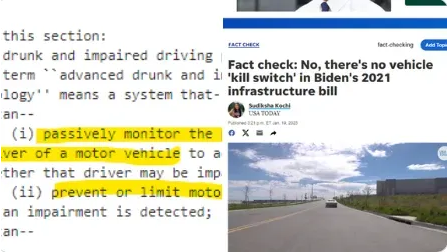
To my relief, I saw several fact-checkers at legacy institutions had determined the “kill switch” mandate was not true.

“Our rating: False,” said USA Today.

“ASSESSMENT: False,” said the Associated Press.

“We rate it Mostly False,” concluded PolitiFact.

(Snopes, a reliably left-leaning fact check group, was a little less conclusive, saying the claim was a “mixture” of true and false.)

Unfortunately, my relief evaporated once I looked at the bill itself.

Sec. 24220 of the law explicitly states: “[T]o ensure the prevention of alcohol-impaired driving fatalities, advanced drunk and impaired driving prevention technology must be standard equipment in all new passenger motor vehicles.”

The legislation then goes on to define the technology as a computer system that can “passively monitor the performance of a driver of a motor vehicle” and can “prevent or limit motor vehicle operation if an impairment is detected” (emphasis added).

How the system will make this determination is unclear, as is the government’s potential role in apprehending suspected drunk drivers (more on that later).

But the law’s language could not be more clear: New motor vehicles must have a computer system to “monitor” drivers, and the system must be able to prevent vehicle operation if it detects impairment.

November 19, 2023

How Himmler Learned to Love the Russians – WW2 – Week 273 – November 18, 1944

World War Two
Published 18 Nov 2023

Heinrich Himmler wants to build an Army of Soviet POWs, but that has some problems; Patrick Hurley becomes US Ambassador to China, but even before that he’s in hot water with Chiang Kai-Shek; and in the field in the west, the Allies launch Operation Queen to try to cross the Roer River and reach the Rhine.
(more…)

« Newer PostsOlder Posts »

Powered by WordPress