
Extra Credits
Published on 17 Dec 2018Join the Patreon community! http://bit.ly/EMPatreon
Krampus’s name is growing popular in the United States, but most of us don’t really know what he does OR that he is partners with St. Nicholas himself. He is in fact just one of many Christmas demons…
December 19, 2018
Krampus – Christmas Demon – Extra Mythology
Comments Off on Krampus – Christmas Demon – Extra Mythology
December 17, 2018
American Jeep vs German Kübelwagen: Truck Face-Off | Combat Dealers
Quest TV
Published on 23 Oct 2018Bruce puts two iconic World War II trucks to the test: the iconic American Jeep and the German Kübelwagen. Which truck will come out on top? #CombatDealers
Comments Off on American Jeep vs German Kübelwagen: Truck Face-Off | Combat Dealers
QotD: Woodrow Wilson’s repressive regime
Not surprisingly, such intellectual kindling was easy to ignite when World War I broke out. The philosopher John Dewey, New Republic founder Herbert Croly, and countless other progressive intellectuals welcomed what Mr. Dewey dubbed “the social possibilities of war.” The war provided an opportunity to force Americans to, as journalist Frederick Lewis Allen put it, “lay by our good-natured individualism and march in step.” Or as another progressive put it, “Laissez faire is dead. Long live social control.”
With the intellectuals on their side, Wilson recruited journalist George Creel to become a propaganda minister as head of the newly formed Committee on Public Information (CPI).
Mr. Creel declared that it was his mission to inflame the American public into “one white-hot mass” under the banner of “100 percent Americanism.” Fear was a vital tool, he argued, “an important element to be bred in the civilian population.”
The CPI printed millions of posters, buttons, pamphlets, that did just that. A typical poster for Liberty Bonds cautioned, “I am Public Opinion. All men fear me!… [I]f you have the money to buy and do not buy, I will make this No Man’s Land for you!” One of Creel’s greatest ideas – an instance of “viral marketing” before its time – was the creation of an army of about 75,000 “Four Minute Men.” Each was equipped and trained by the CPI to deliver a four-minute speech at town meetings, in restaurants, in theaters – anyplace they could get an audience – to spread the word that the “very future of democracy” was at stake. In 1917-18 alone, some 7,555,190 speeches were delivered in 5,200 communities. These speeches celebrated Wilson as a larger-than-life leader and the Germans as less-than-human Huns.
Meanwhile, the CPI released a string of propaganda films with such titles as The Kaiser, The Beast of Berlin, and The Prussian Cur. Remember when French fries became “freedom fries” in the run-up to the Iraq war? Thanks in part to the CPI, sauerkraut become “victory cabbage.”
Under the Espionage Act of 1917 and the Sedition Act of 1918, Wilson’s administration shut down newspapers and magazines at an astounding pace. Indeed, any criticism of the government, even in your own home, could earn you a prison sentence. One man was brought to trial for explaining in his own home why he didn’t want to buy Liberty Bonds.
The Wilson administration sanctioned what could be called an American fascisti, the American Protective League. The APL – a quarter million strong at its height, with offices in 600 cities – carried government-issued badges while beating up dissidents and protesters and conducting warrantless searches and interrogations. Even after the war, Wilson refused to release the last of America’s political prisoners, leaving it to subsequent Republican administrations to free the anti-war Socialist Eugene V. Debs and others.
Jonah Goldberg, “You want a more ‘progressive’ America? Careful what you wish for: Voters should remember what happened under Woodrow Wilson”, Christian Science Monitor, 2008-02-05.
Comments Off on QotD: Woodrow Wilson’s repressive regime
December 13, 2018
When Democrats Loved Deregulation
ReasonTV
Published on 12 Dec 2018Left-leaning politicians of the 1970s understood that red tape punishes consumers and protects big business. The leading deregulator of that era was none other than Jimmy Carter.
————————
Follow us on Twitter: https://twitter.com/reasonReason is the planet’s leading source of news, politics, and culture from a libertarian perspective. Go to reason.com for a point of view you won’t get from legacy media and old left-right opinion magazines.
————————
When President Donald Trump bragged in his first State of the Union address about cutting red tape, the Democratic response was no surprise. “Deregulation,” warned Center for American Progress Senior Advisor Sam Berger in Fortune, “is simply a code word for letting big businesses cut corners at everyone else’s expense.”But many leading Democrats had the opposite view in the 1970s. Then, at the dawn of the deregulation era, left-leaning politicians and economists understood that excessive government management of industry let the big-business incumbents get away with lousy performance at the expense of competitors, taxpayers, and consumers. The leading figure in that fight to cut red tape and shut down entire federal agencies was none other than Jimmy Carter.
It was Sen. Ted Kennedy who held extensive Senate hearings in the early ’70s, with testimony from the likes of Ralph Nader and liberal economist Alfred Kahn, about the benefits of lifting state controls on the airline industry. The resulting Airline Deregulation Act of 1978, signed by Carter, killed the Civil Aeronautics Board — a federal agency that decided which airlines could fly where, and even what they could charge. The new competition to the old airline cartel reduced fares, expanded destinations, increased safety, and made air travel an option for those of us who aren’t rich.
Carter also lifted stifling government oversight of the rail and trucking industries under a Democrat-controlled House and Senate. The result? Competition intensified, prices dropped, and consumers saved more money on everyday products.
In 1978, President Carter signed a bill that lifted Prohibition-era criminal restrictions on home brewing. The legalization of do-it-yourself beer production unleashed a boom of experimentation, paving the way for the craft beer revolution that is ongoing to this day. The year that Carter loosened the rules, the U.S. was home to a mere 50 breweries. Today there are well over 5,000. In two generations of beermaking, America went from global laughingstock to world leader.
The governor of California during Carter’s presidency was none other than Jerry Brown, then known as “Governor Moonbeam” for his far-out musings, glittery social life, and lefty politics. Yet Brown, too, could be a fiery skeptic of government. In his terrific second inaugural address in 1979, Brown stated that “many regulations primarily protect the past, prop up privilege or prevent sensible economic choices.”
But even while some sectors were unleashed four decades ago by far-seeing Democrats and Republicans alike, too many governments at the local, state, and federal levels have forgotten those lessons, and instead imposed entirely new categories of regulations. Occupational licensing, which applied to about one in 10 jobs 40 years ago, now impacts one in three.
So how did the party of Jimmy Carter and sideburns-era Jerry Brown become the ideological home of Elizabeth Warren and Alexandria Ocasio-Cortez? One explanation may be that Democratic support for deregulation back then was born out of a sense of nearly hopeless desperation in the face of stagflation. Cutting red tape to foster dynamism was about the last move politicians had left.
Our long economic expansion and stock-market boom will soon come to an end, imposing limits on government precisely at the moment when it’s asked to do more. When that day of reckoning comes, the best questions for lawmakers of both parties to ask may just be: What would Jimmy Carter do?
Photo credits: Jimmy Carter Library, Arthur Grace/ZUMA Press/Newscom, Dennis Brack/Newscom, Everett Collection/Newscom, Ron Sachs/CNP/MEGA/Newscom, Brian F. Alpert/ZUMA Press/Newscom, Paul Harris/Pacific Coast Nes/Newscom, Bee Staff Photo/ZUMA Press/Newscom, Dennis Brack/bb51/Newscom, Jonathan Bachman/REUTERS/Newscom, Rick Friedman/Polaris/Newscom
Comments Off on When Democrats Loved Deregulation
December 12, 2018
WW1 World Leaders & Generals After The War I THE GREAT WAR Epilogue
The Great War
Published on 10 Dec 2018The First World War was a historic event that challenged established power structures, political and military leaders. It also catapulted new ideas, new leaders and new officers onto the world stage. In this video we briefly explore what happened to them after the Great War.
Comments Off on WW1 World Leaders & Generals After The War I THE GREAT WAR Epilogue
December 11, 2018
QotD: Academia
Academia has an infantilizing effect. I understand that. Many professors dress and act like adolescents right up to the time they are ready to hand in their tenure and live off their generous pensions. The Peter-Pan aspect of academia is not entirely the professors’ fault. After all, the points at which the real world intrudes upon academia are so few and so tenuous that academics may be forgiven for some of their hyperbole and inadvertently comic displays of self-importance. They exist, like kept women of yore, entirely at the pleasure of an affluent society they despise. So in a way it is not surprising that they endeavor to transform their entire campus into a sort of existential boudoir, which is French for “room for pouting in.”
Roger Kimball, “A Modest Disposal”, PJ Media, 2017-01-15.
Comments Off on QotD: Academia
December 10, 2018
Minneapolis abolishes residential zoning to combat racist segregation
I’ve never actually been to Minnesota (despite being a lifetime fan of the Minnesota Vikings), so I didn’t realize that Minneapolis — and presumably other Minnesota cities historically instituted residential zoning to enforce racial segregation:
Minneapolis will become the first major U.S. city to end single-family home zoning, a policy that has done as much as any to entrench segregation, high housing costs, and sprawl as the American urban paradigm over the past century.
On Friday, the City Council passed Minneapolis 2040, a comprehensive plan to permit three-family homes in the city’s residential neighborhoods, abolish parking minimums for all new construction, and allow high-density buildings along transit corridors.
“Large swaths of our city are exclusively zoned for single-family homes, so unless you have the ability to build a very large home on a very large lot, you can’t live in the neighborhood,” Minneapolis Mayor Jacob Frey told me this week. Single-family home zoning was devised as a legal way to keep black Americans and other minorities from moving into certain neighborhoods, and it still functions as an effective barrier today. Abolishing restrictive zoning, the mayor said, was part of a general consensus that the city ought to begin to mend the damage wrought in pursuit of segregation. Human diversity — which nearly everyone in this staunchly liberal city would say is a good thing — only goes as far as the housing stock.
It may be as long as a year before Minneapolis zoning regulations and building codes reflect what’s outlined in the 481-page plan, which was crafted by city planners. Still, its passage makes the 422,000-person city, part of the Twin Cities region, one of the rare U.S. metropolises to publicly confront the racist roots of single-family zoning—and try to address the issue.
“A lot of research has been done on the history that’s led us to this point,” said Cam Gordon, a city councilman who represents the Second Ward, which includes the University of Minnesota’s flagship campus. “That history helped people realize that the way the city is set up right now is based on this government-endorsed and sanctioned racist system.” Easing the plan’s path to approval, he said, was the fact that modest single-family homes in appreciating neighborhoods were already making way for McMansions. Why not allow someone to build three units in the same-size building? (Requirements on height, yard space, and permeable surface remain unchanged in those areas.)
Comments Off on Minneapolis abolishes residential zoning to combat racist segregation
December 7, 2018
“A date that will live in infamy” – Speech
FootageArchive – Videos From The Past
Published on 19 Mar 2015Welcome to FootageArchive! On this channel you’ll find historic and educational videos from the 1900s. Watch, learn, and take a trip back in time as we gain insight into a previous time. Subscribe for more.
Note: this video contains archived public domain / licensed footage. This footage serves documentary purposes on world history and is to be viewed as educational.
Comments Off on “A date that will live in infamy” – Speech
QotD: Why did our grandparents adopt “mass market” foods?
If those authentic old foods were so great, how come our ancestors were so eager to switch to processed foods? The culprit most often identified is the power-mad food scientists of yesteryear, who convinced the housewives of previous generations to give up the good stuff in favor of tasteless packaged foods. The people who write these theories have apparently not spent much time observing today’s food scientists in their tireless quest to get people to stop eating the junk they like to eat now. If they had, they might have asked why yesterday’s food scientists had so much more power to alter dietary habits. And after they asked that question, they might have come to the conclusion that our ancestors switched because they liked the new foods better than whatever they were eating before.
That’s because so much of what we eat now as “authentic” is mostly some combination of peasant special-occasion dishes and the rich-people food of yesteryear, fused with modern technology and a global food-supply chain to become something quite different from what our ancestors ate, or the ancestors of people half a world away ate. And that’s OK. The baguette is delicious, and so is that pricey “peasant” loaf. But they are no better for having been invented decades ago than something that was invented last week, nor would they be better still if Caesar’s legions had been carrying them across Europe.
Megan McArdle, “‘Authentic’ Food Is Not What You Think It Is”, Bloomberg View, 2017-02-24.
Comments Off on QotD: Why did our grandparents adopt “mass market” foods?
December 5, 2018
QotD: Patriotism
Once upon a time, patriotism was a fairly simple thing. It was tribal identification writ large, an emotional attachment to a people and their land. In most of the world, where patriotism exists at all it’s still like this — tribal patriotism, blood-and-soil emotionalism.
A different kind of patriotism emerged from the American and French revolutions. While American patriotism sometimes taps into tribal emotion, it is not fundamentally of that kind. Far more American is the sentiment Benjamin Franklin expressed: “Where liberty dwells, there is my country”
Thus, most Americans love their country in a more conditional way — not as a thing in itself, but insofar as it embodies core ideas about liberty. It is in the same spirit that our Presidents and miltary officers and naturalizing citizens swear to defend, not the land or people of the United States but its Constitution — a political compact. This is adaptive in many ways; one of them is that tribal patriotism is difficult to nourish in a nation of immigrants.
In France, the ideology of the Revolution displaced tribal patriotism, just as it did in the U.S. But the French, roiled by political instability and war, have never settled on a political unifying idea or constitutional touchstone. Instead, French patriotism expresses a loyalty to French language and culture and history. It replaces tribalism not with idealism but with culturism.
America and France are a marked contrast with, say, Denmark. I chose Denmark at random from the class of civilized countries in which patriotism is still fundamentally tribal. You don’t become a Danish patriot by revering the constitution or culture of Denmark; you become one by being a Dane. Which partly means being a tribesman, connected to the Danish gene pool, and partly means identifying with stories of past Danish heroism.
It hasn’t been easy to find a fire-breathing Danish patriot for at least fifty years, though. One of the effects of the terrible convulsions of the 20th century has been to discredit tribal patriotism. Many people in Europe, not unreasonably, associate it with racism and Naziism and are suspicious of anything that smacks of immoderate patriotism.
Eric S. Raymond, “Patriotism And Its Pathologies”, Armed and Dangerous, 2008-07-09.
Comments Off on QotD: Patriotism
December 4, 2018
Sex, Drugs, and the Right to Vote I BETWEEN 2 WARS I 1920 Part 4 of 4
TimeGhost History
Published on 2 Dec 2018When many of the fighting men of The Great War return home addicted to drugs and infected with venereal disease, their sweethearts have decided that it’s time for some serious changes! It’s time for women’s liberation!
Join us on Patreon: https://www.patreon.com/TimeGhostHistory
Hosted by: Indy Neidell
Written and directed by: Spartacus Olsson
Produced by: Astrid Deinhard
Executive Producers: Bodo Rittenauer, Astrid Deinhard, Indy Neidell, Spartacus Olsson
Edited by Wieke Kapteijns and Spartacus OlssonColorized picture of Greta Garbo in the thumbnail courtesy of Olga Shirnina aka Klimbim
Images of Canadian WWI troops courtesy of the Canadian War Museum.
Video Archive by Screenocean/Reuters http://www.screenocean.com
A TimeGhost chronological documentary produced by OnLion Entertainment GmbH
Comments Off on Sex, Drugs, and the Right to Vote I BETWEEN 2 WARS I 1920 Part 4 of 4
December 3, 2018
Eric Swalwell’s Kinsley gaffe
If you haven’t encountered it, a “Kinsley gaffe” is where a politician accidentally tells the truth (Wikipedia). Newly elected US member of the House of Representatives Eric Swalwell committed a classic Kinsley gaffe in an online discussion on social media, as Jeff Fullerton explains:
Democratic representative Eric Swalwell made a really provocative statement this week according to an article from Hot Air. Pretty much serving notice that: If we confiscate your guns and you fight back, we will nuke you.
Representative Swalwell sort of gives a disclaimer that he he was not actually advocating nuking Texas or some other disobedient red state or region — but merely trying to make a point in the fashion of the Borg from Star Trek; that resistance is futile and it is the lot of us all to be assimilated — against our will if necessary. The author of the article from Hot Air points out something that my friend and mentor Bruce the Historian pointed out long ago; that there are an awful lot weapons in the hands of private citizens capable of making it hell on earth for any federal troops deployed to disarm the population or engage in the collectivization of property and resources in a martial law scenario. Or forced relocation of people. That’s the real reason they want everyone disarmed. They know from experiences in Vietnam and the “Forever War” in the Middle East; that cracking down with overwhelming force has its limits and once they put off a nuke to burn a town in Texas they might have to burn every square mile of the nation to put an end to the uprising.
Talk about excessive force!
That they’d even talk at all about using a nuclear weapon to put down an internal insurrection proves beyond the shadow of doubt that power hungry politicians are a far deadlier existential threat to us all than any crazed mass shooter or terrorist could ever hope to be!
This congress creature bases his argument on a fallacy which is common assumption among the political class: that because the federal government is capable of mustering overwhelming force — the Second Amendment is obsolete anyway. He already contradicts himself for if we the people are impotent against the overwhelming fire and manpower of the Army and the bombs and missiles of the Air Force — then why are people like him so adamant about disarming the average Joe? I think I already answered that one. […]
There is also the issue of the military itself that the political class ought to take into consideration. It may be less monolithic than assumed. Many of them still believe in the validity of the Constitution and would side with the resistance while others among the loyalist factions would have problems of conscience when it comes to mass slaughter of fellow Americans. Still others might be fearful of the consequences of being held accountable for atrocities or even treason if they end up on the losing side of things. To attack and kill your own people who you swore to serve and protect is a grievous betrayal. It is treason of the highest order and the punishment for that is death. So if you choose such a course of action and loose the fight; you go down in historic infamy to be remembered like the Nazi war criminals who stood before the Nuremberg tribunals. And you will probably [be] shot or hanged in a public execution!
Comments Off on Eric Swalwell’s Kinsley gaffe
US immigration – two views
In the latest Libertarian Enterprise, John Walker presents two fascinating charts illustrating the levels of immigration to the United States since the beginning of the nineteenth century. Depending on which one you see, your interpretation will likely differ substantially. The first, the way the statistics are usually presented, show the current rate of immigration to be a very significant — even unprecedented — economic and political concern:
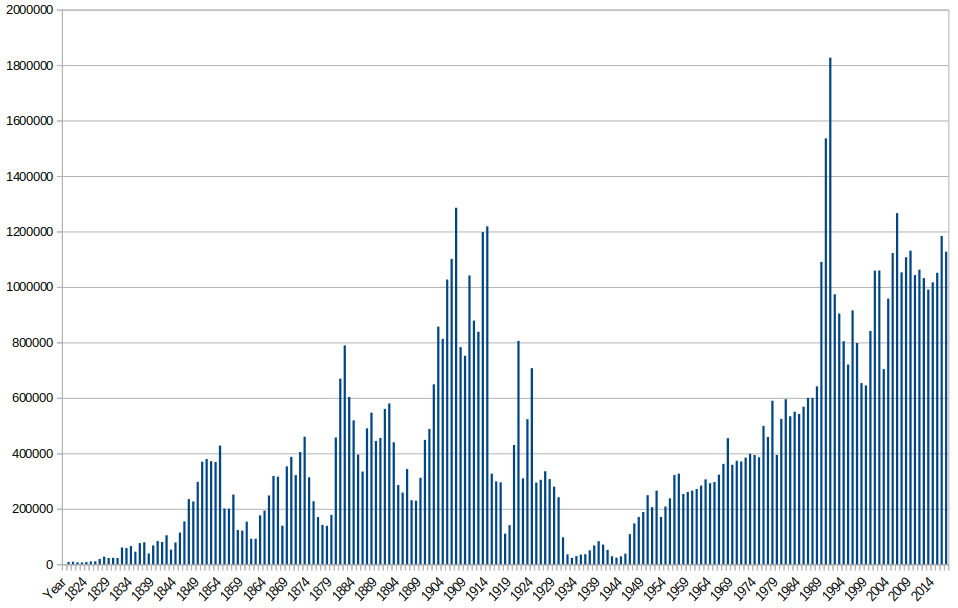
Immigration shown in raw numbers.
The less common way of illustrating the immigration numbers is showing it proportional to the whole population, which would not work anywhere near as well to support certain narratives:
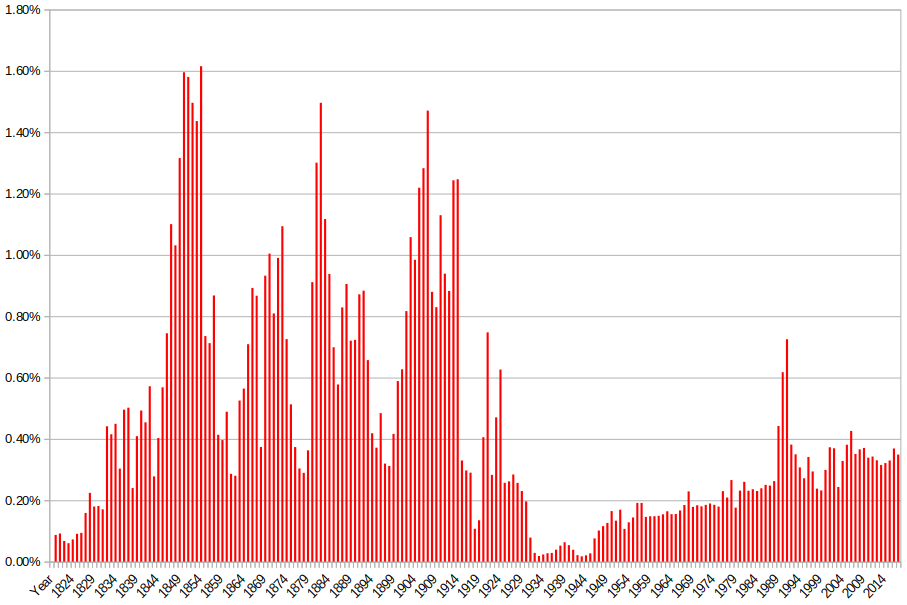
Immigration to the US shown in proportion to the population.
This is a very different picture. There are clearly two different epochs. In the first, between 1820 and 1930, the U.S. was “filling up the empty country” by admitting large numbers of immigrants. Then, due to immigration restrictions in the Immigration Act of 1924 and the subsequent economic depression and war, immigration remained at low levels until 1946 when, in the immediate postwar period, it jumped. In this view, the impact of the Immigration and Nationality Act of 1965 was not the discontinuous change some present it as (at least in terms of absolute numbers; it may have changed the composition of the immigrant population, which is not captured in these statistics).
Instead, the trend established after 1946 continued to rise continuously until 1989–1991 when it went all whacko. These numbers, as a fraction of the population, haven’t been seen 1923 or since. If you take out those crazy years, the overall trend of immigration as a fraction of the existing population continues to rise almost linearly since 1946.
Comments Off on US immigration – two views
The Mini-14: A Cost-Effective Scaled-Down M14
Forgotten Weapons
Published on 10 Nov 2018https://www.forgottenweapons.com/the-…
http://www.patreon.com/ForgottenWeapons
The Ruger Mini-14 is certainly not a “forgotten” weapon, but I think there are some valuable insights to be taken from it. As a company, Ruger has an outstanding track record of making not flashy and exciting guns, but rather guns that are economical and dependable. The Mini-14 is an excellent example of that, with hundreds of thousands sold since its introduction in 1972. So today we will take a look at how Jim Sullivan simplified the M14 design when he scaled it down to 5.56mm for Ruger, and how the company used its investment casting expertise to further reduce production costs.
Contact:
Forgotten Weapons
PO Box 87647
Tucson, AZ 85754
Comments Off on The Mini-14: A Cost-Effective Scaled-Down M14
December 1, 2018
CAFE killed the North American passenger car
The move by GM to close many of its remaining car manufacturing facilities in Canada and the US is a belated rational response — not to the market, but to the ways government action has distorted the market. In the Financial Post, Lawrence Solomon explains how, step-by-step, the CAFE rules have shifted drivers out of sedans and wagons and into minivans, pickup trucks, and SUVs:
Before the U.S. government introduced Corporate Average Fuel Economy (CAFE) standards to increase the distance cars could travel per gallon of gas, sedans and full-size station wagons were popular and SUVs were unknown. CAFE, which effectively governed the entire North American market thanks to the Canada-U.S. Auto Pact, incented manufacturers to artificially raise the cost of large passenger cars in order to favour smaller, more fuel-efficient vehicles. It soon claimed its first victim: the full-size station wagon, whose flexible interior accommodated both passenger and cargo needs, and which, at its peak, came in 62 models to satisfy different tastes.
But, although CAFE priced the station wagon out of the market, the market still demanded a vehicle that offered its flexibility. Enter Lee Iacocca, the chairman of Chrysler, who helped develop the minivan and convinced the U.S. government to deem it a truck rather than a passenger vehicle, thus exempting it from the strict CAFE standards that killed the station wagon. The minivan took off — the first 1984 model, built in Windsor, sold 209,000 its first year — followed by the SUV, which also was deemed a truck rather than a passenger vehicle. By 2000, the passenger car had less than half the market. Today it accounts for only about a third.
CAFE standards didn’t only claim certain car models as victims, they also made the whole industry a victim by making it dependent on government whims and then handouts. CAFE also distorted the market by creating credits for ethanol and electric vehicles and by creating a lobbyist’s dream through ever-changing regulations that led car manufacturers to continually game the system to favour their own vehicles over those of competitors.
Perversely, by improving mileage, CAFE also increased distances travelled and emissions of pollutants such as carbon monoxide and nitrogen oxides. The 2025 CAFE targets (since cancelled by President Trump) ran to almost 2,000 pages and were estimated to add an average of US$1,946 to the cost of a vehicle. Tax loopholes also helped accelerate SUV sales — like all light trucks, they were exempted from the gas-guzzler’s excise tax and also given preferential tax treatment as business vehicles.
Comments Off on CAFE killed the North American passenger car


