
Sabaton History
Published on 23 May 2019Heroism isn’t always measured in blood or danger. Sometimes, to spare your foe is the honourable thing to do. A dramatic example comes in the shape of the American Charlie Brown and German Franz Stigler. Brown was flying his heavily damaged B17 “Flying Fortress” bomber home after a demanding bombing run on Bremen when Franz Stigler in his fighter plane caught sight of its tail. This story is about the encounter between the two enemies and the song that Sabaton wrote about it, called “No Bullets Fly” (on the Heroes album).
Support Sabaton History on Patreon: https://www.patreon.com/sabatonhistory
Find A Higher Call, the book that inspired “No Bullets Fly” here: https://www.valorstudios.com/a-higher…
Check out the trailer for Sabaton’s new album The Great War right here: https://www.youtube.com/watch?v=HCZP1…
Listen to Sabaton on Spotify: http://smarturl.it/SabatonSpotify
Official Sabaton Merchandise Shop: http://bit.ly/SabatonOfficialShopHosted by: Indy Neidell
Written by: Markus Linke and Indy Neidell
Directed by: Astrid Deinhard and Wieke Kapteijns
Produced by: Pär Sundström, Astrid Deinhard and Spartacus Olsson
Creative Producer: Joram Appel
Executive Producers: Pär Sundström, Joakim Broden, Tomas Sunmo, Indy Neidell, Astrid Deinhard, and Spartacus Olsson
Maps by: Eastory
Edited by: Iryna Dulka
Sound Editing by: Marek Kaminski
Eastory YouTube Channel: https://www.youtube.com/channel/UCEly…
Archive by: Reuters/Screenocean https://www.screenocean.com
Music by Sabaton.Sources:
IWM: CL 3395
Plane drawing by EmoscopesAn OnLion Entertainment GmbH and Raging Beaver Publishing AB co-Production.
© Raging Beaver Publishing AB, 2019 – all rights reserved.
May 24, 2019
“No Bullets Fly” – Charlie Brown and Franz Stigler – Sabaton History 016
QotD: Politics and culture
… sometimes Mark Steyn seems like the only conservative you can discuss these issues with, because most Republicans think popular culture is beside the point, if not downright dangerous. Steyn, on the other hand, has performed “Kung Fu Fighting” before thousands of people in civic auditoria more accustomed to Mary Kay Cosmetics conventions, so he gets it.
“Social conservatives are always editing pop culture,” says Steyn, “and it’s completely pathetic. Conservatives play to the caricature. Mention a French movie and the crowd turns on you. It’s a reductive view of the world. There are ideological enforcers casting aside works of art because they contain bad words or uncomfortable associations. It’s one of the biggest abdications of the American right. Who gives a crap about who gets elected to the Congressional district in Ohio? — that’s not going to change the culture. It’s movies that move the culture. And if you abdicate that space, you lose. Jeb Bush spent a billion dollars to get 2.8 per cent of the vote in Iowa. Mitt Romney and people like him who have a billion dollars — don’t spend it on politics, buy a TV network! Theatre, movies, music, that’s where the battles are fought. They’ve abdicated that space in the schools. As a result, my kid had to sit through Al Gore’s lousy movie three times. All effective storytelling is inherently conservative — because your choices have consequences. For the Left, nothing has consequences. But the trends are all in the Left’s direction, because the Right got out of the game — they chose to make themselves culturally irrelevant. If you’re not in the same room, having the conversation, there’s not gonna be a solution.”
Mark Steyn, interviewed by John Bloom, “Mark Steyn, Cole Porter and Free Speech”, Quadrant, 2017-05-11.
May 23, 2019
Those “theories of history”
At Rotten Chestnuts, Severian starts off talking great-man versus vast-impersonal-forces-of-history then segues into passivity (not Severian’s, but the widespread use of the passive voice):
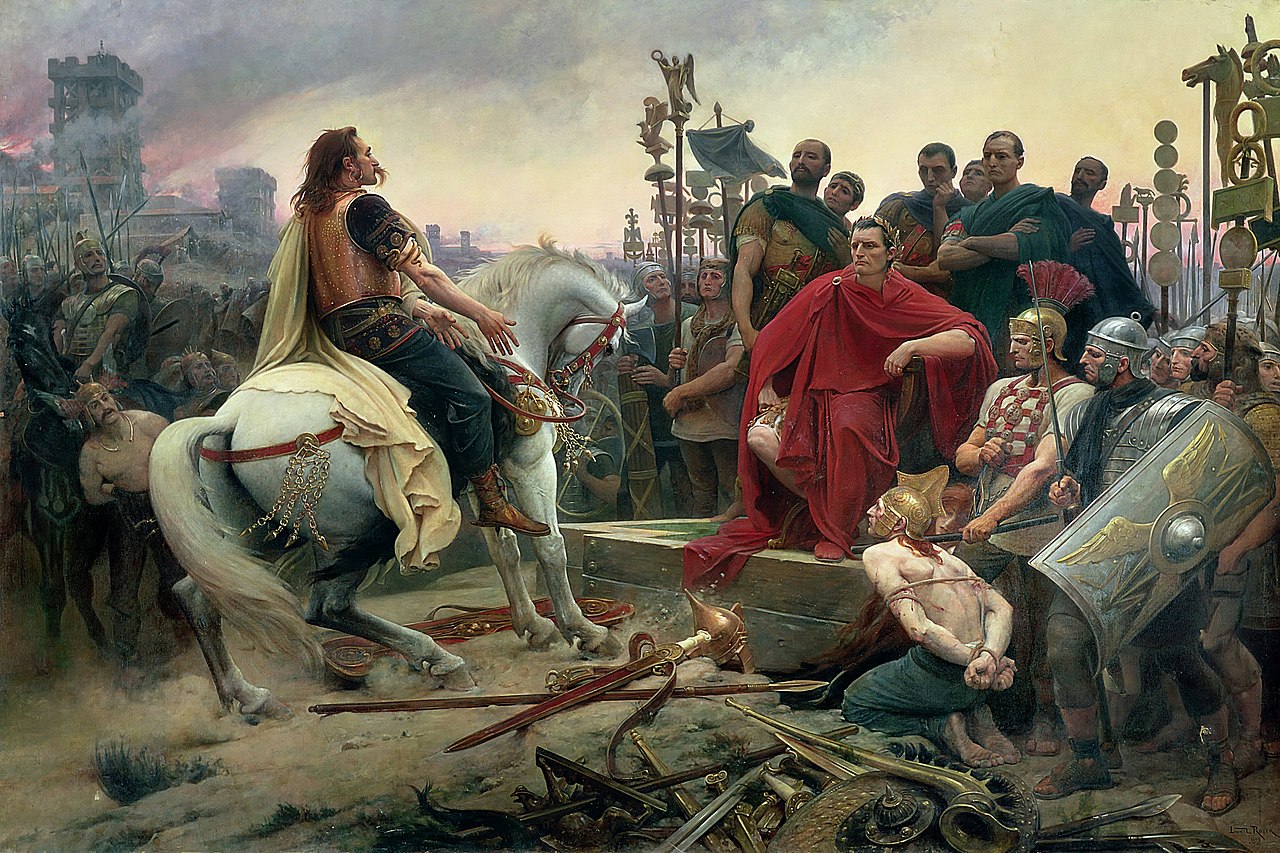
Lionel Royer (1852-1926). Vercingetorix jette ses armes aux pieds de Jules César (Vercingetorix throws down his arms at the feet of Julius Caesar)
The painting depicts the surrender of the Gallic chieftain after the Battle of Alesia (52 BC). The depiction of Gauls with long hair and mustaches is also called into question today. The horse is a Percheron, although at this time this breed was not in Gaul. The rectangular shield also does not accord with the time when they were mostly oval.
Musée CROZATIER du Puy-en-Velay. — http://www.mairie-le-puy-en-velay.fr/ via Wikimedia Commons.
Academics, of course, are all in on “social” explanations of historical phenomena. Being weak, ineffective people themselves, with no experience of life, the very idea of a Caesar frightens and repels them… so they construct theories of History in which it is impossible for a Caesar to exist. On this view, “social forces” (what they used to call “the relations of the means of production”) tore the Roman Republic apart; the Empire was its inevitable next stage. Assign whatever name you like to the Imperator — whether Caesar, Marius, Sulla, or Miles Gloriosus, he’s just the temporary face of the vast, impersonal social forces that control our fate. None of this “History is just the biographies of great men” for them!
The eggheads have a point, though, albeit not the one they think they’re making. The Roman elite’s social system was designed to produce a certain type of man. Whether Gaius Julius Caesar was personally the embodiment of that system, or a perversion of it, is irrelevant — the system was designed to produce men like Caesar, fellows with a very particular set of skills. Eggheads have never seen one, but anyone who has kicked around the world outside the ivory tower for a bit has met that type of guy. The skills themselves are fairly common, at least in embryo. Whether a potential Caesar becomes actual might well be merely a question of opportunity and scale.
A terrifying notion, that, when you look around the modern West. The one characteristic all effective elites have in common is the self-knowledge that they are the elite. The British, for instance, thought nothing of sending some 19 year old kid, whose slim formal education was mostly Latin and Greek, off to govern the Punjab. It worked, largely because that kid, whatever his defects of intellect and ability, had character, of the kind you just don’t get without a pedigree stretching back to Hastings.
Again, if you’ve ever met one of the horsey set you know what I’m talking about. If you haven’t, the most accessible American equivalents are the sons and grandsons of career army officers. Think of Lieutenant Dan in Forrest Gump, as played by Gary Sinise in the movie. That kind of guy always completes the mission, or dies trying, because it’s simply unthinkable that he won’t. After five generations, West Point is in his DNA…
May 22, 2019
May 21, 2019
May 19, 2019
Malcom McLean’s container shipping revolution
At the Foundation for Economic Education, Alexander Hammond recounts the tale of a former truck driver who was instrumental in revolutionizing the way we ship products around the world:

Deep-sea containers from China at Ely, Cambridgeshire
Via Wikimedia Commons.
In 1937, McLean made a routine delivery of cotton bales to a port in North Carolina for shipment to New Jersey. As McLean couldn’t leave until his cargo had been loaded onto the ship, he sat for hours watching dozens of dockhands load thousands of small packages onto the ship. McLean realized that the current loading process wasted enormous amounts of time and money, and he began to wonder if there could be a more productive alternative.
In 1952, McLean thought of loading entire trucks onboard a ship to be transported along the American Atlantic coast (i.e., from North Carolina to New York). Although this idea would dramatically reduce loading times, he soon realized that these “trailer ships” would not be very efficient due to the large amount of wasted cargo space.
Mclean modified his original design so that just the containers—and not the trucks’ chassis—were loaded onto the ship. He also developed a way for the containers to be stacked on top of one another. That was the origin of the modern-day shipping container.
In 1956, McLean secured a bank loan for $22 million. He used the money to buy two World War II tanker ships and convert them to carry his containers. Later that year, one of his two ships, the SS Ideal-X, was loaded with 58 containers and sailed from New Jersey to Houston, Texas. At the time, McLean’s shipping company offered transport prices that were 25 percent lower than those of his competitor as well as the ability to lock the containers in order to prevent cargo theft, which also appealed to many new customers.
By 1966, McLean launched his first transatlantic service and three years later, McLean had started a transpacific shipping line. As the advantages of McLean’s container system became clear, bigger ships, more sophisticated containers, and larger cranes to load cargo were developed.
Update 21 May: Here’s a breathtaking example of just how much McLean’s containers changed the world:
In 1956, hand-loading cargo onto a ship in a U.S. port cost $5.86 per ton ($55.58 in today’s money). By 2006, shipping containers reduced that price to just 16 cents per ton ($0.21 in today’s money). https://t.co/zuMMqOuiAl #HumanProgressData
— Timothy Aeppel (@TimAeppel) May 20, 2019
May 18, 2019
6 Wartime Foods | British Pathé
British Pathé
Published on 20 Sep 2016BON APPETIT – FOOD MONTH ON BRITISH PATHÉ (SEPTEMBER 2016): 6 Wartime Foods.
War and postwar changed the perception of foods that we now may consider as ordinary and basic. Here is a list of 6 Wartime Foods.
Check the newsreels used to make this video here: https://www.youtube.com/playlist?list…
Music:
The Show Must Be Go (incompetech.com)
Licensed under Creative Commons: By Attribution 3.0 License
http://creativecommons.org/licenses/b…A NEW THEME EVERY MONTH!
Each month, a range of new uploads and playlists tell the story of a particular topic through archive footage. Let us know what themes you’d like to see by leaving us a comment or connecting with us on social media.BRITISH PATHÉ’S STORY
Before television, people came to movie theatres to watch the news. British Pathé was at the forefront of cinematic journalism, blending information with entertainment to popular effect. Over the course of a century, it documented everything from major armed conflicts and seismic political crises to the curious hobbies and eccentric lives of ordinary people. If it happened, British Pathé filmed it.Now considered to be the finest newsreel archive in the world, British Pathé is a treasure trove of 85,000 films unrivalled in their historical and cultural significance.
ALL RIGHTS RESERVED
A VIDEO FROM BRITISH PATHÉ. EXPLORE OUR ONLINE CHANNEL, BRITISH PATHÉ TV. IT’S FULL OF GREAT DOCUMENTARIES, FASCINATING INTERVIEWS, AND CLASSIC MOVIES. http://www.britishpathe.tv/
FOR LICENSING ENQUIRIES VISIT http://www.britishpathe.com/
British Pathé also represents the Reuters historical collection, which includes more than 120,000 items from the news agencies Gaumont Graphic (1910-1932), Empire News Bulletin (1926-1930), British Paramount (1931-1957), and Gaumont British (1934-1959), as well as Visnews content from 1957 to the end of 1979. All footage can be viewed on the British Pathé website.
QotD: “Revenue neutral” tax cuts
Real men (as well as pull-no-punches women) cut taxes. The lesser mortals that tend to inhabit Washington wring their hands and get all weak in the knees when it comes to cutting taxes. Rumors are President Trump will propose a real tax cut. I certainly hope so.
Once upon a time, most Republicans believed in tax cuts. Somewhere along the way, inside the beltway especially, Republicans forgot about the benefits of cutting taxes. Republicans became more concerned with government keeping “its” revenue than letting the people keep their money.
Too many Republican have become timid about tax cuts, often spouting the milquetoast line of “revenue neutral tax cuts.”
Let me translate that little bit of Washington-speak for you. “Revenue neutral” tax cuts aren’t really tax cuts. It’s more like tax shifting. Some will pay more. Some will pay less. And the net effect will be that government will collect the same amount of taxes.
If revenue neutral tax shifting is what Republicans stand for, maybe it’s time we re-evaluated what we really stand for.
What will “revenue neutral” tax cut mean to your business? Well, that may depend on how expensive your lobbyist is. Which side of the “revenue-neutral” ledger you wind up on may depend on how well the skids are greased, hardly, a pleasant scenario to anticipate.
I believe as John F. Kennedy and Ronald Reagan did, that the best way to stimulate our economy, promote job growth, and give our ailing middle class a raise is to cut taxes for all.
Rand Paul, “Real Men Cut Taxes”, Breitbart.com, 2016-04-25.
May 15, 2019
May 14, 2019
Hotchkiss Revolving Cannon from San Juan Hill
Forgotten Weapons
Published on 9 Apr 2019This Hotchkiss cannon and its accessories are lot #1116 in the upcoming April 2019 Morphy auction:
https://www.forgottenweapons.com/hotc…
Benjamin Hotchkiss was an American artillery designer who moved to Paris in 1867 in hopes of building a business for his improvements in artillery shells. He experienced the Franco-Prussian War in 1870, and understood the failure of the French Mitrailleuse multi-barrel volley guns. In his opinion, an effective rapid-fire weapon needed to fire explosive projectiles to have a real effect at extended range (unlike the Mitrailleuse which fired simple rifle bullets). So being the inventive sort, he went ahead and designed just such a gun. His revolving cannon was sized for 1-pound (450g) 37mm explosive shells (although he would also produce armor-piercing and canister ammunition). The gun looks like a Gatling gun at first glance, but its mechanical operation is quite different.
The Hotchkiss cannon would become quite popular, with major purchases by the French and American navies as well as many other nations. They would serve into World War One, including some use repurposed as antiaircraft weapons. This particular example was captured by American forces in Cuba during the Spanish-American War, most likely from San Juan Hill. It is a magnificent example of the type, and with a fantastic historical provenance to match.
http://www.patreon.com/ForgottenWeapons
Cool Forgotten Weapons merch! http://shop.bbtv.com/collections/forg…
Contact:
Forgotten Weapons
PO Box 87647
Tucson, AZ 85754
May 13, 2019
“[T]he most famous Zulu word on the planet was invented by a New York socialist in 1951”
I had no idea there was so much back-story to the song “The Lion Sleeps Tonight” aka “Wimoweh” aka “Mbube”, which had managed to be a hit for groups as diverse as Tight Fit, Robert John, the Tokens, the Weavers, Ilonka David-Biluska, Henri Salvador, and others:
Those words about “the jungle, the mighty jungle” sit so perfectly and indivisibly on those notes they sound like they’ve belonged to each other for all time. We know the lyric is George Weiss’, but where did the tune come from?
Well, it’s obvious, isn’t it? It was a “Zulu chant” — ie, “traditional – ie, “anonymous” — ie, out of copyright. Which meant someone else could put it back in copyright. In the Fifties and early Sixties, public demand for “authentic” “traditional” music created a huge windfall for savvy Tin Pan Alleymen. You take some half-forgotten folk dirge, tweak it here and there, and then copyright your version as a full-blown composition in its own right. Everyone was doing it: in the Fifties, “Frankie And Johnny”, “Auld Lang Syne”, “Greensleeves” and a bunch of other things that had been around forever were being copyrighted as brand new songs. Huge and Luge had done it with “Can’t Help Falling In Love”, né “Plaisir d’Amour“. So the first thing they wondered, when the Tokens showed up and began doing their Zulu impressions, was where did this “Wimoweh” thing come from anyway? They looked at the song credits: “Paul Campbell” and “Albert Stanton”.
Bingo! There was no such “Paul” and no such “Albert”. Mr “Campbell” was the name Pete Seeger and the Weavers would put on the sheet music when they’d recorded a folk tune and decided they’d like to cut themselves a piece of the songwriting action. And Mr “Stanton” was the name Al Brackman at the Richmond publishing house put on the music when he wanted to do the same for his bank account. Messrs “Campbell” and “Stanton” thus became successful mid-20th century songwriters who apparently hadn’t written anything since the mid-19th century. So the minute Huge and Luge saw those names on “Wimoweh” they knew it was a plum just ripe for a second picking. If it ever came to court, Huge, Luge and George Weiss’ defense would be yes, they’d plagiarized it not from Campbell & Stanton but from the same 19th century Zulu natives Campbell & Stanton had plagiarized it from. And, because Pete Seeger, the Weavers and the Richmond organization well understood that, they never did bring it to court. So there are two entirely separate mid-20th century pop songs by two entirely separate writing teams, one called “The Lion Sleeps Tonight”, the other called “Wimoweh“.
[…]
In South Africa, it was huge. “Mbube” became not just the name of a hit record but of an entire vocal style — a high-voiced lead over four-part bass-heavy harmony. That, in turn, evolved into “isicathamiya“, a smoother vocal style that descended to Ladysmith Black Mambazo and others, taking its cue from the injunction “Cothoza, bafana” — or “tread carefully, boys”. That’s to say, Zulu stomping is fine in the bush, but when you’re singing in dancehalls and restaurants in you’ve got to be a little more choreographically restrained, if only for the sake of the floorboards.
“Tread carefully, boys” is good advice for anyone in the music business. A few years after Solomon Linda and the Evening Birds made their hit record, it came to the notice of Pete Seeger, on the prowl for yet more “authentic” “traditional” “vernacular” “folk music” for the Weavers to make a killing with. He misheard “Mbube” and transcribed it as “Wimoweh“. That’s a great insight into the “authenticity” of the folk boom: the most famous Zulu word on the planet was invented by a New York socialist in 1951
U.S. Civil War – Surprising Soldiers – Extra History
Extra Credits
Published on 11 May 2019Historians have been learning that the US Civil War armies were a lot more diverse than previously accounted for — partly because many soldiers who hailed from other countries and nations used adopted names. Chinese, Hawaiian, Hispanic, and Cherokee soldiers all participated on both sides of the US civil war — suffering even more conflict in some cases.
Researchers are beginning to learn that the makeup of the Union and Confederate armies in the US Civil War was a lot more nuanced and diverse than we had previously known. Here is an episode on the accounts of some of those surprising soldiers!
Join us on Patreon! http://bit.ly/EHPatreon
May 11, 2019
Jonathan Haidt – Social media has altered a fundamental constant of the universe
Katie Herzog attended the first Heterodox Academy conference and reports on Haidt, the academy’s founder, and other attendees at the event:

Jonathan Haidt at the Miller Center of Public Affairs in Charlottesville, Virginia on 19 March, 2012.
Photo via Wikimedia Commons.
I told three people that Jonathan Haidt will be speaking in Seattle this week. One is a left-leaning university professor, another is an apolitical meditation teacher, and the last is a conservative talk radio host. Despite the chasm between their personal politics, they were all equally enthusiastic to hear Haidt speak. He seems to have that effect on people, and is one of the rare political thinkers who manages to both appeal to (and occasionally enrage) people across the political spectrum.
A professor of social psychology at NYU’s Stern School of Business, Haidt is also the author of best-selling book, The Coddling of the American Mind, which he published with First Amendment lawyer Greg Lukianoff last year. That book grew out of an article of the same name that the duo first published in the Atlantic in 2015. As anyone who was paying attention back then may recall, the article made quite a splash, and it brought some emerging trends at university campuses into the public consciousness, including the rise of trigger warnings, deplatforming speakers, and university administrators’ attempts to protect students from any perceived harm. The article, and the subsequent book, didn’t exactly make Haidt popular in some hyper-left circles, and Haidt is occasionally accused of being a conservative in disguise. What he actually is, is a centrist, which gives him a perspective outside the typically left/right binary, and much of his recent work is about tribalism and division in the U.S. It’s a trend he thinks is getting worse.
[…]
“If you are in a university that puts you into interaction with diverse ideas, that makes you smarter,” Haidt says. “You can solve more problems. You become a more critical thinker. The more you hang out with people who think like you, especially if they enforce orthodoxy, the lower your IQ gets.”
In other words, only engaging with ideas you already support can actually make you dumber. It can also damage your cause. As an example, Haidt sites student attempts to deplatform both outside speakers and faculty on campuses over the last few years. Video of protests at schools like Evergreen State were widely shared on conservative networks, and while the students may have seen themselves as warriors in the fight for social justice, those who don’t already support their ideals were more likely to see hysterical students screaming at befuddled adults. The backlash was inevitable. “The antics on campus did a lot, I think, to elect Donald Trump,” Haidt says. “Most people on the left have not seen those videos but most people on the right have seen them. And so even if you think it’s virtuous to always be fighting, in the long run, you are harming your own side.”
In an effort to reverse the trend of ideological homogeneity on campus, Haidt founded the Heterodox Academy, an organization that advocates for universities to embrace viewpoint diversity (even, yes, when those viewpoints are conservative). Last year, they hosted the first Heterodox Academy Open Minds Conference in New York, which I attended. (Full disclosure: I moderated a panel, for which I was compensated.)
The conference was remarkable: Everyone I spoke to seemed to have some story about what made them first see that the world isn’t cleanly broken up into good versus evil, from professors who’d been the subject of protests to journalists who’d been canceled. Still, this was a conference mostly made up of academics and writers, and I doubt there was a single stereotypical Trump voter or social justice warrior in attendance. For the sake of viewpoint diversity this is probably a failure, but the organization still managed to bring together a crowd that included conservatives like Bret Stephens and liberals like Alice Dreger and libertarians like Kmele Foster all in one space. There were heated discussions, to be sure, but no one called for anyone else to be fired. This, I am sure, would be appalling to a certain subset of leftist Twitter, but as Haidt reminded me, social media may be loud, but it’s not representative. “We have to distinguish between the average and the visible anecdote,” he said. “This is another thing social media has done to us: We used to have a sense of the mood in a room or the mood in our social network, and now we have no idea.”
Still, he’s not optimistic that we’ll work our way out of these divisions, at least without significant disruption in the process. “Things feel so strange to me,” he said. “It feels as though a fundamental constant of the universe has been altered. I think social media has done that.”
Inside the Chieftain’s Hatch. M151 Series
The_Chieftain
Published on 6 Apr 2019A fun, and rather dangerous, little softskin which will easily fit in your garage.
QotD: The Coolidge Effect
Behavioral endocrinologist Frank A. Beach first mentioned the term “Coolidge effect” in publication in 1955, crediting one of his students with suggesting the term at a psychology conference. He attributed the neologism to:
… an old joke about Calvin Coolidge when he was President … The President and Mrs. Coolidge were being shown [separately] around an experimental government farm. When [Mrs. Coolidge] came to the chicken yard she noticed that a rooster was mating very frequently. She asked the attendant how often that happened and was told, “Dozens of times each day.” Mrs. Coolidge said, “Tell that to the President when he comes by.” Upon being told, the President asked, “Same hen every time?” The reply was, “Oh, no, Mr. President, a different hen every time.” President: “Tell that to Mrs. Coolidge.”
The joke appears in a 1978 book (A New Look at Love, by Elaine Hatfield and G. William Walster, p. 75), citing an earlier source (footnote 19, Chapter 5).


