
Let me be clear that I think immigration and diversity are good things, overall. The economists seem to agree that immigration brings large economic benefits. The complete dominance of America in Nobel prizes, music, and the arts, and now the technology sector, would not have happened if we had not been open to immigrants. But as a social psychologist, I must point out that immigration and diversity have many sociological effects, some of which are negative. The main one is that they reduce social capital — the bonds of trust that exist between individuals. The political scientist Robert Putnam found this in a paper titled “E Pluribus Unum,” in which he followed his data to a conclusion he clearly did not relish: “In the short run, immigration and ethnic diversity tend to reduce social solidarity and social capital. New evidence from the US suggests that in ethnically diverse neighborhoods residents of all races tend to ‘hunker down.’ Trust (even of one’s own race) is lower, altruism and community cooperation rarer, friends fewer.”
In short, despite its other benefits, diversity is a centrifugal force, something the Founders were well aware of. In Federalist 2, John Jay wrote that we should count it as a blessing that America possessed “one united people — a people descended from the same ancestors, the same language, professing the same religion.” I repeat that diversity has many good effects too, and I am grateful that America took in my grandparents from Russia and Poland, and my wife’s parents from Korea. But Putnam’s findings make it clear that those who want more diversity should be even more attentive to strengthening centripetal forces.
Jonathan Haidt, “The Age of Outrage: What the current political climate is doing to our country and our universities”, City Journal, 2017-12-17.
February 16, 2020
QotD: Immigration and diversity
February 15, 2020
QotD: Architecture’s lingering racism
In the 1920s, during the time he was a member of the French Fascist party, the seminal architect Le Corbusier said he was disgusted by the “zone of odours, [a] terrible and suffocating zone comparable to a field of gypsies crammed in their caravans amidst disorder and improvisation.” He also chimed in with Loos: “Decoration is of a sensorial and elementary order, as is color, and is suited to simple races, peasants, and savages … The peasant loves ornament and decorates his walls.”
More recently, indicative of architecture’s current race problem, in 2006 the aforementioned highly influential dean of Tulane’s architecture school, Reed Kroloff, wrote the embarrassingly tone-deaf, flat-footed essay “Black Like Me.” (As I discuss below, he collaborated with Betsky on a post-Katrina project.) Kroloff — the privileged, self-described gay white Jew from Waco, Texas — announced that he was now black, that the Hurricane Katrina disaster had made him feel first-hand the African-American predicament. His piece was subject to much ridicule. No wonder the Mods have chosen to insulate themselves from the un(brain)washed masses. Architecture has become a gated community.
Betsky, to his credit, doesn’t pretend that architects should even try to make outreach. Showing little sympathy for democracy, he says that appeals to the public are “mystical.” The people — the 99% — do not deserve a seat at the table. Yet Betsky would have us believe that he and the architecture he supports are “progressive.”
Justin Shubow, “Architecture Continues To Implode: More Insiders Admit The Profession Is Failing”, Forbes, 2015-01-06.
February 13, 2020
Here’s a deceptive factoid … time for you to get angry to suit someone’s political agenda
Did you know that “Three Billionaires Have More Wealth Than Half of America”!!!???!!! Are you angry now? You’re supposed to be, because this factoid was concocted specifically to make people irrationally angry. Daniel C. Jensen explains how this sound bite was created:

Amazon’s Jeff Bezos, Microsoft’s Bill Gates, and Berkshire Hathaway’s Warren Buffet.
Fox Business.
People between 0 and 24 years of age account for about 32 percent of the United States population of 320 million. Almost all of them are going to be in the bottom half of the wealth distribution for reasons including diaper rash and puberty. That means they account for about 63 percent of the “bottom half of the wealth distribution.” Should it surprise us that some kid fresh out of college does not “hold any stocks or bonds”? Or a kid fresh out of the womb?
Then we must consider people with mental and physical disabilities. They will also tend to be in the bottom half of the wealth distribution because they face greater challenges to building wealth. “About 56.7 million people — 19 percent of the population — had a disability” at last count, according to the United States Census Bureau. But there is overlap between the disabled 19 percent and the young 32 percent of the population. If we assume disabilities are evenly distributed in the population, then young people and non-young disabled people account for 45 percent of the population. So we have now accounted for 90 percent of the “160 million Americans in the bottom half of the wealth distribution.”
Next, we must think about other groups who have had limited wealth-building opportunities. What about the 2.2 million people in jail and prison? What about people in their late twenties who pursued PhDs, law degrees, medical residencies, etc., and are just beginning their careers? Now we are close to accounting for 100 percent of the “bottom half of the wealth distribution.” But this wealth distribution is not what any sensible person would expect it to be.
Maybe the factoid is true. Maybe Jeff Bezos, Bill Gates, and Warren Buffet have more wealth than all of the infants, children, students, handicapped, prisoners, and postgrads combined. But you don’t need a PhD to figure out that’s not useful knowledge. Even if the factoid is true, it’s deceitful. Whoever created it was obviously trying to manipulate people. And we uncovered this deception with nothing but some simple knowledge of the US population.
Next time you encounter an economic factoid, remember that it might be pitting a bunch of newborns against Jeff Bezos, and that hardly seems fair. Thankfully, you can save those babies from certain defeat simply by knowing some basic statistics about your country.
February 12, 2020
QotD: Experienced political operators after an unexpected paradigm shift
Look, take a just-now thing: the DNC says that all precincts in Iowa WERE counted. The app recorded every vote, they say. They just need to tally them.
Turns out that’s probably not precisely true.
As a friend noticed, that’s not precisely a lie, that’s just “making sh*t up.”
We’re seeing that a lot from the other side of the aisle suddenly. Unbelievably stupid behavior like the sham wow impeachment.
They keep telling us “Who you gonna believe, me or your lying eyes?” and being shocked and appalled when we choose our lying eyes.
[…]
And then they’re shocked, nay astonished, when these tactics don’t work. While we who are standing outside this look at them and go “Who would think that would work? Some two year old?”
I mean half of the bizarre behavior of our government and its agencies falls under that heading too. “Who could think that would work/wouldn’t be found out/made any sense?”
But the thing you have to understand is that you’re not dealing with stupid people. Not by half. You’re dealing with people who were very competent and comfortable in — for lack of a better term — the previous paradigm of politics, or publishing or whatever.
The more comfortable they were; the easier it was for them, the harder it is to accept that it’s gone and it’s not coming back
For instance, the dems could trust the media would cover for them absolutely and completely, and that their pettiness, idiocy or outright corruption would never be revealed.
They got used to it, they got comfortable. They got to believing it was their natural right. It was just the way things were. They were the good people. Their hearts were pure. No one would ever look into their behavior outside the limelight.
If some psychological tests are correct, they grew to believe they were entitled to corruption and unethical behavior for all the “good” they did, such as Clinton thinking he was entitled to all the women he wanted for “fighting for women’s rights” (Which for men like him always mean abortion, but never mind.)
They can’t adapt. They can’t believe things have changed.
Sarah Hoyt, “How Things Have Always Been”, Libertarian Enterprise, 2020-02-09.
February 11, 2020
“… loveable Nickelodeon show Paw Patrol is an insidious tool of capitalism”
I’ve only heard of the show because my grand-niece is a huge fan, so I can’t say anything one way or another about these heresy allegations:
Six adorable, daring puppies and their whiz kid leader, ten-year-old Ryder, rescue people in the community of Adventure Bay. You would have to be a fool to not love Paw Patrol. And that’s where the Canadian state broadcaster CBC comes in!
A new article by Rebecca Zandbergen explores the groundbreaking new theory by Canadian university professor Liam Kennedy that loveable Nickelodeon show Paw Patrol is an insidious tool of capitalism. Kennedy, from King’s University College, has penned a vital new piece of research called “Whenever there’s trouble. Just yelp for help”: Crime, Conservation and Corporatization in Paw Patrol” in the peer-reviewed journal Crime Media Culture. His child isn’t allowed to watch the show, but Kennedy spent countless hours watching it in his office.
In the show, Ryder is the ring-leader of the pups, each of whom has a job to do as part of their team. There’s Chase, the police dog, Marshall, the fire chief dog who can never quite get control of his hose, Rubble, the builder, Skye, who flies a plane for some reason and is the girl pup, Everest, the extreme outdoor adventuring pup, Rocky, the rescue dog, and Zuma, the pup who drives a boat.
Together, they are the Paw Patrol, and they even have a headquarters, because all kids love a home base. Inexplicably, the grown-ups in town depend on Ryder and the pups to help them when they’re in a jam. Probably because it’s a show for kids, so it’s kid-centric. Kids like that.
Kennedy posits that “Paw Patrol, as a private corporation, is used to help provide basic social services in the Adventure Bay community. That’s problematic in that the Paw Patrol creators are sending this message that we can’t depend on the state to provide these services.”
Kennedy was angry that elected officials are not portrayed as heroes: “Mayor Humdinger and Mayor Goodway — kind of the representatives of the state or the government — are portrayed negatively,” Kennedy argued.
Kennedy also pointed out that, at the age of ten, Ryder should be in school, not saving the world. CBC did not bother to ask Kennedy how he feels about real-life school-skipper and saviour Greta Thunberg. We guess some do-gooders are more equal than others.

Leaving the Left – Part 9: PJ O’Rourke
Economics in the Media
Published 18 Aug 2016“When I got my first paycheck I found that I netted $82.27 after federal income tax, state income tax, city income tax, Social Security, union dues, and pension fund contribution. I was a communist. I had protested for communism. I had rioted for communism. Then I got a capitalist job and found out we had communism already.”
– The Baby Boom, PJ O’RourkeParliament of Whores: A Lone Humorist Attempts to Explain the Entire U.S. Government
Full Interview with Peter Robinson
https://youtu.be/keJYIkxbieg

Animal “rights”
In the latest Libertarian Enterprise, L. Neil Smith republished a short essay he wrote for the March 1996 edition which is still fully relevant today:

An olive ridley sea turtle, a species of the sea turtle superfamily.
NASA image via Wikimedia Commons.
Last Friday I watched an episode of X-Files in which innocent zoo animals were being abducted — apparently by benign, superior UFOsies (the ones who mutilate cattle and stick needles in women’s bellies) — to save them from a despicable mankind responsible for the erasure of thousands of species every year.
Or every week, I forget which.
I was reminded of a debate I’d found myself involved in about sea turtles; I’d suggested that laws prohibiting international trade in certain animal products be repealed so the turtles might be privately farmed and thereby kept from extinction. After all, who ever heard of chickens being an endangered species? From the hysteria I provoked — by breathing the sacred phrase “animal rights” and the vile epithet “profit” in one sentence — you’d have thought I’d demanded that the Virgin be depicted henceforth in mesh stockings and a merry widow like Frank N. Furter in The Rocky Horror Picture Show.
That debate convinced me of two things. First: I wasn’t dealing with politics, here, or even philosophy, but with a religion, one that would irrationally sacrifice its highest value — the survival of a species — if the only way to assure it was to let the moneylenders back into the temple. Its adherents abominate free enterprise more than they adore sea turtles.
Second (on evidence indirect but undeniable): those who cynically constructed this religion have no interest in the true believers at its gullible grassroots, but see it simply as a new way to pursue the same old sinister objective. A friend of mine used to refer to “watermelons” — green on the outside, red on the inside — who use environmental advocacy to abuse individualism and capitalism. Even the impenetrable Rush Limbaugh understands that animal rights and related issues are just another way socialism pursues its obsolete, discredited agenda.
In my experience, those who profess to believe in animal rights usually don’t believe in human rights. That’s the point, after all.
Maxim Pom-Pom 37mm Machine Gun
Forgotten Weapons
Published 13 Sep 2016Failed to sell at auction.
“Pom-Pom” was the name given to the 37mm Maxim gun by the Boers of South Africa, based on the gun’s sound. It was a Maxim machine gun scaled up to the quite impressive 37mm caliber, intended primarily for naval use defending large vessels against small torpedo boats. This particular example is serial number 2024, made in 1889 and then sold three times before being ultimately purchased by the United States Coast Guard and installed on the USS Manning (along with a second gun, number 2026). The Manning was promptly put into military service by the Navy and steamed down to Cuba, where it participated in the first bombardment of Cuba during the Spanish-American War.
These 37mm guns could fire a wide variety of projectiles, including solid rounds which could pierce an inch (25mm) of iron armor at 100 yards and hollow rounds filled with black powder and fused to explode on impact. During World War One, they would be pushed into anti-aircraft service, with the explosive rounds being extremely effective on early aircraft (when you could get a hit, anyway).
Related:
Bethlehem Steel 37mm Gun: https://www.youtube.com/watch?v=abEq7…
Vickers 2.95″ Mountain Gun: https://www.youtube.com/watch?v=-b53i…
Maxim lMG08/15: https://www.youtube.com/watch?v=Gbt1_…

February 10, 2020
QotD: Welfare programs as a form of subsidy to employers
But what about other programs like food stamps or housing assistance? These means tested public assistance programs are not tied to work, and we should not expect them to lower wages. Let’s take food stamps, which are available to eligible families whether or not a family member works or not. Indeed, when people are not working, they are more likely to be eligible for food stamps since their family incomes will be lower. Therefore, SNAP [Supplemental Nutrition Assistance Program] is likely to raise, and not lower a worker’s reservation wages — the fallback position if she loses her job. This will tend to contract labor supply (or improve a worker’s bargaining position), putting an upward pressure on the wage. Whether or not wages are increased is an empirical matter: there is evidence that the initial roll-out of the food stamps program across counties in the 1970s lowered work hours, consistent with an increase in the reservation wage. The key point is that it is difficult to imagine how food stamps would lower wages. And if they don’t lower wages, they can’t be thought of as subsidies to low wage employers. The same logic applies to other means tested programs like energy or housing assistance. Moreover, these conclusions hold in a wide array of models of the labor market, including ones that emphasize bargaining or efficiency wage concerns.
Arindrajit Dube, “Public Assistance, Private Subsidies and Low Wage Jobs”, Arindrajit Dube, 2015-04-19.
February 9, 2020
Bastiat’s parking meters
At the Continental Telegraph, Esteban explains why nineteenth century French writer Frédéric Bastiat would be able to fully explain Atlanta’s parking meter woes even though Bastiat never saw an automobile in his life:

“Parking meter FAIL” by kingdesmond1337 is licensed under CC BY-NC-SA 2.0


One of Frédéric Bastiat’s most famous observations was the importance of recognizing “That which is seen and that which is not seen”. A government agency builds a road, some people get jobs working on the road, voila, look at all the benefits the government has brought us. What is unseen is what would have happened if the government hadn’t taken our resources to build the road, perhaps we would have spent them on something of greater value?
That people often (perhaps usually) overlook the unseen isn’t too surprising, but the inability to see is sometimes striking. A couple of years ago the City of Atlanta decided to get rid of its parking meter enforcement staff and outsource this work to a private sector company (let’s call it NewCo). Some time after the transition there were discussions at the City Council that perhaps they should reverse this decision, or at least find another provider.
What was the source of these complaints? Was NewCo inefficient? Was the City getting less revenue from the meters? No, meter revenues were actually up as were parking ticket revenues. Some misbehavior by NewCo’s employees, bribery, favoritism, kickbacks? No, no, no and no. The problem was that NewCo was doing a better job. Seriously, the City Council was inundated with complaints such as “I was, like, 2 minutes late getting back to my car and they had already ticketed me”. People who had been ticketed as well as many businesses complained about NewCo’s efficiency.
[…]
What really stood out is that no one involved in these discussions – aggrieved parkers or Council members – seemed to think about why we have meters, time limits and tickets. If enforcement is lax, more people overstay their allotted time, one consequence of which is that you have to drive around longer to find a parking space. People notice their parking ticket or the inconvenience of having to run out and feed the meter (that which is seen) but were oblivious to the shortage of parking spaces that is exacerbated by lax enforcement (that which is not seen, or perhaps not identified as connected?).
One wonders how people who live in a City where finding a parking spot is very difficult could “not see” the value of good enforcement. The time spent circling the block, rushing to turn around and grab the space that just opened up before somebody else snagged it, then just missing out and starting the dance over – nobody thought of that? Bueller, anyone?
Emphasis added.
February 8, 2020
Confederate Whitworth Sniper: Hexagonal Bullets in 1860
Forgotten Weapons
Published 12 Oct 2017NOTE: Please see this video for a correction regarding Whitworth accuracy: https://youtu.be/cUd2RQGfL7E
Sold for $161,000.
Sir Joseph Whitworth is quite the famous name in engineering circles, credited with the development of such things as Whitworth threading (the first standardized thread pattern) and engineer’s blue. When he decided to make a rifle, he decided that he could make flat surfaces more precisely than round ones, and chose to design a rifle with a hexagonal bore and mechanically fitted bullets.
The Whitworth rifles proved to be magnificently accurate, with a British military test showing a group of 0.85 MOA at 500 yards, and under 8MOA even at 1800 yards. However, the rifles were equally expensive, and were not given further consideration for military use. Whitworth made a total of about 13,700, selling them to high level competitive marksmen and wealthy shooting enthusiasts. A small number were purchased by Confederate agents during the Civil War, and between 50 and 125 were able to evade the Union blockades to be delivered into Confederate hands. These rifles were equipped with Davidson 4-power telescopic sights, and they were put to extremely good effect by Confederate sharpshooting units. In particular, they were used to shoot at Union artillery crews, and Whitworth bullets have been found on a great many Civil War battlefields. They were not available in large numbers, but they were excellent rifles and put to use as much as possible.
Given the small number originally brought into the CSA, the number of known surviving examples is extremely low. This one, like many, was found without its scope and mount, and those parts have been replaced with period examples. As a true Confederate Whitworth, however, this is an extremely rare and historically relevant rifle!
http://www.patreon.com/ForgottenWeapons
Cool Forgotten Weapons merch! http://shop.bbtv.com/collections/forg…
If you enjoy Forgotten Weapons, check out its sister channel, InRangeTV! http://www.youtube.com/InRangeTVShow

February 7, 2020
Modern day Kremlinology and show trials
At Rotten Chestnuts, Severian explains why the Soviet Union’s Moscow Trials were so important well outside the borders of the USSR:

Krushchev, Brezhnev and other Soviet leaders review the Revolution parade in Red Square, 1962.
LIFE magazine photo by Stan Wayman.
It’s not much of an exaggeration to say that the Moscow Trials set the course of 20th century history. If you want to be a dictator in peacetime, this is pretty much how you have to do it — see e.g. every other Communist regime ever. The downside, though, is that you cost yourself a lot of irreplaceable technical expertise. I’m not saying Hitler would’ve called Barbarossa off if Stalin hadn’t purged all his generals — Hitler was, of course, crazy — but he surely would’ve thought twice about it, the plan relying as it did on the utter incompetence of the now-leaderless Red Army.
The show trials also gave birth to “Kremlinology”, the art and science of reading Soviet tea leaves to find out who’s really in charge. Stalin didn’t invent “elimination by promotion”, but he was a master of it. In Stalin’s USSR, being “promoted” to some big, important-sounding position was an all-but-guarantee that you’re going to get shot. Seemingly minor functionaries, on the other hand, really ran things in the countryside. E.g. Khrushchev, a Red Army commissar — not an unimportant position by any means, but hardly a glory post either. Stalin’s generals knew who he was, but few outside the Red Army’s high command did. And since Stalin liked to signal major policy shifts with articles in obscure publications — he once wrote an article on lingustics that previewed some huge change — you had to be very wired in to figure out who was really a comer.
Let’s imagine, then, that somehow the Moscow Show Trials failed. That Zinoviev, say, was acquitted, because (take your pick) he’d obviously been tortured, the charges were ludicrous, there was zero hard evidence against him, or any combination of the above. Stalin staked his entire position on the outcome of the Trials. What if he’d lost? How long do you think the Boss would’ve remained Boss? A few weeks? A few days? Hours, maybe?
Nancy Pelosi is no Stalin, of course, but whoever survives November’s electoral bloodbath had better start working on Secret Speech 2.0 the very second the last vote is counted. I was doubtful about the 2020 presidential election until they actually decided to show-trial Donald Trump. Since there’s no way in hell they’re going to get a 2/3 majority to vote to convict, the whole thing looks like not just a witch hunt, but a botched witch hunt. No one, not even Koba the Dread, is politically strong enough to survive one of those.
QotD: The negative economic and human value of foreign aid
During the past four decades, Western governments have lavished on Africa nearly a half-trillion dollars in aid. But to no good effect. Everyone agrees that Africans remain desperately poor.
Academic studies confirm aid’s ineffectiveness. In his celebrated 2001 book, The Elusive Quest for Growth, former World Bank economist William Easterly carefully reviews aid’s history and concludes that it is one of abject failure.
Indeed, many studies find that aid harms economies. For example, University of Regina economist Tomi Ovaska, writing in the Cato Journal, finds that “a 1 percent increase in aid as a percent of GDP (gross domestic product) decreased annual real GDP per capita growth by 3.65 percent.”
The reasons for this dismal record should be plain to anyone with a rudimentary understanding of economics. Failure of economies to develop is not because of lack of resources. Instead, it’s because of overbearing and corrupt governments, as well as to the dysfunctional social and cultural institutions that keep such governments in power and that are themselves fostered by such governments.
As long as a country is cursed by a malignant government and dysfunctional institutions, no amount of foreign aid will help it.
Don Boudreaux, “Faulty Band-Aid”, Pittsburgh Tribune-Review, 2005-06-18.
February 6, 2020
Fallen flag – The Nickel Plate Road
Kevin J. Holland provides a brief look at the history of the New York, Chicago & St. Louis, better known as the “Nickel Plate Road”:
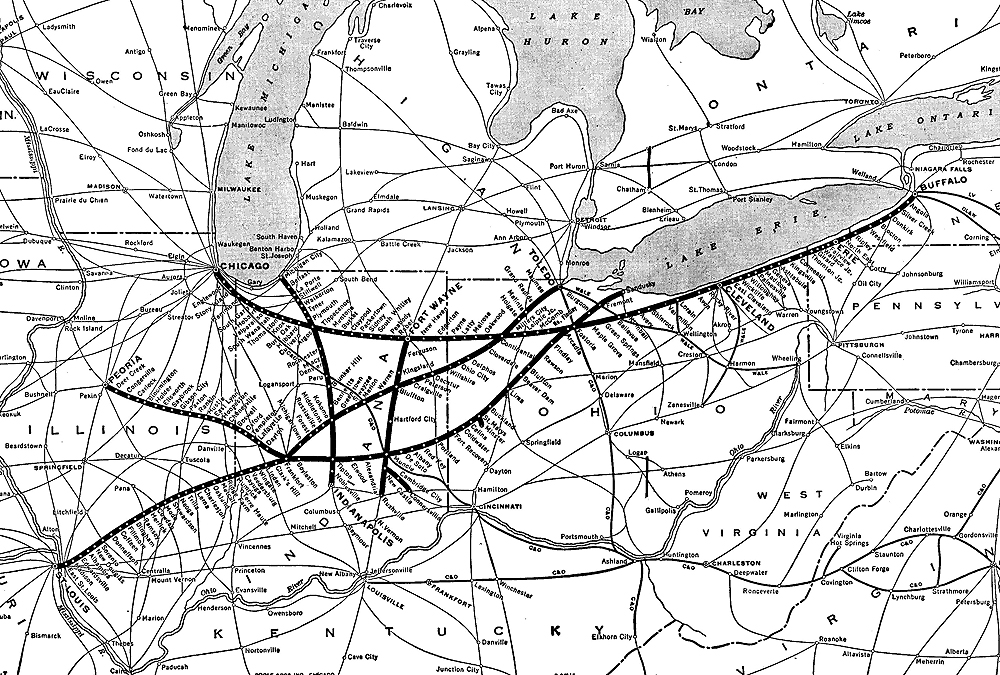
The New York, Chicago & St. Louis opened between Buffalo and Chicago on October 23, 1882, in many spots east of Cleveland just a stone’s throw from rival Lake Shore & Michigan Southern Railway. What would become the Nickel Plate became a Vanderbilt property in January 1883.
Although eclipsed by the Lake Shore’s plush limiteds, NYC&StL from 1893 fielded three unpretentious, reliable Chicago to Buffalo, N.Y., passenger trains, establishing a long-standing pattern of modest passenger service. In 1897, Delaware, Lackawanna & Western entered the picture, conveying NYC&StL cars from Buffalo to Hoboken, N.J.
“The great … Nickel-plated railroad”
When NYC&StL was being surveyed, Editor F. R. Loomis of Ohio’s Norwalk Chronicle waxed enthusiastically on the railroad coming to town referring to it as “the great New York and St. Louis double-track, nickel-plated railroad.” Use of “Nickel Plate Road” proliferated, in newspapers and by the road itself.In 1914, LS&MS and Nickel Plate were wards of New York Central. Passage of the Clayton Act that same year was intended to bolster the earlier Sherman Antitrust Act, and left NYC with a dilemma. Enter brothers Oris P. and Mantis J. Van Sweringen, self-made Cleveland real-estate developers who purchased acreage from NYC Vice President Alfred H. Smith. “The Vans” as the brothers were known, approached Smith, by then NYC president, to discuss their plans involving land owned by the Nickel Plate. As the Clayton Act’s divestiture deadline loomed, Smith engineered a sale to the Vans of not only the land they sought, but of the entire Nickel Plate Road. Their Alleghany Corporation holding company eventually included control of the Nickel Plate, Chesapeake & Ohio, Pere Marquette, Erie, Wheeling & Lake Erie, Chicago & Eastern Illinois, and Missouri Pacific.
The gaunt NYC&StL was ripe for re-equipping under its new owners. Addressing the Vans’ lack of railroad experience, Smith orchestrated John J. Bernet’s move from an NYC vice-presidency to be Nickel Plate’s president. Neglected physical plant and obsolete motive power received needed attention under Bernet, who reincarnated the road into a lean and aggressive contender.


Nickel Plate Road GP9 number 526 switching a way freight at Gibson City, IL on November 24, 1962.
Roger Puta photo from the Mel Finzer Collection via Wikimedia Commons.
February 5, 2020
QotD: The decline of Jazz
Most jazz musicians would agree. As the cliché goes, it’s one thing to do a show for your paying customers, playing what they expect and have paid to hear, but after the squares go home, you can stop blowing shit and make another kind of music altogether. Yet many musicians would also agree that, more often than not, it’s a lot more satisfying to play that personal kind of music than it is to sit and listen to it. Jazz musicians involved with each other in intimate creativity may well be negotiating their way to improvisational sublimity, but they’ve often left the audience out of the musical deal. This is a central but rarely acknowledged tension in Burns’ documentary treatment.
Charles Paul Freund, “Epic Jazz”, Reason, 2001-01-03.


