
Tasting History with Max Miller
Published 29 Jun 2021
(more…)
August 24, 2022
A History of Ice Cream | A Recipe from 1789
Comments Off on A History of Ice Cream | A Recipe from 1789
August 23, 2022
Progressives and the (always just-over-the-horizon) promise of fusion power
I was busy over the weekend, so I didn’t get a chance to post this from Severian at Founding Questions, but it’s still one of those things I wish I’d written:

Nuclear fusion breakthrough as “ignition” finally achieved
Woohoo. They’ve been promising us fusion power my entire life. I can’t even tell how many “breakthroughs” ago I stopped believing it. But since God has a sense of humor, this might actually be it. Wouldn’t that be hilarious? Finally we have pretty much limitless energy, for free… and there’s no fucking way the Left would ever allow it to come online. Because that would result in a massively increased standard of living for the average person, and that’s one thing the Left simply will not allow.
That was really the point of that “if I were rich” post the other day. I will admit up front that Envy has never really been a problem for me (for me, all the hit points that would’ve gone into Envy have been allocated to Gluttony, Sloth, and Lust). Nonetheless, I’ve never been able to understand the sheer pettiness of the Left. It doesn’t bother me that some people have more. Even if they don’t “deserve” it. Hey, them’s the breaks. And in fact, I even largely agree with the very old school Liberal idea of “progressive” taxation — the rich can afford to front their communities a little bit more money, provided it actually goes to the community.
But the PoMo Left is all-in on Envy. But it’s a weird kind of envy — like everything else in Clown World, it’s inverted. They don’t want to have more, themselves, personally — they want you to have less.
To the PoMo Leftist, the only possible point of being rich is to keep other people from having stuff. They don’t want you to eat the bugs because it’s better for the Earth. They want you to eat the bugs to keep you from eating steak. See what I mean? It’s not “you must eat bugs in order that they can have steak,” because of course they can already have steak. Rather: you also can have steak, and that’s bad. You shouldn’t be able to, you filthy prole. You don’t deserve to eat steak, because you’re not Enlightened like they are.
So with fossil fuels and all the rest. You don’t deserve to be able to fly places. If you must travel — you know, if they need your labor somewhere else — you should be down there in steerage. And so on, because that’s what you deserve, peasant. Free, limitless, clean energy would be nice … in the abstract. But since you people would just use it to run your air conditioners and whatnot, we’re going to store the Mr. Fusion machine in that big warehouse with the Ark of the Covenant.
Comments Off on Progressives and the (always just-over-the-horizon) promise of fusion power
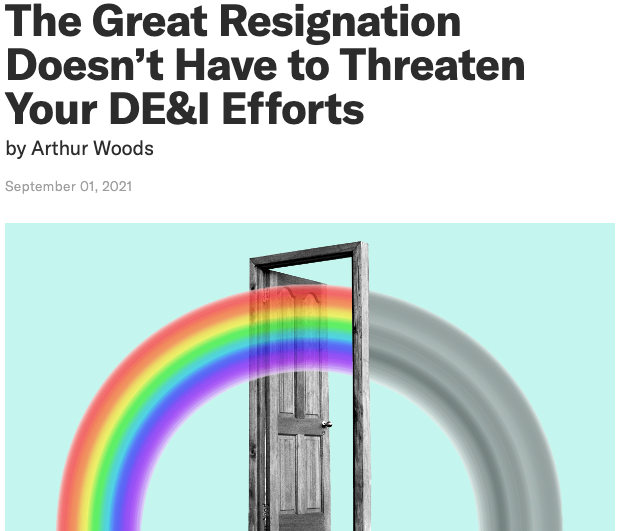
When the Great Reset turns into the Great Resignation, unexpectedly
Elizabeth Nickson is enjoying the spectacle of the Klaus Schwabs of the world being undermined by the rational actions of ordinary people:
Klaus Schwab’s slaves are quietly vanishing.
In the US, 52 million quit their jobs in 2022, which only added to the flood of 2021. 41% of the work force, when interviewed stated they were quitting, and another 38% were planning to. Mostly mid-career. That’s the ball game, baby, that is almost 80%. ABC Corp will be left with oldsters too tired to change and a bunch of kids looking to cash in and cash out as fast as possible.
Corporatists are in a bit of a flap, which is delicious to watch. Their Bible, the Harvard Business Review is scrambling to explain, to deconstruct, to propose ways to get them back, more money, more time off, more benefits. All of which would thrill trade unionists except that they won’t be getting their cut, their vig, their power base. No one is coming back, btw, Klaus, the UN and the CCP screwed the pooch, everyone knows about it, no censorship can hide the fact that their plans for us include pinning us in our matchboxes, hypnotizing us via screens and farming us like sheep with monthly allowances and Prime delivery of cricket paste.
HBR has therefore re-named this The Great Exploration, as a sop to the rapid individuation of the people they tried to turn into machines. Yeah, that’s not going to work either. No workshops from Tony Robbins, no retreats with Oprah, no courses, no sabbaticals, no Five Second Rule gal or Brene Brown explaining that investigating insurance claims is somehow spiritual, especially if you “fight” for the “rights” of the marginal, and give your next promotion to a person of color, preferably other sexed. Nope nope nope. It is over.
Target missed its earnings projections by 90%. Ninety percent. Ninety percent. The thing about being enmeshed in corporate culture is that you need a lot of stuff to be comfort yourself after the brutalism of your days. You can go home and wallow on your green mattress and lots of pillows with your achingly lonely pets. But when you’ve quit, and maybe sold your house and moved to a cheaper location and started farming, you don’t need more stuff, you have tasted freedom and a pox on all your big box stores. Instead of competitive co-workers, you have your dog, your family and friends, and an open road.
Bye-bye Black Rock. It looks like the hail Mary of ESG and DEI failed. In fact, it acted as a repellant. So obviously dishonest and a play to shame employees into submission, added to the manipulations of Covid, the lock-downs, the forced injections, the obvious sickening of your friends and family, bye bye.
I personally could not be more delighted, since I quit almost 20 years ago, reasoning that working in newsrooms was like entering a bee hive without protection. I look around my home place and there are a lot of eager new faces, young and thrilled, and loaded for bear.
Comments Off on When the Great Reset turns into the Great Resignation, unexpectedly
August 21, 2022
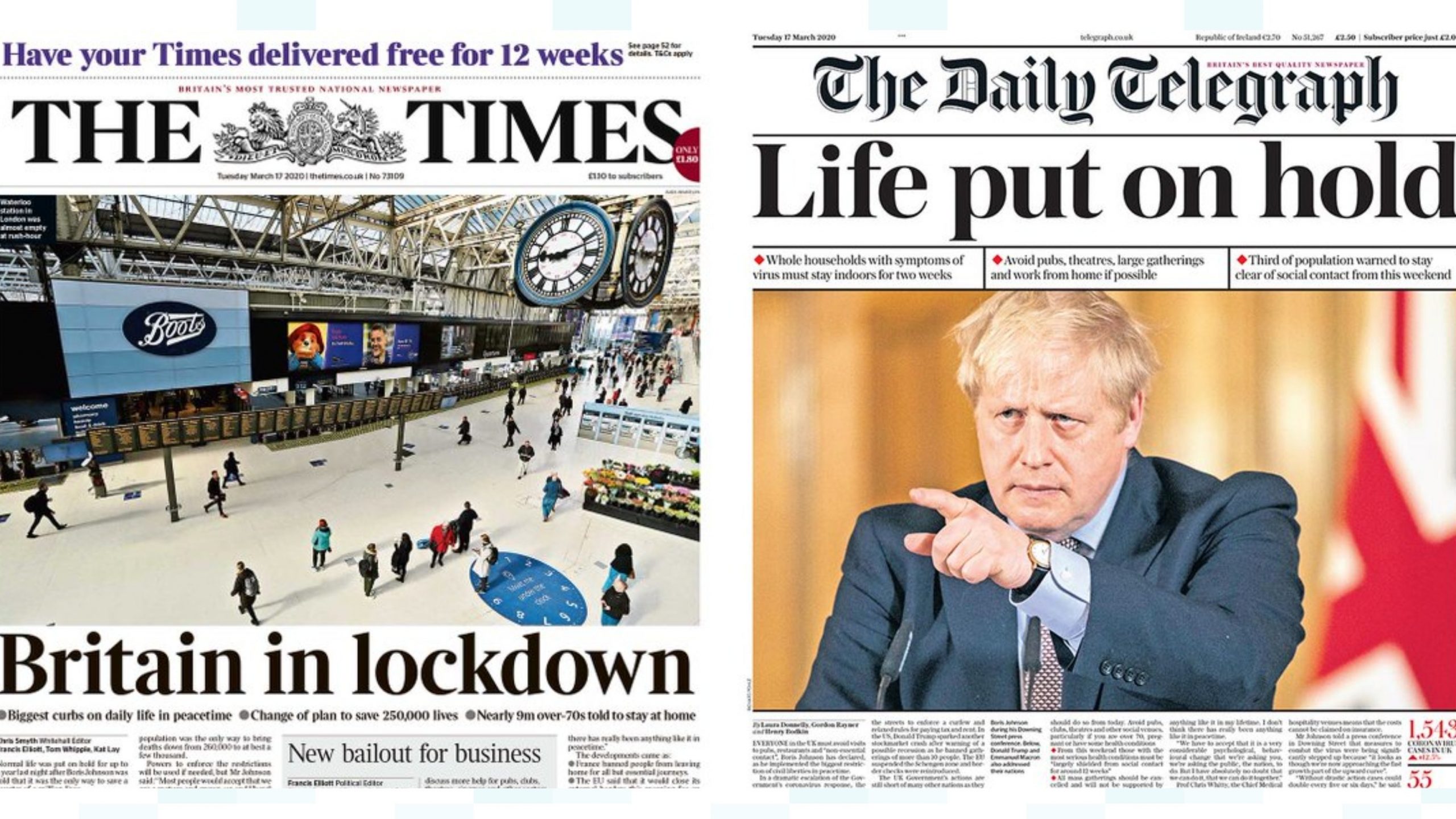
The pandemic lockdowns heralded the “worldwide end of the Nuremburg code”
At Samizdata, Perry de Havilland considers how British culture has been impacted by many of the worst notions coming out of American culture in the last few years:
… support for Brexit, by no means confined to the lumpenproletariat of Guardian reader’s imagination, might not indicate what purveyors of the high status opinion fondly imagine. The conflation of Brexit with the “Trump phenomenon” was always overblown, given the deep social and structural differences between UK and USA. Yes, we are influenced by America, but we are not the same in oh so many ways.
But western civilisation, not just Britain, is undeniably going through a very strange phase. The insane and demonstrably pointless covid lockdowns seem to have had a pressure cooker effect, with every -ism being dialled up several notches. The mainstreaming of transsexuality, a largely harmless hobby until a lunatic fringe grabbed hold of it, indicates the world is not running in well-oiled grooves. An inability to define “what is a woman?”, by sages and politicians who nevertheless expect to be treated as serious people, would have seemed implausible just a few years ago.
But the covid lockdowns, that is the “biggie”: an egregious abridgement of liberty & common sense that placed the global economy into repeated bouts of cardiac arrest. The worldwide end of the Nuremburg code.
The lockdowns were an even more polarising issue that Brexit or Trump or indeed anything else. Why? Because there was no opt-out, you could not just go to work, or visit granny, no ability to ignore the whole thing and just head down the pub or retire for a macha latte in some café. The effects of that will be enduring. That was the issue that taught a lot of people to fear what other people believe to be true, and people always hate what they fear.
Now just wait to see what happens when the green lunacy that stopped investment in reliable power supply and new reservoirs means we start running out of power and water. I suspect that will be what makes the cork finally blow off.
Comments Off on The pandemic lockdowns heralded the “worldwide end of the Nuremburg code”
Sicily Liberated; Italy in the Firing Line – WW2 – 208 – August 20, 1943
World War Two
Published 20 Aug 2022The British and Americans race for Messina to complete the conquest of Sicily — who will reach it first? On New Guinea, the Allies destroy a substantial Japanese air force; there are several major Allied air raids over Europe, the fighting in the USSR around Kharkov is brutal and costly for both sides, and a secret Allied leadership conference in Quebec begins to determine the course of the war. Busy week.
(more…)
Comments Off on Sicily Liberated; Italy in the Firing Line – WW2 – 208 – August 20, 1943
David McCullough, RIP
In the latest SHuSH newsletter, Kenneth Whyte remembers the late David McCullough:
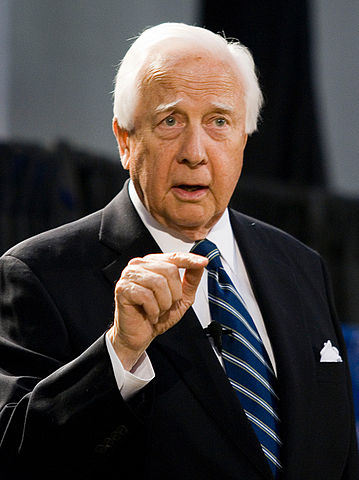
David McCullough speaking at Emory University, 25 April, 2007.
Photo by Brett Weinstein via Wikimedia Commons.
David McCullough died August 7 at the age of 89. He won Pulitzer Prizes for his biographies of John Adams and Harry Truman, National Book Awards for The Path Between the Seas, about the building of the Panama Canal, and Mornings on Horseback, a biography of young Theodore Roosevelt, as well as two Francis Parkman prizes (The Path, Truman) and the Presidential Medal of Freedom. He also enjoyed a prominent career as a broadcaster and several of his books were transformed into important television events, most notably HBO’s John Adams.
I read him closely over the years. Studied him, even. After finishing his major biographies — books that can’t fail to impress for their prodigious research and literary grace — I went back to his early work to trace how long it took him to develop into a master of narrative historical writing. I started at the beginning, The Johnstown Flood (1968), and was stunned to find that he was all there from page one. He had total command of his material and his story at the outset.
I wouldn’t call him a favorite writer. McCullough tended to play safe. He had a somewhat rosy view of American history: “I want to bring to life the best that can be found in the story of why we are the way we are and how we got to where we are.” He was so busy bringing the best to life that he seldom challenged his readers with the worst: truly repellant individuals or unredeemed national failure.
His subjects tended to be public-spirited men of noble character and hard-earned wisdom. He felt comfortable in their company. “It’s like picking a roommate,” he once said, explaining why he dropped the idea of a biography of Pablo Picasso. “After all, you’re going to be with that person every day, maybe for years, and why subject yourself to someone you have no respect for or outright don’t like?”
When the abhorrent forced its way into his stories, he tended to rationalize it. His formulation that Harry Truman’s decision to drop atomic bombs on Japan, killing hundreds of thousands of civilians, was a lesser evil necessary to prevent a greater evil (heavy American troop losses) may have got it exactly backward.
His paeans to American greatness even wore on American audiences in his later years. Reviews of The Pioneers, his 2019 account of the Euro-American settlement of the Ohio River valley, accused him of “romanticizing white settlement and downplaying the pain inflicted on Native Americans.”
I raise these issues not to speak ill of the dead but to say that McCullough is worth reading, and reading again, even if, like me, you’re part of the minority who can find him hard to take at times. (The majority love him: I’m not sure any historian has sold more books.)
I had the pleasure of meeting David McCullough in Toronto at an intimate lunch arranged by his publisher, Simon & Schuster. I interviewed him later for Macleans. He was a complete gentleman and an enjoyable companion, notwithstanding his many twice- and thrice-told stories (an occupational hazard for touring writers).
I was able to draw him out on various aspects of non-fiction craft, which he spoke well on. What follows are some of my favorite quotes from the interview along with several other things McCullough said about writing and one comment by another author, the great Candace Millard, about his work.
Comments Off on David McCullough, RIP
QotD: The “social responsibility” of the corporate executive
In a free-enterprise, private-property system, a corporate executive is an employee of the owners of the business. He has direct responsibility to his employers. That responsibility is to conduct the business in accordance with their desires, which generally will be to make as much money as possible while conforming to their basic rules of the society, both those embodied in law and those embodied in ethical custom. Of course, in some cases his employers may have a different objective. A group of persons might establish a corporation for an eleemosynary purpose — for example, a hospital or a school. The manager of such a corporation will not have money profit as his objectives but the rendering of certain services.
In either case, the key point is that, in his capacity as a corporate executive, the manager is the agent of the individuals who own the corporation or establish the eleemosynary institution, and his primary responsibility is to them.
Needless to say, this does not mean that it is easy to judge how well he is performing his task. But at least the criterion of performance is straight-forward, and the persons among whom a voluntary contractual arrangement exists are clearly defined.
Of course, the corporate executive is also a person in his own right. As a person, he may have many other responsibilities that he recognizes or assumes voluntarily — to his family, his conscience, his feelings of charity, his church, his clubs, his city, his country. He may feel impelled by these responsibilities to devote part of his income to causes he regards as worthy, to refuse to work for particular corporations, even to leave his job, for example, to join his country’s armed forces. If we wish, we may refer to some of these responsibilities as “social responsibilities.” But in these respects he is acting as a principal, not an agent; he is spending his own money or time or energy, not the money of his employers or the time or energy he has contracted to devote to their purposes. If these are “social responsibilities,” they are the social responsibilities of individuals, not business. What does it mean to say that the corporate executive has a “social responsibility” in his capacity as businessman? If this statement is not pure rhetoric, it must mean that he is to act in some way that is not in the interest of his employers. For example, that he is to refrain from increasing the price of the product in order to contribute to the social objective of preventing inflation, even though a price increase would be in the best interests of the corporation. Or that he is to make expenditures on reducing pollution beyond the amount that is in the best interests of the corporation or that is required by law in order to contribute to the social objective of improving the environment. Or that, at the expense of corporate profits, he is to hire “hardcore” unemployed instead of better qualified available workmen to contribute to the social objective of reducing poverty.
In each of these cases, the corporate executive would be spending someone else’s money for a general social interest. Insofar as his actions in accord with his “social responsibility” reduce returns to stockholders, he is spending their money. Insofar as his actions raise the price to customers, he is spending the customers’ money. Insofar as his actions lower the wages of some employees, he is spending their money.
Milton Friedman, “The Social Responsibility of Business is to Increase its Profits”, New York Times, 1970-09-13.
Comments Off on QotD: The “social responsibility” of the corporate executive
August 19, 2022
Why Quebec rejected the American Revolution
Conrad Black outlines the journey of the French colony of New France through the British conquest to the (amazing to the Americans) decision to stay under British control rather than join the breakaway American colonies in 1776:

Civil rights were not a burning issue when Canada was primarily the French colony of New France. The purpose of New France was entirely commercial and essentially based upon the fur trade until Jean Talon created industries that made New France self-sufficient. And to raise the population he imported 1,000 nubile young French women, and today approximately seven million French Canadians and Franco-Americans are descended from them. Only at this point, about 75 years after it was founded, did New France develop a rudimentary legal and judicial framework.
Eighty years later, when the British captured Québec City and Montréal in the Seven Years’ War, a gentle form of British military rule ensued. A small English-speaking population arose, chiefly composed of commercial sharpers from the American colonies claiming to be performing a useful service but, in fact, exploiting the French Canadians. Colonel James Murray became the first English civil governor of Québec in 1764. A Royal proclamation had foreseen an assembly to govern Québec, but this was complicated by the fact that at the time British law excluded any Roman Catholic from voting for or being a member of any such assembly, and accordingly the approximately 500 English-speaking merchants in Québec demanded an assembly since they would be the sole members of it. Murray liked the French Canadians and despised the American interlopers as scoundrels. He wrote: “In general they are the most immoral collection of men I ever knew.” He described the French of Québec as: “a frugal, industrious, moral race of men who (greatly appreciate) the mild treatment they have received from the King’s officers”. Instead of facilitating creation of an assembly that would just be a group of émigré New England hustlers and plunderers, Murray created a governor’s council which functioned as a sort of legislature and packed it with his supporters, and sympathizers of the French Canadians.
The greedy American merchants of Montréal and Québec had enough influence with the board of trade in London, a cabinet office, to have Murray recalled in 1766 for his pro-French attitudes. He was a victim of his support for the civil rights of his subjects, but was replaced by a like-minded governor, the very talented Sir Guy Carleton, [later he became] Lord Dorchester. Murray and Carleton had both been close comrades of General Wolfe. […]
The British had doubled their national debt in the Seven Years’ War and the largest expenses were incurred in expelling the French from Canada at the urgent request of the principal American agent in London, Benjamin Franklin. As the Americans were the most prosperous of all British citizens, the British naturally thought it appropriate that the Americans should pay the Stamp Tax that their British cousins were already paying. The French Canadians had no objection to the Stamp Tax, even though it paid for the expulsion of France from Canada.
As Murray and Carleton foresaw, the British were not able to collect that tax from the Americans; British soldiers would be little motivated to fight their American kinfolk, and now that the Americans didn’t have a neighboring French presence to worry them, they could certainly be tempted to revolt and would be very hard to suppress. As Murray and Carleton also foresaw, the only chance the British would have of retaining Canada and preventing the French Canadians from rallying to the Americans would be if the British crown became symbolic in the mind of French Canada with the survival of the French language and culture and religion. Carleton concluded that to retain Québec’s loyalty, Britain would have to make itself the protector of the culture, the religion, and also the civil law of the French Canadians. From what little they had seen of it, the French Canadians much preferred the British to the French criminal law. In pre-revolutionary France there was no doctrine of habeas corpus and the authorities routinely tortured suspects.
In a historically very significant act, Carleton effectively wrote up the assurances that he thought would be necessary to retain the loyalty of the colony. He wanted to recruit French-speaking officials from among the colonists to give them as much self-government as possible while judiciously feeding the population a worrisome specter of assimilation at the hands of a tidal wave of American officials and commercial hustlers in the event of an American takeover of Canada.
After four years of lobbying non-stop in London, Carleton gained adoption of the Québec Act, which contained the guaranties he thought necessary to satisfy French Canada. He returned to a grateful Québec in 1774. The knotty issue of an assembly, which Québec had never had and was not clamoring for, was ducked, and authority was vested in a governor with an executive and legislative Council of 17 to 23 members chosen by the governor.
Conveniently, the liberality accorded the Roman Catholic Church was furiously attacked by the Americans who in their revolutionary Continental Congress reviled it as “a bloodthirsty, idolatrous, and hypocritical creed … a religion which flooded England with blood, and spread hypocrisy, murder, persecution, and revolt into all parts of the world”. The American revolutionaries produced a bombastic summary of what the French-Canadians ought to do and told them that Americans were grievously moved by their degradation, but warned them that if they did not rally to the American colours they would be henceforth regarded as “inveterate enemies”. This incendiary polemic was translated, printed, and posted throughout the former New France, by the Catholic Church and the British government, acting together. The clergy of the province almost unanimously condemned the American agitation as xenophobic and sectarian incitements to hate and needless bloodshed.
Carleton astounded the French-Canadians, who were accustomed to the graft and embezzlement of French governors, by not taking any payment for his service as governor. It was entirely because of the enlightened policy of Murray and Carleton and Carleton’s skill and persistence as a lobbyist in the corridors of Westminster, that the civil and cultural rights of the great majority of Canadians 250 years ago were conserved. The Americans when they did proclaim the revolution in 1775 and officially in the Declaration of Independence on July 4, 1776, made the British position in Canada somewhat easier by their virulent hostility to Catholicism, and to the French generally.
Comments Off on Why Quebec rejected the American Revolution
How Accurate is Saving Private Ryan? – WW2 D-Day Special
World War Two
Published 16 Aug 2022How accurate is that famous beach scene in Saving Private Ryan? Is it true to the history or just another Hollywood story? Seeing as we’re about to start the filming for our massive D-Day project, we figured we’d break it down, shot by shot.
(more…)
Comments Off on How Accurate is Saving Private Ryan? – WW2 D-Day Special
“This is her advice: Get Married and Make Sure You Stay Married”
Elizabeth Nickson was a feminist entrepreneur (although I’m sure she would not have used that word to describe herself) in her early 20s, earning money to support herself by pushing feminist ideology through theatrical performance and running consciousness raising sessions. It was, as she says, “fashionable”. She now realizes that the changes to sexual belief and behaviour led directly to the modern “hook-up” culture young people now have to navigate to find relationships:

A new book, the Case Against Sexual Revolution, A New Guide to Sex in the 21st Century, written by Louise Perry, a young writer for the New Statesman is published at the end of this month. Perry volunteers in rape centers, and works for the campaign group We Can’t Consent To This, which documents cases in which UK women have been killed and defendants have claimed in court that they died as a result of ‘rough sex’.
This is her advice: Get Married and Make Sure You Stay Married.
Dramatically well-argued and sourced, Perry goes through every “innovation” in the sexual space and demonstrates without flinching, that all of it, all of it, privileges a particular subset of male, the sociosexual male – the kind that preferences quantity over quality – and not only that the worst kind of sociosexual male. The kind who like choking women, the rapists, abusers, serial womanizers, the pedophiles, the pimps, and the traffickers.
Decades later, says Perry, the mothers and grandmothers of 2nd and 3rd stage feminism have created hook-up culture as the near exclusive method of finding a mate. She details the unassailable fact that women, by their very nature, by their evolutionary history, and their specific biology are victimized in every move of hook-up culture, which ruthlessly uses their femininity, their gentleness, kindness, and agreeableness against them. It coarsens men, inflames their worst natures and has turned the netherworld of the sexual marketplace into a vicious free-for-all, a Darwinian thrash-hunt of the most vulnerable.
Everyone is hurt by it. Without exception.
I live in a place socially advanced, jokingly known as the end of the hippie trail. It is prosperous because it is one of the most beautiful places in the world. But, because it is environmentally advanced, our population is aging. The young and busy cannot start businesses or families here, because the environmental regulation is so strict, they cannot afford it. The human wreckage of the sexual revolution, therefore, is on full display. The streets and markets are littered with broken older men and women, long divorced or separated, the women especially living on crumbs, alone and destined to die alone, many without family. Hey, but their 20s and 30s were free. They got to have sex with dozens, if not hundreds of gorgeous men or women. And they used all the drugs.
If you look hard enough, you will see the same people drifting along the margins of every city and town. Break sexual norms, you break the family, and then you break the culture. What is left is pitiable.
Perry makes the point that I have tried to make hundreds of times in the past 20 years. So many of the political aims of upper-middle-class work for them, but for no one else. They are luxury beliefs. Upper-middle-class mothers do not send their gorgeous teens away to college now without very stern warnings about what might happen to them. Without a full delineating of the horrors that attend hooking up. But the less advantaged, those who swallow the propaganda of the culture do not.
Comments Off on “This is her advice: Get Married and Make Sure You Stay Married”
The DeLorean Story
Big Car
Published 5 Jan 2020There’s much more to the DeLorean Motor Company than Doc’s 88mph time machine in Back to the Future. It’s a story of a playboy founder with a meteoric rise, a story of hope and regeneration in an area torn apart after a decade of fighting, and of a cocaine smuggling fall from grace. Yes, this story has it all!
(more…)
Comments Off on The DeLorean Story
August 18, 2022
The Communist Spies in America’s Atomic Program – WW2 – Spies & Ties 22
World War Two
Published 15 Aug 2022The NKVD have wormed their way into British society. Across the pond, America is also teeming with communist spies. They’re in the government, military, even OSS, and the FBI. Now they’re going for the biggest secret of all – the atomic bomb.
(more…)
Comments Off on The Communist Spies in America’s Atomic Program – WW2 – Spies & Ties 22
The acute lack of numbers in every climate debate
The Grumpy Economist notes that every discussion of laws and regulations “to tackle climate change” only ever seem to cover one side of the issue — how much your taxes will go up and how much more your life “needs” to be regulated to “save the planet”. The almost universally lacking numbers are the expected benefits of the law or regulation in climate terms:
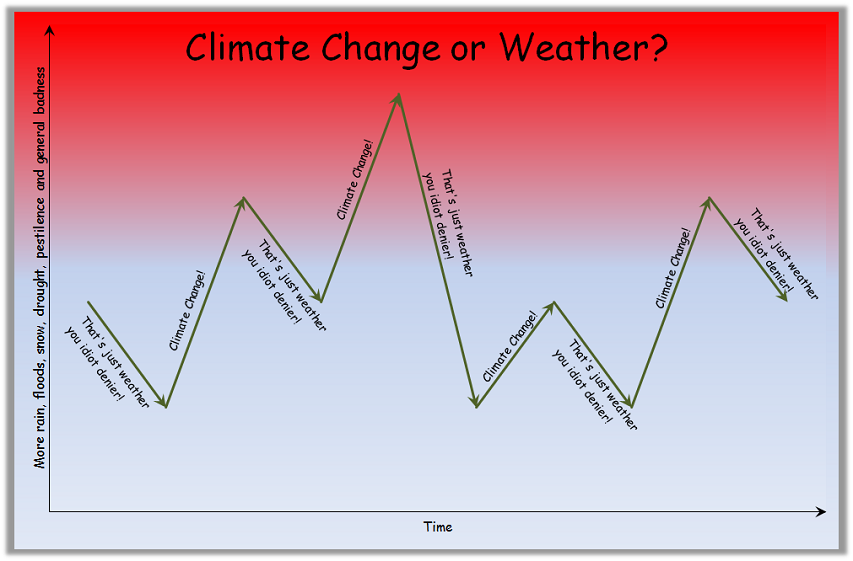
Most legislation or regulation that spends hundreds of billions of dollars aimed at a purpose is extensively analyzed or scored to that purpose. OK, the numbers are often, er, a bit unreliable, but at least proponents go through the motions and lay out assumptions one can examine and calculate differently. Tax and spending laws come with extensive analysis of just how much the government will make or spend. This is especially true when environment is concerned. Building anything requires detailed environmental assessments. An environmental review typically takes 4.5 years before the lawsuits begin.
In this context, I’m amazed that climate policy typically comes with no numbers, or at least none that I can find readily available in major media. We’re going to spend an additional $250 billion or so on climate policies in the humorously titled “inflation reduction act”. OK, how much carbon will that remove, on net, all things included, how much will that lower the temperature and when, how much and when will it quiet the rise of the oceans?
Finally, I have seen one number, advertised in the Wall Street Journal,
Our contributor Bjorn Lomborg looked at the Rhodium Group estimate for CO2 emissions reductions from Schumer-Manchin policies. He then plugged them into the United Nations climate model to measure the impact on global temperature by 2100. He finds the bill will reduce the estimated global temperature rise at the end of this century by all of 0.028 degrees Fahrenheit in the optimistic case. In the pessimistic case, the temperature difference will be 0.0009 degrees Fahrenheit.
Bjorn’s twitter stream on the calculation.
Maybe you don’t like Bjorn’s numbers and the IPCC model. (Not exactly a right-wing operation). Maybe you don’t like the Rhodium group’s analysis. A quick reading left me the impression its thumb might be on the wildly over-optimistic side of what this rathole of pork can produce, and of experience with what the similar past ratholes have produced:
Our preliminary estimate is that the IRA can cut US net greenhouse gas emissions down to 31% to 44% below 2005 levels in 2030—with a central estimate of 40% below 2005 levels — compared to 24% to 35% under current policy. The range reflects uncertainty around future fossil fuel prices, economic growth, and technology costs. It will also meaningfully reduce consumer energy costs and bolster US energy security over the medium-term,
10% of 2005 levels is a lot. Subsidies reduce consumer costs, but not the cost to society overall. Clever. How one can claim that clamping down on fossil fuels and subsidizing windmills and solar panels helps energy security with the German example before us is a good question. Bjorn’s point is that even with this immense thumb on the scale, the actual climate benefit is tiny. If you disagree, fine, produce some alternates.
(BTW, politicians who tell you we need to do something about climate to turn off heat waves and stop forest fires are either lying or profoundly ignorant. Nothing even Greta Thunberg proposes will actually lower temperatures in our great grandchildren’s lifetimes. Read carefully, “reduce the temperature rise“. Not “reduce temperatures”.)
Comments Off on The acute lack of numbers in every climate debate
QotD: Nostalgie de la boue
Nostalgie de la boue (French: “nostalgia for mud”) is the attraction to low-life culture, experience, and degradation, found at times both in individuals and in cultural movements … Tom Wolfe described a party in New York in 1970: “It was at this party that a Black Panther field marshal rose up beside the north piano — there was also a south piano — in Leonard Bernstein’s living room and outlined the Panthers’ ten-point program to a roomful of socialites and celebrities, who, giddy with nostalgie de la boue, entertained a vision of the future in which, after the revolution, there would no longer be any such thing as a two-story, thirteen-room apartment on Park Avenue, with twin grand pianos in the living room, for one family.”
I think TWS is right:
It explains everything from those parties where they pretend to eat people and the Podesta brothers love of pedo-murder art to the Jersey Shore and all rap music. People of Wal-Mart and people who enjoy mocking them. The idea covers everything happening.
Back in the days, they called all that “authenticity”. The Working Man ™ was supposed to have an “authenticity”, a raw experience of life, that the Intelligentsia did not, so the Intelligentsia made it their mission to ape “authentic” proletarian manners and mores. That’s why every self-styled “Intellectual” since Marx has carried on like an unbathed schizophrenic hobo — they think they’re being “authentic”.
It never occurs to them that this is grossly insulting to The Workers they’re supposedly helping, because of course they never ever meet any Workers — they imagine how they think a longshoreman would act, and then go do that.
I have far more respect for “the People of Walmart” than I do for those who make fun of them, because “the People of Walmart” have been beaten down and brutalized by the dominant culture. They’ve had all their self-respect kicked out of them by little college snots with Gender Studies degrees. It’s like the peasantry in pre-Revolution Russia: Everything the intellectuals said about the nobility was true … but everything the nobility said about the serfs was also true. It was a chicken-and-egg problem with no solution save one.
I also have some respect for Walmart as an institution. Yeah, I know, it’s cheap Chinese shit, but trust me: Though I didn’t grow up poor, you could see “poor” from my house for a lot of my childhood. I don’t recall having Walmart back then, but K-Mart’s Blue Light Specials improved our day to day quality of life enormously. And when I first got out on my own, I decorated my entire first apartment in Walmart — it wasn’t fancy, but it worked, and I had a hell of a lot more stuff that I could actually use than I ever could’ve afforded any other way.
You want to make fun of Walmart, and the people who shop there? Ok, fine, motherfucker, but first try living in a trailer where your couch is patched up with duct tape, and go to school wearing your California cousins’ hand me down clothes, so that you’re dressed like a surfer when you’re 500 miles from the nearest ocean.
I will never, ever understand this. You can choose to be ugly, and to surround yourself with ugliness. Or you can choose NOT to do that. Why would anyone pick the former?
Severian, “Friday Mailbag”, Founding Questions, 2022-05-13.
Comments Off on QotD: Nostalgie de la boue
August 17, 2022
“It’s weird what happens when you choke off people’s ability to make a living”
Elizabeth Nickson offers to decode the latest war cry from the great and the good, the well-meaning, the deluded, and the modern-day fellow travellers (who are still useful idiots):
The political circus is gripping, the play before us hypnotic. Audience members drop in, forswear the brutalism of it and go back to their lives, refusing engagement, refusing to look. That’s what it’s for, to alienate you from the real stuff that goes on in the middle of nowhere, where I live.
[…]
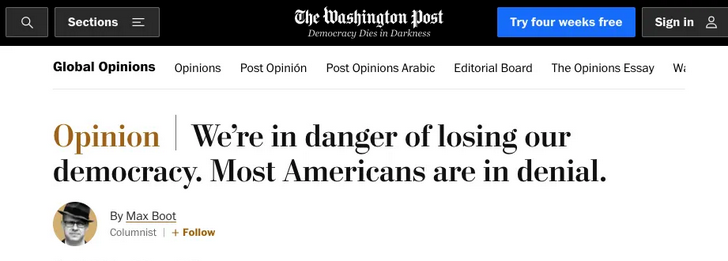
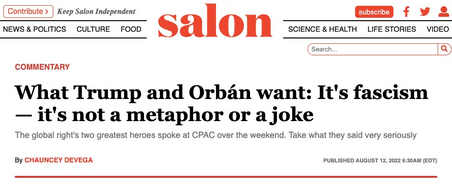
This is a slogan that has been picked up by every operative in every western democracy. State legislators appear on MSNBC frantic with fear, wall-eyed, saying the right is stealing democracy.
Expect to hear this ceaselessly for the next three years. Every hour of every day.
This is what they really mean:
When I moved to the middle of nowhere twenty years ago, I became fascinated with local politics. It seemed that there were a lot of little groups, attached like sucker fish to the giant tax eating behemoth that slid through our lives. Their aims were simple and seemingly good hearted, more waterbird protection, more water protection, more tree protection, more protection of the other sexed, more goodness towards and immigration of the huddled masses in South and Central America, more legislated feminist demands, endless demands of the schools by advocacy groups funded by teachers unions, and of course, stopping all development and industrial production because of climate change. They all had groups, they all lived on little bits of money, they were always harried and despairing. They fought a tight game. Small advances, lots of setbacks. Mostly innocent, though the enviro people had deep-buried terrorist groups who created lovely fires for any developer who particularly crossed them. But otherwise, you could invite them to tea with the Queen.
Twenty years on, they flourish with budgets of seven or eight figures, most of which they receive from the various governments they lobby, but also from the world’s greatest foundations, not to mention substantial funding from the EU, the WEF and the UN. And they are in every capital, waking up every morning for one reason: to force the government to cave to their needs. They are always attached to the bigger of the left-wing parties, who fund them big time. In the US it is the Democrats. In Canada, the Liberal Party. They are paid to act as political action committees, while posturing as neutral advocacy groups. They write legislation. And boy, have they written legislation. They developed a thousand, thousand committees which have methodically re-written laws from the extreme local to national.
The ones I met were upper-middle-class, from nominally Christian households, who had been captured by the socialist dream. They called what they did a new iteration: participatory democracy. Leaders were from Britain or the US. Those seemed the most aggressive. More connected. Very little work has been done on their unnerving connectedness. Most reporters agree with their task, don’t want to dig.
The reason they called it participatory democracy was because they were participating. It seemed no one else was, other than business needing a rule change or permit, so they had free rein. And, to give them credit, they did change the culture. It is rare to find a soul who does not support equality of the sexes, the protection of the environment, acceptance of the other-sexed, pity for the huddled masses in the south and an anxious wish for people of colour to do well.
But then … the German Malthusian Eugenicists at the WEF realized they could fund them and bend them to their purpose. With 100x the power, the good kids went rogue. The goal was to break the power of the American middle class in order to save the climate. To disenfranchise them, to de-legitimize them, to identify them as racist, sexist, homophobic and patriarchal. To de-pluralize them. To drive them to the margins. It was, frankly, an adoption of evil, an adoption of kill-to-save.

Comments Off on “It’s weird what happens when you choke off people’s ability to make a living”


