
World War Two
Published 14 Aug 2022The reality of war finally seeps through to the majority of Germans, and it didn’t match up with the propaganda. Meanwhile resistance is increasing, and part of that is a classic money carriers when the Polish Home Army robs a money transport.
(more…)
August 17, 2022
Amazing Money Heist by Polish Resistance – WAH 073 – August 14, 1943
Comments Off on Amazing Money Heist by Polish Resistance – WAH 073 – August 14, 1943
QotD: Larry Correia’s proposal for a DoFYJS
A well known, yet denied, truth is that most government employees are entrenched and don’t do shit. They’re utterly useless.
Depending on the department you could fire a ton of them and all it would do is free up parking spaces.
Now, there are some government employees who work their asses off. Good. There are some government functions which are necessary. Great.
A great many don’t work, or the work they do is utterly pointless.
Ask any honest gov employee. They will admit this to you in private.
If they say no, everything we do is vital and everyone here is vital, they’re a liar protecting their budget, or one of the useless ones.
Most places, if there are 5 employees, 2 do 90% of the work.
Pournelle’s Iron Law says that as it grows over time any bureaucracy’s purpose will change from its original mission, to a new mission of protecting and growing the bureaucracy.
So now our Department of Labor by itself is bigger than LBJ’s entire federal government. This stuff never shrinks. It only grows. It’s an endless Leviathan.
The Leviathan needs to grow and protect itself against all threats, which is how you get super evil shit like the CIA and FBI meddling in US elections …
Or constantly expanding its powers into new places, like the #MinistryOfTruth
This Leviathan will find allies which help it expand in size and power. The more power/money you give it, the more it can bribe and co-opt other institutions. Academia, media, corporations, etc.
Whichever political philosophy is the most unprincipled will rock this arrangement
As the Leviathan grows in power, it will become more malicious, spiteful, and controlling. Dissent is crushed. Freedom dies.
@elonmusk is currently a speed bump in this, which is why the control freak contingent is super pissed at him.
The big question is, do the people own their government, or does the government own its people? If we are just assets of the gov, we can be spent freely, and bad assets get eliminated.The Leviathan is compelled to own EVERYTHING.
Slowing the Leviathan down isn’t enough. If you concentrate on stopping one part, others keep growing. Then when our bipolar country elects a new leader, those parts start growing again. Repeat forever. And it just keeps getting bigger.
So we’ve got to shrink the whole thing
If the GOP had a brain/spine (lol) they’d slash the shit out of everything. They’d starve the beast. They usually don’t, because they are total chickenshits. They’ll pay lip service to this, do nothing, or feed their favorite parts.
The DNC gleefully feeds the whole thing.
Trump’s biggest weakness was he surrounded himself with people who loved government, and loved expanding government. Of course all of those fucked him at every opportunity.
We need somebody who actively HATES the government to run it.
If I was President (ha!) I would only create a single new executive branch entity. The Department of Fuck Your Job Security.
The DoFYJS would consist of surly auditors, and their only job would be to go into other government agencies to figure out-
A. do you fuckers do anything worth a shit?
B. which of you fuckers actually get shit done?Then fire everyone else.
Right now it is pretty much impossible to fire government employees. The process is asinine. It is so bad that the worst government employees, who nobody else can stand, don’t get fired. They get PROMOTED. It’s easier, and then it’s somebody else’s problem.
But the DoFYJS don’t care. If your job is making taxpayers fill out mandatory paperwork and then filing it somewhere nobody will ever read it?
Fuck you. Gone. Clean out your desk.
We need to get rid of entire agencies. Gone. WTF does the Department of Education improve? NOTHING.
Gone. Fire them all. Sell the assets.
Any agency that survives this purge, move it out of DC to an area more appropriate to its mission. Do we need a Dept of Agriculture? Okay. Go to Kansas.
This will also cause all the DC/NOVA powermonger set to resign so I don’t have to waste time firing them
Oh, and right wing pet causes, you’re not safe. I worked for the Air Force. We all know that we could fire 1/3 of the GS employees tomorrow and the only noticeable difference would be more parking available on base.
Cut everything. We never do, because somebody might cry. Too bad. They’re called budget cuts because they’re supposed to hurt. Not budget tickles. Fuck you. Cut.
Shutting off the money faucet will also destroy the unholy alliance between gov/media/academia/tech.
Right now there is a revolving door, government job, university job, corporate board, think tank, the same crowd who goes to the same parties and went to the same schools and all that other incestuous shit just take turns in the different chairs.
Sell the fucking chairs.
Every entity that gets tax money inevitably turns into a pig trough for these people. Cut it all off. All of these money faucets ALWAYS cause some kind of financial crisis later anyway.
See the student loan crisis caused by the government, here is free money, oh college has become expensive and useless, so now we need more government to solve it. You dummies get to pay for it. Have some inflation.
It’s all bullshit.
Quit pretending any of this makes sense.
The only way the Leviathan shrinks is we elect people who actively hate the government to the government, and then only let them stay there long enough to fuck the government without getting corrupted by it.
The instant you see the small government crusader you sent to DC going “Oh, well maybe an unholy alliance between the state and OmniGlobalMegaCorp to develop a mind control ray is a good thing” FIRE HIM.
So there you have it. That’s my platform if you elect me president. Fire fucking everybody. And only give me one term. Thank you.
Larry Correia, portion of a Twitter thread reposted at Monster Hunter Nation, 2022-05-11.
Comments Off on QotD: Larry Correia’s proposal for a DoFYJS
August 16, 2022
Manstein Goes Great War Style – WW2 – 207 – August 13, 1943
World War Two
Published 13 Aug 2022From Sicily to Spas-Demensk, the Axis continue conceding ground to the Allies this week. But the fighting is still tough. The Wehrmacht has halted the Red Army offensive in the Kuban, and the British and American armies have neither the strength nor the willpower to press the advantage against Axis troops retreating to the Italian mainland.
(more…)
Comments Off on Manstein Goes Great War Style – WW2 – 207 – August 13, 1943
“Penguin Random House is a vampire corporation”
Belatedly, as I was away for the weekend, here’s something from the latest SHuSH newsletter on the Random Penguin court case:

At the beginning of the millennium, Random House (pre-Penguin) had revenues of $2.3 billion (all US figures) and a profit margin of 9 per cent. At the end of the aughts, it had revenues of 2.3 billion and a profit margin of 9 per cent. It was the biggest publishing company on the planet but it had ceased to grow.
Growth matters, especially to Random House’s parent company, Bertelsmann SE, a public company. People buy shares in publicly listed companies because they believe the entity will grow and produce larger profits in the future, making the share price rise and the investor happy. That is the whole game for public companies.
When an asset at a public company does not contribute to growth it is dead weight. It needs to be fixed or jettisoned.
Bertelsmann decided to fix Random House. In 2012, it struck the richest deal in book publishing history, acquiring 53 per cent of Penguin Books, which it then merged with Random House to make the biggest publisher even bigger.
It was said at the time that the two publishers, with combined revenues of $3.9 billion, would be able to share costs, attract better talent, take more risks, offer new products, develop new markets, and otherwise innovate. Together they would have the scale to stand up to bookselling chains like Barnes & Noble and the massive digital players, Amazon and Apple.
It was a lot of hype, of course. Random House had its pick of talent, all the size it needed to negotiate with Barnes & Noble, and it would never be in the same league as Amazon. Markus Dohle, CEO of Penguin Random House, is lucky to get a mid-level account manager on the phone at Amazon.
But the deal went ahead and expectations for the new Penguin Random House were sky high. They had to be. Bertelsmann’s purchase price valued Penguin at $3.5 billion, or more than twenty times its annual profits of $171 million. Penguin Random House would have to be far more than the sum of its parts to justify that price.
Over the next several years, Bertelsmann doubled down on its bet, scooping up the remaining 47 per cent of Penguin in two separate transactions to eventually own it outright.
Did any of the anticipated magic happen?
The first full year of a combined Penguin Random House was 2014. Revenues were about $4 billion, and that’s where they’ve been ever since (leaving aside a nice bump in 2019, the year of Michelle Obama). Profits are up, which might be considered a good sign. But they didn’t grow as a result of the combined firm’s increased scale, new competitive muscle, better talent, new markets, new products, or innovations. As far as I can tell, the improved profitability was achieved the old-fashioned way: the payroll shrunk from a high of 12,800 to 10,800. Also, e-books and audiobooks improved the profitability of all publishers. And the Obamas each knocked one out of the park.
The point is that seven years down the road, Penguin Random House remained exactly the sum of its parts, minus 2000 workers. The acquisition was a big-time bust. Most of the $3.5 billion purchase price was wasted.
Comments Off on “Penguin Random House is a vampire corporation”
Nimble, Sleek, And Almost Useless In A Real Fight; the story of the Canadair CF-5 Freedom Fighter
Polyus Studios
Published 8 May 2021Don’t forget to like the video and subscribe to my channel!
Support me on Patreon – https://www.patreon.com/polyusstudiosThe multi-role CF-5 was intended to replace the nuclear-armed CF-104 Starfighter and CF-101 Voodoo squadrons with a conventional warfighter. However, as an air superiority fighter, it was useless against all but the oldest relics in the Warsaw Pact arsenal. It fared little better as a close air support tactical fighter, thanks to its short range, relatively small weapons load, lack of all-weather navigation, and its inability to survive in a sophisticated, integrated air defense environment. Despite this, 240 were built in Canada and served with the Canadian Armed Forces for 27 years, not as a replacement for the existing fleet, but as an addition to them no one in the military seemed to really want. So why did Canada operate the CF-5? As you might well have assumed, the story behind the acquisition and operation of the CF-5 is a complicated one.
(more…)
Comments Off on Nimble, Sleek, And Almost Useless In A Real Fight; the story of the Canadair CF-5 Freedom Fighter
August 14, 2022
QotD: The 2016 US election was a rejection of the media
The rise in support isn’t the surprising part. The surprising part is that the Media still find this surprising.
Not to toot my own horn too much here, but I’ve been writing about this since 2015 … “Make America Great Again” was the Trump campaign’s official slogan, but unofficially — and much, much more effectively — it was: “Fuck the Media”. The 2016 election is known far and wide as “The Great Fuck You”, but somehow, some way, almost everyone still fails to grasp that it wasn’t the Democrats who got told to fuck off. It wasn’t even the “Progressives”. It was The Media. The Great Fuck You was aimed entirely at the Media.
Severian, “Which Hand Holds the Whip?”, Rotten Chestnuts, 2019-07-17.
Comments Off on QotD: The 2016 US election was a rejection of the media
August 13, 2022
Tired – Orange Man Bad. Inspired – Orange Man Radioactive!
Jim Treacher isn’t a Trump fan, didn’t vote for him, and even he is being coerced into very grudging support of the man, thanks to the incredibly ham-handed things the US federal government has been doing:
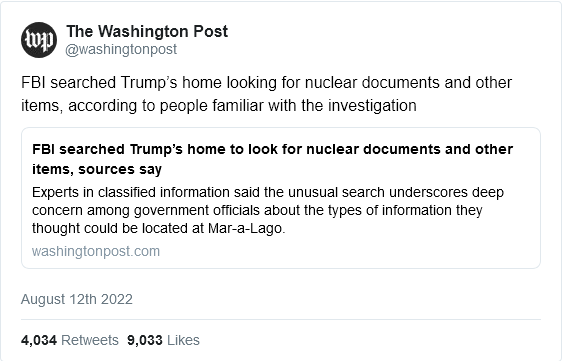
Our moral, ethical, and intellectual betters are now scolding us for referring to the FBI’s search of Mar-a-Lago as a raid. We’re not supposed to call it a raid. Which means, of course, it was definitely a raid.
We still don’t know what they were looking for during this raid. Or do we?
Oh.
Wait.
What?
Nuclear documents? What, like launch codes? Schematics? Locations? What are we talking about here?
What did they think the guy was going to do with this stuff? Is any of it even current? Don’t they change the launch codes every day? And nobody missed these documents for 18 months? What’s the danger here?
Call me a RINO cuck turncoat all you want, but I don’t trust the government, no matter who’s running it. I had to learn that the hard way when the State Department crippled me for life and then lied their asses off about it. That’s what bureaucracies do. They protect themselves at all costs, and the truth is the first thing to go by the wayside.
Sounds like that’s what’s happening here. They really screwed up this time, and now they’re panicking.
It’s been seven years since You-Know-Who rode down that escalator and threw his hat into the ring, and the Democrats have learned absolutely nothing. The more they try to hurt this guy, the more they end up helping him. Now they’re galvanizing the right behind him. Even traitors like me, who think 1/6 was bad and probably wanted Hillary to win, are incredulous that they’re abusing their power like this.
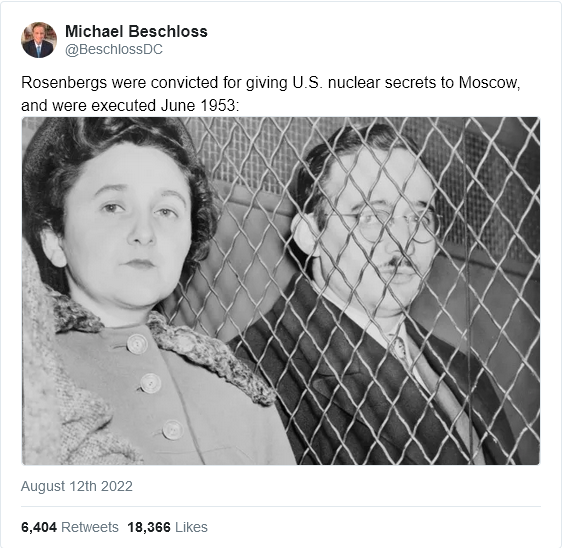
It’s already backfiring, but at least the libs can still air out their bloodthirsty fantasies:
They really do believe that’s what he did. They really do believe that’s what will happen to him. Or at least they’re willing to pander to their insane followers on social media.
Comments Off on Tired – Orange Man Bad. Inspired – Orange Man Radioactive!
Mysterious Home Features No Longer Used
Rhetty for History
Published 22 Apr 2022Home designs have changed a lot over the years and so have the features. In this video we will take a look at some of the mysterious features no longer used in new homes. You may run across these if you purchase an old home or you visit one.
(more…)
Comments Off on Mysterious Home Features No Longer Used
August 12, 2022
Apple, afterwards
In Quillette, Jonathan Kay looks at Apple after the death of Steve Jobs:
In 2004, Apple co-founder Steve Jobs asked famed author Walter Isaacson to write his biography. It’s a mark of Jobs’s hallowed place in the pantheon of American corporate titans that Isaacson, whose other subjects included Henry Kissinger, Benjamin Franklin, and Albert Einstein, would eventually say yes. While best-selling books about successful business leaders represent a popular niche, most specimens are fawning airport reads that combine hagiography with self-help advice for aspiring entrepreneurs. Isaacson’s Steve Jobs (2011), by contrast, was a serious work of literary non-fiction that exalted its subject as a once-in-a-generation technological savant, while also showing him to be a callous parent and scathing boss, not to mention a proponent of loopy “fruitarian” medical theories. (Much has been made of Jobs’s use of fringe therapies to treat the pancreatic cancer that killed him in 2011, but he also entertained the bizarre belief that his vegan diet allowed him to avoid bathing for days on end without developing body odour, a proposition vigorously disputed by co-workers.)
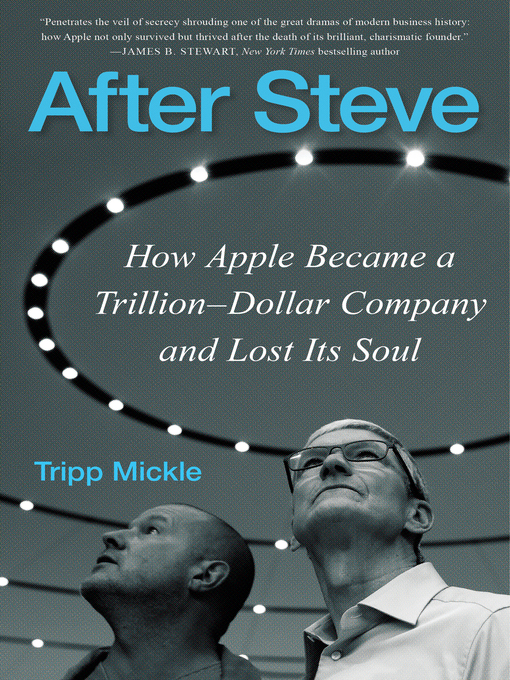
Tripp Mickle, a Wall Street Journal technology journalist who covered the Apple beat for five years, isn’t Walter Isaacson (few of us are); and, to his credit, doesn’t try to be. Nor does he seek to present his primary subjects — former lead Apple designer Jony Ive and incumbent chief executive Tim Cook — as world-changing visionaries on par with their departed boss. Indeed, the very title of his book — After Steve: How Apple Became a Trillion-Dollar Company and Lost Its Soul — presents Apple as existing in a state of creative denouement since Jobs’s death — a bloated (if massively profitable) corporate bureaucracy that increasingly feeds shareholders’ demands for quarterly earnings by milking subscription services such as Apple Music and iCloud instead of developing new products.
The first five chapters of After Steve are structured as a twinned biography, following the lives of Ive and Cook from their precocious childhoods (in England and Alabama, respectively), and on through the 2010s, when the pair jointly ran Apple (in function, if not in title) following Jobs’s death.
Timothy Donald Cook grew up in Robertsdale, a farming community located roughly halfway between Mobile, Alabama and Pensacola, Florida, the middle child of a Korean War veteran and a pharmacist’s assistant. In high school, Cook was named “most studious”, and served as the business manager for the school yearbook. “In three years of math, he had never missed a homework assignment”, reports Mickle, also noting that one teacher remembers him as “efficient and dependable”. Cook also happens to be gay, a subject that caused some awkwardness for his Methodist parents, even though Cook wouldn’t come out publicly till later in life. As a means to deflect questions, Mickle reports, Cook’s mother told drug-store coworkers that her son was dating a girl in Foley, a nearby town.
Following high-school graduation, Cook went on to study industrial engineering at Auburn University and business administration at Duke. He then gravitated to the then-burgeoning field of personal computing, quickly carving out a niche within its production and supply-management back office. At IBM and Compaq, Cook turned himself into a sort of human abacus, ruthlessly bringing reduced costs, increased efficiencies, and smaller inventories to every assembly line he set eyes on. By the time he’d arrived at Apple in 1998, Mickle reports, Cook was completely neurotic about keeping any stocked materials off the books, calling inventory, “fundamentally evil”. In time, he pioneered a process by which yellow lines were painted down the floor of Apple’s production plants, with materials on the storage side of the line remaining on suppliers’ books until the very moment they were brought to the other side for assembly.
Like Ive, Cook declined to be interviewed for After Steve. And so it is entirely possible that the man has a rich inner life that remains opaque to Mickle and the outside world more generally. But the portrait that emerges in this book is one of a fanatically dedicated workaholic who rises before 4am to begin examining spreadsheets, and thinks about little else except the fortunes of Apple Inc. during the waking hours that follow. Mickle reports a sad scene in which Cook is spotted by sympathetic strangers at a fancy Utah resort, dining alone during what appears to be a solitary vacation. We also learn that Cook’s Friday-night meetings with Apple’s operations and finance staff were sometimes called “date night with Tim” by attendees, “because it would stretch for hours into the evening, when Cook seemed to have nowhere else to be.”
Comments Off on Apple, afterwards
Canadian Army Newsreel – Allies take Sicily
canmildoc
Published 4 Sep 2011Canadian war news reel.
Comments Off on Canadian Army Newsreel – Allies take Sicily
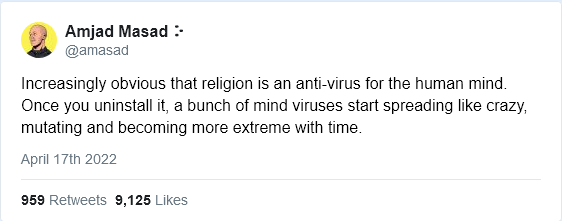
Testing the old saying about those who believe in nothing will believe anything
At Astral Codex Ten, Scott Alexander considers the old saying — often mis-attributed to G.K. Chesterton or C.S. Lewis:
There’s a popular saying among religious apologists:
Once people stop believing in God, the problem is not that they will believe in nothing; rather, the problem is that they will believe anything.
Big talk, although I notice that this is practically always attributed to one of GK Chesterton or CS Lewis, neither of whom actually said it. If you’re making strong claims about how everybody except you is gullible, you should at least bother to double-check the source of your quote.
Still, it’s worth examining as a hypothesis. Are the irreligious really more likely to fall prey to woo and conspiracy theories?
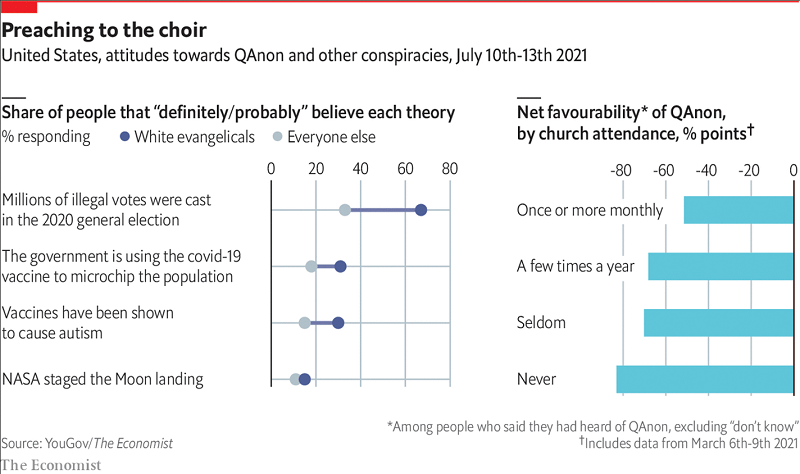
This Economist article examined the question and concluded the opposite. See especially this graph:
“White evangelicals” are more likely to believe most measured conspiracy theories, and churchgoers were more likely to believe in QAnon in particular.
There’s an obvious confounder here: the authors are doing the usual trick where they cherry-pick right-wing examples of something bad, show that more right-wingers are in favor of them, then conclude that Science Has Proven Right-Wingers Are Bad. QAnon, illegal votes, and COVID microchips are inherently right wing conspiracy theories; vaccines/autism has probably become right-coded post-COVID. Only the moon landing seems politically neutral, and it’s hard to tell if there’s a real difference on that one. So this just tells us that white evangelical church-goers are further right than other people, which we already know.
These data still deflate some more extreme claims about religion being absolutely protective against conspiracy theories. But I was interested in seeing how people of different faiths related to politically neutral conspiracies.
Comments Off on Testing the old saying about those who believe in nothing will believe anything
August 11, 2022
US Navy Fleet Problems – Now its time to play with carriers (VIII-XII)
Drachinifel
Published 10 Aug 2022Today we take a look at the background and thinking behind the inter-war USN Fleet Problems, with summaries of Fleet Problems 8 through 12
(more…)
Comments Off on US Navy Fleet Problems – Now its time to play with carriers (VIII-XII)
N.S. Lyons offers a Public Service Announcement for folks in class B
N.S. Lyons is talking to you. Yes, you in particular:

Hello Friend,
I saw your post on the interweb the other day about that nasty thing Team A did, even though they always completely lose their collective mind with moralistic outrage if Team B (which I understand is your team) even thoughtcrimes about doing something similar. In fact Team A seems to blatantly do things all the time that no one on Team B could ever get away with doing without being universally condemned as the absolute worst sort of immoral criminal/being openly threatened with mob violence/losing their livelihood/having their assets frozen/being rounded up by the state and shipped to a black site somewhere for some extended TLC.
Maybe the latest thing was breaking some very important public health rules, or pillaging and burning down government buildings for fun, or mean tweets, or polluting the planet with a private jet, or using allegedly neutral public institutions against political opponents, or just engaging in a little tax-dodging or corruption while doing, like, a ton of blow in a hotel room with some capital city hookers – I forget the specifics. In fact I forget what country you’re even living in nowadays.
But I did see that slick video you posted on how just pointing out “imagine if someone on Team B did this!” is all it takes to blow the lid off this glaring hypocrisy, thus totally destroying Team A with facts and logic. I’ve noticed you posting a lot of things like this, which is nice, since they are very witty and produce a pleasant buzz of smug superiority, even though this feeling never lasts very long.
However, I suddenly realized that you may not be in on the joke, so to speak, so I figured I’d write this short PSA to help explain what “hypocrisy” in politics actually is, just in case you didn’t know and had been fooled into seriously trying to benefit Team B with your comparative memes.
You see, it’s possible you are under the misapprehension that you are not supposed to notice what you described as the “double-standard” in acceptable behavior between Team A and Team B. And that you think if you point out this double-standard, you are foiling the other team’s plot and holding them accountable. This might be because, in your mind, you are still in high school debate club, where if you finger your opponent for having violated the evenly-applied rules a neutral arbiter of acceptable behavior will recognize this unfairness and penalize them with demerits.
Except in reality you are not holding Team A accountable, and in fact are notably never able to hold them accountable for anything at all. Even though Team A gets to hold you accountable for everything and anything whenever they want. This is because unfortunately there is no neutral arbiter listening to your whining. In fact, currently the only arbiter is Team A, because Team A has consolidated all the power to decide the rules, and to enforce or not enforce those rules as they see fit.
[…]
Much like the Great Khan, Class A has decided the greatest happiness in life is to crush its class enemies, see them driven before it, and hear the lamentations of their pundits.
Fundamentally, Class A believes the purpose of power is to reward its friends and punish its enemies. Which is what it does. That way it can keep its enemies down at the same time as it attracts more friends by offering great perks for class membership. And as a controversial Arab thought-leader once said: everyone prefers a strong horse to a weak horse.
If you, Class B serf, do not enjoy this arrangement, your lamentations about hypocrisy will not change it, no matter how loud and shrill. Only taking back control of the levers of power and then using that power to strike the fear of accountability into the hearts of your ruling class will ever be able to do that.
Comments Off on N.S. Lyons offers a Public Service Announcement for folks in class B
“Carbine” Williams’ Battle Rifle: The Winchester G30R
Forgotten Weapons
Published 8 Jan 2018The Winchester G30R is the final iteration of David Marshall Williams’ work on a full power .30 caliber military rifle. The project began with a design by Ed Browning (John Browning’s half brother) using a tilting bolt and annular gas piston, manufactured for US military trials by Colt. It moved to the Winchester company, which assigned Williams to the project when Browning died in 1939. Williams first replaced the annular gas piston with his gas tappet system, creating the G30M rifle. This performed poorly in trials, and the next iteration was the replacement of the tilting bolt with a Garand-type rotating bolt, creating the Winchester M2 rifle.
The US military was not interested in the M2 in .30-06, but thought the concept could be ideal for the Light Rifle trials then underway, and Winchester scaled it down to .30 carbine, and won the Light Rifle trials with it. That weapon would go on to become the M1 Carbine. Once it was in mass production, Winchester returned to the M2 design and improved it into this G30R. It was tested by the Marine Corps, but not adopted. The Canadian military also expressed an interest, but the US government opted to not allow any exports, and so Canada never tested it.
The US Army was quite satisfied with the M1 Garand, but suggested that this rifle might be made into a replacement for the BAR if it were redesigned a bit for greater sustained fire capacity. Winchester did so, creating the Winchester Automatic Rifle (WAR), which was on track for adoption until World War Two ended and immediate arms development became a much less important priority for the military.
Thanks to the Institute of Military Technology for allowing me to have access to this rifle so I can bring it to you! Check out the IMT at:
Comments Off on “Carbine” Williams’ Battle Rifle: The Winchester G30R
August 10, 2022
QotD: “Most academics [are] twitchy closet cases with the social skills of autistic badgers”
I say the answer is: Institutional incentives. I’m not a football coach, but I was an academic — there’s a surprising amount of overlap in their institutional structures. Let me explain: In both cases, working conditions for everyone except those at the very tippy-top are brutal. We’d all willingly endure them, I think, for the kind of money and bennies big league coaches / tenured professors get, but below that tiny handful of folks everyone works even worse hours for far less compensation. Even coaches at dinky little high schools in the middle of Flyover Country spend countless hours breaking down film — he might only have fifteen kids on the team, but he’s expected to win with those fifteen kids, damn it, and win now.
Consider, then, what type of person would willingly sign up for such a life. Leave aside the question of whether or not what academics do has any intrinsic value. The fact remains that simply writing one’s dissertation takes, at minimum, a year or two of grinding toil. I’m the laziest sumbitch in captivity, and nobody’s better than me at gaming the system (especially a droolingly stupid system like academia), but even I pulled more 80+ hour weeks in grad school than I care to remember. It’s simple economics: You’ve got X dollars in grant money to hit the archives. Archives are always located in expensive cities in distant states, if not on different continents. Your X dollars run out pretty goddamn fast in a place like London, even when you’re staying at the cheapest hostel, living on ramen noodles and water, walking everywhere. Given that, you work, for as long as they’ll let you in the building, for as long as your eyesight holds.
And all that is to complete the bare minimum requirement for the possibility — by no means anywhere near the certainty — of securing an entry-level job. I’d ask “Who in his right mind would ever do that?”, but the answer is obvious: Nobody in his right mind would. You have to either really, really want to be an academic (coach), or have absolutely no other choice. Most academics, of course, are the latter — they’re twitchy closet cases with the social skills of autistic badgers. But wannabe-coaches, I hypothesize, face a similar dilemma: You’re an athlete who has made his living off his body. And a nice living it was, too, while it lasted … but now you’re 35 and your body just can’t do it anymore. You have no other skills. What else is there to do, but try coaching?
Severian, “Organizational Behaviour in the Human Male”, Rotten Chestnuts, 2019-09-23.
Comments Off on QotD: “Most academics [are] twitchy closet cases with the social skills of autistic badgers”


