
 One of my favourite things in weeks after a Vikings win is reading Ted Glover’s latest free interpretation of the carefully parsed words of Minnesota Vikings head coach Mike Zimmer. Ted is … highly creative in his work:
November 15, 2017
Zim Tzu’s latest press conference, as “interpreted” by Ted Glover
Comments Off on Zim Tzu’s latest press conference, as “interpreted” by Ted Glover
November 13, 2017
Vikings beat Washington 38-30 in DC
The Vikings play Washington so frequently, this almost seemed like a divisional game. Case Keenum was having a really good game up until back-to-back interceptions allowed Washington to (almost) climb back into contention. Both errant passes were intended for tight end Kyle Rudolph, but both went instead to D.J. Swearinger. For a $2 million investment, Minnesota has had fantastic production from their backup quarterback, but this game showed why he’s never been able to lock down a starting role. When the Vikings defence is on their game, all Keenum needs to do is keep the chains moving and avoid turnovers — this wasn’t one of the times that the vaunted Vikings D was showing at their best (Everson Griffen was not active for the game, and demonstrated how much he provides to the team).
That said, I still hope that the Vikings offer Keenum an extension to stay with the team for at least 2018, but still as a backup to Teddy Bridgewater (or, if Teddy really can’t get back to his pre-injury form, Sam Bradford).
Comments Off on Vikings beat Washington 38-30 in DC
November 9, 2017
Fan reactions to the Vikings’ swap at quarterback
Yesterday’s news that the Vikings were activating Teddy Bridgewater and placing Sam Bradford on injured reserve got lots of reaction from the fan bloggers as well as the pro sports writers in the Twin Cities. 1500ESPN‘s Matthew Coller provided some background on Bridgewater’s early development with the Vikings:
Last year, Vikings head coach Mike Zimmer said he never saw himself having another quarterback other than Bridgewater.
The question comes up often: Why are Zimmer and the Vikings’ players so impressed with a quarterback who only threw 14 touchdowns in 2015?
The first reason is that they don’t grade players on touchdowns. It’s really a bad measure of QB play. In 2015, Bridgewater only threw 42 passes in the red zone, while Blake Bortles tossed 95 passes and was one of the league leaders in touchdowns. Nobody would say Bortles is better than Bridgewater. The Vikings were third in the league in rushing touchdowns in ’15 and seventh in Drive Scoring Percentage. Bridgewater was leading his team down the field, but Adrian Peterson was getting the touches when they were in scoring position.
The second reason: Coaches and teammates focus on the game tape (and winning) rather than the box score.
Before we look at some of the things that made Bridgewater so popular – outside of his personality – it should be noted that we can’t know until he plays whether the former first-round pick will be back to his old self or how long it will take him to trust his repaired knee. For some players, they never make a full recovery.
Comments Off on Fan reactions to the Vikings’ swap at quarterback
November 8, 2017
Vikings activate Teddy Bridgewater, move Sam Bradford to injured reserve
One quarterback in, one out. That’s been the story for Teddy Bridgewater and Sam Bradford over the last season. Bridgewater suffered a terrible injury just before the start of the 2016 season, and the team moved him to injured reserve for the year. Bradford was acquired in a trade with Philadelphia, and was starting for the Vikings by week 2 of the season. This season, Bridgewater started the season on the PUP list, while Bradford had a career game to open the season against the New Orleans Saints. Bradford suffered what appeared to be a mild knee injury in the game, so Case Keenum got the start the following week. Bradford didn’t see the field again until the game against the Chicago Bears, where it became quickly apparent that his knee hadn’t fully recovered and he was mercifully benched for the second half, allowing Keenum to get the Vikings back into position to win the game and has been the starter since then.
Bridgewater was eligible to practice with the team after the sixth game of the season, and the team had a three week window to decide whether to put him back on the 53-man roster, or shut him down for the remainder of the year by moving him back onto injured reserve. Today was the final day for the Vikings to make that decision. In the meantime, Sam Bradford got arthroscopic surgery on his ailing knee yesterday and was looking at a minimum six-week recovery time, so it makes sense for the team to put him on the injured reserve list, where he could be brought back onto the roster if the Vikings make the playoffs (teams can bring up to two players back from IR after a minimum of eight weeks).
Teddy Bridgewater, according to all the media reports, has been looking good in practice and his team-mates have been quite enthusiastic to get him back, but he hasn’t played any football since August 2016 and it’s probably unreasonable to expect him to pick up where he left off at that point without at least a few weeks of re-familiarization and actual game reps. If he has no set-backs and looks comfortable on the field, he could take over for Keenum in a few weeks, or it might take longer and Keenum will be the starter for much of the second half of the season. Nobody knows until Bridgewater gets onto the field.
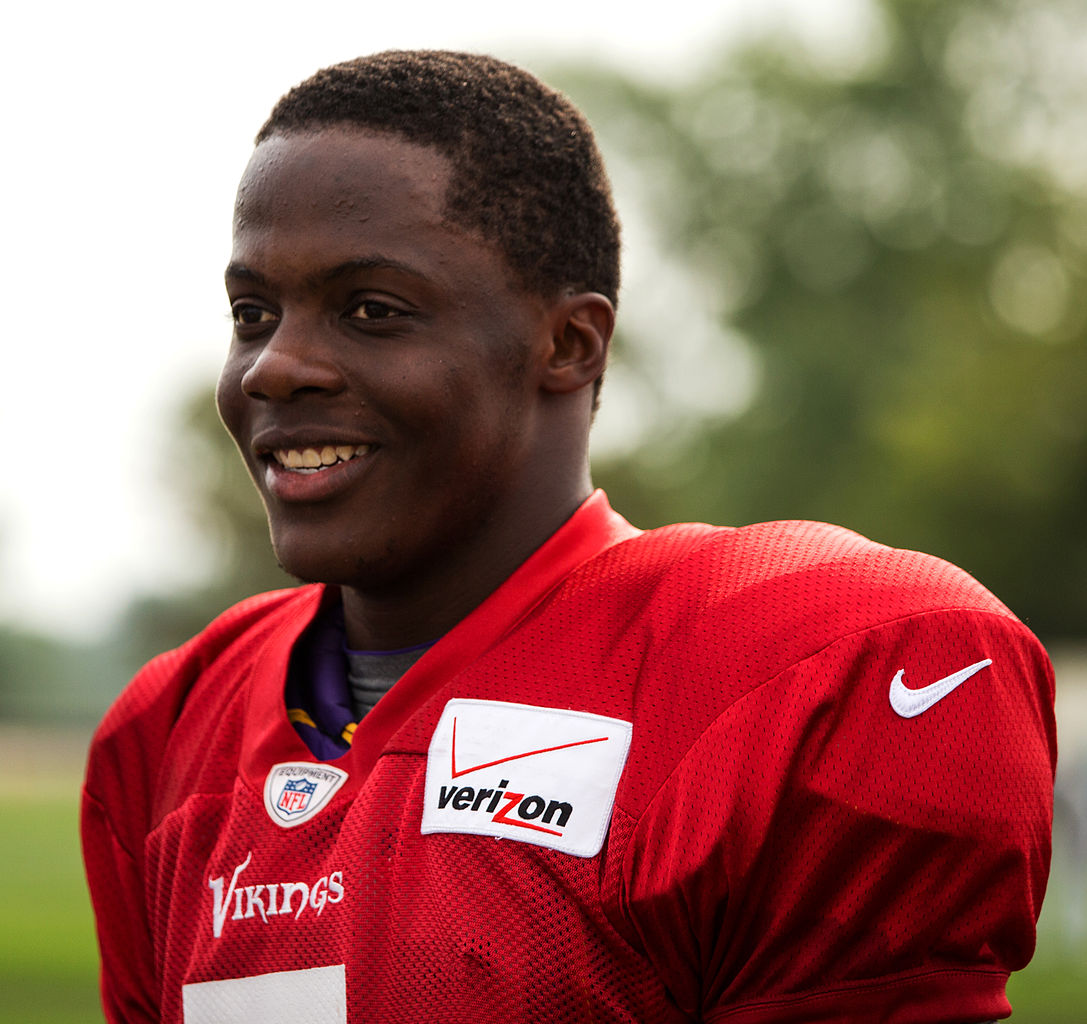
Teddy Bridgewater at Vikings training camp, 2014.
Photo by Matthew Deery via Wikipedia.
Comments Off on Vikings activate Teddy Bridgewater, move Sam Bradford to injured reserve
November 6, 2017
QotD: Bud Grant’s football philosophy
… you have to remember one thing: Football is entertainment; it’s not life or death. Once the game is over, you’re already talking about next year and the draft. It’s just entertainment. It’s like going to a play: When it’s over, you walk out the door and it’s over. There are no residuals to it. You’ve got to start all over again. If winning or losing is going to define your life, you’re on a rough road.
Bud Grant, quoted in “‘If Winning or Losing Is Going to Define You, You’re on a Rough Road'”, The MMQB with Peter King, 2016-02-01.
Comments Off on QotD: Bud Grant’s football philosophy
October 30, 2017
Vikings rally in the second half to beat Cleveland 33-16 at Twickenham Stadium
Early Sunday morning (North American time), the Vikings faced the Cleveland Browns at Twickenham Stadium in the last of four NFL regular season games to be played in the UK this year. Cleveland took advantage of an early break, scoring a touchdown after a Case Keenum pass was deflected and intercepted during the first offensive series (but they didn’t convert on the kick). As the TV announcers mentioned several times, this was only the Browns’ second lead of the season (the Browns were 0-7 coming into the game). At this point, long-time Viking fans may have suddenly started to feel that oh-too-familiar dread that the team had fallen into yet another trap game…
Minnesota took advantage of a muffed punt deep in Cleveland territory, but the drive stalled out quickly so Kai Forbath was called on to kick a field goal. Late in a sloppy first half, Keenum scrambled and passed the ball to an unmarked Adam Thielen in the corner of the end zone for the Vikings’ first TD of the game (the kick was blocked). The half ended with the Vikings trailing by 1 point, 13-12.
Comments Off on Vikings rally in the second half to beat Cleveland 33-16 at Twickenham Stadium
October 28, 2017
Case Keenum gets no respect PLUS rumblings from the Bridgewater Underground
Poor Case Keenum. The Vikings’ backup quarterback has done just about everything you could ask of a backup in the NFL: he’s stepped in when Sam Bradford’s knee started acting up, and he’s kept the Vikings competitive in most of the games he’s played. Yet he still gets no respect, as vividly shown here in a photo caption in the Minneapolis Star Tribune:
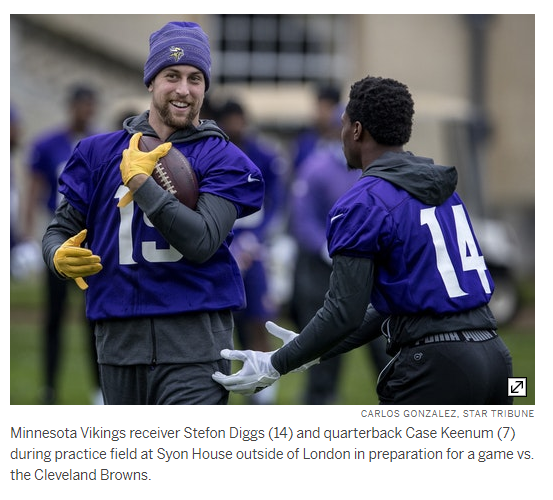
Um, guys, That’d be Stefon Diggs and Adam Thielen, not Case Keenum. The lack of a red practice jersey should have been a dead give away.
(Screen cap from the Star Tribune)
Comments Off on Case Keenum gets no respect PLUS rumblings from the Bridgewater Underground
October 23, 2017
Baltimore Ravens at Minnesota: stout defence and field goals galore in 24-16 Vikings win
Vikings quarterback Sam Bradford didn’t practice at all this week, so he was clearly not going to be playing against Baltimore, this meant that backup Case Keenum automatically became the starter for the game. Keenum didn’t show his abilities to their best during the game (20-of-31 passing for 188 yards and a passer rating of 67.7 and a pick), leading to placekicker Kai Forbath being the key scorer for Minnesota (six field goals from 52, 51, 43, 43, 34 and 32 yards, but a missed extra point to keep him humble), while Baltimore kicker Justin Tucker threatened to score from well outside normal kicking distances (48, 57 and 47 yards, yet the game announcers seemed sure he could make it from inside his own 20 yard line). Still, ugly games count just the same as awesome ones, so chalk this one up as an ugly win.
Both teams were missing key players: Baltimore was already down most of their top receivers (Breshad Perriman, Chris Matthews and Jeremy Maclin) when Mike Wallace took a hit from Vikings safety Andrew Sendejo early in the first half which put him into the NFL’s concussion protocol (Sendejo was penalized for unnecessary roughness on the tackle, which negated a fumble recovery by Xavier Rhodes). Minnesota was missing both Stefon Diggs and Michael Floyd, which gave rarely used veteran Jarius Wright an opportunity to shine, making some clutch catches to extend Viking drives. Nick Easton had been ruled out, so Jeremiah Sirles got the start at left guard, and both Sirles and starting left tackle Riley Reiff suffered injuries during the game, so backup tackle Rashod Hill and rookie guard Danny Isidora got into the game as replacements.
Comments Off on Baltimore Ravens at Minnesota: stout defence and field goals galore in 24-16 Vikings win
October 17, 2017
Teddy Bridgewater cleared to return to Vikings practice
Vikings quarterback Teddy Bridgewater will return to team practice on Wednesday, fourteen months after his career seemed to be over due to catastrophic injury. The team has a three-week window to observe Bridgewater’s progress before they need to either add him to the roster or move him to the injured reserve list for the remainder of the season. Despite the fan enthusiasm, it’s unrealistic to assume that he would be able to step back into the starting role for at least a few weeks, and Case Keenum is doing a good job of keeping the Vikings afloat while Sam Bradford and Teddy Bridgewater are unable to play.
During Bridgewater’s recovery time, Vikings Territory writer Jordan Reid made contact with him:
From a surprising follow back on Twitter, to actually reaching out to him about his progress just to see how he was doing. I can firmly tell you that Bridgewater is exactly the same type of person behind-the-scenes as he is in the public eye-view. He’s not only the quarterback of my favorite NFL team, but he’s now a personal friend and an athlete that means a lot to me outside of just football.
Many say I’m obsessed with Bridgewater, but that’s definitely not the case. Seeing his hard work, monthly progress and sending various encouraging messages during his injury journey helped me realize and have hope for an athlete that experiences trials and tribulations similar to me and you.
Many times, fans forget that athletes are people just like ourselves and get so trapped into just thinking about the football side of things. Seeing the type of individual he is outside of the public eye-view and experiencing first-hand what he went through the past 14 months has once again given me hope of an eventual return.
[…] Now knowing the type of person he is, the fourth-year quarterback is obviously not for everyone. He will never be the most physically gifted quarterback in the NFL. That’s not Teddy Bridgewater, but what he gives you is hope.
Hope meaning a lot things. No. 5 gives hope to a fanbase that’s never won a Superbowl, but suffered through crushing playoff losses and constant instability at quarterback. Yes, I know he’s only thrown 28 touchdown passes in 30 games, but no matter what it takes or what outsiders think of his traits, he just wants to win.
The one underlying quality that Bridgewater has had since his collegiate days at Lousiville and now as an NFL quarterback is leadership. It’s a trait that can not be taught or developed. As I occasionally say on Twitter, it is a trait that an athlete either possesses or they don’t. It can not be developed over time, but is rather something that they are born with.
From beating Florida in the 2014 Sugar Bowl to sideline jokes with his teammates, and even organizing summer workouts in the off-season with other players around the league, leadership is a quality that Bridgewater undoubtedly has. It is a trait that most successful signal-callers must have in order to instill belief in not only his teammates, but the organization and its fanbase as well.
Regardless of how you feel about Teddy Bridgewater, when he was under-center, the last glimpse we saw of him against the then San Diego Chargers was the most hopeful we all have been of a Vikings team in quite some time. Will he ever return to that status? We won’t know, but what we do know is that he is an exuberant individual that we all will be happy for if he ever gets to play the game that he loves once again.
Comments Off on Teddy Bridgewater cleared to return to Vikings practice
October 16, 2017
Packers lose Aaron Rodgers to injury in 23-10 loss to the Vikings
With Aaron Rodgers under centre, the Green Bay Packers are a threat to any team in the league — without Rodgers, the Packers are just another team. Early in the game at US Bank Stadium in Minneapolis, the Packers were transformed from top-tier threat to ordinary as Rodgers was injured and had to leave the game. Green Bay backup Brett Hundley was unable to get the team going consistently, and the injuries piled up as the game went on (it might have been quicker to list the un-injured players by the end of the fourth quarter – “Injured Packers were carted off the field as if the driver were getting paid by the body”). If Rodgers is out for an extended period, Green Bay is going to continue to struggle.
Comments Off on Packers lose Aaron Rodgers to injury in 23-10 loss to the Vikings
October 10, 2017
Vikings hang on to beat Bears 20-17
Perhaps fortunately for my blood pressure, the telecast of this game was pre-empted in my area by an NHL game between Toronto and the Chicago Blackhawks, which went into overtime, so I didn’t see more than the last few minutes of the first half. Vikings starting quarterback Sam Bradford had been ineffective through most of that time, and Vikings Twitter was ablaze with demands to sit Bradford and get Case Keenum out on the field. Despite having taken most of the first-team snaps in practice last week, Bradford was clearly not healthy enough to play, and it’s disturbing that the team allowed him to make the start. By the time he left the field, he’d thrown 11 times with only five receptions for 36 yards, and he’d been sacked four times, including one for a safety.
Comments Off on Vikings hang on to beat Bears 20-17
October 6, 2017
A modest proposal for introducing true equality into the NFL
 ESR linked to this proposal from Scott Swett that would revolutionize the NFL in terms of true equality:
Football players who call for equality are throwing rocks from a glass stadium. The NFL’s high-paying jobs are only given to men with specific physical skills, while the rest of the people are pushed aside.
It’s time for the league to start leading by example. The time is right for the NFL Equality Plan.
The first step in the plan is to guarantee everyone’s right to participate in the games.
Every player in today’s NFL is male, which is obviously unfair. The new balance will be 51% women, 47% men, and 2% transgenders. This means the 53-player roster of every team will have 27 women, 25 men, and one transgender person. Each team shall have 32 Caucasians, seven African-Americans, 10 Hispanics, three Asians, and one person of Native American heritage. At least three players will be gay.
Nor can we ignore age discrimination. Each NFL roster shall include seven players between ages 19 and 25, eight from ages 26-34, seventeen from 35-54, nine from 55-64, and ten players who are 65 or older.
The disabled will be fully represented in the new, inclusive league. Every team shall have no fewer than ten players with physical or mental impairments that significantly affect their major life activities.
The Office of Player Equality will monitor the composition of each team and assess penalties for non-compliance. Temporary, minor variations may be allowed – requests will be considered on a case-by-case basis. The demographic ratios will be regularly adjusted to stay current with population trends.
Next summer, the NFL will host gala events in every stadium to celebrate and welcome the newcomers, who will be called “rainbow players” to honor the complimentary aspects of humanity they represent.
To make room for the rainbow players, many current NFL players will be released from their contracts. This should not be a source of regret, since all these men have benefited unfairly from their physical privilege. The former players will be provided with job-placement services and exit counselling.
Comments Off on A modest proposal for introducing true equality into the NFL
October 2, 2017
Lions beat Vikings 14-7, in a game where if it could go wrong, it did go wrong (for the Vikings)
Two very good teams met in Minneapolis on Sunday afternoon, and the outcome was in doubt until the final minutes. Both teams’ defences held up very well, and both teams’ offences were lacking, so the outcome depended on penalties and luck. The officiating squad didn’t throw a lot of penalty flags (including some that were blatant, yet un-noticed), so the game came down to luck. The Vikings were in luck, but it was all bad.
Sam Bradford’s knee is still not back to normal, so Case Keenum got the start again for the third straight game. Keenum is a very good backup quarterback, but he tends to be a one-read player so he sometimes misses big opportunities because he’s watching the receiver he’s already decided to go to and doesn’t see a better chance elsewhere on the field. Against Tampa Bay, that didn’t matter, but against Pittsburgh and on Sunday against Detroit, it mattered a lot.
The Vikings defence played (mostly) lights-out against the Lions. Danielle Hunter started the game off with a bang, notching his first sack of the season on the opening play, and he got another sack during the game. Everson Griffin chipped in with a sack of his own and two tackles for loss. Linval Joseph also got a sack, and linebacker Eric Kendricks got two. On the other hand, it seemed like everyone in purple had a chance for an interception but none of them could hang on to the ball, and there were periods in the game where Lions ball carriers appeared to be coated in Teflon and the Vikings just couldn’t wrap them up on the tackle.
Injuries are always at least a background concern for NFL teams, and the Lions came in to Minneapolis with a long list of injured players, but the worst injury of the day was on a non-contact run by Vikings rookie sensation Dalvin Cook, who may have torn his ACL while trying to make a cut (he fumbled the ball at that point, but I’m certainly not going to hold it against him under the circumstances). He’ll have an MRI on Monday which will clarify the extent of his injury. Sadly, Eric Thompson’s tweet is still as appropriate as ever:
A friendly reminder in Venn diagram form. #Vikings pic.twitter.com/ooDG1Wxe7V
— Eric Thompson (@eric_j_thompson) September 10, 2015
Update: Yes, coach Zimmer confirms that it’s an ACL tear and Cook is going to be put on the injured reserve, ending his season.
Comments Off on Lions beat Vikings 14-7, in a game where if it could go wrong, it did go wrong (for the Vikings)
Is it becoming time to let the NFL’s “chips fall where they may”?
The modern NFL as we know it enjoys a legal privilege through an act of Congress, allowing the league to negotiate TV rights as a single organization and sharing the revenue equally among all the constituent teams. In City Journal, Steven Malanga recounts the history of how that privilege was granted:
Many sports fans know that Major League Baseball has a unique exemption from the nation’s antitrust laws, thanks to a 1922 Supreme Court decision, which perplexingly ruled that baseball teams do not engage in interstate commerce. Less well understood, however, is that the National Football League retains its own federal exemption through legislation that has allowed the league’s teams to cooperate on television contracts — a gift from Washington that has been crucial to the development of the modern NFL. Over the years, the exemption has proved controversial, though bipartisan calls to revoke or narrow it have never gained much traction. The exemption deserves a fresh look with the players’ extreme politicization of the league, in which they have been aided and abetted by the owners, who have allowed and even taken part in unprecedented partisan posturing — broadcast to the nation via Congress-approved TV deals.
According to NFL mythology, the league’s success is the result of the vision of its mid-1950s and 1960s leadership, including the marketing savvy of former commissioner Pete Rozelle. But the real cornerstone of the NFL’s rise was successful Washington lobbying by league leadership, after a court ruled in 1961 that NFL teams could not negotiate broadcasting rights as a group, because such power would violate antitrust laws against monopolization. Rozelle got a New York congressman, Emanuel Cellar, who chaired the House Judiciary Committee’s Subcommittee on Anti-Trust and Monopoly, to introduce what’s become known as the Sports Broadcasting Act of 1961, which provided limited antitrust exemption, allowing teams to pool their efforts for the sake of negotiating TV deals. When President Kennedy signed the legislation, it permitted a $4.65 million broadcast deal that the NFL had crafted with CBS for the rights to televise football games. The price of broadcasting packages quickly accelerated, especially after the merger of the NFL and the old AFL, and the antitrust exemption allowed for such singular NFL successes as Monday Night Football, introduced in 1970.
Though the act also applies to professional baseball, hockey, and basketball teams, its significance to the NFL came to outweigh the benefits to other leagues, because pro football—with many fewer games per season—exclusively and collectively sells all its TV rights through monopoly pooling, then distributes the revenues to teams equally. Without this exemption, each team would have to negotiate its television contracts individually, which would be fine for powerful teams like the Dallas Cowboys that could probably arrange to have all their games broadcast nationally, but less advantageous for weak teams such as the Cleveland Browns, which might struggle even for local coverage.
[…] The majority of companies in America would not, and do not, allow demonstrations at work by individual employees on political issues unrelated to their employment — just the sort of demonstrations begun last year by former San Francisco 49ers quarterback Colin Kaepernick, and carried on through this weekend by more than 200 players. That the owners have tolerated and lately even encouraged such protests over an issue — charges of police brutality — that divides many Americans is a business risk that they seem willing to take. But the league’s use of its platform — created by its federal antitrust exemption — to broadcast its message across the country is more than a simple business matter. It represents an improper use of resources made available to the NFL by special federal legislation. It’s past time to revoke the Sports Broadcasting Act — and let the “chips fall where they may.”
Comments Off on Is it becoming time to let the NFL’s “chips fall where they may”?
September 25, 2017
Tampa Bay at Minnesota – welcome to the Case Keenum show, starring Case Keenum!
Minnesota’s starting quarterback is still out with knee issues, so backup Case Keenum got all the practice reps with the first team this week, and it really showed to excellent effect in this game. I noted in my game report last week that Keenum didn’t seem to be able to release the ball as fast as Bradford, which allowed defensive pressure to get to him far too often. That issue was completely cleaned up in this game — although it should be noted that Tampa Bay was missing a number of their defensive starters and suffered a rash of injuries during the game on top of that. The final score of 31-17 makes the game appear closer on the scoreboard than it was on the playing field.
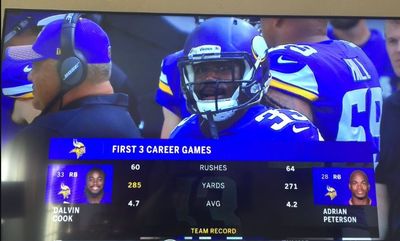
The difference a week of practice will make for an NFL quarterback: Keenum found out about an hour before the Steelers game that he’d be starting, and hadn’t had much chance to work with the starters, and the result was painful to watch. In contrast, having the full week of practice allowed Keenum to develop a good working relationship with wide receivers Stefon Diggs and Adam Thielen, both of whom had great games (Diggs – 8 receptions for 173 yards and 2 TDs, Thielen – 5 for 98 yards). Keenum finished with 25 of 33 completions for 369 yards (a career best) with three touchdowns and a passer rating of 142.1. Best supporting actor player for the offense was probably Dalvin Cook, who is playing at a very high level indeed (my favourite infographic during the game showed a comparison between Adrian Peterson’s first three games and Cook, showing Cook ahead on total yards and yards per carry on fewer carries … while the announcer said “nobody is comparing him to Peterson”). Cook’s numbers for the game were 27 rushes for 97 yards and a TD, with five receptions for 72 yards.
Comments Off on Tampa Bay at Minnesota – welcome to the Case Keenum show, starring Case Keenum!


