
[T]he example of America must be a special example … the example, not merely of peace because it will not fight, but of peace because peace is the healing and elevating influence of the world and strife is not. There is such a thing as a man being too proud to fight. There is such a thing as a nation being so right that it does not need to convince others by force that it is right.
Woodrow Wilson, speech in Philadelphia, 1915-05.
April 10, 2021
QotD: “Too proud to fight”
Comments Off on QotD: “Too proud to fight”
April 9, 2021
QotD: Instant expertise
One of the effects of the COVID-19 epidemic has been to reveal to a very large percentage of the population the joys of instant expertise. The world now has hundreds of millions, if not several billions, of epidemiologists, virologists, and clinicians, all of whom know best how to deal with the pandemic. The only problem is that their solutions are at variance with one another.
It sometimes seems as if the certainty with which views are held is inversely proportional to the solidity of the factual basis on which they are founded. If commentary on the internet is anything to go by (it might not be, of course, for those who avail themselves of this means of self-expression are a self-selected rather than a representative sample), people often take a religious attitude toward their own doctrine and condemn as heretics all those who express doubts about it. I don’t want to sound like a psychoanalyst, that class of person who believes that he unfailingly knows the real meaning of what is said rather than its merely apparent meaning, but stridency of views is often indicative of unacknowledged uncertainties. Zinc supplementarians and others of the type cling to their beliefs with a fervor that evidence does not merit.
Theodore Dalrymple, “Everyone’s an Expert”, Taki’s Magazine, 2020-10-16.
Comments Off on QotD: Instant expertise
April 8, 2021
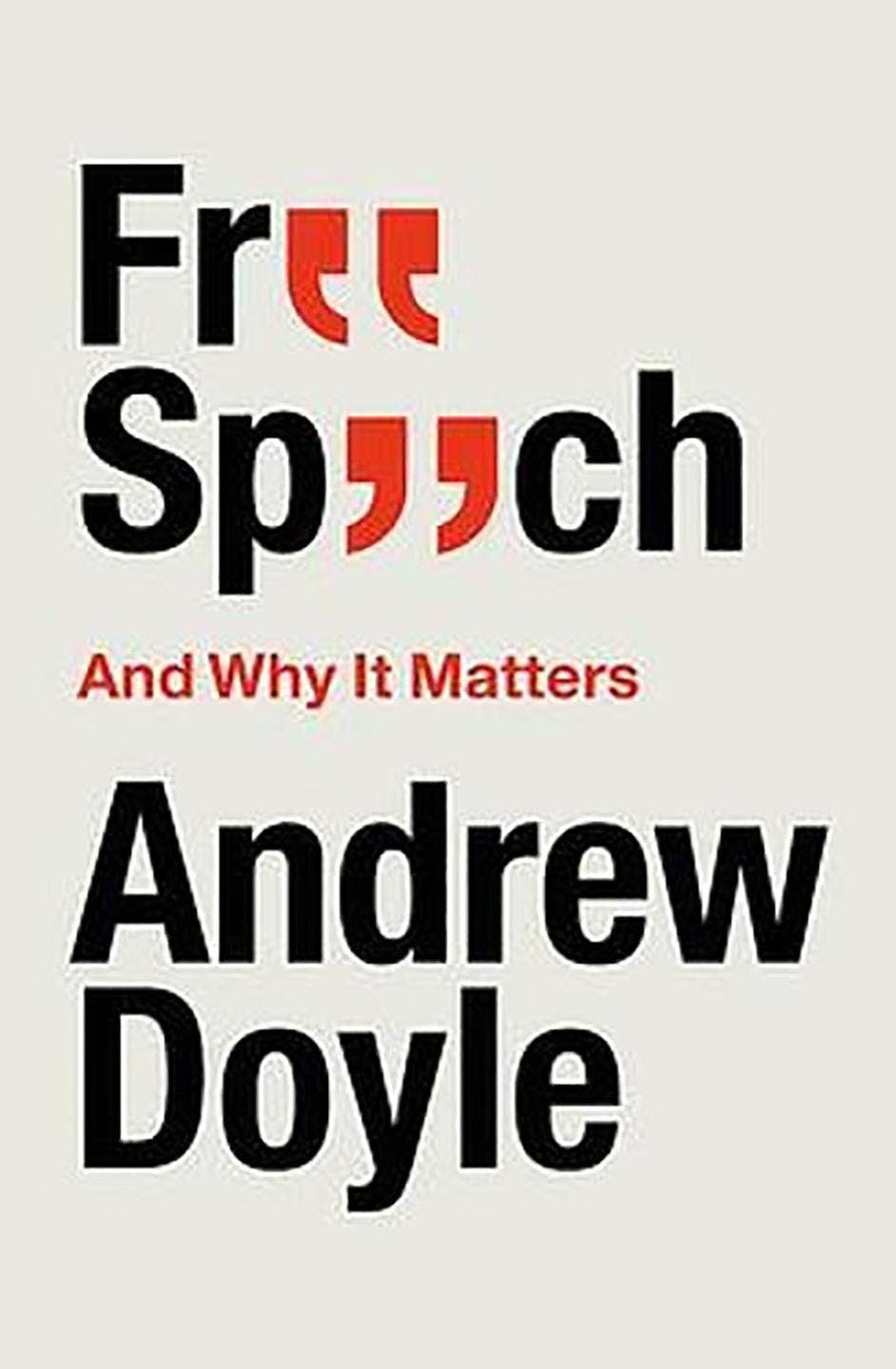
Andrew Doyle defends freedom of speech in his new book
In The Critic, Simon Evans reviews Free Speech And Why It Matters by Andrew Doyle (who is perhaps best known on this side of the pond for his ultrawoke Twitter persona “Titania McGrath”):
When I am weaker than you, I ask you for Freedom, because that is according to your principles; when I am Stronger than you, I take away your freedom because that is according to my principles.
Frank Herbert, Children of DuneIt is most peculiar. If the counter-culture had a dominant theme, it was the right to criticise the establishment and to question orthodoxy of all kinds. Back in the Sixties, it was central to its mission to Expand your Consciousness, man. And it worked. Walls came tumbling down. Yet now, everywhere you look, it seems the elements of society — students, academics, comedians — that one would most naturally associate with that freedom of expression, are introducing caveats and qualifiers to that principle faster than you can cry “Stop Little Pol-Pot, Stop!” They are turning, before our very eyes, into actual scolds.
It must be supposed that what was once the siege army, camped outside the moat like Occupy Wall Street, has captured the castle, for they are demanding that the walls be re-erected. That “hate” speech be distinguished from free speech and dealt with accordingly. That freedom of speech need not mean freedom from consequences. And a general suspicion is at large, among the young, that free speech is some sort of artefact of complacent boomer self-indulgence, like Steely Dan and second homes. No longer counter-culture, but decidedly counter-revolutionary.
I’m a comedian, and these have been strange times for our trade. Brexit saw comedians side with the mirthless neo-liberal consensus, against the humorous, sceptical grumble of the common rabble. The same thing happened in America, with bar-room stand-ups horrified by the vulgarity of Trump. And now the latest revision sees many of my fellow jesters and fools unsure whether people can really be trusted with free speech.One might have thought this issue had been settled long ago, in this country, and in liberty’s favour. But no, it seems we need to sharpen our tools once again, and Andrew Doyle’s new book is an excellent place to start.
Making the case for the defence, Doyle’s book is terse, restrained and as carefully argued as a QC’s summing-up in a top-drawer courtroom drama. Whether his command of the material comes from his doctorate in Renaissance literature or his experience of defending the comedy character Titania McGrath from infuriated wokerati, who knows? It is a beautifully balanced and comprehensive overview that will of course be read by no one who needs to hear it.
It is admirably historically literate. Doyle takes a quote from Milton’s Areopagitica as his epigram, with the old poet, declaiming over the din of the Civil War, as defiant as Satan himself, “Give me liberty to know, to utter, and to argue freely according to conscience, above all liberties.”
This sets the tone for the whole book, but Doyle also presents arguments intended to appeal to those who insist that we live in a society. With the compromises that entails. This was most famously recognised by notorious cis-hetero white man and free speech absolutist John Stuart Mill, who was surveying the world from the heights of Victorian Exceptionalism when he published the still unsurpassed On Liberty.

Comments Off on Andrew Doyle defends freedom of speech in his new book
QotD: Thomas Hobbes and his “state of nature”
One reason I had such a hard time teaching this stuff to undergraduates back in my ivory tower days was that, ironically, we can imagine a much more “realistic” State of Nature than Hobbes could. We even had a TV show about it: Lost (in which, I’m told, one of the characters was actually named “John Locke”). A large group of strangers, unrelated by blood or affinity, would never be shipwrecked on a deserted island in Hobbes’s day, but we Postmoderns have no problem imagining a large international flight going down. Assume everyone survives the crash, and there’s your State of Nature – a much better one than Hobbes’s.
Under those very specific conditions, something like what Hobbes says might come to pass. In reality, of course, we seem to be much likelier to pull together in a disaster than to immediately go full retard, but let’s envision the most apocalyptic scenario, in which every guy who can bench press his body weight (assuming such still exist on international flights) immediately tries to lord it over everyone else on the island. There, and only there, the stuff Hobbes says about equality is true – the strong guy can beat up the weak guy, and enslave him, but the strong guy has to sleep sometime …
… so pretty soon there are no more strong guys, only various flavors of weak, clever guys, and now they have to band together, because you need three or four of them to accomplish the physical labor that one strong guy could’ve before they murdered him in his bed. And so on, you get the point, eventually everyone grudgingly lays down his arms and starts working together for mutual survival.
At this point, I need to point out something fundamental about Thomas Hobbes, that y’all probably don’t know. Hobbes always considered himself first and foremost a mathematician. But he wasn’t a very good mathematician. He’d thought he’d discovered a way to “square the circle,” for instance, and that’s not a metaphor – that was really a thing back then, and Hobbes’s attempt got ripped to shreds by real mathematicians, who thought they were thereby discrediting his metaphysics and, by implication, his political philosophy …
… fun stuff, but irrelevant, the point is, Hobbes was a bad mathematician. So bad, in fact, that even I, a former History professor who needs to pull off a sock every time I have to count past ten, can see the glaring flaw in his “geometrical” political theory: IF it’s based on “the State of Nature,” and we legitimize the Leviathan because that’s what gets us out of the State of Nature, then once we are free of the State of Nature, what’s the point of the Leviathan?
Hobbes didn’t see it that way, of course. He thought that we really did revert to “the war of all against all” the minute the social contract was broken, and in his context – the English Civil Wars, recall – that’s not unreasonable. But what about all the periods of “normal” government? You know, those periods of peace we created the Leviathan specifically to secure? If we get those – and there’s no point to the exercise otherwise – then we seem to have created an all-powerful government that, while it CAN do everything, really shouldn’t do anything.
Severian, “Hobbes (II)”, Founding Questions, 2020-12-11.
Comments Off on QotD: Thomas Hobbes and his “state of nature”
April 7, 2021
QotD: The G-[pick-a-number] meetings
The first three were essential to plan for victory and peace, though many of their key provisions, especially for the liberation of Eastern Europe, were ignored by Stalin. The first Nixon-Brezhnev meeting was substantive and a couple of the later Reagan-Gorbachev meetings were very productive. These were intense business meetings between people who really were at the summit of world power and influence. The only matter agreed to in meetings between Soviet and American leaders between 1945 and 1972 was in the “kitchen debate” between then vice-president Nixon and Khrushchev in Moscow in 1959, when (forgive my coarseness in the interests of historical accuracy), Khrushchev accused Nixon of uttering “Horse shit, no, it is cow shit, and nothing is fouler than that” to which Nixon replied, “You don’t recognize the truth, and incidentally, pig shit is fouler than cow shit.” Khrushchev conceded the second point.
Conrad Black, “Take heed Canada: the U.S. would win a true trade war”, Conrad Black, 2018-06-16.
Comments Off on QotD: The G-[pick-a-number] meetings
April 6, 2021
QotD: Rap music
Theodore Dalrymple, “Liars and Maligners”, Taki’s Magazine, 2020-11-13.
Comments Off on QotD: Rap music
April 5, 2021
QotD: NYC goes out of its way to “afflict the comfortable”
One might ask why a social-services functionary in New York City would cite the Bible in defense of public policy — except that the quotation is not even from the Bible. In fact, it is from Finley Peter Dunne, a popular Chicago columnist from the 1890s who invented a humorous character named “Mr. Dooley,” an Irish bartender who delivered his wisdom in dialect.
The original quotation, in which Mr. Dooley described the function of the newspaper: “Th’ newspaper does ivrything f’r us. It runs th’ polis foorce an’ th’ banks, commands th’ milishy, controls th’ ligislachure, baptizes th’ young, marries th’ foolish, comforts th’ afflicted, afflicts th’ comfortable, buries th’ dead an’ roasts thim aftherward.” Somehow, in a bizarre game of “cultural telephone,” this mock-sonorous fiddle-faddle has gathered the effulgence of holy writ for progressives, who take it as descriptive of their “joyous responsibility.”
On the one hand, it’s comical that this scrap of tabloid wit is taken so gravely by self-righteous officials. Properly speaking, isn’t it their job to make people more comfortable, not to diminish comfort? But on the other hand, it’s frightening to consider that New York is now run by progressive militants who appear to believe that their vocation is to “afflict” their constituents by disrupting their undeserved calm and comfort. Mass immiseration is not a side effect of bad policy; it is the policy.
Seth Barron, “The Politics of Affliction”, City Journal, 2020-12-17.
Comments Off on QotD: NYC goes out of its way to “afflict the comfortable”
April 4, 2021
QotD: Revolution and civil war
There was a little memorial with flowers.
Whenever someone starts talking about maybe voting is useless and perhaps other means are necessary to take back our country, I think of Kosovo. That EXACT rhetoric was part and parcel with the disintegration of the Balkans. The rhetoric I see people casually bandying about, we need to confront them everywhere and they deserve no peace, this is the rhetoric and the justification the Serbs used on their way to killing a quarter of a million people in the Balkans. Their former neighbors; often literally.
It’s worth considering whether all those who killed people in Kosovo started with killing in mind, or were they merely trying to right the wrongs that the other side had perpetrated against them? Civilization is a millimeters thin veneer on top an ocean of violence a billion years of evolution deep. If you think it’s acceptable to use violence for political gain, or if you fantasize for revolution, you’re a monster.
Revolution is not what you think it is. Revolution is civil war. Civil war is driving your neighbors from their homes and forcing them to dig their own graves. It is leaving your grandmother behind because she cannot move fast enough to escape the gunmen; and they won’t stop. Yes, there are monsters in places of power, but you are not absolved of your obligations to humanity because of it. That others have foresworn theirs is no excuse. You fetishize misery you cannot fathom. You are in good company, we are all monsters in civilized clothes; do not be insulted or ashamed.
Endeavor to be more.
Again.
Please.
John Chmelir (@JohnChmelir), Twitter (part of a 20-tweet thread), 2018-10-20.
Comments Off on QotD: Revolution and civil war
April 3, 2021
QotD: When governments try to “help” small businesses
Love for small business is one of the few universals in American politics. In a 2018 Gallup poll, just 56 percent of Americans viewed capitalism positively; but 92 percent had a positive view of small business, and 86 percent viewed entrepreneurs positively. Government at all levels has policies intended to help small businesses, but there’s little evidence that these programs are effective — and even when bureaucrats try to help, they impede small-business creation by imposing new regulations. The New York City Business License and Permit index presents a daunting compendium of licenses and certifications that can be required to start a business in the city — such as the Esthetics License (needed if you want to “conduct beauty treatment”) and the Certificate of Fitness for Fire and Emergency Drill Instructor (necessary to “lead fire drills in buildings that do not require a Fire Safety Director”).
Such overregulation represents a second way that the deck gets stacked in the American economy against outsiders. The decline of American entrepreneurship is a discouraging trend of the last 30 years. In 2015, economist John Haltiwanger documented numerous signs of diminished business dynamism in the United States. In the early 1980s, he noted, America’s startup rate exceeded 13 percent, which meant that about one-eighth of all firms had just begun. The startup share fell to 10 percent near the end of the Clinton years and below 8 percent during the Great Recession. While no consensus exists about the causes of this dramatic drop, expanding business regulation is a plausible candidate.
Edward L. Glaeser, “How to Fix American Capitalism”, City Journal, 2020-12-13.
Comments Off on QotD: When governments try to “help” small businesses
April 2, 2021
QotD: Sex and the grad student lifestyle
- Show up; and
- Bring beer.
For 75-90% of women under 40, step 2 is optional. It would’ve been for Chloe. Especially in a bar full of grad students, who despite their extensive academic training on “the rhetorics of hegemony” and whatnot, still aren’t quite sure how the naughty bits fit together. She might’ve had to draw the guy a map, but surely that’s no problem for someone so assertively in control of her own sexuality as was Chloe …
And that’s just normal people, who know what pronouns to use and never hesitate when choosing a public restroom. The real freakazoids actually have it much easier, since loudly proclaiming a deviant sexuality is a status symbol in the ivory tower. Perhaps your deepest, most secret fetish involves cocktail onions and a Shop-Vac … and let me stop you right there, I do NOT wanna know, I’m only bringing this up to say that hey, I sympathize, love is real and you’re having a hard time finding yours.
You should consider academia, my friend, where not only are such things not shameful, but they’re positively celebrated. If you’ve actually got video of yourself doing the nasty under those conditions, they’ll pretty much hand you a PhD in Performance Art on the spot …… and yet, nobody does.
I’m not saying people don’t have sex in grad school. If I myself wasn’t getting my ashes hauled every day in the ivory tower, I assure you it wasn’t for lack of trying. What I am saying is that academia is the only place on earth where not only is your fetish — whatever it is — not shameful, but easily satisfied. Those of us who actually enjoy the missionary position with committed partners of the opposite-sex used to joke that ours was the only sexual deviancy so perverse, you’d be shunned by all your colleagues if you admitted to it. These people, on the other hand, talk like their gonads rule their lives, but they never actually do anything about it.
I have no idea why, but finding out would tell us a lot about the psychology of the average Leftist.
Severian, “Gettin’ Busy in College Town”, Rotten Chestnuts, 2020-12-04.
Comments Off on QotD: Sex and the grad student lifestyle
April 1, 2021
QotD: Mistakes
Herman Lincoln Wayland
Comments Off on QotD: Mistakes
March 31, 2021
QotD: The first and only “inalienable” right
It would’ve been far better to have kept the trio in Locke’s original words – life, liberty, and property – but even that wouldn’t have saved us, because the proposition is flawed from the beginning. The full quote is:
We hold these truths to be self-evident, that all men are created equal, that they are endowed by their Creator with certain unalienable Rights, that among these are Life, Liberty and the pursuit of Happiness …
… and pretty much all of that is wrong.
As we’ve seen, it was a major part of Hobbes’s project to prove that men do in fact have such rights, because it’s not at all “self-evident.” That was the whole point of the Wars of Religion – heretics have NO rights, because they have put themselves beyond the pale of the human community. For the Wars of Religion to end, political legitimacy had to be secularized.
That was Hobbes’s goal. That’s what the “State of Nature” thought experiment was about. Does man has any rights in himself, that flow only from his existence as a human being? In other words, does he have rights NOT endowed by his Creator?
Hobbes argued that we DO have such rights, of course … but, crucially, we only have the full exercise of them in the State of Nature. For Hobbes, all rights are, at bottom, the right to self-defense. Getting out of the State of Nature involves laying at least part of that right down – “alienating” it, in the Latinate English of the 17th century – creating in the process a “corporate person” who “represents” us all. Far from being “inalienable,” then, Life and Liberty, at least, have to be alienated, at least to some degree, if civilization is to exist at all …
… at least according to Hobbes, and do you see what I mean about people trying to adopt his terms while dumping his conclusions?
Hobbes had plenty of examples to hand, writing as he was in the last, nastiest phase of the Wars of Religion. According to Hobbes, the Leviathan – who, let’s recall, can be a Senate or something just as easily as a monarch – absolutely has the right to your life and liberty, since your voluntary surrender of them is what creates the Leviathan in the first place. How else could wars be fought in the gunpowder age? A medieval king leading his personal affinity into battle didn’t have to worry about political theory. An Early Modern king, fielding armies of tens of thousands, did. Without an animating ideology, they’re just mercenaries – ask Machiavelli how that works out.We’ll skip over that “pursuit of happiness” crap, since that’s probably just Jefferson’s noodle-headed way of alluding to Classical political theory, and circle back to the start: “all men are created equal.” As we’ve seen, this was central to Hobbes’s “State of Nature” thought experiment … but, as is obvious to anyone with real-world experience, it only applies there.
Severian, “Hobbes (II)”, Founding Questions, 2020-12-11.
Comments Off on QotD: The first and only “inalienable” right
March 30, 2021
QotD: Static societies and disruptive outsiders
Stable societies with unchanged boundaries, Olson observed, “tend to accumulate more collusions and organizations for collective action over time.” Instead of accepting rules that encourage overall growth, these collusive organizations — trade groups and labor unions were paradigmatic examples — fight to keep what they have, slowing down “a society’s capacity to adopt new technologies and to reallocate resources in response to changing conditions,” thus reducing economic efficiency. Decline follows.
Olson pointed to Japanese stagnation under the Tokugawa shogunate, when, “before Admiral Perry’s gunboats appeared in 1854, the Japanese were virtually closed off from the international economy.” Ruling Japanese society, he writes, “were any number of powerful za, or guilds, and the shogunate or the daimyo often strengthened them by selling them monopoly rights.” The guilds “fixed prices, restricted production and controlled entry in essentially the same way as cartelistic organization elsewhere.”
A second example: Great Britain, “the major nation with the longest immunity from dictatorship, invasion and revolution” and, consequently, Olson explained, suffering “this century a lower rate of growth than other large, developed democracies.” In Olson’s view, the weak performance resulted from limits on change established by a “powerful network of special-interest organizations,” which included labor unions, industrial groups, and aristocratic cliques. By the 1970s, after the conservative government of Edward Heath fell in a losing battle with striking miners, many deemed Britain ungovernable. Olson contrasted the British situation with that of postwar Germany and Japan, where the chaos and destruction of wartime defeat wiped away established industrial and retail groups, leaving the field open to newcomers like Soichiro Honda or the Albrecht family (creators of international supermarket giant Aldi), who could work economic magic.
The word “ungovernable” was also used to describe New York in the 1960s and 1970s, when Mike Quill’s transit union ran roughshod over Mayor John Lindsay’s attempts to control public-sector wage growth. New York was a long-established city with lots of political collusion. The old Tammany Hall could broker deals to keep Gotham going, but Lindsay’s successor, Abe Beame, proved too weak to resist any special interest that wanted more spending or government favors. New York’s spending kept rising even as public services worsened, until bankruptcy loomed and public power wound up in the hands of the unelected Municipal Assistance Corporation. Thankfully, New York reformed itself economically, at least to some extent, under Mayors Rudolph Giuliani and Michael Bloomberg, as Britain did under Prime Minister Margaret Thatcher. Sufficiently strong leaders can buck entrenched insiders.
Edward L. Glaeser, “How to Fix American Capitalism”, City Journal, 2020-12-13.
Comments Off on QotD: Static societies and disruptive outsiders
March 29, 2021
QotD: Modern conservatism is merely progressive policies on a ten-year delay
So you can take it to the bank that by 2030 rock-ribbed Republicans will be on board with penises in the girls’ changing rooms, but determined to hold the line against whatever the left’s next cause du jour is: human cloning, mandatory transitioning for delinquent boys, voting rights for animals.
There really isn’t much point to conservatism that’s just leftism ten years late, is there? It’s like that ITV+1 satellite service they have in Britain that offers you the ITV schedule but an hour later, in case you were caught in traffic heading home. If you’re considering on which side to bestow your tribal loyalty, the left is right quicker; the right is left behind — but only for a few years until they throw in the towel. If you’re all headed to the same destination, why not ride first class on the TGV instead of the creaking, jerking stopping service? Justin Trudeau’s vapid modishness was perfectly distilled by his campaign catchphrase of four years ago: “Because it’s 2015.” But that beats waiting till 2025 to say “Because it’s 2015”.
Mark Steyn, “Catch-Up Conservatism”, SteynOnline, 2020-12-17.
Comments Off on QotD: Modern conservatism is merely progressive policies on a ten-year delay
March 28, 2021
QotD: Laïcité and French Catholicism
As I said, “secularism” isn’t a real thing. I am an optimist when it comes to French Catholicism. There is a rising generation of young Catholics, and they are excellent, and numerous. More and more people are understanding that the only thing modernity offers is consumer crap from China, divorce, and joyless sex at best. The churches on Sunday are full in the big cities. Houellebecq is right; for us, the future is either the foot of the Cross, or submission to Islam. And I think we’re showing we don’t want to submit to Islam …
What people don’t understand about French Catholicism is that while 1905 was certainly a defeat, French Catholics did not simply disappear. They abandoned politics, but they did continue to have children, to bring them up into Catholic schools, etc. so there has always been an important Catholic subculture, including at the elite levels. I am optimistic about the future of Catholicism in France.
Niccolo Soldo, “The Zürich Interviews – Pascal-Emmanuel Gobry: Unrepentant Baguette Merchant”, Fisted by Foucault, 2020-12-02.
Comments Off on QotD: Laïcité and French Catholicism


