
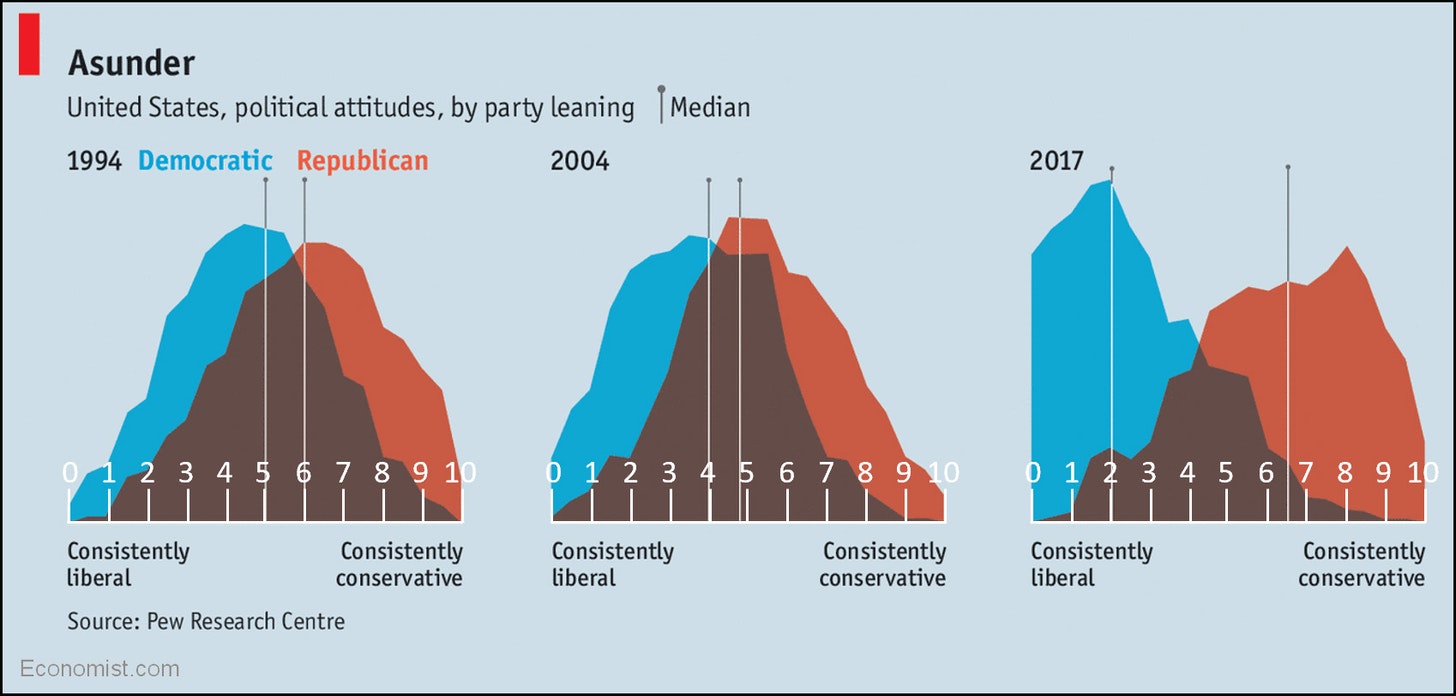
… check out Kevin Drum’s analysis of asymmetric polarization these past few decades. He shows relentlessly that over the past few decades, it’s Democrats who have veered most decisively to the extremes on policy on cultural issues since the 1990s. Not Republicans. Democrats.
On immigration, Republicans have moved around five points to the right; the Democrats 35 points to the left. On abortion, Republicans who advocate a total ban have increased their numbers a couple of points since 1994; Democrats who favor legality in every instance has risen 20 points. On guns, the GOP has moved ten points right; Dems 20 points left.
It is also no accident that, as Drum notes and as David Shor has shown: “white academic theories of racism — and probably the whole woke movement in general — have turned off many moderate Black and Hispanic voters.” This is why even a huge economic boom may not be enough to keep the Democrats in power next year.
We are going through the greatest radicalization of the elites since the 1960s. This isn’t coming from the ground up. It’s being imposed ruthlessly from above, marshaled with a fusillade of constant MSM propaganda, and its victims are often the poor and the black and the brown.
Andrew Sullivan, “What Happened To You?”, The Weekly Dish, 2021-07-09.
January 6, 2022
QotD: The centre cannot hold … because there’s barely any “centre” remaining
January 5, 2022
QotD: Measurement hack that lives on
The hack was too good to let fade away, so every now and then the fraternity makes its pledges repaint the markings. You might think this isn’t the sort of vandalism the police would tolerate, but they do. The smoot markings soon became convenient in recording the exact location of traffic accidents, so (as the story goes) when the bridge walkways needed to be repaved in 1987, the Massachusetts Department of Public Works directed the construction company to lay out the concrete slabs on the walkway not in the customary six-foot lengths but in shorter smoot units. Fifty years after the original hack, the smoot markers have become part of civic tradition: the City of Cambridge declared 4 October 2008 “Smoot Day”. MIT students ran up a commemorative plaque on a precision milling machine and created an aluminium Smoot Stick which they deposited in the university’s museum as a durable reference standard: the unit-smoot is now detached from the person-Smoot. Through the legions of MIT graduates driving global high-tech culture, the smoot has travelled the world. If you use Google Earth, you can elect the units of length in which you’d like distances measured: miles, kilometres, yards, feet – and smoots.
Robert Crease, The Historic Quest for an Absolute System of Measurement, 2011.
January 4, 2022
QotD: Status signalling
In fact, their philosophy — the Marxist ideology they propound and the craziness behind it — has been in control of society, on top, since at least the seventies.
Being a leftist is a mark of being “good” and also well educated. The same way that in Elizabethan England poor mad Christopher Marlowe wrote his stage directions in Latin, to show that he had had an excellent education and deserved respect, so too the leftists of today pepper their works, from movies to TV to books to art, with odes to the oppressed and paeans to the coming revolution. It’s how you show you’re high-class and exquisitely educated.
All the old families, all the rich, all the captains of industry and power brokers signal left as hard as they can, because that’s where the power is — and in my field, the awards, the professorships, and the acclaim. Heck, remember what Trump signaled just to be allowed to do business.
And that’s why I’ve been watching in amusement the left going through the motions of kabuki theater revolution against a society … they control.
Sarah Hoyt, “We’re Seeing the Death Rattle of the Revolution, Not Its Birth”, PJ Media, 2020-07-28.
January 3, 2022
QotD: The Sisyphean quest of conservatives looking for progressive approval
Stop caring what liberals and their media toadies say. Be a conservative and make them pay.
It’s simple, effective, and much more satisfying than trying to get people who hate you to stop hating you.
It’s also more dignified. Look at Chimpy McBu$Hitlerburton. That was what they called George W. Bush back in the day. He was hardly hardcore – the guy was softer than a My Pillow and about 1 percent as based. But they hated him anyway, trashed him, slandered him, and even toobined to their assassination fantasies about him. But he was too gentlemanly to defend himself. Yet, once he retired to paint tacky pictures and began sucking up to the elite, he suddenly became a respected elder statesman. Now you have the Democrats positively orgasmic over his upcoming fundraiser for the doomed reelection bid of the Beltway Cowgirl Liz Cheney, who has likewise earned the temporary reprieve from the hate-tsunami by utterly betraying her fellow Republicans.
So, you can buy yourself some time. The price is your dignity, but if you crawl around on your belly and lick the toes of your vinyl-clad leftist dominatrix – oops, I assumed xis gender! – you’ll get a little less hatred for a little while.
These indisputable facts completely dispel the argument that the problem with conservatives is that they are too scary, that they must be bland and moderate and bipartisan and not upset the erotically-forgone wine women of the suburbs who channel their sexual frustrations into liberal politics. The idea that we will win these people over by not standing up for anything is just silly; how many times do you have to have a plan fail before you admit it’s a failure, GOP?
Kurt Schlichter, “Every Republican Is ‘Literally Hitler’, So Stop Caring What Libs Say”, TownHall.com, 2021-09-29.
January 2, 2022
QotD: Female preference for dominant males
The first reason for this is the value of male dominance in competition with other males. Specifically, if a man exhibits dominance during courtship and copulation, he is signalling his ability to successfully compete with other men for social status in male hierarchies. Women are attracted to high-status men because such men are either genetically superior, have the resources necessary to invest in a woman and her children, or both. Although some degree of sexual conflict between men and women is expected, a man’s non-coercive dominance during courtship and copulation may say something about his ability to stand his ground in interactions with other men.
The second reason that women prefer dominant men is the fact that other women prefer dominant men. This is not a tautology. My high school American History teacher, Ms. Gibbs, once told us an anecdote about Benjamin Franklin. It was said that old kite-flying Ben would surround himself with average looking women at dinner parties so as to grab the attention of the more attractive ones. Whether true or not, Ben Franklin’s supposed exploits are supported by research on what makes men attractive. Specifically, women are attracted to men whom other women — especially physically attractive women — find attractive. So, if other women find dominant men attractive, it would benefit a woman to mate with a dominant man because any son born of such a union would inherit his father’s dominance and thereby help to spread his mother’s genes. This hypothesis — the so-called sexy-son hypothesis — suggests that whatever other benefits a man might accrue through his dominance, it is simply enough for women to consider it “sexy” for it to be sexually selected into the male line of our species.
Most of the time, however, traits that are preferred by members of the opposite sex communicate something important about the bearer of those traits in addition to sexiness per se. As I will elaborate in my discussion of sexual subordination, sexually selected traits are often selected by prospective sex partners because they are honest, costly signals of an individual’s genetic status. So, for example, a man who is capable of exhibiting dominance, while curbing it just enough to not come off as coercive, may be communicating something important about his physical and psychological state. Specifically, if a man is able to toe the fine line of sexual dominance (and even exhibit a certain amount of passionate aggression) without veering over into the danger-zone of coercion, he may be a good catch, indeed. The subtlety, tact, and finesse required to accomplish this should not be dismissed. As it happens, being a successful “dom” (i.e., a sexually dominant or sadistic individual in the BDSM scene) requires such subtlety, tact, and finesse. As Philip Miller and Molly Devon write in Screw the Roses, Send Me the Thorns:
The ideal [dominant] controls himself, so that he might control his submissive. He will, as a stern dominant, cause tears to flow, and as lover, kiss them away … He understands that to own a woman, one must court the mind with intelligence and humor; win the spirit with compassion and warmth; and take the body with determined strength … He is the honorable sadist who uses pain to extend the bounds of pleasure, vigilant that no harm comes of the hurt.
Understanding the evolution of consensual sexual dominance is half the battle. As BDSM practitioners are never tired of saying, the “sub” (i.e., the submissive or masochistic individual in a BDSM interaction) is just as active a participant as the dom. Some further assert that the sub actually controls the scene and that it is the dom who has to read or intuit the needs, desires, fears, discomforts, and pleasures of the sub.
Gregory Gorelik, “What Sadomasochism Can Teach Us About Human Sexuality”, Quillette, 2017-04-04.
January 1, 2022
QotD: Heinlein’s “Crazy Years”, Alfred Korzybski’s General Semantics, and modern times
The great and dire events of the early Twentieth Century no doubt confirmed Korzybski in the rightness of this theory. Nothing prevents a race of people from contracting and fomenting a false-to-facts belief: the fantasies of the Nazi Germans, pseudo-biology and pseudo-economics combined with the romance of neo-paganism, stirred the psyche of the German people for quite understandable reasons. From the point of view of General Semantics, the Germans had divorced their symbols from reality, they mistook metaphors for truth, and their emotions adapted to and reinforced the prevailing narrative. They told themselves stories about Wotan and the Blood, about being betrayed during the Great War, about needing room to live, about the wickedness of Jewish bankers and shopkeepers, about the origin of the wealth of nations — and they went crazy.
The Russians, earlier, and for equally psychological and psychopathic reasons told themselves a more coherent but more unreal story about history and destiny, taken from a Millenarian cultist named Marx, and they were, on an emotional level even if not on a cognitive level, convinced that shedding the blood of millions would bring about wealth as if from nowhere. And, because they used the word “scientific” to describe their brand of socialism, they actually thought their play-pretend neurotic story was a scientific theory that had been discovered by rigorous ratiocination — and they went crazy.
Berlin was bombed into submission during the Second World War, and the Berlin Wall collapsed along with the Soviet Empire at the end of the Cold War. But the modern methods of erecting false-to-facts dramas appealing to mass psychology, once discovered, did not fall when their practitioners fell: scientific socialism, naziism, fascism, communism, all have in common the subordination of word-association to political will. All these doctrines have a common ancestor, which is the social engineering theory of language: if you change the connotation of word, so the theory runs, you change the connotations of thoughts. General Semantics says that if an individual, or whole people en mass, adopt deliberately false beliefs, supported by deliberately manipulative word-uses, he or they will have increasingly unrealistic and maladaptive behaviors. Introduce Political Correctness, ignore factual correctness, and the people will go crazy.
The main sign of when madness has possessed a crowd, or a civilization, is when the people are fearful of imaginary or trivial dangers but nonchalant about real and deep dangers. When that happens, there is gradual deterioration of mores, orientation, and social institutions — the Crazy Years have arrived.
John C. Wright, “The Crazy Years and their Empty Moral Vocabulary”, John C. Wright, 2019-02-18.
December 31, 2021
QotD: Justin Trudeau … “virtue-signalling made flesh”
This is only the latest in a long line of Trudeau blackface scandals, of course. The man appears to have spent a significant chunk of his younger years blacked up. There are three blackface incidents that we know of. There could be more. As one headline put it: “Trudeau says he can’t recall how many times he wore blackface make-up.” Imagine blacking up so often you can’t remember all the times you did it. Trudeau’s defenders say it was youthful daftness. Really? I don’t know a single person who has ever blacked up. I know people who have done daft things, of course. But not that.
Trudeau’s penchant for blackface is very odd. He puts it down to the fact that he has always been “more enthusiastic about costumes than is sometimes appropriate“. Riiight. It is mostly a matter for Mr Trudeau and his conscience, of course, as to why he was black-painting his face – and, in one incident, his tongue too – well into his twenties. But it’s a matter for all of us who inhabit the online world as to why Trudeau has never been cancelled, or even seriously threatened with cancellation, for doing something that would be ferociously denounced as racist if anyone else on earth had done it.
Brendan O’Neill, “The never-ending ridiculousness of Justin Trudeau”, Spiked, 2021-09-21.
December 30, 2021
QotD: Richard Feynman discovers (to his shock) that females can understand analytic geometry
I listened to a conversation between two girls, and one was explaining that if you want to make a straight line, you see, you go over a certain number to the right for each row you go up – that is, if you go over each time the same amount when you go up a row, you make a straight line – a deep principle of analytic geometry! It went on. I was rather amazed. I didn’t realize the female mind was capable of understanding analytic geometry.
She went on and said, “Suppose you have another line coming in from the other side, and you want to figure out where they are going to intersect. Suppose on one line you go over two to the right for every one you go up, and the other line goes over three to the right for every one that it goes up, and they start twenty steps apart,” etc. – I was flabbergasted. She figured out where the intersection was. It turned out that one girl was explaining to the other how to knit argyle socks. I, therefore, did learn a lesson: The female mind is capable of understanding analytic geometry. Those people who have for years been insisting (in the face of all obvious evidence to the contrary) that the male and female are equally capable of rational thought may have something. The difficulty may just be that we have never yet discovered a way to communicate with the female mind. If it is done in the right way, you may be able to get something out of it.
Richard Feynman, “What is Science?”, Richard Feynman [presented at the fifteenth annual meeting of the National Science Teachers Association, 1966 in New York City, and reprinted from The Physics Teacher Vol. 7, issue 6, 1969].
December 29, 2021
QotD: The pervasive infantilization of the “elites”
We’ll get there, fear not. But the appeal of Harry Potter absolutely eludes me. I’m sure it’s a charming enough story, but … it’s kid stuff, and they’re not reading it with their kids, because they don’t have kids. And it’s really creepy, y’all, how seriously they take this kids’ stuff. As Vizzini pointed out yesterday, the very mature deep thinkers in the Totally Legit Joe regime are whiling away their hours behind the razor wire by choosing spirit animals for themselves, based on their favorite Harry Potter characters. And while that is absolutely the kind of thing those imbeciles should be doing, instead of attempting to govern, not a one of them is under age 40 (Jen Psaki, for instance, is 43 — and also, according to anonymous White House sources, a “wild cat”; make of that information what you will).
Part of it is just the infantilization of American culture, of course, but it’s strange and disturbing how the more educated, professional classes seem to be not just more infantile than the hoi polloi, but much more passionate about it, too. I know a senior ER doc at a big hospital, for instance, who is waaaaay into Star Wars. And I don’t mean Star Wars collectibles, though of course he has a bunch of those, and as silly as that is in itself (guilty as charged; let me show you my baseball cards sometime).
I mean the dude is just really, really, really into Star Wars. He’s got Star Wars shit all over his house … his huge, grossly expensive, “befitting a senior trauma surgeon whose wife is also a big league university administrator” house, in the toniest part of town, to which he routinely invites other big league people, including — for professional purposes — politicians and powerful apparatchiks. And let me hasten to add, he’s not House MD, whose abrasive “quirks” are tolerated because of his preternatural genius. This guy is, himself, a slick political operator; he’s got plenty of social savvy. But … he’s also got a scale model Millennium Falcon hanging from the roof in the dining room.
I’m sure there’s an explanation for how nobody but me seems to find this really, deeply, disturbingly fucking odd … but there it is.
Severian, “The One Pop Culture Thing”, Rotten Chestnuts, 2021-09-16.
December 28, 2021
QotD: Football, Minnesota Viking style
Tom Pelissero, “Vikings rediscover winning ways”, KFAN Sports, 2005-01-10.
December 27, 2021
QotD: The purpose of an Eton education
Auberon Waugh, Diary, 1973-09-26.
December 26, 2021
QotD: Boxing Week Sales
James Lileks, “Backfence: Beyond new store’s hype, genuine smiles”, Minneapolis Star Tribune, 2004-08-03.
December 25, 2021
QotD: Blackadder and Melchet exchange Christmas greetings
Lord Melchet: Greetings of the season to you, Blackadder! May the Yule log slip from your fire and burn your house down!Blackadder’s Christmas Carol, 1988.
December 24, 2021
QotD: Christmas nostalgia
James Lileks
December 23, 2021
QotD: Stupid Commercials
Alan McLeod, “1 + 0 = 2”, Gen X at 40, 2005-11-15.


