
The Red Tribe is most classically typified by conservative political beliefs, strong evangelical religious beliefs, creationism, opposing gay marriage, owning guns, eating steak, drinking Coca-Cola, driving SUVs, watching lots of TV, enjoying American football, getting conspicuously upset about terrorists and commies, marrying early, divorcing early, shouting “USA IS NUMBER ONE!!!”, and listening to country music.
The Blue Tribe is most classically typified by liberal political beliefs, vague agnosticism, supporting gay rights, thinking guns are barbaric, eating arugula, drinking fancy bottled water, driving Priuses, reading lots of books, being highly educated, mocking American football, feeling vaguely like they should like soccer but never really being able to get into it, getting conspicuously upset about sexists and bigots, marrying later, constantly pointing out how much more civilized European countries are than America, and listening to “everything except country”.
(There is a partly-formed attempt to spin off a Grey Tribe typified by libertarian political beliefs, Dawkins-style atheism, vague annoyance that the question of gay rights even comes up, eating paleo, drinking Soylent, calling in rides on Uber, reading lots of blogs, calling American football “sportsball”, getting conspicuously upset about the War on Drugs and the NSA, and listening to filk – but for our current purposes this is a distraction and they can safely be considered part of the Blue Tribe most of the time)
I think these “tribes” will turn out to be even stronger categories than politics. Harvard might skew 80-20 in terms of Democrats vs. Republicans, 90-10 in terms of liberals vs. conservatives, but maybe 99-1 in terms of Blues vs. Reds.
Scott Alexander, “I Can Tolerate Anything Except The Outgroup”, Slate Star Codex, 2014-09-30.
October 6, 2014
QotD: The political tribes of America
October 5, 2014
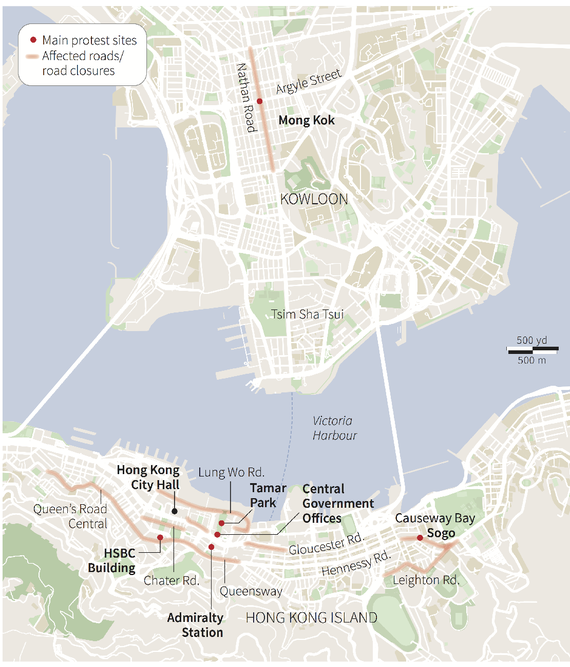
Protest locations in Hong Kong
In The Atlantic, Bourree Lam looks at where the Hong Kong protests tend to be located:
Hong Kong’s “umbrella revolution” — an anticipated protest movement with unanticipated mass turnout — is currently spreading across an island slightly bigger than Manhattan.
The Occupy Central with Love and Peace (OCLP) campaign, whose main demands are the resignation of Chief Executive CY Leung and true democracy for Hong Kong, announced months ago that it planned to shut down Hong Kong’s Central District — the city’s financial hub, which also houses government offices (including the Legislative Council’s buildings and the chief executive’s residence) and a luxury-shopping strip featuring a city block-wide Louis Vuitton store (by night it’s where tourist and locals go drinking and clubbing, especially in the Lan Kwai Fong area). Beginning with British colonial rule in 1841, the district has gradually become the main artery of Hong Kong’s business and social life.
But the protest movement, of which the OCLP is now just one part, has expanded in the last few days to the districts of Admiralty, Causeway Bay, and Mongkok — some of the city’s most bustling commercial sectors. On Tuesday, the protests encompassed the areas of Tsim Sha Tsui and Wan Chai. And, in a twist on the ‘Occupy’ movement in the United States, the demonstrations haven’t been confined to public squares; they’ve also spread to intersections, forcing road closures. Protesters, for instance, are currently holding their positions on Connaught Road Central, a major six-lane throughway that connects four districts on the island.
[…]
Update: Zachary Keck is quite pessimistic on the chances for success.
As covered extensively in The Diplomat, tens of thousands of protesters have taken to the streets of Hong Kong demanding democratic reforms. Specifically, the protesters want free and fair elections and universal suffrage to select the city’s government, which Beijing promised as part of the condition for the U.K. handing back the city to mainland China.
Sadly, Occupy Central is doomed to fail. The Chinese government will not accept the protesters’ demands.
Beijing has already made it clear that it views free and fair elections in Hong Kong to be a threat to one-party rule in the country. At most, it will allow Hongkongers to select one of the candidates that it pre-approves. It has also deemed Occupy Central illegal. In other words, the Chinese Communist Party views the issue as one of its “core interests,” and it hasn’t stayed in power this long by compromising on issues that it views as threats to its survival.
[…]
The massive protests that have swept through Hong Kong in recent days have only made it more urgent that the CCP hold the line on the issue. The Party can ill afford an example of mass demonstrations forcing it to compromise on an issue deemed to be of core importance. Before the protests, it was possible the CCP might have assessed that free and fair elections in Hong Kong would not threaten one-Party rule on the mainland because of the “one country, two systems” mantra. However, the Party giving in on a core issue because of mass protests would, without question, set a dangerous precedent for the CCP’s grip on power in mainland China. It therefore will not be done.
This isn’t to say that a violent crackdown is coming. Indeed, as is almost always the case, the CCP will want the local government on the frontlines in handling the protesters, while Beijing directs things from behind the scenes. As Steve Hess has pointed out in The Diplomat, using local governments as scapegoats has long been an effective tool of the CCP. If it means the restoration of stability, that could very well mean the end of CY Leung’s career. It’s also possible some sort of “compromise” will be worked out that allows the protesters to claim some sort of victory without compromising the CCP’s ability to maintain a large degree of control over the chief executive of Hong Kong.
September 30, 2014
Implementing libertarian principles in practical politics
P.J. O’Rourke talks to Senator Rand Paul:
The Senator smiled and shrugged. “I never really felt like it was a problem explaining libertarian principles in practical politics. Republicans are champions of economic liberty. Democrats are champions of personal liberty. Bring the two back together.”
The Senator said, “The problem is mostly how people characterize libertarianism. But that’s changing. Libertarian has gone from being something scary to something people like as a label for themselves.”
He said, “There are different ways to get where we want to go.” And gave an example of going nowhere. “Nothing good has come out of the war on drugs.”
“What’s a different way?” I asked.
“I like the unenumerated powers.”
The powers not delegated to the United States by the Constitution, nor prohibited by it to the states, are reserved to the states respectively, or to the people. The Tenth Right in the Bill of Rights keeps us from having just nine rights.
“In The Federalist Papers,” I said, “Hamilton argued against the Bill of Rights on the grounds that government even mentioning rights like free speech implied government had some power over those rights.”
“But it’s a good thing we did write them down,” the Senator said, “otherwise we’d have nothing left.”
Senator Paul asked, not quite rhetorically, “Is this the ‘Libertarian Moment’? If so, it probably won’t come from a third party. Probably it will come from within a party.”
“From within the Democratic Party?” He didn’t seem to think it was inconceivable. “In New Hampshire,” he said, “even Democrats are against state income and sales taxes.”
But he didn’t seem to think it was likely either. “Republicans are an ideological coalition,” he said. “Democrats are a coalition of ideologies. The only thing Democrats agree on is income redistribution.”
Sen. Paul said, “Republicans have tradition on their side. It’s the American revolution versus the French Revolution.”
This was a switch – a flip-flop if you will – from Thomas Paine’s radical liberty de facto to Edmund Burke’s traditional liberty de jure. But I don’t fault the Senator. No friend of liberty can avoid the tumble back and forth between Burke and Paine.
“Tradition is a good thing,” the Senator said. “Ninety percent of Americans don’t break the law, not because there’s a law against it, but because they have a tradition of conscience. Republicans are traditional. But tradition can be boring. Libertarianism spices things up. Republicans have to either adapt, evolve, or die. They either have to water [down] their message — or extend liberty.”
September 29, 2014
September 23, 2014
This is what a genuinely ethical oil divestment plan for universities would look like
Megan McArdle explains why universities are not in a particularly righteous position when they push for divesting out of fossil fuels:
I understand that universities are exploring sustainability. Just the same, they consume huge amounts of fossil fuels: To heat and cool their buildings. To power their labs and computer networks. Maintenance and landscaping. Cooking all that food. Lighting all those rooms. Every year, they put on many large events to which people fly or drive long distances. Their students travel to and from their premises multiple times a year, rarely on foot. Their faculty fly to do research or attend conferences; many of my friends in academics have much better frequent-flier status than I could ever dream of. Their admissions officers fly hither and yon to recruit students. Their teams fly or drive to games. But you get the idea. The point is that the fossil-fuel consumption of every university in the country dwarfs the impact of their investments on climate change.
[…]
If divestment activists were serious about making a difference, setting an example, and drawing the full weight of America’s moral opprobrium onto the makers and consumers of fossil fuels, they’d be pushing a University Agenda that looked more like this:
- Require administrators, faculty, sports teams and other student groups to travel exclusively by boat and rail, except for “last mile” journeys.
- Cease construction of new buildings on campus.
- Stop air conditioning buildings, except for laboratories and archives that require climate control. Keep the heat no higher than 60 degrees in winter.
- Put strict caps on power consumption by students, keeping it to enough electricity to power one computer and one study lamp. Remove power outlets from classrooms, except for one at the front for the teacher.
- Ban meat from campus eateries and require full-time students to be on a meal plan.
- Remove all parking spots from campus.
- Stop operating campus shuttles, except for disabled students.
- Divest the endowment from fossil-fuel companies, if it makes you feel better.
Why has No. 8 jumped to No. 1? Because it’s easy. Because a group of students pushing endowment divestiture can shut down a public meeting and be rewarded with the opportunity to hold a teach-in; a group of students pushing a faculty flying ban and the end of campus parking would find the powers that be considerably more unfriendly. Not to mention their fellow students. Or, for that matter, their fellow activists, few of whom are actually ready to commit to never in their lives traveling out of America’s pitiful passenger rail network.
“Rock star economy” leads to first majority government in New Zealand since 1996
Anthony Fensom reports on Saturday’s election results in New Zealand:
New Zealand’s “rock star economy” helped center-right Prime Minister John Key achieve a thumping election victory. But with major trading partner China slowing, are financial market celebrations premature?
The New Zealand dollar, government bonds, and stocks gained after Key’s National Party romped to power in Saturday’s poll, securing its third straight term and the nation’s first majority government since proportional representation was introduced in 1996.
Despite “dirty politics” claims and a late attempted campaign ambush by internet entrepreneur Kim Dotcom, the incumbent National Party won 61 of 121 parliamentary seats and 48.1 percent of the vote, the party’s best result since 1951.
In contrast, the main opposition left-leaning Labour Party, which pledged an expansion of government, secured only 24.7 percent of the vote for its worst performance since 1922. The Greens won 10 percent and New Zealand First 8.9 percent as pre-election predictions of a closer race proved false.
Key pledged to maintain strategic alliances with the Maori, ACT and United Future parties, which won four seats between them, further strengthening his parliamentary majority.
[…]
“Like [Australian Prime Minister] Abbott, Key as a new prime minister inherited a budget and an economy in deep trouble…Six years later, the budget is in surplus, unemployment at 5.6 percent is falling and the economy is growing so strongly the New Zealand Reserve Bank became the first among developed countries to raise interest rates to deter inflation,” noted the Australian Financial Review’s Jennifer Hewett.
“Not only did the Key government cut personal and corporate tax rates, it raised the goods and services tax to 15 percent while steadily reducing government spending over years of ‘zero budgets,’” wrote Hewett, who urged Abbott to “learn some sharp lessons” from Key’s electoral successes.
Key’s party has pledged to cut government debt to 20 percent of gross domestic product (GDP), reduce taxes “when there is room to do so” and create more jobs, aiming to undertake further labor and regulatory reforms as well as boosting the supply of housing.
September 22, 2014
QotD: Dumbing down the universities
Years ago, when I was at university, I asked one of the older professors of history what he thought about the changes in the student body over his career. This gentleman, a word entirely applicable to him, said that when he started teaching in the early 1960s he would flunk between a quarter and a third of his first year classes. Faster forward to the early 2000s and he rarely flunked a student. I jokingly asked him if that was because young people are smarter now than they were forty years earlier. He found my little joke rather too funny.
He confided in me that in the late 1960s the president of the university did the rounds. He explained that he was receiving pressure from the provincial government. Too many students were going off to university and then failing to graduate. The logical inference would have been that the high schools had either failed to prepare these students, or that the students were not academically capable or inclined. Political logic, however, is not like ordinary logic. It works by different rules. A government minister couldn’t admit that many public high schools just weren’t good enough, or that little Johnny was a bit daft. That would have contravened the egalitarian ethos of the age. So if the high schools couldn’t be fixed, they’d fix the universities instead.
Now by fix they didn’t mean improve. Nope. They meant dumb down. Now this was at one of the most prestigious universities in the land. You can well imagine that dumbing down at such a place was bad enough, dumbing down at less academically selective schools would be the equivalent of destroying virtually all academic rigour. This dumbing down also had the added advantage of filling in all those empty spaces left when the Baby Boomers graduated.
Richard Anderson, “The Shadow of Truth”, The Gods of the Copybook Headings, 2014-03-28
September 21, 2014
September 18, 2014
If Rush Limbaugh didn’t exist, the left would have to invent him
Hans Bader on how Rush Limbaugh is a constant gift to his enemies … almost a Rob Ford of US political commentary:
Rush Limbaugh can take a winning issue for conservatives and turn it into a loser just by shooting his mouth off. He gives advocates of extreme left-wing policies ammunition for their views by making stupid arguments when smarter arguments exist, and by lacing his arguments with sexism or scurrilous remarks. He did it recently in response to my commentary about Ohio State University’s ridiculously overbroad and intrusive “sexual assault” definition — which seemingly requires students to agree on “why” they are having sex or making out, which is none of the university’s business. And he did it in 2012, when his scurrilous remarks about contraceptive advocate Sandra Fluke being a “slut” and a “prostitute” drove even moderate liberals to support a contraceptive mandate on religious employers that they had earlier opposed (and which the Supreme Court later ruled 5-to-4 violated the Religious Freedom Restoration Act.)
[…]
But instead of focusing on that in his criticism of Ohio State’s policy, Limbaugh changed the subject to asking whether “no” really means “no,” saying “How many of you guys in your own experience with women have learned that no means yes, if you know how to spot it?” He then temporarily backed away from this remark by saying, “Let me tell you something, in this modern world, that’s simply…that’s not tolerated.” But then he returned to the inflammatory subject of “no” supposedly not meaning “no” by saying “It used to be that it was a cliché. It used to be part of the advice young boys were given.”
Liberal blogs like Think Progress, and newspaper blogs had a field day making fun of his comments questioning whether no means no, and using them to imply that the only reason anybody would ever oppose requiring “affirmative consent” is because they are a misogynistic troll like Limbaugh. In response, a columnist at a major midwestern newspaper endorsed the policy as supposedly being “smart” in light of the need to educate people like Limbaugh about consent. (Never mind that Limbaugh is not a college student, and it’s hard to imagine many college students sharing his ancient views.)
As a result, all of my efforts were undone, by a factor of ten. Overnight, a policy that seemed extreme even to liberals I discussed it with became embraced by many liberal commenters at these blogs, partly out of a desire to spite the hateful Limbaugh. It is being used to depict critics of the extreme policy as themselves being extreme.
September 14, 2014
Australia’s search for new submarines
A few days ago, news reports indicated that the next generation of submarines for the Royal Australian Navy would be bought from Japan, rather than built in Australia. Kym Bergmann says the reports are probably misleading:
There has been a flurry of public commentary following yesterday’s News Limited claims that Australia is about to enter into a commitment to buy its next generation of submarines from Japan. The local submarine community has been concerned about that possibility for some time, and senior members of the Submarine Institute of Australia have been writing to Defence Minister David Johnston — and others — since January of this year warning against such a decision.
Understanding what’s happening is difficult because the speculation appears based on remarks apparently made by Prime Minister Tony Abbott to his Japanese counterpart Shinzo Abe about such a course of action. The concerns have been reinforced among some observers by Abbott’s interest in strengthening Australia–Japan–U.S. defense ties — something in turn being driven by the rise of China. Yesterday Prime Minister Abbott did nothing to dampen the speculation, stating that future submarines were about capability, not about local jobs. As an aside, those sorts of comments also serve the PM’s aggressive political style, jabbing a finger into the eye of the current South Australian Labor Government.
However, the chances of the Federal Government making a unilateral decision to sole source a Japanese solution seem low — and if the Prime Minister were to insist on that particular course of action there could be a serious Cabinet and back bench revolt. Not only would such a decision constitute another broken promise — the word “another” would presumably be contested by the PM on the basis that no promises have been broken to date — but it’d almost certainly lead to the loss of Federal seats in South Australia (Hindmarsh for sure, perhaps Boothby and Sturt), as well as generate enormous resentment within institutions no less than the Royal Australian Navy, the Department of Defence, trade unions and a stack of industry associations, amongst others.
Australia is similar to Canada in this regard: military expenditure is almost always seen as regional development/job creation/political vote-buying first and value-for-money or ensuring that the armed forces have the right kit for the task come a very distant second. This means that the RAN, like the RCN, often ends up with fewer hulls sporting lower capabilities for much more money than if they were able to just buy the best equipment for their needs whether overseas or at home. But that doesn’t get the government votes in “key constituencies”, so let the sailors suffer if it means shoring up support in the next federal election…
September 12, 2014
Scottish businesses face a “day of reckoning” after a Yes vote
Usually, when someone is planning to punish their political enemies, they keep quiet about it until the votes are counted. The former deputy leader of the Scottish National Party is pretty forthright about just who is going to be facing punishment if Scotland votes yes:
Former SNP deputy leader Jim Sillars has claimed there will be a “day of reckoning” for major Scottish employers such as Royal Bank of Scotland and Standard Life after a Yes vote.
Speaking from his campaign vehicle the “Margo Mobile”, Mr Sillars insisted that employers are “subverting Scotland’s democratic process” and vowed that oil giant BP would be nationalised in an independent Scotland.
Earlier this week, a number of banks, including Lloyds Banking Group and RBS, said they would look to move their headquarters south of the border in the event of a Yes vote.
Mr Sillars, who earlier this week claimed he and First Minister Alex Salmond had put their long-held personal differences behind them to campaign together for independence, also revealed that he would not retire from politics on 19 September but said he would be “staying in” if Scotland became independent.
He claimed there is talk of a “boycott” of John Lewis, banks to be split up, and new law to force Ryder Cup sponsor Standard Life to explain to unions its reasons for moving outside Scotland.
He said: “This referendum is about power, and when we get a Yes majority, we will use that power for a day of reckoning with BP and the banks.
“The heads of these companies are rich men, in cahoots with a rich English Tory Prime Minister, to keep Scotland’s poor, poorer through lies and distortions. The power they have now to subvert our democracy will come to an end with a Yes.”
If I had any investments in Scotland, I would be calling my broker to review them in the light of this pretty specific set of economic and political goals for an independent Scotland. It won’t be a safe place to invest any kind of retirement savings if Sillars represents more than a fringe of the SNP.
September 9, 2014
QotD: The Iron Law of Redistributionism
[P]olicies intended to “help” the poor are invariably hijacked by a rentier class that fattens on the rising diversion of income. Result: help never arrives, much wealth is destroyed, growth is strangled, and the poor get poorer.
Eric S. Raymond, Google+, 2014-09-06.
September 1, 2014
Unionists fumble by letting Labour drive the “No” campaign in Scotland
In the Telegraph, Sean Thomas says that the self-loathing tradition among Labour intelligentsia makes Labour the worst possible party to make the case for union, even though Labour stands to lose far more electorally than any other party:
It’s often been observed that a certain type of British Lefty hates Britain – and that they reserve particularly hatred for Englishness. Back in 1941 George Orwell made this acute remark:
England is perhaps the only great country whose intellectuals are ashamed of their own nationality. In left-wing circles it is always felt that there is something slightly disgraceful in being an Englishman and that it is a duty to snigger at every English institution.
So what’s new? The difference today is that this shame and self-hatred now dominates Left-wing thought, whereas it was once balanced by the decent Left: who were proud to inherit the noble traditions of radical English patriotism.
[…] The latest polls show that the United Kingdom is close to breaking up. This is a remarkable state of affairs when you consider that, a year ago, polls were two to one against partition. How has this occurred? Because we have allowed the British Labour party to lead the No debate.
This was a disastrous decision, given that, as Orwell noted, Labourites and Lefties revile and deride so many of the things perceived as quintessentially British. Take your pick from the monarchy, the flag, the Army, the history of rampant conquest, the biggest empire in the world, the supremacy of the English language, anyone who lives in the countryside, the national anthem, the City of London, the Royal Navy, a nuclear deterrent, the lion and the unicorn, duffing up the French, eating loads of beef — all this, for Lefties, is a source of shame.
The result, north of the Border, is plain to see. Whenever the passionate and patriotic SNP asks the No campaign for a positive vision of the UK (instead of dry economic facts, and negative fear-mongering) all we hear is silence, or maybe a quiet murmur about “the NHS”. Yes, the NHS. For many Lefties, the NHS &mdah; an average European health system with several notable flaws — is the only good thing about Britain. It’s like saying we should keep the United Kingdom because of PAYE. Thus we tiptoe towards the dissolution of the nation.
There is a deep irony here. If Scotland secedes it will hurt the Labour Party more than anyone, electorally. But such is the subconscious hatred of Britain and Britishness in Lefty hearts, I believe many of them think that’s a price worth paying: just to kick the “Tory Unionists” in the nuts, just to deliver the final death-blow to British “delusions of grandeur”.


