
Forgotten Weapons
Published 20 Oct 20230:00 Introduction and Overview of the AFN 49
1:23 Detailed Insight into the AFN 49’s Global Presence
3:01 Demonstration and Explanation of the AFN’s Unique Features
5:05 Auto Trip Feature: A Deep Dive
7:27 Unique Characteristics of the AFN 49
8:48 The Journey of AFN 49s to the US
10:17 Conversion of Luxembourg AFN 49s: A Historical Perspective
10:43 Conclusion and AcknowledgementsA note to censors: This video is not a tutorial on full auto conversion. It is an explanation of how the system works, and provides no instruction of how to fabricate or modify parts to modify a semiautomatic firearm into a fully automatic one. Doing that would be illegal for most people — although certainly not all; conversion or ownership of machine guns is legal in most places with the appropriate government permission.
The SAFN, aka FN-49, is one of the classic post-war European battle rifles, and was sold to nine different countries in the early 1950s before the FAL became FN’s primary combat rifle offering. What is often forgotten is that despite being limited to a fixed 10-round magazine, nearly half of all FN-49s produced were actually fully automatic AFN-49s. The Belgian Army, Luxembourg Army, Luxembourg Gendarmerie, and Belgian Congo all purchased the automatic pattern. So today, we’re going to take a look at how it differs from the regular SAFN that we are used to seeing.
Interestingly, a batch of the Luxembourg Gendarmerie rifles were imported into the US without anyone realising that they were automatic until they arrived and were being unpacked. InterArms went to the IRS (the NFA was a tax law administered by the Treasury; this was before the formation of the ATF) and proposed removing the selector levers and auto sears, as well as milling off their attachment points on the receivers. The IRS agreed that this would be an acceptable conversion to render the guns legally semiautomatic only, and the changes were made before the rifles were sold. They remain on the US collector market today as an interesting example of legal conditions prior to the adoption of a pointless and punitive decree of “once a machine gun, always a machine gun”.
Many thanks to the Royal Museum of the Armed Forces and Military History in Brussels for access to this very cool piece! Check them out here: https://www.klm-mra.be/en/
(more…)
January 27, 2024
AFN-49: The Forgotten Full-Auto Brother of the FN-49
January 26, 2024
Canada’s sooper-sekrit warship program
David Pugliese on the cone of silence the federal government seems to have pulled down over the Canadian Surface Combatant shipbuilding program as it steadily escalates in total cost to the taxpayer:
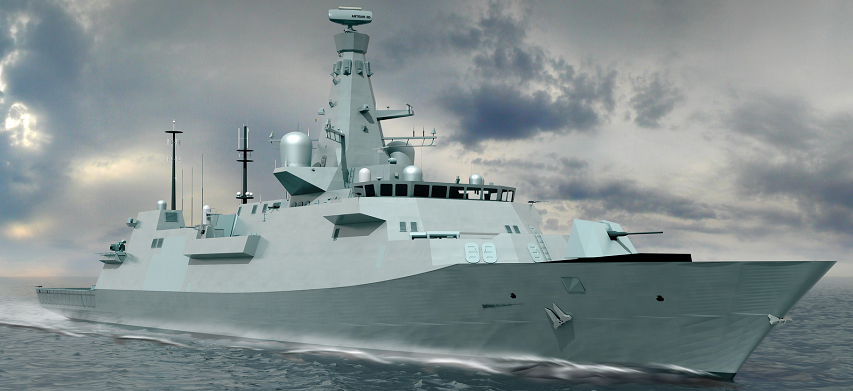
An artist’s rendition of BAE’s Type 26 Global Combat Ship, which was selected as the Canadian Surface Combatant design in 2019, the most recent “largest single expenditure in Canadian government history” (as all major weapon systems purchases tend to be).
(BAE Systems, via Flickr)
National Defence has brought in a new and unprecedented shroud of secrecy around a controversial warship project now estimated to cost taxpayers more than $80 billion.
After withholding documents for almost three years, the Department of National Defence has released nearly 1,700 pages of records that were supposed to outline specific costs and work done so far on the Canadian Surface Combatant program.
But all the details of what taxpayers have so far spent and what type of work has been done by Irving Shipbuilding for that money have been censored from the records.
“I pretty much got nearly 1,700 blank pages,” Ken Rubin said of the access to information request he filed to National Defence in April 2021 about the warship program. “I have never seen this level of secrecy or lack of accountability over a project that is costing so much.”
Rubin, an investigative researcher who has used the access law to obtain federal documents for decades, said there was not a single cost figure contained in any of the 1,700 pages. One page noted that Irving was required to perform 19 specific tasks, but all details were censored. Others pages listed numerous amendments made to the CSC program, but all details were blacked out. Information about the annual profit Irving has made so far on the CSC project is censored.
Irving declined to provide comment, referring this newspaper to National Defence.
Defence Minister Bill Blair’s office sent this newspaper a statement noting the “minister believes strongly in openness and transparency, and expects the Department of National Defence to respect the rights of Canadian citizens, permanent residents and persons or corporations present in Canada, to access records of government institutions that are subject to the Access to Information Act“.
National Defence noted in a statement that, since some of the records involved Irving Shipbuilding, government officials consulted with the firm to determine if the records contained proprietary information of the firm. Irving objected to the release of information, the department added.
But Rubin pointed out that National Defence was not required to follow Irving’s orders on what records could be released to the public. The amount of tax dollars spent on the surface combatant and how that money was being spent shouldn’t be secret, he added.
In addition, National Defence originally claimed in a statement to this newspaper that the long delay in providing the documents was because Rubin had asked for 20 years of records. But, when challenged on that claim, the department acknowledged it wasn’t true. It did not, however, provide an explanation why it had provided false information to this newspaper.
The Canadian Surface Combatant project will involve the construction of 15 warships for the Royal Canadian Navy at Irving on the east coast.
January 25, 2024
Finnish Jews, Polish Special Forces, and MREs – WW2 – OOTF 32
World War Two
Published 24 Jan 2024How did Finland treat its Jews, and what did Finnish people know about the Holocaust? Who were the mysterious Polish Silent Unseen? And, what sort of rations did soldiers carry? Find out in this episode of Out of the Foxholes.
(more…)
USS West Virginia
The History Guy: History Deserves to be Remembered
Published 26 October 2023On December 7, 1941, the battleship USS West Virginia was at Pearl Harbor, moored on Battleship Row, next to USS Tennessee. During the Japanese attack, she was struck by seven torpedoes, sinking in shallow water. But the “We Vee” would rise again, and she would lead the American line of battle at the last battleship on battleship action in history. USS West Virginia deserves to be remembered.
(more…)
January 24, 2024
France’s Final Battle Rifle Iteration: The MAS 49-56
Forgotten Weapons
Published 24 May 2019While the development of the MAS 49 had given France a very utilitarian rifle that could serve as both for both marksmen and grenadiers, it could still be made better. In large part, the change to the 49-56 pattern was motivated by the move to adopt NATO-compatible 22mm rifle grenades. With the new muzzle hardware, several other changes were made. A gas cutoff was added, to prevent wear and tear on the action from grenade use (something that was found to be a real problem on the MAS 49). The gas port was also moved farther down the barrel, and the hand guard and barrel were both shortened to make the rifle a bit lighter and handier.
Production began in 1957, and about 175,000 of the rifles were made, seeing service as France’s standard front-line infantry rifle until the adoption of the FAMAS in 1979.
(more…)
January 23, 2024
The battle of Sangshak, 1944
Dr. Robert Lyman discusses a new book by David Allison that covers one of the many small battles that made up the large Imphal-Kohima campaign:
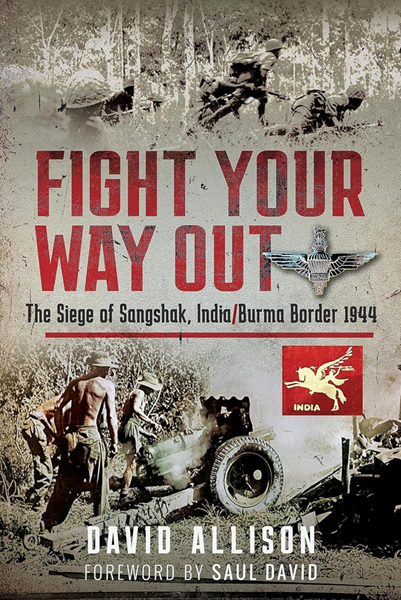
When Wavell, by then Viceroy of India, visited Imphal after the battle in October, to bestow knighthoods on the four victors — Lieutenant Generals Bill Slim (14 Army), Montagu Stopford (33 Corps), Geoffrey Scoones (4 Corps) and Philip Christison (15 Corps) — he admitted to Slim that he found the battle hard to follow, as it seemed to have been fought in “penny-packets”. In professing his ignorance of Slim’s great triumph, Wavell nevertheless hit the nail on the head. Sangshak was one of those penny-packet fights which cumulatively determined the outcome of Japan’s audacious invasion of India.
Like many battles in insufficiently examined wars, Sangshak has suffered over the years from a paucity of rigorous examination. Louis Allen’s magisterial The Longest War gave it short treatment in 1984, and very little else. Until now. I’m delighted to say that a Hong Kong-based Australian lawyer with a military background — David Allison — has produced a new account of this crucial battle, and it is absolutely outstanding. It can be purchased here. I recommend it very strongly. It’s not long: at 159-pages of text you can make your way through this in a couple of days, but it is diligently researched, well written and judiciously argued. For those who know something of the battle, the big arguments in the past about the state training of the 50 Indian Parachute Brigade, the temporary breakdown of its commander, Hope-Thomson and the supposed loss of the captured Japanese map and orders by HQ 23 Indian Division, are calmly and satisfyingly explained.
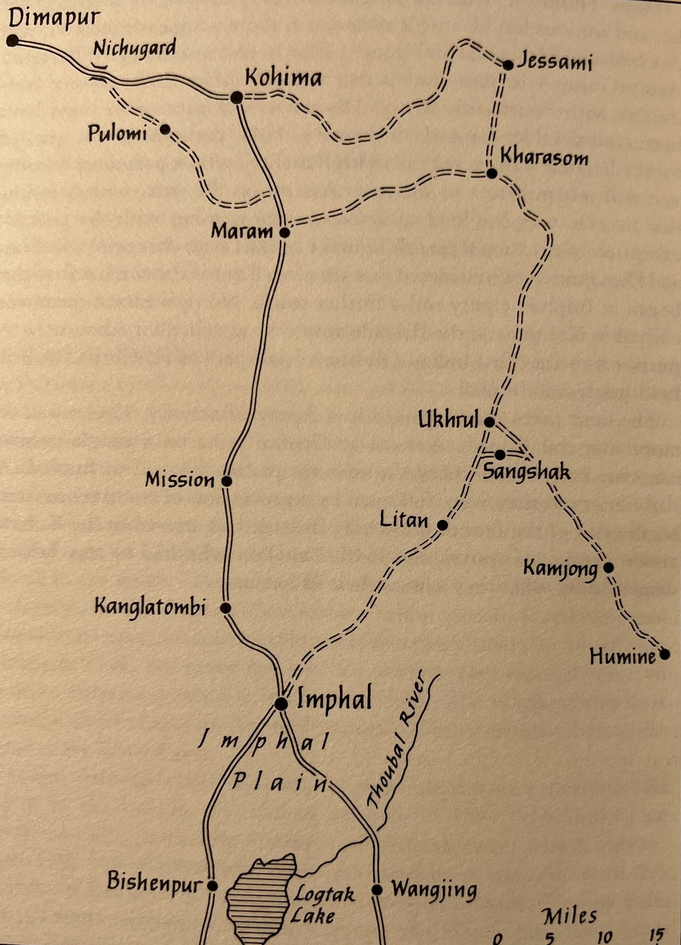
The story can be briefly told. The territory to the north-east of Imphal (centring on the Naga village of Ukhrul) had only the lightest of garrisons and no real defences. Until 16 March it was home to 49 Brigade, which was then despatched to the Tiddim Road to deal with the advance in the south of Lieutenant General Yanagida’s 33 Division. The brigade had considered itself to be in a rear area, and, extraordinarily, no dug-in and wired defensive positions had been prepared. It was one of the most serious British planning failures of the campaign. The entire north-eastern portion of Imphal lay effectively undefended. The gap left by the brigade’s departure had been filled in part by the arrival of the first of the two battalions of the newly raised 50 Indian Parachute Brigade (comprising the Gurkha 152 Battalion and the Indian 153 Battalion), whose young and professional commander, 31-year-old Brigadier M.R.J. (“Tim”) Hope-Thomson, had persuaded New Delhi to allow him to complete the training of his brigade in territory close to the enemy. The area north-east of Imphal was regarded as suitable merely for support troops and training. At the start of March, the brigade HQ and one battalion had arrived in Imphal and began the leisurely process of shaking itself out in the safety of the hills north-east of the town. To the brigade was added 4/5 Mahrattas under Lieutenant Colonel Trim, left behind when 49 Brigade was sent down to the Tiddim Road. To Scoones and his HQ, the area to which Hope-Thomson and his men were sent represented the lowest of all combat priorities. Sent into the jungle almost to fend for themselves, it was not expected that they would have to fight, let alone be on the receiving end of an entire Japanese divisional attack. They had little equipment, no barbed wire, and little or no experience or knowledge of the territory. No one considered it worthwhile to keep them briefed on the developing situation. To all intents and purposes, 50 Indian Parachute Brigade was an irrelevant appendage, attached to Major General Ouvry Roberts’ 23 Indian Division for administrative purposes but otherwise left to its own devices.
Before long, information began to reach Imphal that Japanese troops were advancing in force on Ukhrul and Sangshak. Inexplicably, however, this information appeared not to ring any warning bells in HQ IV Corps in Imphal, which was preoccupied with the developing threat in the Tamu area where the main Japanese thrust was confidently predicted. On the night of 16 March, the single battalion of 50 Parachute Brigade took over responsibility for the Ukhrul area from 49 Brigade, which was hastily departing for the Tiddim Road. They had no idea that an entire Japanese division of 20,000 men was crossing the Chindwin in strength opposite Homalin. On 19 March, large columns of Japanese infantry were reported advancing through the hills.
No one had expected them to be where they were. But the first shock came to the Japanese 3/58 battalion (Major Shimanoe), part of Lieutenant General Sato’s 31 Division – troops whose objective was Kohima, and not Imphal – who were bloodily rebuffed by the determined opposition of the young Gurkha soldiers at an unprepared position forward of Sheldon’s Corner. The 170 Gurkha recruits refused to allow the 900 men of 3/58 to roll over them and inflicted 160 casualties on the advancing Japanese. In the swirling confusion of the next 36 hours, Hope Thomson and his staff kept their heads, attempting to concentrate what remained of the dispersed companies of 152 Battalion and 4/5 Mahrattas back to a common position at the village of Sangshak, which dominated the tracks southwest to Imphal.
It was at this now-deserted Naga village that Hope-Thomson, on 21 March, decided to group his brigade for its last stand, his staff desperately attempting to alert HQ 4 Corps in Imphal to the enormity of what was happening to the north-east. The Japanese columns infiltrated quickly around and through the British positions, heading in the direction of Litan. The Japanese now began days of repeated assaults on the position in a battle of intense bravery and sacrifice for both sides. Hope Thomson’s men could only dig shallow trenches, which provided no protection from Japanese artillery.
The Korean War: The First Year
Army University Press
Published Jan 22, 2024Created for the Department of Command and Leadership and the Department of Military History at the US Army Command and General Staff College, The Korean War: The First Year is a short documentary focused on the major events of the Forgotten War. Designed to address the complex strategic and operational actions from June 1950 – June 1951, the film answers seven key questions that can be found in the timestamps below. Major events such as the initial North Korean invasion, the defense of the Pusan Perimeter, the Inchon landing, and the Chinese intervention are discussed.
Timestamps:
1. Why are there Two Koreas? – 00:25
2. Why did North Korea Attack South Korea? – 02:39
3. How did the UN stop the Communist invasion? – 06:30
4. Why did MacArthur attack at Inchon? – 10:24
5. Why did the UN attack into North Korea? – 14:27
6. Why did China enter the Korean War? – 18:51
7. How did the UN stop the Communist invasion … again? – 21:44
T-34: The tank that won WWII
The Tank Museum
Published 27 Oct 2023The Soviet T-34 was the most prolifically produced tank of WWII. Basic and austere in design, it was highly effective and capable of being mass-produced. In this video we take a close look inside and out at the tank that made victory over Nazi Germany possible.
(more…)
January 22, 2024
NATO at 75
In The Critic, Peter Caddick-Adams considers the role of NATO as the alliance enters its 75th year:
In addition to NATO’s 12 founding countries, four others joined during the Cold War: Greece and Turkey (1952), West Germany (1955) and Spain (1982). Afterwards, the Czech Republic, Hungary and Poland (1999), Bulgaria, Estonia, Latvia, Lithuania, Romania, Slovakia, and Slovenia (2004), Albania and Croatia (2009), Montenegro (2017), and North Macedonia (2020) were all ushered safely into the NATO fold. Prompted by Russia’s aggression in Ukraine, Finland joined last year, while Sweden (currently held up by Hungary and Turkey), Bosnia-Herzegovina, Georgia, and Ukraine have applications pending. In every case the lure has been one of collective security against precisely what Russia is doing to Ukraine at present, and future procurement collaboration.
NATO standards of training and equipment are the envy of the world. When I was last in Lviv, before the 2022 invasion, I found a sticker affixed to the front door of the apartment block in which I was staying. It was placed there by a dodgy private military company seeking to recruit unemployed Ukrainians for foreign military adventures. Apart from modern kit and high rates of pay, it advertised Стандартная подготовка НАТО (NATO-standard training). Yes, even Russian mercenaries then regarded the alliance as the gold standard of military expertise.
NATO further reinvented itself in 1994 with the still-current Partnership for Peace (PfP) programme, aimed at creating trust and cooperation between members and (currently 19) others, mostly the remaining post-Soviet states, plus nations like Austria, Bosnia, Ireland, Malta, Serbia and Switzerland. It also engages with 7 other countries through its Mediterranean Dialogue initiative. During this era, NATO extended its activities into political and humanitarian situations that had not formerly been its concern, notably intervening during the breakup of Yugoslavia. Its first ever military deployment since establishment was to Bosnia in 1995, for which I was the official historian, headquartered a few hundred metres away from where the Austrian Archduke met his fate 81 years earlier, in Sarajevo.
For a seventy-five-year-old institution, NATO has shown itself remarkably resilient in taking on new roles, reflecting the concerns of the post-Soviet era. Since 1997, it has fostered the Euro-Atlantic Partnership Council, comprising all 31 NATO members and the 19 PfP countries. The same year saw the establishment of a NATO-Russia Permanent Joint Council, though Moscow’s mission to NATO was suspended in October 2021, along with that of the alliance in Moscow. With Finland becoming the 31st member state on 4 April 2023, and the application of Sweden pending, NATO is bigger than ever. Yet it is not cumbersome or ossified; its thinking and doctrine are regarded as world-beatingly agile. However, as Grant Shapps outlined on 15 January, the challenges are bigger than at any period during its life. This was the same day that Steve Rosenberg, the BBC’s Moscow correspondent, spotted an electronic billboard in the Russian capital. Next to Putin’s face, it read “Russia’s borders do not end anywhere”.
Although the “peace dividend” effectively ended with Russia’s annexation of the Donbass and Crimea in March-May 2014, it has taken ten years for a UK government minister to formally acknowledge that the world has changed irrevocably. In this election year there is one elephant in the room which neither party will address in any detail. Defence spending. Currently standing at 2.3 per cent of GDP, the national credit card is already maxed out on the NHS, transport, police, education, local government, justice and the rest. There is no more money in the pot, and although £50 billion may sound a lot, it isn’t. According to the World Bank, in 1960, we spent just over 7 per cent of GDP on defence; by 1970 this had declined to 5.2, and in 1990, to 4 percent. In 2017-18, we hit a low of 1.9 per cent of GDP. The largest chunk is spent on its workforce, military and civil service.
The combined militaries of all NATO members include around 3.5 million personnel, with much standardised equipment and logistics. More than enough to take on any global competitor. Yet, such protection and its main headquarters in Brussels, with various cutting edge command centres around Europe, do not come cheap. NATO’s requirement is that all member states contribute a minimum of 2 per cent of their GDP on defence. Only ten member states do this, including Britain, the USA, Greece, Croatia, Estonia, Latvia, Poland, Lithuania, Romania and France. Of these, America spends vastly far more ($811 billion) than the rest of the alliance put together. This imbalance feeds directly into the Republican narrative that Europe is freeloading on American muscle and goodwill. Not even the prospect of a Trump presidency seems to have shaken the non-compliant member states out of their somnolence. If this eventuality arises in Washington DC, and America starts to renege on its commitments to Europe and Ukraine, it will fall to Britain to lead NATO in Europe.
QotD: Mao’s theory of “protracted war” as adapted to Vietnamese conditions by Võ Nguyên Giáp
The primary architect of Vietnam’s strategy, initially against French colonial forces and then later against the United States and the US-backed South Vietnamese (Republic of Vietnam or RVN) government was Võ Nguyên Giáp.
Giáp was facing a different set of challenges in Vietnam facing either France or the United States which required the framework of protracted war to be modified. First, it must have been immediately apparent that it would never be possible for a Vietnamese-based army to match the conventional military capability of its enemies, pound-for-pound. Mao could imagine that at some point the Red Army would be able to win an all-out, head-on-head fight with the Nationalists, but the gap between French and American capabilities and Vietnamese Communist capabilities was so much wider.
At the same time, trading space for time wasn’t going to be much of an option either. China, of course, is a very large country, with many regions that are both vast, difficult to move in, and sparsely populated. It was thus possible for Mao to have his bases in places where Nationalist armies literally could not reach. That was never going to be possible in Vietnam, a country in which almost the entire landmass is within 200 miles of the coast (most of it is far, far less than that) and which is about 4% the size of China.
So the theory is going to have to be adjusted, but the basic groundwork – protract the war, focus on will rather than firepower, grind your enemy down slowly and proceed in phases – remains.
I’m going to need to simplify here, but Giáp makes several key alterations to Mao’s model of protracted war. First, even more than Mao, the political element in the struggle was emphasized as part of the strategy, raised to equality as a concern with the military side and fused with the military operation; together they were termed dau tranh, roughly “the struggle”. Those political activities were divided into three main components. Action among one’s own people consisted of propaganda and motivation designed to reinforce the will of the populace that supported the effort and to gain recruits. Then, action among the enemy people – here meaning Vietnamese who were under the control of the French colonial government or South Vietnam and not yet recruited into the struggle – a mix of propaganda and violent action to gain converts and create dissension. Finally, action against the enemy military, which consisted of what we might define as terroristic violence used as message-sending to negatively impact enemy morale and to encourage Vietnamese who supported the opposition to stop doing so for their own safety.
Part of the reason the political element of this strategy was so important was that Giáp knew that casualty ratios, especially among guerrilla forces – on which, as we’ll see, Giáp would have to rely more heavily – would be very unfavorable. Thus effective recruitment and strong support among the populace was essential not merely to conceal guerrilla forces but also to replace the expected severe losses that came with fighting at such a dramatic disadvantage in industrial firepower.
That concern in turn shaped force-structure. Giáp theorized an essentially three-tier system of force structure. At the bottom were the “popular troops”, essentially politically agitated peasants. Lightly armed, minimally trained but with a lot of local knowledge about enemy dispositions, who exactly supports the enemy and the local terrain, these troops could both accomplish a lot of the political objectives and provide information as well as functioning as local guerrillas in their own villages. Casualties among popular troops were expected to be high as they were likely to “absorb” reprisals from the enemy for guerrilla actions. Experienced veterans of these popular troops could then be recruited up into the “regional troops”, trained men who could now be deployed away from their home villages as full-time guerrillas, and in larger groups. While popular troops were expected to take heavy casualties, regional troops were carefully husbanded for important operations or used to organize new units of popular troops. Collectively these two groups are what are often known in the United States as the Viet Cong, though historians tend to prefer their own name for themselves, the National Liberation Front (Mặt trận Dân tộc Giải phóng miền Nam Việt Nam, “National Liberation Front for South Vietnam”) or NLF. Finally, once the French were forced to leave and Giáp had a territorial base he could operate from in North Vietnam, there were conventional forces, the regular army – the People’s Army of Vietnam (PAVN) – which would build up and wait for that third-phase transition to conventional warfare.
The greater focus on the structure of courses operating in enemy territory reflected Giáp’s adjustment of how the first phase of the protracted war would be fought. Since he had no mountain bases to fall back to, the first phase relied much more on political operations in territory controlled by the enemy and guerrilla operations, once again using the local supportive population as the cover to allow guerrillas and political agitators (generally the same folks, cadres drawn from the regional troops to organize more popular troops) to move undetected. Guerrilla operations would compel the less-casualty-tolerant enemy to concentrate their forces out of a desire for force preservation, creating the second phase strategic stalemate and also clearing territory in which larger mobile forces could be brought together to engage in mobile warfare, eventually culminating in a shift in the third phase to conventional warfare using the regional and regular troops.
Finally, unlike Mao, who could envision (and achieve) a situation where he pushed the Nationalists out of the territories they used to recruit and supply their armies, the Vietnamese Communists had no hope (or desire) to directly attack France or the United States. Indeed, doing so would have been wildly counter-productive as it likely would have fortified French or American will to continue the conflict.
That limitation would, however, demand substantial flexibility in how the Vietnamese Communists moved through the three phases of protracted war. This was not something realized ahead of time, but something learned through painful lessons. Leadership in the Democratic Republic of Vietnam (DRV = North Vietnam) was a lot more split than among Mao’s post-Long-March Chinese Communist Party; another important figure, Lê Duẩn, who became general secretary in 1960, advocated for a strategy of “general offensive” paired with a “general uprising” – essentially jumping straight to the third phase. The effort to implement that strategy in 1964 nearly overran the South, with ARVN (Army of the Republic of Vietnam – the army of South Vietnam) being defeated by PAVN and NLF forces at the Battles of Bình Giã and Đồng Xoài (Dec. 1964 and June 1965, respectively), but this served to bring the United States more fully into the war – a tactical and operational victory that produced a massive strategic setback.
Lê Duẩn did it again in 1968 with the Tet Offensive, attempting a general uprising which, in an operational sense, mostly served to reveal NLF and PAVN formations, exposing them to US and ARVN firepower and thus to severe casualties, though politically and thus strategically the offensive ended up being a success because it undermined American will to continue the fight. American leaders had told the American public that the DRV and the NLF were largely defeated, broken forces – the sudden show of strength exposed those statements as lies, degrading support at home. Nevertheless, in the immediate term, the Tet Offensive’s failure on the ground nearly destroyed the NLF and forced the DRV to back down the phase-ladder to recover. Lê Duẩn actually did it again in 1972 with the Eastern Offensive when American ground troops were effectively gone, exposing his forces to American airpower and getting smashed up for his troubles.
It is difficult to see Lê Duẩn’s strategic impatience as much more than a series of blunders – but crucially Giáp’s framework allowed for recovery from these sorts of defeats. In each case, the NLF and PAVN forces were compelled to do something Mao’s model hadn’t really envisaged, which was to transition back down the phase system, dropping back to phase II or even phase I in response to failed transitions to phase III. By moving more flexibly between the phases (while retaining a focus on the conditions of eventual strategic victory), the DRV could recover from such blunders. I think Wayne Lee actually puts it quite well that whereas Mao’s plan relied on “many small victories” adding up to a large victory (without the quick decision of a single large victory), Giáp’s more flexible framework could survive many small defeats on the road to an eventual strategic victory when the will of the enemy to continue the conflict was exhausted.
Bret Devereaux, “Collections: How the Weak Can Win – A Primer on Protracted War”, A Collection of Unmitigated Pedantry, 2022-03-03.
January 21, 2024
The Red Army Overruns Poland! – WW2 – Week 282 – January 20, 1945
World War Two
Published 20 Jan 2024The huge new Soviet offensives charge ahead this week, taking Warsaw and Krakow; in the west the Battle of the Bulge is officially called over … though there is still fighting there. On Luzon, the Americans push out of their beachhead, though there is heavy fighting to secure their flank.
(more…)
A Book and a Rifle: The Vercors Resistance in WWII
Forgotten Weapons
Published 20 May 2018One of the single largest actions of the French Resistance during World War Two was Operation Montagnards — the plan to drop about 4,000 Allied paratroops onto the Vercors Massif when the resistance was activated in support of the Allied landings in Normandy and Provence. If you are scratching your head trying to figure out why you don’t remember that operation, it is because it never actually happened. The two Allied landings were originally intended to take place simultaneously, but logistical limitations forced the southern landings to be delayed about two months. In an deliberate decision to prevent the Germans from immediately understanding the nature of the Allied attack, the whole of the French Resistance was activated to support the Normandy landings in June 1944. The internal attacks in the south would force the Germans to keep significant forces in that area in expectation of a second landing, which would increase the chances of the Normandy landings succeeding. Unfortunately, the other result of this decision was that Resistance cells would come into the open in anticipation of imminent military support, which would not be coming. The southern elements of the Resistance were basically sacrificed in this gambit.
The Vercors Massif is a large geographical feature near Lyon and Grenoble which comprises basically a triangular sheer-walled plateau rising well above the surrounding plains. It offers a fantastically defensible redoubt, and that is what it was planned to be. Paratroops dropped onto the top of the massif would reinforce a substantial force of Maquis fighters, and create a serious strong point behind the German lines to aid in the fight inland from the landing beaches. The plan was organized in Algiers by Resistance representatives from the Vercors and Free French officers earlier in the war. Some have argued that the lack of support was simply due to the compromises of the single-landing plan, while others fault de Gaulle for deliberately abandoning the men and women on Vercors as part of a strategy to consolidate post-war political support — but that debate is beyond the scope of today’s discussion.
The fighters and civilians on the massif ultimately held out for about 6 weeks — only just too little to still be there when the Allied armored columns reached Grenoble. The German commander in the area spent several weeks making small probing attacks before the final assault with about 10,000 veteran Wehrmacht soldiers, glider-borne infantry, and tanks. Once that attack came, the fate of the Vercors was sealed. With proper military backing they could have defended their redoubt, but instead they had only a smattering of small arms and no heavy weaponry at all. It was a fight that was gloriously courageous but hopelessly doomed to failure.
I am privileged to have in my own collection a Berthier carbine tied to the Vercors Resistance, as evidenced by the brass embellishments on its stock. While I cannot conclusively prove it came from the Resistance, it was sold to me without any premium attached to them, and I have no reason to believe it is fake. And, of course, since I have no plans to sell it, I am not really concerned about conclusively proving its veracity to others. For me, it is a poignant icon of a tremendously heroic group. I hope I would live up to the bar they set should I ever be in a comparable situation!
(more…)
January 18, 2024
Understanding the Spanish Civil War
Niccolo Soldo offers an introduction to the context in which the Spanish Civil War took place, with emphasis on one side’s uneasy coalition of interests:
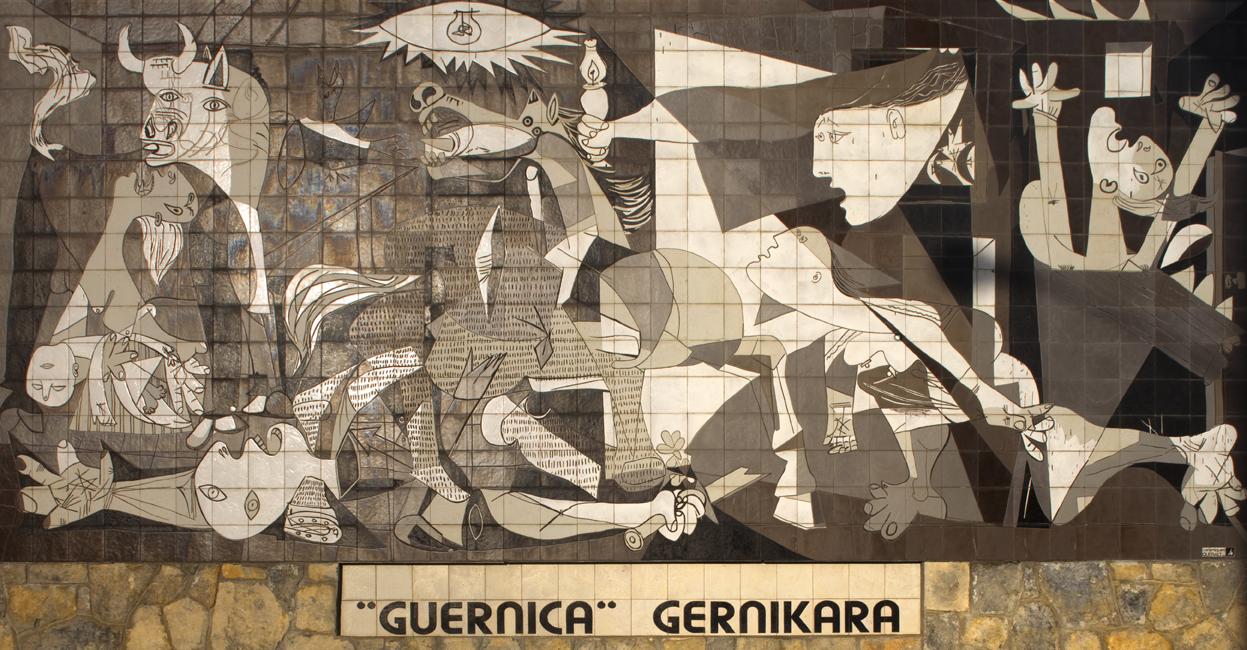
Picasso’s “Guernica” in mural form in the town of Guernica.
Photo by Papamanila via Wikimedia Commons.
At a crossroads in his life, [Ernest Hemingway] decided to go to Spain to cover the conflict for a newspaper chain. Out of his experiences in that war came For Whom the Bell Tolls (1940), one of his most celebrated novels. In this excerpt, he uses the female character “Pilar” to relate the story of how Republican forces massacred a group of people in a small town who were opposed to the government and supported the Spanish Generals seeking to overthrow it. Derided as “fascists”, each of the men were forced to pass a line of pro-government peasants who would beat them with flails before throwing them off of a cliff. Civil wars are indeed the most vicious, even in fictional depictions like this one.
The Spanish Civil War is odd for two reasons, the first one being that more than any other war that I can think of, historians have placed a much stronger focus on the politics of the conflict to the detriment of its military aspects. The second reason is much more important overall, and particularly germane to the subject of this essay: it is the only war that I can think of where the histories have been overwhelmingly written by the losers.1
If you ask a random, somewhat educated person in the West about the Spanish Civil War, they will generally say that “Franco was a fascist who allied himself to Hitler and Mussolini and won the civil war in the most brutal fashion possible. He was a dictator who hated democracy and killed thousands upon thousands of innocent people.” Beyond that, they might make mention of Hemingway and his novel, or even Pablo Picasso’s painting entitled “Guernica”2, that depicts the victims of the German Luftwaffe bombardment of that small Basque town in the north of Spain. Others still will relay the fact that the term “Fifth Column” came out of the Spanish Civil War.3 Added up all together, the most simplified take becomes “Franco bad, Republicans good”.
Of course this take is wrong, as this conflict was too complex to arrive at such a ridiculous reductionist conclusion no matter which side you sympathize(d) with. To give you a quick illustration of just how complex this conflict was, here is a list of the major domestic factions that took part in it:
Spanish Republican Side:
- People’s Army (the armed forces of the Spanish Republic)
- Popular Front (left-wing electoral alliance of communists, socialists, liberals, anarchists)
- UGT (very large trade union affiliated with the Spanish Socialists)
- CNT-FAI (massive trade union of anarchist militants)
- POUM (anti-Stalinist communists, including some Trotskyites)4
- Generalitat de Catalunya (Catalonian Autonomists)
- Euzko Gudarostea (Army of the Basque Nationalists)
Spanish Nationalist Side:
- Spanish Renovation (monarchists supporting the Bourbon claimant to the throne, Alfonso XIII, who abdicated in 1931)
- CEDA (the main conservative party, Catholic conservatives)
- Requetés (traditionalist Catholic monarchist militants who supported the Carlist Dynasty, mainly from the region of Navarre)
- Falange Española de las JONS (Spanish Fascists)
- The Army of Africa, including the Spanish Legion (Spanish Army in Spain’s then-colony of Morocco, with many Moroccans serving in it)
Add to this mix the International Brigades5 that fought on the side of the government, and the German and Italian forces who backed the rebels. To list off all the political groupings that participated in the war is a mouthful, but necessary to hammer home the point of the complexity of this conflict. So here goes: nationalists, monarchists (from two competing royal houses), fascists, conservatives, liberals, social democrats, socialists, communists (from two competing camps), anarchists, and regional autonomists. In short, this war had something for everyone, which is why it caught the attention of so many foreigners (especially famous ones) at the time. But before we dive into the run up to the civil war, we need to understand some of the history of Spain that lead up to this “world war in miniature”.
1. “History will be kind to me, for I intend to write it” – falsely attributed to Winston Churchill, but it makes for a good quote to illustrate the point. From the International Churchill Society: “‘Alas poor Baldwin. History will be unkind to him. For I will write that history.’ And another version often repeated is ‘History will be kind to me. For I intend to write it.’
What Churchill actually said, in the House of Commons in January 1948, was in response to a speech by Herbert Morrison, the Labour Lord Privy Seal, which attacked the Conservatives’ foreign policy before the war:
“For my part, I consider that it will be found much better by all parties to leave the past to history, especially as I propose to write that history myself.”
2. In January of 1937, Picasso was commissioned by the Spanish Republican government to create a work of art to display at the upcoming World’s Fair in Paris in order to draw international attention to their cause. At the time, Picasso was living in the French capital. It wasn’t until he read reports of the bombing of Guernica on April 26 of that same year that he felt inspired enough to create something that he felt was worthwhile for audiences to see.
3. In September 1936, General Francisco Franco supposedly claimed that there were “four nationalist columns approaching Madrid, and a fifth column inside of it ready to attack”.
4. Leon Trotsky did not support POUM and went on to disassociate himself from them and their actions. George Orwell joined POUM when he went to Spain to volunteer to fight against the Spanish nationalists.
5. Formed by volunteers from outside of Spain and almost entirely Stalinist in leadership and political orientation.
Kalashnikov vs Sturmgewehr!
Forgotten Weapons
Published 17 Sept 2016The German Sturmgewehr and the Soviet Kalashnikov are widely and rightly considered the two most influential and iconic of the modern military rifles. While the German rifle certainly influenced the Soviet design, the two were designed with different intentions and goals. The Sturmgewehr was an attempt to blend the roles of rifle and light machine gun, while the Kalashnikov was intended to blend the roles of rifle and submachine gun — and yet they both reached largely the same practical reality.
Which do you think was the better system?
January 15, 2024
An alternative recruiting strategy for the US military
Theophilus Chilton suggests there’s a deeper plan for the US federal government’s blatant encouragement of mass illegal immigration across the US-Mexican border, and if true it might indicate that things are about to “get spicy”:
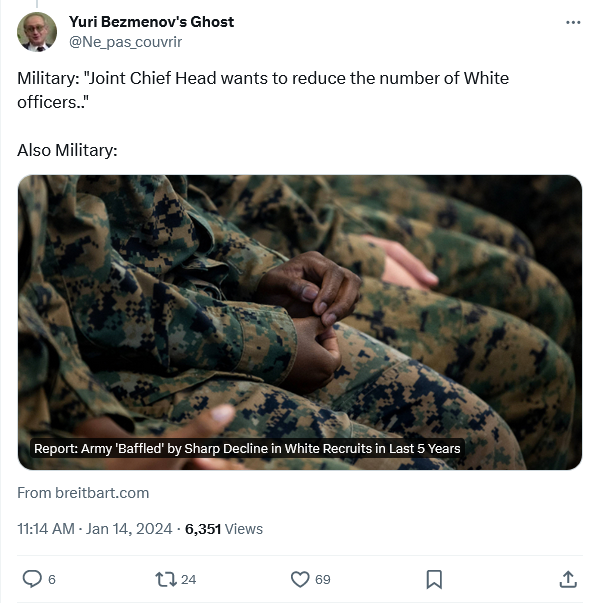
It genuinely is a mystery …
This move by Texas [using state resources to enforce federal border control against the will of the federal government] represents a ratcheting up of our collapse phase trend towards decentralisation. At least for now (and let’s hope Abbott has the fortitude to follow through), a state is openly defying FedGov in a non-Regime approved way that would have been unthinkable even twenty years ago. Even if FedGov wins this standoff, it presages more and more movement in that direction. The Regime is bleeding power and everyone knows it, even if they can’t afford to let on to that fact. Either way, the Regime is going to have to stop this quickly before other states start getting ideas. If they can’t, their already tarnished reputation will take a further massive hit.
So in light of this news, we saw something else on Thursday that ought to be of interest. A very odd bill has been proposed in the House of Representatives by two Democratic representatives – a bill that would ban “private military activity“. On its face this seems strange since every state in the union already does this. However, the bill, as written, is so vague that it could be interpreted to outlaw organised range shooting activities or even paintball games as “combat training”. This bill reeks of desperation because the Regime knows that its path to collapse is further along than a lot of people think and they know that “private military activity” is a very real possibility. The Regime has been accelerating to the point of no return and is trying to stifle any potential serious opposition.
Opposition to what? Well, that’s a good question. Let’s put some pieces together.
It’s no secret that the US military is facing a serious recruiting shortfall. Obviously, the current Regime has little use for the American military as it has traditionally been constituted. This is shown by the absolutely disrespectful way in which our troops are routinely treated by their own government and chain of command. Especially driving this recruitment deficiency is the huge drop in enlistment by the military’s traditional recruiting stock – rural and suburban White men from the South, the Midwest, and the Mountain West. In other words, exactly the kind of people being demonised by the new military with its DIE initiatives, rainbow flags, and trooned officer corps.
So who is going to fill the ranks? Fortuitously, we seem to have a huge flow of military aged males from all over the world crossing our border for whom the Regime has been rolling out the figurative red carpet. These are guys who probably have a lot of time on their hands. Wouldn’t it be a swell idea if we inducted all these guys into the military to make up for the lack of Heritage American interest? Indeed, history repeatedly shows that unpopular regimes typically do exactly this. They start to rely on foreign mercenary forces for a number of purposes.
Certainly, as GAE struggles to keep its steam, there may be a need to send Guatemalans and Nigerians into various Middle Eastern sandboxes to take shrapnel that Americans won’t take. After all, there will still be the vain and desperate attempts to shore up American globohomo empire in that (and other) regions. But historical, one of the main uses of foreign troops has been to try to keep your own potentially rebellious natives in line. Foreign troops have no real connexion with those whom they are suppressing and thus are willing to follow almost any orders that their paymasters give them.
However, unlike many first world countries that are under the Regime’s heel, the USA has a large body of well-armed citizens, many of whom have military training and combat experience. These guys – plus any other patriotic citizens they may be willing to help train – probably won’t take too kindly to being suppressed by foreign hirelings, something that will quickly make a lot of people’s patience run out. Say, wouldn’t it be a shame if all of these armed, trained and trainable people started organising to protect their homes, families, states, and country?
Despite all of the bravado from left-wing


