Quotulatiousness

January 8, 2010

Second career for Jeanne d’Arc?

Filed under: Europe, France, Military — Tags: , — Nicholas @ 12:06

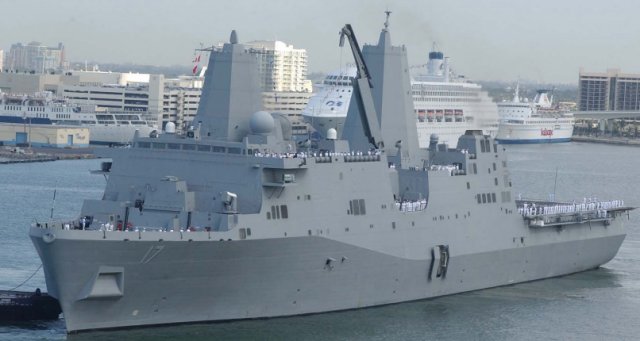
Due for retirement from the French fleet later this year, the helicopter carrier Jeanne d’Arc may have a civilian career ahead of her:

For the past 50 years, the venerable Jeanne d’Arc has had a career worthy of her name. She has toured the world, sailed to the rescue of populations in need and become a symbol of French military might.

But, if a bellicose group of activists get their way, the distinguished helicopter carrier could face a very different future when it is retired in May. Driven to distraction by private helicopters whirring above their homes, St Tropez residents are pushing for the icon of seafaring glory to become a landing strip for the international jet set.

The pressure group Halte Hélico sees the ageing 180m-long hulk of the carrier as a potential solution to the problems they have been fighting for years. Jean-Claude Molho, its president, said: “We thought it could be a good solution as there are already many landing strips for helicopters and we could also transform it into a hotel and restaurant to combine tourism with the practical issues.”

January 6, 2010

Why Avatar might not appeal to soldiers

Filed under: Media, Military — Tags: , — Nicholas @ 12:52

After watching Avatar, Gregg Easterbrook wonders at the gaping plot holes in the story, especially the military ones:

Then there’s director James Cameron’s view of military personnel. If I were a military man or woman, I would find “Avatar” insulting. With one exception, the helicopter pilot played by Michelle Rodriguez — her character is twice referred to as a Marine, suggesting the military personnel are regular military, not mercenaries — all the people in fatigues are brainless sadists. They want to kill, kill, kill the innocent. They can’t wait to begin the next atrocity. It’s true that the U.S. military has conducted atrocities, in Vietnam and during the Plains Indians wars. But slaughter of the innocent is rare in U.S. military annals. In “Avatar,” it’s the norm. The bloodthirsty military personnel readily comply with the colonel’s orders to gun down natives. No one questions him — though in martial law, a soldier not only may but must refuse an illegal order. Plus the military personnel are depicted as such utter morons — not a brain in any of their heads — that none notice the TOTALLY OBVIOUS detail that Pandora’s unusual biology will be worth more than its minerals. Yes, movies traffic in absurd super-simplifications. But we’re supposed to accept that of the deployment of several hundred, every soldier save one is a low-IQ cold-blooded murderer.

What does “Avatar” build up to? Watching the invading soldiers — most of whom happen to be former American military personnel — die is the big cathartic ending of the flick. Extended sequences show Americans being graphically slaughtered in the natives’ counterattack. The deaths of aliens are depicted as heartbreaking tragedies, while the deaths of American security forces are depicted as a whooping good time. In Cameron’s “Aliens,” “The Abyss” and his television show “Dark Angel,” U.S. military personnel are either the bad guys or complete idiots, often shown graphically slaughtered. Cameron is hardly the only commercial-film director to present watching evil U.S. soldiers slaughtered as popcorn-chomping suburban shopping mall fun: in the second “X-Men” flick, U.S. soldiers are the bad guys and graphically killed off. Films that criticize the military for its faults are one thing: When did watching depictions of U.S. soldiers dying become a form of fun?

January 5, 2010

A decade of war

Filed under: Africa, Asia, Europe, History, Middle East, Military — Tags: , , — Nicholas @ 07:19

Strategy Page has an annotated list of the last decade’s wars, declared and undeclared, and armed confrontations just short of warfare:

It’s actually been a decade of less and less war. There’s also been a lot of déjà vu, with many wars seeming to be endless. Some wars are like that. So what were all the current hot spots like a decade ago, and what happened to them? Below is a list, with the short version of what happened (check out archives for the much longer version).

Afghanistan was sort of under the control of the Pakistani backed Taliban in 2000. But the civil war, that began in the late 1970s, was still going on. The Taliban were winning, slowly, fueled by taxes on the heroin trade. But the Taliban were increasingly unpopular, mainly for trying to impose lifestyle rules on a hostile population. September 11, 2001 brought in the Americans to help the factions still fighting the Taliban, and within three months, the Taliban were out of power, and fleeing to Pakistan. A democracy was established, but corruption and tribal rivalries crippled it from the start. The Pushtun tribes resented the domination of the non-Pushtun tribes (60 percent of the population), and this enabled the Taliban to rebuild and undertake a terror campaign to regain control of the country. It’s a suicide mission (even most Pushtuns oppose them), but that’s pretty normal for Afghanistan.

[. . .]

Iraq- Saddam Hussein was under siege at the beginning of the decade, refusing to comply with the terms of his defeat in the 1991 war over Kuwait. Saddam, as he later admitted, had no weapons of mass destruction, but did not want the Iranians (who wanted to kill him for invading in 1980) to know. It was a successful deception, so much so that all the world’s intel agencies agreed that Saddam had these weapons, and that was used to justify the U.S./British invasion of 2003. There followed five years of terrorism, as the Sunni Arab minority (which Saddam had led) tried to murder their way back into power. That didn’t work, and Iraq ends the decade with a booming, not shrinking, economy, and a bloody resolution to some long time political disputes.

December 24, 2009

Jonathan Kay in praise of Paul Martin

Filed under: Cancon, Middle East, Military, Politics — Tags: , , , — Nicholas @ 11:52

In a column ostensibly about the triumph of Canada’s conservatives, Jonathan Kay makes a pitch for both Paul Martin and former Governor General Adrienne Clarkson as unsung political heroes:

Paul Martin will forever be known primarily as the guy who fumbled Jean Chrétien’s dynasty away to Stephen Harper. But if there were more justice in the world — or at least among pundits — he would get his due for making the single most momentous prime ministerial decision of the decade: sending a Canadian combat mission to Kandahar in 2005.

At the time, it hardly seemed epic: Most Canadians didn’t know Kandahar from Kunduz. But the military wonks immediately could tell this was a game-changer. Putting our troops in Kandahar, at the ideological and political center of Taliban territory, meant the Liberals were shedding decades of peacekeeper posturing, and were putting the country on a very real war footing.

[. . .]

Martin didn’t throw a dart at a map of Afghanistan. He fought for Kandahar in the face of U.S. skepticism — even though he knew it would mean body bags, and even though he probably could have landed the Canadian Forces a relatively cushy Euro-style sentry-duty assignment in the northern part of the country.

Our deployment set the stage for many of the other, seemingly unrelated, changes in Canadian policy and politics that followed in the latter part of the decade. A nation at war doesn’t think about itself in the same way as a nation at peace. We got more respect in foreign capitals. We began to take care of our military. We even started to treat our country’s identity and history more seriously.

And equally surprising, the praise for Adrienne Clarkson:

Nor should we ignore the contribution of Adrienne Clarkson. Whatever her elitist, media pedigree, the Canadian Forces had no better friend than the former Governor General. She was a constant presence at Remembrance Day events at home, as well as WWII anniversary ceremonies in Europe. She spent New Year’s with CF members in Afghanistan — twice; and even celebrated Christmas with our naval forces in the Persian Gulf.

That she was a woman, a former CBC staffer, and a visible minority, only increased the symbolic importance of her outreach. It showed Canada that our military is fighting for all us, not just white guys with brush cuts in Shilo and Petawawa.

December 16, 2009

More info on the RAF cuts

Filed under: Britain, Military — Tags: , , — Nicholas @ 12:50

Lewis Page finds the MoD’s recently announced cuts to — shock, horror — make good military and economic sense:

It doesn’t happen often, but just for once there’s good news out of the Ministry of Defence — good news for British troops in combat overseas, and good news for British taxpayers too. But it’s bad news for the UK arms biz, and bad news for certain regional communities who rely on the MoD to bring them government money they wouldn’t otherwise receive — and don’t particularly deserve.

So what’s the government done?

In essence, they have cut down massively on military things which we don’t — and almost certainly won’t — need, and ordered a lot of things which we are desperately short of.

Other than the reduction of the RAF’s Harrier force by one squadron, the government also indicated they may cut the Tornado force by one or two squadrons. This is sensible because the Tornado was designed to do a job that no longer needs to be done — or, rather, no longer needs to be done by manned bombers. Another big change is that the RAF will be losing their Nimrod aircraft, which has both military and political aspects:

Quite apart from all that, the Nimrod MR2 — being a flying antique — is horribly expensive to run, both in money and in lives. The MR2’s extensive use above Afghanistan in recent times as a flying spyeye and to relay radio messages between ground units in no way justified its continued, very expensive existence; far less could such unimportant work possibly have justified the known risks of refuelling these aged birds in mid-air.

So getting rid of the MR2s loses us nothing important, and will make our service people noticeably safer — the Nimrod has actually killed one of our people for every 15 killed by the Taliban. Better still, this will permit another pricey airbase here in the UK to largely close, saving money to be spent at the front line. As a fringe benefit, the base in question — RAF Kinloss — is in a Scottish National Party constituency, giving people there a taste of the independence from the UK that they have voted for. (Strangely the local SNP member of parliament still isn’t happy**.)

December 15, 2009

RAF and Royal Navy facing further cuts

Filed under: Britain, Bureaucracy, Military — Tags: , , , , — Nicholas @ 07:40

With the costs of maintaining British troops in Afghanistan still rising, the government is expected to announce further cuts to the Royal Air Force and Royal Navy today:

Some RAF bases face closure to pay for extra equipment for British forces in Afghanistan, a defence minister indicated this morning.

Quentin Davies said that it would be a “very good thing” to get by with fewer RAF bases if that was possible and that the Ministry of Defence wanted to spend its money with “maximum effect”.

[. . .]

Some Tornado and Harrier aircraft and small navy surface vessels are likely to face cuts. A number of RAF bases will be closed — including reportedly RAF Kinloss in Moray — and part of the sovereign base areas in Cyprus will be sold.

The two large aircraft carriers are expected to survive this particular cut, although it wouldn’t be surprising to see further delay introduced into their construction . . . even though stretching out delivery dates is an expensive way to increase short-term savings:

The announcement follows the publication of a report from the National Audit Office saying the gap between the cost of planned weapons projects and what the MoD can actually afford could be as much as £36bn.

The gap would have been larger had the ministry not delayed a number of projects, such as the construction of two large aircraft carriers, the Queen Elizabeth and the Prince of Wales, the NAO reports.

However, the decision to delay the carrier project to save £450m over the next four years will increase costs by £1.12bn over later years — a net increase of £674m, the NAO says.

The MoD has also decided to reduce an order of Lynx Wildcats from 80 to 62 helicopters, saving £194m but reducing planned flying hours by a third. The report says that last year the price for the 15 biggest military schemes rose by £1.2bn, £733m of which was the result of delays designed to save money in the short term.

Update: Believe it or not, there’s actually some sense to the government’s announced changes:

The headlining move comes with the announcement, widely anticipated, that the British fleet of US-made Chinook heavy-lift helicopters is to increase from 48 to 70 aircraft, with initial deliveries of ten new choppers arriving by 2013. The Chinook is the only helicopter in widespread Western service with enough spare lift to operate with any freedom in Afghanistan’s heat and high altitudes, and the new copters will be extremely welcome among British forces there.

It is also expected that another Boeing C-17 heavy transport plane will be ordered to join the existing UK fleet of 5, which are regarded as crucial to sustaining the “air bridge” logistic link between Blighty and its troops in Afghanistan.

These short-term improvements will be paid for not by any budget increase, but by reducing the active forces of Tornado bombers and Harrier close-support jets, and early retirement for much of the existing fleet of antique Nimrod MR2 maritime patrol aircraft. These moves will allow closure or mothballing of some of the RAF’s 45+ UK stations, with associated further job losses and savings.

They’ve also announced the retirement of the Sea King helicopter from active service, with the existing inventory of Merlin HC3 moving from the RAF to RN service (including whatever refitting will be necessary to “maricise” them for full-time service with the fleet).

Overall, the changes make a good deal of sense . . . what a surprise.

December 10, 2009

Russia does it again, to NATO’s benefit

Filed under: Military, Politics, Russia — Tags: , , , — Nicholas @ 09:19

Sometimes, the Russian approach to diplomacy results in exactly the opposite to the intended outcome:

In the 1990s, when enlarging NATO to take in the ex-communist countries still seemed perilous and impractical, help came from an unexpected source. Yevgeny Primakov, a steely old Soviet spook who became first head of Russia’s Foreign Intelligence Service, then foreign minister and even, briefly, prime minister, liked to say that it would be “impermissible” for the alliance to admit ex-communist states.

His remarks, and others in similar vein by leading Russian politicians, proved counterproductive. The more the Kremlin huffed and puffed about ex-captive nations deciding their own future, the harder it became to dismiss those countries’ fears: if your neighbour terms it “impermissible” for you to install a burglar alarm, people will start taking your security worries seriously. Some wags even suggested that a “Primakov prize” be established to mark the boost he had given to the cause.

But the lesson apparently was not learned:

Instead, Russia is adopting the opposite course. It habitually violates Baltic airspace. It maintains a vocal propaganda offensive (such as a report being launched in Brussels this week by a Russian-backed think-tank, which criticises Baltic language and citizenship laws). This autumn, it scandalised NATO opinion by running two big military exercises, without foreign observers, based on highly threatening scenarios (culminating in a Strategic Rocket Forces drill in which Russia “nuked” Poland). The exercises demonstrated weakness and incompetence, as well as force of numbers and nasty thinking. But they made life hard for peacemongers and strengthened the arguments of NATO hawks and the twitchy eastern Europeans.

December 8, 2009

India grounds their SU-30 fighters (again)

Filed under: India, Military, Russia — Tags: , — Nicholas @ 08:26

The Indian military has grounded their fleet of Russian SU-30 fighters after a crash involving a more advanced version:

For the second time this year, India has grounded its Su-30 fighters because one of the aircraft crashed. This time, the grounding of the 98 Su-30s in service is expected to last only a few days. Earlier this year, in May, its Su-30 fighters were grounded for a month after one of them appeared to develop engine problems and crashed. One of the pilots survived, but the parachute of the other failed to open. Four days before the Indian Su-30 went down, a Russian Su-35 also crashed because of engine problems. The Su-35 is an advanced version of the Su-30, and uses a similar engine. Earlier this year, Russia grounded all its MiG-29 fighters to check for structural problems, after one of them came apart in flight. All this is particularly upsetting to Indians, who had been assured by the Russians that the Su-30 was a modern (built to Western standards of reliability) aircraft. Such assurances were necessary because of earlier Indian experience with the MiG-21, and Russian aircraft in general. So far this year, India has lost twelve military aircraft, most of them of Russian design.

December 4, 2009

Britain lowers defences against alien invasion

Filed under: Britain, Government, Military, Space — Tags: , — Nicholas @ 10:02

It’s true . . . the British are now wide-open to invaders from Rigel: they’ve re-assigned their UFO investigation forces to other duties:

The Ministry of Defence has closed its UFO unit after more than 50 years of investigating reported UK sightings.

A hotline and e-mail address for the public to report possible sightings was shut on 1 December because it had no “defence value”, the MoD said.

The officer handling reports has moved to another post, saving £44,000 a year.

The MoD said the unit had received thousands of reports, although none had yielded proof of aliens or any security threat to the UK.

Well of course they’d say that, wouldn’t they? Expect the mothership to show up any day now . . .

December 1, 2009

US Army bows to the inevitable

Filed under: Middle East, Military — Tags: , — Nicholas @ 08:23

With more than one in ten of the troops deployed to Afghanistan being female, the US Army had been trying desperately to prevent healthy young soldiers doing what healthy young soldiers are often most interested in. The army has finally acknowledged that their King Canute imitation wasn’t realistic, given human nature:

Last year, the U.S. Army in Afghanistan has removed the prohibition on sex between male and female soldiers. There are 68,000 U.S. troops in Afghanistan, and about ten percent of them are female. So far this year, about fifteen percent of these female troops have had pregnancy tests, and a few percent of the female troops have gone home because they were pregnant.

Since the 1990s, the army has been big on clean living (or whatever you want to call it) in combat zones. No booze, no sex and not cavorting (you know what that means) with the locals. But with most of the troops in combat zones being young and single, things happened. Some couples got caught. Commanders got tired of having to punish (usually with an Article 15, which is just short of a court martial) troops for “unauthorized fornication.” So now it is, if not authorized, not likely to get you punished (aside from the occasional unexpected pregnancy).

November 26, 2009

It’s not a protective force field . . .

Filed under: Military, Technology — Tags: , , — Nicholas @ 08:35

. . . but if it provides a useful degree of protection against splinters and shell fragments, it’s certainly worth testing in a combat zone:

The U.S. Army has developed shell proof wallpaper. The fabric is applied, like wallpaper, on the inside of troop work and living quarters, in areas where the enemy fires rockets and mortar shells into the area. Thus when fast moving fragments or debris hit the structure, the new material, called X-Flex, stretches and halts, or slows down, the fast moving object. This makes it much less likely that anyone inside the structure will be killed.

Over the last five years, the U.S. Army has gone to great lengths to protect troops in camps. Tight perimeter security has kept suicide bombers, and terrorists in general, out of the camps. But there are still rocket and mortar attacks. These usually cause few casualties, but those that do occur are the result of shell fragments or debris coming through the walls.

If it works as well in real life application as it apparently has done in controlled testing, it’ll be a welcome addition to the defenses.

November 24, 2009

Corruption and imaginary museum thefts

Filed under: Media, Middle East, Military — Tags: , , , , — Nicholas @ 07:13

Do you remember the reports from Iraq in the wake of the invasion about the mass looting of museums? If any of it happened, it was a small-scale effort, not the major haul that was so breathlessly reported:

Western archeologists are finding that many of the news stories coming out of Iraq about the theft or destruction of ancient artifacts were false. The national museum had preserved nearly all its treasures, and there was no widespread damage to archeological sites. Like much of the reports from Iraq over the last six years, the main intent was to get an exciting headline, not report what was actually going on. Some reporters, especially those embedded with U.S. troops, reported having their stories rewritten, or simply not published, because their editors felt what was actually happening over there contradicted the U.S. medias belief about what was actually going on. Some of this attitude persists.

A recent international corruption survey found Iraq at the bottom of the list (of over 160 nations) in the company of Somalia, Afghanistan, Burma and Sudan. Because of election laws, that force people to vote for “lists” rather than individuals, it’s difficult to hold anyone accountable for corruption. A new election law, that fixed many of these problems, was recently passed, but senior (and often corrupt) officials are still trying to block this reform. Many of the Shia politicians running the government would be happy to see a Shia dictatorship established, with them running things. Most Iraqis are not so sure about that idea.

RN ship stood by, failing to do anything

Filed under: Africa, Britain, Bureaucracy, Military — Tags: , , , , — Nicholas @ 01:11

Max Hastings contrasts the Royal Navy of Churchill’s day with the modern one:

On February 16, 1940, the destroyer Cossack, acting on Churchill’s personal orders, steamed headlong into neutral Norwegian territorial waters in defiance of international law, boarded the German freighter Altmark and freed 299 captive British merchant seamen.

Legend held that the first the prisoners knew of their deliverance was a shout down a hatchway from a sailor on deck: ‘The Navy’s here!’ The episode passed into folklore, exemplifying the Royal Navy’s centuries-old tradition of triumphant boldness.

On October 28, 2009, the armed Royal Fleet Auxiliary tanker Wave Knight met Somali pirates transferring the British couple Paul and Rachel Chandler from their yacht Lynn Rival to a hijacked Singaporean container vessel.

When warning shots from Wave Knight failed to deter the pirates, its 100-strong crew stood by and did . . . absolutely nothing.

We know of this sorry incident only because a British sailor leaked the truth. The Ministry of Defence’s original statement declared, evasively and deceitfully, that Wave Knight had encountered the yacht unmanned. Nothing was said about the British ship witnessing the hostages’ removal.

I guess it’s a sign of progress that the Somali pirates were content with just capturing two civilians and didn’t also take the Wave Knight and her crew as well. That might count as a win — no formal inquiry, so the lawyers won’t be sent in to bayonet the survivors.

Today, instead, lawyers reign supreme, not least in the Ministry of Defence and even on Afghan and Iraqi battlefields. No warship’s captain feels able to take action that might breach the rights of others, even when those others are murderous Somalis.

The Royal Navy’s officers in the Indian Ocean know that every shot they fire is liable to be the subject of a later inquiry, possible litigation, even a criminal trial.

Then there is the galling question of human rights. You can almost hear the MoD’s solicitors putting forward the following argument: you have to be careful because any captured pirates might claim political asylum in the UK and that it would be a breach of their rights to send them back to the anarchy in Somalia.

Alternatively, suppose a pirate swims ashore from a craft sunk by the Navy, and uses some saved-up hijack plunder to fly to Europe. He finds a smart human rights lawyer and pleads that he was an innocent fisherman pulling in his nets when British cannon fire killed half his family.

The European Court in Strasbourg might award him almost as much booty as he would gain from ransoming a family of European yachtsmen.

It’s so bad that it may be a serious breach of human rights to refer to the pirates as pirates . . .

November 19, 2009

Female fighter pilots in Pakistan, but not in India

Filed under: China, India, Military — Tags: , , — Nicholas @ 08:30

Strategy Page looks at the differing outlooks for female pilots in Indian and Pakistani service:

The Indian Air Force does not plan to train women to be fighter pilots. Neighboring Pakistan is not much better, even though it has seven female fighter pilots. They fly F-7s, a Chinese version of the Russian MiG-21. None have been in combat yet, despite the heavy use of jet fighter-bombers in nearly a year of fighting in the tribal territories. There, the more modern F-16s are doing most of the bombing of Taliban targets. The Indian air force leaders believe that it costs so much (over $2 million) to train a fighter pilot, that they air force needs 10-15 years of active service to get that investment back. But women tend to leave the air force to have children, thus making them much more expensive fighter pilots than their male counterparts. So the Indian leadership is holding off on female fighter pilots.

Women flying Pakistani F-7s are a very recent development, part of a program that only began six years ago. Pakistan is not alone using women as fighter pilots, with China graduating its first 16 female fighter pilots this year. There are already 52 women flying non-combat aircraft, and another 545 in training. India has female military pilots, who only operate helicopters and transports.

[. . .]

All the nations considering female fighter pilots, are having a hard time keeping male pilots in uniform. Too many of the men depart for more lucrative, and less stressful, careers as commercial pilots. Women may not be the solution. Currently, only about half of Indian female officers stay in past their initial five year contract. Indian women, even military pilots, are under tremendous social and family pressure to marry. Those that do may still be pilots, but married women expected to have children. The Indian Air Force provides its female officers with ten months leave for this, six months during pregnancy, and four months after delivery. The air force does all this because pilots are very expensive to train. Fuel costs the same everywhere, as are spare parts. So what India may save in lower salaries, is not enough. A good pilot costs over half a million dollars for training expenses, and requires over five years flying experience to become effective in a first line fighter (the Su-30 for India). It’s all that expensive aviation fuel that pushes the final “cost of a fighter pilot” to over $2 million. Many women are willing to take up the challenge. But they have already heard from their peers in Western air force, that motherhood and piloting can be a very exhausting combination.

November 17, 2009

India to purchase “spare” British carrier?

Filed under: Britain, India, Military — Tags: , , — Nicholas @ 18:23

Ah, it must be a nightmare to be in the Royal Navy’s forward planning department these days. First, they gave up half the fleet now in exchange for guarantees that they’d get two new aircraft carriers in the near future. Then it became known that the government was considering equipping only one of the new ships as an aircraft carrier and converting the second to a helicopter carrier. Now, India’s growing navy appears to have a strong interest in taking one of those under-construction vessels off the Royal Navy’s hands. You can almost hear the gleeful cackling from the Brown government’s financial whizzes:

Yet another scheme by the MoD for cutting costs on the Royal Navy’s new aircraft carriers has surfaced in the media, with claims now being aired that one of the two ships might be sold to India.

The Guardian reports that India “has recently lodged a firm expression of interest to buy one of the two state-of-the-art 65,000 tonne carriers” and that an unnamed “defence source” has told the paper’s Tim Webb that “selling a carrier is one very serious option”.

As Webb is the Graun’s industrial editor, and glovepuppeting of biz correspondents by big companies is the most common way for such stories to appear, we can probably take it that the tale emanates from someone in the industrial consortium building the ships, led by BAE Systems. This is the more so as the article repeatedly states that contract penalties would make it impossibly expensive for the government to cancel one or both of the ships, which is probably the main message that Webb’s industry informant was trying to push.

« Newer PostsOlder Posts »

Powered by WordPress