
Brendan Behan once said there is no situation so bad that it cannot be made worse by the arrival of a policeman. Well today there is no war so bloody that it cannot be made bloodier still by the intervention of the ICC. From the luxurious environs of The Hague, cheered on by liberals who get a cheap political thrill from seeing white lawyers stand up to evil Africans, the ICC has today issued an arrest warrant for Colonel Gaddafi, one of his sons and his security chief. This act of international moral posturing, designed to make the ICC look serious and superior, is likely to intensify the stand-off in Libya.
On one level, the issuing of the arrest warrant just seems barmy. These ICC bigwigs seem so removed from the real and messy world of politics and warfare that they seriously imagine it is possible to bring a war to an end by press-releasing a piece of paper saying: “Wanted for crimes against humanity: Muammar Gaddafi.” They seem to have confused the war in Libya with a nightclub brawl in Camberwell, imagining it is possible to resolve the whole miserable shebang by demanding the arrest of a few of the ringleaders. Once upon a time only spotty sixth-formers in turgid classroom discussions about conflict resolution would say things like “Hey, let’s just arrest the evil dude!” Now such political naiveté has been institutionalised in the ICC.
Yet on another level, the ICC’s game of cops and robbers, cowboys and Indians, the Enlightened West against the Dark Continent, can have unpredictable, potentially dangerous repercussions. If earlier instances of ICC interference into African conflicts are anything to by, the impact of the lawyerly intervention into Libya is likely to be twofold. Firstly it will further entrench Gaddafi and his forces, convincing them that it would be better go down with all guns blazing than to end up in The Hague alongside Karadzic and various other hated evil figures. And secondly it will remove the political initiative from the rebel forces in the east of the country, sending them the ultimately debilitating message that they would be better off waiting for outside forces to come and rescue them — in this instance, white, wig-wearing moral crusaders from the ICC — than to realise for themselves the liberation of their country.
Brendan O’Neill, “There is no war so bad that it cannot be made worse by the intervention of the ICC “, The Telegraph, 2011-06-28
June 28, 2011
QotD: Combining stupidity, smugness, and the illusion of legal process
June 24, 2011
June 19, 2011
Cyber-espionage in theory and practice
An interesting article at Strategy Page discussing online espionage:
Firms with the most to lose, like financial institutions, guard their data most successfully. They do this the old-fashioned way, with layers and layers of security, implemented by the best (and most highly paid) people and pushed by senior managers who take the time to learn about what they are dealing with, and what it will take to stay on top of the problem.
It’s different in the defense business. If the Chinese steal data on some new weapon, there might be a problem years down the road, when the Chinese offer a cheaper alternative to an American weapon, for the export market. But even that problem has a silver lining, in that you can get away with insisting that those clever Chinese developed your technology independently. Meanwhile, everyone insists that there was no espionage, cyber or traditional, involved. As a further benefit, the American firm will get more money from a terrified government, in order to maintain the American technical edge. It’s the same general drill for military organizations. But for financial institutions, especially those that trade in fast moving currency, derivatives and bond markets, any information leaks can have immediate, and calamitous consequences. You must either protect your data, or die.
It’s not exactly a secret that China has been active in this area, but the extent of their official activity is hard to state. However, just as non-state actors take advantage of individuals who fail to use anti-virus software on their computers, ignorance and apathy are tools for state actors:
But the biggest problem, according to military Cyber War commanders, is the difficulty in making it clear to political leaders, and non-expert (in Internet matters) military commanders, what the cyber weapons are, and the ramifications of the attacks. Some types of attacks are accompanied by the risk of shutting down much, or all, of the Internet. Other types of operations can be traced back to the source. This could trigger a more conventional, even nuclear, response. Some attacks use worms (programs that, once unleashed, keep spreading by themselves.) You can program worms to shut down after a certain time (or when certain conditions are met). But these weapons are difficult, often impossible, to test “in the wild” (on the Internet). By comparison, nuclear weapons were a new, very high-tech, weapon in 1945. But nukes were easy to understand; it was a very powerful bomb. Cyber weapons are much less predictable, and that will make them more difficult for senior officials to order unleashed.
So the first order of business is to develop reliable techniques to quickly, and accurately, educate the senior decision makers about what they are about to unleash. This would begin with the simplest, and cheapest, weapons, which are botnets, used for DDOS attacks. In plain English, that means gaining (by purchase or otherwise) access to hundreds, or thousands, of home and business PCs that have had special software secretly installed. This allows whoever installed the software that turned these PCs into zombies, to do whatever they want with these machines. The most common thing done is to have those PCs, when hooked up to the Internet, to send as many emails, or other electronic messages, as it can, to a specified website. When this is done with lots of zombies (a botnet), the flood of messages becomes a DDOS (Distributed Denial of Service) attack that shuts the target down. This happens because so much junk is coming in from the botnet, that no one else can use the web site.
June 18, 2011
June 17, 2011
June 15, 2011
Canada orders more Paveway kits
Once again, “for operational security reasons”, the Canadian military is being cagey about the actual cost of the kits:
The latest order is for 1,000 bomb kits.
The original order last month was for more than 1,300 such kits. So in total more than 2,300 Paveway bombs.
The orders consist of specialized nose and tail systems, which transform an unguided dumb bombs into a laser-guided smart bombs.
[. . .]
So how much is this costing taxpayers?
According to DND, “for operational security reasons” the cost is not being released.
But John Pike, director of the Washington-based defence think-tank, Global Security.org, has said the weapons cost around $100,000 each.
However, another analyst, Bob Bergen of the University of Calgary noted in his study of Canada’s participation in the 1999 Kosovo air war, each Paveway cost Canada in those days $25,000.
At the CANSEC military trade show in Ottawa on June 2 an officer I was talking to suggested the cost of $35,000 for each bomb.
But hold on, says another well-placed source.
That individual says that each “bomb set” costs $15,000.
As a taxpayer, I rather hope the cost is closer to that last figure than the original number quoted!
Daily link roundup
More links that don’t quite make it as separate blog entries.
- North Carolina shipwreck officially recognized as being Queen Ann’s Revenge, the flagship of the infamous pirate Blackbeard. “The Queen Anne’s Revenge, a captured French slave ship, was part of a four-vessel pirate flotilla when it ran aground in 1718 beside the inlet leading to Beaufort and was abandoned. The wreck was found a little more than a mile off the beach in 1996 by Intersal, a private salvage company. The location precisely matched historical accounts of the grounding, and the ship appeared to be the right vintage and size and was armed to an unusual degree. And from the first, the artifacts brought up fit the origins of the ship, the crew and the places it was known to have visited.”
- If more reporters (and bloggers) followed John Rentoul’s list of forbidden words and phrases the internet would be only a few megabytes in size (really, those phrases seem to appear in every article and blog post lately). “The original Banned List was, of course, George Orwell’s in 1946: dying metaphors (“Examples are: Ring the changes on, take up the cudgel for, toe the line, ride roughshod over, stand shoulder to shoulder with, play into the hands of, no axe to grind, grist to the mill, fishing in troubled waters, on the order of the day, Achilles’ heel, swan song, hotbed”); verbal false limbs (“Characteristic phrases are render inoperative, militate against, make contact with, be subjected to, give rise to, give grounds for, have the effect of, play a leading part (role) in, make itself felt, take effect, exhibit a tendency to, serve the purpose of”); pretentious diction (“Words like phenomenon, element, individual (as noun), objective, categorical, effective, virtual, basic, primary, promote, constitute, exhibit, exploit, utilise, eliminate, liquidate”); and meaningless words (his examples included “class, totalitarian, science, progressive, reactionary, bourgeois, equality”).”
- Significantly different approaches by Canadian and British militaries to dealing with “operational security” over Libyan operations. “It is interesting to contrast the amount of information the Canadian Forces releases on its missions in Libya. It talks about the war in general terms but CF spokesman Brig. Gen. Richard Blanchette claims that detailing the type or numbers of bombs dropped on targets (or even naming specific targets) would violate operational security.” The British, in contrast, are eager to tell how many bombs (and of what type) were dropped from which aircraft and which Royal Navy vessels were involved in combat operations.
- I was happy to see that Rogier van Bakel is now working with some co-bloggers at a new URL. Here’s the round-up of who, what, and where.
June 9, 2011
Is the Shi Lang a naval “Potemkin Village”?
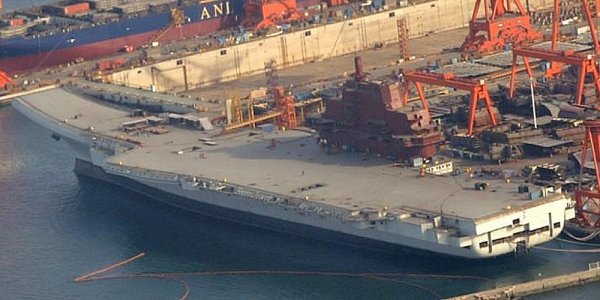
David Axe is not losing any sleep over the soon-to-be commissioned Chinese carrier Shi Lang:
Leaving aside her modest size compared to American carriers, her incomplete air wing and escort force and the fact that she’ll sail without the company of allied flattops, Shi Lang could be even less of a threat than her striking appearance implies. Shi Lang’s greatest potential weakness could be under her skin, in her Ukrainian-supplied engines.
Powerplants — that is, jet engines for airplanes, turbines for ships — are some of the most complex, expensive and potentially troublesome components of any weapon system. Just ask the designers of the Pentagon’s F-35 stealth fighter and the U.S. Navy’s San Antonio-class amphibious ships. Both have been nearly sidelined by engine woes.
China has struggled for years to design and build adequate powerplants for its ships and aircraft. Although Chinese aerospace firms are increasingly adept at manufacturing airframes, they still have not mastered motors. That’s why the new WZ-10 attack helicopter was delayed nearly a decade, and why there appear to be two different prototypes for the J-20 stealth fighter. One flies with reliable Russian-made AL-31F engines; the other apparently uses a less trustworthy Chinese design, the WS-10A.
For Shi Lang, China reportedly purchased turbines from Ukraine. Though surely superior to any ship engines China could have produced on its own, the Ukrainian models might still be unreliable by Western standards. Russia’s Kuznetsov, also fitted with Ukrainian turbines, has long suffered propulsion problems that have forced her to spend most of her 30-year career tied to a pier for maintenance. When she does sail, a large tugboat usually tags along, just in case the carrier breaks down.
If Shi Lang is anything like her sister, she could turn out to be a naval version of the mythical “Potemkin village” — an impressive facade over a rickety interior.
H/T to Nicholas “Ghost of a Flea” Packwood for the link.
June 8, 2011
China admits it’s hard to hide 1000ft-long aircraft carrier
China has finally gotten around to acknowledging that they’re rebuilding the former Soviet aircraft carrier for use by their navy:
Gen Chen Bingde refused to say when the carrier — a remodelled Soviet-era vessel, the Varyag — would be ready.
A member of his staff said the carrier would pose no threat to other nations.
The 300m (990ft) carrier, which is being built in the north-east port of Dalian, has been one of China’s worst-kept secrets, analysts say.
Gen Chen made his comments to the Chinese-language Hong Kong Commercial Daily newspaper.
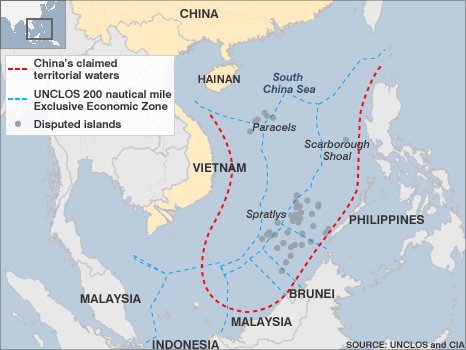
Although the Chinese say that the ship, once ready for operations, won’t enter other countries’ territorial waters, keep in mind that China doesn’t have the same idea about maritime rights as others in the South China Sea region:
Earlier posts about the Shi Lang (nee Varyag) here.
Canadian troops complete last combat mission before withdrawal from Afghanistan
Susan Sachs reports on the conclusion of the last planned combat mission for Canadian troops ahead of withdrawal this summer:
More than five years after taking charge of security in one of the most violent regions in Afghanistan, Canadian troops wrapped up their final combat operation with a two-week sweep through a rural swath of Kandahar that was undisputed Taliban territory just a year ago.
The offensive, conducted with a bulked-up Afghan National Army brigade in the lead, marks Canada’s last days in the long and deadly war. All combat troops are set to withdraw this summer, 5½ years after the mission in Kandahar began.
Until the last soldier leaves, the danger that has stalked Canadian soldiers in Kandahar, the birthplace of the Taliban and still one of its strongholds, remains.
Members of the Royal 22nd Regiment will still be patrolling the volatile area, risking death by improvised explosive devices and operating isolated outposts up to the day they hand off their positions to U.S. soldiers.
“RAF’s new superfighter was thrashed in the very type of combat it is supposed to be best at by a 1970s-era plane”
Lewis Page talks about claims from a Pakistani Air Force fighter pilot that their F-16s had “shot down” Royal Air Force Typhoons in three separate air training exercises in Turkey.
The RAF Typhoon, formerly known as the Eurofighter, should nonetheless have been vastly superior in air-to-air combat whether BVR or close in within visual range (WVR). The cripplingly expensive, long-delayed Eurofighter was specifically designed to address the defects of its predecessor the Tornado F3 — famously almost useless in close-in, dogfighting-style air combat. The Typhoon was meant to see off such deadly in-close threats as Soviet “Fulcrums” and “Flankers” using short-range missiles fired using helmet-mounted sight systems: such planes were thought well able to beat not just Tornados but F-16s in close fighting, and this expectation was borne out after the Cold War when the Luftwaffe inherited some from the East German air force and tried them out in exercises.
Thus it is that huge emphasis was placed on manoeuvring capability and dogfighting in the design of the Eurofighter. The expensive Euro-jet was initially designed, in fact, as a pure fighter with no ground attack options at all — bomber capability has had to be retrofitted subsequently at still more expense. Despite lacking various modern technologies such as Stealth and thrust-vectoring the resulting Typhoon is generally touted as being one of the best air-to-air combat planes in the world right now. Certainly it is meant to be good in close fighting: it is armed with the Advanced Short Range Air to Air Missile (ASRAAM) which as its name suggests is intended for the close WVR fight.
Perhaps the account above is simply a lie, or anyway a bit of a fighter pilot tall story. But the pilot quoted will be easily identifiable inside his community if not to the outside world, and he could expect a lot of flak for telling a lie on such a matter in public. It seems likelier that the story is the truth as he perceived it: that the RAF’s new superfighter was thrashed in the very type of combat it is supposed to be best at by a 1970s-era plane, albeit much modernised.
June 6, 2011
Colour footage of D-Day, 1944
H/T to Nick Gillespie for the link.
June 3, 2011
China’s first aircraft carrier edges closer to readiness
The Chinese navy is a bit closer to having an operational aircraft carrier, as the Shi Lang (formerly Varyag in Russian service) is being equipped with radar and weapons:
In the last month, the new Chinese aircraft carrier, the Shi Lang (formerly Varyag) has had several major electronic systems, and its first weapons, installed. The most notable electronic item to show up are the four AESA radar panels. This is a state-of-the-art radar similar to the one used in the American Aegis system. There were a lot of other electronic items being carried into the Shi Lang, indicating that the ship will be equipped with extensive networked computers and communications systems.
The two main weapons were also installed. One was a new version of the older, Type 730 seven barrel, 30mm close-in anti-missile automatic cannon. Operating like the American Phalanx, the new version of the Type 730 seen on the Shi Lang had ten barrels. The other weapon was the FL-3000N anti-missile systems. These are similar to the American RAM anti-missile missile system, except that they come in a 24 missile launcher and are less accurate. FL-3000N was only introduced three years ago, and uses smaller missiles than RAM. The two meter long FL-3000N missiles have a max range of nine kilometers (about half that for very fast incoming missiles). The 120mm, two meter long missiles now use a similar guidance system to RAM, but are not as agile in flight.
[. . .]
The Shi Lang/Varyag is one of the Kuznetsov class carriers that Russia began building in the 1980s. Originally the Kuznetsovs were to be 90,000 ton, nuclear powered ships, similar to American carriers (complete with steam catapults). Instead, because of the high cost, and the complexity of modern (American style) carriers, the Russians were forced to scale back their plans, and ended up with 65,000 ton (full load) ships that lacked steam catapults, and used a ski jump type flight deck instead. Nuclear power was dropped, but the Kuznetsov class was still a formidable design. The 323 meter (thousand foot) long ship normally carries a dozen navalized Su-27s (called Su-33s), 14 Ka-27PL anti-submarine helicopters, two electronic warfare helicopters and two search and rescue helicopters. But the ship was meant to regularly carry 36 Su-33s and sixteen helicopters. The ship carries 2,500 tons of aviation fuel, allowing it to generate 500-1,000 aircraft and helicopter sorties. Crew size is 2,500 (or 3,000 with a full aircraft load.) Only two ships of this class exist; the original Kuznetsov, which is in Russian service, and the Varyag. Like most modern carriers, the only weapons carried are anti-missile systems like Phalanx and FL-3000N, plus some heavy machine-guns (which are often kept inside the ship, and mounted outside only when needed.) However, Russian practice was been to sometimes install long range anti-ship missiles as well. China may also do this with Shi Lang.
June 2, 2011
When shipyards produce pork instead of effective ships for the Navy
Shipbuilding for the navy has traditionally been a good source of pork for politicians to dole out as their political fortunes require. The US Navy is having monumental problems with the quality of ships, but the problem isn’t easy to fix:
The U.S. Navy continues to have serious problems with shoddy shipbuilders. The latest incident involved a support ship, the 12,000 ton, 172 meter (534 foot) long radar ship, the Howard O. Lorenzen. The ship recently failed its acceptance tests. The Lorenzen was built to carry a special, billion dollar, radar used to track ICBM tests. This tracking activity also supports verification of missile and nuclear weapons treaty compliance. The Lorenzen replaces a similar ship that is over 30 years old. The acceptance tests found serious problems with the steering, electrical system, damage control, anchor control, and aviation (helicopter) facilities. The yard that built the Lorenzen, VT Halter Marine, builds military and civilian ships, and has had problems with some of the other military ships it has built recently. Like the Lorenzen, the other ships were late, over budget and suffered quality control problems.
[. . .]
While the admirals are correct in blaming the shipyards for many of the problems, the navy shares a lot of the blame as well. It is, after all, the navy that draws up the contracts, and supplies inspectors during construction. However, inspectors are regularly deceived and lied to (about the quality of work and supervision and known defects being fixed). While Congressional interference can be blamed as well, in the end, it’s the navy that has the most to say, and do, about how the ships are built. The problem is, admirals who stand up and take on the contractors and politicians put their careers on the line. The ship builder deploys a large number of lobbyists and has many key politicians as allies.
[. . .]
The problems with nuclear subs and carriers were minor compared to the LPD 17 travails. Still, the sheer extent of the problems, across so many ships, is very disturbing. This may be why a growing number of admirals are willing to take career risks, and try for some fundamental reform, and finally fix the “system” that turns out more problems than warships. Victory is not assured. The shipyards and their suppliers have powerful allies in Congress. All that money translates into votes that gets incumbent politicians reelected. Congress is not inclined to attack this kind of patronage and pork, since nearly all members of Congress depend on it. The admirals can openly complain, but offended legislators can quietly cripple the careers of those critics. The smart money is betting against the good guys here. So far, the smart money is right. But the bad builder mess is so vast, expensive and messy that even many politicians are calling for some fundamental changes.
The poster children for defective ships is the San Antonio LPD 17 class of amphibious ships.
May 30, 2011
Formal review for Canadian defence policies?
David Pugliese has word that the “fully funded” Canada First Defence Strategy is going to be reviewed starting in late June:
Some are calling this a “Canada First Reset.” This review would look at what by how much this strategy is underfunded and how should DND proceed in the future on CFDS, according to sources. It was described to Defence Watch as a “step-back to look at the strategy” and an examination of what aspects of the plan — mainly within procurement — need to be dropped (something like….maybe JUSTAS) because of the lack of money.
My reaction? It’s all very interesting to say the least. That’s because the basis of this review team goes against what has been a DND/CF mantra for three years now: that is the Canada First Defence Strategy is fully funded.
Numerous generals and DND bureaucrats are on record stating that in no uncertain terms. No question about it. Period, full stop.
You may remember that a few defence analysts suggested the strategy was not proper funded and that the many projects outlined in the document wouldn’t see the light of day.
But those claims were dismissed outright.
Will a CFDS review committee even get off the ground considering that it has the potential to embarrass the government?
If the minister had been replaced, this might make some political sense: it’s a good opportunity to get in some significant change and the previous minister gets the “blame” for the change being necessary. Peter MacKay stayed on at the ministry, so that’s not the answer. It’s possible that the government, now in safe majority territory, can bear the burden of critically reviewing the CFDS without feeling the risk of triggering an election.
The CFDS was originally drawn up as a plan to address impending retirement of much of the Canadian Forces’ major equipment:
Over the next 20 years, six of the CF’s core equipment fleets will reach the end of their operational lives and will need to be replaced. These include destroyers, frigates, maritime patrol aircraft, fixed-wing search and rescue aircraft, next-generation fighter aircraft, and a new family of land combat vehicles and systems.
The question about whether the CFDS is fully funded, therefore, is key to addressing the real equipment replacement schedule. If the money isn’t there, something has to give.


