Quotulatiousness

December 3, 2010

HMS Ark Royal arrives in Portsmouth to be decommissioned

Filed under: Britain, Military — Tags: , — Nicholas @ 11:06

Steven Morris was there as HMS Ark Royal arrived back at her home port for the final time:

The music was corny: a Royal Marines band was belting out a version of the Rod Stewart hit Sailing as HMS Ark Royal emerged from the freezing fog to tie up at her home port for the final time.

But the emotion was genuine enough. From the quarter deck to the frozen quayside, tough sailors gulped back tears at the end of a chapter in Britain’s proud naval history.

After a quarter of a century of service around the globe, the aircraft carrier is being decommissioned as part of the defence review. The former flagship’s future remains unclear. There has been talk that she could be turned into a museum, but that may be too expensive. It is more likely that she will be sold off or simply scrapped for parts.

“It’s very emotional,” said Leading Seaman Paul Stockell, one of those who had tears in his eyes — and not just because of the biting wind — as he helped bring the ship alongside in Portsmouth today.

Sniper detection systems continue to improve

Filed under: Military, Technology — Tags: , , — Nicholas @ 09:30

Strategy Page looks at the continuing evolution of sniper detection devices:

The U.S. Army has ordered another 13,500 SWATS (Soldier Worn Acoustic Targeting Systems) sniper detectors. These 183 g (6.4 ounce) devices come in two pieces. One is the sensor, that is worn on the shoulder, while the controller, with small LCD display, is worn in front, where it can be quickly glanced at. SWATS calculates (from the of the sound weapon fired) direction of fire in a tenth of a second. SWATS has been very popular with troops, and costs about $5,000 each. SWATS can also be mounted on vehicles, and work when the vehicle is moving at speeds of 80 kilometers an hour or more.

Acoustic gunfire (sniper) detectors, which have been in the field for a decade, have had increasing success. Over 50,000 sniper detectors have been shipped to Iraq and Afghanistan, where they have been increasingly useful. Sniper detection systems provide directional information about where the snipers are. Several generations of these systems have showed up over the last decade. The usefulness of these anti-sniper systems has increased as the manufacturers have decreased the number of false alarms, and improved the user interface. There are other reasons for all this progress, including major advances in computing power, sensor quality and software development. One of the latest, and most useful, improvements is providing nearly instant, and easy to comprehend, location info on the sniper.

December 1, 2010

Want to buy (the remains of) an aircraft carrier?

Filed under: Britain, Environment, Military — Tags: , , — Nicholas @ 09:47

HMS Invincible is being disposed of:

Strategy Page has more:

Britain has put its decommissioned (in 2005) 20,000 ton aircraft carrier, HMS Invincible, up for auction at edisposals.com. Five years ago, the Royal Navy said that the ship would be held in reserve until September, 2010, for possible reactivation. That process would take 18 months. However, by last year, Invincible was in a sad state, with its many components removed, and tended to by a detachment of only four sailors. Thus the auction did not come as a big surprise, and the Royal Navy hopes to obtain at least $3 million for the old ship. The Invincible entered service in 1977, and normally carried 18 Sea Harrier vertical takeoff jets, four helicopters and a crew of 1,050. The Invincible underwent a refurbishment in 2004, but cuts in the navy budget forced retirement the next year. Invincible played a vital role in the 1982 Falklands campaign.

It’s not as easy as it used to be for navies to get rid of unwanted ships:

In the past, navies would send retired ships “to the breakers” and receive a portion of the value of the scrap metal obtained when the breakers (the firm the disassembles ships) finished their work. But this is no long profitable in many cases, because taking ships apart in an environmentally correct way costs too much. This has become a problem for navies, that have no easy way to get rid of old ships. The U.S. uses many old ships for target practice and lets them sink at sea. But even this practice is under attack because of potential environmental damage.

Update, 3 December: HMS Ark Royal has just arrived in Portsmouth to be paid off. It’s not clear if the British government will try to sell the ship or if she’s headed to the breaker’s yard.

November 29, 2010

“They’ve taken leave of their senses”

Filed under: Britain, Bureaucracy, Military — Tags: , , , — Nicholas @ 17:24

Con Coughlin was also aboard HMS Ark Royal for the final Harrier launch:

In many respects, it was an appropriate end to the glittering career of one of Britain’s most iconic warplanes. For none of the Royal Navy crewmen and women who braved the sub-zero temperatures were in much of a mood to celebrate the Harrier’s last appearance on the deck of a British aircraft carrier.

Most of them are still too shell-shocked over the Government’s decision to consign the entire Harrier fleet to the scrapheap, together with the Royal Navy flagship which has been the fighters’ proud host for nearly three decades.

“They’ve taken leave of their senses,” was one young rating’s verdict of the Government’s decision to scrap the Harriers and HMS Ark Royal. “You can’t get a better fighting combination than this, and yet they are sending us all to the scrapyard. They can find £7 billion to bail out Ireland, but they can’t find a few measly million to keep us going.”

I wonder what the bookies are offering for the British government to sell off the new carriers as they come off the launchways, rather than putting them into commission?

November 26, 2010

Time to upgrade your rifle sights?

Filed under: Military, Technology, USA — Tags: , , — Nicholas @ 12:10

The Register looks at futuristic guns, including a coming-into-production sighting system:

As everyone who has read the Discworld books knows, million-to-one shots actually hit nine times out of ten. Pentagon weaponeers saw no reason why this should not also become true for US military snipers, leading them to begin work on the “One Shot” miracle sniper-scope project.

One Shot works by using a laser to measure not just the exact range to the target (this is already common practice among snipers) but also to measure the wind forces along the bullet’s line of flight. Wind is perhaps the marksman’s greatest bugbear in long-range shooting, so much so that snipers aren’t expected to achieve a first-shot kill any further off than 600m in normal circumstances.

The One Shot instrument, which will replace the telescope used by the sniper team’s spotter, will measure wind, range, inclination, air pressure and humidity. Linked to the scope on the sniper rifle, it will continually generate artificial crosshairs indicating where the bullet will actually strike: it will also indicate the likelihood of a wind shift during the projectile’s flight time, allowing the shooter to pick the best moment to fire. All the sniper has to do is move the crosshairs onto target, wait for the circle of uncertainty to stabilise, and shoot.

According to spec, the One Shot system isn’t quite as good as the Pratchett effect: it will deliver first-shot kills out to 1500m only six times out of ten rather than nine.

Rewarding bravery or giving “attaboy” awards?

Filed under: Military, USA — Tags: , , , , , — Nicholas @ 09:45

Strategy Page reports on the huge increase in medals being awarded to US troops:

The U.S. Army has reported that some 857,000 medals have been awarded to the 1.2 million soldiers who have served in Iraq and Afghanistan. That’s 48 percent as many medals awarded during World War II, when six times as many soldiers served overseas. It’s also 30 percent of those awarded during Vietnam, where 25 percent more soldiers served. This odd pattern is the result of the excessive number of medals given out during the Vietnam war.

This has not been forgotten. Five years ago, American troops began grumbling about what was perceived as disrespectful use of Bronze Star medals as “attaboy” awards for officers and senior NCOs who served in Iraq and Afghanistan, or for lower ranking personnel you want to pin a medal on for no good reason

[. . .]

This awards inflation was a very unpopular aspect of the Vietnam war, and became a major embarrassment after the 1983 Grenada invasion (where the army tried to award more medals than there were troops involved, but the public caught wind of it and forced the brass to back off.)

Compared to the Canadian military, the US hands out a lot more medals: in my long-ago militia days, we used to joke that American recruits got medals for shining boots and using the latrine. Of course, that was right after the Vietnam era, so the “medal inflation” was perhaps at its most obvious stage.

November 25, 2010

Video of the last Harrier flight from HMS Ark Royal

Filed under: Britain, Military — Tags: , , , — Nicholas @ 13:03

November 24, 2010

End of an era

Filed under: Britain, Military — Tags: , , , — Nicholas @ 18:49

The last Harrier takes off from HMS Ark Royal earlier today:

Lt. Cdr. James Blackmore was the last Harrier pilot to launch from HMS Ark Royal, noting that “this is truly a memorable day.” But as it is never a good idea to tell your bosses they are a bunch of idiots, he also adds that “we accept the decision to decommission both the Harrier and HMS Ark Royal; however, of course the final launch will be emotional.”

More information at Aviation Week.

RN’s Type 45 destroyer has even more trouble

Filed under: Britain, France, Military — Tags: , — Nicholas @ 12:54

Remember the Royal Navy’s latest destroyer, the Type 45? It’s the one without effective main armament. As if that wasn’t bad enough, the lead ship of the class, HMS Daring, broke down at sea recently:

The Royal Navy’s new Type 45 destroyers continue to suffer from technical mishaps, with first ship of the class HMS Daring arriving a week late in Portsmouth on Saturday following emergency propulsion repairs in Canada. The £1.1bn+ ship had previously broken down in mid-Atlantic.

The News of Portsmouth reported on the breakdown and the destroyer’s delayed return to its home port, noting that a similar propulsion problem had occurred just four months previously during an outing in the Solent for families of the ship’s company.

[. . .]

The Type 45s’ hulls and some of their kit — for instance the fire-control radar — are made in Britain but much of the colossal expense of the ships has gone on equipment from the US, Italy and France. Particularly well-known are their French-made Aster air-defence missiles, which have been delayed for several years following repeated failures in test-firings caused by a manufacturing fault.

The UK Public Accounts Committee went so far to describe the missile-system, named “Sea Viper” in British service, as “disgraceful” in 2009 … and that was before the most recent test failure. However the flaws in the Aster missiles are now reportedly rectified and successful firings have since taken place. The UK Ministry of Defence expects to declare its first Sea Viper system operational next year: until then, the Type 45 destroyers will continue to be almost unarmed, able to employ only basic guns and cannon.*

[. . .]

*Apart from Sea Viper, the only armament possessed by a Type 45 is a single 4.5-inch “Kryten” gun turret, primarily useful for bombarding targets ashore (within a few miles of deep water) and two light 30mm cannon for close-in work against pirate dhows or the like.

Sea Viper will not enhance the destroyers’ abilities against other ships or land targets when it becomes operational as it has no surface-to-surface mode. It is said to be superior to any other system against missiles and aircraft, perhaps even offering an effective defence against widely-feared shipkiller missiles of Russian manufacture which approach their target at supersonic speeds. However Aster/Sea Viper has never been tested against a supersonic target and there are no plans to do so, which means that any battle plan based on such a capability would be a gutsy call indeed.

As you can tell, Lewis Page isn’t a fan of the Type 45 destroyers . . .

China’s first aircraft carrier approaching completion?

Filed under: China, Military — Tags: , — Nicholas @ 08:08

In their growth from a small coastal protection flotilla to a blue water navy, the next milestone for China’s navy will be the completion of the Shi Lang:

Work is picking up on what appears to be China’s first aircraft carrier, the Shi Lang. For eight years now, China has been tinkering with a half finished Russian aircraft carrier. Two years ago, this ex-Russian aircraft carrier, Varyag, was renamed the Shi Lang (after the Chinese general who took possession of Taiwan in 1681, the first time China ever paid any attention to the island) and given the pennant number 83.

Until last year, progress was slow. But there has been a lot of work lately. Early in 2009, China moved the Shi Lang into dry dock, where work is now obviously underway to install engines and other heavy equipment. A year ago, the radar mast was completed, and now there is a Chinese radar system being installed. Officially, the Chinese say nothing. But the dockyard workers keep at it, and it’s possible to take photos from a distance. It appears that the Shi Lang is a year or so from going to sea.

November 22, 2010

US Army suddenly discovers that women are shaped differently

Filed under: Military, USA — Tags: , , , — Nicholas @ 13:07

It’s things like this that reinforce the impression that the military still hasn’t grown used to the fact that women are serving in combat zones:

Over the past seven years, the U.S. Army has responded to complaints from the troops about the combat uniform (ACU, or ACUPAT, for Army Combat Uniform camouflage pattern). But now the army is fixing a set of problems that have long been ignored; how the ACU fits women. Up to fifteen percent of the troops in combat zones are women, and the new uniform recognizes this. The older ACU just assumed female troops were one of the guys, which they are not. Women have a different shape, and that is very true when it comes to ACUs, and their placement of the waistline, many pockets and pouches for things like knee pads. What worked for the male body, did not work for female troops. Everything was just a little bit (or a lot) off, making the ACU much less comfortable for women doing the same jobs as the guys. So the army simply designed an ACU version based on the shape of the female body. The first prototypes were given to women to try out, and after a few hours, all the female troops asked where they could buy some more of them. Unfortunately, the female ACU won’t be available for another two years. Lots of additional tests have to be performed to make sure all the details are correctly incorporated.

Perhaps the physical variation among “average” women is relatively greater than that among “average” men, but it’s still surprising that the US Army is only now taking that into account.

November 19, 2010

The A400M is a “Euro-wanking make-work project”

Filed under: Britain, Military, Politics — Tags: , , — Nicholas @ 10:32

Gotta love those unbridled opinions in British politics:

A peer and former defence minister has described the A400M military transport plane — which is being bought by the cash-strapped UK armed forces for a secret but outrageous amount of money — as a “Euro-wanking make-work project” in the written Parliamentary record.

The straight talk came from Lord Gilbert, who held various ministerial portfolios in the 1970s – including a defence one – and did another spell in the MoD as a peer in the first years of the Blair government. Last week he made the following remarks in the House of Lords:

I regard the decision on the A400M as the most bone-stupid in the 40 years that I have been at one end or other of this building. It is an absolutely idiotic decision. We have a military airlift fleet of C-17s and C-130s. We have total interoperability with the United States… six or seven countries altogether will be flying the A400M. Flying the C130, which it is intended to replace, are 60 countries, with 2,600 or so C130Js currently being used. That is the interoperability that we are losing…

November 18, 2010

How to actually implement the lessons of combat

Filed under: Bureaucracy, Education, History, Military — Tags: , , , — Nicholas @ 09:24

Strategy Page has an excellent short article on how the “lessons learned” in battle are used (and sometimes abused):

American operations in Afghanistan and Iraq brought out the military historians and survey teams in force. The Department of Defense was determined to avoid the usual wartime pattern and not make the same mistakes twice during the War on Terror. This is not easy to do. As far back as World War II, there were organizations in the U.S. military that looked for “lessons learned” and tried to get the information passed around to everyone as quickly as possible. This was difficult because the training all the troops (be they army, navy or air force) received was laid down in manuals and training courses. It was exceedingly difficult to change training manuals, if only because of the time required to rewrite them and publish new ones. The training courses were based on the manuals and the military, like any bureaucracy, lives to do things “by the book.”

Although the image of military leaders always preparing to fight “the last war” is deeply embedded in popular culture, it isn’t universally true. Some leaders certainly do think and act as if the next battle will be much like the last one. Others go too far the other way and seem to feel that the next battle will have nothing in common with the last one. Neither extreme is accurate for most military leaders (at least in western armies).

Most generals don’t actually command troops in the field — in effect, they’re uniformed managers, directors, and other bureaucratic functionaries — and those generals will be the ones most likely to expect tomorrow to be a clone of today. Bureaucracies operate best when “business as usual” is the pattern. Generals in the field don’t have that luxury.

It’s easier to identify a lesson than to get an organization to act on it and implement a useful solution. For that reason, the British like to use the phrase “lessons identified” to make clear that just noting a problem does not solve it. When you uncover a problem, you are calling into question the wisdom of some earlier decisions. Large organizations do not take kindly to such criticism. Excuses and creative explanations will emerge if a lesson learned threatens some cherished program. For example, before the invasion of Iraq, the attitude in the Department of Defense was that heavy forces (tanks and all their accompanying armored vehicles) were on their way out. But what led the dash to Baghdad? Tanks. Embedded journalists made it pretty obvious how useful the tanks and other armored vehicles were. The Department of Defense had a hard time absorbing this lesson. Another example occurred when many helicopter gunships got shot up when they flew, according to current doctrine, deep into enemy territory to attack Iraqi tanks and troops. This “lesson learned” has sparked a major debate in the army aviation community, for billions have been spent to build an attack helicopter force that can “go deep.” Now that it’s been tried on a real battlefield, and failed, painful decisions are called for. Such decisions may not be made. It’s happened before.

Getting the right equipment in the hands of the troops in the field is very important, but how the troops use those tools matters at least as much. A classic example of this is the differences between the French and British armoured formations in the early part of World War Two and their German opponents. The allied tanks were at least as good as the German tanks, but the way they were used wasted almost all of their strong points. The early German tanks were not designed for tank-to-tank slugging matches: they were just good enough to engage enemy tanks. The task of killing enemy tanks fell to the German anti-tank forces, who were used much more aggressively than their French or British counterparts.

The British cavalry units (equipped with faster, more lightly armoured tanks) were used like Napoleonic cavalry, charging forward to engage German tanks (and their usually hidden-from-sight anti-tank units). In most cases, the British tanks would be decimated in the process, but didn’t realize it wasn’t the Panzers doing the damage.

British leadership took the wrong lesson from the experience, and as late as the fall of 1944, were still using medium tanks like the Earl of Cardigan’s Light Brigade, and still losing them in droves. The British tanks had improved, but their doctrine was still faulty, and many soldiers died as a result.

In a more modern vein, even leaders on the same side can take very different interpretations from the same experiences:

But there are other problems as well. “Lessons learned” often become twisted to support pet projects. The air force has, since 1991, come up with quite different “lessons learned”, than the army, for the very same battles. Air force doctrine sees air power becoming the dominant combat force, while the army sees the primacy of ground forces unchanged. The air force also has a hard time accepting the fact that in Afghanistan and Iraq, their contribution was to have aircraft circling overhead, dropping smart bombs at the command of army troops down below. Air force “lessons learned” play up the traditional air force use of complex combat missions, using highly trained pilots and expensive electronic equipment. The air force does not want to dwell on the valuable contribution of their heavy bombers acting as delivery trucks for smart bombs ordered by combat troops.

I’m sometimes amused that it was always the aristocratic cavalry looking down on the lowly peasant infantry and the bourgeoisie in charge of them. The classes have faded in importance, but it was cavalry officers who took to flying in WW1, and now it’s the aristocratic air force looking down on the peasant army. Patterns repeat.

Afghanistan forced everyone to take a closer look at Afghan history, which revealed some interesting local customs (tribalism, corruption and the great honor bestowed on those who take loot.) But Afghan history also reveals an acceptance of change, a desire to get away from the constant warfare and blood feuds, and the willingness of traditionalists and warlords to resist those changes. Another lesson re-learned was one the British noted over a century ago; “you can’t hustle the East.”

Normally, no one really wants a totally dispassionate look at the lessons learned. No one wants the chips to fall where they may. Too much collateral damage that way. Yet, in the end, truth and logic will rule. The true meaning of each lesson learned will be there on the next battlefield, whether you have come up with the best implementation of the lesson or not. In wartime, the lessons identified are quickly followed by learning and solutions. In peacetime, you can put off the reckoning. But not when an enemy is trying to kill you, and failure to react to lessons identified and learned can get you killed.

November 15, 2010

Russian “sleeper” agents apparently betrayed by “middle management”

Filed under: Military, Politics, Russia, USA — Tags: , — Nicholas @ 00:03

If you remember the foofaraw about the ten Russian sleeper agents who were in the news earlier this year, Strategy Page says they were actually unmasked long before it became public knowledge:

According to Russian officials, the ten Russian spies arrested in the United States last June were betrayed by a Russian espionage official (identified only as “colonel Shcherbakov”) in the SVR (Russian CIA). The U.S. claimed they had been watching the ten sleepers for several years, which may indicate that Shcherbakov has revealed a lot more if he was on the American payroll all that time. Shcherbakov was in charge of the SVR sleeper cell operation. The Russians use military ranks in the police and intelligence services, and colonels are middle-management. There is political pressure to on the head of SVR to resign, indicating that the damage was greater than anyone wants to admit.

Last July, after Shcherbakov was safely in the U.S., American and Russian officials conducted a spy swap in Vienna, Austria. This was the largest such swap since the Cold War. Russia pardoned and freed four Russians, including two former intel officers who had revealed the identities of numerous Russian agents in the West. These two are believed to have more information and insights of value. The U.S. released the ten Russians who had, for the last decade, been trying to pass themselves off as Americans, and operate as “illegals” (spies without diplomatic cover and protection). As part of the deal, the ten Russians had to admit their guilt. The FBI said that they caught on to this bunch early on, and have been watching them for years, trying to obtain more information on how Russian espionage operate in the United States. The FBI finally arrested these ten when it became apparent that the Russians had detected that they were being watched. Or because colonel Shcherbakov believed his SVR bosses were on to him, or because the colonel believed it was time to retire to that secret condo in the United States. Russian government officials are indicating that SVR assassins have been sent to kill Shcherbakov.

Some have speculated that these agents were actually just a cover for “real” sleeper agents who were doing actual espionage work — it’s as viable an explanation as the SVR deliberately placing ineffective agents.

November 12, 2010

Another call to keep the Harrier in operation

Filed under: Britain, Economics, Military — Tags: , , , , — Nicholas @ 08:33

The Economist sums up the arguments in favour of retaining the Harrier over the RAF’s preferred Tornado:

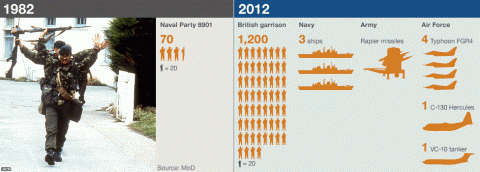
Francis Tusa of Defence Analysis, a newsletter, reckons that retiring the much more maintenance-heavy Tornados instead of the Harriers would have saved £4 billion-5 billion, while keeping Ark Royal going would cost only about £120m a year. He adds that getting out of the strike-carrier business for ten years means that critical skills will be lost. Others, including the letter’s authors, fear that the “carrier gap” will mean Britain loses the ability to carry out autonomous expeditionary missions. Among other things, that would, they say, leave the Falkland Islands (and their valuable oilfields) vulnerable to attack.

What appears to have changed the new (and inexperienced) National Security Council’s mind at the last moment was the air force’s claim that the Tornado was more effective than the Harrier in Afghanistan. It is odd that this was regarded as a clinching argument, as there are more than enough jets in Afghanistan. It is true that in terms of range, payload, speed and its ability to hit moving targets, the Tornado wins. On the other hand, the Harrier can operate from makeshift landing sites, is more flexible and reliable and could easily be equipped with the advanced Brimstone anti-tank missiles carried by the Tornado. And for five months of the year in Afghanistan, when the weather is hot, the Tornado can only take off with a similar weapons load to the Harrier.

The RAF’s enthusiasm for the Tornado is understandable. It does not have to share it with the navy (the Harrier is operated by a Joint Strike Wing) and it needs a lot more people to operate it (saving air-force jobs). Mr Tusa suggests a sensible compromise that would still save billions of pounds: get rid of half the Tornados, keeping 60 until they are not needed in Afghanistan; retain 20 Harriers for carrier duty until their replacements arrive in 2020; and accelerate the deployment of the strike version of the Typhoon. Time for a rethink.

« Newer PostsOlder Posts »

Powered by WordPress