Quotulatiousness

November 18, 2013

The Pentagon (accounting) papers

Filed under: Bureaucracy, Military, USA — Tags: , , , — Nicholas @ 17:25

Unlike other branches of the US government, the Department of Defence still isn’t properly accounting for all its expenditure, says Scot J. Paltrow in a Reuters report:

The Defense Department’s 2012 budget totaled $565.8 billion, more than the annual defense budgets of the 10 next largest military spenders combined, including Russia and China. How much of that money is spent as intended is impossible to determine.

In its investigation, Reuters has found that the Pentagon is largely incapable of keeping track of its vast stores of weapons, ammunition and other supplies; thus it continues to spend money on new supplies it doesn’t need and on storing others long out of date. It has amassed a backlog of more than half a trillion dollars in unaudited contracts with outside vendors; how much of that money paid for actual goods and services delivered isn’t known. And it repeatedly falls prey to fraud and theft that can go undiscovered for years, often eventually detected by external law enforcement agencies.

The consequences aren’t only financial; bad bookkeeping can affect the nation’s defense. In one example of many, the Army lost track of $5.8 billion of supplies between 2003 and 2011 as it shuffled equipment between reserve and regular units. Affected units “may experience equipment shortages that could hinder their ability to train soldiers and respond to emergencies,” the Pentagon inspector general said in a September 2012 report.

Because of its persistent inability to tally its accounts, the Pentagon is the only federal agency that has not complied with a law that requires annual audits of all government departments. That means that the $8.5 trillion in taxpayer money doled out by Congress to the Pentagon since 1996, the first year it was supposed to be audited, has never been accounted for. That sum exceeds the value of China’s economic output last year.

November 11, 2013

“The Canadian Corps … had beaten 47 German divisions since Aug. 8”

Filed under: Cancon, Europe, France, Germany, History, Military, WW1 — Tags: , , , , — Nicholas @ 15:55

In the Globe and Mail, J.L. Granatstein wants us to remember the greatest military achievement of the Canadian Corps in World War One (and it isn’t the battle of Vimy Ridge):

On Aug. 8, 1918, the Canadian Corps had secretly moved into position in front of the French city of Amiens. The German army had been on the offensive since March, and the Amiens sector was rather lightly defended. The Canadians, British and Australians struck this sector a surprise hammer blow in the early morning, a hurricane of artillery fire clearing the way for the tanks and infantry that blasted through the defences. Thousands of Germans surrendered, more were killed and within a few hours, the Canadian advance was almost 15 kilometres. This, wrote the German army’s great strategist, General Erich Ludendorff, was “the black day” of the German Army.

Lt.-Gen. Currie’s troops then moved north to the Arras area, where, at the end of the month, they struck toward and then through the Drocourt-Quéant Line, an immensely strong extension of the Hindenburg Line defended by crack troops. In heavy fighting at high cost, the Corps broke the line, forcing the Germans back behind the Canal du Nord, their last position protecting the key supply point of Cambrai.

[…]

The Germans now were in full retreat, moving eastward as fast as they could go. The Canadians took Valenciennes, smashing the enemy defences with a massive artillery barrage, and then moved into Belgium. By Nov. 11, they were in Mons, the same small town where the men of the British Expeditionary Force had first faced the invading Germans in August, 1914.

The Canadian Corps, more than a hundred thousand strong, had fought its last battles. As Lt.-Gen. Currie noted proudly, it had beaten 47 German divisions since Aug. 8, a quarter of the German forces in the West. The Corps had accomplished this because of its great fighting spirit, its fine leadership at all levels and its effective reinforcement and logistics systems. The cost in lives and in wounded was terrible — 45,000 casualties, 20 per cent of the total of Canadian losses in the entire war — but for once, the campaign had achieved measurable gains on the ground. More than that, the Canadian shock troops had battered the enemy, forced them eastward and obliged them to seek an armistice that was a de facto capitulation. It had scored its greatest victory, the greatest battlefield triumph ever by Canadian troops.

In memorium

Filed under: Britain, History, Military, WW1, WW2 — Tags: , , — Nicholas @ 11:00

A simple recognition of some of our family members who served in the First and Second World Wars:

The Great War

  • A Poppy is to RememberPrivate William Penman, Scots Guards, died 1915 at Le Touret, age 25
    (Elizabeth’s great uncle)
  • Private David Buller, Highland Light Infantry, died 1915 at Loos, age 35
    (Elizabeth’s great grandfather)
  • Private Walter Porteous, Northumberland Fusiliers, died 1917 at Passchendaele, age 18
    (my great uncle)
  • Corporal John Mulholland, Royal Tank Corps, died 1918 at Harbonnieres, age 24
    (Elizabeth’s great uncle)

The Second World War

  • Flying Officer Richard Porteous, RAF, survived the defeat in Malaya and lived through the war
    (my uncle)
  • Able Seaman John Penman, RN, served in the Defensively Equipped Merchant fleet on the Murmansk Run (and other convoy routes), lived through the war
    (Elizabeth’s father)
  • Private Archie Black (commissioned after the war and retired as a Major), Gordon Highlanders, captured at Singapore (aged 15) and survived a Japanese POW camp
    (Elizabeth’s uncle)
  • Elizabeth Buller, “Lumberjill” in the Women’s Land Army in Scotland through the war.
    (Elizabeth’s mother)

In Flanders fields the poppies blow
Between the crosses row on row,
That mark our place; and in the sky
The larks, still bravely singing, fly
Scarce heard amid the guns below.

We are the Dead. Short days ago
We lived, felt dawn, saw sunset glow,
Loved and were loved, and now we lie
In Flanders fields.

Take up our quarrel with the foe:
To you from failing hands we throw
The torch; be yours to hold it high.
If ye break faith with us who die
We shall not sleep, though poppies grow
In Flanders fields.

Lieutenant Colonel John McCrae, MD Canadian Army Medical Corps (1872-1918)

We will remember them

Filed under: Britain, Cancon, History, Military, WW1, WW2 — Tags: , — Nicholas @ 00:01

A Remembrance Day slideshow using Mark Knopfler’s wonderful “Remembrance Day” song from the album Get Lucky (2009). The early part of the song conveys many British images, but I have added some very Canadian images also which fit with many of the lyrics. The theme and message is universal… ‘we will remember them’.

November 10, 2013

Grave robbers of the western front

Filed under: Britain, Europe, France, History, Military, WW1 — Tags: — Nicholas @ 12:05

In the Telegraph, Willard Foxton explains why the growing interest in the centenary of the First World War is also giving a boost to the grave robbers:

Across the UK, there has been a rash of police finds of these First World War explosives, as the online trade in them has boomed. Dealers will often home defuse them, putting themselves and others at risk; some have been maimed doing so. […]

As dangerous as these unexploded devices are, perhaps the ugliest corner of the trade is the sale of other relics — especially dead soldiers’ identification marks. In particular, there’s a premium on British soldier’s spoons, which would often have their owner’s names embossed on them. Helmets can fetch high prices, too — including those bent out of shape by bullets or shells, which gives you some idea of what happened to the poor guy wearing it. As Andy Brockman, a leading conflict archaeologist told me:

“There is a market in all kinds of battlefield memorabilia and in the worst cases this can lead to the sale of identification tags and the removal of personal possessions like spoons and toothbrushes from battlefield burials. These objects can carry identifying marks and their loss can prevent authorities like the Commonwealth War Graves Commission from identifying the soldier concerned, robbing them of the chance of a marked grave.

“When it comes to the illegal removal of equipment and personal possessions from the remains of the missing to feed the collectors market, I would agree with Andy Robertshaw of the Royal Logistics Corps Museum who says that it’s like killing them twice.”

November 9, 2013

Contemplating a smaller US military

Filed under: Military, USA — Tags: , , — Nicholas @ 10:13

As Robert Heinlein wrote, “The most expensive thing in the world is a second-best military establishment, good but not good enough to win”, which is both obviously true and not very helpful when you are looking at the biggest, best-equipped military force in human history. Since the end of the Cold War, there really has only been one country with a right to the term “superpower” (and for the Soviet Union, in retrospect it was more of a courtesy title anyway). The world still stands in the military shadow of the US Army, US Navy, and US Air Force.

But even superpowers have to face economic reality at some point, so it’s time to consider just how big the US military forces need to be to accomplish US goals. In The Atlantic, Eric Schnurer wonders if the defence budget can be trimmed without endangering national security:

Since protecting citizens’ lives is the first duty of government, public-safety functions are usually the last to feel the effects of tightened budgets. This is especially true at the federal level, where cuts to the defense budget are generally portrayed as assaults on the nation’s very existence. There are a variety of reasons to tread softly on any sort of defense cuts: You only get to err by under-defending the country once. The battlefield edge today, and even more so in the future is a product of advanced — and expensive — technologies. Those who put their lives on the line for the rest of us deserve the best equipment and protective gear, and the most reasonable pay and benefits, that we can afford.

But does that mean that we cannot cut the defense budget without short-changing national security? To hear some tell it the answer is “no.” But the Defense Department is part of the same government that most Americans abjure for its inefficiency, waste, and fraud. In fact, you can find just about everything that’s wrong with government in the defense budget. Oklahoma Republican Senator Tom Coburn, no liberal, has derided the Pentagon as the “Department of Everything” for its wide-ranging activities.

Of all the services that critics complain the Pentagon needlessly duplicates—from schools and rec centers to scientific research and grocery stores — the most expensive is health care. Ten percent of the Pentagon’s non-war budget — $53 billion—goes to health care. As with civilian health care, savings are achievable here but face implacable opposition from military retirees. But as no less a military enthusiast than John McCain said last year on the Senate floor, “We are going to have to get serious about entitlements for the military just as we are going to have to get serious about entitlements for nonmilitary.”

November 7, 2013

Rick Mercer on the plight of injured veterans

Filed under: Cancon, Government, Military — Tags: , , , — Nicholas @ 09:10

November 6, 2013

Taiwan suffers espionage leak

Filed under: China, Military, Technology, USA — Tags: , , , , — Nicholas @ 09:17

Strategy Page on the most recent intelligence coup by the Chinese military:

Taiwan recently admitted that it had suffered some serious damage when it discovered that one of its air force officers (identified only as “Major Hao”) sold many technical details of the new E-2K AWACS (Airborne Warning and Control System) aircraft to China. Hao did it for money, and Taiwanese counterintelligence found over a dozen other Chinese intel operatives during the investigation that uncovered the E-2K leaks. Since the E-2K contains mostly American technology and is based on the E-2C use on American aircraft carriers, this intelligence disaster is going to cost America a lot as well. Since China now knows the details of how the E-2 electronics work, they can develop better ways to deceive and disrupt E-2 operations.

Earlier this year Taiwan received the last two of four E-2K aircraft from the U.S., where they have been sent for upgrading to the E-2C 2000 standard. The first two E-2Ks were sent in 2009. The upgrade cost about $63 million per aircraft. Taiwan bought two E-2Ks new in 2006 as well.

The Taiwanese E-2K is very similar to the American E-2C, which is being replaced with a newer model. In 2010 the U.S. Navy received its first E-2D aircraft. This is the latest version of the E-2 Hawkeye radar aircraft that was originally introduced in 1964. The two engine, 24 ton E-2 was never produced in large quantities (fewer than a hundred are in use). Six years ago the E-2 fleet reached a milestone of a million flight hours.

[…]

The U.S. usually does not export the latest versions of electronic equipment. Thus the Taiwan leak means the older American E-2C is compromised but not (to a great extent) the most recent E-2D model. But the Taiwanese are justifiably afraid that there will be even more reluctance by the United States to sell Taiwan the latest versions of anything because of the successful Chinese espionage efforts in Taiwan. Then again, maybe not. That’s because that espionage works both ways. The Taiwanese have been very successful using the same tactics (offering cash or using blackmail and other threats) against the Chinese. While the American and Taiwanese tech is more valuable (because it is more advanced) it’s useful to know the details of the best stuff the Chinese have.

November 5, 2013

Lake Michigan’s carrier fleet

Filed under: History, Military, USA, WW2 — Tags: , , , , , — Nicholas @ 12:21

I’d never heard of the US Navy’s carrier training ships that operated on Lake Michigan from 1942-45, so this link to a thread at Warbird Information Exchange from Roger Henry was of great interest:

This thread may give you a nice idea of what that exercise was all about. Many interesting images to study here and quite possibly of interest to those who are involved with the restoration of aircraft that have been recovered from the Lakes. I have also included a page from my dad’s logbook showing his 1st thru 8th carrier landings on the USS Wolverine in July 1944. Sources are the NMNA archives, Library of Congress photo archives, LIFE image archives.

This will be a large photo thread in a few parts so we’ll start with the two principal ships.

WIKI: USS Sable (IX-81) was a training ship of the United States Navy during World War II. Originally built as the Greater Buffalo, a sidewheel excursion steamer, she was converted in 1942 to a freshwater aircraft carrier to be used on the Great Lakes. She was used for advanced training for naval aviators in carrier takeoffs and landings. One aviator that trained upon the Sable was future president George H. W. Bush. Following World War II, Sable was decommissioned on 7 November 1945. She was sold for scrapping on 7 July 1948 to the H.H. Buncher Company.

The steamship 'Greater Buffalo' before it was converted to the 'USS Sable' (IX-81).

The steamship Greater Buffalo before it was converted to the USS Sable (IX-81).

Overhead view of the training aircraft carrier 'Sable' (IX 81) underway on Lake Michigan with an FM Wildcat making a deck launch from the flattop 1945

Overhead view of the training aircraft carrier Sable (IX 81) underway on Lake Michigan with an FM Wildcat making a deck launch from the flattop 1945

I was initially surprised that both training carriers were converted side-paddle steamers … I’d have thought the extra costs in converting to propeller drive would make them less-than ideal conversion subjects — you can clearly see in the second image that they left the side-paddles in place, so the main cost of conversion was the construction of the flight deck and repositioning the smokestacks to the starboard side (no hangar deck, elevators, or catapults in evidence):

WIKI: USS Wolverine (IX-64) a side-wheel excursion steamer built in 1913—was originally named Seeandbee, a name based upon her owners’ company name, the Cleveland and Buffalo Transit Co.[4] She was constructed by the American Ship Building Company of Wyandotte, Michigan. The Navy acquired the sidewheeler on 12 March 1942 and designated her an unclassified miscellaneous auxiliary, IX-64. She was purchased by the Navy in March 1942 and conversion to a training aircraft carrier began on 6 May 1942.[5] The name Wolverine was approved on 2 August 1942 with the ship being commissioned on 12 August 1942.[5][6] Intended to operate on Lake Michigan, IX-64 received its name because the state of Michigan is known as the Wolverine State.

The steamship 'Seeandbee' before it was converted to the 'USS Wolverine' (IX-64)

The steamship Seeandbee before it was converted to the USS Wolverine (IX-64)

A view of the USS Wolverine (IX-64) while underway in Lake Michigan 1942

A view of the USS Wolverine (IX-64) while underway in Lake Michigan 1942

And given that almost all the pilots were still learning their trade — these were training ships, after all — there were more than a few mishaps:

USS Sable (IX 81) showing a TBF hanging over the side after crashing during carrier qualifications on Lake Michigan.

USS Sable (IX 81) showing a TBF hanging over the side after crashing during carrier qualifications on Lake Michigan.

FM-2 Wildcat after crash onboard USS Sable

FM-2 Wildcat after crash onboard USS Sable

November 4, 2013

Law, the military, and the media

Filed under: Britain, Law, Military — Tags: , , , , — Nicholas @ 11:23

Sir Humphrey debunks a recent story in the Telegraph which makes a big deal about the British military hiring more lawyers at the same time as they are disbanding front-line units:

The Forces have always needed effective legal support, and arguably the tiny number of military lawyers provides an utterly vital capability. Its not just about the provision of support to people who understand the arcane intricacies of a military law system which is very complex, and very different to our normal law — though this is extremely important. It’s about the provision of people who bring a vital advisory role to Commanders on the ground, and the wider MOD.

[…]

Similarly, once the direct fighting is over, UK troops often find themselves operating in a very strange environment — one only has to look at Iraq in the aftermath of the initial war fighting phase to realise that its not a clear cut place to operate. The advice offered by in theatre legal personnel can often make a huge difference in helping commanders understand their freedom to operate, and what genuine constraints may affect them. For instance, on a single tour in Iraq, units may have found themselves conducting everything from searches, checking for IEDS, detaining known individuals through deliberate operations, and then engaging in combat — quite possibly in the same day. The requirement for modern troops to adapt very quickly to all manner of situations places a huge burden on them — it is important that they get the best possible guidance to know they are acting correctly. Certainly in this authors experience on both TELIC and HERRICK, the LEGAD advice was often one of the most critical parts of any potential operation.

The same lawyers provide vital services back home — in the Royal Navy for instance, there are a range of in house experts on the Law of the Sea, international maritime disputes and territorial waters and the like. This may sound questionable, but when the RN is daily conducting counter piracy and counter narcotics operations across the globe, or sailing in possible maritime flashpoints where different nations have very different interpretations of maritime boundaries, having a good legal understanding on hand of the art of the possible is absolutely vital.

October 31, 2013

Canada’s shipbuilding strategy – the worst of both worlds

Filed under: Cancon, Economics, Military — Tags: , , , — Nicholas @ 11:15

The Royal Canadian Navy (RCN) and the Canadian Coast Guard (CCG) both are badly in need of new ships. The federal government has been aware of this for quite some time and has made plenty of announcements about addressing those needs … but the actual steps taken do not give me hope that the needs will be met economically or in a timely fashion. Canada no longer has a domestic ship-building industry with experience in producing military vessels, and it does not make economic sense to re-create it for the relatively small number of ships the RCN and the CCG actually need.

Politically, it can be a good election ploy to pour lots of government money into new shipyards which will employ hundreds of skilled and unskilled workers. The newly employed will be spending their salaries in Halifax, Vancouver, and Quebec and the visible signs of construction (both of the facilities themselves and of the hulls of the ships) will be a steady reminder to voters that the feds are investing in their cities. From the political viewpoint, it makes lots of sense to design and build the ships in Canada.

Economically, the situation is quite different. None of the remaining shipbuilding firms have the trained staff for either designing or assembling modern military ships. They’ll need to expand their yards and hire new skilled workers to take on the contracts. The civilian economy probably does not have all the necessary trained would-be employees ready to hire, so many would need to be brought in from other countries while training courses eventually turn out enough Canadians able to take those jobs. This will all increase the cost of the shipbuilding program, and delay the already belated eventual delivery of the ships. J.L. Granatstein explains:

The government’s National Shipbuilding Strategy aims to provide Arctic patrol ships, supply vessels and eventually replacements for the RCN’s fine frigates, as well as a large icebreaker and 10 smaller ships for the Coast Guard. The cost, including the frigate replacement, is estimated at $80 billion, and the process involves re-establishing the nation’s shipyards in Vancouver and Halifax, in effect re-creating a defunct industry. Up to 15,000 jobs are to be created.

But this is Canada, so pork and high costs are inevitable. National Defence and Public Works are deeply involved, politicians’ hands are all over the plans, and costs are sky-high. Consider the two Joint Support Ships to be built in Vancouver for $3 billion. They will likely be fine ships when they hit the water, years late. Britain’s Royal Navy, however, is buying four roughly similar ships from South Korean builders for $750 million — for all four. Should the RCN ships cost eight times those of the British? The Dutch navy is buying ships built in Romania; the Danes use ships built in Poland. Why? Because the cost is far less, the quality is good, and the work of installing the armaments and communications systems can be done in home waters, creating good jobs.

Take another case, the 10 small vessels to be built on the west coast for the Coast Guard for $3.3 billion. In 2007, the Danes bought similar, larger ships for $50 million each, ships with an icebreaking capacity the CCG ships will not have. Even with six years of inflation factored in, the CCG ships will cost at least three to five times as much.

But, the government will say, the jobs being created on the coasts are good ones, paying well for the skilled workers who are being trained to fill them. It is true, but will the Canadian public support the RCN and the Coast Guard when it realizes the massive costs involved to create each job? Moreover, no government can bind its successors to follow any policy. Jean Chrétien killed the maritime helicopter project when he came to power two decades ago, and the RCN still has no new ones. A future government might well say that the deficit is too high and the ship projects cannot proceed. After all, governments have killed the shipbuilding industry in this country before — after the two world wars and after the RCN frigate program ended in the 1990s. There are no guarantees in politics, and neither the Liberals nor the NDP seem high on defence spending for anything other than peacekeeping.

However, any time the political equations and the economic equations point in very different directions, you can almost always count on the politicians to go for the most expensive/most politically advantageous answer.

October 29, 2013

Even selling the USS Forrestal for $1 was a win for the US Navy

Filed under: Economics, Environment, Military, USA — Tags: , , , , — Nicholas @ 07:21

Several people have commented about the headlines proclaiming that the very first supercarrier had been sold for a princely sum of $1, but Strategy Page explains why even that token dollar was better than all the other options:

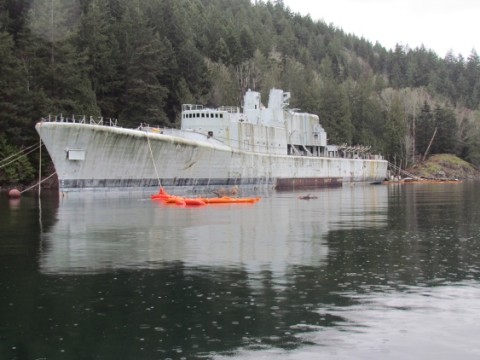
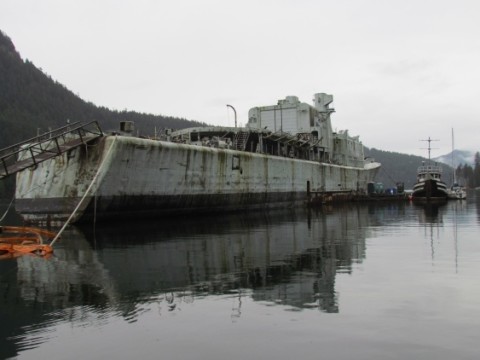
The U.S. Navy recently sold a decommissioned (in 1993) aircraft carrier (USS Forrestal) for scrap. The ship yard that will take the Forrestal apart (All Star Metals of Texas) paid the navy one cent ($.01) for the ship. That’s because this was the best deal the navy could get. That’s because it will cost many millions to take the ship apart in a legal fashion (being careful to avoid releasing any real or imagined harmful substances into the environment). The other alternative was to sink the Forrestal at sea. But this requires partial disassembly (to remove anything that could or might pollute the ocean), that would be even more expensive.

[…]

Since the 1990s, sending warships to the scrap yard has not been considered a viable alternative. It’s all about pollution, bad press, and cost. That was because of the experience with the largest warship to be scrapped to date, the 45,000 ton carrier USS Coral Sea. This ship took until 2000 (seven years) to be broken up. Thus, the new ecologically correct process was not only expensive but it took a long time. Then the navy discovered that the cost of scrapping a nuclear powered carrier like the USS Enterprise would be close to a billion dollars. This was largely the result of a lot more environmental and safety regulations. With so many navy ships (especially nuclear subs) being broken up in the 1990s, and all these new regulations arriving, the cost of disposing of these ships skyrocketed. This was especially true with carriers.

So for over a decade the navy just tied up retired ships and waited for some better solution to appear. That never happened. In fact, the situation has gotten worse. The navy only has one ship scrapping facility (Brownsville, Texas), so only one carrier at a time can be dismantled. Using official estimates of the time required to dismantle each of the biggest ships, it’ll take seven decades to get rid of the surviving conventionally powered carriers. Note also that the conventional carrier in the absolute worst shape, the USS John F Kennedy, is the one being officially retained in category B reserve (but only until Congress forgets all about her, of course). Name recognition really does count.

It gets worse. With the really vast number of single hull tankers being scrapped and large numbers of old, smaller-capacity container ships laid up and likely to be offered for scrap fairly soon, the market for difficult-to-scrap naval ships is going to shrivel and the price for scrap steel will drop. Efforts to get the navy to include the costs of disposal in the budget for lifetime costs has never caught on and now it’s obvious why not. The real nightmare begins with the first nuclear powered carrier (the 93,000 ton USS Enterprise), which began the decommissioning process in late 2012 (with the lengthy removal of all classified or reusable equipment). The cost of dismantling this ship (and disposing of radioactive components) may be close to $2 billion.

October 27, 2013

“Dangerous Ground” in the South China Sea

Filed under: China, Military, Pacific — Tags: , , — Nicholas @ 09:26

John Donovan linked to this interesting New York Times Magazine feature about the Spratly Islands and the geopolitical standoff between China and pretty much all of the other nations bordering the South China Sea:

Spratly Islands - Sierra Madre aground on Ayungin

Ayungin Shoal lies 105 nautical miles from the Philippines. There’s little to commend the spot, apart from its plentiful fish and safe harbor — except that Ayungin sits at the southwestern edge of an area called Reed Bank, which is rumored to contain vast reserves of oil and natural gas. And also that it is home to a World War II-era ship called the Sierra Madre, which the Philippine government ran aground on the reef in 1999 and has since maintained as a kind of post-apocalyptic military garrison, the small detachment of Filipino troops stationed there struggling to survive extreme mental and physical desolation. Of all places, the scorched shell of the Sierra Madre has become an unlikely battleground in a geopolitical struggle that will shape the future of the South China Sea and, to some extent, the rest of the world.

[…]

To understand how Ayungin (known to the Western world as Second Thomas Shoal) could become contested ground is to confront, in miniature, both the rise of China and the potential future of U.S. foreign policy. It is also to enter into a morass of competing historical, territorial and even moral claims in an area where defining what is true or fair may be no easier than it has proved to be in the Middle East.

The Spratly Islands sprawl over roughly 160,000 square miles in the waters of the coasts of the Philippines, Malaysia, Brunei, Taiwan and China — all of whom claim part of the islands.

Spratly Islands shipping lanes

October 26, 2013

NATO after the cold war

Filed under: Europe, Military, Russia, USA — Tags: , , , , — Nicholas @ 09:15

Austin Bay looks at the latest re-invention of the North Atlantic Treaty Organization (NATO):

As the Cold War faded in the early 1990s, “end of NATO” prognosticators argued that the collapse of the Soviet Union would lead to the collapse of the military alliance forged to defeat it. They maintained that intra-alliance political frictions, no longer checked by the threat of Soviet tanks and nuclear weapons, would inevitably fracture the complex organization.

Moreover, Western Europe, re-cast as the European Economic Community and preparing for life as the European Union, could do it alone, militarily and economically. According to these seers, the outbreak of peace in Europe meant Europeans no longer needed to fret with those overbearing Americans.

However, European peace didn’t break out, not quite. Instead, Yugoslavia broke up, a USSR in Balkan miniature, its dissolution sparking a series of dirty wars on European soil.

U.N. peacekeeping efforts in the Balkans failed to prevent massacres like Bosnia’s Srebrenica genocide. When Kosovo exploded, the Clinton Administration, Britain and France sidestepped the U.N. To fight the Kosovo War, they used a democratic political alliance capable of waging war on behalf of a better peace: NATO. By doing so, they reinvented NATO as a global actor for the North Atlantic democracies.

Balkan troubles still plague Europe, but NATO’s Kosovo intervention staunched the bloodshed. European diplomats also quickly learned that (excepting Serbia) the ex-Yugoslav Balkan states regarded NATO and the European Union as classy clubs. Diplomatic clout is one of NATO’s continuing utilities. Membership has prestige. Dangling NATO and European Union membership still encourages better, if not quite good, Balkan behavior.

[…]

The “deep goal” of this new round of reinvention is to insure that the alliance can fulfill its NATO treaty Article 5 obligation to current members. Article 5 commits every NATO nation to the defense of a member suffering attack by a non-NATO member. NATO invoked Article 5 after the 9-11 terror attacks on the U.S. The 9-11 Article 5 invocation and the Kosovo War were predicates to NATO’s “beyond Europe” involvement in Afghanistan and in Libya 2011.

NATO’s demise is anything but imminent. Evolving threats have seeded closer cooperation.

The origins of the British army

Filed under: Britain, History, Military — Tags: , , — Nicholas @ 09:07

A primer called “Boots on the Ground” at Think Defence provides a quick historical sketch of how the British army came to be:

It is worth reminding ourselves that up until Cromwell in effect there was no ‘Army’ as such.

Individual nobles raised troops top fight for the king in haphazard amounts and units, equipped according to their finances; and often with little relation to their feudal dues. A rich Knight often turned up to fight for or against the King with more and better equipped troops than a poor Earl.

The New model Army (more properly contemporaneously called the ‘Newly Modelled’ Army,(if I recall) changed that. Fed up with troops that would only fight under ‘Their’ commander and on ‘Their’ turf Parliament said (and I paraphrase):-

    ‘Sod this literally for a game of soldiers we need to get an Army we can command, if we are going to get any of this shit sorted’…

So the UK’s first professional full time paid and resourced Army was born.

The revolutionary Ideas of:

  • Paying the troops well and on time,
  • Concentrating on Moral, (through religious conformity it its case),
  • An organization of units according to modern requirements,
  • Proper logistics.
  • And a proper code of Military justice.

Worked so well that it pretty much kicked arse from the moment it hit the ground.

However with the restoration of the monarchy a lot of old attitudes re-emerged.

It was very much the case for hundreds of years that you joined ‘The Regiment’. Often named after the Colonel who was in command. The British Army seems at some points to have been almost an accidental conglomeration of like minded units a bit like a trade organisation of organisations who happened to wear uniforms and fight for the King.

OK, this was slowly chipped away at by events in the Napoleonic and Crimean wars, to the stage by the late 19th century it was an ‘Army’, but some traditions and mindsets seem to take an age to die.

For all the ‘esprit de corps’ it undoubtedly delivered, incidents of internecine ‘warfare’ between units hampering actions in the field are well recorded up to WWII and beyond.

It is worth reminding ourselves that we are only now returning to an army the same size as the one we entered the run up to World war 1 with. That’s the one that was so small by European power standards that when asked what he would do if the British Army invaded Germany in the 1890′s [Otto von Bismarck] replied ‘I would call the police and have it arrested’!

On the topic of internecine warfare between army units, regimental memories are long and opportunities to “pay off” old scores arise when dissimilar/unfriendly units are brigaded together. George MacDonald Fraser (author of the fantastic Flashman novels) mentioned in one of his MacAuslan stories that it was dangerous to let certain Highland regiments get too close to one another for fear they’d fight one another instead of the enemy (or overthrow the government).

I strongly disagree with the author’s belief that the regimental system should be scrapped, but he makes a reasonable case for that step (“reasonable” if you’ve never actually served in the army, that is…)

« Newer PostsOlder Posts »

Powered by WordPress