
Tom Scott
Published 4 Jul 2022There are only a few working Link Trainers left in the world: but before microprocessors, before display screnes, half a million pilots learned the basics of instrument flying inside one. More: https://www.most.org/explore/link-fli…
(more…)
November 5, 2022
A working flight simulator, no computers necessary
Comments Off on A working flight simulator, no computers necessary
QotD: The use of chemical weapons after WW2
During WWII, everyone seems to have expected the use of chemical weapons, but never actually found a situation where doing so was advantageous. This is often phrased in terms of fears of escalation (this usually comes packaged with the idea of MAD (Mutually Assured Destruction), but that’s an anachronism – while Bernard Brodie is sniffing around the ideas of what would become MAD as early as ’46, MAD itself only emerges after ’62). Retaliation was certainly a concern, but I think it is hard to argue that the combatants in WWII hadn’t already been pushed to the limits of their escalation capability, in a war where the first terror bombing happened on the first day. German death-squads were in the initial invasion-waves in both Poland, as were Soviet death squads in their invasion of Poland in concert with the Germans and also later in the war. WWII was an existential war, all of the states involved knew it by 1941 (if not earlier), and they all escalated to the peak of their ability from the start; I find it hard to believe that, had they thought it was really a war winner, any of the powers in the war would have refrained from using chemical weapons. The British feared escalation to a degree (but also thought that chemical weapons use would squander valuable support in occupied France), but I struggle to imagine that, with the Nazis at the very gates of Moscow, Stalin was moved either by escalation concerns or the moral compass he so clearly lacked at every other moment of his life.
Both Cold War superpowers stockpiled chemical weapons, but seem to have retained considerable ambivalence about their use. In the United States, chemical weapons seem to have been primarily viewed not as part of tactical doctrine, but as a smaller step on a nuclear deterrence ladder (the idea being that the ability to retaliate in smaller but still dramatic steps to deter more dramatic escalations; the idea of an “escalation ladder” belongs to Herman Kahn); chemical weapons weren’t a tactical option but baby-steps on the road to tactical and then strategic nuclear devices (as an aside, I find the idea that “tactical” WMDs – nuclear or chemical – could somehow be used without triggering escalation to strategic use deeply misguided). At the same time, there was quite a bit of active research for a weapon-system that had an uncertain place in the doctrine – an effort to find a use for a weapon-system the United States already had, which never quite seems to have succeeded. The ambivalence seems to have been resolved decisively in 1969 when Nixon simply took chemical weapons off of the table with an open “no first use” policy.
Looking at Soviet doctrine is harder (both because I don’t read Russian and also, quite frankly because the current epidemic makes it hard for me to get German and English language resources on the topic) The USSR was more strongly interested in chemical weapons throughout the Cold War than the United States (note that while the linked article presents US intelligence on Soviet doctrine as uncomplicated, the actual intelligence was ambivalent – with the CIA and Army intelligence generally downgrading expectations of chemical use by the USSR, especially by the 1980s). The USSR does seem to have doctrine imagine their use at the tactical and operational level (specifically as stop-gap measures for when tactical nuclear weapons weren’t available – you’d use chemical weapons on targets when you ran out of tactical nuclear weapons), but then, that had been true in WWII but when push came to shove, the chemical munitions weren’t used. The Soviets appear to have used chemical weapons as a terror weapon in Afghanistan, but that was hardly a use against a peer modern system force. But it seems that, as the Cold War wound down, planners in the USSR came around to the same basic idea as American thinkers, with the role of chemical weapons – even as more and more effective chemicals were developed – being progressively downgraded before the program was abandoned altogether.
This certainly wasn’t because the USSR of the 1980s thought that a confrontation with NATO was less likely – the Able Archer exercise in 1983 could be argued to represent the absolute peak of Cold War tensions, rivaled only by the Cuban Missile Crisis. So this steady move away from chemical warfare wasn’t out of pacifism or utopianism; it stands to reason that it was instead motivated by a calculation as to the (limited) effectiveness of such weapons.
And I think it is worth noting that this sort of cycle – an effort to find a use for an existing weapon – is fairly common in modern military development. You can see similar efforts in the development of tactical nuclear weapons: developmental dead-ends like Davy Crockett or nuclear artillery. But the conclusion that was reached was not “chemical weapons are morally terrible” but rather “chemical weapons offer no real advantage”. In essence, the two big powers of the Cold War (and, as a side note, also the lesser components of the Warsaw Pact and NATO) spent the whole Cold War looking for an effective way to use chemical weapons against each other, and seem to have – by the end – concluded on the balance that there wasn’t one. Either conventional weapons get the job done, or you escalate to nuclear systems.
(Israel, as an aside, seems to have gone through this process in microcosm. Threatened by neighbors with active chemical weapons programs, the Israelis seem to have developed their own, but have never found a battlefield use for them, despite having been in no less than three conventional, existential wars (meaning the very existence of the state was threatened – the sort of war where moral qualms mean relatively little) since 1948.)
And I want to stress this point: it isn’t that chemical munitions do nothing, but rather they are less effective than an equivalent amount of conventional, high explosive munitions (or, at levels of extreme escalation, tactical and strategic nuclear weapons). This isn’t a value question, but a value-against-replacement question – why maintain, issue, store, and shoot expensive chemical munitions if cheap, easier to store, easier to manufacture high explosive munitions are both more obtainable and also better? When you add the geopolitical and morale impact on top of that – you sacrifice diplomatic capital using such weapons and potentially demoralize your own soldiers, who don’t want to see themselves as delivering inhumane weapons – it’s pretty clear why they wouldn’t bother. Nevertheless, the moral calculus isn’t the dominant factor: battlefield efficacy – or the relative lack thereof – is.
Bret Devereaux, “Collections: Why Don’t We Use Chemical Weapons Anymore?”, A Collection of Unmitigated Pedantry, 2020-03-20.
Comments Off on QotD: The use of chemical weapons after WW2
November 4, 2022
Tank Chats #157 | Ferret MKII & V | The Tank Museum
The Tank Museum
Published 1 Jul 2022Join David Fletcher for a new Tank Chat on the Ferret.
(more…)
Comments Off on Tank Chats #157 | Ferret MKII & V | The Tank Museum
November 2, 2022
QotD: Being “the world’s policeman”
The United States took on the mantle of world’s policeman in the post-Second World War world. They have spent much of the last 60 years trying to keep the peace, and, interestingly, to maintain the balance of power. (Do not be fooled by the concept of the overwhelming superpower. Britain was a lot closer to being able to take on the rest of the world in the 19th century, when it really could defeat every other navy in the world combined; than the US is now, where it could perhaps face Iran, Russia and India simultaneously, as long as the European Union is friendly. Whoops, forgot China, the Balkans, Palestine, Syria, North Korea, Iraq, Afghanistan, Somalia and other little blips on the US horizon. Well let’s be honest, no one has ever been able to take on more than a few of the other powers simultaneously. NO one.)
For their troubles, they are usually pilloried by those all about them, particularly by up and coming powers who want their “place in the sun” – the Soviet Union and China being the stand-out examples. (Though there is a lot of whinging from old allies like France). For the last forty years (since Vietnam, and certainly since Gulf War One), there have been signs that the US voter is having serious second thoughts about the whole concept.
Britain was quite reluctant to take over later imperial dependencies, particularly leftover states of defeated Empires like Turkey, such as Iraq and Palestine: but also parts of Africa and Asia “of interest to no bugger”. They were never part of the British ideal of commercial empire, and were almost impossible to govern. They were abandoned as soon as possible.
The United States is currently experiencing the joys of taking over, or being responsible for unwanted bits of empire. Strangely the names Iraq and Palestine are occurring on that list, as well as Afghanistan and possibly other commitments to come. (The US has interfered in these areas far longer than Britain had before she was stuck with them). They cannot be considered part of a logical geopolitical empire (not even for oil conspiracy nuts), and will be abandoned as soon as possible.
The British voter responded to the world wars by wanting out of empire. Now. Some of the states thus “released” were well-developed societies with decent infrastructure and good literacy and rule of law concepts. India, Malta, Ceylon, Bermuda and Singapore spring to mind. Others were abandoned prematurely: without literacy, rule of law, good infrastructure, a developed civil service, practice of voting, or any of the other minor necessities for establishing a democratic state. See any list of African dictatorships.
The US voter is responding to current events by wanting out of the Middle East ASAP. They are intent on abandoning states to “democracy”, regardless of a lack of literacy, rule of law, good infrastructure, a developed civil service, practice of voting, or any of the other minor necessities for establishing a democratic state. Whoops.
Britain suffered from an immense artificial economic high after the Napoleonic war. This left the British economy extremely artificially inflated for eighty years, and still well above its realistic weight in the world for another fifty (and only really brought back to the field by the immense economic losses of two world wars). In the last twenty years Britain has held a more realistic place in the world economy for its population and industrial level (though still relatively inflated by an immense backlog of prestige and sometimes reluctant respect.).
The US suffered from an immense artificial economic high after WWII. This left the US economy artificially inflated for the rest of the century, and still well above its realistic weight in the world to the present. … Sometime in the next few decades, the US will probably return to a more realistic place in the world economy for its population and industrial level. (Minor variables like World War III may make this projection uncertain as to actual timing, but it will happen: simply because the US will not be able to largely sit out most of the next world wars and profiteer from everyone else’s ruin the way she could in the last two).
Nigel Davies, “The Empires of Britain and the United States – Toying with Historical Analogy”, rethinking history, 2009-01-10.
Comments Off on QotD: Being “the world’s policeman”
November 1, 2022
Ukraine unleashes the modern descendent of the “fireship” against Sevastopol
CDR Salamander on the Ukrainian attack on Russian shipping in Sevastopol harbour over the weekend:
The big navalist news over the weekend was unquestionably what appears to be a successful attack on the Russian Navy at Sevastopol by remotely piloted surface craft by the Ukrainians.
Some reports call them “drones” or other such descriptors, but really they appear to be an upscaled militarized remotely piloted surface vessel on a one way trip. There is a lot of expected hyperbole about the attack, and that is what I wanted to address today. I am concerned that the overhype by the ignorant, click hunting, or agenda driven people in the public space will cause us to miss the most important lesson here.
This attack was not historically significant in a larger sense, no more than the attack on the Moskva was. This is not a glimpse into the future of naval warfare. This was simply a continuation of sound naval tactics with a pedigree directly tracible thousands of years in to the past. Not to understand this is to dangerously not understand what happened.
First of all, let’s take a moment to state the obvious: the Russians should have been ready. They had about as clear of a warning as possible in September.
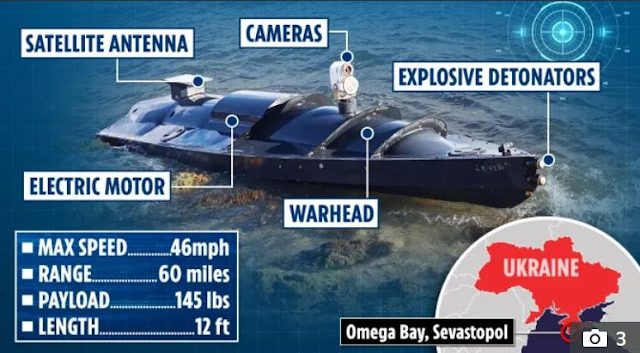
A MYSTERIOUS vessel widely believed to be a Ukrainian suicide drone has washed up near to a Russian naval base.
The vessel was found in Omega Bay, by the port of Sevastopol, which is home to Vladimir Putin’s Black Sea fleet.
We can safely assume — as the videos below seem to demonstrate — that the ones used in the attack are of the same design.
We will loop back to this point later, but just behold the simplicity of it via the article from The Sun linked above;
This is all COTS technology riding on either a canoe or ocean going kayak. If you have someone with an understanding of explosives and communications (the only part requiring military expertise +/-) and then any garden variety electrician, small engine pro, and fiberglass guy … you can run a production line of these on a shoestring budget at scale.
[…]
This is another demonstration that the military culture of Russia is broken. The human element in the Sevastopol was manifested in the complete lack of preparation for the attack in spite of the warnings so clearly provided in September.
As old as “fire ships” are to naval warfare are the defenses against them. They are as simple as the weapons you need to defend against them. Barriers at the water level and crew served weapons — preferable optically sighted — as a backup.
Part of the video above you can see both surface ship and helo gunfire taking out the threat from one boat, but other boats were able to approach surface ships underway and penetrate deep in to port.
Why?
What is one of the things we have repeatedly discussed here for the last 18-years? When war comes you never have enough of what? That’s right, anti-aircraft defenses and medium caliber guns including crew served weapons.
We build our ships around the most high-technology threats and equally exquisite defenses against them, but completely overlook the low-tech weapons that are just as deadly. We ignore mine warfare, and we also ignore threats as simple as a converted kayak. It isn’t sexy and the contracts awarded are small … but the threats are real.
Comments Off on Ukraine unleashes the modern descendent of the “fireship” against Sevastopol
Britain’s Final Assault – Falklands War
Historigraph
Published 29 Oct 2022In the closing days of May 1982, the British land campaign to recapture the Falkland Islands began, after an eight thousand mile voyage and weeks of battles at sea and in the air. With a beachhead established, British troops were now charged with rapidly defeating an Argentinian force that was more numerous and had spent weeks preparing defences. The Battle for the Falklands was about to begin.
(more…)
Comments Off on Britain’s Final Assault – Falklands War
QotD: Spartan strategy during the Persian wars
The hammer Sparta has, of course, is hoplite battle. Sparta seeks to solve almost all of its issues by applying a hoplite phalanx to the problem, regardless of if the problem can be solved by a hoplite phalanx. Spartan strategic thinking is thus marred by both a failure to consider military solutions that did not consist of traditional hoplite battles, as well as an inability to consider or execute non-military solutions at all.
We can see the former weakness in Spartan planning in the Persian Wars. Spartan planning is both direct and unrealistic: find a choke-point, fortify it and hold it indefinately with a hoplite army. Attempted at Thermopylae this plan fails; the Battle of Thermopylae is often represented in popular culture as an intentional delaying action, but it was nothing of the sort – Herodotus is clear that this was supposed to be the decisive land engagement (Hdt. 7.175; Cf. Diodorus 11.4.1-5). The Spartans then attempt to recreate this plan at the Isthmus of Corinth and have to be rescued from their strategic stupidity by the Athenians, who threaten to leave the alliance if the plan isn’t abandoned (Hdt. 8.49-62). A blockade at the Isthmus would be easy for the Persian army to bypass – assuming it didn’t simply defeat it with generally superior Persian siegecraft – and worse yet was a diplomatic disaster given that it meant essentially writing Athens off as a loss, when the Athenian navy provided the bulk of the ships protecting the Isthmus.
Bret Devereaux, “Collections: This. Isn’t. Sparta. Part VII: Spartan Ends”, A Collection of Unmitigated Pedantry, 2019-09-27.
Comments Off on QotD: Spartan strategy during the Persian wars
October 31, 2022
Executed for Telling a Joke – October 30, 1943 – WAH 084
World War Two
Published 30 Oct 2022From a conference in Moscow the United Nations Alliance issues a warning to Nazi Germany about their atrocities, while those atrocities continue unabated.
(more…)
Comments Off on Executed for Telling a Joke – October 30, 1943 – WAH 084
October 30, 2022
Fresh German Armor in the USSR! – WW2 – 218 – October 29, 1943
World War Two
Published 29 Oct 2022Erich von Manstein finally gets the reserve armor he’s been begging Hitler for, so he can carry out his counteroffensive in Ukraine. The Soviets are still on the move themselves though. In Italy, though, the Allies are moving at a crawl since the Germans have mined and booby trapped everything. There’s also new action in the Solomons and a celebration in Japan.
(more…)
Comments Off on Fresh German Armor in the USSR! – WW2 – 218 – October 29, 1943
October 29, 2022
Your Thoughts on Our D-Day Coverage So Far – WW2 – Reading Comments
Updated with re-uploaded video, 3 Nov 2022. The original video was taken down within a few hours. This is the same video less one short rant that Indy reconsidered and has chosen to omit.
World War Two
Published 28 Oct 2022Indy and Sparty pick out some of the best, most interesting, and even controversial comments by you under our videos. Stay for the PJs.
(more…)
Comments Off on Your Thoughts on Our D-Day Coverage So Far – WW2 – Reading Comments
The Canadian government, despite committing billions to replace old equipment, is still not serious about the Canadian Armed Forces
In The Line, Matt Gurney explains why — despite big-ticket items getting a few headlines — the Canadian Armed Forces need far more than what any government has been willing to provide since the start of the Cold War:
Objectively speaking, there has been progress. Canada has committed billions to replacing the CF-18 fighter jets with F-35s — 88 of them. (That’s still way too small an air fleet for a country our literal size — it’s not a lot of planes for such a big place, folks — but it’s something.) Billions more have been committed to modernizing NORAD’s early warning systems. And, miracle of miracles, we finally got around to replacing the goddamned Second World War-era pistols!
These are real, tangible things. These things matter. They will leave the Canadian Armed Forces better off, our soldiers better protected and our continent more secure. This is good news.
It’s also the bare minimum.
Even these big spending announcements, and even the itty bitty pistol one, don’t actually add capabilities to the Canadian military. They replace existing ones. They maintain our capabilities. Sure, we can quibble about “maintain” or “replace” — the F-35 will give Canada a stealth capacity it has never had before, and all that jazz. Fine. Fair. But it isn’t really adding to the overall list of missions we are capable of conducting. It’s fleshing out capabilities that, due to advanced age and wear-and-tear for our critical equipment, were starting to exist only on paper. The government deserves credit for this, but only a really small amount of credit. Getting the urgently necessary basics done, many years after they should have been handled, is good, but it’s not worth a pat on the back. It is the bare minimum the country deserved and that the military needed to function, so that’s how far I’ll go in my praise: congratulations, Liberals, on responding to a massive change in our geopolitical order by accomplishing the bare minimum that was already overdue.
If that sounds scathing, here’s the worst part: that’s me being sincere. Thanks for the bare minimum! I wasn’t sure we’d get even that
So yeah. Good, but … you see the problem here, no? In a new era of global instability and geopolitical turmoil, the Canadian response, thus far, has been to get caught up to where we should have been 10 years ago. At the latest. And it’s far from clear that, if not for Russia kicking off the largest conflict we’ve seen in Europe since 1945, we’d have even bothered to do these necessary, long-overdue things.
And this is all shaping up to be just the latest iteration of a little game both Liberals and Conservatives like to play with the Canadian Armed Forces (and, come to think of it, most policy files). They’ll point to specific investments or particular accomplishments when defending their record. And the investment and accomplishment may well be excellent indeed! But they won’t speak to the full, broader picture. And the full, broader picture of the Canadian Armed Forces is grim, and some new F-35s and 9mm pistols isn’t going to change that.
There was a little story last month you might have seen. After Hurricane Fiona wrecked big parts of several Atlantic provinces, the feds sent in the military. This is right and proper. The troops would have made a welcome sight in those communities, of course. What you might not have noticed, though, was that Nova Scotia had to go public with its desire for more troops. It asked for a thousand. It got 500. It kept asking for more. It got the 500. And most of those 500 were troops already stationed in Nova Scotia; only about 200 were actually sent in from elsewhere. The government never really commented on this, but it’s not hard to suss out the problem: the military couldn’t scrape together any more troops.
Comments Off on The Canadian government, despite committing billions to replace old equipment, is still not serious about the Canadian Armed Forces
October 27, 2022
MPi-81: Steyr Basically Makes the Uzi
Forgotten Weapons
Published 17 Jun 2022
(more…)
Comments Off on MPi-81: Steyr Basically Makes the Uzi
October 25, 2022
Canadian Armed Forces recruiting crisis may be “more serious” than we’ve been told so far
Rachel Gilmore on the state of recruiting for the Canadian Armed Forces:
As the Canadian Armed Forces grapples with how to boost recruitment amid growing global dangers, a former chief of the defence staff is warning that the situation might be even worse than the top brass are letting on.
Current Chief of the Defence Staff Gen. Wayne Eyre has warned in recent weeks that, due to recruitment issues, Canada does not have the military “that we need” to tackle future threats — and that readiness within the CAF is “going down”.
“In reality, I believe the case is much more serious than what Wayne has articulated,” said retired Gen. Rick Hillier, speaking in an interview with The West Block‘s Mercedes Stephenson.
The Canadian Armed Forces is supposed to be adding about 5,000 troops to regular and reserve forces, to meet a growing list of demands, but are instead short more than 10,000 trained members – meaning about one in 10 positions are currently vacant.
However, Hillier says the number that he’s hearing suggest the military is down “far greater than 10 per cent”.
“Instead of being at 70,000 people, the Canadian Forces are operating probably somewhere at about 45,000 people — and out of that, there are a significant percentage of them who are not operationally deployable or capable,” Hillier said.
“So the capability of the Canadian Forces, what we rely upon to look after us in Canada and then to represent us and protect our interests around the world and to take our values with them, that part that can do that is minuscule right now, and we need to change it.”
Comments Off on Canadian Armed Forces recruiting crisis may be “more serious” than we’ve been told so far
October 24, 2022
Another bombed city – war still not ended – October 23, 1943 – WAH 083
World War Two
Published 23 Oct 2022Trainload after trainload arrives at the slave and murder factories in Auschwitz, and a Fürstin is created in Kassel, while the United Nations War Crimes Committee UNWCC is formed.
(more…)
Comments Off on Another bombed city – war still not ended – October 23, 1943 – WAH 083
An overview of strategic airpower
Bret Devereaux wants to provide a basic idea of what we mean when we use the military term “strategic airpower”:
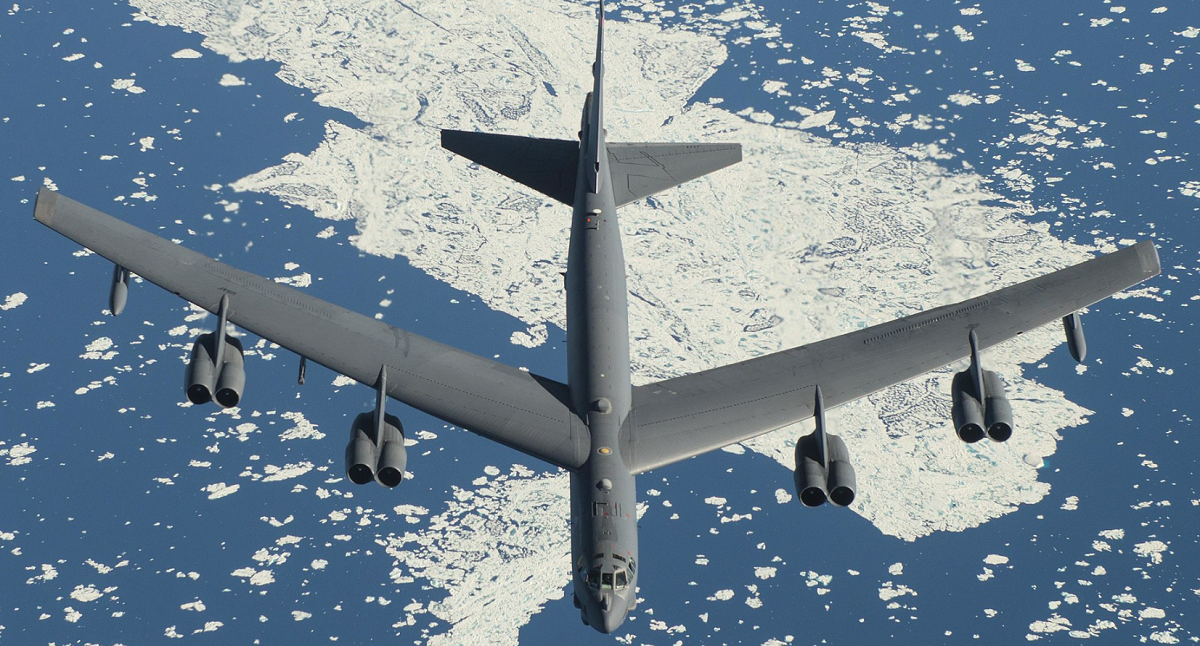
USAF B-52 Stratofortress near the North Pole on 31 July, 2016 during the Polar Roar exercise.
Detail of original USAF photo by Senior Airman Joshua King via Wikimedia Commons.
This week, I’m going to offer a fairly basic overview of the concept of strategic airpower, akin to our discussions of protracted war and nuclear deterrence. While the immediate impetus for this post has been Russian efforts to use airpower coercively in Ukraine, we’re going to focus more broadly on the topic: what is strategic airpower, where did the idea come from, how has it been used and does it actually work? As with nuclear deterrence, this is a much debated topic, so what I am going to present here is an overview of the sort I’d provide for an introductory class on the topic and then at the end we’ll cover some of the implications for the current conflict in Ukraine. That said, this is also an issue where I think most historians of the topic tend to part ways with both some things the public think they know about the topic and some of the things that occasionally the relevant branches of the military want to know about the topic; in any case I am going to try to present a fairly “down the middle” historian’s view of the question.
Before we dive in, we need to define what makes certain uses of airpower strategic because strategic airpower isn’t the only kind. The reason for the definition will emerge pretty quickly when we talk about origins, but let’s get it out of the way here: strategic airpower is the use of attack by air (read: bombing) to achieve “strategic effects”. Now that formal definition is a bit tautological, but it becomes clarifying when we talk about what we mean by strategic effects; these are effects that aim to alter enemy policy or win the war on their own.
Put another way, if you use aircraft to attack enemy units in support of a ground operation (like an invasion), that would be tactical airpower; the airpower is a tactic that aims to win a battle which is still primarily a ground (or naval) battle. We often call this kind of airpower “close air support” but not all tactical airpower is CAS. If you instead use airpower to shape ground operations – for instance by attacking infrastructure (like bridges or railroads) or by bombing enemy units to force them to stay put (often by forcing them to move only at night) – that’s operational airpower. The most common form of this kind of airpower is “interdiction” bombing, which aims to slow down enemy ground movements so that friendly units can out-maneuver them in larger-scale sweeping movements.
By contrast strategic airpower aims to produce effects at the strategic (that is, top-most) level on its own. Sometimes that is quite blunt: strategic airpower aims to win the war on its own without reference to ground forces, or at least advance the ball on winning a conflict or achieving a desired end-state (that is, the airpower may not be the only thing producing strategic effects). Of course strategic effects can go beyond “winning the war” – coercing or deterring another power are both strategic effects as well, forcing the enemy to redefine their strategy. That said, as we’ll see, this initially very expansive definition of strategic airpower really narrows quite quickly. Aircraft cannot generally hold ground, administer territory, build trust, establish institutions, or consolidate gains, so using airpower rapidly becomes a question of “what to bomb” because delivering firepower is what those aircraft can do.
As an aside, this sort of cabined definition of airpower and thus strategic airpower has always been frustrating to me. It is how airpower is often discussed, so it’s how I am going to discuss it, but of course aircraft can move more than bombs. Aircraft might move troops – that’s an operational use of airpower – but they can also move goods and supplies. Arguably the most successful example of strategic airpower use anywhere, ever is the Berlin Airlift, which was a pure airpower operation that comprehensively defeated a major Soviet strategic aim, and yet the U.S. Air Force is far more built around strategic bombing than it is around strategic humanitarian airlift (it does the latter, but the Army and the Navy, rather than the Air Force, tend to take the lead in long-distance humanitarian operations). Nevertheless that definition – excessively narrow, I would argue – is a clear product of the history of strategic airpower, so let’s start there.
And once again before we get started, a reminder that the conflict in Ukraine is not notional or theoretical but very real and is causing very real suffering, including displacing large numbers of Ukrainians as refugees, both within Ukraine and beyond its borders. If you want to help, consider donating to Ukrainian aid organizations like Razom for Ukraine or to the Ukrainian Red Cross. As we’re going to see here, airpower offers no quick solution for the War in Ukraine for either party, but the recent Russian shift to air attacks on civilian centers sadly promises more suffering and more pressing need for humanitarian assistance for Putin’s many victims.
Finally, a content warning: what we’re discussing today is largely (though not entirely) the application of airpower against civilian targets because it turns usually what “strategic” airpower ends up being. This is a discussion of the theory, which means it’s going to be pretty bloodless, but nevertheless this topic ought to be uncomfortable.
On with our topic, starting with the question of where the idea of strategic airpower comes from.
Comments Off on An overview of strategic airpower


